
Top AI Search Engines Compared for 2026
Last Updated: January 2026
The AI search landscape has fundamentally transformed how we find information online. With ChatGPT now commanding 800 million monthly active users and Google Gemini reaching 650 million, the choice of best AI search engine 2026 has to offer affects everything from daily research to business decision-making.
This guide compares the best AI search engine 2026 contenders, breaking down their strengths, weaknesses, and ideal use cases to help you choose the right one for your needs.
What Is an AI Search Engine?
An AI search engine uses large language models to understand query intent and synthesize answers directly—not just return blue links. Unlike traditional search, the best AI search engine 2026 contenders retrieve and summarize information from multiple sources in one response.
Most AI search engines fall into two categories: answer engines (like Perplexity and Komo) that prioritize sourced, factual responses, and creative engines (like ChatGPT) that excel at generation and reasoning. Academic-focused tools like Consensus apply AI specifically to peer-reviewed research, synthesizing scientific evidence for evidence-based queries.
The key difference lies in transparency and sourcing. Traditional search shows you where to look; AI search engines synthesize the answer for you. This convenience comes with tradeoffs—citation quality varies widely, and some platforms are more prone to hallucination than others.
Choosing wisely requires understanding how each engine handles real-time data, source attribution, and factual verification before you commit to one as your primary research tool.
The AI Search Engine Landscape in 2026
The market has crystallized into two distinct categories: AI-native "answer engines" built from the ground up for conversational Q&A, and AI-enhanced traditional search giants integrating generative layers atop classic search.
Current Market Leaders by Users
Here are the top AI search platforms ranked by monthly active users as of early 2026.
Rank | AI Search Engine | Monthly Active Users |
1 | ChatGPT (OpenAI) | 800 million |
2 | Google Gemini | 650 million |
3 | Doubao (ByteDance) | 159 million |
4 | Quark AI (Alibaba) | 150 million |
5 | Perplexity AI | 45 million |
6 | Microsoft Copilot | 33 million |
7 | Grok (xAI) | 30 million |
8 | Claude AI (Anthropic) | 19 million |
Key insight: User numbers don't tell the whole story. ChatGPT commands 800 million monthly users vs. Perplexity's 45 million—yet Perplexity is the go-to for researchers who need cited, verifiable answers.
The best AI search engine for you depends on what you're trying to accomplish, not on which platform has the most users.
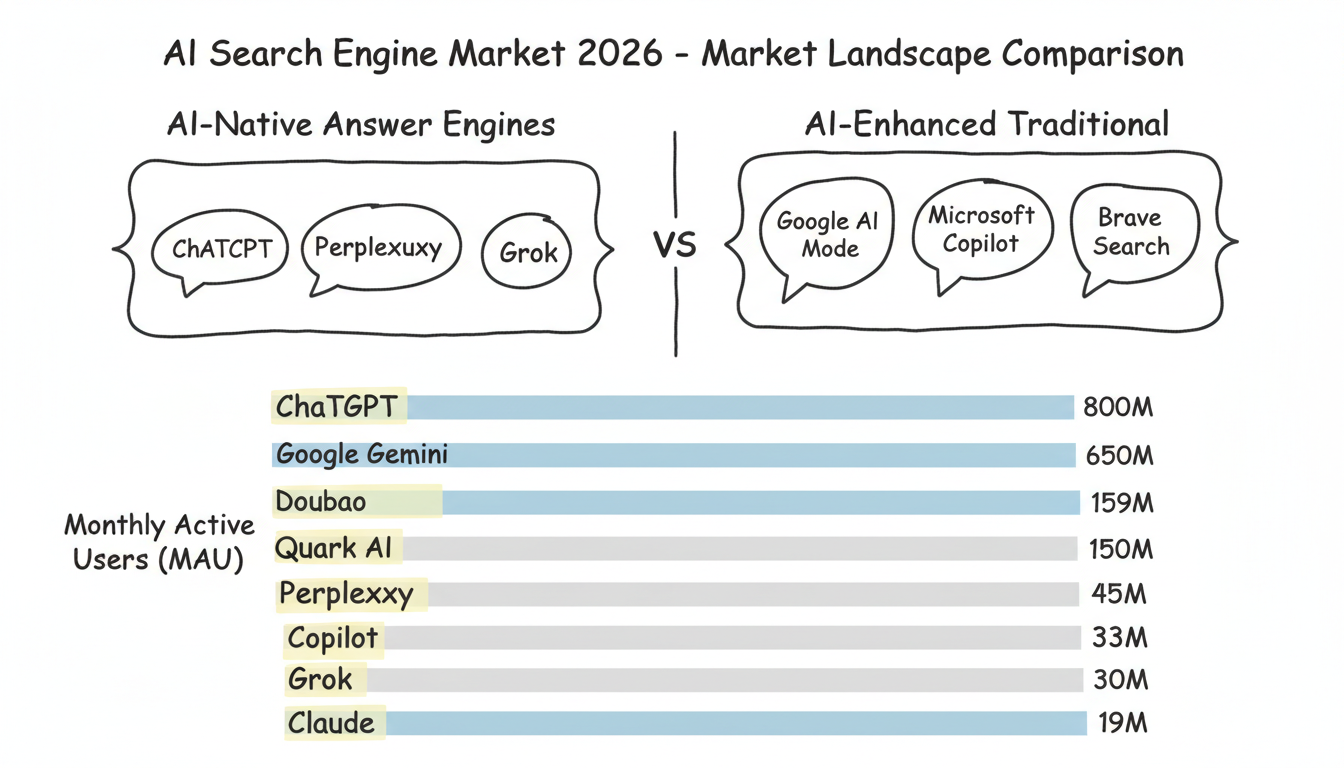
The Chinese-originated platforms—Doubao and Quark AI—dominate by volume but remain largely confined to the Chinese market. For English-language users, the competitive field narrows to ChatGPT, Google AI Mode, and Perplexity as the daily-use leaders. Microsoft Copilot holds enterprise ground through Microsoft 365 integration rather than raw search quality.
Understanding this landscape helps you evaluate which platforms are genuinely competing for your specific use case versus those winning on distribution advantages alone.
Top AI Search Engines Compared
Each platform serves a distinct use case. Here is how the top contenders compare across strengths, weaknesses, and pricing.
1. Google AI Mode (Google Search)
Best for: General everyday queries, users already in the Google ecosystem
Google's AI Mode represents the search giant's response to AI-native competitors. It integrates generative AI directly into traditional search, providing AI-generated summaries alongside conventional results.
Strengths:
- Seamless integration with existing Google services
- Massive index of web content
- Familiar interface for long-time Google users
- Strong local search capabilities
Weaknesses:
- Less transparent about sources than competitors
- AI summaries can feel like a "black box"
- Sometimes unclear which sources inform answers
Google AI Mode also benefits from its integration with Google Shopping, Maps, and Knowledge Graph, making it the most capable engine for local, product, and entity-rich queries where other platforms fall short.
Understanding disabling Google AI Overviews when and how can help users who prefer traditional search results over AI-generated summaries.
Pricing: Free
2. Perplexity AI
Best for: Research, fact-checking, citation-heavy work
Perplexity has established itself as the "answer engine" leader for users who need trustworthy, verifiable information. Every claim links back to its source, making it invaluable for research and professional use.
Strengths:
- Transparent citations for every claim
- Real-time web search for current information
- Model-agnostic approach (toggle between GPT, Claude, and proprietary models)
- Excellent for academic and professional research
- Clean, focused interface
Weaknesses:
- Deep research features can be slower
- Smaller user base means less mainstream recognition
- Some creative tasks better handled elsewhere
Companies looking to maximize their visibility in Perplexity's results should consider implementing a comprehensive Perplexity AI optimization strategy to improve their rankings and citation frequency.
Pricing: Free tier available; Pro at $20/month for unlimited queries and advanced models
3. ChatGPT Search
Best for: Creative work, coding, complex problem-solving, conversational research
ChatGPT has evolved from a chatbot into what many call a "creative OS." Its Deep Research AI search mode goes beyond standard queries to synthesize multi-step reports from dozens of sources. With GPT-4 and specialized reasoning models, it excels at generative tasks, complex coding, and nuanced conversation.
Strengths:
- Excellent conversational flow
- Strong creative writing and coding capabilities
- Maintains context across long conversations
- Deep research features for complex topics
- Massive ecosystem of plugins and integrations
Weaknesses:
- Web search sometimes lags behind real-time events
- Less transparent sourcing than Perplexity
- Can rely on training data rather than fresh searches
Pricing: Free tier available; Plus at $20/month; Pro at $200/month
4. Microsoft Copilot (Bing)
Best for: Enterprise users, Microsoft 365 integration, productivity workflows
Microsoft Copilot integrates deeply with the Microsoft ecosystem, making it powerful for users embedded in Office 365 and Windows environments.
Strengths:
- Native Microsoft 365 integration
- Enterprise-grade security and compliance
- Strong productivity features
- Access to GPT-4 models
Weaknesses:
- Best value for existing Microsoft users
- Can feel clunky outside Microsoft ecosystem
- Less specialized for pure research
Pricing: Free tier; Pro at $30-36/month for full Microsoft integration
For enterprise teams already standardized on Microsoft tools, Copilot eliminates the friction of switching contexts between productivity software and AI search. It can draft emails, summarize meetings, and search the web—all from within the apps your team already uses every day.
5. Claude AI (Anthropic)
Best for: Document analysis, long-form content, safety-conscious users
Claude focuses on thoughtful, safe responses rather than real-time web search. It excels at processing lengthy documents and maintaining coherent long conversations.
Strengths:
- Excellent at analyzing long documents
- Strong reasoning capabilities
- Safety-focused design
- Thoughtful, nuanced responses
Weaknesses:
- Limited real-time web search capabilities
- Smaller market share than competitors
- Better for analysis than current-events research
Pricing: Free tier; Pro at $20/month
Claude is particularly valuable for businesses processing large documents, legal contracts, or long-form research. Its extended context window handles inputs that would overwhelm most competitors, making it the preferred choice for document-intensive workflows over pure web search use cases.
6. You.Com
Best for: Customization, multi-app workflows, business professionals
You.com offers high customization with a multi-app interface, allowing users to tailor their search experience extensively.
Strengths:
- Highly customizable interface
- Multiple specialized apps within one platform
- Good balance of search and AI features
Weaknesses:
- Less mainstream recognition
- Learning curve for customization features
Pricing: Free tier; Pro at $15/month
You.com stands out for its Apps feature, which lets users toggle between dedicated modes for coding, writing, research, and image generation within a single interface. This modularity makes it a strong choice for professionals who need multiple AI capabilities without switching between different tools throughout their workday.
7. Brave Search (Leo)
Best for: Privacy-conscious users
Brave Search prioritizes privacy, offering AI capabilities without tracking user behavior.
Strengths:
- Privacy-first design
- No user tracking
- Clean interface
- Integrated with Brave browser
Weaknesses:
- Smaller index than Google
- AI features less advanced than specialized competitors
Pricing: Free
Brave Search uses its own independent web index rather than relying on Google or Bing APIs, which means it is not subject to the same algorithmic biases or data-sharing arrangements. For users who regularly research sensitive topics in legal, health, or financial domains, Brave offers a meaningful privacy guarantee that mainstream engines cannot match without compromising on reach.
8. Phind
Best for: Developers, coding questions, technical research
Phind has carved out a niche as the dominant developer and code-specific AI search tool.
Strengths:
- Optimized for technical queries
- Excellent code understanding
- Developer-focused interface
Weaknesses:
- Narrow focus limits general use
- Less suitable for non-technical queries
Pricing: Free tier available; paid plans for advanced features
Phind indexes technical documentation, GitHub repositories, and Stack Overflow in addition to the open web, which means its answers are grounded in code-level reality rather than general web content. For developers debugging production issues or evaluating new frameworks, Phind consistently outperforms general-purpose AI search engines on specificity and accuracy.
Choosing the Right AI Search Engine
The right tool depends on your workflow. Use these recommendations as your starting point. For businesses that need a full AI search strategy, Stackmatix AI marketing services can help align AI visibility with conversion goals.
For Research and Academic Work
Choose Perplexity. Its citation-first approach means you can verify every claim. The ability to toggle between models ensures you're getting the best available AI for your specific query.
For Creative Work and Writing
Choose ChatGPT. Its conversational abilities and creative capabilities make it ideal for brainstorming, drafting, and iterating on creative projects.
For Everyday General Queries
Choose Google AI Mode if you're already in the Google ecosystem, or Perplexity if you prefer clearer sourcing.
For Privacy
Choose Brave Search. If avoiding tracking matters to you, Brave offers capable AI search without the data collection.
Privacy-first users should also verify that their AI search tool does not store query history or use conversation data for model training. Brave explicitly commits to this. For sensitive professional queries in legal, medical, or financial contexts, privacy guarantees matter as much as answer quality.
For Enterprise/Productivity
Choose Microsoft Copilot if your organization uses Microsoft 365. The integration alone justifies the choice for enterprise users.
For Coding and Development
Choose Phind for dedicated technical queries, or ChatGPT for coding within broader project contexts.
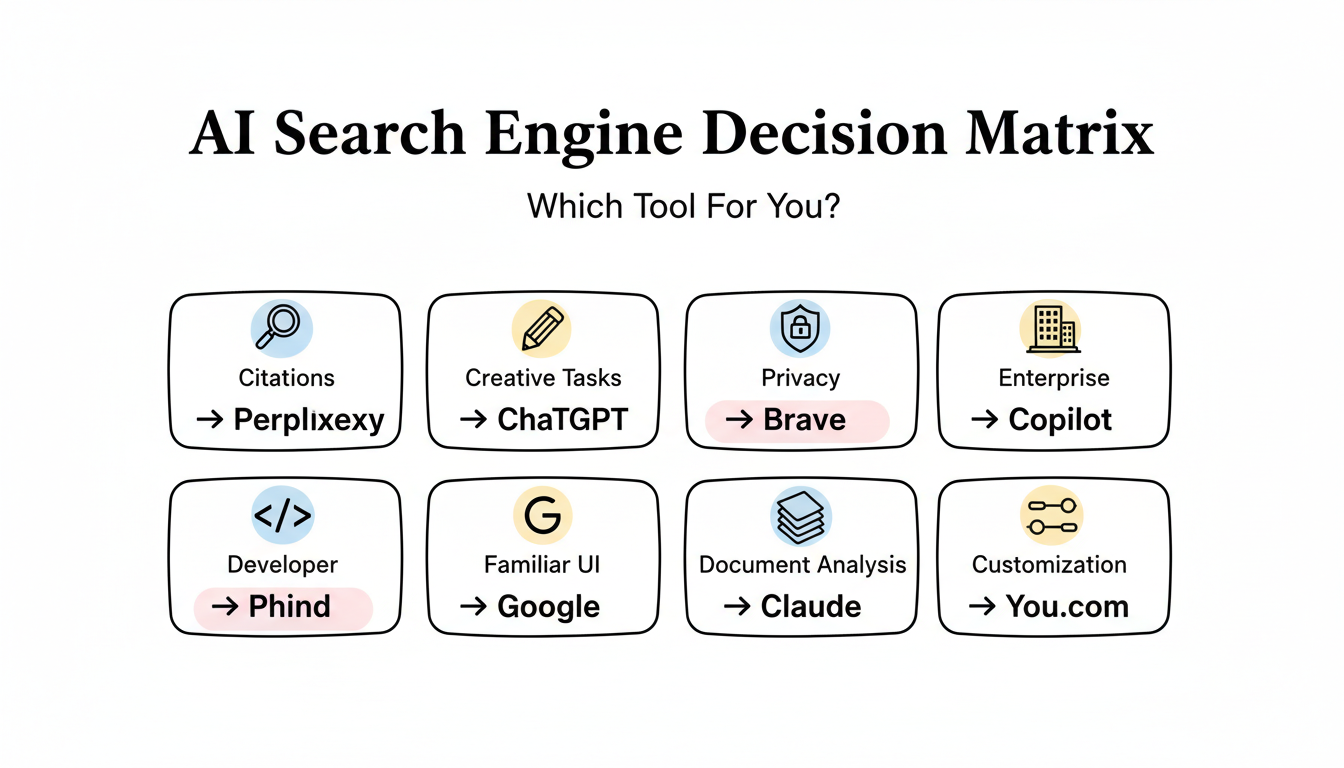
Quick Decision Matrix
Find your best match quickly using this comparison table.
Your Priority | Best Choice |
Citation accuracy | Perplexity |
Creative tasks | ChatGPT |
Privacy | Brave Search |
Enterprise integration | Microsoft Copilot |
Developer focus | Phind |
Familiar interface | Google AI Mode |
Document analysis | Claude |
Customization | You.com |
The Future of AI Search
The best AI search engine 2026 market continues evolving rapidly. The distinction between "answer engines" like Perplexity and "creative engines" like ChatGPT represents a fundamental fork in how AI assists with information retrieval.
As businesses adapt to this new landscape, implementing generative engine optimization strategies has become essential for maintaining visibility across AI-powered search platforms.
Several trends are shaping the next phase of AI search. Multimodal queries now let users search with images, audio, and video—not just text. Agentic search goes further: tools like ChatGPT Operator and Perplexity Actions can execute tasks on your behalf, booking appointments or filling forms automatically.
The future is about creating, not just searching. AI search engines are shifting from retrieval tools to reasoning and generation platforms that synthesize knowledge on demand.
AI indexes are also diverging from traditional web crawls—leading engines now prioritize structured data, transparent citations, and verified expert authorship signals over raw link authority alone. For content creators and brands operating in this new environment, optimizing for AI citation frequency has become just as important as traditional keyword ranking.
For most users in 2026, the practical approach is maintaining access to multiple platforms:
- Perplexity for research requiring verified sources
- ChatGPT for creative and complex reasoning tasks
- Google AI Mode for quick everyday queries
Pro tip: Rather than committing to one platform, build a multi-tool workflow. Perplexity for fact-checking. ChatGPT for drafting and coding. Google AI Mode for quick lookups. Each has a distinct edge.
The "best" AI search engine depends entirely on what you're trying to accomplish. Rather than choosing one, consider which combination serves your specific workflow.
The Bottom Line
No single best AI search engine 2026 has to offer dominates all use cases. Perplexity leads for research and citation-heavy work. ChatGPT excels at creative tasks and complex reasoning. Google AI Mode offers familiarity and ecosystem integration. Microsoft Copilot serves enterprise users best.
The race to dominate AI search is also driving aggressive pricing competition. Free tiers are expanding, premium features are multiplying, and the distinction between AI assistant and AI search engine continues to blur as platforms like ChatGPT, Gemini, and Copilot blend search, creation, and task automation into single interfaces.
You can measure your own content's AI-readiness with the free AEO Grader Tool. The winners in this landscape are users who understand each platform's strengths and choose accordingly—not those who commit exclusively to any single tool. Start with free tiers, evaluate your results, then invest in the plan that fits your workflow.