
Best Generative Engine Optimization Tools: 2026 Guide
Generative engine optimization tools have emerged to solve a critical challenge: understanding how AI platforms mention your brand. With ChatGPT, Perplexity, and Google AI Overviews reshaping search behavior, tracking AI visibility requires specialized software. But choosing the right tool depends on your specific situation—budget, team capabilities, and optimization goals.
This comprehensive guide compares 13 leading best generative engine optimization tools and ai visibility platforms, with detailed pricing, platform coverage, and feature breakdowns to help you select the right solution.
How Generative Engine Optimization Works
Before evaluating the best generative engine optimization tools, understand the mechanics that drive AI visibility. Generative engines like ChatGPT, Perplexity, and Google AI Overviews don't retrieve results the way traditional search does. Instead, they synthesize answers by evaluating signals from your content, brand entity relationships, and web authority.
Differences Between SEO, AI SEO, AEO and GEO
Traditional SEO optimizes for ranked positions on search results pages. AI SEO adapts those techniques for AI-influenced rankings. AEO targets featured snippets. GEO focuses on getting your brand cited in AI-generated responses from platforms like ChatGPT and Perplexity.
Entity Recognition and Knowledge Graphs
AI models identify entities (brands, products, concepts) and map relationships between them. Well-structured content with schema.org markup provides machine-readable entity definitions that AI crawlers (GPTBot, ClaudeBot, PerplexityBot) parse to determine citation relevance.
Consensus Signals and Corroboration
AI models look for consensus across multiple authoritative sources. Consistent mentions in third-party reviews and industry publications give AI platforms confidence to cite your brand. GEO tools help identify where your consensus signals are weakest.
AI Crawler Analytics
Modern GEO platforms can monitor which AI bots crawl your site, how frequently they visit, and which pages they index. Tracking GPTBot, ClaudeBot, and PerplexityBot activity in your server logs reveals whether your content is even accessible to AI engines before you troubleshoot visibility issues.
Key GEO Metrics to Track
Effective ai search optimization starts with measuring the right metrics. These are the core KPIs that GEO tools report on:
AI Citation Rate is the foundational GEO metric — it measures the percentage of relevant prompts where an AI engine mentions your brand, and it's the north star for any GEO program.
- AI Citation Rate: The percentage of relevant prompts where an AI engine mentions your brand. This is the foundational GEO metric.
- Inclusion Rate / Share of Answers: How often your brand appears in AI-generated answers versus the total number of monitored prompts. Tracks overall presence.
- Prompt Win Rate: The percentage of prompts where your brand is recommended over competitors. Measures competitive positioning directly.
- AI Share of Voice: Your brand's mention frequency relative to all competitors for a given topic cluster. The GEO equivalent of traditional share of voice.
- Sentiment Analysis: Whether AI mentions your brand positively, negatively, or neutrally. Critical for brand reputation management across AI platforms.
- Time-to-Change Velocity: How quickly your GEO optimizations translate into visibility improvements. Helps calibrate optimization cadence and expectations.
When evaluating the best generative engine optimization tools, prioritize platforms that report on AI Citation Rate and Share of Voice natively — these two metrics account for most strategic decisions in a mature GEO program. Time-to-Change Velocity is underrated: it tells you how quickly your optimizations take effect, helping you calibrate your content publishing cadence.
Not all GEO metrics are equally actionable. Citation Rate and Prompt Win Rate directly inform content strategy. Sentiment Analysis requires human review to act on. Start with quantitative metrics before layering in sentiment analysis as your program matures.
What GEO Tools Actually Measure
Before comparing the best generative engine optimization tools, understand what they track.
Citation Monitoring
GEO tools query AI platforms with relevant prompts and record when your brand appears in responses. They track:
- Citation frequency: How often AI mentions your brand for target queries
- Citation accuracy: Whether AI represents your information correctly
- Citation context: How AI positions your brand relative to competitors
What to Look for in an LLM Tracking Platform
When evaluating any LLM tracking platform for GEO, prioritize these four core capabilities above all others to maximize ROI.
- Prompt transparency: You should be able to see the exact prompts being sent to AI engines, not just aggregated metrics. This allows you to audit data quality and customize queries for your specific industry
- Multi-engine coverage: A platform that only tracks ChatGPT gives you an incomplete picture. Insist on coverage across at least ChatGPT, Perplexity, and Google AI Overviews as a baseline
- Historical data retention: AI citation patterns shift quickly. Platforms that retain 6-12 months of historical data let you identify seasonal trends and measure long-term optimization impact
- API or export access: For teams using BI tools or custom dashboards, the ability to export raw citation data programmatically is essential for integrating GEO metrics with broader marketing analytics
Competitive Analysis
Most platforms compare your visibility against competitors:
- Share of voice: Your mention percentage versus competitors
- Competitive gaps: Queries where competitors appear but you don't
- Positioning trends: How competitive landscape shifts over time
Content Performance
Advanced tools connect citations to specific content:
- Source attribution: Which pages AI cites most frequently
- Content gaps: Topics where you lack citable content
- Optimization opportunities: Content changes that could improve citations
How the Best GEO Tools Were Evaluated
Each tool was assessed across five dimensions: AI platform coverage, query customization, reporting depth, pricing transparency, and ease of use. Evaluations use publicly available information, user reviews, and documented feature sets.
Key Evaluation Criteria
Evaluate each GEO platform across these five dimensions before committing to a paid plan.
Platform Coverage
Different tools monitor different AI platforms. Evaluate based on where your audience searches.
Essential coverage:
- ChatGPT (OpenAI)
- Perplexity AI
- Google AI Overviews
Extended coverage:
- Claude (Anthropic)
- Microsoft Copilot
- Gemini
Tools covering only one or two platforms provide incomplete visibility. Prioritize platforms your audience actually uses. For instance, Claude AI optimization requires different tracking approaches than other platforms.
Query Customization
Generic monitoring misses industry-specific queries. Evaluate:
Query capabilities:
- Custom query creation for your topics
- Query templates by industry
- Automated query suggestions
- Query performance analytics
The best tools let you monitor exact phrases your audience asks, not just generic keyword variations.
Reporting Depth
Surface-level metrics don't drive optimization decisions. Look for:
Essential reporting:
- Time-series trend analysis
- Competitor comparison dashboards
- Content attribution reports
- Export capabilities
Advanced reporting:
- Automated alerts for visibility changes
- Integration with existing analytics
- White-label reporting for agencies
- Custom metric definitions
Update Frequency
AI responses change constantly. Monitoring frequency matters.
Frequency tiers:
- Daily: Sufficient for most businesses
- Real-time: Necessary for news/time-sensitive content
- Weekly: Inadequate for active optimization
Balance monitoring frequency against cost—more frequent updates typically mean higher pricing.
Ease of Use
Complex tools require dedicated specialists. Assess:
- Setup complexity and time-to-value
- Learning curve for team members
- Documentation and support quality
- Interface intuitiveness
A powerful tool your team won't use delivers zero value.
Leading Best Generative Engine Optimization Tools Compared
Here are the top platforms for AI visibility monitoring, with strengths, limitations, and pricing for each tool.
Otterly.AI
Best for: Comprehensive AI visibility across multiple platforms
Otterly provides broad platform coverage with detailed competitive analysis. The dashboard surfaces citation trends and competitive positioning clearly.
Strengths:
- Monitors ChatGPT, Perplexity, Google AI Overviews, Gemini, and Copilot
- Strong competitive benchmarking with share-of-voice tracking
- Intuitive interface for non-technical users
- Regular platform coverage updates as new AI engines launch
Limitations:
- Premium pricing for full feature access
- Limited custom query flexibility in basic tiers
- Newer platform, less established track record
Pricing: Lite plan from $29/month; Pro from $199/month for full monitoring
Profound
Best for: Enterprise brands requiring detailed analytics and white-label reporting
Profound offers enterprise-grade GEO monitoring with deep integration capabilities and advanced reporting. Covers ChatGPT, Perplexity, Google AI Overviews, and Gemini with granular prompt-level analytics.
Strengths:
- Comprehensive analytics and custom reporting
- API access for data integration
- White-label options for agencies
- Dedicated account management
Limitations:
- Higher price point
- Complexity may exceed smaller team needs
- Longer implementation timeline
Pricing: Custom enterprise pricing, typically $1,000+/month
Peec AI
Best for: Teams wanting AI visibility plus optimization guidance
Peec combines monitoring with actionable optimization recommendations, bridging tracking and execution. It suggests specific content changes to improve your citation rate.
Strengths:
- Monitoring plus optimization suggestions
- Content improvement recommendations based on citation gaps
- Workflow integration for content teams
- Competitive citation analysis across ChatGPT and Perplexity
Limitations:
- Recommendation quality varies by industry
- Platform coverage still expanding
- Newer entrant to market
Pricing: Mid-range, approximately $250-500/month
SE Ranking / SE Visible
Best for: Teams wanting full-stack GEO + traditional SEO in one platform
SE Ranking's SE Visible module integrates AI visibility tracking directly into their established SEO platform. This means you can monitor organic rankings and AI citations from a single dashboard, reducing tool sprawl. SE Visible tracks brand mentions across ChatGPT, Perplexity, and Google AI Overviews with competitor benchmarking built in.
Strengths:
- Combined SEO + GEO monitoring eliminates switching between tools
- Tracks AI citations alongside organic SERP rankings
- Competitor AI visibility benchmarking
- Established platform with years of SEO tooling maturity
Limitations:
- GEO features are newer compared to core SEO functionality
- Full GEO capability requires higher-tier plans
- Less specialized than pure-play GEO tools
Pricing: From $103.20/month (annual billing); GEO features in Pro tier and above
Semrush AI Visibility Toolkit
Best for: Marketing teams already using Semrush who want integrated AI visibility
Semrush's AI Visibility Toolkit adds AI search monitoring to their comprehensive SEO suite. It tracks brand presence in AI Overviews, ChatGPT, and Perplexity, and provides strategic recommendations for improving AI inclusion. The integration with Semrush's keyword and backlink data creates a unified view of both traditional and AI search performance.
Strengths:
- 360-degree AI visibility with strategic optimization recommendations
- Seamless integration with existing Semrush workflows
- AI Overview tracking for thousands of keywords automatically
- Competitive AI visibility benchmarking with market-level insights
Limitations:
- Requires Semrush subscription as the base platform
- AI-specific features still being expanded
- Per-domain pricing adds up for multi-site teams
Pricing: $99/month per domain as an add-on to Semrush plans
Writesonic GEO Suite
Best for: Content teams that need both AI content creation and GEO analytics
Writesonic uniquely combines AI content generation with GEO performance tracking. Create content optimized for AI citations and then monitor how that content performs across AI platforms—all in one workflow. Tracks visibility across ChatGPT, Perplexity, Google AI Overviews, and Claude.
Strengths:
- Combines content creation with GEO monitoring in a single platform
- AI-optimized content templates designed for citation
- Real-time monitoring across 4+ AI platforms
- Content performance attribution linking citations to specific pages
Limitations:
- Content generation quality varies; human editing still needed
- Higher price point than monitoring-only tools
- GEO analytics not as deep as dedicated monitoring platforms
Pricing: From $249/month for the GEO Suite tier
Athenahq
Best for: Ecommerce brands and enterprises tracking AI product recommendations
AthenaHQ specializes in mapping how AI platforms recommend products and services. It excels at tracking AI-generated product comparisons, "best of" lists, and recommendation responses—making it particularly valuable for ecommerce and SaaS brands. Includes Shopify integration for direct revenue attribution.
Strengths:
- AI recommendation mapping tracks product-level mentions
- Ecommerce and Shopify integration for revenue attribution
- Competitive recommendation analysis across AI platforms
- Tracks how AI positions products in comparison and buying contexts
Limitations:
- Best suited for product-focused businesses; less relevant for content publishers
- Higher entry price point
- Enterprise onboarding can take 2-3 weeks
Pricing: From $295/month; enterprise plans with custom pricing
Scrunch AI
Best for: Competitive intelligence and competitor replacement detection
Scrunch AI focuses on the competitive dimension of GEO. Its standout feature is competitor replacement detection—it alerts you when AI platforms start recommending a competitor where they previously recommended you. Also provides entity strengthening recommendations to reinforce your brand's knowledge graph signals.
Strengths:
- Competitor replacement alerts catch visibility drops early
- Entity strengthening recommendations improve knowledge graph presence
- Prompt-level visibility tracking across major AI platforms
- Competitive landscape reports show positioning shifts over time
Limitations:
- Narrower focus on competitive intelligence versus broad monitoring
- Fewer content optimization recommendations than other tools
- Minimum contract commitment on some plans
Pricing: From $250/month
Xfunnel
Best for: Teams focused on tying AI visibility to revenue and conversions
XFunnel bridges the gap between GEO monitoring and business outcomes. Its AI-to-conversion attribution model tracks the full journey from AI mention to website visit to conversion, answering the ROI question that other GEO tools struggle with. Particularly strong for B2B SaaS and high-consideration purchase cycles.
Strengths:
- AI-to-conversion attribution connects visibility to revenue
- Buying journey analysis across AI touchpoints
- Pipeline influence reporting for B2B sales teams
- Integrates with CRMs (Salesforce, HubSpot) for closed-loop attribution
Limitations:
- Custom pricing can be expensive for smaller teams
- Requires CRM integration for full value
- Less focus on content optimization; primarily an analytics tool
Pricing: Custom pricing based on monitored domains and integrations
Conductor
Best for: Enterprise teams wanting user-friendly AI visibility with organic integration
Conductor adds AI visibility tracking to its established organic marketing platform. Known for its approachable interface, Conductor makes GEO accessible to marketing teams without requiring dedicated analysts. Tracks AI crawler access patterns and provides insights on which AI bots index your content.
Strengths:
- Enterprise-grade with an intuitive, non-technical interface
- AI crawler access insights show which bots are indexing your content
- Integrates AI visibility with organic content performance
- Strong customer success and onboarding support
Limitations:
- Enterprise pricing puts it out of reach for SMBs
- AI-specific features are newer additions to the platform
- Less granular prompt-level analytics than pure-play GEO tools
Pricing: Custom enterprise pricing
Goodie AI
Best for: Multi-language brands and semantic optimization across global markets
Goodie AI positions itself as a semantic optimization hub, analyzing how AI platforms understand your content's meaning rather than just matching keywords. Supports multi-language GEO tracking, making it valuable for brands operating across multiple markets and languages.
Strengths:
- Semantic analysis goes beyond keyword matching to evaluate meaning
- Multi-language support for international GEO monitoring
- Content optimization suggestions based on semantic gaps
- Entity relationship mapping shows how AI connects your brand to topics
Limitations:
- Higher price point for full multi-language support
- Semantic analysis adds complexity that smaller teams may not need
- Smaller user community compared to established platforms
Pricing: Approximately $495/month on annual plans
Getcito
Best for: Tracking how AI platforms cite your brand across long-tail and conversational queries
GetCito specializes in citation monitoring at the query level, allowing you to track exactly which prompts trigger AI citations of your brand and which don't. Particularly useful for content teams that want to connect specific pages to their AI citation performance.
Pricing: Contact for pricing
Rankscale AI
Best for: Budget-conscious teams and startups entering GEO monitoring
Rankscale AI offers the most affordable entry point into GEO monitoring. Despite the low price, it includes citation source mapping that shows which of your pages AI platforms pull from. A strong option for small businesses and freelancers who want basic AI visibility data without enterprise budgets.
Strengths:
- Most affordable GEO tool on the market at $20/month
- Citation source mapping identifies which pages earn mentions
- Simple dashboard focused on core GEO metrics
- Quick setup with minimal configuration needed
Limitations:
- Limited platform coverage compared to premium tools
- Basic competitive analysis features
- Fewer automated recommendations
Pricing: From $20/month; Pro tier at $79/month
HubSpot Search Grader
Best for: Free AI search readiness assessment before committing to paid tools
HubSpot's Search Grader is a free tool that scores your website's readiness for AI search. While not a full monitoring platform, it provides a useful starting point for teams evaluating whether they need dedicated GEO software. Analyzes your content structure, schema markup, and entity clarity.
Strengths:
- Completely free with no account required
- Quick AI readiness score provides an instant baseline
- Identifies schema markup and content structure gaps
- Good educational tool for teams new to GEO concepts
Limitations:
- Point-in-time assessment, not ongoing monitoring
- No competitive analysis or citation tracking
- Limited depth compared to paid platforms
Pricing: Free
GEO Tools Comparison Table
Use this comparison table to quickly evaluate which best generative engine optimization tools fit your requirements:
| Tool | Best For | AI Platforms Tracked | Starting Price | Key Differentiator |
|---|---|---|---|---|
| Otterly.AI | Broad AI visibility | ChatGPT, Perplexity, AI Overviews, Gemini, Copilot | $29/mo (Lite) | Widest platform coverage |
| Profound | Enterprise analytics | ChatGPT, Perplexity, AI Overviews, Gemini | $1,000+/mo | White-label + API access |
| Peec AI | Monitoring + optimization | ChatGPT, Perplexity | $250/mo | Actionable content recs |
| SE Ranking | Full-stack SEO + GEO | ChatGPT, Perplexity, AI Overviews | $103.20/mo | Combined SEO + GEO dashboard |
| Semrush AI | Integrated SEO suites | ChatGPT, Perplexity, AI Overviews | $99/mo add-on | Keyword + AI data unified |
| Writesonic | Content creation + GEO | ChatGPT, Perplexity, AI Overviews, Claude | $249/mo | Content gen + monitoring |
| AthenaHQ | Ecommerce / product recs | ChatGPT, Perplexity, AI Overviews | $295/mo | Product recommendation mapping |
| Scrunch AI | Competitive intelligence | ChatGPT, Perplexity, AI Overviews | $250/mo | Competitor replacement alerts |
| XFunnel | Revenue attribution | ChatGPT, Perplexity, AI Overviews | Custom | AI-to-conversion tracking |
| Conductor | Enterprise user-friendly | ChatGPT, Perplexity, AI Overviews | Custom | AI crawler access insights |
| Goodie AI | Multi-language / semantic | ChatGPT, Perplexity, AI Overviews | $495/mo | Semantic optimization hub |
| Rankscale AI | Budget / startups | ChatGPT, Perplexity | $20/mo | Lowest cost GEO entry point |
| HubSpot Grader | Free assessment | N/A (readiness score) | Free | No-cost AI readiness check |
Choosing Based on Your Situation
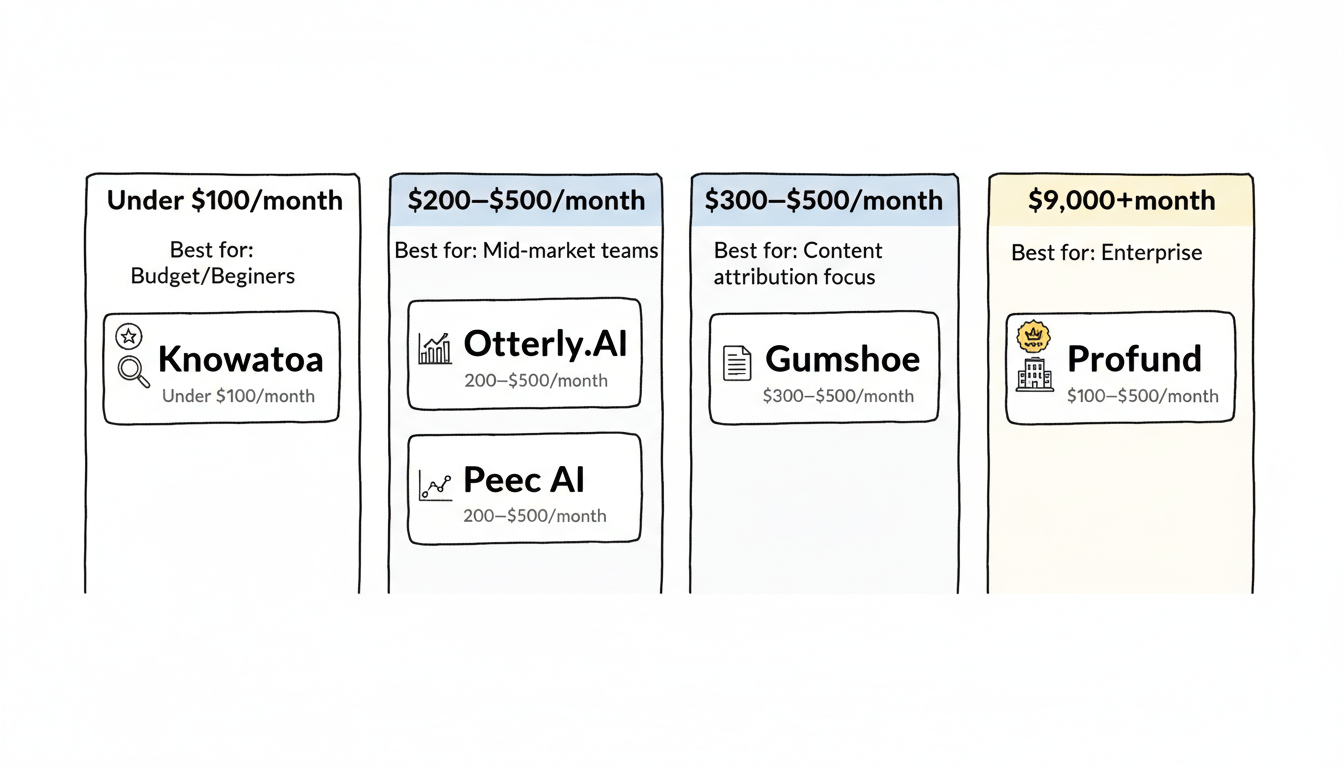
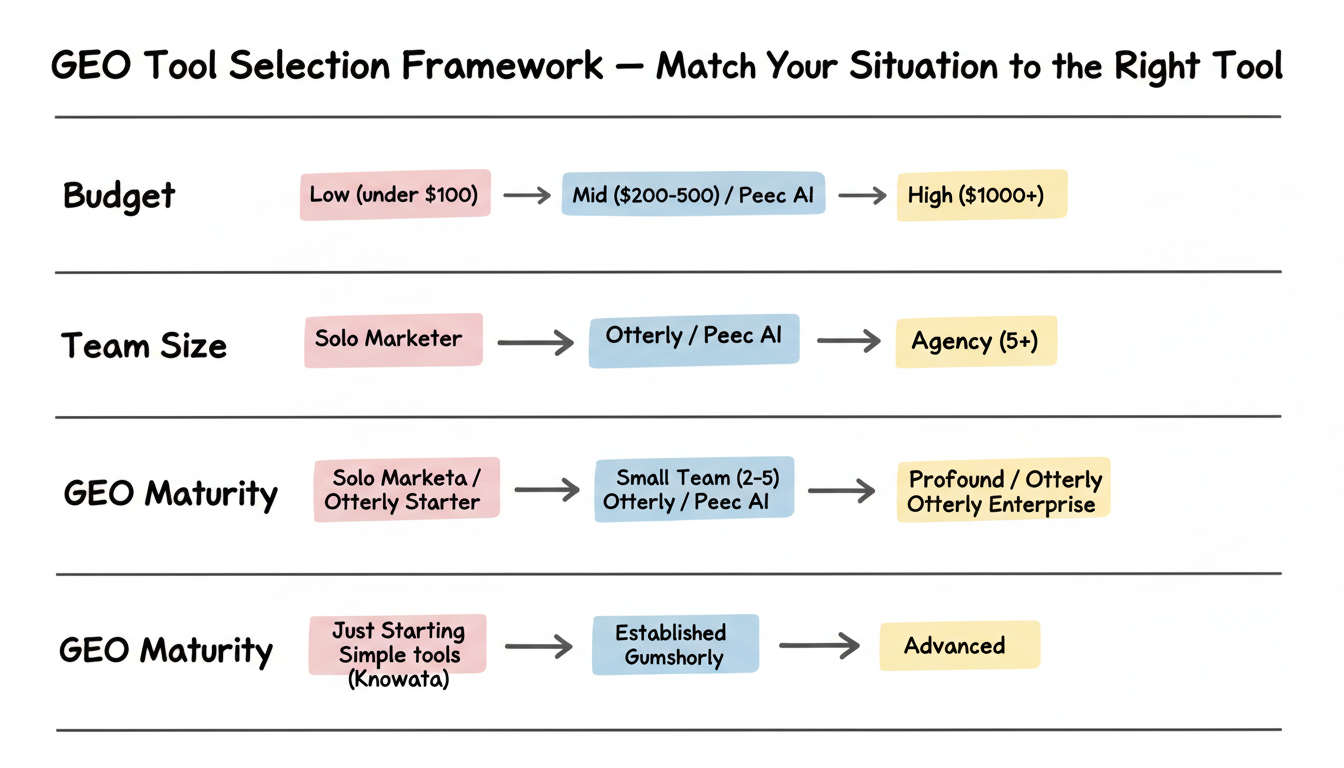
The right GEO tool depends on your budget, team size, and optimization maturity level.
By Budget
Free / Under $50/month:
- HubSpot Search Grader for a free baseline assessment
- Rankscale AI ($20/mo) for basic citation monitoring on a startup budget
- Manual tracking supplementing tool data
$100-300/month:
- SE Ranking for combined SEO + GEO monitoring
- Semrush AI Toolkit as an add-on if you already use Semrush
- Otterly.AI Pro or Peec AI for dedicated GEO monitoring
- Scrunch AI for competitive-focused intelligence
$300-500/month:
- AthenaHQ for ecommerce product recommendation tracking
- Writesonic GEO Suite for combined content creation and monitoring
- Goodie AI for multi-language semantic optimization
$1,000+/month:
- Profound for enterprise analytics and white-label needs
- XFunnel for AI-to-revenue attribution
- Conductor for enterprise-scale organic + AI visibility
By Team Size
Solo marketers: Prioritize ease of use over feature depth. Rankscale AI or Otterly Lite tier. Start with HubSpot Search Grader for a free assessment. Avoid tools requiring dedicated analysts.
Small teams (2-5): Balance capability with usability. Otterly Pro, SE Ranking, or Peec AI provide features without overwhelming complexity. Consider exploring best free AI SEO tools 2026 to supplement paid GEO platforms.
Larger teams (5+): Can leverage advanced features. Semrush AI Toolkit, Writesonic GEO Suite, or AthenaHQ with API access and custom reporting. XFunnel for teams that need revenue attribution. Explore Stackmatix AI SEO services for managed GEO implementation.
Agencies: Require white-label capabilities, multi-client management. Profound or Otterly agency tiers. Many agencies also offer white label AEO services to complement GEO monitoring.
By Optimization Maturity
Just starting GEO: Begin with affordable, simple tools. HubSpot Search Grader (free) to assess readiness, then Rankscale AI or Otterly Lite to start tracking. Learn what metrics matter before investing in advanced platforms.
Established GEO program: Need deeper analytics and competitive intelligence. Scrunch AI for competitive monitoring, SE Ranking for full-stack SEO+GEO, or Semrush AI Toolkit for integrated workflows.
Advanced optimization: Require API integration, custom reporting, enterprise support. Profound for maximum analytics capability, XFunnel for revenue attribution, or Conductor for enterprise-scale operations.
Implementation Best Practices
Getting value from any GEO platform requires a disciplined setup and review process from day one.
Start Focused
Don't monitor everything immediately. Begin with:
- 10-20 priority queries most important for your business
- 3-5 key competitors to benchmark against
- One platform thoroughly before expanding
Expand monitoring as you understand what data drives decisions.
The most common GEO monitoring failure mode is analysis paralysis — teams that spend months collecting data without making content changes. Set a rule: every monitoring review must produce at least one content action item, even a minor one. Small, consistent optimizations compound over time more effectively than occasional large overhauls.
Track optimization-to-citation lag times across your best generative engine optimization tools data. If your optimizations aren't showing up as citation improvements within 8 weeks, the tool may not be capturing full AI engine behavior — or your optimization strategy needs reassessment.
Establish Baselines
Before optimizing, document current state:
- Citation frequency for priority queries
- Competitive share of voice
- Content currently earning citations
Baselines enable measuring optimization impact. Use the AEO grader tool to benchmark your content's AI readiness before and after optimization.
Create Monitoring Cadence
Establish regular review rhythms:
- Weekly: Check citation trends and anomalies
- Monthly: Analyze competitive shifts and content performance
- Quarterly: Evaluate tool ROI and coverage needs
Consistency matters more than frequency.
Connect to Action
Monitoring without action wastes investment. For each review:
- Identify top 3 optimization opportunities
- Assign owners and deadlines
- Track optimization impact in subsequent reviews
Common Selection Mistakes
Teams new to GEO monitoring often make these four avoidable mistakes when selecting their first platform.
Over-Buying Features
Sophisticated tools don't help if your team lacks bandwidth to use them. Start simpler, upgrade when you've maximized current capabilities.
Ignoring Platform Coverage
A tool monitoring only ChatGPT misses Perplexity users asking the same questions. Ensure coverage matches audience behavior.
Expecting Automation
GEO tools surface data — turning insights into improved citations still requires human strategy and content execution.
The best generative engine optimization tools provide visibility and data — but turning those insights into improved AI citations still requires human strategy and consistent content execution.
The best generative engine optimization tools provide visibility, not automatic optimization. Budget for human analysis and action on tool insights.
Neglecting Integration
Standalone tools create data silos. Consider how GEO data connects to existing analytics, CMS, and workflow tools.
Making Your Decision
Evaluation checklist:
- Covers AI platforms your audience uses
- Supports custom queries for your industry
- Provides competitive benchmarking
- Fits your budget sustainably
- Matches your team's technical capability
- Offers adequate support and documentation
- Integrates with existing tools (if needed)
Before running a trial, define your evaluation criteria. What does success look like after 30 days? For most teams, success means having baseline data on AI Citation Rate for 10+ priority queries and at least one competitive gap identified. Set this bar before you start the trial so you evaluate tools on outcomes, not features.
Consider total cost of ownership, not just the monthly subscription. Factor in setup time, team training, and the analyst hours needed to act on insights. A $500/month tool your team uses weekly beats a $200/month tool no one opens.
Trial Approach:
Most best generative engine optimization tools offer trials or demos. Before committing:
- Run pilot with 10-15 priority queries
- Evaluate data quality and actionability
- Assess team adoption and usability
- Compare results across 2-3 tools if possible
Choose based on actual experience, not feature lists.
Future of GEO Tools: Predictions for 2026–2027
The best generative engine optimization tools are evolving rapidly as AI search adoption grows. Several trends are shaping the next generation of GEO platforms:
- Real-time citation tracking: Platforms are moving toward sub-minute monitoring as AI engines update responses more frequently
- LLM tracking platform consolidation: Expect major SEO suites (Semrush, Ahrefs) to acquire or build native GEO modules, reducing the standalone tool market
- Revenue attribution improvements: Connecting AI citations directly to pipeline and closed revenue will become table-stakes for enterprise GEO tools
- Multi-modal GEO: Tracking brand mentions in AI-generated images, video summaries, and voice responses alongside text citations
Teams that invest in AI visibility monitoring today will hold a structural advantage as AI search adoption grows. The best generative engine optimization tools available now are early-stage compared to what will exist in 2027 — but the data you collect today establishes competitive benchmarks that will prove invaluable as the market matures.
Bottom Line: Start Tracking Your AI Visibility Now
GEO is no longer optional for brands that rely on search-driven growth. As AI platforms handle more queries than traditional search, your visibility in AI-generated responses impacts traffic, brand awareness, and revenue. The best generative engine optimization tools give you data to measure and improve that visibility over time.
- Budget-constrained teams: Start with Rankscale AI ($20/mo) or HubSpot Search Grader (free) to establish a baseline
- Growth-stage companies: Otterly.AI, SE Ranking, or Peec AI offer the best capability-to-cost ratio
- Enterprise teams: Profound, XFunnel, or Conductor for white-label analytics and revenue attribution
- Ecommerce brands: AthenaHQ for product recommendation tracking with Shopify integration
Frequently Asked Questions
Common questions about generative engine optimization tools, GEO metrics, and platform selection answered concisely.
What Is Generative Engine Optimization?
Generative engine optimization (GEO) is the practice of optimizing your content and online presence to improve visibility in AI-generated responses. Unlike traditional SEO which targets search engine results pages, GEO focuses on getting your brand mentioned and recommended by AI platforms like ChatGPT, Perplexity, Google AI Overviews, and Claude.
What Are the Best Free GEO Tools?
HubSpot Search Grader is the best free option, providing an AI readiness score for your website. Rankscale AI at $20/month is the most affordable paid option for ongoing monitoring. Some tools like Otterly.AI offer limited free tiers or trial periods that let you test core features before committing.
How Do GEO Tools Differ from Traditional SEO Tools?
Traditional SEO tools track rankings on search results pages. GEO tools track brand citations within AI-generated responses — measuring citation rate, share of answers, and sentiment. SE Ranking and Semrush now combine both in a single dashboard.
How Long Does It Take to See Results from GEO Optimization?
Initial visibility changes can appear within 2-4 weeks as AI platforms re-crawl and re-index your content. However, meaningful improvements in citation rate and share of voice typically take 6-12 weeks of consistent optimization. The time-to-change velocity metric helps you track this progress and adjust your optimization cadence accordingly.
Which AI Platforms Should I Track for GEO?
At minimum, track ChatGPT, Perplexity, and Google AI Overviews—these represent the majority of AI-assisted search activity. Depending on your audience, also consider Claude (Anthropic), Microsoft Copilot, and Gemini. Choose a GEO tool that covers the platforms your specific audience uses most frequently.
Which GEO Metrics Matter Most?
AI Citation Rate and AI Share of Voice are the core metrics. Citation Rate measures how often AI platforms mention your brand for target queries, while Share of Voice shows your presence relative to competitors. Prompt Win Rate and Sentiment Analysis round out the essential GEO measurement framework.
Which Teams Should Use GEO Tools?
SEO teams, content teams, brand managers, and agencies managing AI search visibility are the primary GEO tool users. Enterprise demand generation and ecommerce teams also rely on GEO tools for competitive intelligence.
Is GEO Only About ChatGPT?
No. While ChatGPT is the largest AI platform, Perplexity AI, Google AI Overviews, Claude (Anthropic), Microsoft Copilot, and Gemini all represent significant AI search traffic. Effective GEO requires monitoring across all platforms your audience uses. Each AI engine has different citation patterns and content preferences.
Can GEO Tools Support Competitive Benchmarking in AI Search Results?
Yes. Most enterprise GEO platforms provide competitive benchmarking that compares your AI citation rate, share of voice, and prompt win rate against direct competitors. Tools like Scrunch AI, Profound, and Otterly.AI specifically highlight competitive gaps — queries where competitors appear in AI responses but your brand does not.
Conclusion
Choosing the best generative engine optimization tools means matching your budget, team capabilities, and AI platform priorities. Start free to establish a baseline, then scale to paid monitoring as your program matures. Every week without GEO tracking is visibility data lost.