
Finding the best PPC agency for your business isn't about picking the biggest name or the lowest price. It's about finding a partner whose expertise, communication style, and approach align with your specific goals. The right agency can transform your advertising performance; the wrong one can waste months of budget and opportunity.
This guide provides the evaluation framework, essential questions, and red flags that help you identify a PPC agency that will actually deliver results.
What Makes a Great PPC Agency
Before diving into evaluation criteria, understand what separates excellent PPC agencies from mediocre ones.
Core Competencies
According to agency evaluation research, the best PPC agencies in 2026 share these characteristics:
Competency | Why It Matters |
Platform expertise | Deep knowledge of Google, Microsoft, and social platforms |
Industry experience | Understanding of your market's nuances and benchmarks |
Data-driven approach | Decisions based on performance data, not assumptions |
Transparent reporting | Clear communication about what's working and what isn't |
Proactive optimization | Continuous improvement, not set-and-forget management |
The Agency Landscape in 2026
The PPC agency landscape has evolved significantly. According to industry analysis, key trends shaping agency capabilities include:
- AI and automation integration: Agencies leveraging AI tools for bid management, creative optimization, and audience targeting
- Cross-platform expertise: Managing campaigns across Google, Microsoft, Meta, and emerging platforms
- Privacy-first strategies: Adapting to cookie deprecation and first-party data requirements
- Performance Max mastery: Understanding how to optimize Google's AI-driven campaign types
Evaluation Criteria
Use these criteria to systematically evaluate potential PPC agency partners.
Certifications and Partnerships
Platform certifications indicate baseline competency:
Certification | What It Demonstrates |
Google Partner/Premier Partner | Proven Google Ads expertise, ongoing training |
Microsoft Advertising Partner | Proficiency with Bing and Microsoft network |
Meta Business Partner | Facebook and Instagram advertising expertise |
Platform-specific badges | Specialized skills (Shopping, Video, etc.) |
Important: Certifications are necessary but not sufficient. They indicate the agency has passed exams, not that they'll deliver results for your specific business.
Track Record and Case Studies
According to PPC agency evaluation guides, look for:
- Relevant case studies: Results in your industry or with similar business models
- Specific metrics: Actual numbers (ROAS, CPA, conversion rates) rather than vague improvements
- Verifiable results: References you can contact or publicly available examples
- Long-term clients: Retention indicates ongoing value delivery
Team Structure and Expertise
Factor | Questions to Consider |
Team size | Will you have dedicated attention or be one of hundreds? |
Specialist roles | Are there dedicated strategists, analysts, and creatives? |
Experience level | Who actually manages your account day-to-day? |
Turnover rate | High turnover disrupts campaign continuity |
Pricing and Transparency
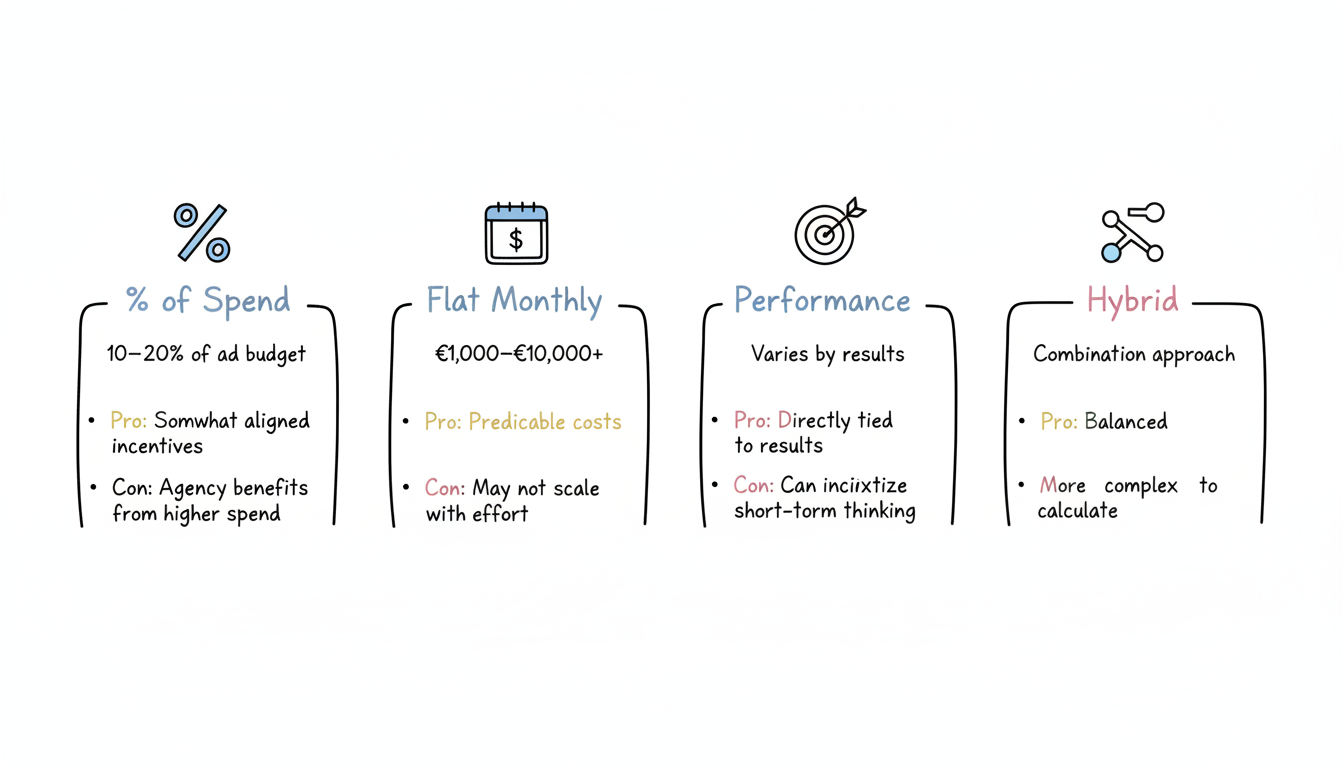
Common PPC agency pricing models:
Model | Typical Range | Pros | Cons |
Percentage of spend | 10-20% of ad budget | Aligns incentives somewhat | Agency benefits from higher spend |
Flat monthly fee | $1,000-$10,000+ | Predictable costs | May not scale with effort |
Performance-based | Varies | Directly tied to results | Can incentivize short-term thinking |
Hybrid | Combination | Balanced approach | More complex to calculate |
Red flag: Agencies unwilling to clearly explain their pricing structure or who hide fees in complex contracts.
Questions to Ask Potential Agencies
These questions reveal whether an agency is genuinely qualified or just good at sales pitches.
About Their Approach
According to agency vetting research, ask:
- "How would you approach our specific business/industry?"
- Good answer: Specific insights about your market, competitors, and opportunities
- Bad answer: Generic responses that could apply to any business
- "What's your optimization cadence and process?"
- Good answer: Specific schedule (weekly bid adjustments, monthly strategy reviews) with clear methodology
- Bad answer: Vague promises about "continuous optimization"
- "How do you handle underperforming campaigns?"
- Good answer: Structured troubleshooting process, willingness to try new approaches
- Bad answer: Blame external factors or request more budget
About Results and Reporting
- "What KPIs do you focus on, and why?"
- Good answer: Focus on business outcomes (ROAS, CPA, revenue) tied to your goals
- Bad answer: Emphasis on vanity metrics (impressions, CTR without context)
- "Can you share examples of accounts you've grown significantly?"
- Good answer: Specific case studies with metrics you can verify
- Bad answer: "We can't share due to confidentiality" (for all examples)
- "What reporting do you provide, and how often?"
- Good answer: Regular reports with actionable insights, not just data dumps
- Bad answer: Monthly PDFs with no explanation or recommendations
About Communication and Partnership
- "Who will be managing our account day-to-day?"
- Good answer: Introduction to the actual team members, their experience
- Bad answer: "Our team" without specifics
- "How quickly do you respond to urgent issues?"
- Good answer: Defined SLAs, emergency contact procedures
- Bad answer: "We'll get back to you as soon as possible"
- "What access will we have to our accounts?"
- Good answer: Full ownership and visibility into your ad accounts
- Bad answer: Limited or no direct access to your own accounts
Red Flags to Avoid
These warning signs indicate potential problems:
Promises That Sound Too Good
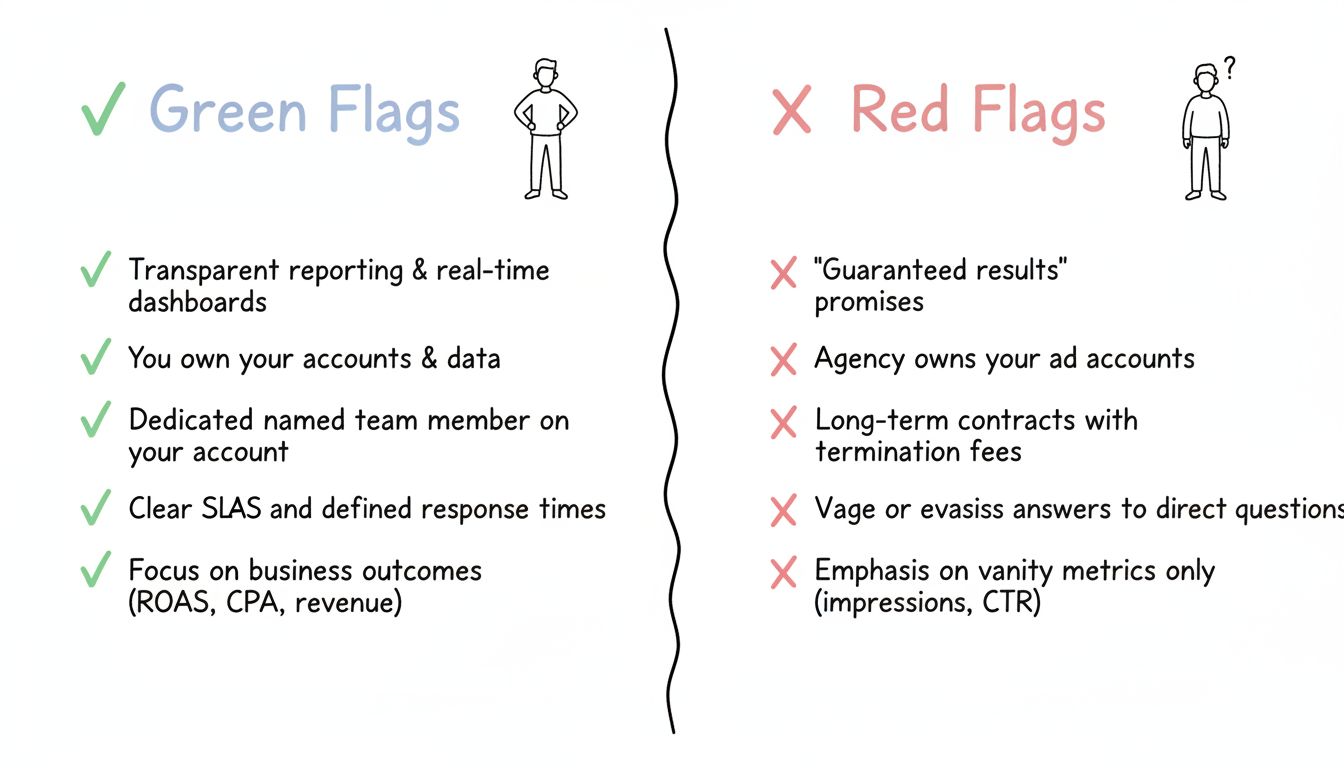
Red Flag | Reality |
"Guaranteed results" | No agency can guarantee specific outcomes in an auction-based system |
"We have inside connections at Google" | Platform relationships don't override algorithm-based ad serving |
"Triple your leads in 30 days" | Dramatic short-term promises often involve unsustainable tactics |
Structural Problems
According to agency evaluation experts, watch for:
- Long-term contracts with early termination fees: Good agencies keep clients through results, not contracts
- Owning your ad accounts: You should always own your accounts and data
- Lack of transparency: Refusing to explain strategy or provide detailed reporting
- One-size-fits-all approach: Your business is unique; cookie-cutter strategies won't maximize results
When evaluating agencies, understanding what is paid search advertising can help you assess whether they truly understand the fundamentals.
Communication Issues
- Slow response times during sales process: If they're slow now, expect worse after you sign
- Evasive answers to direct questions: Good agencies are confident discussing their approach
- Only talking to salespeople: You should meet the team who'll actually manage your account
- Pressure tactics: "Sign today for a discount" indicates they're more focused on closing than fit
Our Approach to PPC Management
At Stackmatix, we believe in a different kind of agency relationship.
What Sets Us Apart
Our Approach | Why It Matters |
Transparent reporting | Real-time dashboards plus monthly strategic reviews |
You own everything | Your accounts, your data, your campaigns |
Dedicated team | Named strategist and analyst on every account |
Multi-platform expertise | Google, Microsoft, Meta, and emerging platforms |
Performance focus | Compensation tied to your actual business outcomes |
Our Specialization
We specialize in what is Microsoft Advertising platform alongside Google Ads, helping clients capture the 30-70% lower CPCs available on Bing while maintaining Google performance. This dual-platform approach typically delivers 15-25% more conversions at the same or lower total cost.
How We Work
- Discovery: Understanding your business, goals, and competitive landscape
- Audit: Analyzing current performance and identifying opportunities
- Strategy: Developing a custom plan with specific targets
- Execution: Launching optimized campaigns with proper tracking
- Optimization: Continuous improvement based on data
- Reporting: Clear communication about results and next steps
For businesses just starting out, our approach aligns with PPC for beginners getting started principles while delivering enterprise-level expertise.
Frequently Asked Questions
How Much Should I Expect to Pay a PPC Agency?
Agency fees typically range from $1,000-$10,000+ monthly for management, plus your ad spend. According to industry data, percentage-based fees usually run 10-20% of ad spend. For budgets under $10,000/month, flat fees often make more sense. The right price depends on your budget size, campaign complexity, and the agency's expertise level. Tools like a PPC budget calculator ad spend can help you determine appropriate investment levels.
How Long Before I See Results from a New PPC Agency?
You should see initial data within the first week and meaningful performance trends within 30-60 days. However, reaching optimal performance typically takes 90 days as the agency tests strategies, refines targeting, and accumulates conversion data for smart bidding. Be wary of agencies promising dramatic results faster—sustainable improvement takes time.
Should I Choose a Specialized or Full-Service Agency?
It depends on your needs. Specialized PPC agencies often deliver better results because of deeper expertise, while full-service agencies offer convenience if you need multiple marketing services. If PPC is a significant revenue driver, a specialized agency typically provides better ROI. For supplementary channels, integrated services may be more efficient.