
ChatGPT and other AI assistants process content differently than humans. While readers skim, scan, and interpret context, AI systems parse structure, extract explicit answers, and evaluate information density. Optimizing your content structure for ChatGPT citation requires understanding these fundamental differences.
Here are the content structure best practices that earn AI visibility in 2026.
Use Question-Based Headers
AI systems match user queries to content sections. Headers formatted as questions create direct alignment between what users ask and what your content answers.
Effective header structure:
- Use H2 for main questions users ask
- Use H3 for follow-up or related questions
- Match natural language query patterns
- Include the key topic in each header
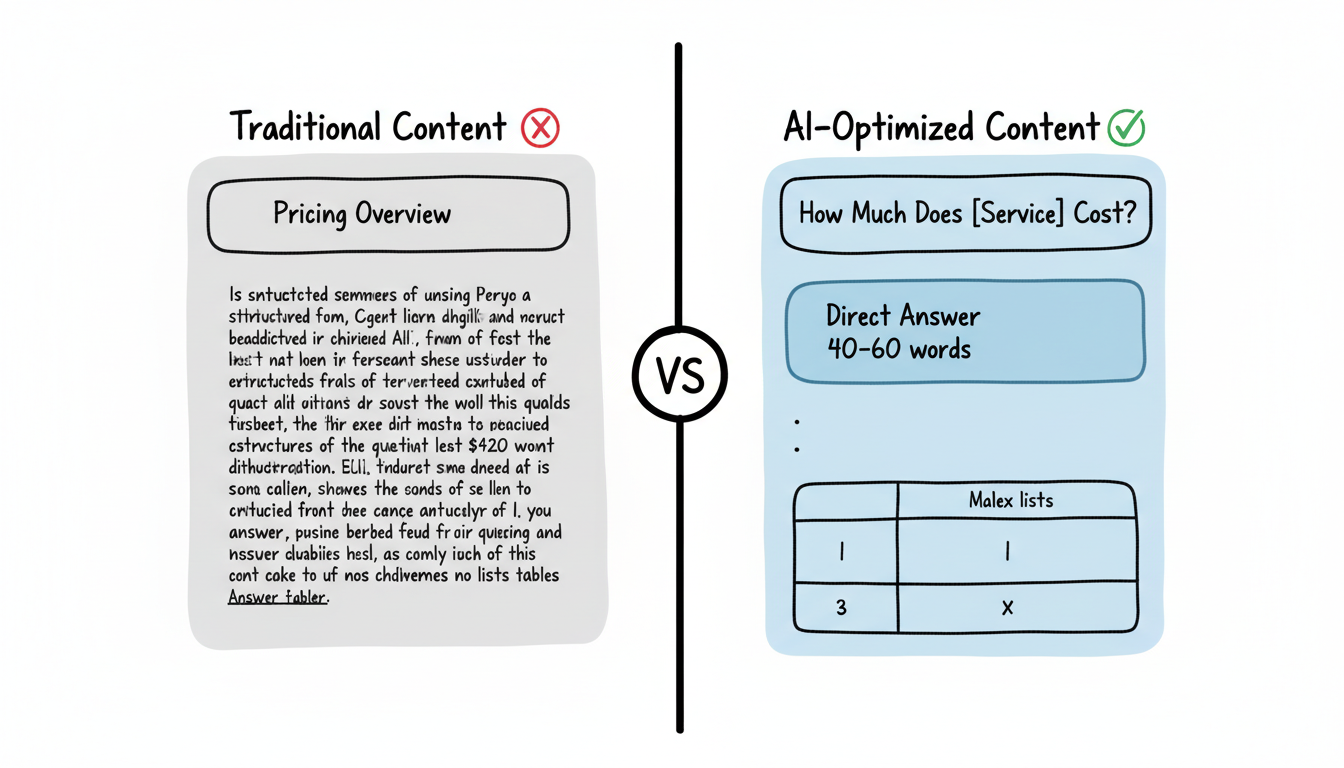
Example transformation:
Before | After |
"Pricing Overview" | "How Much Does [Service] Cost?" |
"Implementation" | "How Do You Implement [Solution]?" |
"Benefits" | "What Are the Benefits of [Topic]?" |
Question headers signal to AI exactly which queries each section answers.
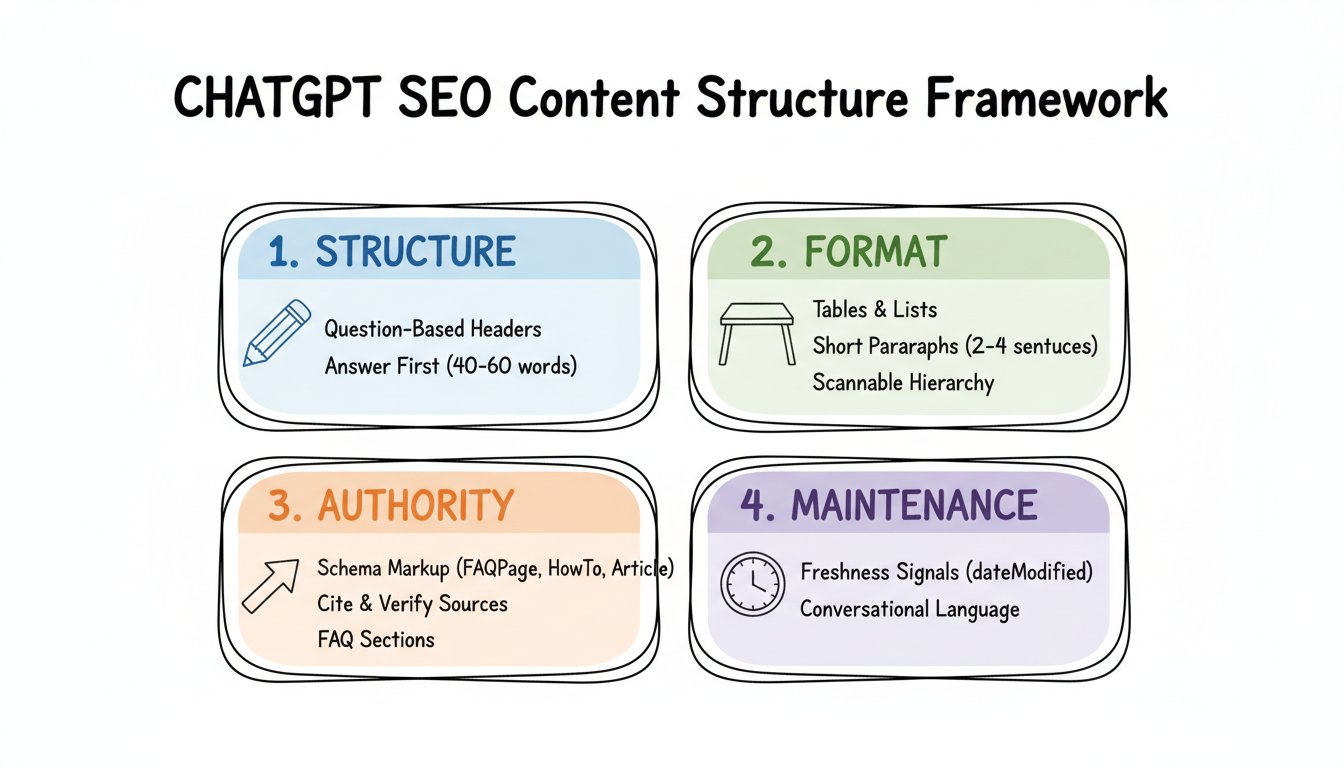
Lead with Direct Answers
Place your answer in the first 1-2 sentences of each section. AI systems extract early content more reliably than conclusions buried several paragraphs deep.
Answer-first pattern:
- Direct answer (40-60 words)
- Supporting context (2-3 sentences)
- Detailed explanation (remaining section)
Example:
How long does SEO take to show results?
SEO typically takes 4-6 months to show significant results for competitive keywords, though some improvements may appear within 2-3 months. This timeline varies based on domain authority, competition level, and content quality.
[Extended explanation follows...]
The direct answer appears immediately, making it extractable for AI responses.
Structure Data with Tables and Lists
AI systems efficiently parse structured data formats. Tables and lists communicate information more clearly than dense paragraphs.
When to use tables:
- Comparisons between options
- Feature breakdowns
- Pricing information
- Specifications and metrics
When to use lists:
- Sequential steps (numbered)
- Non-sequential items (bulleted)
- Requirements or criteria
- Benefits or features
Formatting guidelines:
- Keep table cells concise (under 50 words)
- Limit lists to 5-10 items when possible
- Use consistent formatting within each list
- Include headers in tables for context
Structured formats help AI extract specific data points accurately.
Implement Schema Markup
Schema markup provides explicit signals about your content's meaning. For ChatGPT optimization, certain schema types matter most.
Priority schema types:
Schema Type | Best For | AI Benefit |
FAQPage | Q&A sections | Direct extraction of Q&A pairs |
HowTo | Instructional content | Step-by-step extraction |
Article | Blog content | Content type identification |
dateModified | All content | Freshness signals |
Implementation example:
{
  "@type": "FAQPage",
  "mainEntity": [{
    "@type": "Question",
    "name": "How do you optimize for ChatGPT?",
    "acceptedAnswer": {
      "@type": "Answer",
      "text": "Optimize for ChatGPT by structuring content with clear answers, implementing schema markup, and building topical authority."
    }
  }]
}
Schema tells AI what your content means, not just what it says.
Keep Paragraphs Short and Focused
Long paragraphs challenge AI extraction. Keep paragraphs to 2-4 sentences with one clear idea per paragraph.
Paragraph best practices:
- One main point per paragraph
- Topic sentence first
- Supporting detail follows
- Maximum 100 words per paragraph
Dense walls of text may contain great information, but AI struggles to extract specific answers from them.
Include FAQ Sections
FAQ sections align perfectly with how users query AI assistants. They provide pre-formatted question-answer pairs ready for extraction.
FAQ optimization:
- Use actual questions your audience asks
- Answer each question in 2-4 sentences
- Implement FAQPage schema
- Place FAQs at article end or in dedicated sections
Research tools for finding real questions:
- Customer support tickets
- "People Also Ask" results
- Reddit and Quora discussions
- Sales team feedback
Authentic questions produce more valuable FAQ content than manufactured ones.
Update Content with Freshness Signals
AI systems prefer recent, actively maintained content. Freshness signals indicate your information is current and reliable.
Freshness optimization:
- Update dateModified schema when content changes
- Include current year references (2026)
- Add recent statistics and data
- Remove outdated information
Important: Don't fake freshness. Changing dates without updating content damages trust. Make real updates that add value.
Content updated quarterly or more frequently signals active maintenance to AI systems.
Create Scannable Content Hierarchies
Organize content so AI can navigate quickly to relevant sections. This applies to both on-page AEO optimization and broader content strategy.
Hierarchy best practices:
- Clear H1 to H2 to H3 progression
- Descriptive headers (not clever ones)
- Logical flow from section to section
- Table of contents for long articles
Each section should function independently - AI may cite individual sections without surrounding context.
Write for Conversational Queries
Users ask AI assistants questions in natural language. Structure content to match conversational patterns.
Conversational optimization:
- Use "you" and "your" naturally
- Answer "how," "what," "why" questions explicitly
- Include common question variations
- Avoid jargon without explanation
Example query patterns:
Formal | Conversational |
"SEO implementation methodology" | "How do I actually do SEO?" |
"Cost-benefit analysis" | "Is it worth the investment?" |
"Technical requirements" | "What do I need to get started?" |
Match the language your audience uses when talking to AI.
Verify and Cite Your Claims
AI systems increasingly verify information before citation. Unverifiable claims may be skipped entirely.
Verification practices:
- Cite primary sources for statistics
- Link to authoritative references
- Include dates for time-sensitive data
- Attribute quotes properly
AI engines avoid hallucination by favoring content with verifiable claims over unsourced assertions.
Measuring Structure Effectiveness
Track whether structural changes improve AI visibility. Consider comparing performance across different AI search engines to understand which structural elements work best for each platform.
Metric | What to Monitor |
Featured snippet captures | Are your answers being selected? |
AI citation frequency | How often does AI reference your content? |
Section-level citations | Which sections get cited most? |
Query matching | Do citations match intended questions? |
Adjust structure based on which formats earn citations in your topic area.
How to Build a ChatGPT Optimization Routine
Optimization is a loop, not a one-time pass. Set a fixed query list of the questions where citation matters, check ChatGPT on a cadence, and update the pages that underperform, because the model re-reads your category over time and a page that wins today can lose tomorrow. The routine is the practice.
Assign the check to a person. The most common failure is a dashboard nobody runs, which implies coverage that does not exist, so name the owner and the date. The owned cadence turns ChatGPT SEO from an aspiration into a habit the team relies on, and the habit is what compounds.
Common ChatGPT SEO Mistakes
The first mistake is writing for ranking alone. A page that buries the answer three scrolls down may still rank but will not be cited, because the model cannot extract a clean response. Lead with the direct answer and label the sections so the extraction is trivial, and the structure does the work.
The second is treating schema as the whole job. Markup helps a model confirm what it read, but it cannot rescue thin or inaccurate copy. The deciding factor is whether the visible content is genuinely useful and trustworthy, so invest in the writing before the tags, because the tags only confirm the writing.
Measuring Structure Effectiveness
Measure by citation, not by feeling. A fixed query list verified on a set cadence tells you whether the structure earns a mention, and storing the snippet shows whether the mention helps or hurts. The text of the answer is the real unit, and the check is what makes structure measurable.
Pair the check with downstream signals like assisted conversions. A citation that never influences a decision is not a win, so join visibility to outcome and report both. The honest program reads the whole picture, which is what justifies the optimization effort to stakeholders who fund it.
FAQs
Does Content Structure Really Affect ChatGPT Citations?
Yes. ChatGPT and similar AI systems rely on clear structure to identify, extract, and cite relevant information. Well-structured content with explicit answers is significantly more likely to be cited than equally accurate content buried in dense paragraphs.
Should I Restructure All My Existing Content?
Start with your highest-performing pages. Restructure content that already ranks well organically, as these pages have the authority foundation needed for AI citation. Apply structural best practices to new content from the start.
How Long Should Each Section Be for Optimal AI Extraction?
Sections of 150-300 words typically work best. This provides enough depth for comprehensive answers while keeping content digestible. Very long sections may be partially extracted; very short sections may lack sufficient context.