
ChatGPT has evolved from a conversational AI into a full-fledged search engine with nearly 800 million weekly active users. When users ask ChatGPT for recommendations, information, or solutions, brands that appear in those AI-generated responses gain unprecedented visibility. The question isn't whether you should optimize for ChatGPT—it's how to do it effectively.
Traditional SEO prepared you for Google rankings. ChatGPT search optimization requires a fundamentally different approach: one focused on citations, entity recognition, and content that AI systems can confidently reference. This discipline is part of a broader field known as Generative Engine Optimization (GEO)—the practice of optimizing content to appear in AI-generated responses across platforms like ChatGPT, Perplexity, and Google AI Overviews. ChatGPT SEO is a key subset of GEO, focused specifically on earning visibility and citations within ChatGPT search.
This guide covers everything you need to know about ranking in ChatGPT search in 2026, including practical ways to use ChatGPT as an SEO tool, technical indexing setup for AI crawlers, and the latest AI visibility measurement platforms.
What Does "Ranking" Mean in ChatGPT Search?
Unlike traditional search engines, ChatGPT doesn't present a ranked list of 10 blue links. Instead, it generates synthesized answers and cites sources that support its claims.
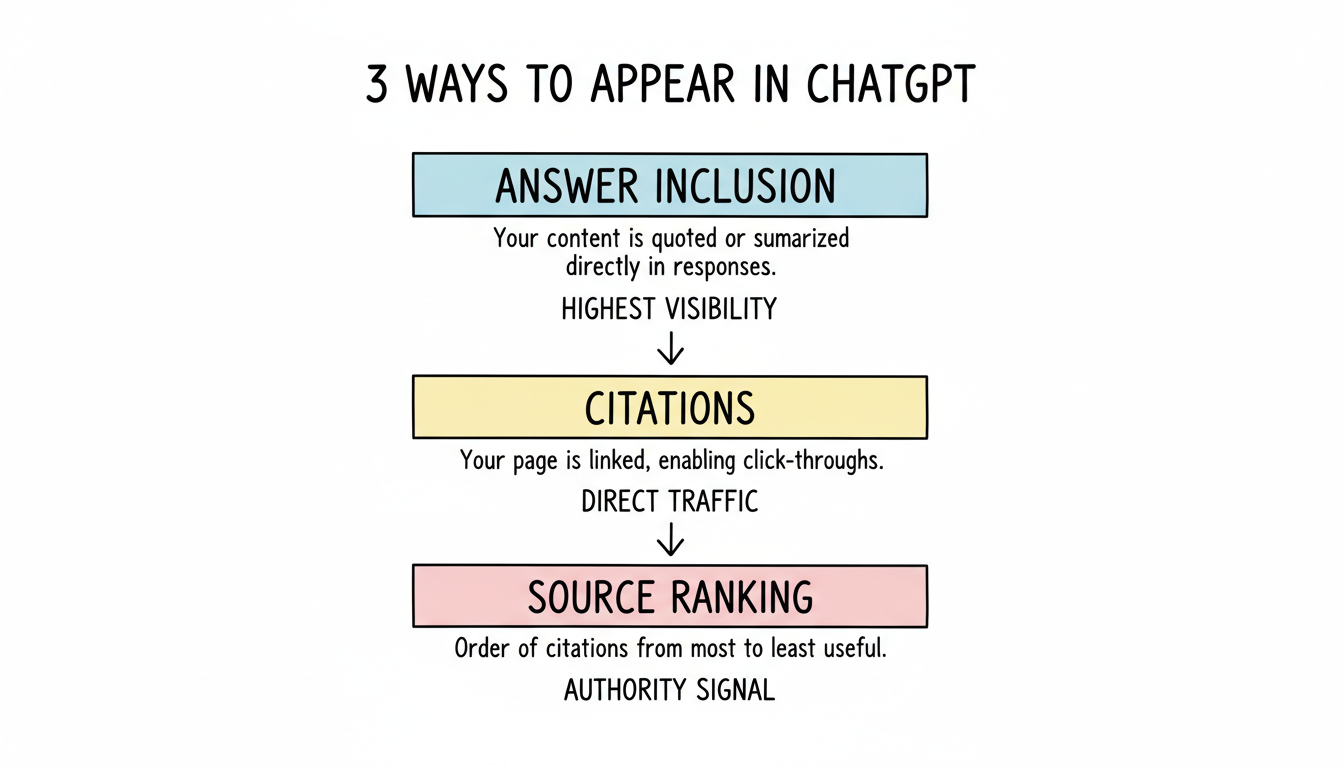
According to Fortis Media's ChatGPT ranking guide, "ranking" in ChatGPT manifests in three ways:
Types of ChatGPT visibility:
Visibility Type | Description | Impact |
Answer inclusion | Your content is quoted or summarized in responses | Highest visibility |
Citations | Your page is linked, enabling click-throughs | Direct traffic potential |
Source ranking | Order of citations, typically most to least useful | Authority signal |
According to SeoProfy's ChatGPT ranking guide, ChatGPT now serves nearly 800 million weekly active users and has become one of the fastest-growing search engines in B2B. People use it for personalized recommendations across products and services—making ChatGPT visibility increasingly valuable for businesses.
Establishing your brand as a reliable source is your gateway to ChatGPT visibility.
How ChatGPT Selects and Ranks Sources
ChatGPT doesn't rely on keyword matching the way Google traditionally did. It evaluates context, concept, and trustworthiness.
According to Fortis Media, ChatGPT evaluates sources through several lenses:
ChatGPT source selection criteria:
- Meaning first, not keywords - Semantic capability matches user intent with direct answers
- Entity connections - Analyzes how your brand relates to particular topics
- Fact-checking - Rates content according to "confidence scores" while cross-checking sources
- Trust signals - Provides more brand mentions to high-authority sites with clear authorship
- Layout clarity - Prioritizes pages with clean formatting: headings, bullets, tables, short sections
According to Kevin Indig's State of AI Search Optimization 2026, models can only cite sources that enter the context window. Pre-training mentions often go unattributed, while live retrieval adds a URL that enables attribution. This distinction matters for your optimization strategy.
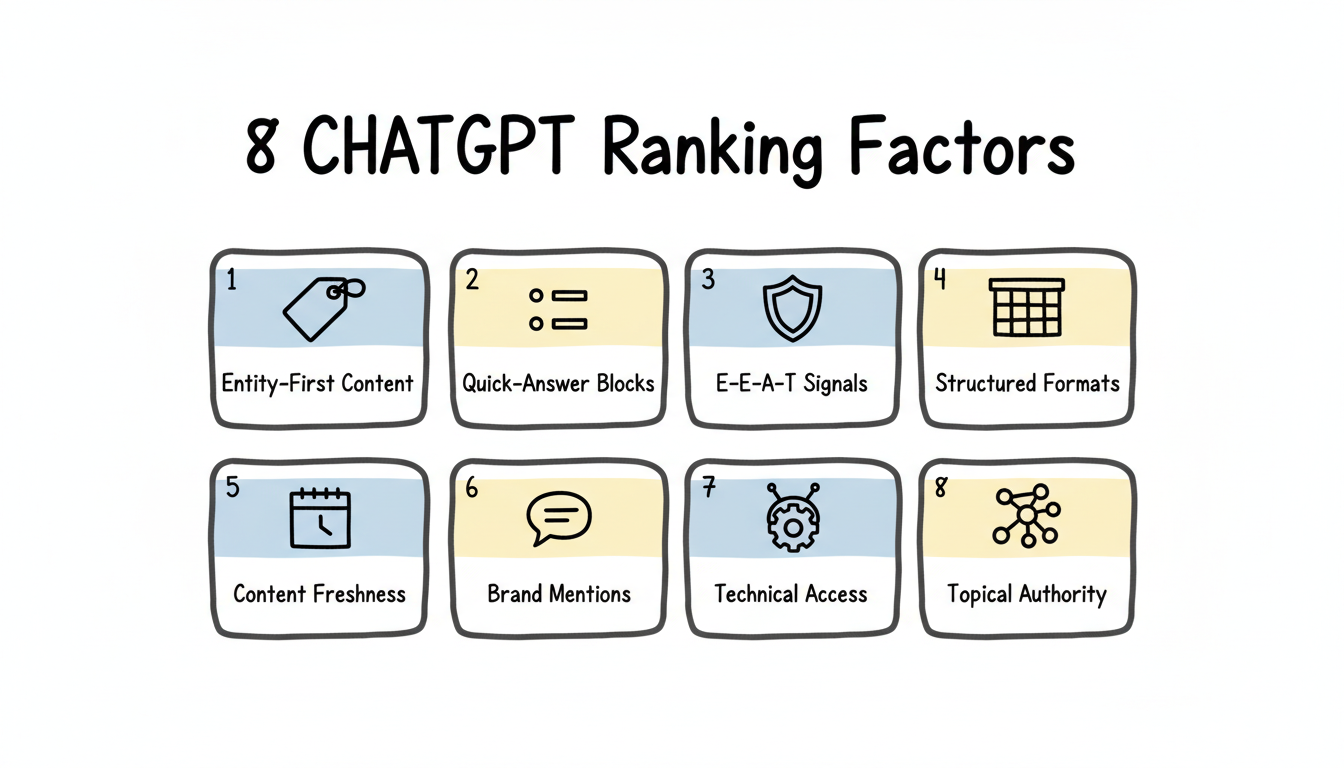
The 8 Key ChatGPT Ranking Factors
Based on extensive research and industry analysis, eight factors consistently influence ChatGPT citations.
1. Entity-First Content Structuring
According to Fortis Media, entity-first content structuring is essential for ChatGPT visibility.
Implementation approach:
- Start pages with "What is" sections that clearly define the main subject
- Maintain consistent names for products or concepts across all pages
- Mention essential related concepts (for "electric cars," include "batteries," "charging stations," "range")
- Build explicit connections between your brand and topic entities
According to ALM Corp's SEO guide, entity optimization goes beyond traditional keyword targeting to focus on specific people, places, brands, products, and concepts. Instead of optimizing for "best smartphones 2025," optimize for specific entities like brand and model names.
2. Quick-Answer Blocks and Factual Sections
ChatGPT extracts discrete facts more easily than it parses narrative content. Structure matters for citation, particularly when optimizing for ai-search-content-structure.
Factual content requirements:
- Lead every major section with a direct 30-50 word summary
- Include specific data points, statistics, and numbers
- Use tables and bulleted lists for easy extraction
- Provide definitive answers before elaboration
According to Digital SEO Land's optimization guide, AI favors accurate, in-depth content that answers questions well. Instead of generic content like "SEO Tips," break topics into specific sections like "SEO Strategies for Beginners," "Common SEO Mistakes to Avoid," and "Top SEO Tools for 2026."
3. E-E-A-T Signal Strength
ChatGPT favors content from trusted brands with genuine expertise. E-E-A-T (Experience, Expertise, Authoritativeness, Trustworthiness) signals matter even more for AI citations than traditional search.
According to Fortis Media, strengthening E-E-A-T for ChatGPT isn't difficult but requires deliberate effort.
E-E-A-T implementation checklist:
Signal | Implementation |
Bylines | Add author names with credentials to all articles |
Author pages | Create dedicated pages with bio, role, and previous work |
Digital PR | Earn mentions in relevant online publications |
Original sourcing | Link to studies, data, and verifiable quotes |
Transparent methodology | Explain how conclusions were reached |
According to Search Engine Journal's 2026 predictions, being mentioned in AI search is all about reputability, experience, and trust. The more well-known and well-respected your brand is in your industry, the more likely LLMs will cite you as a trusted source.
4. Structured Formats ChatGPT Prefers
Not all content formats perform equally. Certain structures make extraction dramatically easier for AI systems, especially when implementing aeo-content-templates.
According to ALM Corp, specific format patterns drive higher citation rates:
High-performing content formats:
Format | Use Case | Citation Impact |
Definition blocks | "What is X?" content | Very high |
Step-by-step guides | Procedural content | Very high |
Comparison tables | Product/service comparisons | High |
FAQ sections | Common question coverage | High |
Bulleted lists | Feature/benefit lists | Medium-high |
Data tables | Statistical content | High |
According to Bluehost's ChatGPT SEO guide, AI-powered content structuring generates logical content hierarchies with nested headings, scannable layouts, and strategic keyword placement.
5. Content Freshness and Update Signals
ChatGPT tends to ignore outdated content. Freshness directly impacts citation probability.
According to Kevin Indig's AI Search Optimization report, content updated within the past 3 months performs best across all intents. Over 70% of pages cited by ChatGPT were updated within 12 months.
Freshness optimization tactics:
- Refresh recency-sensitive topics regularly ("best apps of 2026," "current policies")
- Display "last modified" dates prominently
- Add new statistics, screenshots, and product news to existing content
- Check which sources ChatGPT recommends and ensure your content stays competitive
According to SeoProfy, relevance and content-freshness-signals-answer-engines are the number one priority when optimizing for ChatGPT. AI models scan the web for the newest material that reflects current questions and conversations.
6. Brand Mentions and Third-Party Signals
Brand mentions have moved from nice-to-have to essential infrastructure for AI visibility.
According to Search Engine Land's brand mention analysis, LLMs evaluate mentions, context, and repeated co-occurrence between your brand and target topics. Brand mentions are part of the ranking moat—this is not a return to backlink strategies.
Brand mention strategy:
- Build presence on cited platforms: Reddit, Quora, review sites, LinkedIn, niche forums
- Earn editorial mentions in industry publications
- Create co-occurrence between your brand and topic keywords
- Generate positive reviews across relevant platforms
- Engage authentically in community discussions
According to Kevin Indig, third-party mentions ("Webutation") significantly influence citation probability. LLMs assess brand credibility through external validation.
7. Technical Accessibility for AI Crawlers
AI systems can only cite content they can access and parse. Technical barriers block citation opportunities.
According to ALM Corp, a structured implementation plan should include verifying AI crawler access.
Technical requirements:
Requirement | Implementation |
Robots.txt | Ensure AI crawlers aren't blocked |
Schema markup | Implement Article, FAQ, HowTo, Organization |
Page speed | Optimize Core Web Vitals |
Rendering | Use server-side rendering or static generation |
URL structure | Semantic clarity in URLs |
Understanding schema-markup-alignment-aeo becomes critical for proper implementation.
According to SeoProfy, making sure AI crawlers can easily access your pages is fundamental to ChatGPT visibility.
8. Topical Authority Through Content Clusters
You can't publish one blog and expect AI to trust you. ChatGPT rewards depth.
According to TripleDart's ChatGPT optimization guide, building topical authority is key to ChatGPT search visibility.
Cluster-building approach:
- Start with comprehensive pillar posts on core topics
- Build supporting content around related queries
- Establish internal linking between cluster pieces
- Demonstrate comprehensive expertise across the topic
According to TripleDart, maintained content clusters earn topical authority over time. The difference between getting quoted and getting ignored often comes down to systematic refresh cycles.
How to Use ChatGPT for SEO
Beyond optimizing for ChatGPT search, ChatGPT itself is a powerful SEO tool. Marketers and SEO professionals can leverage ChatGPT prompts to accelerate keyword research, content creation, and competitive analysis—making it a practical GEO and traditional SEO assistant.
Keyword Research Prompts
ChatGPT excels at generating keyword ideas and clustering them by intent. Effective ChatGPT SEO prompts for keyword research include:
- "List 20 long-tail keywords related to [topic] grouped by search intent (informational, transactional, navigational)"
- "Generate semantic keyword clusters for [seed keyword] including related entities and subtopics"
- "Identify question-based keywords people ask about [topic] suitable for FAQ sections and featured snippets"
These prompts help uncover keyword opportunities that traditional tools might miss, particularly conversational and question-based queries that align with how people search in AI platforms.
Content Optimization Prompts
Use ChatGPT to refine existing content for both traditional and AI search visibility:
- "Analyze this content and suggest structural improvements for AI citation readability: [paste content]"
- "Rewrite this paragraph to lead with a direct answer followed by supporting detail: [paste paragraph]"
- "Generate a definition block, comparison table, and FAQ section for this topic: [topic]"
Meta Tag a/B Testing
ChatGPT can rapidly generate multiple meta title and description variants for testing:
- "Write 5 meta title variations for a page about [topic] that include the primary keyword and stay under 60 characters"
- "Generate 5 meta description options for [URL topic] that include a call-to-action and stay under 155 characters"
Test these variants using Google Search Console click-through rate data to identify top performers.
Competitive Analysis Workflows
Leverage ChatGPT for efficient competitor research:
- "Compare the content structure and topic coverage of these three URLs: [URL1], [URL2], [URL3]. Identify content gaps."
- "Based on this competitor content, suggest unique angles and original data points I could add to differentiate my piece"
- "Analyze these top-ranking pages for [keyword] and identify common entities, structured data types, and content patterns they share"
Using ChatGPT as an SEO workflow tool complements your GEO strategy—the same content improvements that help you rank in Google also increase your probability of being cited by AI search platforms.
Bing & Google Indexing for ChatGPT Visibility
ChatGPT uses Bing's index for live web search, making Bing indexing a critical and often overlooked component of ChatGPT SEO. Without proper Bing indexing, your content cannot appear in ChatGPT search results regardless of its quality.
Step-By-Step Bing Webmaster Tools Setup
Follow these steps to ensure your site is discoverable by ChatGPT search:
- Create a Bing Webmaster Tools account at bing.com/webmasters
- Verify your site ownership using DNS record, meta tag, or CNAME verification
- Submit your XML sitemap (typically at yoursite.com/sitemap.xml)
- Review the crawl report to identify and fix any blocked or errored pages
- Check the "URL Inspection" tool for key pages to confirm they are indexed
Indexnow Protocol for Faster Indexing
IndexNow is an instant-indexing protocol supported by Bing (and by extension, ChatGPT search). When you publish or update content, IndexNow notifies Bing immediately rather than waiting for a crawl cycle.
Implementation steps:
- Generate an IndexNow API key from Bing Webmaster Tools
- Host the key file at your site root (yoursite.com/{key}.txt)
- Send a POST request to api.indexnow.org/indexnow with your updated URLs
- Integrate IndexNow into your CMS publishing workflow for automatic notification on every publish
OAI-Searchbot Robots.Txt Configuration
OpenAI uses a dedicated crawler called OAI-SearchBot to fetch content for ChatGPT search results. Ensure your robots.txt file explicitly allows this crawler:
Required robots.txt directive:
- User-agent: OAI-SearchBot
- Allow: /
Note: OAI-SearchBot is separate from GPTBot (used for training data). You can allow OAI-SearchBot for search visibility while blocking GPTBot if you prefer not to contribute to training data.
Google Search Console Indexing
While ChatGPT primarily uses Bing, Google indexing remains important because Google AI Overviews and Gemini pull from Google's index, and strong Google rankings correlate with higher AI citation rates across all platforms.
- Submit your sitemap in Google Search Console
- Use the URL Inspection tool to request indexing for new or updated pages
- Monitor the Coverage report for crawl errors and excluded pages
- Ensure your content renders fully without requiring JavaScript execution where possible
Javascript Rendering Concerns for AI Crawlers
Many AI crawlers, including OAI-SearchBot, have limited JavaScript rendering capabilities. Content that depends entirely on client-side JavaScript may not be visible to these crawlers.
Best practices:
- Use server-side rendering (SSR) or static site generation (SSG) for critical content pages
- Ensure primary content is present in the initial HTML response
- Test your pages using Bing Webmaster Tools' "URL Inspection" to see what the crawler actually sees
- Avoid hiding key content behind JavaScript-triggered tabs, accordions, or infinite scroll
AI Visibility Measurement Tools
As GEO matures, a new category of tools has emerged to track how brands perform in AI-generated responses. These platforms go beyond traditional rank tracking to measure citation frequency, sentiment, and share of voice across ChatGPT, Perplexity, Gemini, and other AI search surfaces.
Semrush AI Visibility Toolkit
Semrush has introduced an AI Visibility Index that tracks your brand's presence across major AI platforms. Key features include:
- AI citation tracking across ChatGPT, Perplexity, and Google AI Overviews
- Share of voice metrics comparing your AI visibility against competitors
- Historical trend analysis showing citation changes over time
- Keyword-level AI visibility reporting
SE Ranking GEO Tool
SE Ranking offers a dedicated GEO tool that monitors generative engine optimization performance:
- Tracks which queries trigger AI citations for your domain
- Monitors competitor citation patterns
- Provides AI-specific content recommendations
- Integrates with traditional rank tracking for a unified view
Brand Sentiment Analysis in AI Responses
Understanding how AI platforms describe your brand is as important as being cited. Track these dimensions:
- Sentiment polarity - Is your brand mentioned positively, neutrally, or negatively?
- Narrative accuracy - Does the AI correctly represent your products, services, and positioning?
- Narrative Drivers report - Identifies which content themes and topics drive your brand mentions in AI responses, revealing gap analysis opportunities
- Competitor comparison - How does your brand sentiment compare to competitors in the same AI responses?
ChatGPT SEO vs. Traditional SEO: Key Differences
Understanding what's changed helps focus optimization efforts appropriately.
According to NoGood's future of search analysis, search marketing in 2026 includes traditional SEO plus AEO (Answer Engine Optimization). Traditional tactics like keyword research and content optimization still matter, but you're also optimizing for how ChatGPT decides what to cite.
Key differences between ChatGPT SEO and traditional SEO:
Aspect | Traditional SEO | ChatGPT SEO |
Goal | Rank in positions 1-10 | Get cited in AI responses |
Keywords | Exact match optimization | Entity and topic optimization |
Success metric | Rankings, clicks | Citations, brand mentions |
Content format | Long-form for dwell time | Structured for extraction |
Authority signals | Backlinks | Brand mentions + backlinks |
Freshness | Important | Critical |
Competition | Page-to-page | Source-to-source |
Learn more about the distinctions in traditional-seo-vs-ai-search-optimization.
According to Search Engine Journal, in 2026 SEOs need to treat visibility as something earned through retrieval, not ranking. Focus on how content is chunked, cited, and trusted by AI systems.
The Relationship Between Google Rankings and ChatGPT Citations
Google rankings still matter for ChatGPT visibility—but the relationship isn't straightforward.
According to Kevin Indig, pages in Google's top 10 show a strong correlation (~0.65) with LLM mentions, and 76% of AI Overview citations pull from these positions. However, correlation varies by LLM. Notably, research indicates that 85% of pages cited by ChatGPT also rank in Google's organic top results—demonstrating that traditional SEO and AI search optimization are deeply complementary strategies.
Ranking-citation correlation:
Platform | Correlation with Google Top 10 |
Google AI Overviews | High (76% pull from top 10) |
ChatGPT | Moderate (uses Bing index) |
Perplexity | Moderate-high |
According to ALM Corp, since Google AI Overviews draw heavily from traditional search results, prioritizing conventional SEO remains critical. Pages ranking in positions 1-10 have the highest probability of ai-overview-website-optimization citations.
But here's the nuance: ChatGPT uses Bing's index for live search, not Google's. Optimizing for both search engines increases citation probability across AI platforms.
How to Track ChatGPT SEO Performance
Traditional analytics weren't built for AI search measurement. New approaches are required.
According to NoGood, the new metrics dashboard should incorporate both traditional and AI search metrics.
ChatGPT SEO metrics to track:
Metric Category | Specific Metrics |
Traditional | Rankings, impressions, organic traffic |
AI Search | Citation frequency, LLM referral traffic, brand search lift |
Brand | Share of voice in AI responses, sentiment, accuracy |
According to MadX Digital's AI SEO tools review, "AI mode" tools analyze AI search surfaces in addition to classic SERPs, then report visibility, citations, and sentiment from LLMs. Look for metrics like share of voice, citation rate, and historical trends.
Manual baseline approach:
- Ask main chatbots about your niche and note citations
- Track which page they pull and how they describe your brand
- Monitor changes over time across multiple queries
- Use aggregate trends rather than individual responses
Voice Search Optimization for AI Platforms
As ChatGPT integrates with voice assistants and conversational interfaces, voice search optimization becomes an important GEO consideration. Voice queries tend to be longer, more conversational, and question-based—aligning closely with the content structures that already perform well in ChatGPT search.
Voice search optimization tactics:
- Write content that answers questions in natural, conversational language
- Include "how do I," "what is the best," and "why does" question patterns
- Provide concise direct answers (40-60 words) that can be read aloud naturally
- Structure FAQ sections with conversational question phrasing
About Page Optimization as a GEO Ranking Factor
Your About page plays a surprisingly important role in AI visibility. AI systems use About pages to establish entity identity, verify E-E-A-T credentials, and understand the relationship between your brand and your topic expertise.
About page optimization checklist:
- Clearly state what your company does and who it serves in the first paragraph
- Include founder and team credentials relevant to your content topics
- List notable clients, partnerships, or industry recognitions
- Use structured data (Organization schema) to reinforce entity signals
- Keep the page updated—AI crawlers check freshness signals here too
Content Optimization Checklist for ChatGPT
Use this checklist to audit and optimize existing content for ChatGPT visibility.
Structure optimization:
- Clear H1 that matches page topic
- "What is" definition section near the top
- Question-based H2 headers where appropriate
- Bulleted lists for features, benefits, steps
- Tables for comparisons and data
- Short paragraphs (2-4 sentences)
- FAQ section with common questions
Content quality:
- Original data or unique insights
- Specific statistics with sources
- Clear, literal language (minimal jargon)
- Definitive answers before elaboration
- Updated within last 3 months
- Author byline with credentials
Technical implementation:
- Schema markup (Article, FAQ, HowTo)
- Fast page load speed
- Mobile-friendly design
- AI crawler access verified
- "Last updated" date displayed
Consider implementing aeo-schema-markup-priority best practices throughout your content.
Case Studies: Brands Succeeding with ChatGPT SEO
Real examples demonstrate what's possible with strategic ChatGPT optimization.
According to TripleDart, Viv—a sustainable period care company—achieved remarkable results through ChatGPT-optimized content. Their blog features clean, structured, question-led content that directly addresses what people ask ChatGPT.
Viv's results:
- 400% increase in blog traffic
- 436% boost in sales conversions
- Results driven primarily by ChatGPT visibility
According to SeoProfy, brands that combine comprehensive content with strategic brand building see consistent citation improvements across AI platforms.
Common ChatGPT SEO Mistakes to Avoid
Avoid these pitfalls that undermine ChatGPT visibility efforts.
According to WordStream's SEO trends analysis, several common approaches don't work:
Ineffective tactics:
Mistake | Why It Fails |
Creating AI-friendly site copies | Little impact, can cause SEO issues |
Generating many specific "GEO pages" | Seen as thin content, low actual impact |
Keyword stuffing for AI | ChatGPT uses semantics, not keywords |
Ignoring traditional SEO | Google rankings still influence citations |
One-time optimization | Freshness decay quickly reduces visibility |
According to Marketer Milk's 2026 SEO trends, people will realize that optimizing for Google allows them to show up in ChatGPT and Perplexity as well. The fundamentals haven't changed—execution has.
Implementation Roadmap: 30-Day ChatGPT SEO Plan
A structured approach ensures comprehensive optimization.
According to ALM Corp, a phased implementation delivers better results than scattered efforts.
Week 1: Audit and baseline
- Test current AI visibility across ChatGPT, Perplexity, Gemini
- Document which queries return your content
- Analyze top 20 pages using AI optimization checklists
- Install analytics tracking for AI referral traffic
- Verify AI crawler access (check robots.txt)
Week 2: Technical implementation
- Implement priority schema markup
- Validate schema using testing tools
- Audit page speed and Core Web Vitals
- Ensure proper rendering for content pages
- Optimize URL structure for semantic clarity
Week 3: Content structure optimization
- Add definition sections to key pages
- Implement question-based headers
- Create tables and structured lists
- Build FAQ sections for common queries
- Add author bylines and credentials
Week 4: Authority building
- Plan digital PR for brand mentions
- Engage on relevant platforms (Reddit, Quora, LinkedIn)
- Schedule content refresh cycles
- Monitor citation patterns and iterate
- Build content clusters around priority topics
The Future of ChatGPT SEO
ChatGPT search continues to evolve rapidly. Understanding trends helps future-proof your strategy.
According to SEO.com's AI search trends, ChatGPT is anticipated to introduce advertising in 2026. While CEO Sam Altman isn't a fan of ads, platform sustainability may require them—creating new opportunities for brands. Early adopters of ChatGPT ad placements may benefit from lower competition and cost-per-click rates compared to mature Google Ads auctions.
Emerging trends:
- Conversational queries (5x longer than Google searches)
- Multimodal responses (text, images, video integration)
- Personalized recommendations based on user context
- Real-time information synthesis
- Tighter integration with productivity tools
- ChatGPT advertising expected to launch in 2026, creating paid visibility opportunities alongside organic GEO
According to Search Engine Journal, ChatGPT Search integrates real-time web search with conversational AI, providing up-to-date information with direct source links. This functionality continues to expand, making perplexity-seo-optimization and similar strategies increasingly important.
Frequently Asked Questions
Can ChatGPT Optimize for SEO?
Yes. ChatGPT can assist with SEO in two ways: you can optimize your content to be cited by ChatGPT search (ChatGPT SEO), and you can use ChatGPT as an SEO tool for keyword research, content optimization, meta tag generation, and competitive analysis. Both directions fall under the broader discipline of Generative Engine Optimization (GEO).
Is SEO Still Worth It with AI?
Absolutely. Research shows that 85% of pages cited by ChatGPT also rank in Google's organic top results. Traditional SEO and AI search optimization are complementary, not competing strategies. Strong Google rankings increase your probability of being cited by AI platforms including ChatGPT, Perplexity, and Google AI Overviews.
What Is Generative Engine Optimization?
Generative Engine Optimization (GEO) is the practice of optimizing content to appear in AI-generated responses from platforms like ChatGPT, Perplexity, Google AI Overviews, and other generative search engines. ChatGPT SEO is a subset of GEO focused specifically on earning citations in ChatGPT search results. GEO encompasses entity optimization, structured content formatting, E-E-A-T signal building, and technical accessibility for AI crawlers.
How Do I Get My Content Cited in ChatGPT?
To earn ChatGPT citations: structure content with clear definitions, tables, and bulleted lists for easy extraction; build E-E-A-T signals through author bylines and original research; ensure your site is indexed in Bing (ChatGPT uses Bing for live search); allow OAI-SearchBot in your robots.txt; maintain content freshness with quarterly updates; and build brand mentions across third-party platforms like Reddit, Quora, and industry publications.
Key Takeaways
ChatGPT SEO requires a strategic shift from ranking to citation-earning:
- Citations, not rankings - Success means appearing in AI-generated answers with attributed sources
- Entity optimization - Focus on concepts and relationships, not just keywords
- Structured content - Format for easy extraction with definitions, lists, tables
- E-E-A-T signals - Build trust through expertise, authorship, and original insights
- Freshness matters - Update content quarterly; 3-month freshness performs best
- Brand mentions - Third-party signals increasingly influence AI citations
- Technical access - Ensure AI crawlers can reach and parse your content
- Topical authority - Build clusters, not isolated pages
- Dual optimization - Google rankings still influence ChatGPT visibility
- Measurement evolution - Track citations and brand mentions, not just traffic
ChatGPT's 800 million weekly users represent massive visibility opportunity. The brands that systematically optimize for AI citation will capture disproportionate value as AI search continues to grow.