
ChatGPT and Perplexity have emerged as the two dominant AI platforms where users discover brands and information. But they work fundamentally differently - and optimizing for one doesn't automatically mean visibility in the other.
Understanding how each platform retrieves, processes, and cites information helps you build strategies that capture visibility across both. Here's what marketers need to know.
Market Position in 2026
The scale difference between these platforms is significant:
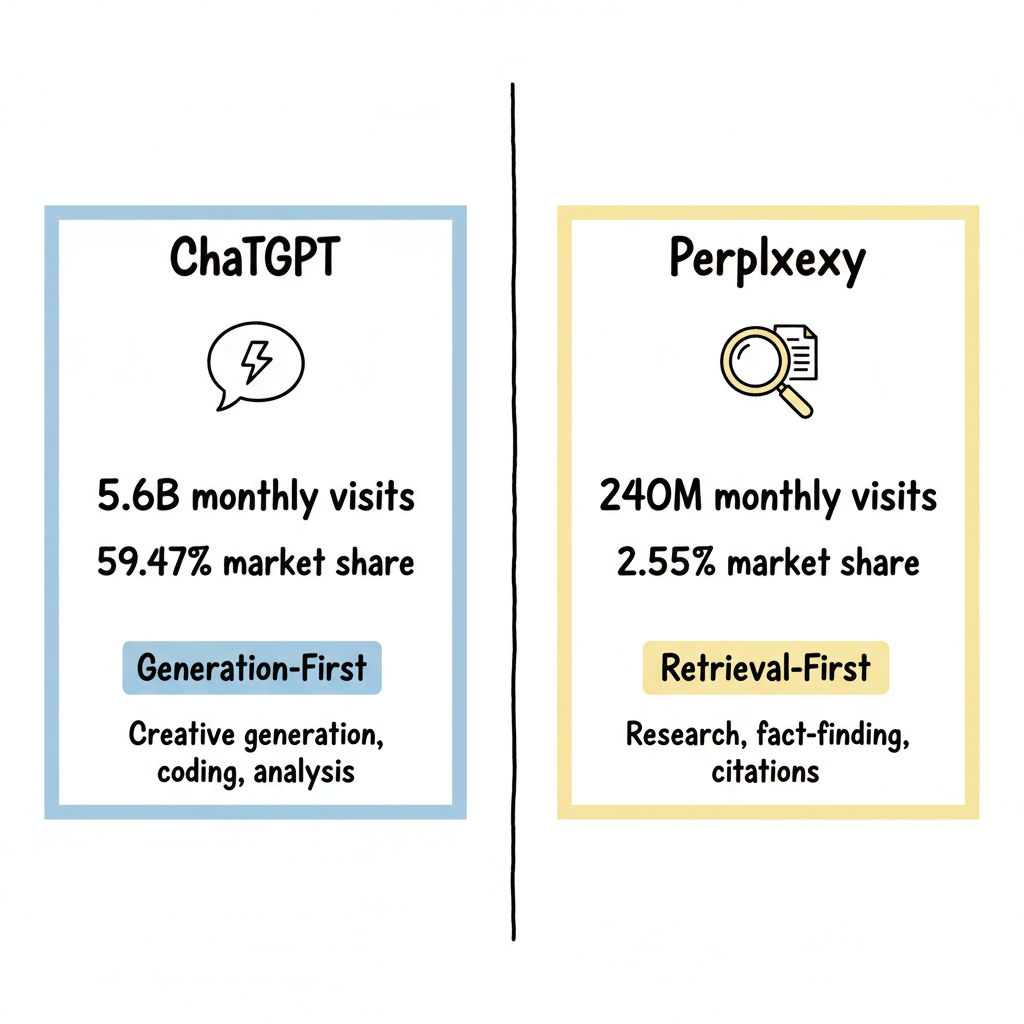
Metric | ChatGPT | Perplexity |
Monthly visits | 5.6 billion | 240 million |
Market share | 59.47% | 2.55% |
Primary use case | Creative generation | Research & answers |
Citation style | Variable | Persistent numbered |
ChatGPT dominates in sheer volume, but Perplexity's research-focused users often have higher purchase intent. Both platforms matter for comprehensive AI visibility.
Fundamental Architecture Differences
ChatGPT: Generation-First
ChatGPT operates as a "Creative Engine." It generates responses primarily from its trained knowledge, adding web search when explicitly needed or when queries require current information.
How ChatGPT works:
- Generates responses from parametric memory (trained knowledge)
- Web browsing is supplementary, not default
- Citations appear inconsistently
- Prioritizes conversational flow over source attribution
- Excels at creative tasks, coding, analysis
When ChatGPT does cite sources, the references tend to be less prominent and may not persist throughout the conversation.
Perplexity: Retrieval-First
Perplexity operates as an "Answer Engine." It searches the web by default for every query, then synthesizes findings into structured answers with persistent citations.
How Perplexity works:
- Searches web by default for every query
- Synthesizes multiple sources into cohesive answers
- Provides numbered citations that persist throughout responses
- Prioritizes accuracy and source transparency
- Excels at research, fact-finding, comparisons
Perplexity's architecture means your content needs to be discoverable and extractable - it's actively pulling from the web in real-time.
Citation Transparency Comparison
The platforms handle source attribution very differently:
ChatGPT Citations
- Appear when web browsing is triggered
- Often summarize without explicit attribution
- Can be inconsistent across similar queries
- May mention sources in narrative form rather than numbered references
- Focus on answer quality over source transparency
Perplexity Citations
- Numbered citations appear throughout every response
- Sources are prominently displayed and clickable
- Users can verify claims by checking original sources
- Citation format is consistent and predictable
- Transparency is a core product feature
For brands, Perplexity's citation model provides clearer attribution when your content is used. ChatGPT's attribution is less reliable for measuring visibility.
Content That Performs on Each Platform
Optimizing for ChatGPT
ChatGPT draws heavily from its training data, which means:
Authority signals matter: Content from recognized, authoritative sources gets weighted in training data. Building domain authority improves ChatGPT visibility.
Comprehensive coverage helps: ChatGPT synthesizes information from its training. Thorough, well-structured content on topics you want to be known for improves representation.
Freshness is limited: ChatGPT's knowledge has cutoff dates. Real-time optimization is less effective unless you're targeting browsing-enabled queries.
Brand mentions count: If your brand is frequently mentioned across the web in relevant contexts, ChatGPT learns those associations.
Optimizing for Perplexity
Perplexity searches in real-time, requiring different tactics:
SEO fundamentals apply: Perplexity pulls from web search results. Strong traditional SEO improves Perplexity visibility directly.
Answer-first formatting: Structure content with direct answers early. Perplexity extracts key information, so placement matters. Using descriptive subheadings can significantly improve how AI engines extract and cite your content.
Fresh content wins: Unlike ChatGPT, Perplexity accesses current web content. Recent, updated pages have advantages.
Citation-worthy structure: Create content that's easy to cite - clear claims, data points, quotable insights.
User Intent Differences
Understanding why users choose each platform shapes optimization priorities:
ChatGPT Users Typically Want:
- Creative assistance (writing, brainstorming, coding)
- Analysis and interpretation
- Conversational exploration of topics
- Task completion (emails, documents, translations)
- Problem-solving with context
Perplexity Users Typically Want:
- Quick, accurate answers to specific questions
- Research with verifiable sources
- Fact-checking and comparison
- Current information and news
- Deep dives with multiple perspectives
If your target audience primarily researches before purchasing, Perplexity optimization becomes critical. If they're seeking creative solutions or analysis, ChatGPT matters more.
Measuring Visibility on Each Platform
Tracking performance differs by platform:
ChatGPT Visibility
- Harder to measure systematically
- Manual testing with relevant prompts
- Brand mention monitoring in responses
- AEO tools like SE Visible and Otterly track ChatGPT citations
- Attribution is less consistent
Perplexity Visibility
- Clearer citation tracking possible
- Numbered references make brand attribution visible
- AEO tools provide more reliable Perplexity data
- Source prominence is measurable
- Click-through potential is higher due to visible citations
For systematic monitoring, specialized AEO tools provide the most reliable data across both platforms.
Integrated Optimization Strategy
Rather than choosing one platform, build strategies that work for both:
Foundation Layer (Both Platforms)
- Build topical authority: Create comprehensive content clusters that establish expertise
- Maintain strong SEO: Both platforms benefit from traditional search visibility
- Update content regularly: Fresh content matters more for Perplexity but helps overall authority
- Structure for extraction: Clear headings, direct answers, scannable formatting
ChatGPT-Specific Tactics
- Focus on comprehensive coverage: Detailed, authoritative content enters training data
- Build brand presence: Mentions across the web improve ChatGPT's brand recognition
- Target evergreen topics: Training data makes fresh content less impactful
- Establish entity connections: Link your brand to relevant topics and categories
Perplexity-Specific Tactics
- Optimize for featured snippets: These often translate to Perplexity citations
- Create citation-worthy content: Data, statistics, quotable insights
- Maintain freshness: Update content within the 13-week window for optimal citation rates
- Answer questions directly: Q&A formatting aligns with Perplexity's answer focus
Which Platform to Prioritize?
Consider your specific situation:
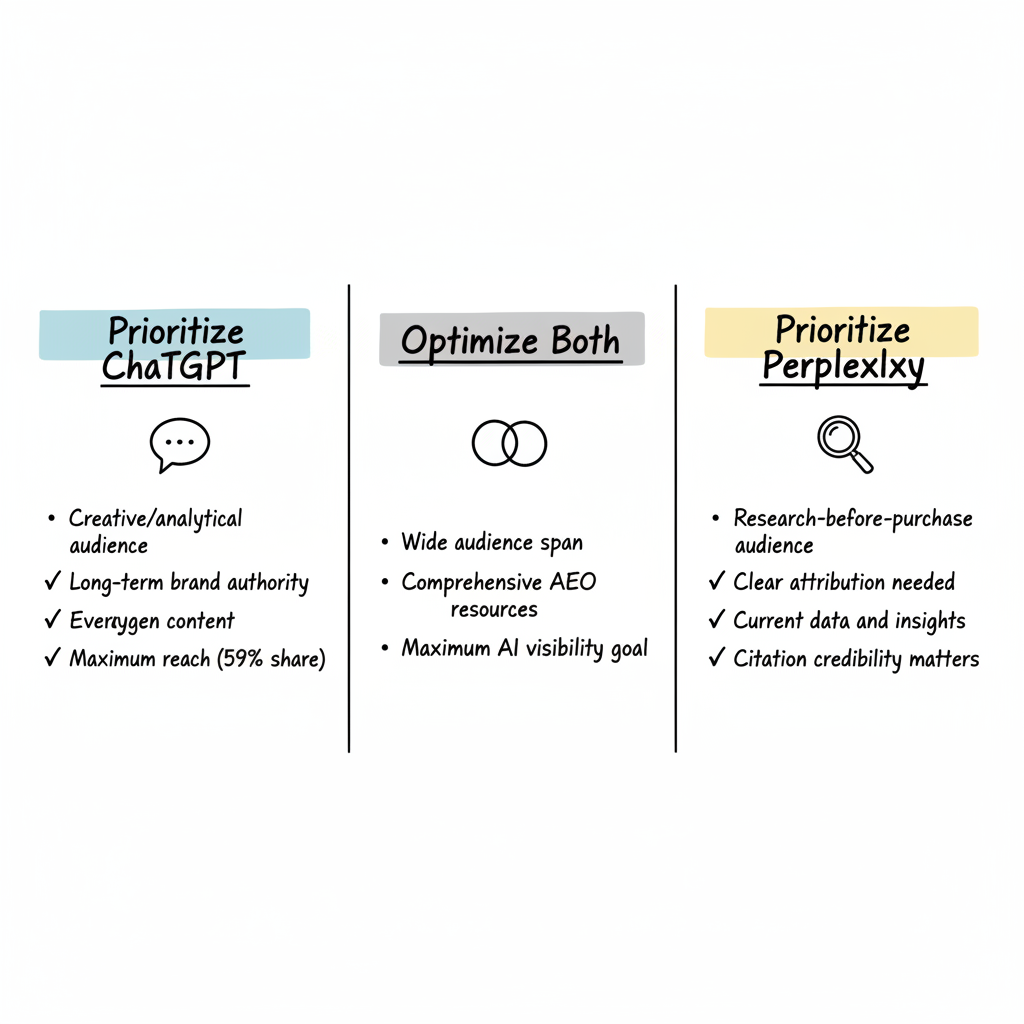
Prioritize ChatGPT if:
- Your audience seeks creative or analytical assistance
- You're building long-term brand authority
- Your content is evergreen rather than time-sensitive
- You want maximum reach (59% market share)
Prioritize Perplexity if:
- Your audience researches before purchasing
- You want clear attribution and citations
- Your content includes current data and insights
- Citation transparency matters for credibility
Optimize for both if:
- You have resources for comprehensive AEO
- Your audience spans research and creative use cases
- Maximum AI visibility is a strategic priority
Organizations often benefit from developing a comprehensive AI search optimization case study template to track performance across multiple platforms and identify which strategies deliver the strongest results for their specific goals.
How to Prioritize Between the Two
Let your buyer decide. If they research with conversational, open-ended questions, ChatGPT's breadth matters; if they ask specific, sourced product questions, Perplexity's citation model matters more. Weight the optimization to the surface your segment actually uses, because the platform that fits the query is the one to win first.
Run a small test on each before committing. Check whether your pages are cited on both for your core queries, because the gap reveals where the easier win is, and the test beats a guess. The evidence from the check is what should set the priority, not the market hype around either name.
Content That Performs on Each Platform
ChatGPT rewards clear, complete prose with evidence a model can trust, so answer-first pages with real examples do well. Perplexity rewards structure and sources it can point to, so pages with labeled sections and credible references earn the citation. The overlap is large, but the emphasis differs by surface.
Avoid over-fitting to one. Tricks aimed at a single parser break when it updates, while accurate, extractable content travels. The stable advantage comes from markup and writing that honestly describe the page, not from gaming a current quirk that will not last, so build once for both.
Measuring Visibility on Each Platform
Use a fixed query list per platform and record whether you appear and what the snippet says, because the two surfaces cite differently and a blended yes-or-no hides the difference. The separate reads show where the representation is strong and where it is missing, and that is the actionable split.
Join the checks to outcomes. A citation on either platform that never moves a metric is vanity, so pair visibility with assisted conversion and branded search lift. The combined view tells you which platform's mention actually drives your business, and that is the number worth reporting.
FAQs
Can I Optimize for Both ChatGPT and Perplexity Simultaneously?
Yes. Foundation practices - strong SEO, comprehensive content, clear structure - benefit both platforms. Add platform-specific tactics on top: brand building for ChatGPT, citation-worthy formatting for Perplexity. Many companies find success by implementing a generative engine content strategy that addresses both platforms with unified frameworks.
Which Platform Provides Better Brand Attribution?
Perplexity provides clearer attribution through persistent numbered citations. ChatGPT's attribution is more variable and less consistent, making it harder to track and verify visibility.
Is ChatGPT or Perplexity More Important for B2B Marketing?
Both matter, but Perplexity's research-focused users often align with B2B buying behavior. Decision-makers researching solutions frequently use Perplexity for its source transparency. However, ChatGPT's larger audience means broader reach. Before allocating resources, consider conducting an AI overview impact analysis to understand which platform drives more qualified traffic for your specific industry.