
Claude AI Optimization: How to Get Cited in Claude Search
Claude, developed by Anthropic, has emerged as a major AI assistant with distinct behaviors that differentiate it from ChatGPT and other competitors.
With web search capabilities now integrated into Claude's functionality, optimizing content for Claude citations has become a meaningful visibility opportunity. As AI-referred traffic has grown 527% year-over-year and early adopters capture 60% more citations, the window to establish Claude visibility is now. Meanwhile, roughly 60% of Google searches already end without a click, and search volume is predicted to decline 25% by 2026—making AI citation optimization increasingly critical.
As an introduction to claude ai optimization, this guide covers how Claude selects information sources and the specific strategies that earn citations from Anthropic's AI assistant.
Check how well your content is optimized for Claude and other AI engines with our free AEO grader tool.
How Claude Differs from Other AI Systems
Claude operates with architectural and philosophical differences that affect content optimization strategies.
Training and Knowledge Sources
Claude's language models are trained on:
- Publicly available text and code from the internet
- Licensed content from data partnerships
- Books, academic papers, and research publications
- User interactions (with privacy protections)
Claude maintains knowledge cutoffs that vary by model version. The addition of web search capabilities in 2025 allows Claude to access current information beyond its training data—making real-time content optimization relevant.
Claude'S Source Preferences
Research and user testing reveal Claude exhibits distinct preferences when selecting and citing information:
Authority signals matter significantly. Claude weights content from sources demonstrating clear expertise and authoritativeness. Academic-style citations, peer-reviewed references, and formal language patterns align with Claude's training emphasis on reliable information.
Balanced perspectives are valued. Unlike systems that may prefer definitive statements, Claude responds well to content acknowledging limitations, presenting multiple viewpoints, and avoiding overconfident claims.
Author credentials influence selection. Content with detailed author bios, professional credentials, and demonstrated expertise earns higher trust signals from Claude.
Constitutional AI and Content Selection
Claude's content selection is deeply shaped by Anthropic's Constitutional AI (CAI) framework. Unlike standard RLHF (Reinforcement Learning from Human Feedback), CAI adds an additional layer: the model evaluates its own outputs against a set of constitutional principles emphasizing helpfulness, harmlessness, and honesty.
For content creators, this has direct implications. Claude's training pipeline filters source material through these principles, meaning content that aligns with CAI values receives preferential treatment during citation selection:
- Helpfulness: Content that directly answers questions with actionable, specific information rather than vague generalizations
- Harmlessness: Content that avoids misinformation, exaggerated claims, or potentially misleading statistics without proper context
- Honesty: Content that acknowledges uncertainty, presents limitations, and distinguishes between established facts and emerging theories
Content that aligns with Claude’s Constitutional AI values—helpful, harmless, and honest—receives preferential treatment during citation selection, even over technically accurate content that violates these principles.
Content that violates these principles—even if factually accurate—may be deprioritized. For example, a technically correct comparison article that uses manipulative framing or cherry-picked data points could trigger Claude's harmlessness filters, reducing citation likelihood.
Optimizing for Claude Model Variants
Claude is available in multiple model tiers, each with different optimization considerations:
- Claude Opus: The most capable model, used for complex reasoning and in-depth analysis. Opus processes longer documents thoroughly and favors academic depth, comprehensive citations, and nuanced argumentation. Content targeting Opus queries should prioritize exhaustive coverage and methodological rigor.
- Claude Sonnet: The balanced mid-tier model handling most general queries. Sonnet responds well to clearly structured content with strong E-E-A-T signals. This is where most web search citations originate, making it the primary optimization target for visibility.
- Claude Haiku: The fastest, most concise model optimized for quick answers. Haiku favors content with clear, direct answers near the top of sections—bullet points, definition-style openings, and concise summaries. Front-load key information for Haiku citation potential.
When optimizing, consider that users querying through different Claude models may trigger different citation patterns. Creating content with both depth (for Opus) and clear summary elements (for Haiku) maximizes coverage across the model lineup.
Optimization Strategies for Claude
Apply these claude ai optimization strategies to improve Claude citation likelihood and implement an effective aeo-implementation-roadmap for AI search visibility.
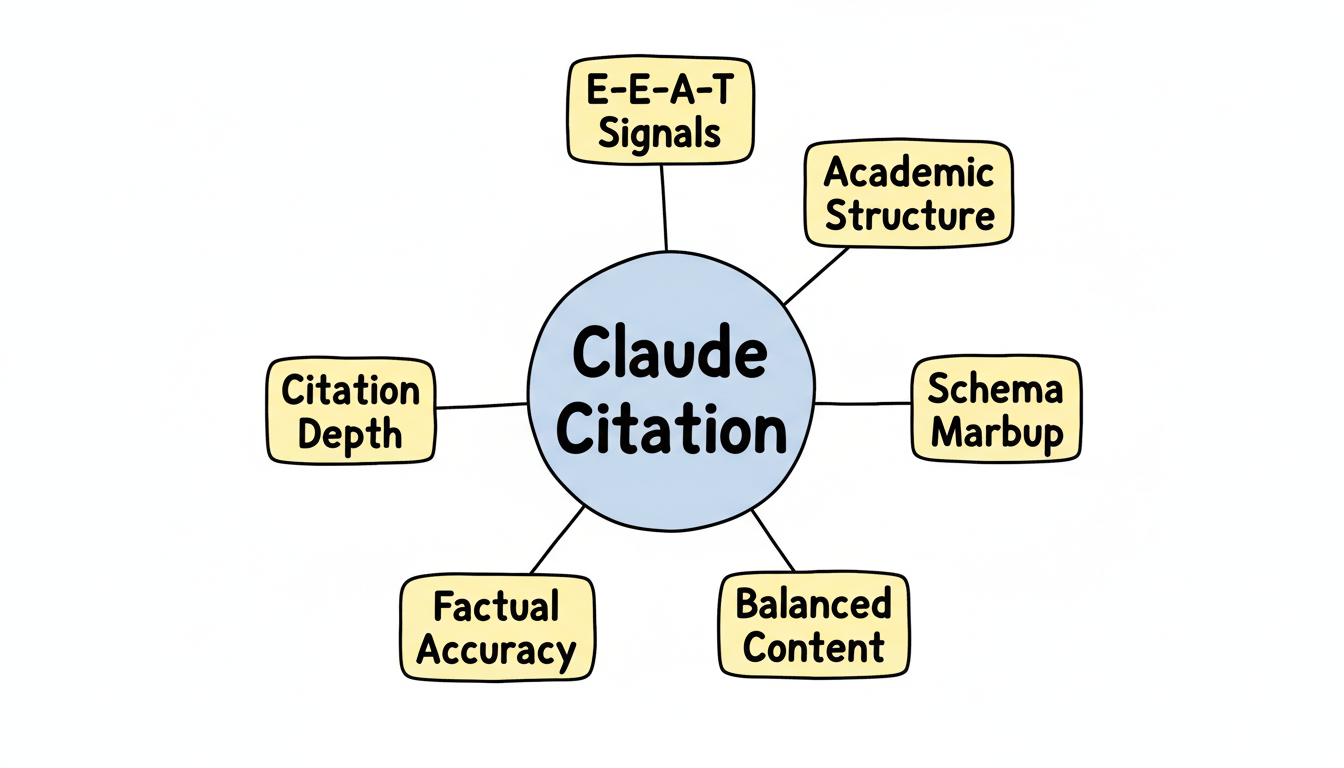
1. Emphasize E-E-A-T Signals
Claude's training emphasizes trustworthy sources. Strengthen Experience, Expertise, Authoritativeness, and Trustworthiness signals throughout your content.
Implementation:
- Add comprehensive author bylines with credentials
- Include first-person experience and case studies
- Reference primary sources and peer-reviewed research
- Display organizational credentials and industry recognition
Content demonstrating genuine expertise performs better than generic informational pages when Claude evaluates sources.
2. Use Academic-Style Structure
Claude's training data includes substantial academic and research content. Adopting academic formatting patterns improves source recognition.
Implementation:
- Include proper citations with publication details
- Use formal language and precise terminology
- Structure content with clear methodology sections
- Present evidence before conclusions
- Acknowledge limitations and alternative viewpoints
This doesn't mean writing inaccessibly—maintain readability while incorporating academic credibility signals.
3. Implement Comprehensive Schema Markup
Structured data helps Claude understand content context and authority. Implement schema-markup-alignment-aeo that establishes entity identity and relationships.
Essential schema types:
- Organization schema with complete business information
- Person schema for content authors with credentials
- Article schema with publication metadata
- sameAs links connecting to authoritative profiles (Wikipedia, LinkedIn, industry directories)
Schema markup makes content more "digestible" for AI algorithms evaluating source quality.
4. Present Balanced, Nuanced Content
Claude is trained to avoid overconfident responses and appreciate nuanced analysis. Content that mirrors this approach earns more citations.
Implementation:
- Acknowledge when topics have multiple valid perspectives
- Include "however" and "on the other hand" analysis
- Avoid absolutist language ("always," "never," "best")
- Present limitations alongside strengths
- Cite opposing viewpoints respectfully
Claude's Constitutional AI training emphasizes helpful, harmless, and honest responses—content reflecting these values aligns with its selection criteria.
5. Maintain Factual Accuracy
Claude prioritizes factual accuracy and will avoid citing sources containing errors or misleading information.
Implementation:
- Fact-check all statistics and claims before publishing
- Update content when information becomes outdated
- Remove or correct any inaccuracies promptly
- Use precise language rather than vague generalizations
- Cite original sources rather than secondary references
Inaccurate content may be actively avoided by Claude, even if it ranks well in traditional search.
6. Create Citation-Worthy Depth
Claude synthesizes information from multiple sources. Provide comprehensive coverage that gives Claude substantive material to reference.
Implementation:
- Cover topics thoroughly rather than superficially
- Include specific data points, statistics, and examples
- Provide actionable detail beyond surface-level overview
- Address related questions and edge cases
- Offer unique insights or original analysis
Shallow content gets passed over for sources providing genuine informational value.
7. Adopt a Neutral, Analyst Tone
Claude's Constitutional AI training creates a strong bias against promotional content. Content written in a "salesy" or brand-forward voice is less likely to be cited, even when factually accurate.
To align with Claude's preferences:
- Write in a third-person analyst voice rather than first-person promotional
- Replace superlatives ("the best," "industry-leading," "unmatched") with specific, verifiable claims
- Support assertions with data points, case studies, or cited research rather than opinion
- Avoid embedded calls-to-action within informational body content—keep CTAs in dedicated sections
- Present your brand's solution as one option among several, acknowledging alternatives
Content that reads like a research report or industry analysis earns significantly more Claude citations than content that reads like a landing page or sales brochure.
8. Optimize for Conversational Queries
Users interact with Claude using natural language rather than keyword strings. Where a Google searcher might type "claude AI optimization tips," a Claude user is more likely to ask: "How do I get my content cited by Claude?"
Optimization strategies for conversational patterns:
- Include full-sentence questions as H3 headings or within content body
- Structure answer sections with the direct answer in the first sentence, followed by supporting detail
- Address follow-up questions that naturally arise from your primary topic
- Use question-answer formatting in sections where users are likely seeking specific information
- Mirror natural speech patterns rather than keyword-stuffed constructions
Content optimized for conversational queries also performs well in Google's AI Overviews and featured snippets, creating compounding visibility benefits across platforms.
9. Leverage Claude'S Extended Context Window
Claude's 200K+ token context window—approximately 3x larger than most competing models—means it can process and cite from comprehensive long-form content that other AI systems might truncate or skip.
This creates a strategic advantage for pillar content:
- Create thorough, exhaustive guides that cover a topic from multiple angles rather than splitting into thin separate posts
- Use clear hierarchical structure (H2/H3/H4) so Claude can navigate long documents efficiently
- Include tables of contents, section summaries, and cross-references within long-form pieces
- Front-load each section with key takeaways before expanding into detail
While shorter content can still earn citations, comprehensive resources that demonstrate complete topic mastery are more likely to be selected when Claude processes a large batch of search results and must choose which sources to cite.
Technical Requirements for Claude Visibility
Ensure Claude can access and understand your content.
Crawler Access
Claude's web search uses crawlers to access content. Configure your robots.txt appropriately:
- Allow anthropic-ai crawler access
- Don't block JavaScript-rendered content
- Ensure critical information loads without authentication
The Llms.Txt File Standard
The llms.txt file is an emerging standard that provides AI-specific guidance for large language models, functioning similarly to how robots.txt guides traditional search crawlers. Placing an llms.txt file at your domain root (e.g., yoursite.com/llms.txt) gives AI systems structured context about your site.
A well-configured llms.txt file should include:
- Site description: A concise summary of your organization and its areas of expertise
- Key content pages: URLs to your most authoritative and frequently updated content
- Content descriptions: Brief summaries of what each key page covers, helping AI systems understand relevance without fully crawling
- Update frequency: How often your content is refreshed, signaling freshness reliability
While there is no public confirmation that Claude specifically reads llms.txt files today, implementing the standard aligns with the broader trajectory of AI-specific site guidance. Early adoption establishes your site's readiness as AI crawlers evolve, and the exercise of creating an llms.txt file forces useful thinking about which pages represent your highest-authority content.
Indexnow Protocol for AI Platforms
IndexNow is a protocol that allows website owners to notify search engines and AI platforms instantly when content is created, updated, or deleted. Rather than waiting for crawlers to discover changes, IndexNow pushes update notifications directly.
Implementation steps:
- Generate an IndexNow API key and host the key file at your domain root
- Submit URLs via the IndexNow API endpoint whenever you publish or significantly update content
- Integrate IndexNow into your CMS workflow so notifications fire automatically on publish
- Monitor submission responses to confirm platforms are receiving your notifications
IndexNow is supported by Bing, Yandex, and an expanding list of platforms. For Claude optimization, faster indexing means your updated content—with fresh statistics, corrected information, or new sections—enters Claude's web search index sooner, improving the timeliness of potential citations.
Multimodal Content Optimization
Claude's capabilities extend beyond text to include vision (image analysis and document reading), with audio and video processing on the horizon. Preparing content for multimodal consumption broadens citation potential.
Key multimodal optimization practices:
- Image alt text: Write descriptive, contextual alt text that explains what the image shows and why it matters—not just "chart" but "bar chart comparing Claude, ChatGPT, and Perplexity citation rates by content type"
- Structured image data: Use ImageObject schema markup with descriptive captions and content URLs
- Infographic accessibility: When using infographics, include the full data in text or table format nearby so Claude can access the information regardless of visual processing
- Document formatting: PDFs and downloadable resources should use proper heading structure and text layers (not image-only scans) for AI readability
As Claude's multimodal capabilities expand, content that is accessible across formats will have a citation advantage over text-only or poorly structured visual content.
Content Accessibility
Ensure Claude can access your content by following semantic HTML standards and removing unnecessary JavaScript barriers.
- Use semantic HTML structure with proper heading hierarchy
- Ensure content loads without heavy JavaScript dependency
- Provide alt text for images and charts
- Make data tables accessible and properly formatted
Freshness Signals
Claude's web search capability means fresh content can appear in responses:
- Update publication dates when making meaningful revisions
- Add recent statistics and examples
- Remove outdated references
- Maintain regular content refresh schedules
When planning content updates, consider Claude's training data knowledge cutoff dates. Content published well before a training cutoff has a chance of being absorbed into Claude's base knowledge (not just web search results), creating a more durable citation pathway. Maintain a dual strategy: publish evergreen content ahead of anticipated training refreshes for long-term knowledge integration, and keep time-sensitive content updated for web search citation relevance. Monitor Anthropic's model release announcements for signals about upcoming training data cutoffs.
Measuring Claude Performance
Track your claude ai optimization success through available methods, including using an ai-search-analytics-dashboard to monitor performance across multiple AI platforms.
Manual Testing
Regularly query Claude with prompts relevant to your content:
- Test industry questions where you have expertise
- Note when and how Claude cites your content
- Compare citation patterns against competitors
- Document response variations over time
Analytics Attribution
Monitor for Claude-related traffic patterns:
- Track anthropic.com referral traffic in analytics
- Monitor branded search increases correlated with Claude visibility
- Compare engagement metrics for AI-referred visitors
- Configure analytics cookie settings to capture AI referral traffic and attribution data accurately
Brand Mention Monitoring
Use AI visibility tools that track Claude mentions:
- Otterly AI: Automates AI search monitoring across Claude, ChatGPT, and Perplexity with scheduled tracking of brand mentions and citation frequency
- Sight AI: Provides multi-platform AI visibility tracking with competitive benchmarking and historical trend analysis
- Hall: Specializes in real-time brand mention alerts across AI assistants, with notification workflows for when competitors gain or lose citations
- Set up weekly or bi-weekly automated monitoring reports to track citation share of voice against competitors over time
Claude Visibility Audit Process
Conduct a structured audit to baseline and improve your brand's visibility in Claude responses:
- Define audit queries: Create 10–15 prompts spanning your core topics, including both branded queries ("What does [brand] do?") and unbranded queries ("What are the best tools for [your category]?")
- Test across models: Run each query through Claude Opus, Sonnet, and Haiku—citation behavior varies by model tier
- Document results: For each query, record whether Claude mentions your brand, cites your content URL, references competitors, or provides a generic answer
- Score your presence: Calculate a visibility score: (queries where you are cited / total queries) as a percentage baseline
- Identify gaps: For queries where competitors are cited but you are not, analyze what their content offers that yours does not
- Implement and re-test: After making content changes, wait 2–4 weeks for Claude's web search index to refresh, then re-run the same queries to measure improvement
Repeat audits monthly to track trends and catch regressions early. Over time, this creates a longitudinal dataset showing which content changes drive the most citation improvement.
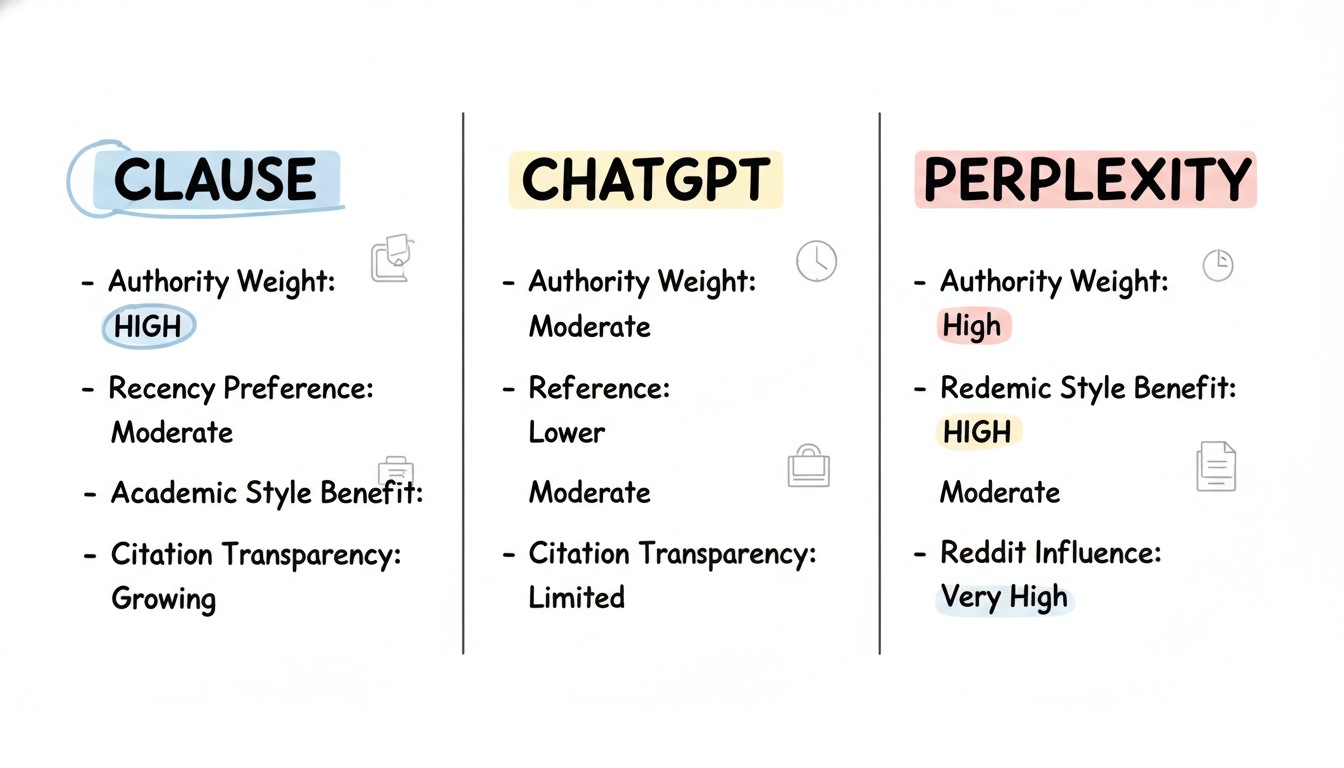
Claude vs Other AI Platforms
Optimization approaches vary by platform. Here's how Claude differs:
Factor | Claude | ChatGPT | Perplexity |
Authority weight | High | Moderate | High |
Recency preference | Moderate | Lower | High |
Citation transparency | Growing | Limited | High |
Academic style benefit | High | Moderate | Moderate |
Reddit influence | Lower | Lower | Very High |
Claude's emphasis on authoritative, balanced content creates opportunities for businesses with genuine expertise—even if they lack the brand recognition that benefits ChatGPT visibility. Understanding geo-vs-aeo-vs-seo differences helps prioritize optimization efforts across search paradigms.
Building Long-Term Claude Authority
Long-term claude ai optimization success builds over time through consistent quality signals.
Authority Development
Practitioner analyses, including research written by Oliver Foster and other Claude power-users, consistently highlight entity consistency and E-E-A-T depth as the two strongest long-term authority signals for Claude citation.
- Publish consistently in your expertise areas
- Earn mentions from recognized industry sources
- Build cross-platform presence with consistent information
- Develop original research and proprietary data
Entity Authority and Knowledge Graph Signals
Claude's ability to recognize and trust your brand depends partly on consistent entity identity across the web. AI systems build internal knowledge graph representations from structured and unstructured data—the more consistently your entity information appears across authoritative platforms, the stronger your recognition signal.
Build entity authority through:
- Structured data sameAs links: Connect your Organization and Person schema to Wikipedia, Wikidata, Crunchbase, LinkedIn, and industry-specific directories
- Cross-platform consistency: Ensure your brand name, description, founding date, key personnel, and contact information are identical across all platforms
- Wikipedia and Wikidata presence: If your organization meets notability criteria, a Wikipedia article with proper Wikidata entries provides strong entity grounding for AI systems
- Industry directory listings: Maintain profiles on relevant industry directories (G2, Capterra, Clutch for SaaS; industry-specific directories for other verticals)
When Claude encounters your brand across multiple trusted platforms with consistent information, it builds higher confidence in your entity identity—increasing the likelihood of citation in relevant contexts.
Content Quality Maintenance
Regular content audits maintain the factual accuracy and authority signals that Claude rewards with sustained citation preference.
- Audit existing content for accuracy regularly
- Update older content with current information
- Remove or improve underperforming pages
- Maintain editorial standards across all publications
Claude's emphasis on trustworthiness means authority compounds—sources that demonstrate reliability over time earn increasing citation preference.
Key Takeaways: Claude AI Optimization Checklist
Apply this claude ai optimization checklist before publishing to maximize Claude citation eligibility. The goal of every claude ai optimization effort is Constitutional AI alignment—content that is helpful, harmless, and honest.
- Technical access: robots.txt allows the anthropic-ai crawler; llms.txt file is configured at your domain root
- E-E-A-T signals: Author byline with verifiable credentials and first-person experience included
- Schema markup: BlogPosting, FAQPage, and Organization sameAs links implemented
- Balanced tone: Content acknowledges limitations, avoids absolutist claims, and cites opposing viewpoints
- Direct answers: Each H2 and H3 opens with a concise response under 50 words
- Entity authority: Brand information is consistent across Wikipedia, Wikidata, and industry directories
- IndexNow integration: Content update notifications fire automatically on each publish
- Freshness: Statistics, dates, and model version references are current
Each claude ai optimization cycle should test one change at a time—run monthly query audits to measure citation share against competitors. For a complete claude ai optimization assessment, test prompts across Claude Opus, Sonnet, and Haiku models to identify model-specific visibility gaps. Revisit this claude ai optimization checklist quarterly to catch regressions before they affect citation share of voice.
FAQs
Common questions about Claude AI optimization, citation behavior, and how Claude differs from ChatGPT and Perplexity.
Does Claude Cite Sources Like Perplexity Does?
Claude's citation behavior varies by context and query type. When using web search, Claude can reference sources, though citation patterns differ from Perplexity's inline linking approach. Optimization still matters for inclusion in Claude's synthesized responses.
How Quickly Do Claude Optimizations Show Results?
Changes may appear within weeks for content Claude's web search indexes. However, deeper authority signals that influence Claude's training-based knowledge take longer to develop. Focus on sustainable quality improvements rather than quick fixes.
What Is Llms.Txt and Does Claude Use It?
The llms.txt file provides AI-specific site guidance, functioning like robots.txt for large language models. It contains your site summary, key content URLs, and descriptions. While Claude's specific use is not confirmed, implementing the standard positions your site for AI discoverability as crawlers evolve.
How Does Claude Choose Which Sources to Cite?
Claude evaluates sources based on authority signals, factual accuracy, and content depth. Its Constitutional AI training prioritizes helpful, harmless, and honest content. Content with strong E-E-A-T signals and verifiable data consistently earns more citations than generic or promotional content.
Does Claude Optimization Differ from ChatGPT Optimization?
Yes. Claude places higher weight on academic-style formatting, neutral tone, and factual precision. ChatGPT responds more to brand recognition and conversational authority. Both benefit from E-E-A-T signals, but Claude penalizes promotional language more aggressively due to its Constitutional AI training.
How Do I Audit My Brand'S Visibility in Claude?
Define 10–15 queries spanning your core topics and run each through Claude Opus, Sonnet, and Haiku, documenting citation presence. Calculate a baseline visibility score (citations / total queries), identify gaps where competitors are cited, then re-test monthly after implementing improvements.