
Content decay happens far faster in AI search than traditional SEO. Research shows that Perplexity visibility begins dropping just 2-3 days after publication without strategic refreshes. Over 70% of pages cited by ChatGPT were updated within 12 months, but content updated in the last 3 months performs best across all intents.
Freshness isn't optional for AI visibility - it's a core ranking signal that determines whether your content gets cited or ignored.
Why AI Systems Prioritize Fresh Content
AI search engines show a strong preference for recent content because users expect current information. When someone asks an AI assistant about pricing, trends, or best practices, outdated answers destroy trust in the platform.
The freshness imperative:
- AI systems discover and begin citing new content in days, not the weeks or months typical of traditional SEO
- Perplexity explicitly favors recency as a primary ranking factor
- Google AI Overviews parse "last updated" timestamps when evaluating sources
- ChatGPT with browsing actively seeks current information for time-sensitive queries
This creates both challenge and opportunity. The challenge: content requires constant maintenance. The opportunity: consistent updates become a competitive advantage that compounds over time.
Platform-Specific Freshness Requirements
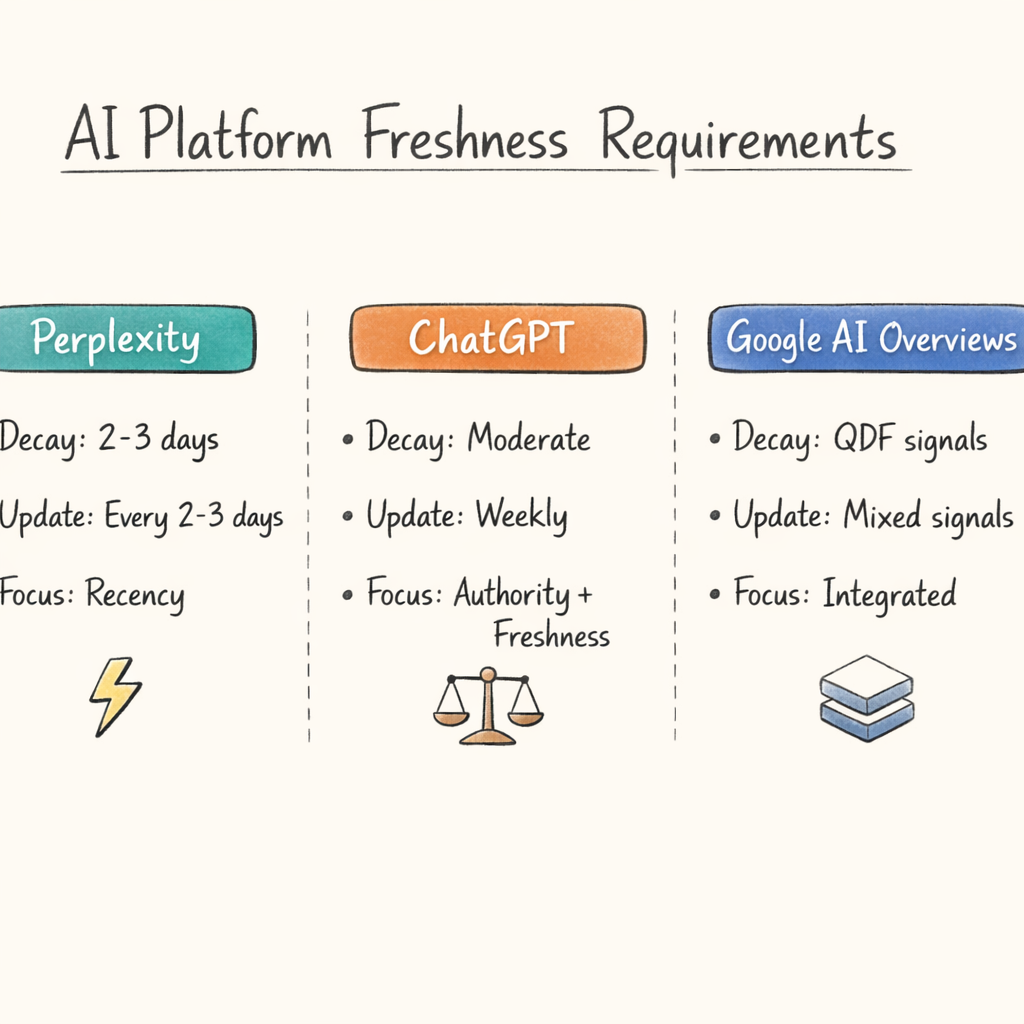
Different AI platforms weight freshness differently:
Perplexity: Extreme Recency Focus
Perplexity operates as a real-time retrieval system with the most aggressive freshness requirements:
- Content decay window: 2-3 days without updates
- Update frequency for top visibility: Every 2-3 days for priority content
- Quality score threshold: 0.75 minimum to rank in top placements
- Citation diversity: Often pulls from 10+ sources per query
Perplexity serves researchers and early adopters who value source transparency and current information. Stale content quickly loses citation eligibility. For more on this platform's approach, see our Perplexity AI powered search engine analysis.
ChatGPT: Moderate Freshness Preference
ChatGPT balances parametric memory (training data) with real-time browsing:
- Content decay: Less aggressive than Perplexity
- Update frequency: Weekly updates maintain strong visibility
- Authority weight: Domain authority matters alongside freshness
- Browsing triggers: Time-sensitive queries activate real-time retrieval
ChatGPT's 200+ million daily users expect current information for certain query types while accepting historical knowledge for others.
Google AI Overviews: Integrated Signals
Google AI Overviews leverage existing search infrastructure:
- Freshness signals: Publication dates, crawl timestamps, content changes
- Query deserves freshness (QDF): Same logic as traditional search
- Authority balance: Freshness weighted against domain authority
- Update visibility: Favors recently updated content over outdated alternatives
Google's scale means your freshness signals compete against the entire indexed web. Understanding the differences between Google AI Overviews vs featured snippets helps clarify how freshness signals apply in each context.
Key Freshness Signals AI Systems Parse
AI platforms look for specific indicators of content currency:
Explicit Date Signals
Include clear temporal markers that AI systems can parse:
- "Last updated: [month, year]" near the top of pages
- Publication dates in schema markup and visible content
- "As of [date]" qualifiers near time-sensitive facts
- Validity windows for information with expiration dates
Example: "As of Q1 2026, enterprise AEO programs typically cost $50,000-500,000 annually."
Metadata Freshness
Technical signals that indicate content currency:
- DateModified schema: Machine-readable update timestamps
- lastReviewed markup: Signals content has been recently validated
- Sitemap timestamps: Accurate last-modified dates in XML sitemaps
- IndexNow notifications: Push instant update alerts to search engines
IndexNow has become critical - it pushes notifications directly to search engines the moment content is published or updated, making content available for AI citation faster.
Content-Level Indicators
Within the content itself, freshness signals include:
- Current year references: Statistics and examples from 2026
- Recent case studies: Examples dated within past 6-12 months
- Updated statistics: Fresh data replacing outdated numbers
- Changelog documentation: Visible record of content updates
AI systems recognize when content cites 2023 statistics while claiming to be a 2026 guide. That inconsistency hurts citation probability.
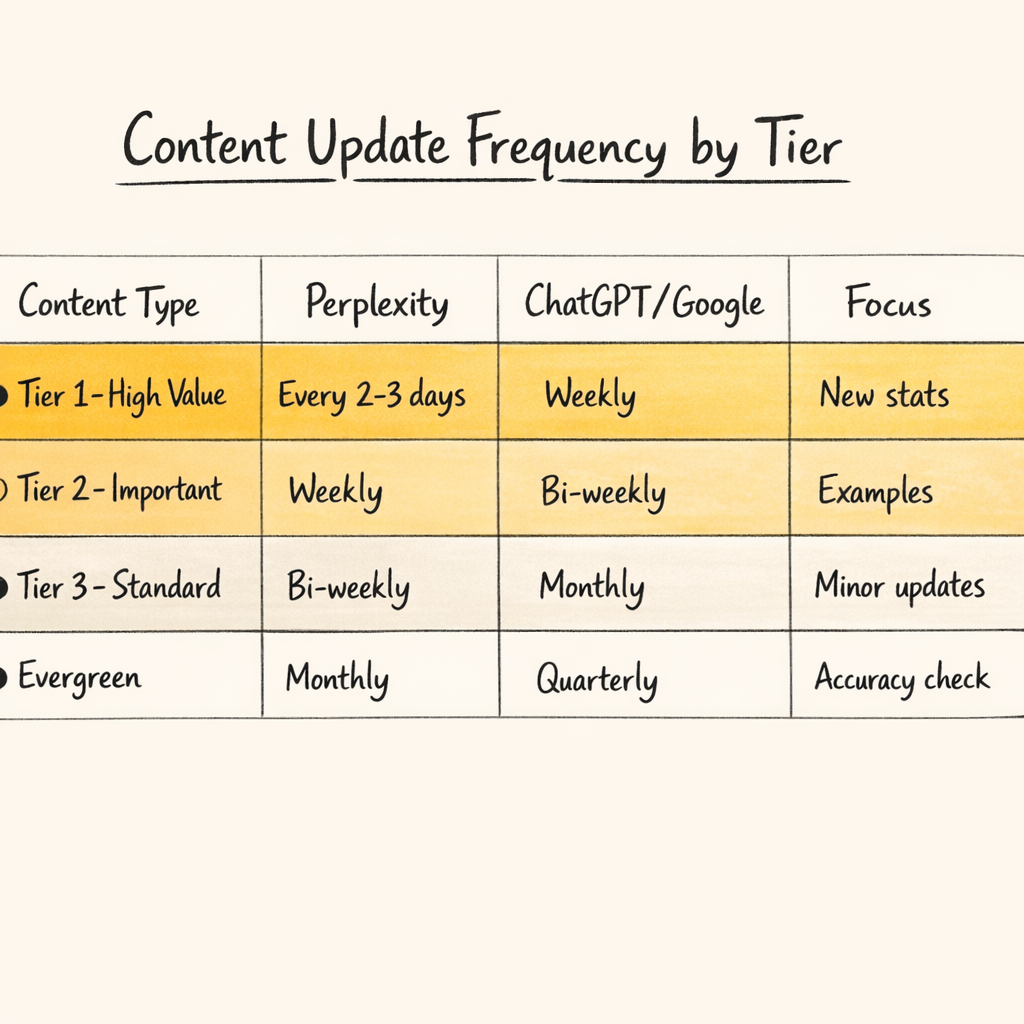
Update Frequency by Content Type
Not all content needs the same refresh schedule:
Content Type | Perplexity | ChatGPT/Google | Update Focus |
Tier 1 (highest value) | Every 2-3 days | Weekly | New sections, statistics |
Tier 2 (important) | Weekly | Bi-weekly | Examples, recent developments |
Tier 3 (standard) | Bi-weekly | Monthly | Minor refreshes, date updates |
Evergreen foundational | Monthly | Quarterly | Accuracy validation |
Updates don't require complete rewrites. Adding new sections, refreshing statistics, incorporating recent examples, or expanding based on reader questions all signal freshness while maintaining AI visibility. A well-planned AEO strategy incorporates these update cycles into content workflows.
Implementing a Freshness Strategy
Audit Current Content
Identify content with freshness problems:
- Check last-modified dates across priority pages
- Find pages with outdated statistics or examples
- Review metadata for missing DateModified schema
- Test visibility on AI platforms - are you being cited?
Establish Update Schedules
Create systematic refresh workflows:
- Priority queue: Rank pages by business value and update urgency
- Calendar integration: Schedule regular review cycles
- Trigger-based updates: Update when industry changes occur
- Competitive monitoring: Refresh when competitors publish better content
Track Freshness Impact
Measure how updates affect AI visibility:
- Monitor citation frequency before and after updates
- Track referral traffic from perplexity.ai, bing.com/chat
- Test AI platforms with relevant prompts to check citation status
- Compare visibility decay rates across content types
Setting appropriate metrics is critical - see our guide on AI search KPI goal setting for tracking frameworks.
Common Freshness Mistakes
Over-Updating Without Substance
Changing dates without adding value doesn't fool AI systems. They can detect superficial updates versus meaningful content changes.
Ignoring Metadata
Visible date updates without corresponding schema changes create inconsistency. AI systems parse both - mismatches hurt credibility.
Uniform Update Schedules
Not all content needs the same frequency. Technical documentation needs less updating than pricing guides. Match schedules to content volatility.
Neglecting Evergreen Foundations
Base content still needs periodic validation. Even "timeless" topics evolve - ensure foundational content remains accurate.
How to Build a Freshness Strategy
Set the cadence to the topic, not the calendar. A fast-moving category needs monthly reviews; a stable one can be quarterly, so match the frequency to how often the facts change. The right rhythm keeps the page current without busywork, and the discipline is what signals freshness honestly.
Show the date and the change. A visible "updated" line and a short note on what shifted tells both readers and systems the page was recently validated, so the freshness is demonstrable, not claimed. The visible signal is part of the value in trust-sensitive categories especially.
Common Freshness Mistakes
The first mistake is dating content and forgetting it. A 2024 stamp on a 2026 query reads as stale and costs trust, so the date must move when the page does. The published date is a promise; breaking it is worse than not stating one, so keep the stamp honest by updating it.
The second is churning for its own sake. Editing a page with no real change to fake freshness adds noise and can hurt, because the substance, not the timestamp, is what engines parse. Update when something actually shifted, and let the change be real, because fake freshness is a tell, not a signal.
Measuring Freshness Impact
Measure by citation movement after an update, not by the edit count. A fixed query list checked before and after a refresh shows whether the freshness changed anything, and that is the only honest proof. The observed lift is the metric, and the cadence is what makes the proof repeatable.
Pair freshness with structure and evidence. A dated page that is thin still will not cite, so freshness is one input among several, not a standalone fix. The combined view, reported plainly, is what keeps the strategy credible and stops teams from over-investing in timestamps alone.
FAQs
How Quickly Does Fresh Content Start Getting Cited by AI?
AI systems can discover and begin citing new content within days - far faster than traditional SEO. Well-structured content on authoritative domains may appear in AI responses within 24-48 hours of publication, especially on Perplexity.
Do I Need to Update Every Page Every Few Days?
No. Prioritize updates based on content value and topic volatility. High-priority pages targeting competitive, time-sensitive topics need frequent updates. Evergreen foundational content can follow monthly or quarterly schedules.
What'S the Minimum Update to Signal Freshness?
Small but meaningful updates work: adding new statistics, incorporating recent examples, updating date references with actual content changes, or expanding sections based on emerging questions. Date changes alone without content changes don't provide sustainable freshness signals.