
Microsoft Copilot displays citations differently depending on the query type, response format, and interface context. Understanding these citation patterns helps you recognize when and how your content might appear - and what optimization approaches align with each citation type. Copilot's attribution behavior follows patterns distinct from ChatGPT, Perplexity, and Google AI Overviews.
This guide examines Copilot's specific citation formats and attribution mechanisms.
Copilot'S Citation Display Formats
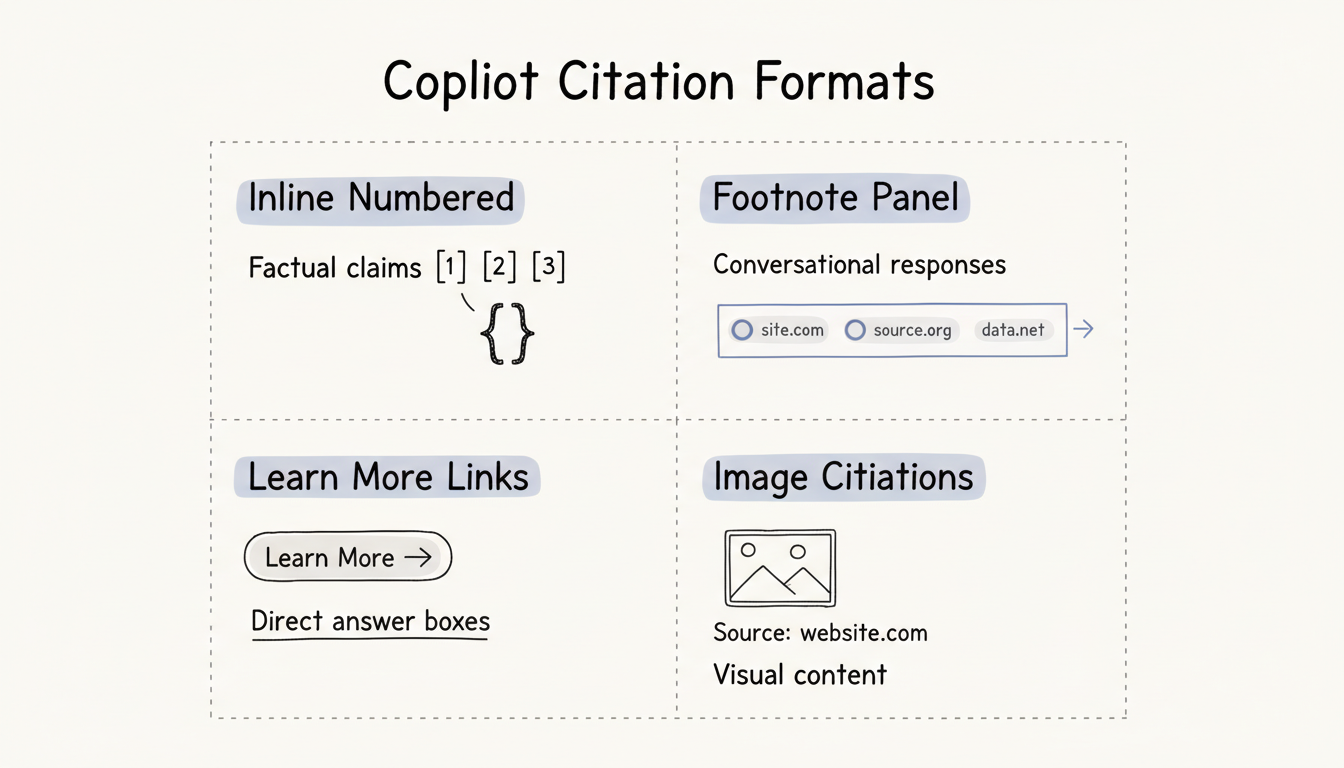
Copilot uses multiple citation formats depending on context and response type.
Primary citation formats:
Format | Appearance | When Used |
Inline numbered | [1], [2], [3] within text | Factual claims needing attribution |
Footnote panel | Expandable source list | Most conversational responses |
Learn more links | "Learn more" with source | Direct answer boxes |
Image citations | Source beneath images | Visual content responses |
Citation panel structure:
Copilot Response with Citations:
 Response text with [1] [2] markers
 Horizontal citation bar
    Source 1: [favicon] Title - domain.com
    Source 2: [favicon] Title - domain.com
    Source 3: [favicon] Title - domain.com
 "See more" expansion (additional sources)
The citation bar appears below the response text, showing favicons, page titles, and domains for quick source identification.
Query Types and Citation Behavior
Different query patterns trigger different citation approaches.
Factual Queries
Queries seeking specific facts produce inline citations.
Example behavior:
Query Type | Citation Pattern |
"What is [term]" | Definition with [1] attribution |
"[Event] date" | Specific answer with source |
"[Company] headquarters" | Direct fact with citation |
"How many [statistic]" | Number plus source |
Copilot attributes factual claims more consistently than opinion or analysis content, similar to how Google AI Overview settings determine which sources appear in generative search results.
Comparison Queries
Product and service comparisons trigger multi-source citations.
Comparison citation pattern:
Query: "Slack vs Teams comparison"

Copilot Response:
"According to [source], Slack offers... [1]
Teams provides... [2]
For pricing, [source] notes... [3]"

Citations typically include:
- Review sites (G2, Capterra)
- Vendor comparison pages
- Tech publication reviews
Comparison queries often cite three to five sources, weighting review platforms heavily.
How-To Queries
Process-oriented queries may cite single authoritative sources or aggregate multiple.
Query Complexity | Citation Behavior |
Simple how-to | Often single source |
Multi-step process | Multiple sources for different steps |
Technical procedure | Documentation sites weighted |
Attribution Triggers
Certain content characteristics increase attribution likelihood.
Factors that trigger citation:
Factor | Impact on Attribution |
Specific data/statistics | High - numbers need sources |
Named entities | Medium-high - brand mentions cited |
Controversial claims | High - balance requires sources |
Process steps | Medium - depends on complexity |
General knowledge | Low - common info uncited |
Content less likely to receive attribution:
- Common definitions available everywhere
- Basic explanations without unique data
- Information Copilot can synthesize from training
- Simple lists of well-known items
Copilot vs Other AI Citation Patterns
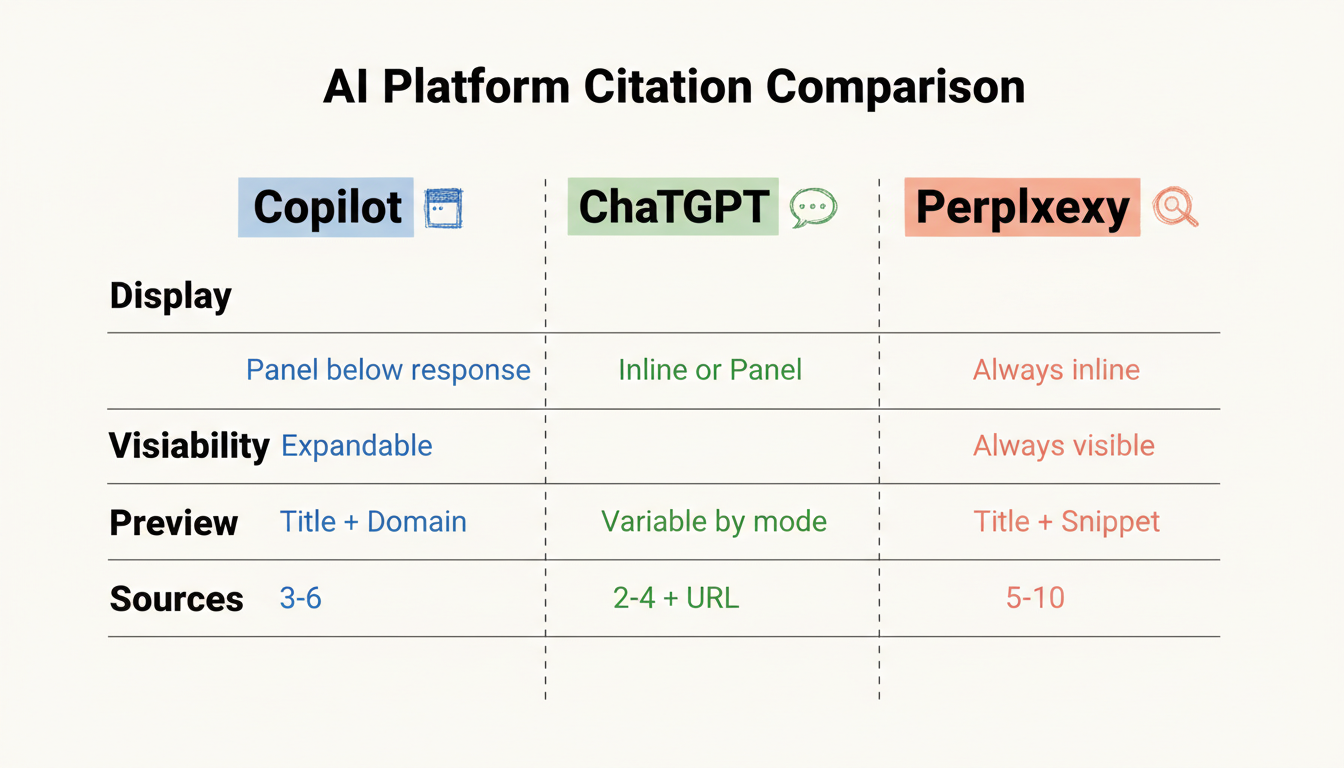
Copilot's citation behavior differs from competing platforms.
Platform citation comparison:
Aspect | Copilot | ChatGPT | Perplexity |
Default citation display | Panel below response | Inline or panel | Always inline |
Citation visibility | Expandable | Variable by mode | Always visible |
Source preview | Title + domain | Title + URL | Title + snippet |
Number of sources | 3-6 typical | 2-4 typical | 5-10 typical |
Understanding these differences is crucial for developing a comprehensive multi-platform AEO strategy that addresses each AI search engine's unique citation mechanics.
Copilot-specific patterns:
- Bing-favored sources - Sites ranking well in Bing appear more frequently
- Microsoft ecosystem preference - Microsoft Learn, GitHub Docs get citation priority
- News recency weighting - Recent news sources cited for current events
- Local source inclusion - Location-relevant sources when applicable
Citation Position and Visibility
Where your citation appears affects visibility value.
Citation position hierarchy:
Citation Value by Position:
 First citation [1] - Highest visibility
    Appears earliest, establishes authority
 Second/Third [2][3] - Strong visibility
    Supporting sources, still prominent
 Panel citations 4-6 - Moderate visibility
    Visible in expanded view
 "See more" citations - Lower visibility
     Require user expansion to view
What influences position:
Factor | Position Impact |
Domain authority in Bing | Higher authority = earlier position |
Content match to query | Better match = higher position |
Recency | Newer content often positioned higher |
Structured data | Schema markup may improve position |
Enterprise Copilot Attribution
Copilot for Microsoft 365 handles citations differently from consumer Copilot. Organizations implementing Copilot Teams optimization need to understand these enterprise-specific attribution patterns.
Enterprise citation differences:
Aspect | Consumer Copilot | Copilot for M365 |
Source pool | Public web (Bing) | Internal org data |
Citation format | Web URLs | Document links |
Attribution detail | Domain + title | File name + location |
Verification | Public source | SharePoint/OneDrive |
Enterprise Copilot citations link to internal documents, emails, and Teams content - not external websites.
Monitoring Your Copilot Citations
Track how Copilot cites your content over time using AEO checker tools designed to monitor citation patterns across multiple AI platforms.
Monitoring approach:
- Create test queries relevant to your content
- Run queries in Copilot (Edge or copilot.microsoft.com)
- Document citation presence, position, and context
- Note how Copilot describes/presents your content
- Track changes over time
What to record:
Data Point | Why It Matters |
Citation presence | Basic visibility confirmation |
Position (1st, 2nd, etc.) | Relative authority indicator |
Title displayed | How Copilot presents your page |
Context of citation | What claim your content supports |
Competitors cited alongside | Competitive positioning |
Optimizing Content for Copilot Citations
Because Copilot draws heavily from the Bing index and the Microsoft ecosystem, the practical optimization path starts with strong Bing SEO: exact-match keywords in titles, a meta description that states the answer, and active social signals, since Bing reads them more directly than Google. Content that already ranks well in Bing is the most likely to be pulled into a Copilot answer.
Layered on top, the same AEO fundamentals apply: answer-first structure, FAQ schema, and specific citable data. Microsoft's own documentation and GitHub repos get citation priority, so earning mentions from authoritative Microsoft-adjacent sources can lift your visibility in enterprise Copilot contexts. The goal is to be both Bing-findable and extractable.
Common Misconceptions About Copilot Citations
A frequent myth is that Copilot cites the same sources as ChatGPT. In practice Copilot favors Bing-ranked pages and Microsoft ecosystem content, so a page invisible on Bing is rarely cited by Copilot even if it performs elsewhere. Another myth is that more links guarantee citation; Copilot weights relevance, recency, and structured clarity as much as raw authority.
The third misconception is that enterprise Copilot cites public websites. Inside Microsoft 365, Copilot cites internal documents, emails, and Teams content, not the open web. Teams optimizing for enterprise visibility should focus on structuring their internal knowledge - SharePoint, OneDrive, and clear document metadata - rather than public SEO alone.
Copilot Citation Patterns and Your Measurement Plan
To know whether Copilot cites you, run a weekly set of representative queries in Edge or copilot.microsoft.com and record presence, position, and the title shown. Pair that with Bing Webmaster Tools data and any third-party AEO tracking that covers Copilot, so you see both the public and the Bing-sourced view.
What to record over time is the trend, not a single snapshot: are you moving from uncited to first-position citations on your priority queries? Because Copilot's source pool leans on Bing, improvements in Bing rankings often precede improvements in Copilot citations, making Bing positioning a leading indicator worth watching in your reporting.
Key Takeaways
Understanding Copilot's citation patterns:
- Multiple formats exist - Inline numbered citations, footnote panels, and learn-more links serve different purposes
- Query type affects patterns - Factual queries cite more consistently than general questions
- Specific data triggers attribution - Statistics, named entities, and unique information get cited
- Position matters - First citation [1] carries more visibility than expanded sources
- Bing ranking influences Copilot - Strong Bing presence improves citation likelihood
- Enterprise Copilot differs - Internal document citations, not external web sources
- Monitor systematically - Regular testing reveals citation pattern changes
Copilot's citation behavior rewards content that provides specific, citable information - particularly data, comparisons, and factual claims that require source attribution.