
Paid search advertising delivers immediate visibility and measurable results, but it's not without drawbacks. Understanding the disadvantages of paid search advertising helps you make informed decisions about budget allocation and set realistic expectations.
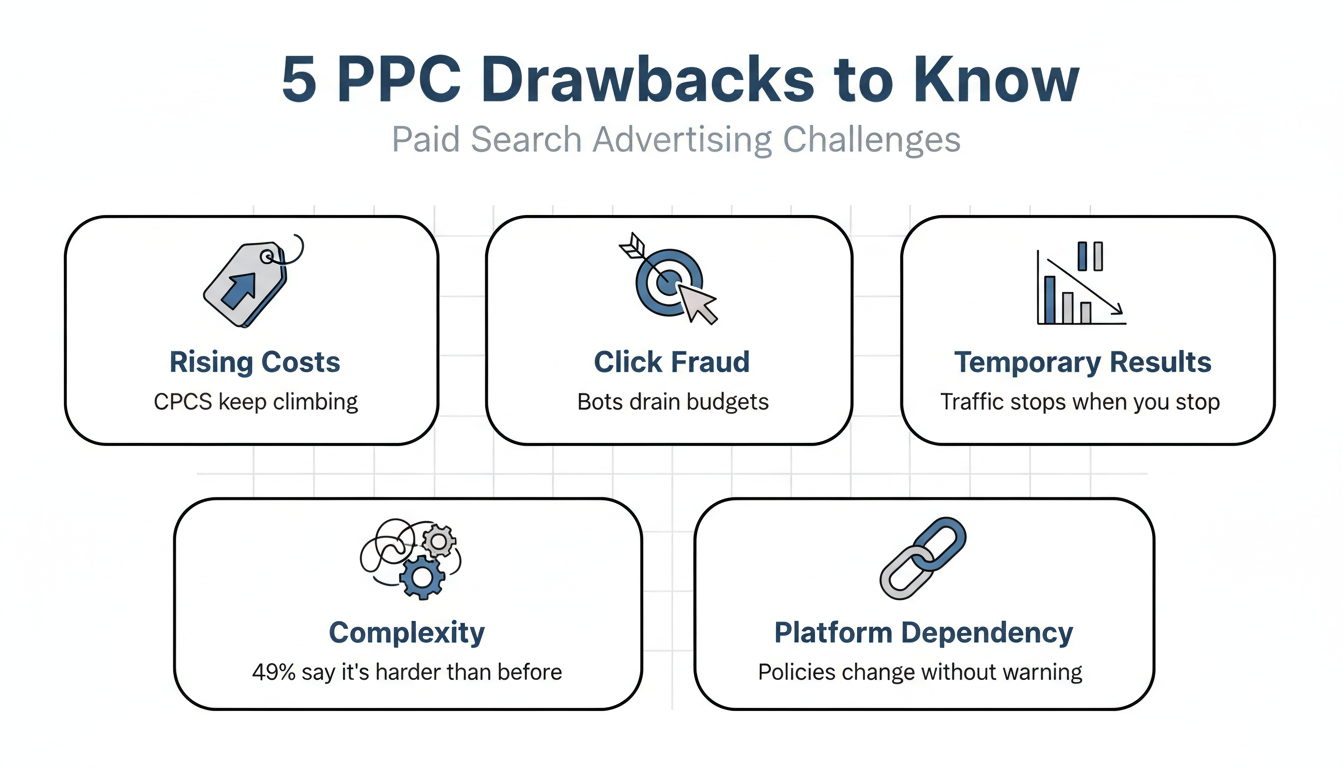
This guide examines the real challenges of PPC - rising costs, click fraud, temporary results, and complexity - plus practical strategies to mitigate each one.
Cost Concerns
The most frequently cited disadvantage of paid search is cost, which continues to rise as competition intensifies.
Rising Cpcs
According to 2026 PPC industry data, rising CPCs and market saturation represent two of the biggest challenges facing advertisers. More businesses competing for the same keywords inevitably drives prices up.
Cost trends to understand:
Factor | Impact |
Increased competition | CPCs rise as more advertisers bid on keywords |
Seasonal fluctuations | Holiday seasons can double or triple normal CPCs |
Industry variations | Legal, insurance, and finance face $50+ CPCs for competitive terms |
Quality Score impact | Low Quality Scores force you to pay more for the same position |
Budget Drain Without Optimization
Without continuous optimization, paid search can drain budgets quickly. According to Google Ads research, common mistakes like inconsistent conversion tracking and poor negative keyword management lead to significant wasted spend.
The budget reality:
- Clicks cost money whether they convert or not
- Testing requires budget that may not produce immediate returns
- Competitive keywords can exhaust budgets within hours
- Small businesses often can't compete on high-value terms
Mitigation Strategies
- Focus on long-tail keywords: Lower competition, lower CPCs, higher intent
- Improve Quality Score: Higher scores reduce what you pay per click
- Set strict budgets: Daily and monthly caps prevent overspending
- Consider Microsoft Ads: 30-70% lower CPCs than Google for many keywords
Click Fraud
Click fraud remains a persistent concern in paid search advertising, where competitors or bots can click your ads without any intent to convert.
The Scale of the Problem
According to industry analysis, click fraud rates vary significantly by platform and network. While major platforms have fraud detection systems, they can't catch everything. Understanding what is SEM marketing helps you recognize when click patterns deviate from normal search behavior.
Click fraud sources:
Source | Description |
Competitor clicks | Rivals clicking to drain your budget |
Bot traffic | Automated programs generating fake clicks |
Click farms | Low-wage workers paid to click ads |
Accidental clicks | Mobile users tapping unintentionally |
Financial Impact
Every fraudulent click costs you money without any possibility of conversion. For businesses in competitive industries with high CPCs, even a small percentage of fraudulent clicks represents significant waste.
Mitigation Strategies
- Monitor click patterns: Unusual spikes in clicks without conversions signal potential fraud
- Use click fraud detection tools: Third-party software identifies suspicious activity
- Implement IP exclusions: Block IPs showing fraudulent behavior
- Report to platforms: Google and Microsoft investigate reported fraud
- Adjust targeting: Exclude locations or times with high fraud rates
Temporary Results
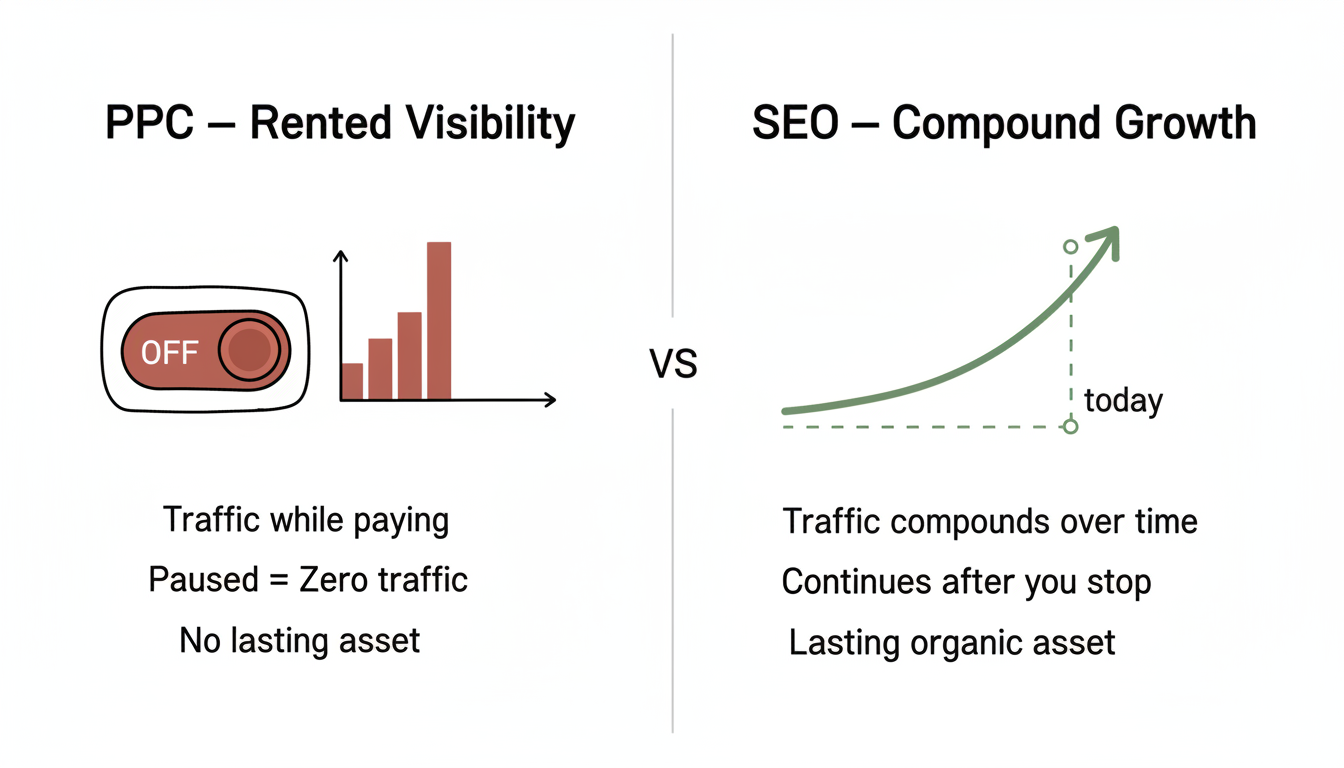
Unlike SEO, which builds lasting organic visibility, paid search traffic stops the moment you stop paying.
The "Rented Visibility" Problem
According to digital marketing strategy research, PPC delivers immediate results but creates no lasting asset. You're essentially renting your position in search results.
The temporary nature of PPC:
Scenario | What Happens |
Budget runs out | Ads stop showing immediately |
Pause campaigns | Traffic drops to zero |
Competitor outbids | Position and traffic decline |
Algorithm changes | Performance can shift overnight |
No Compound Growth
SEO efforts compound over time - content that ranks today continues generating traffic for years. Paid search offers no such compounding. January's ad spend generates January's traffic; it contributes nothing to February's results. This is why many businesses balance paid search advertising strategies with long-term organic initiatives.
Mitigation Strategies
- Combine with SEO: Use paid search query data to inform organic content strategy, as recommended by digital marketing experts
- Build remarketing lists: Paid traffic builds audiences you can retarget
- Capture leads: Convert paid traffic into owned contacts (email lists)
- Invest in brand building: Paid exposure can increase branded search volume
Complexity and Learning Curve
Managing paid search effectively requires significant expertise and ongoing attention.
The Expertise Gap
According to PPC survey data, 49% of marketing professionals say managing PPC campaigns is harder today than it was two years ago. The platforms grow more complex each year.
Areas requiring expertise:
Area | Why It's Complex |
Bidding strategies | Multiple automated options with different behaviors |
Campaign structure | Architecture decisions impact performance |
Audience targeting | Layering options require testing and optimization |
Attribution | Understanding what actually drove conversions |
Platform updates | Google alone made 10+ major changes in 2025 |
Time Investment
Effective PPC management isn't "set it and forget it." According to Google Ads best practices, avoiding common mistakes requires regular attention to search term reports, negative keywords, and bid adjustments. Professional PPC campaign management services exist specifically because this ongoing work demands specialized expertise.
Ongoing management requirements:
- Weekly search term analysis
- Regular bid adjustments
- Continuous ad testing
- Landing page optimization
- Conversion tracking maintenance
- Competitor monitoring
Mitigation Strategies
- Invest in training: Platform certifications provide foundational knowledge
- Start simple: Master one campaign type before expanding
- Use automation wisely: Let AI handle bid adjustments once you have data
- Consider agency support: Professional management handles complexity for you
Platform Dependency
Relying heavily on paid search creates dependency on platforms you don't control.
Policy and Algorithm Risk
Platforms can change policies, pause accounts, or shift algorithms without warning. According to industry analysis, unusual policy restrictions can stall campaigns at the worst times. A comprehensive paid search advertising platforms comparison reveals how different platforms handle policy enforcement and account stability.
Dependency risks:
- Account suspensions (sometimes without clear explanation)
- Policy changes affecting your industry
- Algorithm updates changing performance overnight
- Increasing costs as platforms prioritize revenue
Mitigation Strategies
- Diversify platforms: Don't rely solely on Google; add Microsoft Ads, social platforms
- Build owned channels: Email lists, organic traffic, direct relationships
- Maintain policy compliance: Regular audits prevent unexpected issues
- Document everything: Keep records for appeals if needed
How to Manage the Real Costs
Cost is manageable when you scope the auction. Use exact and phrase match with a tight negative list so you pay only for the intent you want, because broad match without cleanup is where the budget leaks. The discipline of the negative list is the quiet lever that protects the spend.
Set a target before the campaign and review it. A cost that drifts upward while conversions fall is a setup problem, not an algorithm flaw, so check the events and the bid. The early fix is usually in the configuration, and the habit of reviewing keeps the cost honest against the outcome.
Reducing Platform Dependency
Dependency shrinks when you diversify the discovery mix. Paid search is one input; organic, social, and email are others, so build them in parallel so a single auction change cannot sink the pipeline. The resilient brand is the one with more than one tap, and the mix is the insurance.
Own the audience where you can. A list and a relationship you control survive a platform shift better than a rented click, so invest in the channel you own alongside the one you rent. The balance is what keeps a paid-search shock from becoming a business shock, and the discipline is the hedge.
Addressing Complexity and the Learning Curve
Complexity falls when you document the setup. A written account structure with the naming scheme and the rules lets a new operator run it without relearning, because the knowledge lives in the doc, not one person's head. The documentation is what makes the curve survivable and the account portable.
Use a small test to learn the system. A contained campaign that teaches the auction before the full budget goes in avoids expensive lessons at scale, so start narrow and widen as the signal arrives. The staged learning is cheaper than a big bet on a tool you do not yet understand, and the caution pays.
Frequently Asked Questions
Is Paid Search Advertising Worth It Despite These Disadvantages?
Yes, for most businesses. Paid search delivers immediate, measurable results that other channels can't match. The disadvantages are real but manageable with proper strategy. The key is understanding these limitations upfront and planning accordingly rather than expecting paid search to solve every marketing challenge.
How Much Budget Do I Need to Test If Paid Search Works for My Business?
Plan for at least $1,000-$3,000 over 60-90 days to gather meaningful data. Less than this won't generate enough clicks and conversions to draw conclusions. Start with your highest-intent keywords and expand only after proving profitability.
Should I Do Paid Search Myself or Hire an Agency?
If you have time to learn and manage campaigns actively, self-management is viable for smaller budgets. For budgets over $5,000/month or complex campaigns, professional management typically pays for itself through improved efficiency and reduced wasted spend.
Key Takeaways
- Rising CPCs and competition make paid search increasingly expensive, especially for competitive keywords
- Click fraud remains a concern, though platforms provide some protection
- Traffic stops immediately when you stop paying - no compound growth like SEO
- Complexity increases every year, with 49% of marketers finding PPC harder than before
- Platform dependency creates risk from policy changes and algorithm updates
- All disadvantages are manageable with proper strategy and realistic expectations