
Choosing between display advertising and paid search is one of the most fundamental decisions in digital advertising. Each serves a distinct purpose in the customer journey - and understanding when to use each (and how to combine them) separates effective campaigns from wasted budgets.
This guide breaks down the key differences, performance benchmarks, and strategic applications for both advertising types in 2026.
What Is Display Advertising
Display advertising uses visual banner ads, images, and rich media to reach audiences across websites, apps, and video platforms. These ads appear based on audience targeting rather than search queries.
How Display Ads Work
- Audience targeting: You define who should see ads based on demographics, interests, behaviors, or remarketing lists
- Placement selection: Ads appear across publisher networks (Google Display Network reaches 90%+ of internet users)
- Impression-based delivery: You pay for impressions (CPM) or clicks (CPC)
- Visual format: Images, animations, video, and interactive creative
Common Display Ad Types
- Standard banners: Static or animated image ads in standard sizes
- Responsive display ads: Automatically adjust to fit available ad space
- Native ads: Match the look and feel of surrounding content
- Video ads: Pre-roll, mid-roll, or outstream video placements
- Rich media: Interactive ads with expandable or engaging elements
Where Display Ads Appear
Display ads run across massive networks:
- Google Display Network (millions of websites and apps)
- Microsoft Audience Network
- Programmatic exchanges
- Social media platforms
- Publisher direct buys
What Is Paid Search
Paid search (also called search advertising or PPC) displays text ads to users actively searching for specific terms on search engines like Google and Bing.
How Paid Search Works
- Keyword targeting: You bid on search terms your customers use
- Auction system: When someone searches, an auction determines which ads appear
- Intent matching: Ads show based on query relevance, not just bid amount
- Click-based pricing: You pay only when someone clicks your ad
Common Paid Search Ad Types
- Text ads: Headlines and descriptions appearing above/below search results
- Shopping ads: Product listings with images, prices, and reviews
- Local services ads: Service provider listings with ratings
- Dynamic search ads: Automatically generated based on website content
Where Search Ads Appear
Search ads display on:
- Google Search results (90% global search market share)
- Microsoft Bing results (including Yahoo and AOL)
- Search partner networks
- Google Maps
Key Differences
Understanding these distinctions helps you allocate budget effectively.
Intent Level
Factor | Display Advertising | Paid Search |
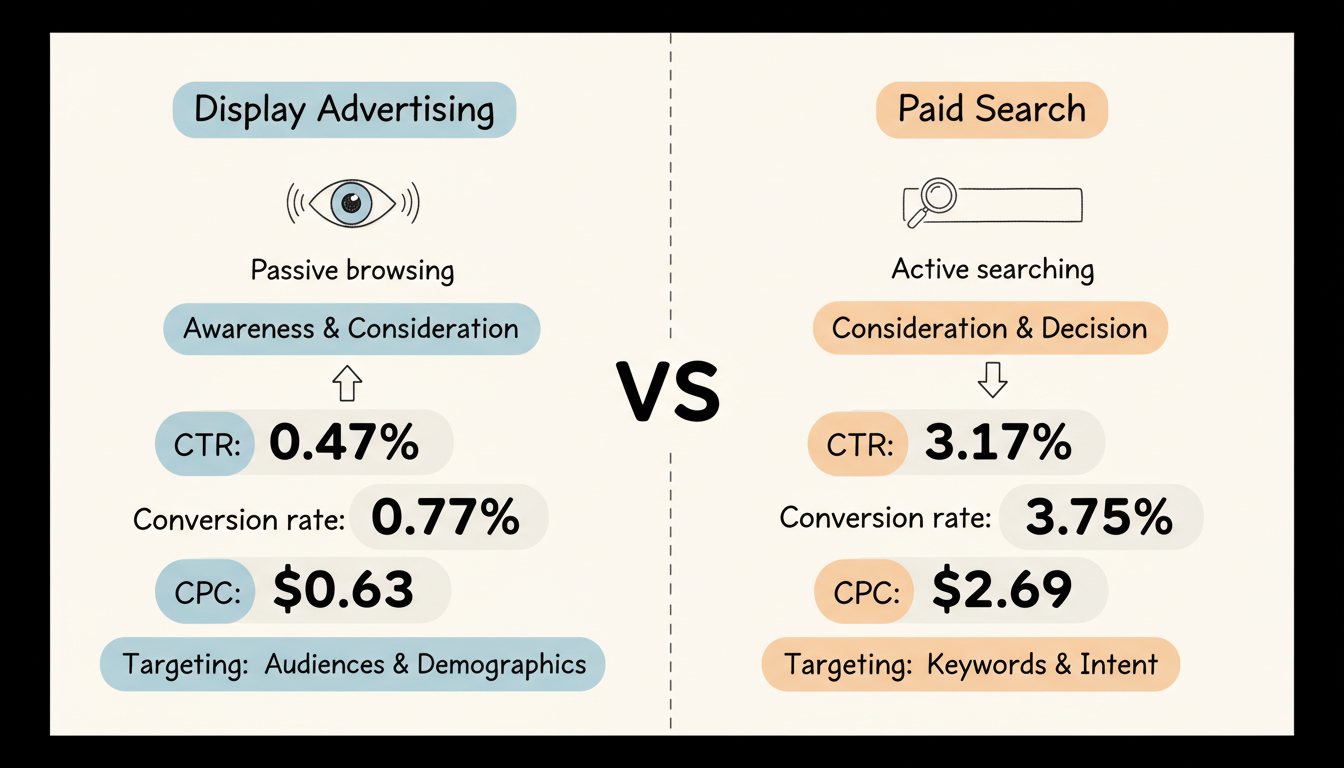
User mindset | Passive browsing | Active searching |
Intent level | Low to medium | High |
Stage in funnel | Awareness, consideration | Consideration, decision |
Primary goal | Reach and awareness | Conversions and leads |
The fundamental difference: display ads interrupt; search ads respond. This is why paid search advertising statistics consistently show higher conversion rates for search compared to display campaigns.
Performance Benchmarks
According to 2026 PPC benchmark data, the performance gap between formats is significant:
Metric | Search Ads | Display Ads |
Average CTR | 3.17% | 0.47% |
Average conversion rate | 3.75% | 0.77% |
Average CPC | $2.69 | $0.63 |
Search ads dramatically outperform display on click-through and conversion rates - but display delivers far more impressions at lower cost.
Targeting Approach
Display advertising targets people:
- Demographics (age, gender, income)
- Interests and affinities
- In-market audiences (active researchers)
- Remarketing lists (previous visitors)
- Custom audiences
Paid search targets intent:
- Keywords and search queries
- Match types (exact, phrase, broad)
- Geographic location
- Device type
- Time of day
Creative Requirements
Element | Display | Search |
Visual assets | Required (images, video) | Not required |
Ad copy | Limited text | Headlines + descriptions |
Landing pages | Recommended | Critical |
A/B testing | Creative variations | Copy variations |
Display demands visual creative; search demands compelling copy.
When to Use Each
Strategic selection depends on your goals and where customers are in their journey.
Choose Display Advertising When
Building brand awareness: Display reaches massive audiences who don't yet know your brand. Display networks provide access to users you cannot reach through search alone.
Retargeting past visitors: Someone visited your site but didn't convert? Display remarketing keeps your brand visible as they browse other sites.
Visual product showcase: Fashion, home decor, travel - industries where visuals drive desire benefit from display's image-forward format.
Launching new products: When no one is searching for your new offering yet, display creates initial awareness.
Supplementing search reach: Even dominant search advertisers can't reach everyone through keywords alone. For a comprehensive approach, consider paid search agency services that integrate both channels.
Choose Paid Search When
Capturing high-intent traffic: Users searching "buy [product]" or "[service] near me" have immediate purchase intent. Search captures them at decision time.
Generating leads and sales: Search ads deliver higher conversion rates because users are actively seeking solutions. Understanding how pay-per-click works helps you maximize this conversion advantage.
Targeting specific problems: When people search for solutions to problems you solve, search ads put your answer directly in front of them.
Limited creative resources: No design team? Search ads require only text - fast to create and test.
Competitive industries: When competitors are bidding on keywords, absence from search results cedes market share.
Using Both Together
The most effective strategies combine both formats strategically.
Full-Funnel Approach
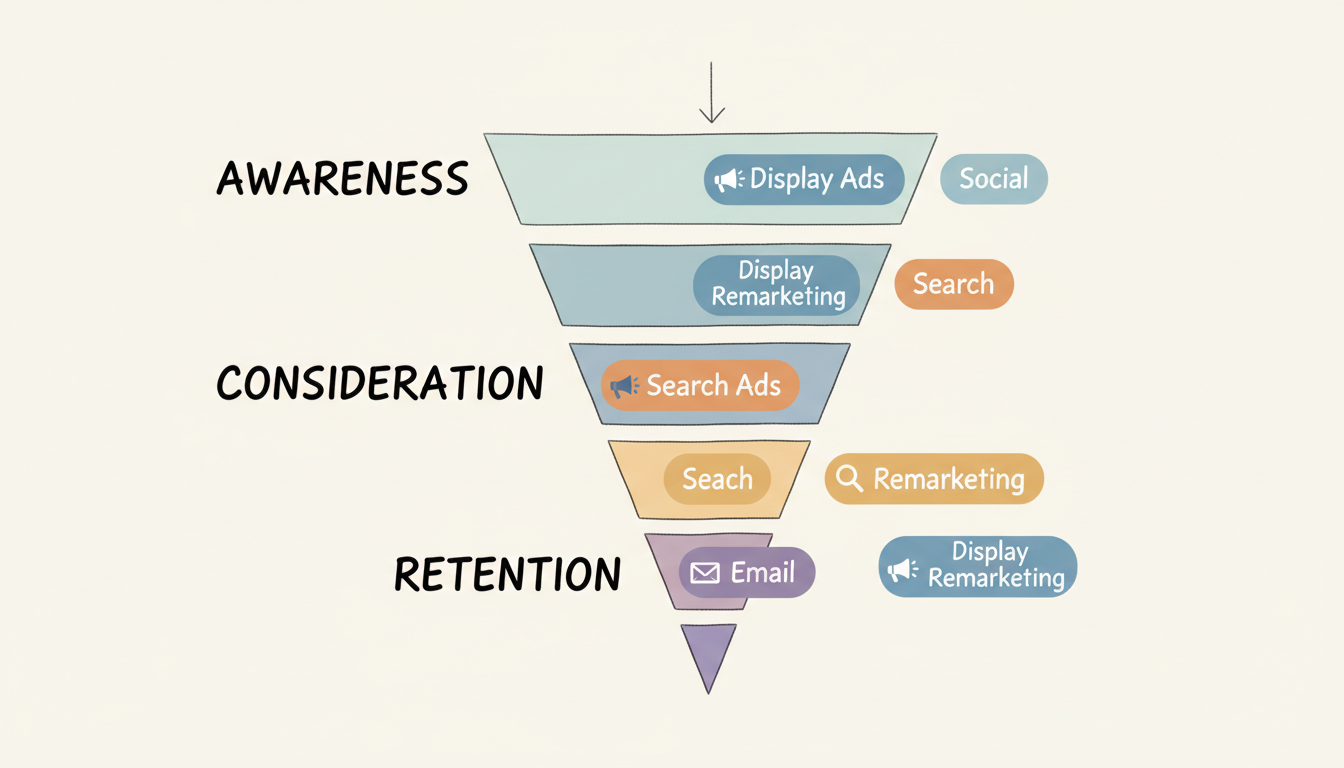
Leading brands in 2026 diversify their media mix rather than relying on a single channel:
Funnel Stage | Primary Channel | Supporting Channel |
Awareness | Display | Social |
Consideration | Display remarketing | Search |
Decision | Search | Remarketing |
Retention | Display remarketing |
Remarketing Sequences
The proven combination:
- Search captures initial interest: User searches, clicks your ad, visits site
- Display maintains presence: If they don't convert, remarketing ads follow them
- Search closes the deal: When they're ready to buy, search ads are waiting
This approach leverages each channel's strength: search for intent, display for persistence. A comprehensive SEM marketing strategy framework incorporates both channels to maximize customer acquisition.
Budget Allocation
Expert recommendations for 2026:
- Direct response focus: 70-80% search, 20-30% display
- Brand building focus: 40-50% display, 30-40% search, remainder social
- Balanced approach: 60% search, 25% display, 15% other
Start with search to establish baseline conversions, then layer in display for incremental reach.
Cross-Channel Measurement
As channels increasingly interact, measurement must account for assisted conversions - not just last-click attribution:
- Display often assists search conversions
- Users may see display ads before searching your brand
- True ROI requires multi-touch attribution
When to Use Each
Use paid search for intent and display for influence. The searcher has named the need; the viewer is being shaped toward it, so the two serve different moments in the same journey. The honest plan funds both by stage, because picking one and ignoring the other leaves a gap the competitor fills.
Start with search if the budget is small. A tight paid-search campaign on high-intent queries returns faster than a broad display buy, so prove the message there first, then use display to widen the reach. The sequence protects the dollar and teaches the offer before the awareness spend begins.
Using Both Together
Run them as a path, not two silos. Display warms the buyer; search catches them when they are ready, so the combined view shows assisted conversions that last-click misses. The joined read is what justifies the display spend, because the search win often started with a display impression weeks earlier.
Assign the metric per channel and report them together. Search reads on conversion and cost; display reads on reach and influence, so the dashboard that shows both tells the real story. The separated view under-credits display; the combined one shows where the next dollar belongs, and the framing is the honest one.
Key Differences in Practice
In practice the difference is control. Search hands you the query; display hands you the context, so the creative and the target differ by what you know. The side-by-side only makes sense when read as a sequence, and the sequence is the strategy that actually fills the pipeline across the funnel.
Avoid funding one at the expense of the other. A quarter that over-invests in capture looks great then stalls; a quarter that over-invests in awareness looks quiet then floods, so hold the balance against the stage of the business. The steady mix outperforms the swing, and the discipline is the quiet edge.
Frequently Asked Questions
Which Is Better: Display or Search Advertising?
Neither is universally "better." Search advertising delivers higher conversion rates and captures high-intent users ready to buy. Display advertising excels at brand awareness, remarketing, and reaching audiences not actively searching. Most businesses benefit from using both strategically.
What Is the Average CTR for Display vs Search Ads?
According to 2026 benchmarks, average search ad CTR is 3.17% while display ad CTR averages 0.47%. The difference reflects user intent - search users are actively looking for solutions, while display users are passively browsing.
Should I Start with Display or Search Advertising?
Start with search advertising if you have limited budget and need direct conversions. Search captures users with immediate purchase intent and delivers faster ROI. Add display once search campaigns are profitable, using it for remarketing and awareness building.
Key Takeaways
- Search ads capture intent with 3.17% average CTR vs. 0.47% for display
- Display ads build awareness and reach users not actively searching
- Conversion rates differ dramatically: 3.75% for search vs. 0.77% for display
- Use both together for full-funnel coverage - search for conversions, display for remarketing
- Budget allocation depends on goals: conversion-focused campaigns favor search; brand-building favors display