
Choosing the right ecommerce Facebook ads agency can be the difference between profitable growth and wasted ad spend. Online stores face unique challenges that require specialized expertise: managing product catalogs, optimizing for purchases, handling dynamic retargeting, and integrating with platforms like Shopify and WooCommerce.
This guide covers what makes an ecommerce-focused agency different, the services they provide, real-world results, and how to start working with one.
Ecommerce Expertise
Not all Facebook ads agencies understand ecommerce. Running ads for an online store requires specific skills that generalist agencies often lack.
What Makes Ecommerce Different
Product Catalog Management: Ecommerce campaigns rely heavily on product catalogs connected to Meta. This includes setting up product feeds, troubleshooting disapprovals, and optimizing product titles and descriptions for the algorithm.
Dynamic Product Ads: DPA campaigns show users the exact products they viewed or similar items. Setting these up correctly requires technical expertise with pixel events, catalog segments, and retargeting windows.
Purchase Optimization: Unlike lead generation, ecommerce campaigns optimize for actual purchases. This requires robust conversion tracking, understanding attributed revenue, and managing ROAS targets across campaigns. Understanding how to increase roi facebook ads is crucial for ecommerce success.
Platform Integration: Most ecommerce agencies have deep experience with Shopify, WooCommerce, BigCommerce, and other platforms. They understand how to configure tracking, sync catalogs, and troubleshoot integration issues.
According to industry analysis of ecommerce agencies, the best agencies typically offer conversion rate optimization, paid advertising across Meta and other networks, SEO for product pages, email marketing including abandonment recovery, and creative production optimized for ecommerce performance.
Red Flags to Avoid
Watch for agencies that:
- Have no specific ecommerce case studies
- Cannot explain dynamic product ads setup
- Do not understand product feed optimization
- Have no experience with your ecommerce platform
- Focus only on traffic metrics instead of ROAS
Our Services
A comprehensive ecommerce Facebook ads agency should provide end-to-end campaign management tailored to online stores.
Campaign Strategy
Before launching ads, we develop strategy based on:
- Store analysis and current performance audit
- Competitive research in your niche
- Customer journey mapping
- Full-funnel campaign architecture
- Budget allocation recommendations
Developing a comprehensive meta ads strategy ensures your campaigns align with business objectives and customer behavior patterns.
Product Catalog Setup
We ensure your product catalog is optimized:
- Feed configuration and troubleshooting
- Product set creation for campaigns
- Title and description optimization
- Image quality assessment
- Catalog segmentation for targeting
Campaign Types
We manage all ecommerce-relevant campaign types:
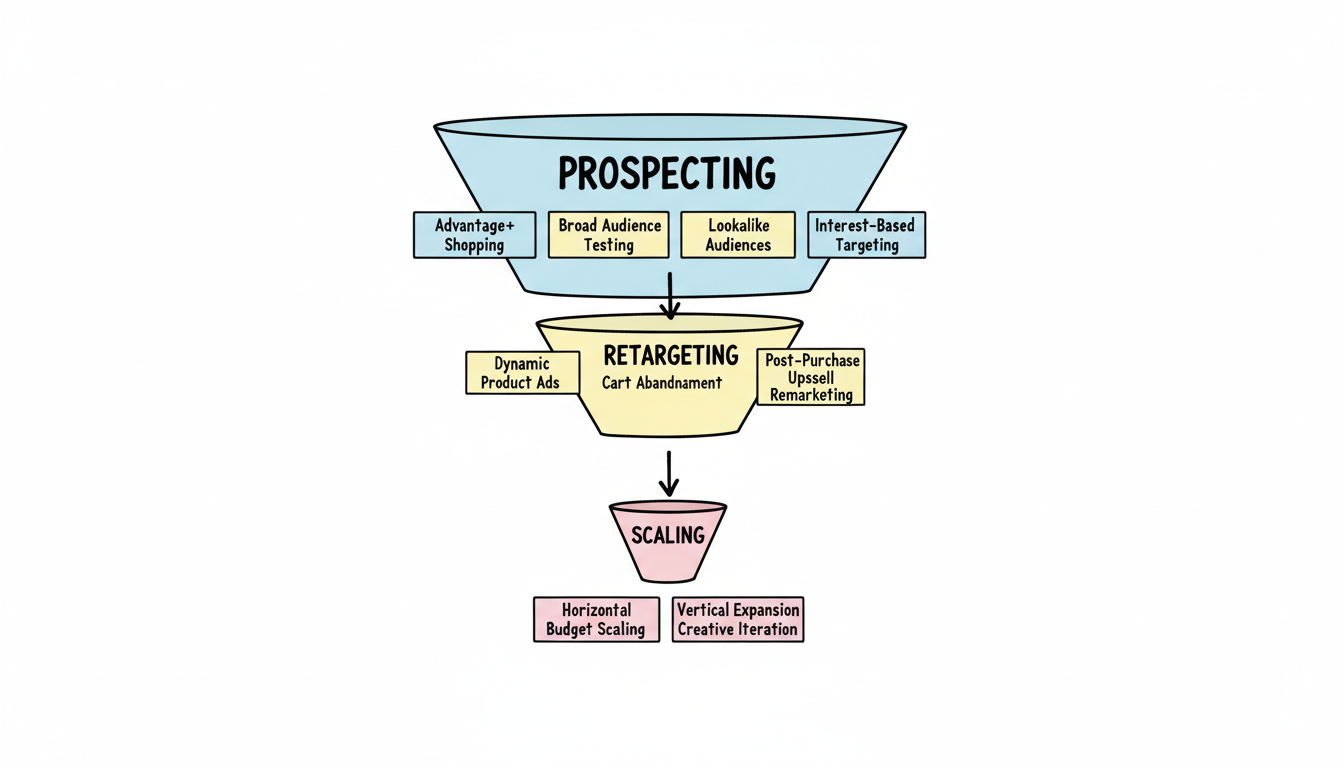
Prospecting Campaigns:
- Advantage+ Shopping campaigns
- Broad audience testing
- Lookalike audiences from purchasers
- Interest-based targeting tests
Retargeting Campaigns:
- Dynamic Product Ads for viewers
- Cart abandonment campaigns
- Post-purchase cross-sell and upsell
- Email list remarketing
Scaling Campaigns:
- Horizontal expansion to new audiences
- Vertical budget scaling on winners
- Creative iteration and testing
Creative Production
Ecommerce creative differs from other industries. We produce:
- Product-focused static images
- UGC-style video content
- Lifestyle photography ads
- Carousel ads highlighting collections
- Video ads demonstrating products
Looking at successful meta ads examples can provide inspiration for creative approaches that resonate with ecommerce audiences.
Tracking and Attribution
Accurate measurement is essential for ecommerce:
- Meta Pixel implementation
- Conversions API setup
- Server-side tracking configuration
- Multi-touch attribution analysis
- ROAS and incremental revenue reporting
According to attribution research, last-click tends to overcredit bottom-funnel intent while undercrediting impression-assisted journeys. We use multi-touch attribution where appropriate to understand true campaign value.
Case Studies
Results matter more than promises. Here are examples of what ecommerce-focused Facebook ads management delivers.
Case Study 1: Fashion DTC Brand
Challenge: A direct-to-consumer fashion brand was spending $15K/month with inconsistent ROAS ranging from 1.5x to 3x depending on the week.
Approach:
- Restructured campaigns around Advantage+ Shopping
- Built segmented catalogs for top performers
- Implemented aggressive creative testing (15+ new ads weekly)
- Set up proper exclusions to reduce audience overlap
Results:
- Stabilized ROAS at 3.2x average
- Scaled to $35K/month profitably
- Reduced CPA by 28% while increasing volume
Case Study 2: Home Goods Retailer
Challenge: A home goods store had never run paid advertising and wanted to test Facebook ads without risking significant budget.
Approach:
- Started with $3K/month test budget
- Focused on bestselling products only
- Built lookalike audiences from email subscribers
- Created UGC-style creative showing products in homes
Results:
- Achieved 4.1x ROAS in first month
- Identified winning products for expansion
- Scaled to $12K/month within 90 days
Case Study 3: Supplements Brand
Challenge: A supplements company was seeing declining ROAS after iOS 14 privacy changes disrupted their tracking and targeting.
Approach:
- Implemented Conversions API for better data
- Shifted to broader Advantage+ audiences
- Built first-party data strategy with email capture
- Increased creative volume to give algorithm more signals
Results:
- Recovered from 1.8x to 2.9x ROAS
- Reduced reliance on third-party data
- Built sustainable audience sources
According to Facebook advertising agencies research, one client noted scaling ad spend from $5K per month to over $50K while also increasing ROAS. These results require both expertise and proper website infrastructure.
Get Started
Working with an ecommerce Facebook ads agency typically follows a structured process.
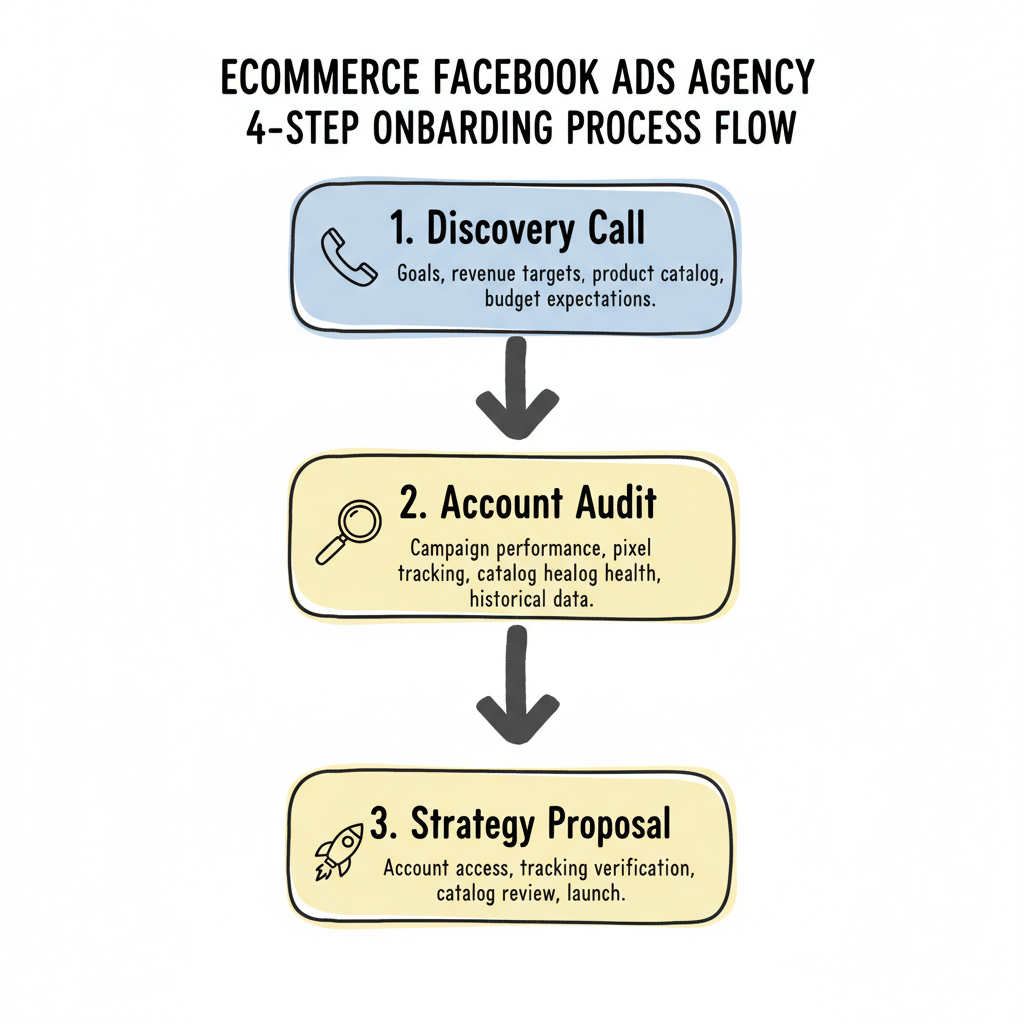
Step 1: Discovery Call
We start with a discovery call to understand:
- Your current advertising situation
- Revenue goals and growth targets
- Product catalog and margins
- Previous advertising experience
- Timeline and budget expectations
Step 2: Account Audit
Before proposing services, we audit your existing setup:
- Current campaign performance
- Tracking and pixel configuration
- Catalog health and feed quality
- Historical data and trends
- Competitive landscape
Step 3: Strategy Proposal
Based on discovery and audit, we present:
- Recommended campaign structure
- Budget allocation by campaign type
- Expected timeline to results
- Pricing and terms
Step 4: Onboarding
Once engaged, we complete onboarding:
- Account access and permissions
- Tracking verification
- Catalog review and optimization
- Creative asset collection
- Launch timeline confirmation
Minimum Requirements
Most reputable agencies require minimum ad spend to make management worthwhile. According to industry standards, if you are not spending at least $1,000 to $3,000 per month on ads alone (excluding agency fees), you might be better off managing it yourself until you scale up.
What Ecommerce Expertise Looks Like
It shows in the funnel, not the logo. An ecommerce agency knows the product feed, the catalog, and the retention loop, because the buyer here repeats and the margin lives in the repeat, so the shop should prove it can run the full commerce path. The generalist ad buyer misses the commerce nuance and fails the segment.
It also shows in the creative for the category. Ecommerce wins on the product in motion and the proof of fit, so the agency should produce and test that specific creative, not a generic brand film. The relevant craft is the signal, and the portfolio should prove it before the contract is signed.
Case Studies That Actually Matter
Weigh the case by the business fit, not the size. A win for a store like yours beats a bigger one in another category, so read the result against your stage and margin. The comparable case is the one that predicts your outcome, and the disciplined read ignores the impressive-but-irrelevant win.
Ask for the metric behind the story. A case study that ends with a vague lift hides the cost, so request cost per acquisition and the period, because the honest case states both. The number is what lets you judge whether the agency can repeat the result for you, and the missing number is a warning.
Getting Started and Red Flags
Start with a small scoped pilot. A defined campaign on your hero product proves the fit before a long term, so the pilot is the test, not a formality. The brand that pilots protects the budget and learns the method, and the agency that resists a pilot is one to question.
Beware contracts that punish leaving. Long terms with no performance exit, or cancellation fees that trigger on any scope change, are built to survive underperformance. Insist on a short ramp and a clear exit so the incentive stays aligned with your result after the onboarding glow fades, because commerce pilots need room to prove.
Frequently Asked Questions
How Much Does an Ecommerce Facebook Ads Agency Cost?
Agency fees typically range from 10-20% of ad spend or flat monthly retainers from $1,000 to $5,000+. Higher service levels, more platforms, and creative production increase costs. Most agencies require minimum monthly ad spend of $3,000-$5,000 before taking on new clients.
What ROAS Should I Expect from Facebook Ads for Ecommerce?
Healthy ROAS varies by product margins. Brands with 70%+ margins can be profitable at 2x ROAS. Brands with 40% margins need 3x+ to profit. Expect 30-60 days for campaigns to optimize before evaluating true ROAS potential.
How Long Before I See Results from an Ecommerce Agency?
Initial data comes within the first 2 weeks. Meaningful optimization typically requires 30-60 days of data. Full campaign maturity and stable performance usually takes 90 days. Avoid agencies promising instant results.