
Search engines no longer match keywords—they understand topics, entities, and relationships. As of March 2026, entity-based SEO represents the shift from optimizing for search terms to becoming a recognized concept within search engines' Knowledge Graphs.
For brands competing in AI-powered search, entity recognition determines whether you're cited as an authority or overlooked entirely. This guide explains how entity-based SEO builds topical authority and positions your brand for both traditional and AI search visibility.
What Is Entity-Based SEO?
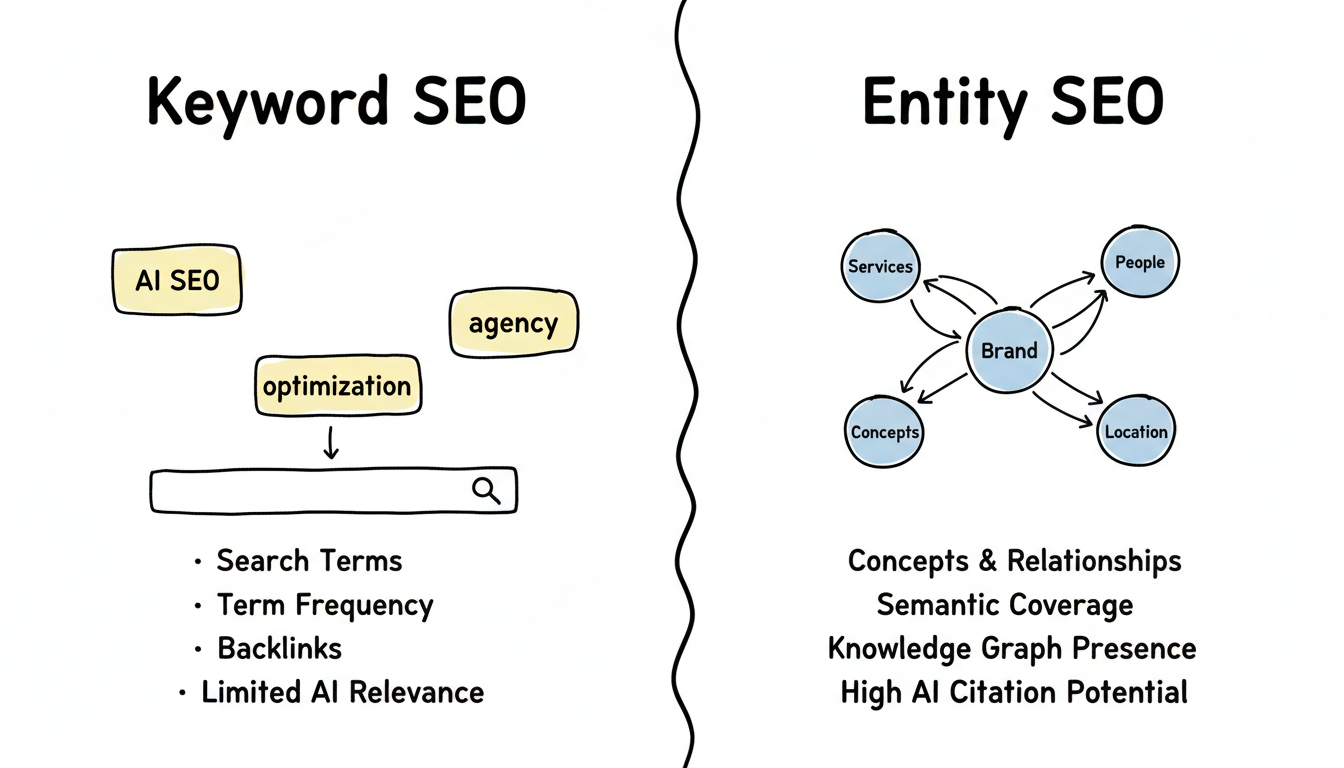
Entity-based SEO focuses on how search engines identify and classify the "who, what, where, and why" of your content and brand. Rather than treating your website as a collection of keyword-optimized pages, entity SEO positions your brand as a defined concept with clear relationships to other recognized entities.
Entities vs. Keywords
Aspect | Keyword SEO | Entity SEO |
Focus | Search terms | Concepts and relationships |
Optimization | Term frequency | Semantic coverage |
Authority | Backlinks | Knowledge Graph presence |
AI relevance | Limited | High citation potential |
Entity-Based SEO Examples
Understanding entity SEO becomes clearer through concrete examples of how Google uses entity recognition to serve better results.
Example 1: Brand disambiguation. When someone searches "Apple," Google uses entity context to determine intent. The query "Apple stock price" maps to Apple Inc. (organization entity), while "apple nutrition facts" maps to apple (fruit entity). Google's Knowledge Graph holds separate entity entries for each, linked to different attributes, relationships, and data sources. Entity-based SEO ensures your brand is correctly classified so searches resolve to your entity.
Example 2: Local business entities. A dentist named "Bright Smile Dental" in Austin competes with dozens of similar names. By building a consistent entity—verified Google Business Profile, LocalBusiness schema, matching NAP across Yelp, Healthgrades, and social profiles—Google connects all signals into one entity node. The result: a Knowledge Panel, map pack placement, and higher AI citation likelihood for local queries.
Example 3: E-commerce product entities. A retailer selling "Nike Air Max 90" benefits when Google recognizes the product as a distinct entity tied to Nike (brand entity), Air Max (product line entity), and running shoes (category entity). Implementing Product schema with GTIN identifiers and brand references makes these entity relationships explicit, improving visibility in shopping results, rich snippets, and AI-generated product comparisons.
Example 4: Content topic entities. A blog post about "machine learning" performs better when Google recognizes it covers related entities like neural networks, supervised learning, TensorFlow, and Andrew Ng. These co-occurring entities signal topical depth and improve the post's entity salience score—making it more likely to appear in AI Overviews.
How Google Understands Entities
Google's Knowledge Graph maps entities and their relationships. When you search for "Apple," Google understands whether you mean the company, the fruit, or a related concept based on context and entity relationships.
For your brand, entity recognition means Google understands:
- What you are: Company, person, product, concept
- What you do: Services, expertise, industry
- Who you relate to: Partners, competitors, industry associations
- Where you fit: Geographic presence, market position
This understanding influences how Google and AI systems present your content—as a relevant authority or an unknown source. Understanding the key AI search ranking factors helps you optimize for entity recognition across both traditional and emerging search platforms.
NLP and Entity Recognition in Search
Google's ability to understand entities relies on Natural Language Processing (NLP)—the branch of AI that enables machines to parse and interpret human language. Google's NLP systems power entity extraction, which identifies the people, places, organizations, and concepts mentioned in any piece of content.
How Google's NLP processes your content:
- Entity extraction: Google's algorithms scan your content and identify named entities (e.g., "Stackmatix" as an Organization, "entity-based SEO" as a Concept)
- Salience scoring: Each entity receives a salience score from 0 to 1 indicating how central it is to the content. Higher salience means stronger association.
- Sentiment and category analysis: Google classifies the content's topic category and overall sentiment toward mentioned entities
- Relationship mapping: Extracted entities are linked to Knowledge Graph nodes, connecting your content to the broader entity web
Testing your entity signals with Google NLP API: The Google Cloud Natural Language API lets you analyze how Google "reads" your content. Submit your page text and review which entities Google extracts, their salience scores, and their Knowledge Graph IDs (MIDs). If your target entity has low salience or is missing entirely, restructure your content to place it more prominently—in the title, first paragraph, headings, and concluding summary.
This NLP-driven understanding is why semantic search has replaced pure keyword matching. Google no longer counts how many times you mention "entity SEO"—it evaluates whether your content demonstrates genuine understanding of the concept and its relationships to related entities.
Building Topical Authority Through Entities
Topical authority comes from demonstrating comprehensive expertise within a defined subject area. Entity-based SEO accelerates topical authority by making relationships explicit.
The Content Knowledge Graph Approach
Rather than creating isolated pages, build an interconnected content ecosystem that mirrors how Knowledge Graphs work.
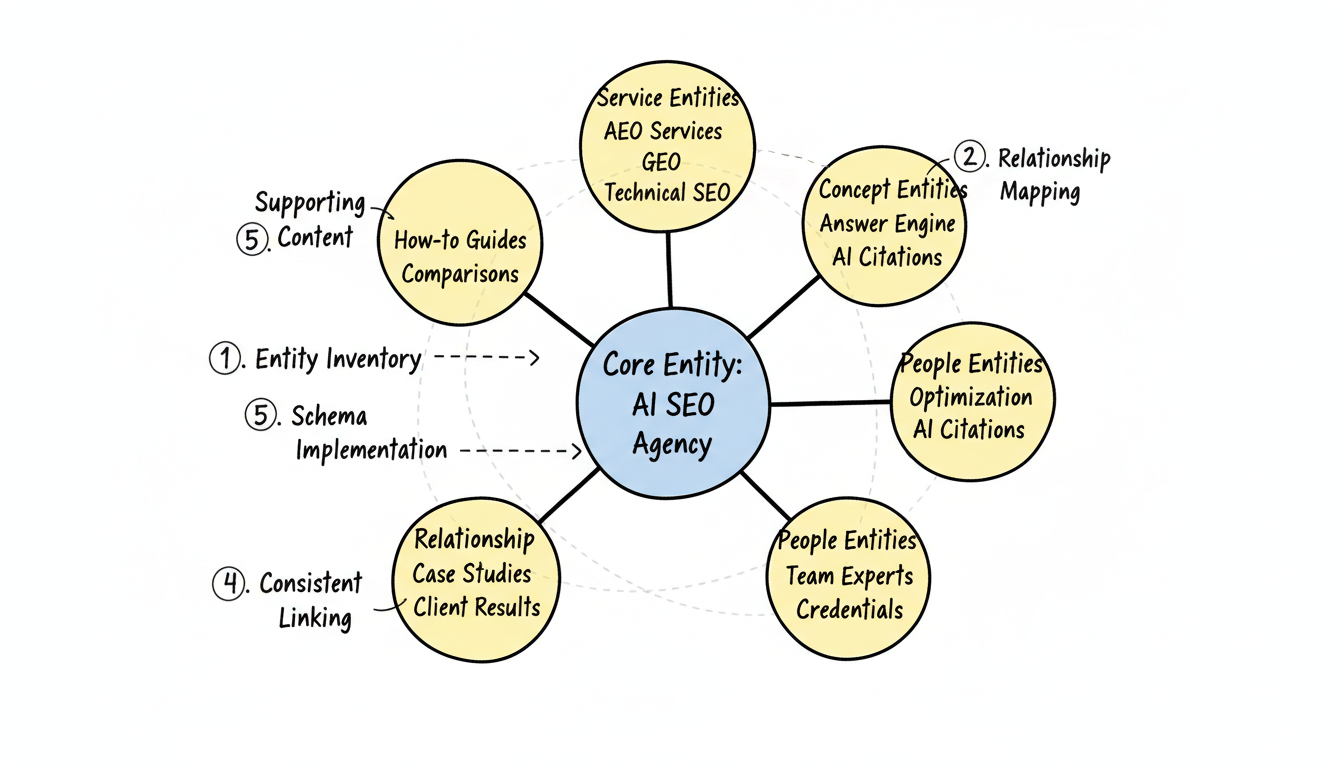
Process:
- Entity inventory: Catalog all entities in your content—people, products, concepts, locations
- Relationship mapping: Define how entities relate to each other
- Central entity hubs: Create authoritative pages for core entities
- Consistent linking: Reference central entities across all content
- Schema implementation: Mark up entities with structured data
Semantic Clustering for Authority
Group content around core entities to demonstrate depth. According to industry research, semantic SEO via schema markup is foundational for entity-based search visibility in 2026. When implementing structured data, it's important to understand the difference between JSON-LD and Microdata for Knowledge Graph optimization.
Example cluster structure:
Core Entity: "AI SEO Agency"
├── Service entities: AEO services, GEO services, Technical SEO
├── Concept entities: Answer Engine Optimization, AI citations
├── People entities: Team experts with credentials
├── Relationship entities: Case studies, client results
└── Supporting content: How-to guides, comparisons, research
Each piece of content reinforces relationships and builds the entity definition.
Entity Variants and Synonyms Strategy
Search engines recognize that a single entity can be referenced in multiple ways. Leveraging entity variants—the different names, abbreviations, and synonyms for the same concept—strengthens your entity signals and captures a wider range of search queries.
Why entity variants matter: Google's Knowledge Graph links variants to a single entity node. "SEO" and "search engine optimization" resolve to the same concept. "Google" and "Alphabet Inc." connect to related but distinct entities. When your content uses variants naturally, it reinforces entity recognition and demonstrates authoritative understanding.
How to map entity variants using Wikipedia structure:
Wikipedia provides a practical framework for identifying entity variants. Each Wikipedia article includes redirects, "also known as" references, and disambiguation pages—all of which reveal how a concept is referenced across contexts.
- Look up your target entity on Wikipedia and note the article title, redirects, and the "also known as" text in the introduction
- Check the disambiguation page (if one exists) to understand how the entity differs from similar concepts
- Review the "See also" section for related entities you should co-reference
- Use these variants throughout your content in headings, body text, alt attributes, and schema markup
Entity variants checklist for content optimization:
- Use the full formal name at least once (e.g., "entity-based search engine optimization")
- Use the common abbreviation or short form in most references (e.g., "entity SEO")
- Include industry-specific synonyms (e.g., "semantic entity optimization," "Knowledge Graph SEO")
- Reference the entity in different grammatical contexts (noun, adjective, process)
- Add co-occurring entities that commonly appear alongside your target (e.g., "structured data," "Knowledge Graph," "NLP")
- Implement variant names in schema markup using the
alternateNameproperty
Why Thin Content Fails
Search engines detect "thin semantic coverage." According to current SEO research, repeating keywords without covering related concepts fails to build authority.
Modern search expects content about "AI SEO" to also mention:
- Google AI Overviews
- Answer engine optimization
- Schema markup
- E-E-A-T signals
- Content structure
Missing these related concepts signals incomplete understanding—undermining entity authority.
Knowledge Graph Optimization
Becoming a node in Google's Knowledge Graph requires strategic entity building. Many organizations have achieved significant visibility improvements through systematic Knowledge Graph optimization, as demonstrated by various knowledge panel success stories.
Entity Signals That Matter
Business entities need:
- Consistent NAP (Name, Address, Phone) across platforms
- Verified Google Business Profile
- Wikipedia presence (for established brands)
- Industry directory listings
- Social media profiles with consistent naming
Personal entities (for thought leadership) need:
- Author pages with credentials
- Bylines on authoritative publications
- Social profiles linked through schema
- Speaking engagements and citations
- Professional directory presence
Schema Markup for Entity Definition
Structured data explicitly defines entities for search engines. Priority schema types for entity SEO:
Organization schema:
{
  "@type": "Organization",
  "name": "Your Brand",
  "sameAs": [
    "https://linkedin.com/company/yourbrand",
    "https://twitter.com/yourbrand"
  ],
  "knowsAbout": ["AI SEO", "Answer Engine Optimization"]
}
Person schema (for authors):
{
  "@type": "Person",
  "name": "Expert Name",
  "jobTitle": "AI SEO Specialist",
  "worksFor": {"@type": "Organization", "name": "Your Brand"},
  "sameAs": ["https://linkedin.com/in/expertname"]
}
Article schema with authorship:
{
  "@type": "Article",
  "author": {"@type": "Person", "name": "Expert Name"},
  "about": {"@type": "Thing", "name": "Entity-Based SEO"}
}
Build explicit relationships through content structure:
- Mentions: Reference related entities naturally
- About: Focus content on specific entity topics
- isPartOf: Connect supporting content to pillar pages
- sameAs: Link to external entity definitions
Entity SEO Tools
Effective entity optimization requires tools that analyze how search engines perceive your content's entities, salience, and relationships. Here are the most valuable tools for an entity-based SEO framework.
Entity Analysis and Extraction
- Google Cloud Natural Language API: The most direct signal of how Google interprets entities in your content. Submit text or a URL to receive entity extraction with salience scores, Knowledge Graph MIDs, and category classification. Use this to verify your target entities have high salience and are correctly typed.
- InLinks: A dedicated entity SEO platform that builds internal knowledge graphs for your website. InLinks automatically identifies entities in your content, suggests internal linking opportunities based on entity relationships, and generates schema markup. It maps your content against Google's Knowledge Graph to find entity gaps.
- WordLift: An AI-powered SEO tool that adds structured data to your content and builds a site-level knowledge graph. WordLift identifies entities in your text, creates JSON-LD markup automatically, and connects your content to external knowledge bases like Wikidata and DBpedia.
Semantic Content Optimization
- Clearscope: Analyzes top-ranking content for a keyword and identifies the entities and related terms that high-performing pages cover. Useful for finding entity gaps in your content compared to competitors.
- MarketMuse: Maps topical authority at the site level, identifying which entity clusters you cover well and where you lack depth. Generates content briefs that include entity recommendations for comprehensive coverage.
- Surfer SEO: Provides NLP-based content analysis showing which entities and terms Google associates with your target keyword. Its content editor highlights missing entities in real time as you write.
Schema and Knowledge Graph Tools
- Google Rich Results Test: Validates your structured data and previews how Google will display your schema markup in search results. Essential for verifying entity definitions are correctly implemented.
- Schema Markup Validator (schema.org): Tests raw JSON-LD, Microdata, or RDFa markup against the schema.org vocabulary to catch errors before deployment.
- Knowledge Graph Search API: Google's API for querying the Knowledge Graph directly. Use it to check whether your brand or key entities have Knowledge Graph entries, review their descriptions, and find their MIDs for cross-referencing.
- Wikidata: The structured data backbone behind Wikipedia. Search for your entities on Wikidata to find their Q-identifiers and use
sameAslinks in your schema to connect your content to these authoritative entity definitions.
Entity SEO for AI Citations
In AI-powered search, entity recognition determines citation likelihood. According to authority building research, brands need to transform from keyword collections into recognized concepts within the AI Knowledge Graph.
How AI Systems Use Entities
AI systems prefer citing recognized entities because:
- Verified information: Known entities have validated facts
- Relationship context: Entities connect to related concepts
- Authority signals: Entity recognition implies trust
- Consistent naming: Clear entity definition prevents confusion
Building Entity Authority for AI
Key actions:
- Proprietary research: Content based on original data gets featured more often in AI results
- Schema markup: Structured data multiplies citation potential
- Brand consistency: Consistent naming across platforms strengthens entity recognition
- Expert attribution: Connect content to recognized author entities
Understanding what is AEO in digital marketing helps you align your entity-building strategy with the optimization techniques that improve visibility in AI-powered answer engines.
The Authority Flywheel Effect
According to case study data, a two-year entity reinforcement campaign yielded 119.5% increase in organic traffic and 14.1% Domain Authority gain. Entity building compounds over time.
Implementing Entity-Based SEO
Phase 1: Entity Audit (Week 1)
Assess current state:
- Search your brand name—does a Knowledge Panel appear?
- Check Google's understanding of your brand entities
- Audit schema markup implementation
- Identify entity gaps vs. competitors
Phase 2: Entity Definition (Weeks 2-4)
Define core entities:
- Document primary brand entity
- List service/product entities
- Identify key people entities
- Map relationship structure
Implement foundations:
- Complete schema markup for all entity types
- Verify business listings consistency
- Create authoritative hub pages for core entities
- Establish author profiles with credentials
Phase 3: Entity Expansion (Ongoing)
Build relationships:
- Create content clusters around entities
- Earn mentions and citations from authoritative sources
- Expand schema coverage across all content
- Monitor entity recognition improvements
Measuring Entity Authority
Track these metrics:
Metric | Measurement | Target |
Knowledge Panel | Brand search results | Appearance |
Entity recognition | Structured data testing | All entities defined |
Citation rate | AI response monitoring | Increasing mentions |
Topic coverage | Content audit | Comprehensive clusters |
FAQs
What Is an Example of Entity-Based SEO?
A classic example is brand disambiguation. When Google encounters "Apple," it uses entity context—surrounding words, page schema, and linked data—to determine whether the query refers to Apple Inc. (technology company) or apple (fruit). Entity-based SEO ensures your brand, products, or topics are classified as distinct entities with the right attributes, so Google serves your content for the correct searches.
How Long Does It Take to Build Entity Authority?
Entity authority builds gradually. Initial schema implementation can show results in weeks, but significant Knowledge Graph recognition typically takes 6-12 months of consistent entity building.
Do Small Businesses Need Entity SEO?
Yes. Even local businesses benefit from entity recognition. Google Business Profile optimization, local schema markup, and consistent NAP information build entity authority that improves local search and AI citation potential.
Is Entity SEO Different from Semantic SEO?
Entity SEO is a subset of semantic SEO. Semantic SEO focuses on meaning and context broadly; entity SEO specifically addresses how search engines identify and classify concepts, brands, and people. Both rely on NLP and Natural Language Processing to interpret content, but entity SEO zeroes in on making your brand, products, and topics recognizable as distinct Knowledge Graph nodes.
Can I Build Entity Authority Without Wikipedia?
Yes. Wikipedia helps establish entity recognition but isn't required. Consistent business information, schema markup, authoritative content, and earned mentions build entity authority regardless of Wikipedia presence. Tools like Wikidata let you create structured entity entries that connect to the Knowledge Graph even without a full Wikipedia article.
What Tools Can I Use for Entity SEO?
Key tools include the Google Cloud Natural Language API for entity extraction and salience analysis, InLinks for automated entity-based internal linking and schema generation, WordLift for building site-level knowledge graphs, and Clearscope or MarketMuse for identifying entity gaps in your content versus competitors. The Google Knowledge Graph Search API also lets you verify whether your brand has a Knowledge Graph entry.