
LinkedIn costs more per click, but Facebook isn't always cheaper when you measure what matters: cost per qualified lead and pipeline generated. This comparison breaks down the real costs of each platform and helps you decide where to allocate B2B budget.
2026 Cost Benchmarks at a Glance
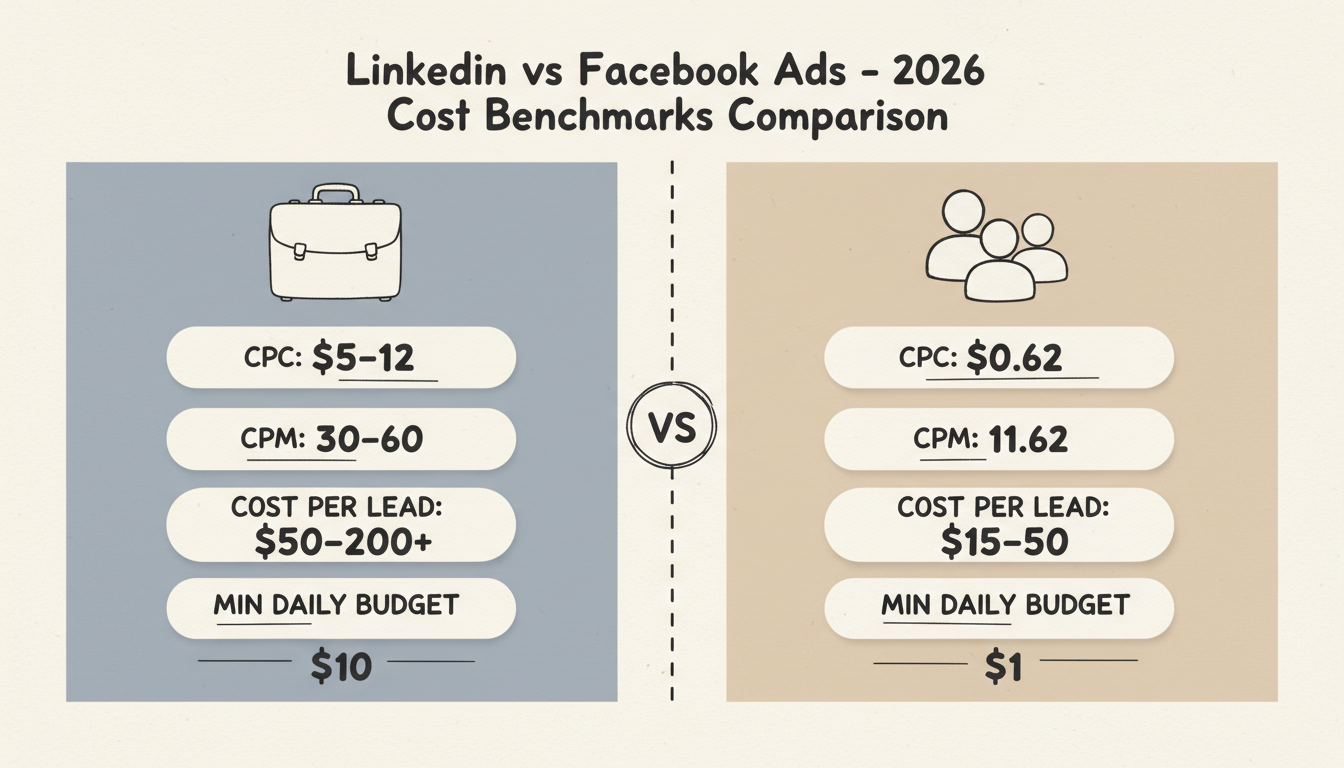
According to industry benchmarks, here's how LinkedIn and Facebook compare:
Metric | ||
Average CPC | $5-12 | $0.62 |
Average CPM | $30-60 | $11.62 |
Cost Per Lead | $50-200+ | $15-50 |
Minimum Daily Budget | $10 | $1 |
On surface metrics, Facebook wins decisively. But these numbers don't tell the full story.
Why LinkedIn Costs More
Premium Professional Audience
LinkedIn's 1 billion members include verified decision-makers with self-reported professional data. You're paying for:
- Accurate job titles: Target "VP of Marketing" specifically
- Verified company information: Reach employees at named accounts
- Professional context: Users are in business mindset
- Limited inventory: Fewer ad placements than Facebook
Smaller Audience Pool
Facebook has 3+ billion users; LinkedIn has 1 billion. Smaller inventory means more competition for impressions among B2B advertisers.
According to 2025 benchmarks, LinkedIn CPMs increased 28% year-over-year as more B2B budgets shifted to the platform. LinkedIn now captures 39% of B2B paid media budgets.
The Real Cost Comparison: CPL and Pipeline
Per-Click vs per-Lead
A $10 LinkedIn click that converts to a lead costs $10 per lead if 100% convert. A $1 Facebook click that converts 5% costs $20 per lead.
According to Social Rails' analysis, LinkedIn costs 5-10x more per click, but that doesn't mean it costs more per sale. For B2B, calculate cost per qualified lead, not cost per click.
Lead Quality Matters
Factor | ||
Data accuracy | Self-reported, verified | Inferred, estimated |
Professional context | Users in business mode | Users in personal mode |
Decision-maker access | Direct | Harder to reach |
Lead qualification | Higher baseline quality | Requires more filtering |
A LeadsBridge benchmark study shows LinkedIn Lead Gen Forms achieve higher form completion rates with pre-filled professional data that's actually accurate.
Detailed Cost Breakdown by Format
LinkedIn Advertising Costs (2026)
According to LeadsBridge benchmarks:
Format | Cost Range |
CPC (Sponsored Content) | $5-9 for decision-makers |
CPM | $30-60 |
Cost Per Send (Messages) | $0.25-1.50 |
CPL (Lead Gen Forms) | $50-200+ |
Additional 2026 benchmarks show:
- Document Ads CPL (US): $255.81
- Single Image CPL (US): $317.36
- Document Ads form completion rate: 22.73%
- Video Ads form completion rate: 2.26%
Facebook Advertising Costs (2026)
According to Neal Schaffer's research:
Metric | Range |
CPC | $0.32-1.68 |
CPM | $4.43-15+ |
CPL | Varies widely by niche |
Facebook costs vary significantly by industry, targeting, and season.
Targeting Comparison
Where LinkedIn Wins
According to platform comparison data:
Targeting Capability | ||
Job title | [star][star][star][star][star] | [star][star] |
Specific companies | [star][star][star][star][star] | [star][star] |
Industry | [star][star][star][star][star] | [star][star][star] |
Seniority level | [star][star][star][star][star] | [star][star] |
Where Facebook Wins
Targeting Capability | ||
Interests/hobbies | [star][star][star] | [star][star][star][star][star] |
Purchase behavior | [star][star] | [star][star][star][star][star] |
Demographics | [star][star][star] | [star][star][star][star][star] |
Lookalike audiences | [star][star][star] | [star][star][star][star][star] |
Retargeting | [star][star][star][star] | [star][star][star][star][star] |
When to Use Each Platform
Choose LinkedIn When
Targeting specific B2B roles: If you need to reach "IT Directors at mid-market financial services companies," only LinkedIn delivers.
High-value offerings ($5K+): When customer lifetime value is high, LinkedIn's premium CPLs make sense. According to Social Rails, LinkedIn's precision often wins for B2B when measuring cost per qualified lead.
Account-based marketing: Upload company lists and reach employees at specific target accounts. For advanced ABM strategies, comprehensive LinkedIn advertising targeting options enable precision audience segmentation.
Bottom-of-funnel campaigns: Research shows LinkedIn excels at deal acceleration and conversion (BOFU).
Choose Facebook When
Top-of-funnel awareness: Facebook delivers massive reach at low CPMs for brand building.
Broader professional audiences: When you don't need precise job titles, Facebook's scale wins.
Budget constraints: With limited budget, Facebook lets you test more variations and audiences.
Retargeting campaigns: Facebook's pixel and lookalike capabilities are more mature.
The Hybrid Approach
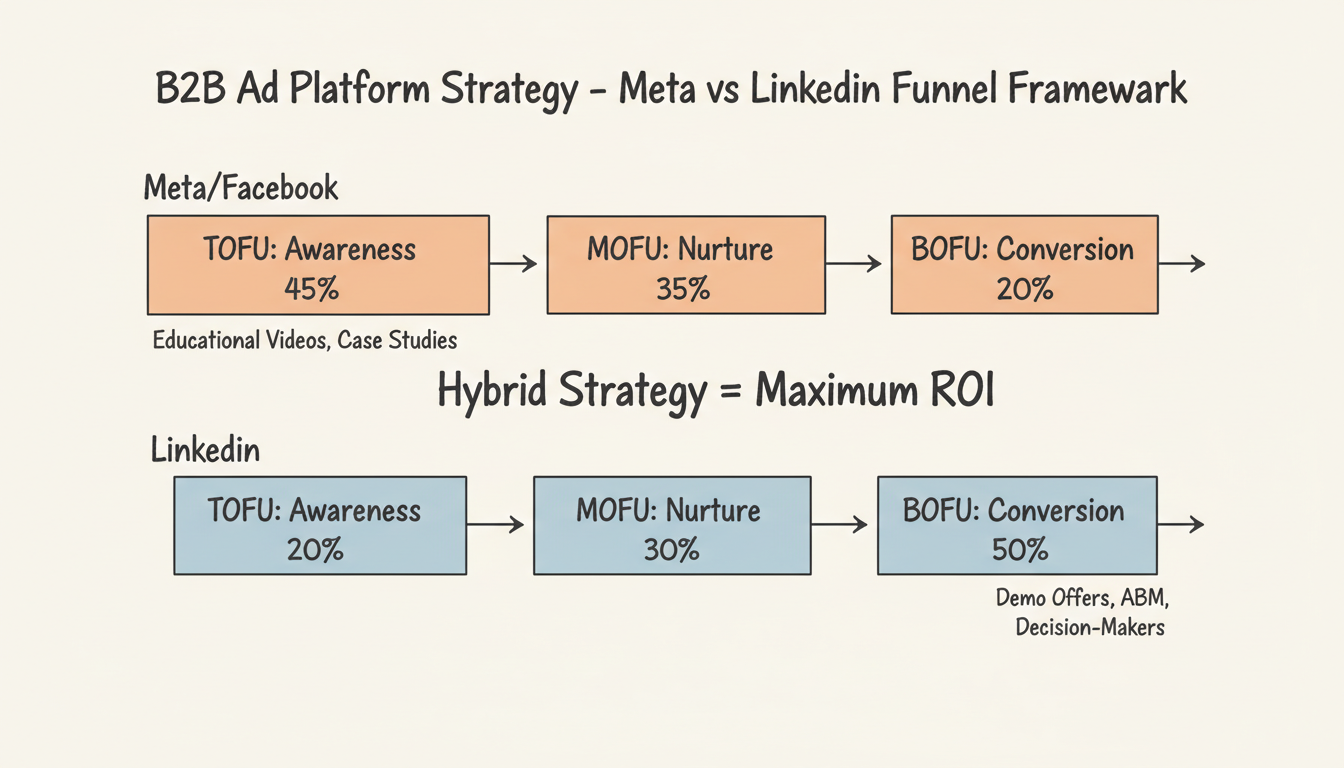
According to 2026 ABM benchmarks, top performers use both platforms strategically:
Meta (Facebook/Instagram) Strengths
- TOFU & MOFU campaigns
- Educational videos
- Case studies
- Retargeting
- Budget allocation: Awareness (45%) | Nurture (35%) | Conversion (20%)
LinkedIn Strengths
- BOFU campaigns
- Demo offers
- Decision-maker messaging
- ABM
- Budget allocation: Awareness (20%) | Nurture (30%) | Conversion (50%)
The highest ROI doesn't come from choosing one platform - but from combining Meta for demand creation and LinkedIn for demand capture.
Real-World Cost Example
Scenario: Selling $50,000 Enterprise Software to Ctos
Facebook approach:
- CPC: $1
- CTR to page: 3%
- 1,000 clicks = $1,000
- Estimated qualified leads: 5 (CTOs are hard to target)
- Cost per qualified lead: $200
LinkedIn approach:
- CPC: $10
- CTR to lead form: 10%
- 100 clicks = $1,000
- Qualified leads (targeting CTOs directly): 8
- Cost per qualified lead: $125
Despite 10x higher CPC, LinkedIn delivers lower cost per qualified lead because targeting precision eliminates waste. Working with a LinkedIn lead generation agency can help optimize these numbers further through expert campaign management.
Budget Allocation Guidelines
Under $5,000/Month
Focus on one platform. If targeting specific roles, LinkedIn. If building awareness, Facebook.
$5,000-15,000/Month
Split 70/30: Primary platform gets 70%, test the other with 30%.
$15,000+/Month
Run both platforms strategically:
- Facebook for awareness and retargeting
- LinkedIn for conversion and ABM
Measuring What Matters
Don'T Compare
- CPC across platforms (meaningless)
- Raw lead volume (quality varies)
- Surface-level metrics
Do Compare
- Cost per qualified lead
- Cost per opportunity
- Cost per customer
- Pipeline generated
- Revenue attributed
Set up conversion tracking on both platforms and track leads through your CRM to measure true cost comparison. Effective LinkedIn ads reporting provides the attribution data needed to calculate true ROI across platforms.
The Real Cost Comparison: CPL and Pipeline
Cost per lead lies when the lead is unqualified, so read the cost per qualified pipeline instead. A platform with a higher CPL but a better-fit buyer can beat a cheaper one on the number that matters, so the comparison must follow the buyer to the outcome. The honest read weights the result, not the click.
Use a fixed query list per platform and record presence and outcome, because the separate reads reveal where the efficiency lives. The split is the actionable signal, and a blended average hides it, so the discipline of per-platform checking is what makes the comparison real rather than a rounding error.
When to Use Each Platform
Use Facebook for the visual researcher and LinkedIn for the professional evaluator, because the intent differs by surface, and the format should follow. The honest plan funds each by stage, because picking one and ignoring the other leaves a gap the competitor fills. The sequence is the strategy, not the slogan.
Start with the cheaper proof. A tight Facebook campaign on high-intent audiences returns faster than a broad LinkedIn buy, so prove the message there first, then use the professional network to reach the evaluator. The order protects the dollar and teaches the offer before the premium spend begins.
The Hybrid Approach and Allocation
Run them as a path, not two silos. Facebook warms the buyer; LinkedIn catches the evaluator; the combined view shows assisted conversions that last-click misses. The joined read is what justifies the LinkedIn spend, because the Facebook win often started with a Facebook impression weeks earlier, and the framing is the honest one.
Allocate by where the buyer researches, not by reputation. A surface dominant in a category you do not serve is less relevant than a smaller one your buyers live in, so read the data against your own mix. The allocation follows the buyer, and the evidence from the checks sets it, not the market hype around either name.
Frequently Asked Questions
Is LinkedIn or Facebook Better for B2B Advertising?
It depends on your targeting needs and budget. LinkedIn delivers better results when you need to reach specific job titles, companies, or decision-makers - but costs 5-10x more per click. Facebook offers better reach and lower costs for broader awareness campaigns. Most successful B2B advertisers use both: Facebook for demand creation (TOFU) and LinkedIn for demand capture (BOFU).
Why Is LinkedIn Advertising So Much More Expensive Than Facebook?
LinkedIn's premium costs reflect its unique value: verified professional data, access to decision-makers, and a business-focused user base. With 1 billion users versus Facebook's 3+ billion, LinkedIn has less inventory and more competition among B2B advertisers. CPMs have increased 28% year-over-year as more B2B budgets shift to the platform.
Can Facebook Ads Work for B2B?
Yes. Facebook's massive scale and advanced targeting (interests, behaviors, lookalikes) can reach B2B audiences effectively, especially for awareness and nurture campaigns. However, Facebook relies on inferred professional data rather than LinkedIn's self-reported information, so targeting precision is lower. Many B2B companies use Facebook for top-of-funnel and retargeting while reserving LinkedIn for conversion campaigns. For teams new to the platform, investing in LinkedIn ads training helps maximize campaign performance from day one.