
Facebook Ads Objectives: All 6 Meta Campaign Goals for 2026
Selecting the right Facebook ads objective is the most important decision you make when creating Facebook ads. Your objective tells Meta what result you want, and the platform optimizes every aspect of ad delivery to achieve that goal. Choose the wrong objective and you'll waste budget reaching people who never take the action you actually want.
This guide explains all six Facebook ads objectives available in 2026, when to use each one, and how to match your Facebook ads objectives to the marketing funnel.
Objective Types
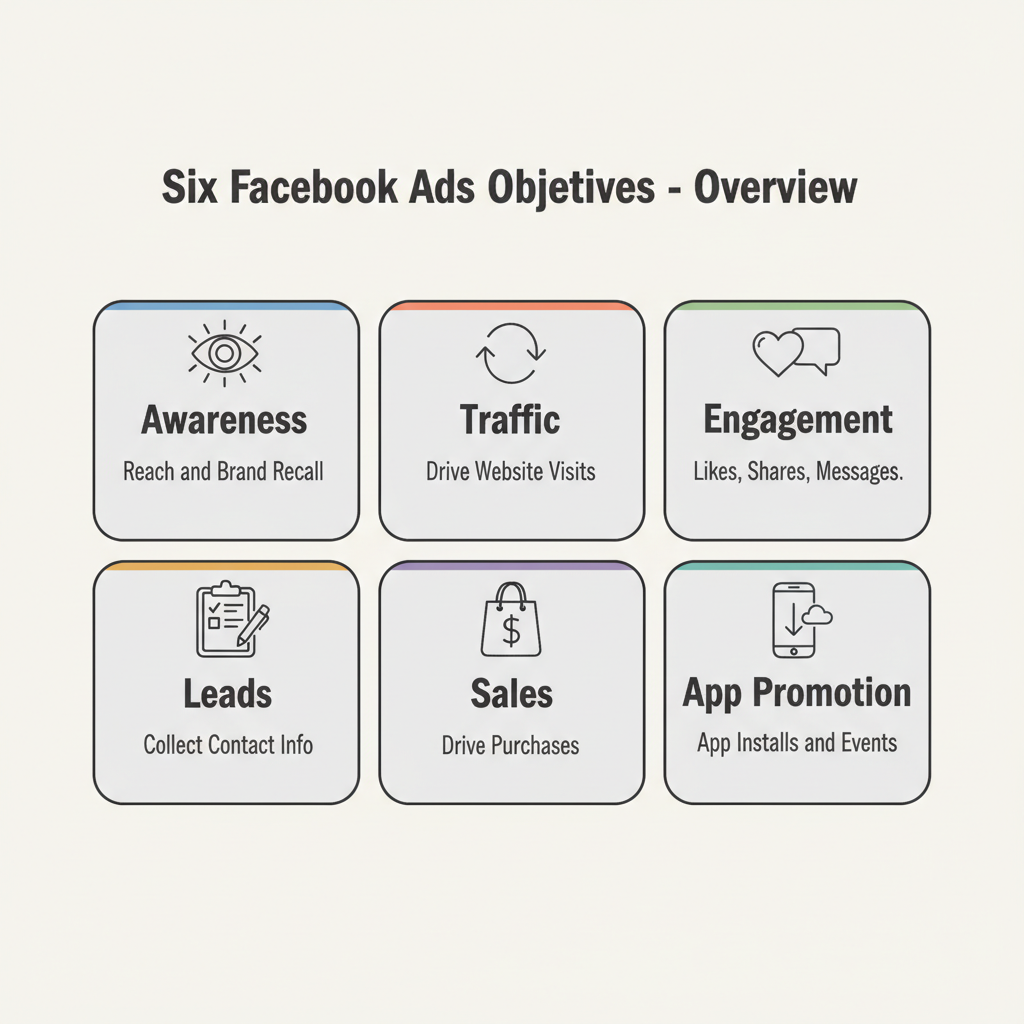
Meta consolidated its original 11 objectives into 6 streamlined options as part of the Outcome-Driven Ad Experiences (ODAX) update. Here are all six Facebook ads objectives and when to use each one.
Awareness
The Awareness objective maximizes how many people see your ad. Meta optimizes for reach and brand recall, showing your ads to users most likely to remember them.
Formerly included:
- Brand Awareness
- Reach
- Video Views
- Store Traffic
Best for:
- Launching a new brand or product
- Building name recognition in a new market
- Promoting a local store or event
- Top-of-funnel campaigns
Performance goals available:
- Maximize reach
- Maximize brand awareness
- Maximize ad recall lift
Example: A new fitness studio running ads to introduce themselves to people within 10 miles of their location.
Traffic
The Traffic objective sends people to a destination—your website, app, or Messenger conversation. Meta optimizes for link clicks or landing page views.
Best for:
- Driving visitors to blog posts or content
- Sending people to product pages
- Growing website traffic for retargeting
- Promoting a landing page when you can't track conversions
Performance goals available:
- Maximize link clicks
- Maximize landing page views
Important note: Traffic campaigns optimize for clicks, not conversions. People who click may not buy, so use this objective when you cannot track sales or leads on your website, or when you specifically need traffic volume.
Example: A SaaS company driving visitors to a blog post to build their retargeting audience.
Engagement
The Engagement objective gets people to interact with your content through likes, comments, shares, messages, or video views.
Formerly included:
- Engagement (post engagement)
- Messages
- Video Views
- Conversions (event responses)
Best for:
- Growing social proof on posts
- Starting Messenger conversations
- Getting video views for awareness
- Promoting events
- Building engagement for future remarketing
Performance goals available:
- Maximize engagement
- Maximize video views
- Maximize messages
Example: An e-commerce brand promoting a product video to build an audience of viewers they can retarget with Sales campaigns.
Leads
The Leads objective collects contact information from potential customers. This objective works with lead forms that keep users on Facebook, or with conversion tracking on your website.
Best for:
- Building email lists
- Collecting phone numbers for sales calls
- Generating quote requests
- Webinar registrations
- Any business where getting contact info is the first step
Performance goals available:
- Maximize lead conversions
- Maximize conversion leads (higher quality)
Pro tip: The "Conversion Leads" performance goal uses your CRM data to optimize for leads most likely to become customers, not just people who fill out forms.
Example: A B2B software company collecting demo requests through an instant form that stays on Facebook.
Sales
The Sales objective drives purchases, sign-ups, or other valuable conversion actions. This is the most powerful objective for businesses selling products or services online.
Formerly included:
- Conversions
- Catalog Sales
Best for:
- E-commerce product sales
- Service bookings
- Subscription sign-ups
- Any business tracking purchases with the Meta Pixel
Performance goals available:
- Maximize conversions
- Maximize conversion value (optimize for revenue, not just conversion count)
Important: Sales campaigns require proper conversion tracking through the Meta Pixel and/or Conversions API. Without tracking, Meta cannot optimize delivery.
Example: An online retailer running dynamic product ads that automatically show users items they viewed on the website.
App Promotion
The App Promotion objective drives mobile app installs and in-app actions.
Best for:
- Mobile app launches
- Growing app user base
- Re-engaging lapsed app users
- Driving specific in-app events
Performance goals available:
- Maximize app installs
- Maximize app events
Example: A gaming company running ads to drive downloads of their new mobile game.
When to Use Each
Matching your Facebook ads objective to your actual business goal is critical. Here's a quick reference:
Your Goal | Use This Objective |
Get my brand seen by new people | Awareness |
Drive visitors to my website | Traffic |
Get comments, shares, video views | Engagement |
Collect contact information | Leads |
Make sales online | Sales |
Get app downloads | App Promotion |
Decision Framework
Ask yourself these questions to choose correctly:
- Can I track the final action on my website? If yes, use Sales or Leads. If no, use Traffic or Engagement.
- What's the value of each result? If leads or sales vary in value, use "maximize value" goals instead of "maximize conversions."
- Where is my audience in the buying journey? Cold audiences often need Awareness or Traffic first; warm audiences convert better with Leads or Sales.
Traffic vs Engagement vs Sales: Comparing Performance Goals
One of the most common questions about Facebook ads objectives is whether to optimize for value or conversions, and which objective delivers the best results for your specific situation. The answer depends on your conversion volume, average order value, and where your audience sits in the buying journey.
Performance Goal: Value vs Conversions
When using the Sales objective, Meta offers two paths: "Maximize conversions" finds the most buyers at the lowest cost per acquisition. "Maximize conversion value" prioritizes high-value orders and optimizes for total revenue instead of transaction count.
Use value optimization when your products have a wide price range and you want Meta to prioritize customers who spend more.
To use value optimization effectively, you need to pass purchase values through the Meta Pixel or Conversions API. Meta's algorithm then learns which audience segments generate the highest ROAS and allocates budget accordingly.
When to Choose Each Objective
Use this reference to identify the best Facebook ads objective for your specific scenario.
Scenario | Best Objective | Why |
No Pixel tracking installed | Traffic | Cannot optimize for conversions without tracking |
Want social proof and shares | Engagement | Optimizes for interactions, not clicks or purchases |
E-commerce with Pixel active | Sales | Finds actual buyers, not just clickers |
High-value products with price variance | Sales (value optimization) | Prioritizes revenue over transaction count |
Building retargeting audiences | Traffic or Engagement | Generates volume for future remarketing |
Landing page views matter most | Traffic (landing page views) | Filters out accidental clicks, counts only page loads |
Key takeaway: If you can track conversions, always test Sales against Traffic. In most cases, Sales campaigns deliver a lower cost per acquisition even though the CPM is higher, because Meta targets people with purchase intent rather than click intent.
Audience Targeting and Ad Set Structure
Your Facebook ads objective determines what Meta optimizes for, but your audience targeting determines who sees the ads. Combining the right objective with the right audience is what separates profitable campaigns from wasted spend.
Custom Audiences
Custom audiences let you retarget people who already know your brand. Create them from website visitors (via Meta Pixel), email lists, app users, or people who engaged with your Facebook content. They work best with Sales and Leads objectives.
Common custom audience sources:
- Website visitors (last 30, 60, or 180 days)
- Email or phone number lists from your CRM
- People who watched a percentage of your videos
- Users who interacted with your Facebook page or Instagram profile
Lookalike Audiences
Lookalike audiences find new people who resemble your best customers. Meta analyzes your source audience—such as purchasers or top leads—and finds similar users who haven't interacted with your brand. Start with a 1% lookalike for the closest match.
Best practices for lookalike audiences:
- Use your highest-value customers as the source, not all website visitors
- Create separate lookalikes from purchasers, leads, and engaged users
- Pair lookalike audiences with the Sales or Leads objective for best results
- Refresh your source audience quarterly to keep it current
Interest Targeting
Interest-based targeting reaches cold audiences using their behaviors, demographics, and interests on Meta. Use it when you lack customer data for lookalikes, and pair it with Awareness or Traffic Facebook ads objectives before switching to Sales or Leads.
Ad Set Structure Best Practices
How you organize your ad sets directly affects how quickly Meta exits the learning phase and starts delivering consistent results. Campaign consolidation is the recommended approach: fewer ad sets with larger budgets perform better than many ad sets with small budgets.
Guidelines for structuring ad sets:
- Aim for 50 or more conversion events per ad set per week to exit the learning phase
- Combine similar audiences into one ad set instead of splitting them
- Use Campaign Budget Optimization (CBO) to let Meta allocate spend across ad sets automatically
- Limit yourself to 3-5 ad sets per campaign for most account sizes
Advantage+ Shopping Campaigns
Advantage+ Shopping campaigns are Meta's fully automated campaign type designed for e-commerce advertisers. Unlike manual Facebook ads objectives where you choose audiences, placements, and budgets per ad set, Advantage+ Shopping removes most manual controls and lets Meta's machine learning handle targeting decisions.
How Advantage+ Shopping works:
- You provide creative assets and a daily budget
- Meta automatically tests creative combinations across all placements
- The algorithm targets both new and existing customers, allocating budget to whoever is most likely to convert
- You can set a cap on the percentage of budget spent on existing customers
When to use Advantage+ Shopping vs manual Sales campaigns:
- Use Advantage+ Shopping when you have strong creative variety (10+ ads) and want maximum automation
- Use manual Sales campaigns when you need tight audience control, have specific exclusions, or want to test individual audience segments
- Many advertisers run both in parallel: Advantage+ Shopping for broad prospecting and manual campaigns for specific retargeting segments
Advantage+ Shopping typically exits the learning phase faster because it consolidates all targeting into a single ad set structure, giving Meta more data to optimize against.
Testing and Optimization
Choosing a Facebook ads objective is the starting point. Ongoing testing determines whether you picked the right one and helps you improve results over time.
A/B Testing Objectives
Meta's built-in A/B testing tool (Experiments) lets you compare two campaigns with different objectives against each other. This is the only reliable way to determine which of your Facebook ads objectives performs better for your specific product and audience.
How to set up an objective A/B test:
- Create two campaigns with identical budgets, creative, and targeting
- Set one to Traffic (optimize for landing page views) and the other to Sales (optimize for conversions)
- Run both for at least 7 days with sufficient budget to generate 50+ conversions
- Compare cost per result, ROAS, and conversion volume
Common findings from A/B tests: Sales campaigns usually win on cost per acquisition for warm audiences. Traffic campaigns sometimes win for cold audiences with low brand awareness, where the algorithm needs click data before it can optimize for conversions.
A/B test your Facebook ads objectives before scaling. In most accounts, Sales campaigns outperform Traffic campaigns on cost-per-acquisition for warm audiences — but Traffic wins for cold audiences with low brand awareness where click data helps Meta calibrate before optimizing for conversions.
The Learning Phase
Every new campaign, ad set, or significant edit enters the learning phase. During this period, Meta's delivery system explores different audiences and placements to find the most efficient way to deliver your desired result. Performance is typically unstable and costs are higher during the learning phase.
Key facts about the learning phase:
- It lasts until the ad set generates approximately 50 optimization events in a 7-day window
- Significant edits (budget changes over 20%, new creative, audience changes) reset the learning phase
- Ad sets stuck in "Learning Limited" status are not getting enough conversions to optimize properly
- If an ad set stays in Learning Limited, broaden your audience, increase budget, or switch to an optimization event that occurs more frequently
Choosing the right objective directly impacts how quickly you exit the learning phase. If your Sales campaign gets only 10 purchases per week, consider optimizing for "Add to Cart" instead, or switch to a Traffic objective until you build enough volume.
Value Optimization and ROAS
Return on ad spend (ROAS) measures revenue per dollar of ad spend. A ROAS of 4.0x means you earn $4 for every $1 spent. Value optimization in Sales tells Meta to maximize total ROAS, not just conversion count.
Requirements for value optimization:
- You must pass dynamic purchase values through the Meta Pixel or Conversions API
- Your product catalog should have a meaningful price range (value optimization matters less if all products cost the same)
- The ad set needs sufficient conversion volume (50+ per week) to learn which users generate higher order values
When value optimization works well, Meta shifts budget toward audience segments that place larger orders. This often means fewer total conversions but higher total revenue and better ROAS. To master campaign structure for maximum ROAS, explore our Meta ads funnel strategy guide.
Tracking and Measurement
Accurate tracking is the foundation of effective Facebook advertising. Without it, Meta cannot optimize delivery and you cannot measure true performance.
UTM Tracking for Facebook Ads
UTM parameters let you track exactly which campaigns, ad sets, and ads drive traffic in Google Analytics. Add UTM parameters to every destination URL so you can compare Facebook ad performance alongside other channels.
Recommended UTM structure for Facebook ads:
- utm_source: facebook
- utm_medium: paid-social
- utm_campaign: {campaign name or ID}
- utm_content: {ad name or creative variant}
- utm_term: {audience or ad set name}
Meta Ads Manager also supports dynamic UTM parameters using URL tags like {{campaign.name}} and {{adset.name}} that auto-populate with your actual campaign names.
Key Metrics by Objective
Each objective has different success metrics. Tracking the wrong metric leads to poor optimization decisions.
Objective | Primary Metric | Secondary Metrics |
Awareness | Reach, Ad Recall Lift | CPM, Frequency |
Traffic | Link Clicks, Landing Page Views | CPC, CTR, Bounce Rate |
Engagement | Post Engagement, Video Views | Cost Per Engagement, ThruPlay Rate |
Leads | Leads, Cost Per Lead | Lead Form Completion Rate, Lead Quality Score |
Sales | Purchases, ROAS | CPA, Conversion Rate, AOV |
App Promotion | App Installs, Cost Per Install | In-App Events, Day 7 Retention |
When reviewing campaign performance, always compare your metrics against current Facebook ads benchmarks for your industry. Cross-industry averages: CTR of 0.9%, CPM of $14.90, CPC of $1.72, and a target ROAS of 4x or higher for e-commerce. Significant deviation from these baselines signals an objective mismatch, audience problem, or creative fatigue.
iOS 14+ and Privacy Changes
Apple's App Tracking Transparency (ATT) framework significantly changed how Meta tracks conversions from iOS devices. Advertisers must adapt their tracking setup to maintain accurate measurement.
What changed with iOS 14+:
- Users can opt out of cross-app tracking, reducing the data Meta receives
- Meta introduced Aggregated Event Measurement (AEM) which limits you to 8 prioritized conversion events per domain
- Conversion reporting may be delayed up to 72 hours for iOS users
- View-through attribution windows were reduced
How to adapt:
- Install the Conversions API alongside the Meta Pixel for server-side tracking that bypasses browser restrictions
- Verify your domain in Meta Business Manager
- Prioritize your 8 conversion events carefully (put Purchase at the top)
- Use the Facebook SDK for app install campaigns to enable SKAdNetwork reporting
- Consider broader audience targeting since detailed tracking is less reliable on iOS
Funnel Mapping
Different Facebook ads objectives work best at different stages of the customer journey.
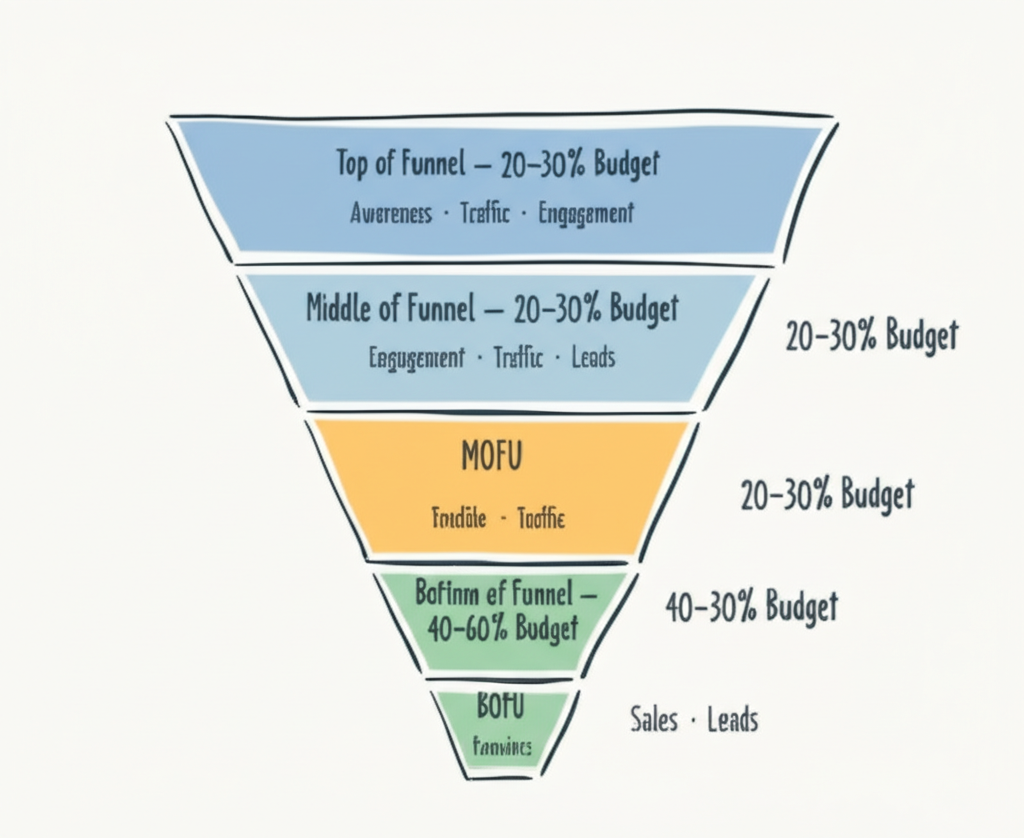
Top of Funnel (TOFU) - Awareness Stage
Goal: Introduce your brand to people who don't know you
Best objectives:
- Awareness - Maximize reach to cold audiences
- Traffic - Drive visitors to educational content
- Engagement - Build video view audiences for remarketing
Recommended budget allocation: 20-30% of total ad spend
Middle of Funnel (MOFU) - Consideration Stage
Goal: Nurture interested prospects toward a decision
Best objectives:
- Engagement - Start conversations via Messenger
- Traffic - Send visitors to comparison pages, case studies
- Leads - Collect information for email nurturing
Recommended budget allocation: 20-30% of total ad spend
Bottom of Funnel (BOFU) - Decision Stage
Goal: Convert warm prospects into customers
Best objectives:
- Sales - Drive purchases from retargeting audiences
- Leads - Collect high-intent requests (demos, quotes)
Recommended budget allocation: 40-60% of total ad spend
Full-Funnel Example
A software company might structure campaigns like this:
- Awareness campaign targeting broad interests → builds audiences
- Traffic campaign retargeting video viewers → drives them to blog content
- Leads campaign retargeting website visitors → collects demo requests
- Sales campaign retargeting demo requesters → closes trials
Common Mistakes
Avoid these Facebook ads objectives selection errors that waste budget and deliver poor results.
Mistake 1: Using Traffic When You Want Sales
Traffic campaigns find clickers—not buyers. Meta shows your ads to frequent clickers who rarely purchase. For conversions, use the Sales objective with Meta Pixel. Understanding how to calculate ROI for Facebook ads helps measure actual sales performance.
Fix: If you can track purchases with the Pixel, use the Sales objective.
Mistake 2: Choosing Awareness for Direct Response
Awareness campaigns maximize eyeballs, not actions. If you need sales or leads, Awareness will underdeliver because Meta optimizes for completely different behaviors.
Fix: Reserve Awareness for true brand-building campaigns where recall matters more than immediate action.
Mistake 3: Skipping Conversion Tracking Setup
The Sales and Leads objectives only work well when Meta can verify conversions. Without proper Pixel and Conversions API setup, Meta can't learn who converts and cannot optimize effectively. This is particularly critical when developing a comprehensive meta ads strategy that depends on accurate performance data.
Fix: Set up conversion tracking before launching Sales or Leads campaigns. Verify events are firing correctly in Events Manager.
Mistake 4: Mismatching Objective and Creative
Your ad creative should match your objective. Awareness campaigns need memorable branding; Sales campaigns need clear product benefits and CTAs.
Fix: Align creative with objective. Awareness gets storytelling; Sales gets product-focused offers.
Mistake 5: Starting with Sales on Cold Audiences
Cold audiences who've never heard of you rarely convert immediately. Jumping straight to Sales campaigns often results in expensive, low-converting traffic. If you're just getting started, learning how to create facebook ads for beginners will help you understand proper audience warming techniques.
Fix: Warm up audiences first with Awareness or Engagement campaigns, then retarget with Sales.
Key Takeaways
The most critical principles for selecting and optimizing your Facebook ads objectives across the customer journey.
- Use the Sales objective when you can track conversions with Meta Pixel — it finds buyers, not just clickers.
- Use Traffic or Engagement when you lack conversion tracking or are building retargeting audiences.
- Use Leads for B2B and service businesses that collect contact information as the first step in their funnel.
- Cold audiences need Awareness or Traffic first; warm audiences convert better with Sales or Leads.
- Exit the learning phase by generating 50+ optimization events per ad set per week.
- For high-value products with price variance, use value optimization in the Sales objective to maximize ROAS instead of conversion count.
Frequently Asked Questions
Common questions about Facebook ads objectives, the learning phase, and how to measure campaign performance.
What Are the 6 Facebook Ad Objectives?
The six Facebook ads objectives are Awareness, Traffic, Engagement, Leads, App Promotion, and Sales. Each tells Meta Ads Manager what result you want, and the algorithm optimizes delivery to achieve that goal.
Awareness maximizes reach, Traffic drives website visits, Engagement generates interactions, Leads collects contact information, App Promotion drives installs, and Sales optimizes for purchases.
Which Facebook Ad Objective Is Best for Beginners?
Start with the objective that matches your business model. E-commerce: use Sales. Services: use Leads. If unsure, Traffic is safer since it doesn't require conversion tracking. First, understand how Facebook ads are priced so you can budget appropriately.
Can I Change My Campaign Objective After Launching?
No, you cannot change the objective of an existing campaign. You'll need to create a new campaign with the correct objective and pause or delete the old one.
Why Is My Traffic Campaign Getting Clicks but No Sales?
Traffic campaigns optimize for clicks, not conversions. Meta shows your ads to people who click frequently, but frequent clickers aren't necessarily buyers. Switch to a Sales objective if you want purchases.
How Does the Learning Phase Affect My Facebook Ads?
The learning phase is when Meta's algorithm tests audiences and placements to find the best delivery strategy. Performance fluctuates and costs are higher until each ad set generates approximately 50 optimization events within 7 days.
If your ad set shows "Learning Limited" status, you are not generating enough conversions for Meta to optimize effectively. Fix this by broadening your audience, increasing your budget, or choosing a more frequent conversion event.
Should I Use Advantage+ Shopping or Manual Sales Campaigns?
Advantage+ Shopping works best with diverse creative assets (10+ ads) and when you want full automation. Manual Sales campaigns give more control over audience selection, exclusions, and budget per ad set.
Many advertisers run both: Advantage+ Shopping for broad prospecting and manual campaigns for specific retargeting. Start with manual Sales campaigns to learn how audiences interact with your chosen objective before enabling full automation.
How Do I Track ROAS for Facebook Ad Campaigns?
ROAS is total revenue divided by total ad spend. To track it accurately, pass purchase values through the Meta Pixel or Conversions API and add the "Purchase ROAS" column in Ads Manager.
For the most accurate measurement, implement UTM tracking and cross-reference Facebook-reported revenue with your analytics platform or e-commerce backend.