
Facebook Ads vs Google Ads: Which Is Better? (2026)
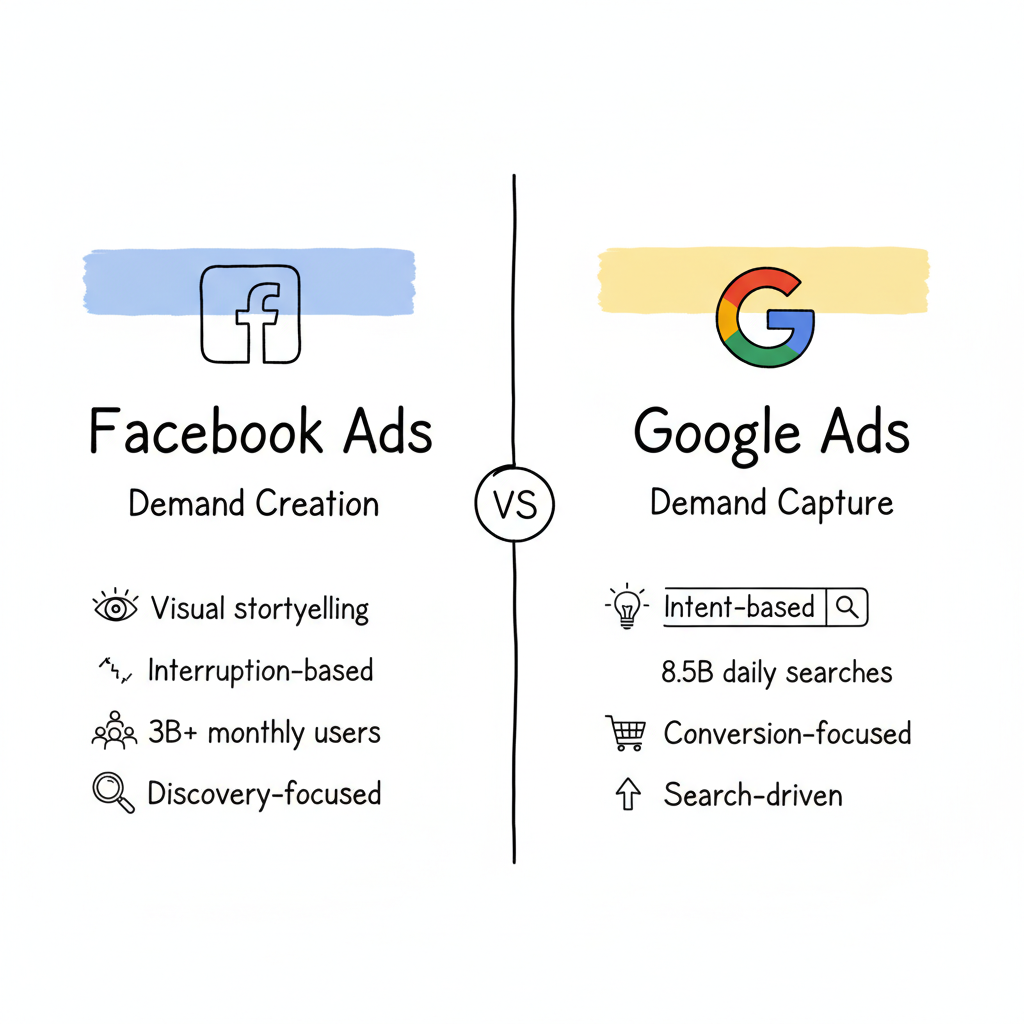
Choosing between Facebook Ads and Google Ads is one of the most important decisions advertisers face in 2026. Both platforms offer powerful pay-per-click (PPC) advertising capabilities, but they serve fundamentally different purposes in the customer journey. Facebook Ads excels at creating demand through visual storytelling and precise demographic targeting, while Google Ads captures existing demand from users actively searching for solutions.
This comprehensive comparison breaks down everything you need to know about Facebook Ads vs Google Ads—from costs, conversion rates, and customer acquisition cost (CAC) to targeting capabilities, AI-powered automation, and best use cases—so you can make an informed decision for your business.
Whichever platform you choose, our free Meta Ads course can help you master Meta's advertising ecosystem from the ground up.
Platform Overview
Understanding the core differences in this Facebook Ads vs Google Ads comparison is essential before diving into specific platform analysis.
Facebook Ads (Meta Ads)
Facebook Ads, now officially part of what are meta ads ecosystem, allows advertisers to reach users across Facebook, Instagram, Messenger, and the Audience Network. The platform's strength lies in its 3 billion+ monthly active users and the extensive demographic, behavioral, and interest-based data it collects.
Key characteristics of Facebook Ads include:
- Interruption-based advertising: Users aren't actively searching for products—they're scrolling through social content
- Visual-first format: Images and videos are central to ad creative
- Broad reach: Access to Facebook, Instagram, Messenger, and partner networks
- Discovery-focused: Ideal for introducing products to audiences who don't know they need them yet
Google Ads
Google Ads operates across Search, Display Network (reaching over 90% of internet users across 35+ million websites), YouTube, and Shopping. The platform captures users at the moment of intent—when they're actively searching for products, services, or information.
Key characteristics of Google Ads include:
- Intent-based advertising: Users are actively searching for solutions
- Text and visual options: Search ads are text-based; Display and YouTube offer visual formats
- Massive reach: Google processes 8.5 billion searches daily
- Conversion-focused: Captures demand rather than creating it
Cost Comparison
One of the biggest factors in the Facebook Ads vs Google Ads debate is cost. Understanding the average cost of facebook ads can help you budget effectively. Here's how the platforms compare in 2026:
Average Cost per Click (CPC)
Facebook Ads average CPC is $0.62 versus Google Search Ads at $2.69. Facebook is cheaper per click, but Google drives higher purchase intent, which often produces better conversion rates.
Platform | Average CPC | Typical Range |
Facebook Ads | $0.62 | $0.51 - $1.50 |
Instagram Ads | $1.17 | $0.70 - $2.00 |
Google Search Ads | $2.69 | $1.00 - $50+ |
Google Display Network | $0.63 | $0.30 - $1.00 |
Average Cost per Thousand Impressions (CPM)
Facebook Ads CPM averages $11.54 globally; Google Display Network averages $3.12. Facebook charges more per 1,000 impressions but delivers superior audience precision.
Platform | Average CPM | Notes |
Facebook Ads | $11.62 | US market averages $17-23 |
Instagram Ads | $12.19 | Slightly higher than Facebook |
Google Display Network | $3.12 | Lowest CPM option |
YouTube Ads | $4-$10 | Varies by ad format |
Key insight: Facebook Ads average CPM is $11.54 versus Google Display Network at $3.12. For brand awareness campaigns targeting broad audiences, Facebook delivers more cost-efficient impressions per dollar.
Cost by Industry
Both platforms see significant cost variations by industry. If you're wondering how much to run ads on facebook for your specific sector, these benchmarks provide helpful guidance:
Facebook Ads CPC by Industry:
- Finance & Insurance: $3.77
- B2B: $2.52
- Legal Services: $1.81
- Retail: $0.70
- E-commerce: $0.45
Google Ads CPC by Industry (USD):
- Legal: $6.75
- Consumer Services: $6.40
- Finance & Insurance: $3.44
- B2B: $3.33
- E-commerce: $1.16
The bottom line: Facebook Ads typically offers lower CPCs across most industries, but Google Ads users often have higher purchase intent, which can lead to better conversion rates and ROAS despite higher costs.
Audience Targeting
Both platforms offer sophisticated targeting, but their approaches differ significantly. Mastering facebook ads targeting is crucial for campaign success.
Facebook Ads Targeting
Facebook's targeting leverages the extensive personal data users share on the platform. According to advertising experts, Facebook's targeting capabilities remain one of its significant advantages in 2026.
Core targeting options include:
- Demographics: Age, gender, education, job title, relationship status, life events
- Interests: Pages liked, activities, hobbies, entertainment preferences
- Behaviors: Purchase behavior, device usage, travel patterns
- Custom Audiences: Upload customer lists, website visitors, app users
- Lookalike Audiences: Find users similar to your best customers using Meta's algorithm to identify shared traits, behaviors, and interests among your highest-value segments. Start with a 1% lookalike for precision or scale to 5-10% for broader reach.
Key strength: The Lookalike Audience feature is particularly powerful for finding users with characteristics similar to your existing customers.
Limitation: iOS 14.5 privacy changes have reduced some tracking capabilities, making first-party data more important than ever.
Google Ads Targeting
Google Ads targeting is built around user intent and contextual relevance:
Search Ads targeting:
- Keywords: Target specific search terms users are typing
- Location: Geographic targeting down to zip code level
- Demographics: Age, gender, household income
- Audiences: In-market audiences, affinity audiences, custom intent
Display Network targeting:
- Contextual: Ads appear on relevant content
- Placement: Choose specific websites
- Remarketing: Re-engage past website visitors
- Similar Audiences: Reach users similar to converters
Key strength: Intent-based targeting means you're reaching people actively searching for what you offer, leading to higher conversion rates for high-intent keywords.
Limitation: Less granular demographic data compared to Facebook.
Ad Formats
The platforms offer distinctly different creative options. Developing a strong meta ads creative strategy is essential for maximizing engagement and conversions.
Facebook Ads Formats
Meta's ecosystem supports highly visual, engaging ad formats:
- Image Ads: Single static image with copy
- Video Ads: Up to 240 minutes, though 15-30 seconds performs best. Video ads on Facebook average 2-3x higher engagement rates compared to static images.
- Carousel Ads: Multiple scrollable images or videos. Carousel ads typically achieve 20-30% higher CTR than single-image ads, making them ideal for showcasing product catalogs or telling a sequential story.
- Collection Ads: Immersive mobile shopping experience
- Stories Ads: Full-screen vertical format
- Reels Ads: Short-form video placement
- Instant Experience: Full-screen interactive ads
- Dynamic Ads: Automatically personalized product ads
Best for: Brands with strong visual assets, products that benefit from lifestyle imagery, and advertisers who want creative flexibility.
Google Ads Formats
Google offers formats optimized for different campaign objectives:
Search Ads:
- Responsive Search Ads: Multiple headlines and descriptions that Google tests
- Call Ads: Mobile-only ads that generate phone calls
- Dynamic Search Ads: Automatically generated based on website content
Display & Video:
- Responsive Display Ads: Automatically adjust size and format
- Image Ads: Standard banner formats
- YouTube Video Ads: Skippable, non-skippable, bumper, and overlay formats
- Shopping Ads: Product images with prices in search results. Google Shopping campaigns are particularly effective for e-commerce, generating up to 85% of all retail search ad clicks with prominent visual placements at the top of search results.
- Performance Max: AI-driven cross-channel campaigns
Best for: Direct response campaigns, capturing high-intent traffic, and product-specific advertising.
Best Use Cases
Understanding when to use each platform in this Facebook Ads vs Google Ads comparison is crucial for maximizing your advertising ROI. Many businesses choose to work with a facebook ads marketing agency to navigate these strategic decisions.
When to Use Facebook Ads
Facebook Ads works best when you need to:
- Build brand awareness: Reach new audiences who don't know about your product yet
- Target specific demographics: Reach users by life events, interests, or behaviors
- Promote visual products: Fashion, home decor, food, lifestyle products
- Generate top-of-funnel leads: Capture interest before users are ready to buy
- Retarget website visitors: Re-engage people who've shown interest
- Launch new products: Introduce offerings to cold audiences
- Promote local businesses: Target users in specific geographic areas
Industries that thrive on Facebook Ads:
- E-commerce and retail
- Real estate
- Restaurants and hospitality
- SaaS (for awareness and lead generation)
- Health and wellness
- Entertainment
When to Use Google Ads
Google Ads excels when you need to:
- Capture high-intent searchers: Reach users actively looking for your solution
- Drive immediate conversions: Convert users who are ready to buy
- Target specific search queries: Appear for exact product or service searches
- Compete for branded searches: Protect your brand from competitors
- Reach B2B decision-makers: Target users researching business solutions
- Promote local services: Appear in local search results
- Drive e-commerce sales: Use Shopping ads for product visibility
Industries that thrive on Google Ads:
- Professional services (legal, accounting, consulting)
- Home services (plumbing, HVAC, roofing)
- Healthcare
- B2B software and services
- Local businesses
- Travel and hospitality
When to Use Both Platforms
The most successful advertisers in 2026 don't choose one side in the Facebook Ads vs Google Ads debate—they use both strategically. For e-commerce businesses specifically, understanding google ads vs facebook ads ecommerce dynamics is particularly important. According to industry experts, combining the platforms creates a powerful full-funnel approach.
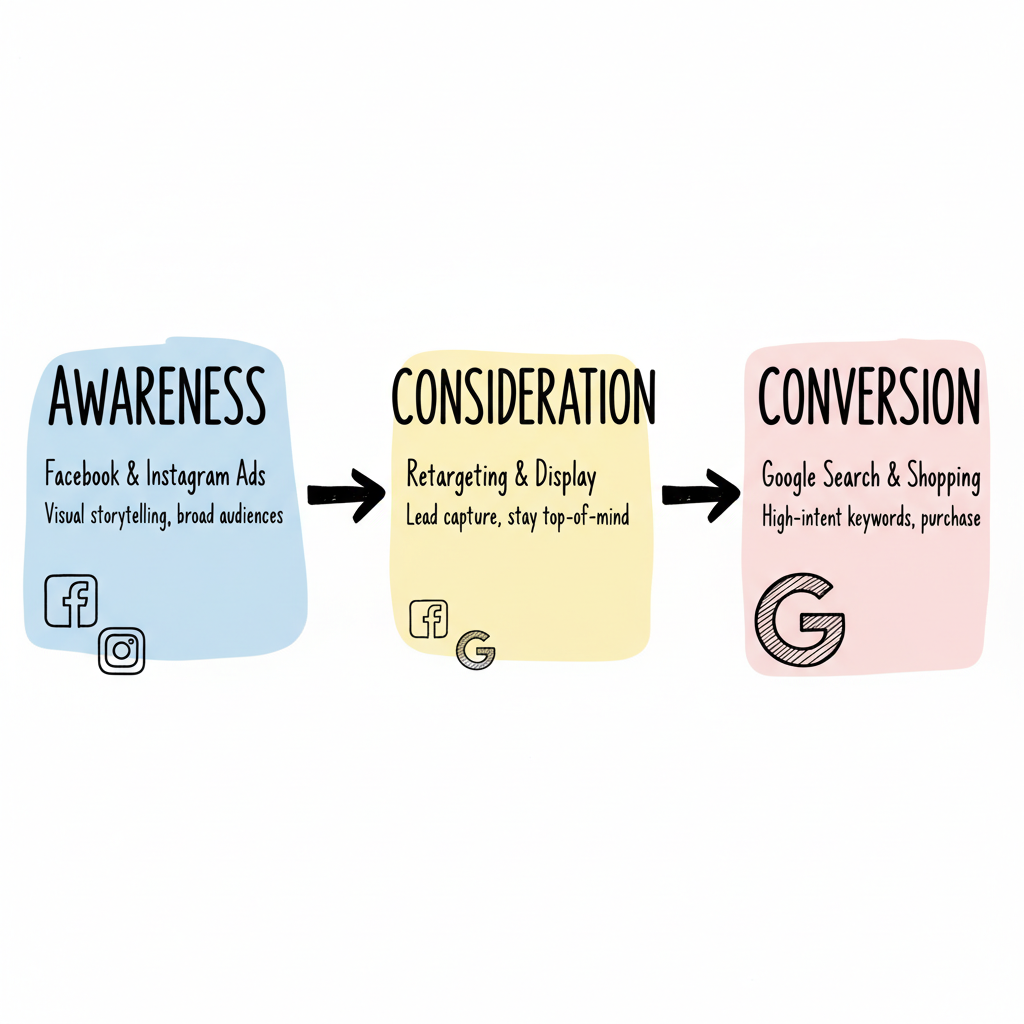
Full-Funnel Strategy
Here's how to integrate both platforms. If you're learning how to use meta ads instagram as part of your social strategy, it integrates seamlessly with this approach:
Top of Funnel (Awareness):
- Use Facebook/Instagram ads to introduce your brand
- Run YouTube ads for video storytelling
- Target broad audiences with compelling creative
Middle of Funnel (Consideration):
- Retarget Facebook video viewers with more detailed content
- Use Google Display to stay top-of-mind
- Create Facebook Lead Ads to capture contact information
Bottom of Funnel (Conversion):
- Run Google Search campaigns for high-intent keywords
- Use Facebook retargeting for website visitors who didn't convert
- Deploy Google Shopping ads for e-commerce
Budget Allocation
A common starting framework for using both platforms. Use a facebook ads cost calculator to estimate your investment across channels:
Business Type | Facebook Ads | Google Ads |
E-commerce (new brand) | 60% | 40% |
E-commerce (established) | 40% | 60% |
Local services | 30% | 70% |
B2B SaaS | 40% | 60% |
D2C consumer goods | 70% | 30% |
Adjust based on performance data and your specific customer journey. Understanding what is good roi facebook ads benchmarks helps you evaluate performance objectively.
How PPC Auction Mechanics Work on Each Platform
Both Facebook Ads and Google Ads operate on a pay-per-click (PPC) auction model, but the way each platform determines which ads to show—and how much to charge—differs significantly. Understanding these mechanics helps you optimize bids and reduce wasted spend.
Google Ads Auction: Quality Score and Ad Rank
Every time a user enters a search query, Google runs a real-time auction among all advertisers bidding on relevant keywords. Your ad's position is determined by Ad Rank, which is calculated as:
Ad Rank = Max CPC Bid x Quality Score
Quality Score (rated 1-10) is Google's assessment of three factors:
- Expected click-through rate (CTR): How likely users are to click your ad
- Ad relevance: How closely your ad matches the searcher's intent
- Landing page experience: How useful and relevant your landing page is to someone who clicks
Google uses a second-price auction model, meaning you don't pay your maximum bid. Instead, you pay just enough to beat the Ad Rank of the advertiser below you. This means a higher Quality Score directly lowers your actual CPC—advertisers with a Quality Score of 8+ often pay 30-50% less per click than competitors with a score of 5 or below.
Facebook Ads Auction: Total Value Score
Facebook's auction runs each time there's an opportunity to show an ad to a user. Instead of Quality Score, Facebook calculates a Total Value Score:
Total Value = Advertiser Bid x Estimated Action Rate x Ad Quality
- Advertiser Bid: Your maximum bid (or the bid set by automated bidding)
- Estimated Action Rate: How likely the user is to take your desired action (click, purchase, sign up)
- Ad Quality: Based on feedback signals, engagement history, and relevance to the target audience
Unlike Google's keyword-based auction, Facebook's auction is impression-based—you're competing for the right to show your ad to a specific person in a specific placement at a specific moment. This is why creative quality has an outsized impact on Facebook Ads costs.
Conversion Rate and ROAS Benchmarks (2026)
Cost per click only tells part of the story. To truly compare Facebook Ads vs Google Ads, you need to look at conversion rates, return on ad spend (ROAS), and customer acquisition cost (CAC).
Average Conversion Rates by Platform
Google Search Ads convert at 4.40% on average across industries, compared to 1-3% for Facebook Ads. Higher-intent traffic explains this gap — users actively searching are closer to buying.
Platform / Campaign Type | Avg. Conversion Rate | Notes |
Google Search Ads | 4.40% | Highest intent; users actively searching |
Google Shopping Ads | 2.81% | Strong for e-commerce product discovery |
Google Display Network | 0.57% | Lower intent; awareness-focused |
Facebook Ads (Lead Gen) | 8.25% | In-platform lead forms boost CVR |
Facebook Ads (E-commerce) | 2.07% | Varies significantly by product and creative |
Facebook Ads (Overall) | 9.21% | All objectives averaged; lead gen inflates this |
ROAS Benchmarks by Platform
Google Shopping Ads deliver 4:1 to 8:1 ROAS on average — the highest of any ad format. Facebook Ads e-commerce campaigns average 1.5:1 to 4:1, with creative quality as the primary performance driver.
Platform | Average ROAS | "Good" ROAS Target |
Google Search Ads | 2:1 to 4:1 | 4:1+ for most industries |
Google Shopping Ads | 4:1 to 8:1 | 5:1+ is strong |
Facebook Ads (E-commerce) | 1.5:1 to 4:1 | 3:1+ is considered profitable |
Facebook Ads (Lead Gen) | Varies | Measured by cost per lead, not ROAS |
Key insight: Google Shopping Ads achieve 4:1 to 8:1 ROAS on average — the highest of any ad format on either platform. Facebook Ads e-commerce campaigns typically deliver 1.5:1 to 4:1 ROAS, making audience segmentation critical to profitability.
Customer Acquisition Cost (CAC) Framework
Rather than comparing platforms purely on CPC, experienced advertisers evaluate customer acquisition cost (CAC)—the total cost to acquire a paying customer:
CAC = Total Ad Spend / Number of New Customers
A low CPC means nothing if your conversion rate is also low. For example:
- Facebook Ads: $0.62 CPC with a 2% conversion rate = $31.00 CAC
- Google Ads: $2.69 CPC with a 4.4% conversion rate = $61.14 CAC
In this scenario, Facebook's lower CPC results in a lower CAC. But for high-intent industries like legal or B2B services, Google Ads often delivers lower CAC because the conversion rate advantage more than offsets the higher CPC.
Evaluating CAC with Customer Lifetime Value (CLV)
A $60 CAC is excellent if your average customer's lifetime value (CLV) is $600, but unsustainable if CLV is $80. The key metric is your CLV-to-CAC ratio:
- 3:1 or higher: Healthy and scalable—you can afford to increase spend
- 1:1 to 3:1: Break-even to modest profitability—optimize before scaling
- Below 1:1: Unsustainable—rethink targeting, creative, or platform choice
When comparing Facebook Ads vs Google Ads, calculate CAC and CLV for each platform independently. The platform with the better CLV-to-CAC ratio is delivering more long-term value, even if its CPC is higher.
AI-Powered Campaigns and Automation in 2026
Both Google and Meta have invested heavily in AI-driven campaign management. Understanding these tools is essential for staying competitive in 2026.
Google Ads AI Features
Google's AI suite automates bidding, targeting, and creative across all placements using first-party conversion data. Performance Max and Smart Bidding are the core AI tools for maximizing campaign efficiency.
- Performance Max (PMax): Google's flagship AI campaign type uses machine learning to serve ads across Search, Display, YouTube, Gmail, and Maps simultaneously. PMax automatically optimizes bidding, audience targeting, and creative combinations to maximize conversions within your budget.
- Smart Bidding strategies: Target CPA, Target ROAS, Maximize Conversions, and Maximize Conversion Value use real-time signals (device, location, time, audience) to adjust bids at auction time.
- AI-generated ad copy: Google's AI now suggests and auto-generates headlines and descriptions for Responsive Search Ads, continuously testing combinations to find the highest-performing variants.
- Broad Match + Smart Bidding: Google recommends pairing broad match keywords with Smart Bidding, allowing AI to identify high-converting search queries you might not have targeted manually.
Meta (Facebook) Ads AI Features
Meta's Advantage+ suite automates audience targeting, creative delivery, and budget allocation. It requires minimal input once objectives and creatives are set, using AI to find the highest-value conversions.
- Advantage+ Shopping Campaigns: Meta's AI-driven campaign type automates audience targeting, creative selection, and budget allocation for e-commerce advertisers. Early adopters report up to 32% lower cost per acquisition compared to manual campaigns.
- Advantage+ Audience: Replaces traditional interest and behavior targeting with AI-driven audience expansion. Meta's algorithm finds your best customers without you needing to define narrow targeting parameters.
- Advantage+ Creative: Automatically optimizes images and videos with enhancements like brightness adjustments, aspect ratio changes, and text overlays tailored to each placement.
- Automated rules and budget optimization: Campaign budget optimization (CBO) distributes budget across ad sets based on real-time performance, while automated rules can pause underperforming ads or scale winners.
When to Use AI vs. Manual Campaign Management
AI campaigns work best with sufficient data: Google recommends 30+ conversions per month for Smart Bidding, Meta recommends 50+ per week for Advantage+. For new accounts or low-volume products, manual bidding often outperforms AI until data accumulates.
B2B vs B2C: Choosing the Right Platform
Your business model should heavily influence your Facebook Ads vs Google Ads platform choice. B2B and B2C advertisers have fundamentally different needs when it comes to targeting, creative, and conversion paths.
B2B Advertising: Google Ads Advantage
For B2B companies with longer sales cycles, Google Ads typically delivers better results because:
- Intent matters more: B2B buyers actively research solutions on Google. Capturing them at the search moment yields higher-quality leads.
- Higher CPCs, but higher deal values: A $15 CPC is justified when average deal size is $10,000+. Google Ads' higher intent often translates to better lead-to-close rates.
- LinkedIn integration: While not part of Google Ads, pairing Google Search campaigns with LinkedIn retargeting creates a powerful B2B strategy.
- Keyword specificity: B2B search terms (e.g., "enterprise CRM software") signal strong purchase intent that Facebook can't match.
B2C Advertising: Facebook Ads Advantage
For B2C companies with shorter sales cycles and impulse-driven purchases, Facebook Ads often wins because:
- Visual discovery: Consumers browse Facebook and Instagram in a receptive, discovery-oriented mindset—ideal for introducing products they didn't know they wanted.
- Lower CPCs at scale: B2C products with broad appeal benefit from Facebook's lower costs and massive reach.
- Social proof: Likes, comments, and shares on ads serve as built-in social validation, boosting conversion rates.
- Impulse purchase potential: In-app checkout and collection ads reduce friction for products under $100.
Quick Decision Matrix
Use this matrix to quickly match your business goal and model to the most effective platform. Most businesses benefit from using both, prioritizing budget toward whichever best fits their primary objective.
Factor | Choose Google Ads | Choose Facebook Ads |
Sales cycle | Long (weeks to months) | Short (impulse to days) |
Average order value | High ($500+) | Low to medium ($10-$200) |
Product awareness | Known category (people search for it) | New/novel (needs discovery) |
Primary goal | Lead generation, demos, sign-ups | Brand awareness, direct sales |
Creative assets | Limited (text-based is fine) | Strong visual/video assets |
What about TikTok Ads? For B2C brands targeting audiences under 35, TikTok Ads is emerging as a strong complement to Facebook Ads. TikTok's CPMs are often 30-50% lower than Meta's, and its algorithm excels at surfacing content to engaged users. However, TikTok's ad platform is less mature for conversion optimization, making it better suited for awareness and consideration rather than direct response.
Cross-Platform Remarketing and Tracking Setup
Effective advertising in 2026 requires robust tracking and a cross-platform remarketing strategy. Here's how to set up and optimize tracking on both platforms.
Meta Pixel and Conversions API Setup
The Meta Pixel (formerly Facebook Pixel) is a JavaScript snippet installed on your website that tracks visitor actions. In 2026, best practice is to implement both the Meta Pixel and the Conversions API (CAPI) for redundant tracking:
- Meta Pixel: Tracks browser-side events (page views, add-to-cart, purchases). Install via Google Tag Manager or directly in your site header.
- Conversions API: Server-side event tracking that bypasses browser restrictions. Essential for accurate data post-iOS 14.5.
- Event Match Quality score: Aim for 6.0+ by passing customer parameters (email, phone) with events for better attribution.
Google Ads Conversion Tracking with GA4
Google Ads conversion tracking works through Google Analytics 4 (GA4) and the Google Ads tag:
- Google Ads tag (gtag.js): Install on all pages for basic conversion tracking and remarketing lists.
- GA4 integration: Link GA4 to Google Ads to import conversion events and build audiences based on website behavior.
- Enhanced conversions: Send hashed first-party data (email, phone) with conversion tags for more accurate measurement.
Cross-Platform Retargeting Strategy
The most effective approach uses both platforms' remarketing capabilities together:
- Awareness (Facebook/Instagram): Show video ads to broad audiences, then build custom audiences from video viewers.
- Consideration (Google Display + Facebook retargeting): Retarget video viewers and website visitors across both networks with product-specific messaging.
- Conversion (Google Search + Facebook dynamic ads): Capture high-intent searches on Google while showing dynamic product ads on Facebook to cart abandoners.
Privacy and Tracking in 2026: ATT and Privacy Sandbox
Two major privacy initiatives continue to reshape ad tracking:
- App Tracking Transparency (ATT): Apple's iOS framework requires apps to ask permission before tracking user activity across other apps and websites. Opt-in rates hover around 25-35%, significantly reducing Facebook's ability to track cross-app conversions. This is why server-side tracking (Conversions API) and first-party data strategies are now essential for Meta advertisers.
- Google Privacy Sandbox: Google's initiative to replace third-party cookies in Chrome with privacy-preserving APIs. Topics API replaces cookie-based interest tracking, while Attribution Reporting API provides conversion measurement without cross-site tracking. Google Ads campaigns (especially Search) are less affected since they rely on first-party search data, but Display and YouTube remarketing strategies need adaptation.
Managing Ad Fatigue and Frequency
Ad fatigue occurs when your audience sees the same ad too many times, causing CTR to decline and CPC to rise. This is particularly common on Facebook, where users encounter ads in their social feed repeatedly:
- Monitor frequency: Keep Facebook ad frequency below 3.0 for prospecting campaigns and below 8-10 for retargeting
- Rotate creative: Refresh ad creative every 2-4 weeks to maintain engagement
- Use frequency caps: Set manual frequency caps on Google Display campaigns to limit impressions per user
- Diversify placements: Spread ads across multiple placements (Feed, Stories, Reels, Audience Network) to reduce repetition on any single surface
Understanding Facebook'S Learning Phase
When you launch or significantly edit a Facebook ad set, it enters a learning phase where Meta's algorithm explores different audiences, placements, and delivery optimizations. During this phase (typically 3-7 days or until approximately 50 optimization events occur):
- Performance is unstable and costs are often higher than average
- Avoid making edits to targeting, budget, creative, or bid strategy—each edit resets the learning phase
- Budget changes of less than 20% per day typically won't reset learning
- Ad sets that fail to exit learning ("Learning Limited" status) need broader targeting, higher budgets, or a higher-funnel optimization event
A/B Testing Framework for Both Platforms
Systematic testing separates guesswork from data. Both Google Ads and Facebook Ads offer native A/B testing tools, but the variables, timelines, and statistical thresholds differ between platforms.
Google Ads Testing
Google Ads Experiments lets you run controlled tests with statistical significance tracking. Focus on headlines, landing pages, and bidding strategies for the highest-impact results.
- Ad variations: Test different headlines, descriptions, and display paths within RSAs. Google automatically tests combinations, but you can pin specific headlines to positions for controlled testing.
- Campaign experiments: Split traffic 50/50 between a control campaign and a variant to test bid strategies, keyword match types, or landing pages with statistical rigor.
- Responsive Search Ads (RSA) combinations: Provide 10-15 headlines and 4 descriptions. Google will test thousands of combinations and surface the top performers in your ad strength report.
Facebook Ads Testing
- A/B testing tool: Meta's built-in tool lets you test one variable at a time: creative, audience, placement, or delivery optimization. Each variant gets an equal share of budget.
- Creative testing: Test 3-5 creative variants per ad set. Focus on testing one element at a time—image vs. video, short vs. long copy, different hooks in the first 3 seconds of video.
- Audience testing: Compare lookalike audiences (1% vs 5%), interest-based vs. broad targeting, or different custom audience segments.
- Dynamic Creative: Upload multiple images, headlines, descriptions, and CTAs. Facebook's algorithm assembles and tests combinations automatically—similar to Google's RSA approach.
Testing Best Practices for Both Platforms
- Budget requirement: Allocate enough budget to reach statistical significance. A general rule: each variant needs at least 100 conversions (or 1,000 clicks for CTR testing) before drawing conclusions.
- Test duration: Run tests for at least 7-14 days to account for day-of-week and time-of-day variation.
- One variable at a time: Multivariate testing requires dramatically more traffic. For most advertisers, sequential single-variable tests are more practical and actionable.
- Landing page testing: Don't just test ads—test landing pages too. A well-optimized landing page can improve conversion rates by 20-50%, regardless of which ad platform drives the traffic.
Frequently Asked Questions
Common questions about Facebook Ads vs Google Ads, covering costs, conversion rates, ROI, and how to choose the right platform for your business goals in 2026.
Is Facebook Ads or Google Ads Cheaper?
Facebook Ads averages $0.62 CPC versus Google Search Ads at $2.69 — making Facebook cheaper per click. However, Google's higher-intent traffic often converts better, so cost-effectiveness depends on your industry, goals, and conversion rates.
Which Platform Is Better for Beginners?
Facebook Ads is more beginner-friendly with lower minimum budgets — you can start with $5/day and a simple campaign structure. Google Ads has a steeper learning curve for keyword research and bid strategy, but extensive certifications help newcomers get up to speed.
Can I Run Ads on Both Platforms Simultaneously?
Yes — many successful advertisers run both simultaneously. Use Facebook to build awareness and capture interest, then Google to convert high-intent searchers. Ensure proper cross-platform tracking (Meta Pixel and Google Analytics) to measure blended performance.
Which Platform Has Better ROI?
ROI varies by industry and execution. Facebook Ads typically delivers 1.5x to 4x ROAS for e-commerce; Google Ads delivers higher conversion rates for high-intent searches. The platform with better ROI depends on your product, margins, and target audience — test both before committing budget.
How Do Privacy Changes Affect Each Platform?
iOS 14.5 and privacy regulations impacted Facebook Ads more severely due to cross-app tracking reliance. Google Search campaigns remain relatively unaffected, relying on first-party intent data. Both platforms now use enhanced conversion tracking and modeled results.
Is $10 a Day Enough for Facebook Ads?
Yes, $10/day is viable for Facebook Ads testing. At $0.62 average CPC, that's ~16 clicks/day — enough to identify winning audiences. For awareness campaigns, $10/day reaches 1,000-3,000 daily users. Scale once you hit 50 conversions/week per ad set for Meta's algorithm to optimize.
How Much Does 1,000 Views Cost on Facebook Ads?
Facebook Ads CPM averages $11.62 globally; US advertisers pay $17-23 CPM. Video ThruPlay costs $0.01-0.15 per 15-second view, so 1,000 video views run $10-$150 depending on audience and creative. Brand awareness campaigns in 2026 typically see $8-15 CPM in the US.
Is $20 a Day Good for Google Ads?
$20/day ($600/month) is reasonable for Google Ads in low-to-moderate competition industries, yielding ~7-8 clicks/day at $2.69 average CPC. For competitive niches like legal ($6.75 CPC) or insurance ($3.44 CPC), $20/day provides insufficient data. Google recommends a budget generating 30+ conversions/month for Smart Bidding to optimize.
What Is a Good Conversion Rate for Facebook Ads vs Google Ads?
Google Search Ads average a 4.40% conversion rate; Facebook Ads averages 9.21% overall (inflated by in-platform lead gen forms). For e-commerce, Google converts at 3-5% versus Facebook's 2-3%. A good conversion rate is one delivering a profitable CAC relative to customer lifetime value.
How Do You Calculate Customer Acquisition Cost for Ad Campaigns?
Customer acquisition cost (CAC) = Total Ad Spend / New Customers. Spending $1,000 on Google Ads and acquiring 15 customers yields a $66.67 CAC. A healthy CAC should not exceed one-third of your customer lifetime value (CLV).
Track CAC separately per channel and compare it to CLV — not CPC — to make fair platform comparisons.
Key Takeaways
- Facebook Ads excels at creating demand through visual storytelling and reaching users based on demographics and interests, with lower average CPCs around $0.62
- Google Ads captures existing demand from users actively searching for solutions, with higher CPCs but often better conversion rates for high-intent keywords
- Cost varies by industry—legal and finance see the highest CPCs on both platforms, while retail and e-commerce enjoy lower costs
- Understand PPC auction mechanics: Google uses Quality Score and Ad Rank; Facebook uses Total Value Score with estimated action rates
- Compare platforms on CAC and CLV-to-CAC ratio, not just CPC—a higher CPC can still deliver lower customer acquisition costs
- Leverage AI-powered campaigns: Performance Max and Advantage+ Shopping can reduce costs by 20-30% when you have sufficient conversion data
- B2B advertisers should lean toward Google Ads for intent capture; B2C brands often see better results from Facebook's visual discovery
- The best strategy often combines both platforms in a full-funnel approach: Facebook for awareness and Google for conversion
- Platform choice depends on your goals—use Facebook for brand building and discovery, Google for capturing high-intent traffic
Ready to maximize your ad spend on both platforms? Stackmatix's paid media management services help businesses scale Google Ads and Facebook Ads with data-driven strategy, creative testing, and full-funnel optimization. Get started with Stackmatix today.