
Facebook Ads vs Google Ads vs TikTok Ads: 3-Way Comparison
Choosing the right advertising platform can make or break your digital marketing success. Facebook (Meta), Google, and TikTok dominate the landscape—but each serves fundamentally different purposes.
This Facebook ads vs Google ads vs TikTok ads comparison breaks down costs, audiences, and use cases to help you choose the right platform for your business goals in 2026.
Platform Overview
When comparing Facebook ads vs Google ads vs TikTok ads, each platform captures users at different stages of the buying journey, which fundamentally shapes how you should use them.
Google Ads: The Intent-Driven Powerhouse
Google Ads excels at reaching people actively searching for solutions. When someone types "best CRM software" or "plumber near me," they're demonstrating purchase intent.
Strengths:
- Captures high-intent search traffic
- More qualified leads with stronger close rates
- Works across search, display, YouTube, and shopping
- Excellent for lead generation and e-commerce
Best for: Businesses where customers actively search for products or services—local services, B2B software, professional services, e-commerce.
Facebook Ads: The Social Engagement Champion
Facebook and Instagram dominate discovery and social engagement. Rather than capturing existing demand, Meta creates demand by reaching people who haven't started searching yet. Understanding how to run Meta ads effectively allows brands to build awareness and nurture prospects through the consideration stage.
Strengths:
- Powerful audience targeting and lookalikes
- Strong visual storytelling capabilities
- Excellent retargeting tools
- Broad demographic reach (3+ billion monthly users)
Best for: Brand awareness, consideration-stage marketing, retargeting, visual products, and demand generation.
TikTok Ads: The Viral Discovery Engine
TikTok has evolved from entertainment platform to major discovery engine—15% of all product discoveries now happen on TikTok, and 56% of users open the app specifically to discover something new.
Strengths:
- Highest engagement rates among social platforms
- Strong with Gen Z and younger millennials
- Creator-driven content performs exceptionally well
- Currently underpriced compared to Meta
Best for: E-commerce, beauty, fashion, mobile apps, direct-to-consumer brands targeting younger demographics.
Head-To-Head Platform Comparison: Key Metrics That Matter
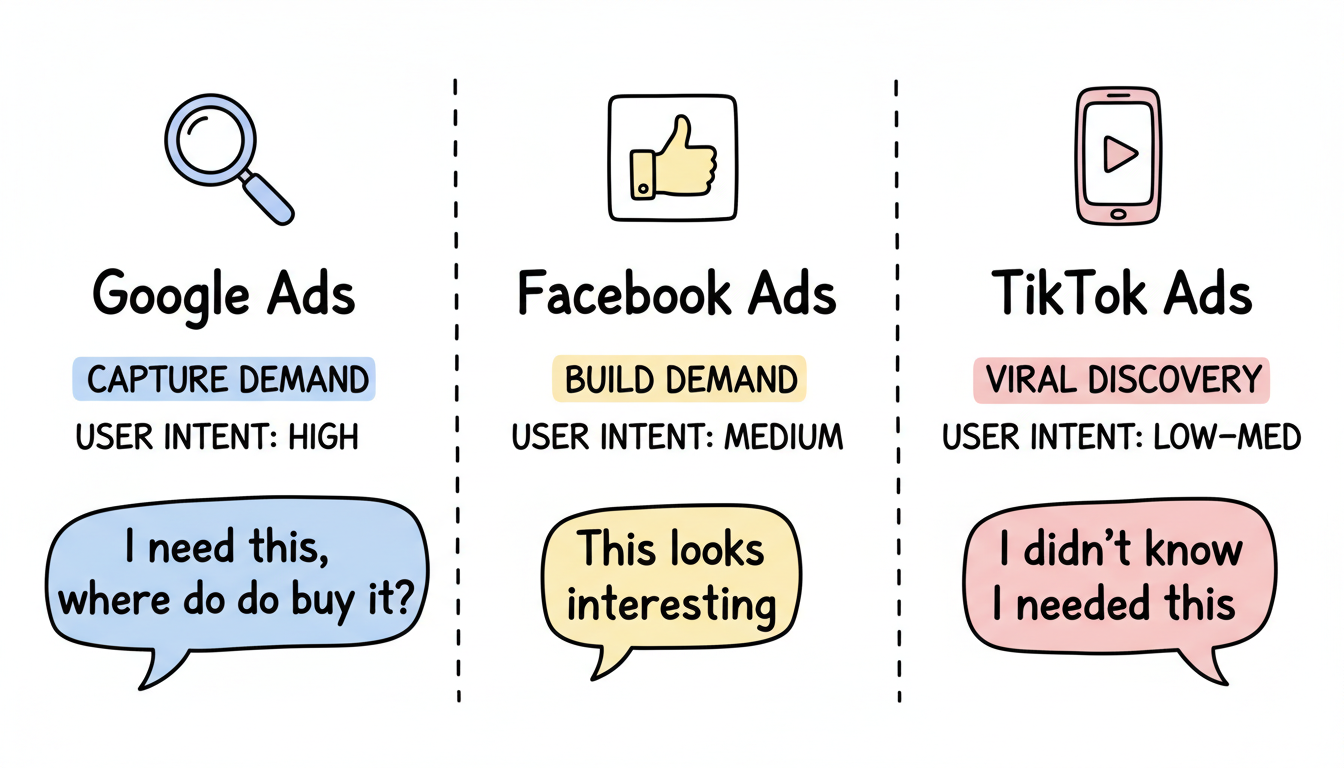
Google captures intent, Facebook builds demand, and TikTok drives discovery — each platform serves a distinct role in the funnel.
Platform | Primary Function | User Intent |
Google Ads | Capture existing demand | High (actively searching) |
Facebook/Instagram | Create demand | Medium (browsing, discovery) |
TikTok | Viral discovery | Low-Medium (entertainment-driven) |
Cost Efficiency: Where Your Budget Goes Furthest
Ad costs vary significantly across platforms. Here's what to expect based on 2025-2026 benchmark data. When evaluating Facebook ads cost, it's important to consider not just the CPC or CPM but also the quality of engagement and conversion potential.
Average Cost Benchmarks
CPCs and CPMs vary significantly by platform. Here is what to expect based on 2025-2026 benchmark data.
Platform | Avg. CPC | Avg. CPM | Notes |
$0.62 | $11.62 | Most balanced cost-to-reach ratio | |
$1.17 | $12.19 | Higher engagement, slightly more expensive | |
Google Search | $5.26 | N/A | Highest CPC but highest intent |
Google Display | $0.63 | $3.12 | Lowest CPM, awareness-focused |
TikTok | $1.00 | $10.00 | Currently underpriced for results |
Source: Data compiled from WordStream, Revealbot, Statista
Cost per Platform Comparison
According to the Global Ad Cost Index 2026:
Platform | Global Avg. Cost | 2026 Outlook |
Meta (FB/IG) | $6.59 CPM | Stable |
Google Search | ~$1.50 CPC | Rising |
TikTok | $3.50 CPM | Underpriced |
$28.00 CPM | Very Expensive |
TikTok currently offers the best cost efficiency—in emerging markets, CPMs can fall below $1.00, creating significant ROI opportunities.
ROAS Comparison
Return on ad spend varies by platform and business type:
Platform | Average ROAS | Best Performance Sector |
Google Ads | 4.5x | E-commerce, services |
Meta Ads | 2.2x | E-commerce, apps |
TikTok Ads | 1.4x-4.0x | E-commerce, beauty, home goods |
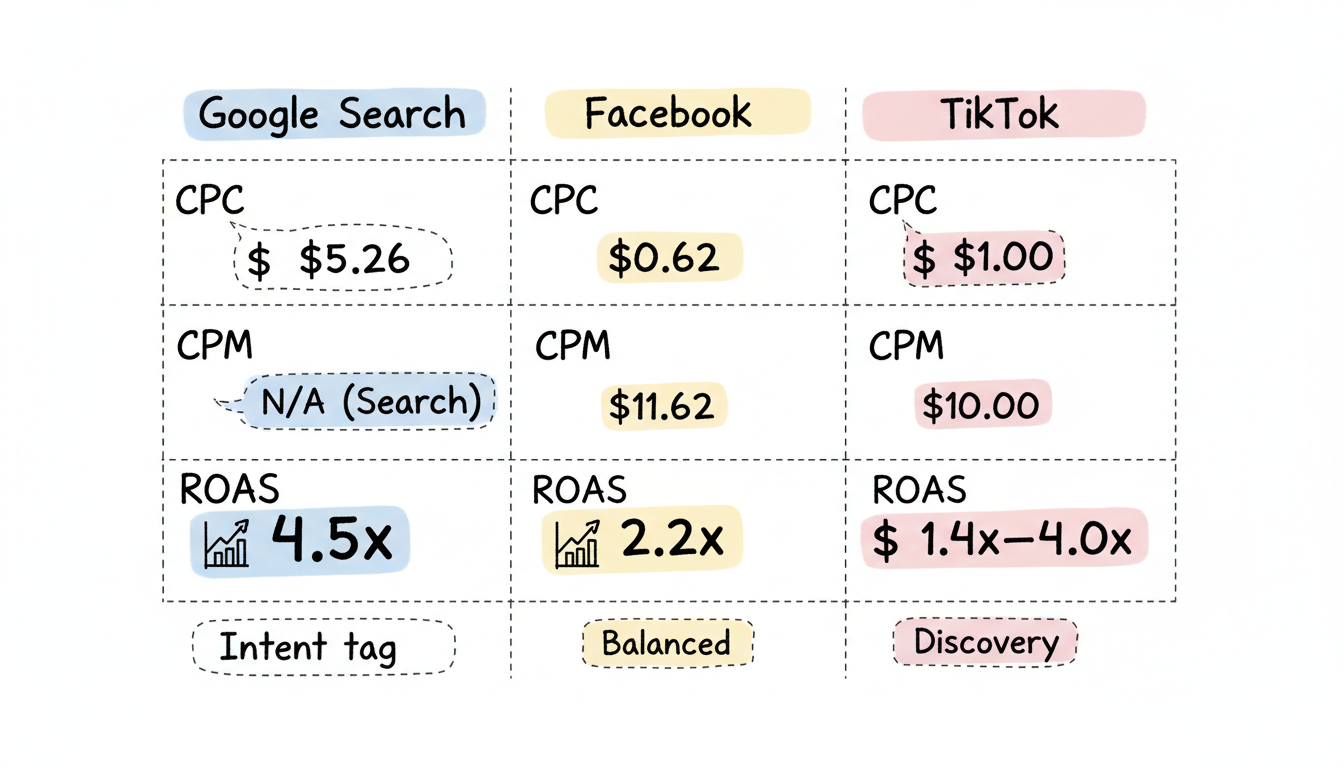
According to industry research, Google Ads consistently delivers the highest ROAS due to capturing high-intent searchers. However, TikTok is reporting 96% higher ROAS compared to other digital channels for brands that crack the creative code.
Industry-Specific Performance: Which Platform Wins Your Sector?
For TikTok specifically:
Industry | Avg. CPC | Avg. CPM | Expected ROAS |
E-Commerce & Retail | $0.50-$1.50 | $6-$12 | 2.0-4.0x |
Beauty & Skincare | $0.50-$1.50 | $6-$12 | 0.91x |
Mobile Apps & Gaming | $0.50-$1.80 | $5-$10 | Varies |
B2B / SaaS | $1.50-$3.00 | $5-$12 | LTV focus |
Home Goods | $0.40-$1.20 | $5-$10 | 4.2x |
Conversion Rate Benchmarks
Beyond cost-per-click, conversion rates reveal how effectively each platform turns ad interactions into actual customers. These benchmarks help you calculate true cost per acquisition across platforms.
Metric | Google Ads | Facebook/Meta Ads | TikTok Ads |
Avg. Conversion Rate (CVR) | 4.4% | 1.85% | 1.22% |
Avg. ROI Per Dollar Spent | $8.00 | $4.20 | $3.60 |
Typical CPA Range | $30–$120 | $15–$75 | $10–$50 |
Best CPA Sector | Services, B2B | E-commerce, Apps | DTC, Beauty |
Google Ads leads with a 4.4% conversion rate because it captures users with active purchase intent. Facebook and TikTok have lower CVRs since they target users earlier in the funnel, but their lower CPCs can still deliver competitive CPAs. When evaluating platforms, look beyond conversion rate alone—consider average order value (AOV) and customer lifetime value (LTV). TikTok customers may convert at a lower rate initially but often show strong repeat purchase behavior for brands that build authentic creator-driven funnels.
Audience Targeting: Precision vs Discovery
Google targets by search intent, Facebook by demographics and interests, and TikTok by behavioral signals and algorithmic discovery.
Demographics
Facebook:
- Broadest age range (25-65+ well-represented)
- Strong with parents and homeowners
- 3+ billion monthly active users globally
- Best for reaching decision-makers across demographics
Google:
- Reaches users across all demographics
- Audience defined by search behavior, not demographics
- Captures people actively looking for solutions
- 8.5 billion searches per day
TikTok:
- Skews younger: 43% of users are Gen Z
- 1.9 billion users worldwide
- Expanding into older demographics but still youth-focused
- Highest engagement rates of any social platform
Buying Behavior
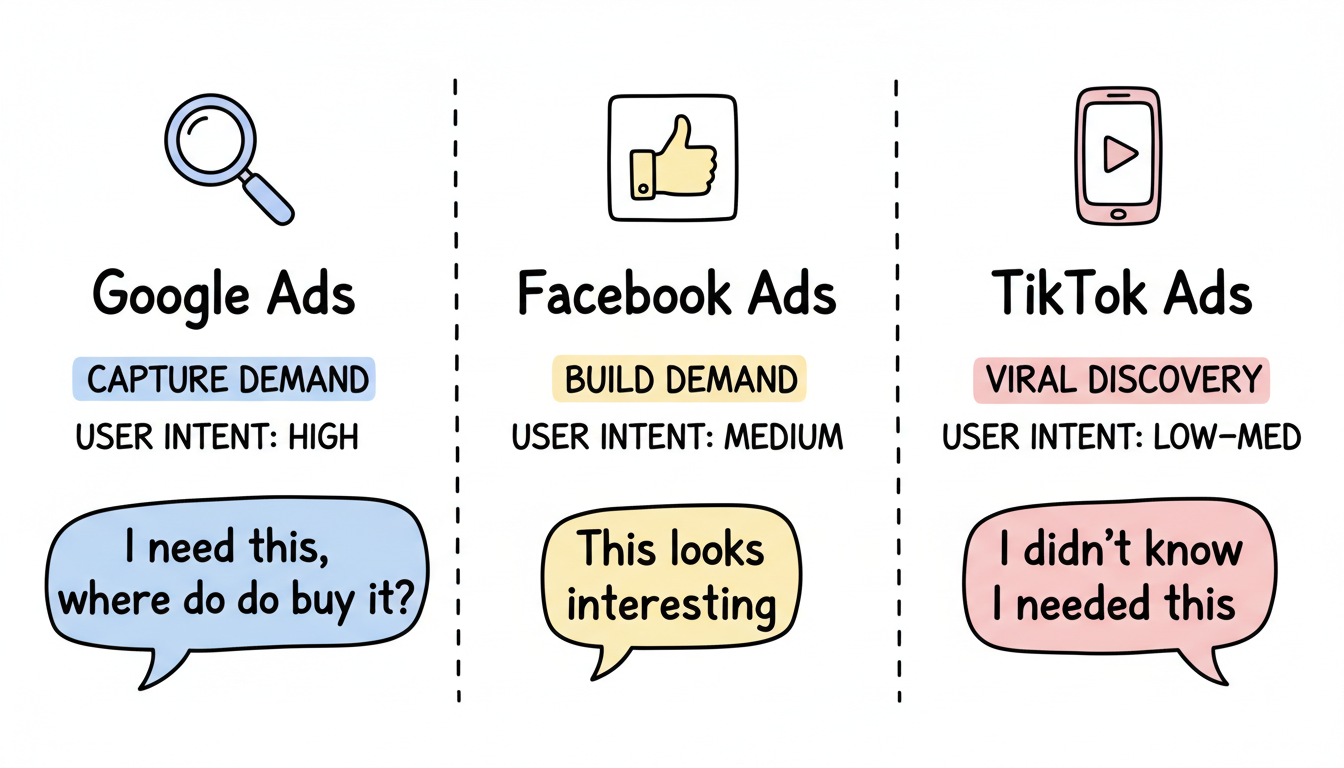
User mindset differs by platform, which determines which stage of the purchase funnel each ad channel targets most effectively.
Platform | Buying Stage | User Mindset |
Decision/Purchase | "I need this, where do I buy it?" | |
Awareness/Consideration | "This looks interesting, let me learn more" | |
TikTok | Discovery | "I didn't know I needed this" |
According to platform research, 72% of TikTok users find ads "inspiring" and 70% say they're even enjoyable—a stark contrast to how users typically feel about advertising.
Creative Requirements: What Works on Each Platform
Ad creative is where platform differences become most pronounced. What works on Google Search (text-based, keyword-driven) fails on TikTok (entertainment-first, native-feeling video). Understanding each platform's creative requirements is critical to maximizing your ad spend.
Creative Formats by Platform
Each platform supports different ad formats, from text-based Search ads to immersive TikTok video and Facebook carousel.
Format | Google Ads | Facebook/Meta Ads | TikTok Ads |
Text Ads | Primary format (Search) | Not available | Not available |
Static Image | Display Network | Feed, Stories | Limited use |
Carousel | Shopping, Display | Feed (up to 10 cards) | Not available |
Vertical Video | YouTube Shorts | Reels, Stories | Primary format (In-Feed, TopView) |
Shopping/Product | Google Shopping | Dynamic Product Ads | TikTok Shop, Collection Ads |
Interactive | N/A | AR filters, Playables | Branded Hashtag Challenges, Spark Ads |
TikTok's Spark Ads deserve special attention—they let you boost existing organic creator posts as paid ads, maintaining the authentic feel that drives higher engagement. TopView ads appear as the first thing users see when opening TikTok, delivering massive reach but at premium pricing.
UGC & Creator Content Strategy
User-generated content (UGC) has become the dominant creative strategy across social advertising platforms, but each platform rewards different approaches:
- TikTok: Entertainment-first content wins. The most effective TikTok ads look like organic posts—how-to tutorials, product unboxing videos, and authentic reviews outperform polished brand creative. The TikTok Creative Exchange connects brands with vetted creators for scalable UGC production.
- Facebook/Instagram: Direct response creative still works well on Meta. Carousel ads showcasing multiple products, before-and-after imagery, and testimonial-style UGC drive strong conversion rates. Meta's Dynamic Creative feature automatically tests combinations of headlines, images, and CTAs to find top performers.
- Google: Creative is less visual on Search (text ads), but YouTube and Display require strong video and banner creative. Performance Max campaigns use AI to mix and match creative assets across all Google surfaces.
To combat ad fatigue—the inevitable decline in performance when audiences see the same creative repeatedly—plan to refresh your ad creative every 2–4 weeks on TikTok, every 4–6 weeks on Facebook, and monthly on Google Display. Search ads can run longer since they match specific queries.
Advanced Targeting and Optimization Strategies
Accurate tracking is essential for understanding which platform actually drives your conversions. Each platform uses different attribution models and tracking mechanisms, which directly affects how you evaluate performance.
Pixels & Attribution Windows
Each platform uses distinct tracking tools and attribution windows, directly affecting how you measure and compare performance.
Feature | Google Ads | Facebook/Meta Ads | TikTok Ads |
Tracking Tool | Google Analytics 4 + Google Tag | Facebook Pixel + Conversions API | TikTok Pixel + Events API |
Default Click Window | 30 days | 7 days | 7 days |
Default View Window | N/A (search) | 1 day | 1 day |
Attribution Model | Data-driven (GA4) | Last-touch within window | Last-touch within window |
Server-Side Tracking | Server-side GTM | Conversions API (CAPI) | Events API |
A key challenge with cross-platform advertising is that each platform takes credit for the same conversion. A customer might discover your product on TikTok, research it via Google, and finally purchase after seeing a Facebook retargeting ad. All three platforms would claim that conversion. Using a third-party attribution tool or comparing in-platform ROAS against first-party data (your actual revenue) helps identify which platform truly drives incremental sales.
Privacy and Tracking Changes
Apple's iOS 14.5+ App Tracking Transparency (ATT) update significantly impacted social advertising platforms. When users opt out of tracking—and roughly 75% do—platforms lose visibility into post-click behavior.
- Facebook/Meta: Hardest hit. Audience sizes shrank, lookalike audiences became less precise, and reported conversions dropped 15–30% compared to actual results. Meta responded with the Conversions API (server-side tracking) and Advantage+ automated campaigns that rely less on individual user tracking.
- TikTok: Affected similarly, though TikTok's algorithm-driven discovery model (rather than audience-based targeting) makes it somewhat more resilient. Server-side tracking via Events API is now essential.
- Google: Least affected on Search (intent-based, not profile-based). Google is replacing third-party cookies with Privacy Sandbox, using aggregated signals instead of individual tracking. Performance Max campaigns are designed to work well with limited user-level data.
For all platforms, implementing server-side tracking and building first-party data strategies (email lists, customer databases) has become non-negotiable for accurate measurement and effective targeting in 2026.
Google Ads Optimization: Beyond Basic Keywords
Smart Bidding, Performance Max, and audience layering move Google campaigns beyond keyword targeting. Use customer match lists, in-market audiences, and remarketing to capture high-value intent at every stage.
Facebook Ads Optimization: Leveraging Social Signals
Advantage+ campaigns and lookalike audiences turn existing customer data into scalable growth. Combine Conversions API with dynamic creative testing to find top-performing combinations faster.
TikTok Ads Optimization: Riding the Algorithm Wave
TikTok's algorithm rewards native-feeling creative. Refresh creatives every 2–3 weeks, test Spark Ads to boost organic posts, and use Smart Performance campaigns to let the algorithm find your best audience.
Future Trends: What'S Coming Next in Digital Advertising
All three platforms are evolving rapidly. Staying ahead means understanding where each is headed.
Video and Interactive Content Evolution
Short-form video now drives discovery across all platforms. TikTok leads, but Meta Reels and YouTube Shorts are growing fast. Interactive formats—polls, shoppable videos, AR try-ons—are becoming standard ad units.
The Current Digital Advertising Landscape in 2025
Google holds 39% of global digital ad revenue, Meta 19%, and TikTok is the fastest-growing platform with double-digit annual gains.
Market Share Battle: Who'S Leading the Race?
Google leads in search, Meta dominates social, and TikTok is gaining rapidly—especially among Gen Z consumers who spend over 90 minutes per day on the platform.
Consumer Behavior Shifts That Matter
Shoppers now discover products on TikTok, research on Google, and buy after Meta retargeting. Understanding these multi-touch paths is essential for platform allocation.
Platform Performance Deep Dive: The Numbers Don'T Lie
Google delivers 4.4% average CVR and 4.5x ROAS. Meta achieves 1.85% CVR with strong remarketing efficiency. TikTok reports 96% higher ROAS for brands that crack the creative code.
Best Use Cases
Understanding the strengths of Facebook ads vs Google ads vs TikTok ads helps you match each platform to your specific marketing goals and budget.
Ecommerce and Retail: The Platform Performance Breakdown
Google Shopping captures purchase-ready buyers; Facebook drives discovery and retargeting; TikTok converts browsers into impulse buyers through engaging video content.
Service-Based Businesses: Where Intent Meets Action
Service businesses benefit most from Google Search where high-intent queries translate directly to calls and form fills. Facebook retargeting and TikTok brand awareness support the full funnel.
When to Use Google Ads
Best for:
- Local services (plumbers, lawyers, dentists)
- B2B lead generation
- E-commerce with established demand
- High-intent product searches
- Businesses where customers know what they want
Avoid if: You're selling a new product category that people don't search for yet.
When to Use Facebook/Instagram Ads
Best for:
- Building brand awareness
- Retargeting website visitors
- Visual products (fashion, home decor, food)
- Lead generation with educational content
- Reaching specific demographic segments
- Higher average order value products
Avoid if: You have zero brand presence and no pixel data to leverage.
When to Use TikTok Ads
Best for:
- E-commerce and direct-to-consumer brands
- Products that demonstrate well in video
- Reaching Gen Z and younger millennials
- Creator-driven marketing strategies
- Brands willing to embrace authentic, less polished content
Avoid if: Your target audience is 55+ or you're in a heavily regulated industry.
Multi-Platform Strategy
The best-performing brands in 2026 aren't choosing one platform—they're integrating all three to cover the full customer journey. When debating Google ads vs Facebook ads, many marketers find that combining both platforms delivers the strongest overall performance.
- Awareness: Meta Ads + TikTok Ads
- Search Intent: Google Ads
- Retarget & Re-Engage: Meta Ads + Google Display
Budget Allocation: Strategic Spending Across Platforms
One of the most common questions advertisers face is how to divide their budget across platforms. The 70-20-10 rule provides a practical starting framework:
- 70% to your proven platform — the channel that currently delivers the best ROAS and most consistent results for your business.
- 20% to your scaling platform — a channel showing promise that you're actively optimizing and growing.
- 10% to experimental — testing new platforms, ad formats, or audience segments to discover future growth opportunities.
Minimum monthly budgets to generate meaningful data vary by platform: Google Ads typically requires $1,000–$2,000/month for Search campaigns (depending on keyword competitiveness), Facebook/Meta works effectively starting at $500–$1,000/month, and TikTok recommends at least $500/month with a $50/day minimum per ad group. For new businesses testing advertising for the first time, starting with $1,500–$3,000/month on a single platform—whichever best matches your audience—will generate enough data to make informed optimization decisions within 4–6 weeks.
AI-Powered Campaign Optimization
All three platforms have invested heavily in AI and machine learning to automate campaign optimization, but each takes a different approach:
- Google Performance Max: Google's most AI-driven campaign type combines Search, Display, YouTube, Shopping, Gmail, and Discover into a single campaign. You provide creative assets, audience signals, and a conversion goal—Google's AI handles bidding, targeting, and placement. Smart Bidding strategies like Target ROAS and Enhanced CPC (ECPC) use real-time auction signals to optimize bids automatically.
- Meta Advantage+: Meta's Advantage+ Shopping Campaigns use machine learning to test up to 150 creative combinations automatically, finding the best performing ad for each audience segment. Advantage+ reduces the manual setup from traditional campaigns—you provide products and creative, and Meta's AI handles audience targeting and budget allocation across placements.
- TikTok Smart Performance: TikTok's automated campaign option uses its recommendation algorithm to find the best audiences for your creative. While less mature than Google and Meta's AI, TikTok's strength lies in its algorithm's ability to identify niche interest groups that traditional demographic targeting would miss.
The trade-off with AI-optimized campaigns is control vs. performance. Performance Max and Advantage+ often deliver strong results but offer limited visibility into which specific placements, audiences, or creative combinations drive conversions. Many advertisers run AI campaigns alongside manual campaigns to maintain both performance and insight.
Platform Selection Framework
Match your business situation to the right primary and secondary ad platform using this decision framework.
Your Situation | Primary Platform | Secondary Platform |
New brand, visual product, young audience | TikTok | |
Established brand, all ages | ||
Service business, high-intent searches | Facebook (retargeting) | |
E-commerce, broad appeal | Google Shopping + TikTok | |
B2B, long sales cycle | LinkedIn + Facebook |
Frequently Asked Questions
Common questions about Facebook, Google, and TikTok advertising costs, targeting, and platform selection answered concisely.
What Are the 4 Types of Advertising?
The 4 main types of advertising are search advertising (Google Ads), social advertising (Facebook, TikTok), display advertising (Google Display Network), and video advertising (YouTube, TikTok). Each type serves a different intent and funnel stage.
Which Platform Has the Lowest Advertising Costs?
TikTok currently offers the lowest CPMs globally at around $3.50, compared to Meta's $6.59 CPM. However, lowest cost doesn't always mean best value—Google's higher CPCs often deliver higher intent traffic that converts better. Facebook offers the most balanced cost-to-reach ratio for most businesses.
Can I Advertise on All Three Platforms Simultaneously?
Yes, and many successful brands do exactly this. The key is allocating budget based on each platform's strengths: Google for capturing search intent, Facebook/Instagram for awareness and retargeting, and TikTok for discovery and viral reach. Start with one or two platforms, then expand once you've established winning campaigns.
Which Platform Is Best for E-Commerce?
All three can work for e-commerce, but with different functions. Google Shopping captures buyers ready to purchase. Facebook excels at retargeting cart abandoners and reaching lookalike audiences.
For Shopify merchants specifically, learning how to run Facebook ads for Shopify can unlock powerful integration opportunities. TikTok drives discovery and impulse purchases, especially for visual products. Most successful e-commerce brands use all three in coordination.
Is It Better to Run Ads on Facebook or TikTok?
It depends on your audience and goals. Facebook delivers stronger results for retargeting, lookalike audiences, and reaching users aged 25–65+, with a proven conversion infrastructure.
TikTok is better for reaching Gen Z and younger millennials, driving product discovery through authentic creator content, and achieving lower CPMs. Many brands find success running both: TikTok for top-of-funnel discovery and Facebook for mid-funnel retargeting and conversion.
How Much Do Ads Cost per 1,000 Views on TikTok?
TikTok's average CPM (cost per 1,000 impressions) is approximately $3.50 globally, making it the most affordable major advertising platform. In competitive verticals like e-commerce and beauty, CPMs range from $6–$12.
In emerging markets, CPMs can fall below $1.00. TikTok's TopView ads (the first ad users see when opening the app) carry premium pricing, often $50,000+ per day for guaranteed placement.
Is $10 a Day Enough for Facebook Ads?
$10 per day ($300/month) is enough to learn the basics and test simple campaigns, but it limits Facebook's ability to optimize effectively.
Meta's algorithm needs roughly 50 conversions per week to exit the learning phase—at $10/day, this may take several weeks depending on your conversion cost. For meaningful results and faster optimization, $20–$50 per day is a more realistic starting point for most businesses.
Actionable Recommendations: Your Next Steps
Use these findings to prioritize your ad spend and platform strategy for 2026.
Key Takeaways
The most important insights from this Facebook ads vs Google ads vs TikTok ads comparison:
- Google Ads captures high-intent search traffic (best ROAS at 4.5x average)
- Facebook/Instagram builds demand and excels at retargeting (stable, proven platform)
- TikTok offers the lowest costs and highest engagement but skews younger
- Average CPCs: Google Search $5.26, Instagram $1.17, TikTok $1.00, Facebook $0.62
- The best strategy combines platforms: awareness (Meta/TikTok) → search (Google) → retargeting (Meta)
- Choose platforms based on where your audience is and what stage of the buying journey you're targeting
- Conversion rates differ significantly: Google 4.4%, Facebook 1.85%, TikTok 1.22%—but lower CVR platforms often compensate with lower CPAs
- Use the 70-20-10 budget rule: 70% proven channel, 20% scaling, 10% experimental
- AI-powered campaigns (Performance Max, Advantage+) are becoming essential for efficient optimization across all platforms
Immediate Actions (Next 30 Days)
Select your primary platform, install the tracking pixel, and launch a test campaign with a $500-$1,000 minimum budget to generate statistically meaningful data.
Strategic Planning (Next 90 Days)
Analyze first-month data, identify the best-performing platform, and scale using the 70-20-10 rule while expanding to secondary channels.
Conclusion
Whether you choose Google, Facebook, or TikTok depends on where your customers are and what stage of the buying journey you're targeting. Use this Facebook ads vs Google ads vs TikTok ads guide to match each platform's strengths to your specific goals and budget in 2026.
The future of DTC ecommerce growth relies on brands that master cross-channel attribution. For scaling brands, a DTC brand agency can help optimize spend across all three platforms. Review DTC advertising examples that convert in 2026 to benchmark your creative performance.