
G2 and Capterra Review Strategy: How to Win in B2B Review Sites
To win on G2 and Capterra, B2B SaaS companies must run review generation as a system: earn reviews at peak satisfaction, answer every negative in public, and automate collection. B2B buyers consult G2 and Capterra before talking to sales, so your profile drives organic discovery, buyer confidence, and deal velocity. A disciplined review strategy is now core to B2B growth.
Your Buyers Are Already on G2 and Capterra
The B2B software buying journey has fundamentally shifted. Buyers, empowered by independent information, now use review sites as a primary filter. These platforms have become the de facto source for unbiased, peer-based validation. If you're not actively managing your presence there, you're conceding the first and most critical step in the buyer's research process. Your pipeline depends on winning this initial consideration.
Decoding G2'S Grid: The Levers You Control
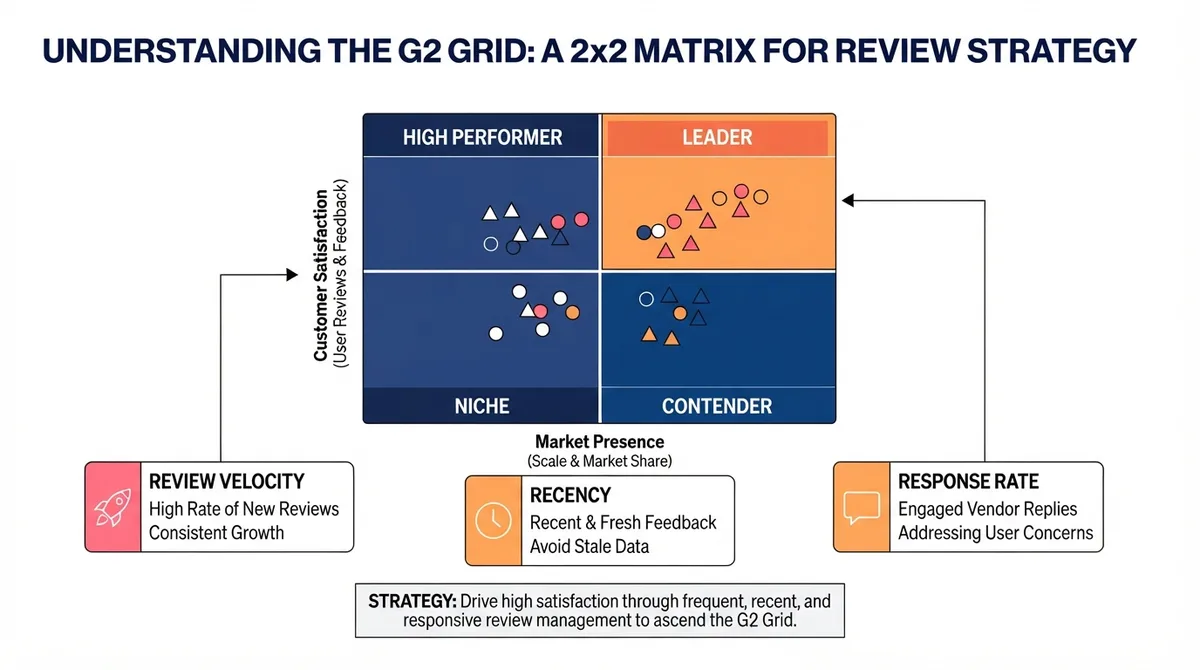
Your position on the G2 Grid directly influences visibility and perceived market leadership. Understanding the ranking factors is the first step to influencing them. The Grid is determined by a combination of Market Presence (size and reach) and Satisfaction scores, calculated from verified user reviews.
Key factors within your control include: * Volume & Recency: A steady stream of fresh reviews signals an active, supported product. * Review Quality: Detailed, thoughtful reviews with high ratings carry more weight. * Response to Reviews: Publicly engaging with feedback, especially critical feedback, demonstrates commitment.
Factors like company size and web traffic influence Market Presence, but the Satisfaction score is your primary lever. Focus your efforts there. For a tactical deep dive into soliciting impactful reviews, you should consult the full review generation playbook.
Building a Systematic Review Generation Engine
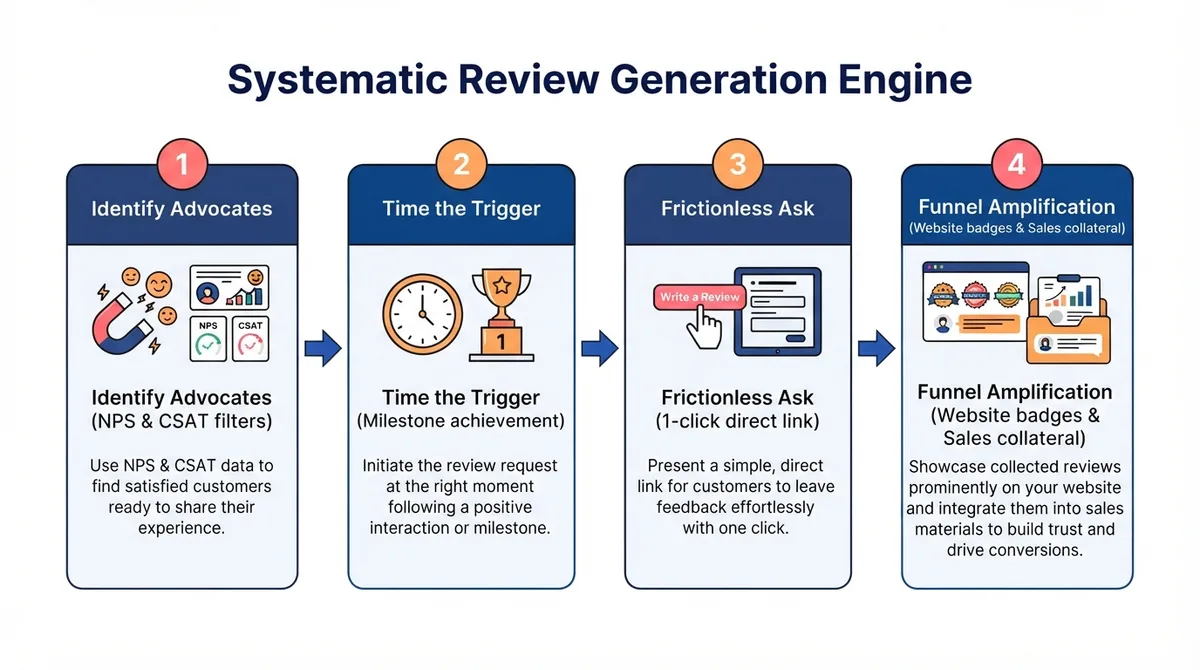
A successful campaign is systematic, not sporadic. It treats review generation as a core marketing function.
1. Identify Your Advocates Use product usage data, NPS/CSAT scores, and customer health scores to pinpoint happy users. The ideal reviewer is engaged, derives clear value, and has been a customer for 3-6 months.
2. Time the Ask Perfectly Ask immediately after a positive support interaction, a successful onboarding milestone, or a quarterly business review. Strike when the experience is fresh and positive.
3. Make Submission Frictionless Send a direct, one-click link to your G2 or Capterra review page. Provide a brief email template they can easily edit. Never ask them to search for your profile.
Example Email Ask: "Hi [Name], thrilled to see you hitting [goal] with [Product]. Would you be open to sharing your experience on G2 to help other teams like yours? It takes just 2-3 minutes here: [Direct Link]. We'd be immensely grateful!"
4. Comply with Platform Rules G2 and Capterra strictly prohibit paying for reviews. You can, however, incentivize participation with small thank-you gifts like charity donations, branded swag, or gift cards, as long as they are not contingent on a positive review. Always disclose any incentive. This process should be integrated with building a testimonial pipeline alongside reviews.
Turning Your Profile into a Conversion Machine
Your profile page is a landing page you don't own. Optimize it to convert visitors into leads.
- Select All Relevant Categories: Appear in more searches by choosing every applicable software category.
- Craft a Benefit-Driven Description: Don't just list features. Articulate the business outcomes you help customers achieve.
- Populate Feature Comparisons: Fill out your comparison data versus competitors. This feeds the "Compare" tools buyers use.
- Strategically Respond to All Reviews: Thank positive reviewers. Address negative reviews publicly with a professional, solution-oriented response that shows prospects you listen and act.
Amplifying Your Review Site Credibility Everywhere
Your G2 and Capterra presence shouldn't live in a silo. Integrate it across your marketing and sales funnel.
- On Your Website: Display G2 Badges (Leader, High Performer, etc.) on your homepage, pricing page, and landing pages. This is a prime example of using review badges as trust signals on your site.
- In Paid & Organic Campaigns: Feature compelling review snippets in ad copy and meta descriptions. Use comparison reports in LinkedIn campaigns targeting competitors.
- For Sales Enablement: Arm reps with your G2 Crowd Report and highlight specific, relevant reviews during demos to overcome objections.
- For Content Development: High-scoring, detailed reviewers are your best potential advocates for converting reviewers into case study candidates.
A proactive, disciplined approach to B2B review sites builds a sustainable competitive moat. It fuels organic discovery, accelerates sales cycles, and builds the third-party trust that marketing copy alone cannot achieve.
G2 vs Capterra: Which One Matters More for Your Category
Not every B2B SaaS company should split effort evenly between the two platforms. G2 attracts more mid-market and enterprise software buyers and powers category Grid Reports that influence procurement committees. Capterra captures a broader SMB audience and ranks strongly in Google for "best [category] software" searches. If you sell to enterprise, lead with G2; if you sell to SMB, lead with Capterra. Most winners build a presence on both and weight the ask toward the platform their buyers use most.
Beyond audience, the mechanics differ. G2 ranks vendors by a Satisfaction score (derived from verified reviews) and a Market Presence score (web traffic, employee count, and funding signals), then places them on the Grid once they clear the review threshold for their category. Capterra leans on category landing pages that capture high-intent top-of-funnel searches and surfaces shortlisted vendors through its own comparison widgets. Map your category placement carefully: claiming the wrong or too-narrow category on either platform hides you from the buyers you actually want. Review each platform's category taxonomy annually as your product and market evolve.
Automating Review Collection: Tools and Workflows
Manual review asks do not scale. Build an automated review collection workflow: trigger a request from your CRM when an NPS score is high or a support ticket closes on a positive note, route satisfied customers to a direct G2 or Capterra review link, and log every touch. Tools like HubSpot and Salesforce workflows, Zapier or Make automation, and review management platforms such as BirdEye or Reputation.com can send timed, personalized asks. Connect the trigger to product analytics so the request fires at the moment of peak value.
Operationalize the cadence so the system runs without constant human nudging. Send the first ask within 24 hours of a positive signal, a gentle reminder at day 7 if no response, and a final nudge at day 14, then stop to avoid fatigue. Route everyone who declines or leaves a low score into a separate feedback loop with customer success rather than pushing them to a public profile. Track throughput as a funnel: invites sent, links clicked, reviews submitted, and verified. A healthy program converts 15 to 30 percent of invited customers into published reviews, and the only way to learn your real rate is to instrument every step. Close the loop internally by reporting monthly review velocity and category rank to product and marketing leadership.
How Review Sites Influence AI Recommendations (GEO Angle)
Generative engines including ChatGPT, Perplexity, and Google AI Overviews increasingly cite G2 and Capterra when answering software buying questions. A well-structured profile with consistent categories, detailed review text, and strong ratings raises the odds your product is named when a buyer asks for the best tool in your category. Treat your review presence as a Generative Engine Optimization (GEO) surface: the same reviews that win human buyers also feed the retrieval data these AI models use, so review quality now compounds across both search and AI discovery.
GEO rewards the same signals that win traditional rankings, plus a few new ones. Keep your company name, category, and positioning identical across your site, G2, Capterra, and third-party directories so models resolve you as a single, unambiguous entity. Encourage reviewers to name concrete features and outcomes in their text, because retrievers match specific phrases like "automated onboarding" or "reduced churn" far better than vague praise. Publish supporting structured data (the same FAQPage and BlogPosting markup on this page) so machines can parse your claims. Where you control the comparison page, ensure it loads fast, uses clear headings, and answers the exact questions buyers ask AI assistants. Over a quarter or two, a consistent review and entity-hygiene program tends to show up as more citations in AI-generated shortlists.
Frequently Asked Questions
How many reviews do I need to be competitive on G2 and Capterra? The threshold varies by category, but generally you need at least 50 reviews on G2 to appear in their Grid Reports and be taken seriously by buyers. Focus on review velocity, meaning a steady stream of recent reviews, rather than a one-time batch. Platforms weight recency heavily in their ranking algorithms.
Should I incentivize customers to leave reviews? G2 and Capterra allow gift card incentives for completing reviews, which is a common and accepted practice. The key is incentivizing the act of reviewing, not the sentiment. Never offer rewards contingent on positive reviews, as this violates platform policies and undermines credibility if discovered.
How do I handle negative reviews on G2 or Capterra? Respond promptly, professionally, and specifically to the concern raised. Acknowledge the issue, describe what you are doing to address it, and invite the reviewer to continue the conversation offline. Thoughtful responses to negative reviews often build more buyer trust than a wall of uncontested five-star ratings.
How long does it take for reviews to impact pipeline? Most B2B buyers research review sites 2-4 weeks before engaging sales. Once you establish a strong review presence, expect to see increased inbound quality and shortened sales cycles within 1-2 quarters. The impact compounds as your review volume and recency improve.
How do G2 and Capterra differ in audience and buyer intent? G2 attracts more mid-market and enterprise software buyers and powers category Grid Reports that shape procurement. Capterra captures a broader SMB audience and ranks strongly in Google for "best [category] software" searches. Enterprise-focused B2B SaaS companies should prioritize G2, while SMB-focused teams get more top-of-funnel value from Capterra. Most winners build a presence on both and lead with the platform their buyers use most.
What tools can automate G2 and Capterra review collection? You can automate review requests with CRM workflows in HubSpot or Salesforce, no-code automation in Zapier or Make, and review management platforms such as BirdEye or Reputation.com. Trigger a direct G2 or Capterra review link when an NPS survey comes back positive or a support ticket closes, then log the touch. Connecting the ask to product analytics ensures it fires at the moment of peak value.
Do AI assistants like ChatGPT use G2 and Capterra in software recommendations? Yes. Generative engines including ChatGPT, Perplexity, and Google AI Overviews frequently cite G2 and Capterra when answering software buying questions. A well-structured profile with consistent categories, detailed reviews, and strong ratings raises the odds your product is named. Treat your review presence as a Generative Engine Optimization (GEO) surface, since the same reviews that win buyers also feed the data these models retrieve.
Key Takeaways
- Review velocity matters more than total count. A steady stream of recent reviews signals an active, trusted product more than a stale batch from two years ago.
- Build a systematic review generation engine. Trigger requests at moments of demonstrated satisfaction, like after a successful onboarding or positive support interaction, rather than sending mass email blasts.
- Optimize your profile as a conversion page. Treat your G2 and Capterra profiles with the same rigor as your website landing pages, complete with compelling descriptions, updated screenshots, and strategic category placement.
- Respond to every negative review thoughtfully. Buyers judge you more by how you handle criticism than by whether you have any. Professional responses build credibility.
- Amplify reviews across your entire marketing stack. Feature review badges on your website, quote reviewers in sales collateral, and use comparison data in competitive campaigns.
Measuring Review Program ROI
Track the downstream impact of your review program through three metrics: inbound demo requests that mention reviews as a research source, win rates for deals where the buyer referenced your G2 or Capterra profile, and the conversion rate on pages that display review badges versus those that do not. Most B2B software companies see a measurable lift in demo-to-close rates within two quarters of launching a systematic review generation engine.