
Generative engine optimization (GEO) is the practice of structuring content so AI-powered search platforms find, understand, and cite it. As more users turn to ChatGPT, Perplexity, and Google AI Overviews for answers, traditional SEO alone no longer guarantees visibility. GEO addresses this shift.
This guide covers what GEO means, how generative engines work under the hood, how GEO compares to SEO, which metrics to track, what tools are available, and how to start optimizing for AI-powered search in 2026.
What Is Generative Engine Optimization?
Generative engine optimization focuses on making your content the source AI systems reference when generating answers. Unlike traditional search where users click through to websites, AI search synthesizes information directly into responses—often citing sources but not always driving clicks.
GEO encompasses several optimization targets:
- ChatGPT and Claude: Conversational AI assistants with hundreds of millions of users
- Google Gemini: Google's multimodal AI platform integrated across Search, Workspace, and Android
- Perplexity: AI-powered search engine that cites sources directly
- Google AI Overviews: AI-generated summaries appearing above traditional search results
- Bing Copilot: Microsoft's AI-integrated search experience
Each platform uses different approaches to retrieve and cite content, but the fundamental optimization principles overlap significantly.
Why GEO Matters Now
User behavior is shifting rapidly toward AI-powered search:
- Over 400 million weekly users interact with ChatGPT
- Perplexity processes millions of queries daily
- Google AI Overviews appear on an increasing percentage of searches
- Research shows 63% of marketers now prioritize generative search optimization
Brands that don't appear in AI-generated responses lose visibility to competitors who do. This isn't hypothetical future concern—it's happening now. Understanding the Google AI Overview SEO impact on your traffic is an essential first step.
How Generative Engines Actually Work: Llms, RAG, and Vector Search
Generative engines like ChatGPT, Google Gemini, Perplexity, and AI Overviews are powered by large language models (LLMs). These AI systems do not simply recall memorized training data when answering queries. Instead, most modern generative engines use a technique called Retrieval-Augmented Generation (RAG) to pull in live, relevant content at query time.
RAG works in two stages. First, the system converts web content into numerical representations called embeddings and stores them in a vector database. When a user asks a question, the query is also converted into an embedding, and the system performs a vector search to find the most semantically similar content chunks. Second, the LLM uses those retrieved passages as context to generate its response, often citing the sources it drew from.
This architecture explains why structured, authoritative, and well-cited content gets referenced more often. The retrieval step favors content that clearly addresses a topic with specific, extractable statements. Content buried in complex page layouts or hidden behind JavaScript rendering may never make it into the vector index.
The major companies building these systems include OpenAI (ChatGPT), Google (Gemini), and Anthropic (Claude). Each takes a slightly different approach to retrieval and citation, but all reward content that is semantically clear, factually grounded, and structured for extraction. For a deeper look at optimizing for Claude AI specifically, see our dedicated guide.
GEO vs SEO: Key Differences and Why You Need Both
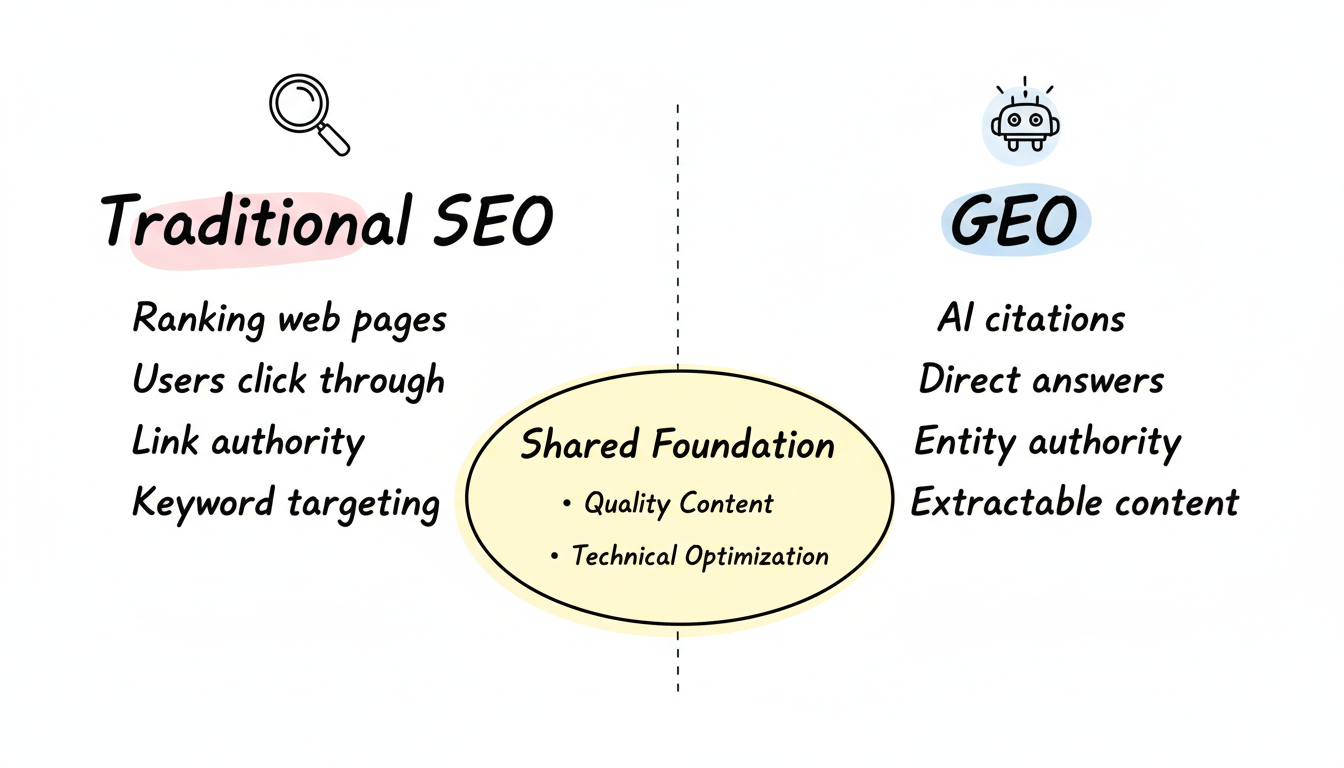
GEO and SEO share the same goal—visibility—but they differ in how that visibility is earned and measured. Understanding both is critical for a complete digital strategy in 2026.
Key differences between SEO and GEO:
- Ranking factor: SEO optimizes for search engine algorithms and SERP position. GEO optimizes for AI retrieval relevance and citation likelihood.
- Success metric: SEO tracks click-through rate and rankings. GEO tracks reference rate and AI share of voice.
- Content format: SEO values keyword-optimized pages. GEO values concise, extractable, citation-worthy statements.
- Technical requirements: SEO focuses on crawlability and Core Web Vitals. GEO adds structured data, entity consistency, and semantic clarity.
- Timeline: SEO results typically appear in weeks to months via Google Search Console. GEO results emerge as AI platforms refresh their indexes, often on different schedules.
The two disciplines are complementary, not competing. E-E-A-T (Experience, Expertise, Authoritativeness, Trustworthiness)—Google's quality framework—is equally critical for GEO because AI systems use similar trust signals when selecting sources to cite. Backlinks, brand mentions, and brand sentiment all feed into how AI systems evaluate source authority.
Third-party platforms play a key role in entity corroboration. AI systems consult sources like Quora, Reddit, G2, Trustpilot, and Crunchbase to verify that a brand is a legitimate authority on a topic. Claiming and maintaining profiles on these platforms strengthens your entity signal across both search and AI. For more on establishing entity authority, see our guide on how to get a Google Knowledge Panel.
For a more detailed breakdown of how these disciplines interact, read our comparison of AEO vs GEO vs SEO.
How to Measure GEO: Key Metrics and Kpis
Measuring GEO performance requires different metrics than traditional SEO. Here are the key indicators to track:
- AI Visibility Score: How often your brand appears in AI-generated responses across platforms. This is the GEO equivalent of SERP rankings.
- Reference Rate: The percentage of relevant prompts where AI cites your content as a source. Track this across ChatGPT, Gemini, and Perplexity separately.
- Share of Voice (AI): Your brand's share of AI citations versus competitors for target topics. This reveals competitive positioning in the AI landscape.
- Brand Mentions in AI: The volume of unprompted brand references in AI outputs, indicating organic authority recognition.
- Brand Sentiment: Whether AI systems describe your brand positively, neutrally, or negatively when referencing it in responses.
Tools that track these metrics include the Semrush AI Visibility Toolkit, Ahrefs, and specialized AI citation tracking tools. Traditional SERP features still matter as a complementary signal—pages that earn featured snippets and knowledge panels are more likely to be cited by AI systems as well.
Generative Engine Optimization Tools
The GEO tools landscape is growing rapidly as marketers recognize the need for AI visibility tracking alongside traditional SEO monitoring.
Key tool categories include AI visibility trackers like the Semrush AI Visibility Toolkit, SEO suites with GEO features such as Ahrefs and Moz, and specialized citation monitoring tools that track how often and where AI platforms reference your content.
Some tools focus on specific platforms—tracking ChatGPT citations separately from Gemini or Perplexity—while others provide a unified dashboard across all major AI engines. The choice depends on which platforms matter most for your audience.
An important technical prerequisite for AI crawlability is server-side rendering. Content that requires JavaScript execution to display may not be indexed by AI retrieval systems. For guidance on making dynamic sites crawlable, see our guide on SEO for single-page applications.
For detailed tool comparisons and recommendations, see our full guide to the best generative engine optimization tools.
Challenges of Generative Engine Optimization
While GEO presents significant opportunity, it comes with real challenges that teams should understand upfront:
- Measurement opacity: AI platforms do not provide analytics dashboards comparable to Google Search Console. Tracking citation performance requires third-party tools and manual monitoring.
- Rapid platform evolution: AI models update frequently, changing citation behavior. A strategy optimized for one model version may underperform after an update.
- Multi-platform fragmentation: Optimizing for ChatGPT does not guarantee visibility in Gemini or Perplexity. Each platform has different retrieval mechanisms and citation preferences.
- No direct traffic attribution: Users may receive complete answers from AI without ever clicking through to your site, making it difficult to tie GEO efforts to website analytics.
- User-generated content influence: Platforms like Reddit and Quora shape AI training data and retrieval indexes in ways brands cannot fully control. Negative sentiment on these platforms can affect how AI systems present your brand.
These challenges make GEO a discipline that requires patience, consistent monitoring, and a willingness to adapt as the AI search landscape evolves.
Core GEO Principles
Effective generative engine optimization builds on several foundational concepts.
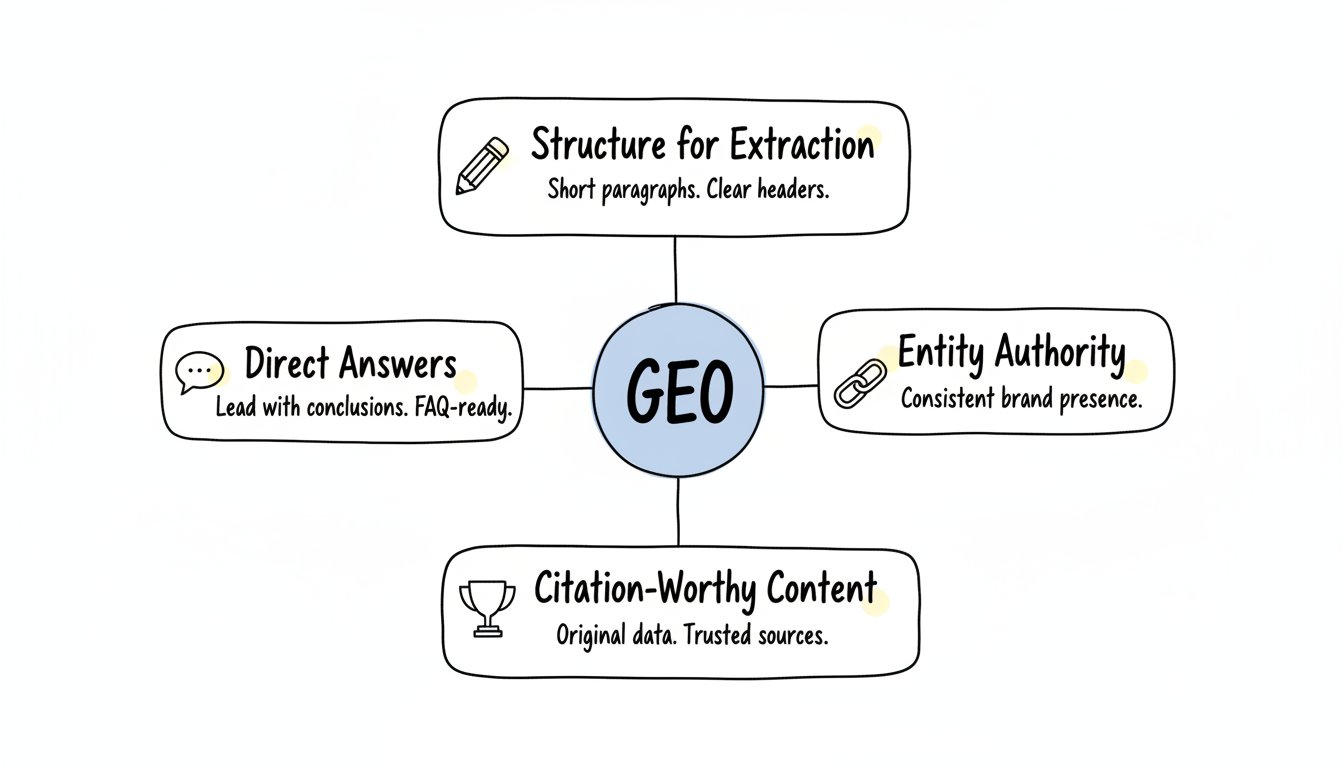
Structure Content for Extraction
AI systems extract content at the paragraph level. They look for clear, quotable statements rather than processing entire articles. To optimize:
- Keep paragraphs under 80 words
- Lead with the key point in each paragraph
- Write standalone statements that make sense without surrounding context
- Use clear headers that match how users phrase questions
Build Entity Authority
AI systems evaluate authority through entity relationships—connections between your brand, your experts, and topics you cover. Strengthen this by:
- Maintaining consistent brand information across all platforms
- Attributing content to recognized experts
- Building presence on platforms AI systems crawl
- Creating comprehensive content around core topics
Create Citation-Worthy Content
AI systems cite sources they trust. Earning citations requires demonstrating expertise through original research and comprehensive topic coverage. Successful search engine optimization using ai combines data-driven insights with content structured for machine extraction:
- Original research and proprietary data
- Specific statistics with clear attribution
- Comprehensive coverage of topics
- Regular updates that maintain accuracy
Optimize for Direct Answers
Structure content to answer questions directly:
- Include FAQ sections with clear questions and answers
- State conclusions at the beginning of sections, not the end
- Provide specific, actionable information
- Cover both primary questions and logical follow-ups
Getting Started with GEO
For teams new to generative engine optimization, start with these practical steps.
Audit Current AI Visibility
Before optimizing, understand your baseline:
- Test relevant queries in ChatGPT, Perplexity, and Google AI Overviews
- Document whether your brand appears in responses
- Note which competitors get cited instead
- Identify patterns in what AI systems reference
Understanding the differences between traditional seo vs ai search optimization helps teams benchmark their current performance and identify gaps in their content strategy.
Restructure Existing High-Value Content
Don't create new content immediately. Instead:
- Identify your best-performing pages
- Break long paragraphs into shorter, extractable units
- Add clear headers matching user questions
- Include specific data points with sources
- Update outdated information
Build Consistent Entity Information
Audit your digital presence for consistency:
- Verify business information matches across directories
- Update LinkedIn company pages and author profiles
- Ensure Google Business Profile is accurate and complete
- Check that Wikipedia/Wikidata entries (if applicable) are current
Implementing effective ai search analytics tracking enables teams to monitor citation performance and measure the impact of entity consistency improvements across platforms.
Implement Technical Requirements
Technical optimization supports AI extraction:
- Add schema markup (FAQ, Article, Organization schemas)
- Ensure content renders without JavaScript where possible
- Maintain fast page load speeds
- Structure URLs and metadata clearly
Schema Markup for GEO: JSON-LD Best Practices
JSON-LD is the recommended format for structured data in GEO (not Microdata or RDFa). It allows you to explicitly define entity relationships and content structure in a way that AI retrieval systems can parse efficiently.
Key schema types to implement for GEO:
- Article schema: Defines the content type, author, publisher, and publication dates. Helps AI systems understand what the content is and who created it.
- Organization schema: Establishes your brand as a recognized entity with consistent name, URL, logo, and social profiles.
- FAQ schema: Marks up question-and-answer pairs, making them directly extractable by AI systems generating conversational responses.
Each schema type should include as many relevant properties as possible—datePublished, dateModified, author with @type Person, and keywords are particularly valuable. For a comprehensive guide to implementation, see our post on structured data for AI search.
Key Takeaways
Generative engine optimization addresses a fundamental shift in how users find information. AI-powered search is here now, not a future possibility.
The core principle: Make your content easy for AI systems to find, understand, trust, and cite.
Where to start: Audit current AI visibility, restructure existing content for extraction, and ensure entity consistency across platforms.
The relationship to SEO: GEO complements rather than replaces traditional SEO. Strong SEO performance often correlates with better AI visibility since AI systems reference authoritative sources. Organizations implementing a geo seo combined strategy gain advantages in both traditional and AI-powered search environments.
Organizations that begin GEO optimization now position themselves ahead of competitors still focused solely on traditional search.
Frequently Asked Questions
What Is Generative Engine Optimization?
Generative engine optimization (GEO) is the practice of optimizing your content and digital presence to increase visibility in AI-powered search engines like ChatGPT, Google Gemini, Perplexity, and AI Overviews. Unlike traditional SEO which targets search engine results pages, GEO focuses on getting your content cited and referenced by large language models (LLMs) that generate conversational answers.
Will GEO Replace SEO?
No. GEO complements SEO rather than replacing it. Traditional SEO fundamentals—quality content, backlinks, E-E-A-T signals, and technical optimization—remain the foundation. GEO adds a layer focused on AI citation optimization, entity authority, and structured data that helps AI systems understand and reference your content. Most effective strategies combine both.
What Tools Are Available for Generative Engine Optimization?
Several tools now track AI visibility, including Semrush AI Visibility Toolkit, Ahrefs, Moz, and specialized GEO platforms. These tools monitor how often AI engines cite your content (reference rate), your share of voice in AI answers, and brand sentiment across AI platforms. See our full guide to the best generative engine optimization tools for detailed comparisons.
How Long Does It Take to See Results from GEO?
GEO results typically take 4-12 weeks to materialize, depending on your existing domain authority, content quality, and the specific AI platforms you are targeting. Unlike SEO where changes can be tracked in Google Search Console, GEO progress requires monitoring AI citation tools over time. Quick wins include adding JSON-LD structured data and claiming profiles on entity-corroborating platforms like Crunchbase, G2, and Wikipedia.
How Is GEO Different from SEO?
SEO focuses on ranking web pages in traditional search results where users click through to websites. GEO focuses on getting content cited in AI-generated responses where users may receive answers directly without clicking. Both share the goal of visibility, but the mechanisms differ.
Do I Need to Choose Between GEO and SEO?
No. The best approach integrates both. Strong SEO foundations—authoritative content, technical optimization, quality signals—support GEO success. Many optimization principles overlap.
How Long Does GEO Take to Show Results?
Results vary based on AI platform update cycles. Some improvements appear within weeks as AI systems refresh their knowledge. Others take months as changes propagate through training data. Expect gradual improvement rather than overnight transformation.
Can Small Businesses Compete in GEO?
Yes. AI systems prioritize content quality and relevance over brand recognition alone. Small businesses with excellent, authoritative content can earn citations over larger competitors with less helpful content.