
The Generative Engine Optimization paper published by researchers at Princeton University and Georgia Tech established the academic foundation for GEO as a legitimate discipline. Published in the KDD 2024 proceedings, this research introduced systematic methods for optimizing content visibility in AI-generated responses and documented measurable improvements from specific optimization techniques.
This guide examines the paper's key findings and explains their practical implications for marketers optimizing content for AI search platforms.
The Research Background
The Princeton GEO paper emerged as AI search platforms gained significant user adoption. ChatGPT, Perplexity, and Google's AI features were transforming how users discover information. Yet no systematic research existed on how content creators could improve visibility in these new environments.
Traditional SEO research focused on ranked search results. The GEO paper asked a different question: what makes content citation-worthy when AI systems synthesize answers from multiple sources?
The researchers developed the GEO framework - Generative Engine Optimization - as the formal methodology for addressing this challenge.
Key Research Findings
The paper documented several significant findings that continue shaping GEO practice.
The 40% Visibility Improvement
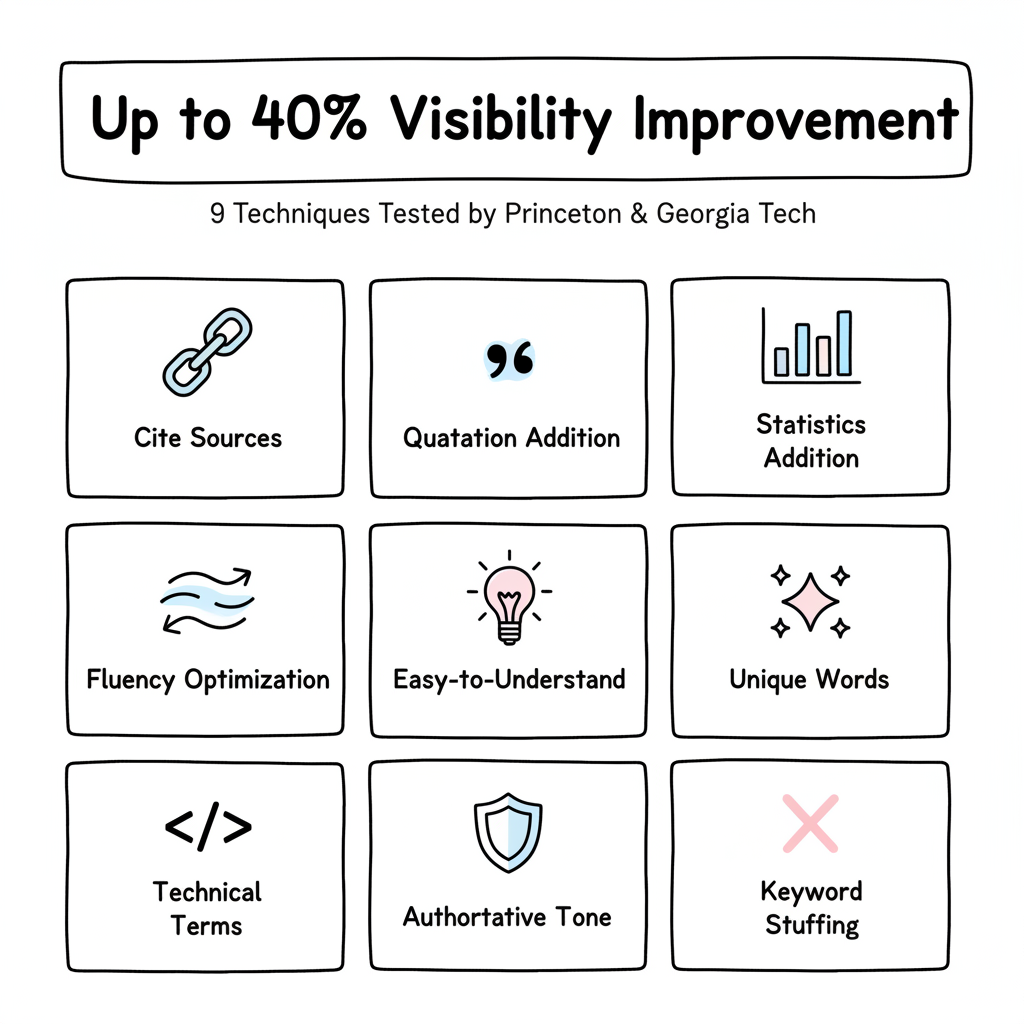
The headline finding: specific optimization techniques improved content visibility in AI-generated responses by up to 40%. This wasn't speculation - the researchers measured visibility changes across multiple AI platforms using controlled experiments.
The improvement varied based on technique and content type, but the overall finding validated that optimization efforts produce measurable results in AI search environments. Companies implementing enterprise AI SEO platforms have leveraged these findings to systematically improve their content's citation rates across generative engines.
Nine Optimization Methods Tested
The research tested nine distinct optimization approaches:
- Cite Sources - Adding authoritative citations within content
- Quotation Addition - Including relevant quotes from experts
- Statistics Addition - Incorporating quantitative data
- Fluency Optimization - Improving writing clarity
- Easy-to-Understand - Simplifying complex explanations
- Unique Words - Using distinctive terminology
- Technical Terms - Including domain-specific vocabulary
- Authoritative Tone - Writing with expertise signals
- Keyword Stuffing - Adding target keywords (control/negative test)
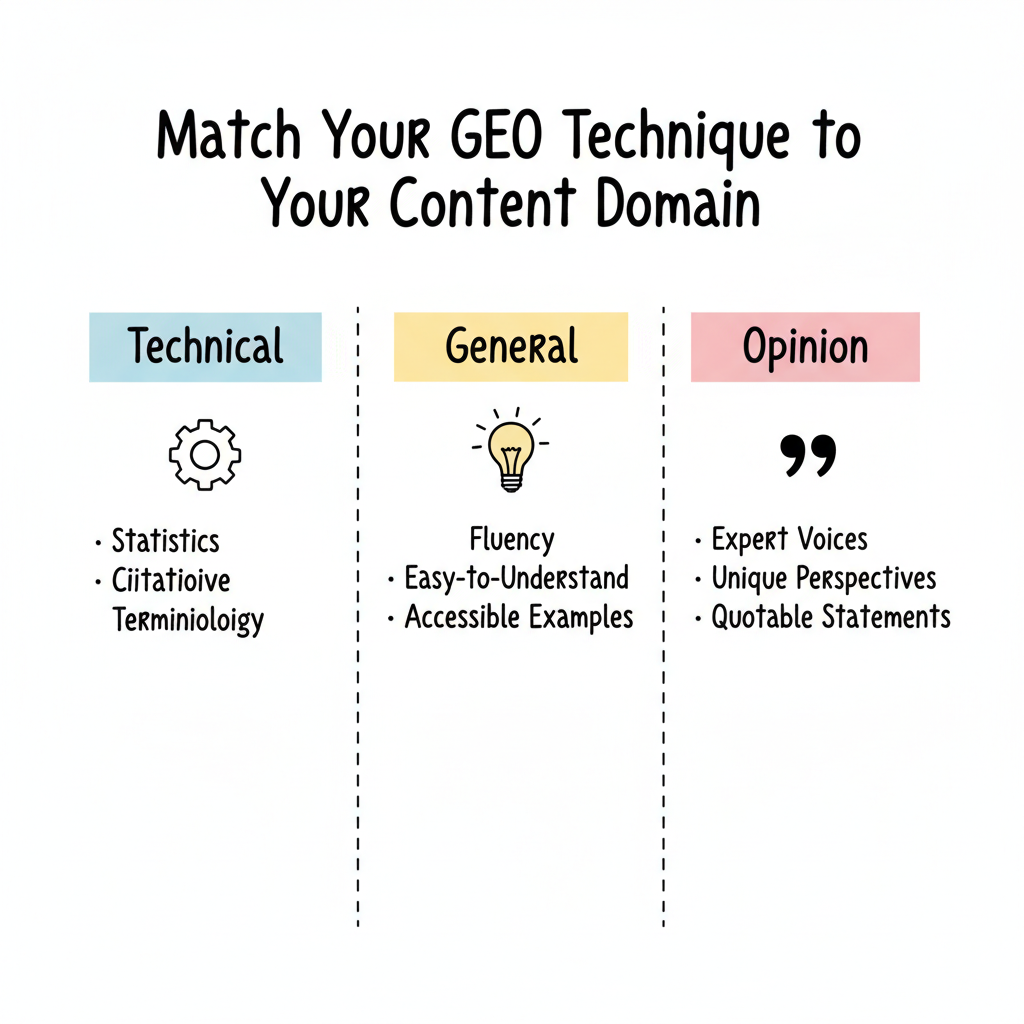
Different techniques performed better for different content domains. Technical topics benefited from statistical additions and authoritative citations. Consumer topics performed better with simplified explanations and quotations.
Domain-Specific Effectiveness
The paper revealed that optimization effectiveness varies significantly by content domain. No single technique works universally across all topics.
For scientific and technical content, citation additions and statistics produced the strongest visibility improvements. For general interest topics, fluency optimization and easy-to-understand approaches proved more effective. Organizations approaching AEO migration must consider these domain-specific patterns when transitioning their content strategy.
This finding emphasizes that GEO requires tailored approaches rather than universal formulas.
Source Quality Matters
The research confirmed that AI systems evaluate source quality when selecting content to cite. Higher domain authority, established expertise signals, and consistent information patterns increased citation likelihood.
This aligns with Google's E-E-A-T framework (Experience, Expertise, Authoritativeness, Trustworthiness) but applies specifically to how AI systems select citation sources rather than how search engines rank pages.
Methodology Overview
Understanding the research methodology helps evaluate the findings' reliability.
Experimental Design
The researchers created controlled experiments where they modified content using each optimization technique, then measured how frequently AI systems cited the modified versus original content when generating responses to relevant queries.
This controlled approach isolated the impact of specific changes rather than observing correlations in uncontrolled environments.
AI Platforms Tested
The research included multiple AI platforms to ensure findings weren't specific to one system. Different platforms showed varying preferences, but overall patterns remained consistent across systems.
Measurement Approach
Visibility was measured through citation frequency - how often content appeared as a source in AI-generated responses for target queries. This direct measurement captures the core GEO outcome rather than proxy metrics.
Practical Implications
The research findings translate into actionable guidance for content optimization.
Structure Content for Extraction
AI systems extract specific passages to cite. Content structured with clear, quotable statements performs better than dense, complex text that resists extraction.
Practical applications:
- Lead sections with direct, complete statements
- Use short paragraphs addressing single concepts
- Create definition statements that stand alone when extracted
- Develop FAQ formats providing ready-to-cite answers
Add Credibility Signals
The citation and statistics techniques that improved visibility work because they add credibility signals AI systems recognize. Understanding schema validation AI search patterns helps ensure your structured data reinforces these credibility signals effectively.
Practical applications:
- Include relevant data from authoritative sources
- Cite research supporting key claims
- Add expert quotes with attribution
- Reference recognized industry sources
Match Optimization to Topic
Since effectiveness varies by domain, match techniques to content type.
For technical content: prioritize statistics, citations, and authoritative terminology.
For general content: prioritize clarity, accessible explanations, and relatable examples.
For opinion content: prioritize expert voices, unique perspectives, and quotable statements.
Avoid Manipulation Attempts
The research tested keyword stuffing as a control and found it ineffective or counterproductive. AI systems evaluate content quality holistically rather than responding to keyword density.
This finding reinforces that GEO requires genuine quality improvements rather than gaming attempts.
Limitations and Considerations
The research established foundational knowledge while acknowledging limitations.
Evolving AI Systems
AI platforms continue developing. Techniques effective when the research was conducted may need adjustment as platforms update their selection criteria.
The principles - quality, authority, extractability - remain relevant even as specific implementation details evolve.
Competitive Dynamics
As more content creators implement GEO techniques, the competitive baseline shifts. Early adopters gain advantages that diminish as optimization becomes widespread.
This dynamic mirrors traditional SEO evolution - baseline optimization becomes table stakes while differentiation requires deeper quality investments.
Platform Variation
Different AI platforms prioritize different signals. Content optimized for ChatGPT may perform differently on Perplexity or Google AI Overviews. Comprehensive GEO requires understanding platform-specific patterns, including copilot citation patterns for Microsoft's generative search features.
The Research Legacy
The Princeton GEO paper established academic legitimacy for AI visibility optimization. Before this research, GEO was speculation and anecdote. After publication, practitioners had documented evidence that specific techniques produce measurable improvements.
The 40% visibility improvement headline captured attention, but the deeper contribution was the systematic framework for understanding and measuring AI visibility optimization.
Subsequent research and industry practice build on this foundation, testing additional techniques and refining understanding of what makes content citation-worthy in AI search environments.
The Research Background
The paper set the field. It named the generative engine as a reader of structured, cited content, so the work that followed inherited the frame. The honest read treats the study as the baseline, and the discipline of knowing it is the edge as the practice grows, because the foundation is the signal.
Avoid treating the paper as the final word. A method that worked in the study may shift as the engines mature, so the program that adapts beats the one that repeats. The flexible stance is what survives the change, and the discipline of revision is what keeps the brand in the answer, because the update is the constant.
Practical Implications
The implication is the cited asset. A page that is clean and schema'd is the one the model pulls, so lead with the answer and support it. The honest content is the one the system can read, and the discipline of the format is what makes the page citable instead of skipped, because the extraction favors the shape.
Use a consistent hierarchy to help the pick. A logical structure where each heading earns its place reads as one coherent answer, so the order is the signal the engine rewards. The balanced shape beats the wall of tiny headings and the page with none, and the coherence is what earns the placement rather than the skip, because the structure is the lever.
Limitations and Legacy
The limit is the moving target. The engines change faster than the study, so the citation that holds today may shift tomorrow, and the honest program watches the box. The disciplined check is what catches the loss early, and the patience to monitor is the quiet edge most teams skip while they assume the win holds, because the measurement is the point.
The legacy is the method. The paper gave the team a way to think about the answer as a structured object, so the discipline of the shape outlives the specific findings. The lasting value is the frame, and the clarity is what lets the team build on it instead of rediscovering it, because the principle is the anchor.
FAQs
Where Can I Find the Original GEO Research Paper?
The paper was published in the KDD 2024 conference proceedings. Search for "Generative Engine Optimization" with authors from Princeton University and Georgia Tech. Academic databases and the conference proceedings contain the full paper.
Are the Research Findings Still Relevant in 2026?
The core principles remain relevant - quality signals, extractable structure, and authority indicators continue influencing AI citation decisions. Specific technique effectiveness may shift as platforms evolve, but the foundational framework continues guiding effective GEO practice.
How Do I Apply the Research to My Content?
Start with the techniques matching your content domain. For technical content, add citations and statistics. For general content, focus on clarity and accessibility. Structure all content with extractable statements AI systems can cite directly.