
Last Updated: January 2026
Generative Engine Optimization (GEO) tools have become essential for marketers tracking visibility across AI-powered search platforms. As ChatGPT, Perplexity, and Google AI Overviews reshape how users find information, specialized tools now exist to monitor, measure, and improve your presence in AI-generated responses.
This guide covers the leading GEO tools in 2026, their features, pricing, and how to choose the right solution for your needs.
What Are GEO Tools?
GEO tools - Generative Engine Optimization tools - help marketers track and improve their visibility in AI-generated search responses. Unlike traditional SEO tools that monitor search rankings, GEO tools analyze:
- Whether AI platforms cite your content when answering relevant queries
- How often your brand appears in AI-generated responses
- Your competitive position compared to other sources AI systems reference
- Which content performs best for AI citation
The category emerged as AI search platforms gained mainstream adoption in 2025, creating demand for measurement tools that traditional SEO platforms couldn't address. As organizations adopt generative engine optimization strategies, having the right measurement infrastructure becomes critical.
Top GEO Tools in 2026
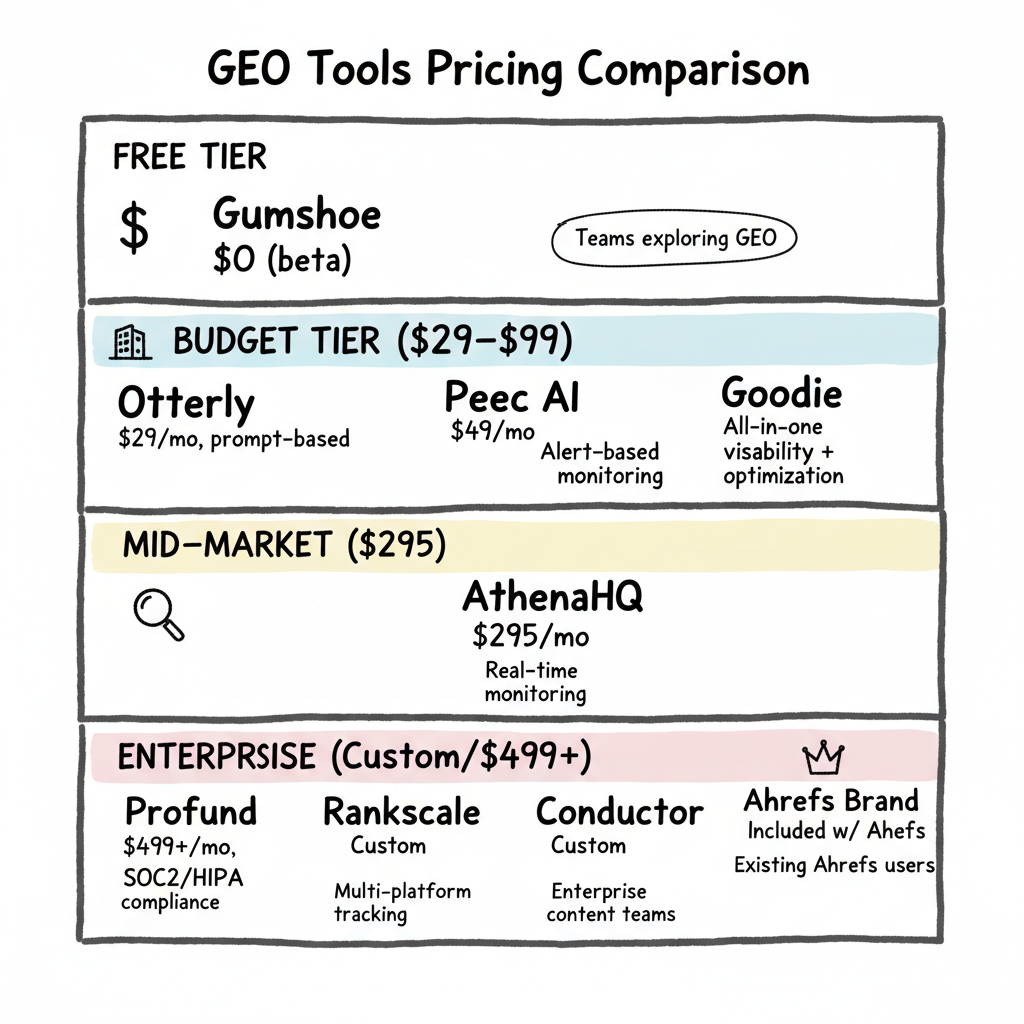
Profound
Best for: Enterprise organizations with compliance requirements
Pricing: Starting at $499/month
Profound tracks brand visibility across 10+ AI engines including ChatGPT, Perplexity, Google AI Overviews, and Microsoft Copilot. The platform emphasizes enterprise features with SOC 2 and HIPAA compliance, making it suitable for regulated industries.
Key features include multi-engine tracking, competitive share of voice analysis, and detailed citation reporting. The higher price point reflects enterprise-grade security and support.
Otterly
Best for: Small to mid-size businesses on a budget
Pricing: Starting at $29/month (prompt-based tiers)
Otterly provides accessible GEO tracking with a prompt-based pricing model - you pay based on how many queries you monitor rather than flat monthly fees. This makes it practical for smaller teams testing AI visibility strategies.
The platform focuses on converting traditional SEO insights to AI optimization recommendations, helping teams transition their existing content strategies for generative search.
Gumshoe
Best for: Teams exploring GEO without budget commitment
Pricing: Free (currently in beta)
Gumshoe offers brand topic tracking and competitive ranking analysis at no cost during its beta period. While feature-limited compared to paid alternatives, it provides a solid entry point for understanding your AI visibility baseline.
Expect capabilities to expand and pricing to emerge as the platform exits beta.
Athenahq
Best for: Real-time visibility monitoring
Pricing: $295/month
AthenaHQ specializes in real-time AI visibility dashboards, alerting teams when their brand appears (or disappears) from AI responses. The platform's strength lies in immediate notification capabilities rather than historical analysis.
Particularly useful for PR and communications teams monitoring brand mentions across AI platforms.
Goodie
Best for: All-in-one visibility and optimization
Pricing: $99/month
Goodie combines visibility tracking with optimization recommendations in a single platform. Rather than just showing where you appear, it suggests specific content improvements to increase AI citation likelihood.
The mid-range pricing and combined functionality makes it attractive for marketing teams wanting both measurement and actionable guidance.
Rankscale
Best for: Comprehensive multi-platform tracking
Pricing: Custom (contact for quote)
Rankscale provides detailed tracking across Perplexity, ChatGPT, and Google AI Overviews with emphasis on understanding why certain content earns citations. The platform includes content analysis features that identify patterns in successful AI-cited content.
Conductor
Best for: Enterprise content teams
Pricing: Enterprise (custom)
Conductor, known for enterprise SEO, has expanded into GEO with features connecting AI visibility to content execution workflows. Integration with existing content management systems makes it practical for large teams with established content operations.
Peec AI
Best for: Alert-based monitoring
Pricing: Starting at $49/month
Peec AI focuses on instant visibility alerts and citation tracking. When your brand gets mentioned (or stops being mentioned) in AI responses, Peec notifies your team immediately. Simple, focused functionality without overwhelming feature complexity.
Ahrefs Brand Radar
Best for: Teams already using Ahrefs
Pricing: Included with Ahrefs subscription
Ahrefs has added AI visibility tracking to its existing SEO platform through Brand Radar. Features include share of voice measurement and cited URL tracking. For teams already invested in Ahrefs, this provides GEO capabilities without additional tool subscriptions.
Key Features to Look For
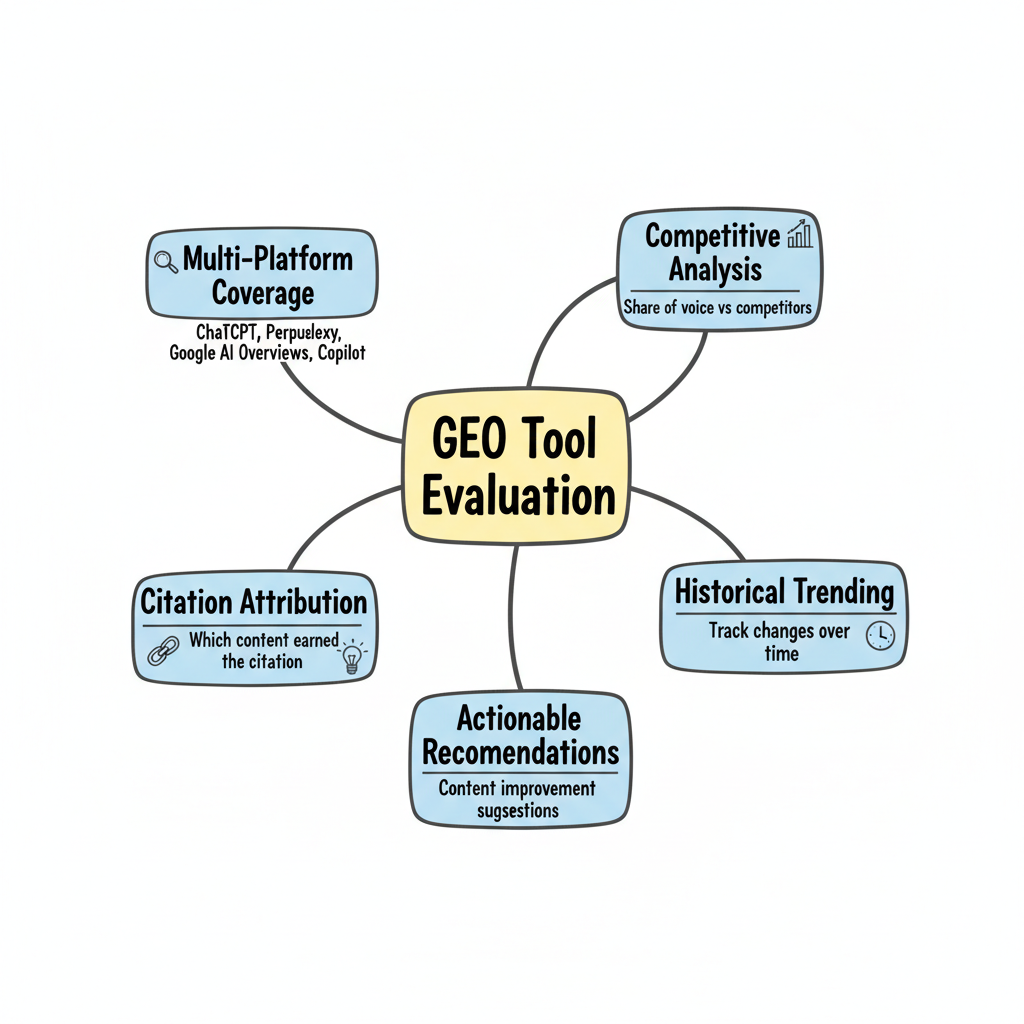
When evaluating GEO tools, prioritize these capabilities:
Multi-Platform Coverage
AI search spans multiple platforms. Tools should track at minimum:
- ChatGPT
- Perplexity
- Google AI Overviews
- Microsoft Copilot
Limited platform coverage means incomplete visibility data. Organizations following geo-optimization-strategies need comprehensive platform coverage to understand the full competitive landscape.
Competitive Analysis
Understanding your position relative to competitors matters more than absolute metrics. Look for share of voice tracking that shows how often you're cited versus competitors for relevant queries.
Citation Attribution
Beyond knowing you were cited, understand which specific content earned the citation. This informs future content optimization.
Historical Trending
Point-in-time snapshots don't show progress. Tools should track visibility changes over time to measure optimization efforts. For effective tracking-ai-overview-performance, historical data becomes essential for identifying trends and measuring the impact of optimization efforts.
Actionable Recommendations
The best tools don't just measure - they suggest improvements. Look for platforms that analyze what makes content citable and recommend specific optimizations.
How to Choose the Right GEO Tool
Budget Considerations
GEO tools range from free (Gumshoe) to $500+/month (Profound). Match your investment to your AI visibility priority:
- Testing the waters: Start with Gumshoe (free) or Otterly ($29)
- Serious optimization: Goodie ($99) or AthenaHQ ($295)
- Enterprise requirements: Profound ($499+) or Conductor (custom)
Integration Needs
Consider your existing tool stack. Teams using Ahrefs should explore Brand Radar first. Enterprise teams with content workflows benefit from Conductor's integrations.
Team Size and Expertise
Smaller teams benefit from simpler tools with built-in guidance. Enterprise teams often need advanced customization and multi-user features. Organizations implementing best-generative-engine-optimization-strategy at scale typically require enterprise-grade solutions with robust analytics and reporting capabilities.
Getting Started with GEO Tools
- Establish baseline: Before optimizing, understand current visibility. Run initial queries for your key topics across AI platforms.
- Identify priorities: Which AI platforms matter most for your audience? Focus measurement there first.
- Monitor competitors: Track competitive visibility to identify opportunities and threats.
- Connect to optimization: Use insights to guide content improvements, not just report on current state.
- Measure impact: Track visibility changes after content optimizations to understand what works.
What Are GEO Tools
GEO tools are the loop, not the trick. They find the gap, shape the content, and track the citation, so the tool that covers the workflow beats the point solution. The honest pick follows the gap, and the discipline of fit is the edge, because the tool that serves the need beats the one with the longer spec.
Avoid assuming one tool does it all. A content optimizer and a citation tracker are complementary, so the stack that uses both sees more than either alone. The combined view is what makes the work coherent, and the silence on one side is the gap the competitor fills, because the tools serve different moments in the same loop.
Key Features to Look For
The feature that matters is the proof. A tool that shows the citation and the query it earned is the one worth the fee, so read the output against the coverage. The honest investment map ties the price to the inventory it must serve, and the clarity is what lets the team plan the spend instead of guessing at the label.
Use a trial on your own data. The test reveals whether the tool finds gaps you care about or only vanity metrics, and that difference decides the purchase. Prove the workflow with a small check first, then pay only for the scale and consistency you have shown you need, because the disciplined buy is the one that pays.
Getting Started
Start with one tool and one cadence. A weekly pull of the query data and a monthly pass of the content keeps the program working, so the routine is the engine. The disciplined schedule is what turns the tool into enough, and the patience to run it is the quiet edge most teams skip while they shop for the paid fix that replaces the habit.
Name an owner per tool so it is used. The most common failure is a paid tool nobody runs, which implies coverage that does not exist, so assign the person and the cadence. The human who watches the data is what keeps it honest, and the ownership is the difference between tooling and theater, because the discipline is the edge.
The Bottom Line
GEO tools transform AI visibility from guesswork into measurable data. As AI-powered search continues growing, these tools become as essential as traditional SEO platforms.
Start with a tool matching your budget and needs. The specific platform matters less than establishing measurement discipline - you can't optimize what you don't measure.