
Search has fundamentally changed. Users increasingly bypass traditional search results entirely, asking AI assistants direct questions and receiving synthesized answers. Generative search engine optimization (generative SEO) is the practice of ensuring your content becomes a trusted source that AI systems cite when generating these responses.
According to Search Engine Land, generative engine optimization is the practice of optimizing content so it's more likely to be surfaced, cited, or recommended by AI-driven search and discovery platforms. This represents a fundamental shift from ranking on results pages to being cited in AI-generated answers.
What Is Generative Search Engine Optimization?
Generative search engine optimization focuses on making your content discoverable, trustworthy, and citation-worthy within AI-powered search systems. Unlike traditional SEO where success means ranking on a results page, generative SEO success means getting mentioned, quoted, or recommended in AI-synthesized responses.
According to WordStream's SEO guide, GEO is like traditional SEO but specifically optimized for AI search engines such as ChatGPT, Perplexity, Google AI Overviews, and similar platforms that generate direct answers rather than link lists.
Key generative search platforms:
Platform | How It Works | Citation Style |
ChatGPT | Synthesizes from training + web search | Inline citations with links |
Perplexity | Real-time web search + synthesis | Numbered source citations |
Google AI Overviews | Combines search index + AI generation | Expandable source cards |
Claude | Training data + web tools | Contextual references |
Gemini | Google index + generative synthesis | Source attribution |
How Generative Search Differs from Traditional Search
According to Exploding Topics' research, 67% of organizations adopted large language models in 2025, fundamentally changing how users discover information and how content must be optimized.
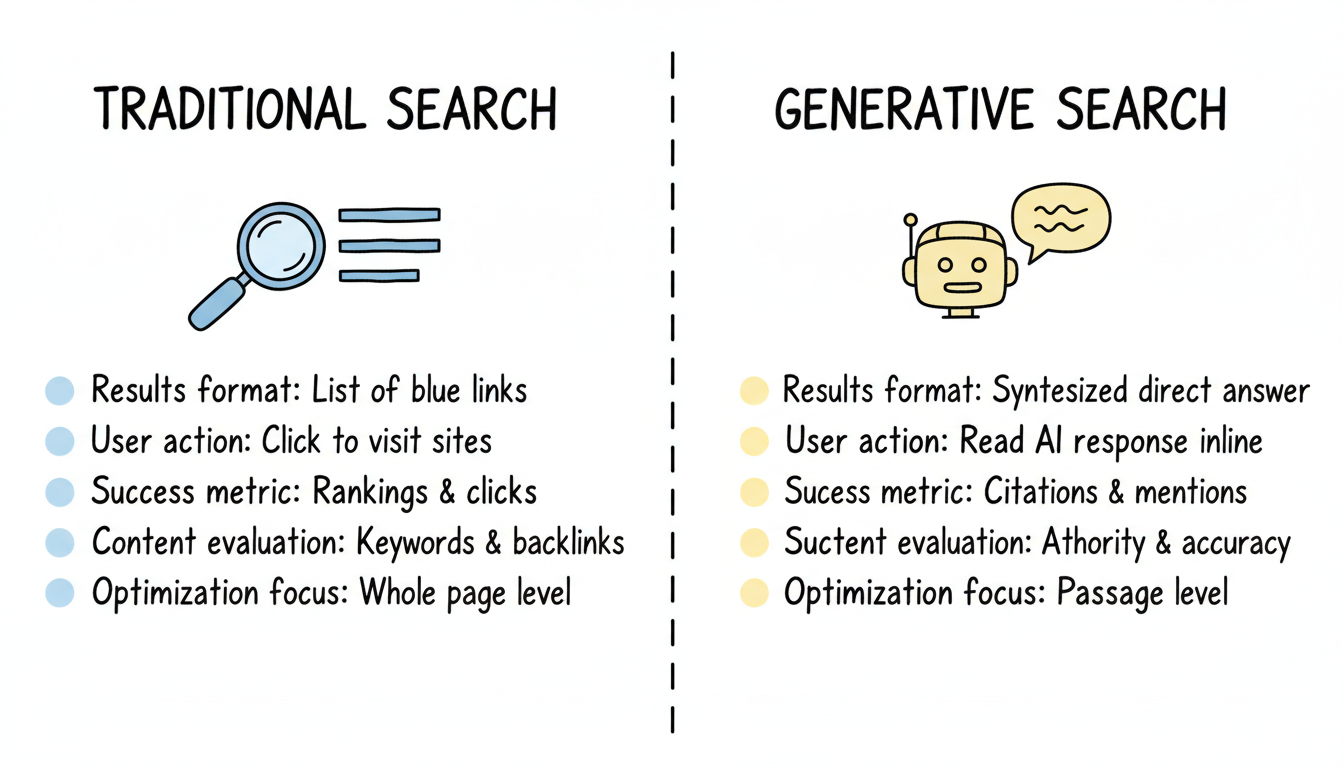
Traditional search vs generative search:
Aspect | Traditional Search | Generative Search |
Results format | List of links | Synthesized answers |
User action | Click to visit sites | Read answer directly |
Success metric | Rankings, clicks | Citations, mentions |
Content evaluation | Keywords, backlinks | Authority, accuracy, structure |
Optimization focus | Page-level | Passage-level |
According to PR News Online's analysis, AI search traffic is converting at 4.4x the rate of traditional organic search, making generative search optimization increasingly valuable for businesses.
Why Traditional SEO Isn'T Enough
According to Search Engine Journal, 63% of marketers prioritized generative engine optimization in their 2024-25 strategies, recognizing that traditional SEO alone doesn't capture AI-driven discovery.
Where traditional SEO falls short for AI search:
- Keyword focus vs semantic understanding - AI evaluates meaning, not just keyword presence
- Page-level vs passage-level - AI extracts specific passages rather than ranking whole pages
- Rankings vs citations - Being #1 doesn't guarantee AI will cite you
- Link authority vs source credibility - AI cross-references multiple trust signals
- Click optimization vs answer optimization - AI needs extractable, quotable content
Understanding these differences is critical when evaluating how to choose an AI SEO agency that can handle both traditional and generative optimization strategies. According to Omnius's industry report, LLMs focus on semantic relevance, topical authority, and trustworthiness rather than traditional ranking factors, requiring different optimization approaches.
Core Generative SEO Strategies
Strategy 1: Optimize for Passage Extraction
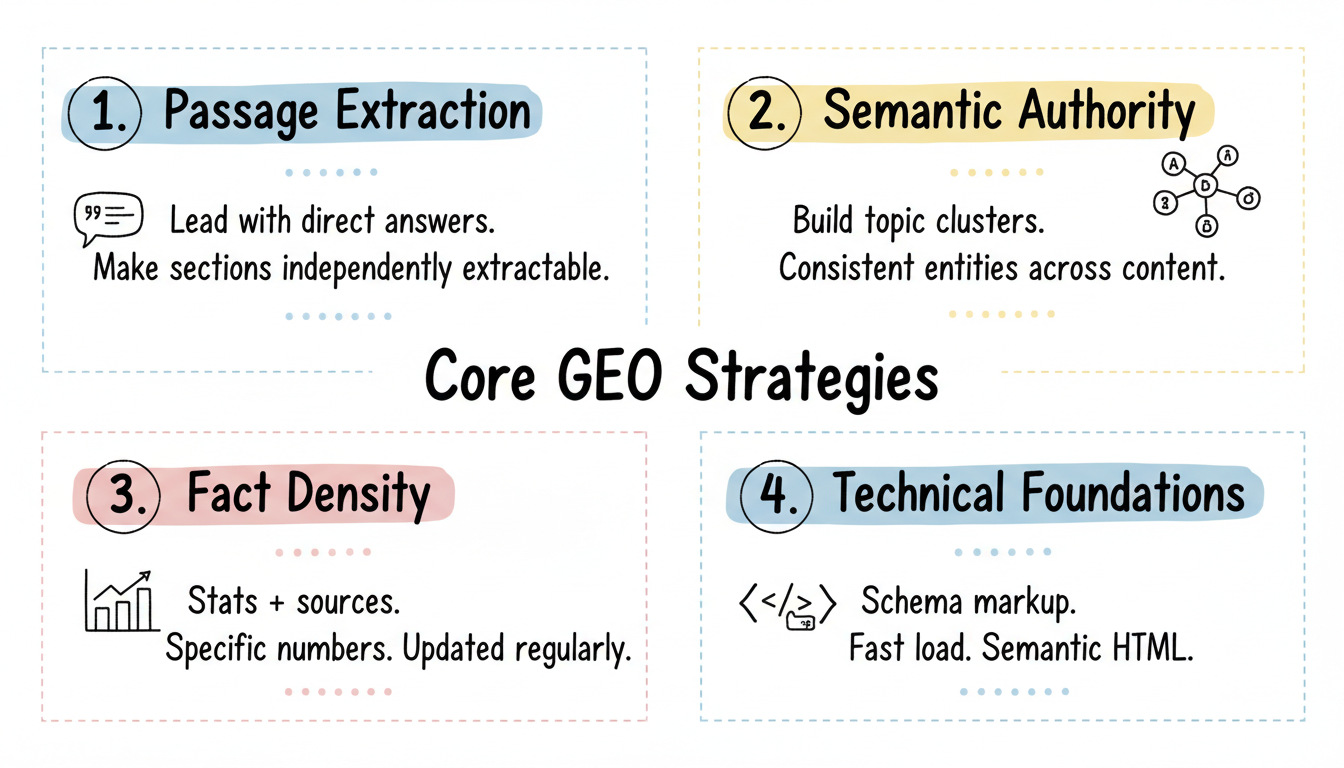
AI systems extract specific passages rather than evaluating entire pages. Structure content so key information stands alone.
According to Siege Media's GEO guide, AI search engines pull from specific sections rather than evaluating entire pages, making passage-level optimization essential for citations.
Passage optimization tactics:
- Lead with direct answers in opening sentences
- Make each section independently valuable
- Include specific data points within passages
- Use clear, quotable statements
- Format for easy extraction
Strategy 2: Build Semantic Authority
AI systems evaluate topical expertise across your content ecosystem, not just individual pages.
Semantic authority building:
Element | Purpose | Implementation |
Topic clusters | Demonstrate comprehensive coverage | Interlinked content hubs |
Entity consistency | Strengthen brand recognition | Consistent naming and information |
Expert signals | Establish credibility | Author bios, credentials, citations |
Content depth | Show expertise | Comprehensive topic treatment |
Strategy 3: Prioritize Fact Density
According to Tailored Tactiqs' optimization guide, AI systems prefer content with verifiable, specific information because they can cross-reference claims against multiple sources.
Fact-density requirements:
- Include statistics with sources
- Reference specific dates and numbers
- Cite authoritative publications
- Add comparison metrics
- Update information regularly
Strategy 4: Implement Technical Foundations
Technical factors affect how AI systems access and interpret your content. For a deeper dive into technical optimization for AI-powered search platforms, explore our generative engine optimization guide.
Technical optimization checklist:
- Comprehensive schema markup (Organization, Article, FAQ, HowTo)
- Fast page load times
- Mobile-friendly design
- Clean, semantic HTML
- Clear site architecture
- AI crawler accessibility
Measuring Generative Search Success
Traditional SEO metrics don't capture generative search performance. New measurement frameworks are required.
Generative SEO metrics:
Metric | What It Measures | Tracking Method |
Citation frequency | How often AI mentions your brand | AI monitoring tools |
Share of voice | Visibility vs competitors | Competitive analysis |
Citation accuracy | Correctness of AI brand mentions | Manual audits |
AI referral traffic | Visitors from AI platforms | Analytics segmentation |
Sentiment | Tone of AI mentions | Sentiment analysis |
Common Generative SEO Mistakes
According to JSA's SEO analysis, many brands make optimization mistakes that prevent their content from being cited, even when content quality is high.
Mistakes to avoid:
- Ignoring structured data - Schema helps AI understand content context
- Vague generalizations - Specific, verifiable claims outperform general statements
- Outdated information - AI systems favor recently-updated content
- Missing external validation - Brands need third-party authority signals
- Poor content structure - Disorganized content is harder to extract and cite
For businesses seeking expert support, researching affordable AEO services can provide cost-effective solutions for implementing these optimization strategies without common pitfalls.
The Future of Generative Search
According to Exploding Topics, 58% of consumers now rely on AI for product recommendations, signaling continued growth in AI-powered discovery.
Emerging trends:
- Multi-modal search (text, image, video)
- Agentic AI with autonomous research capabilities
- Real-time personalization in AI responses
- Voice-first AI search interfaces
- Deeper integration of AI into purchase journeys
Understanding the distinctions between platforms like Google AI Mode vs AI Overview helps marketers prepare for these evolving AI search experiences.
How Generative Search Differs
Generative search answers; classic search links. The user gets the summary instead of the ten blue links, so the brand that is cited in the answer is the one the user meets. The honest program treats the answer as the channel, and the discipline of showing up is the edge as the behavior shifts, because the presence is the first step.
Avoid optimizing only for the old results. A page that ranks ten on the classic engine can still lose to the answer that cites a competitor, so cover the new surface. The distributed plan is what protects the reach, and the clarity is what makes the work coherent instead of a bet on a single box, because the spread is the hedge.
Why Traditional SEO Isn'T Enough
Traditional SEO earns the link; generative SEO earns the citation. The two overlap but the second needs the structured, quotable answer, so the page must do both. The honest content is the one the system can read and the user can click, and the discipline of the dual target is the quiet advantage most teams skip while they tune for one.
Use a consistent hierarchy to help both. A logical structure where each heading earns its place reads as one coherent answer to the engine and one clear page to the user. The balanced shape serves both readers, and the coherence is what earns the placement and the click rather than the skip, because the order is the signal.
Core Strategies
The core is clarity, structure, citation, and measurement. A page that answers cleanly, is laid out logically, is quoted correctly, and is tracked honestly earns the placement, so the four are the backbone. The disciplined program scores each, and the patience to build all four is the edge while the discipline forms, because the set is the signal.
Measure the citation, not the vanity. A post that is quoted by the engine but never clicked or converted needs a second look, so join the presence to the outcome. The honest program reads the whole picture, and the combined view is what justifies the effort to the stakeholders who fund it, because the use is the measure and the data is the guide.
Common Mistakes
The mistake is the thin answer. A page that wins the box but cannot satisfy the click loses the trust it just earned, so the answer must lead and the depth must follow. The honest snippet is the one the page can back up, and the mismatch is what costs the brand the next time, because the substance is the point.
Another mistake is the missing schema. A page without the markup is harder for the engine to cite, so add the structured data as a default. The disciplined markup is what makes the content machine-readable, and the patience to tag it is the quiet edge that compounds across every post the team publishes, because the signal is the asset that pays.
Key Takeaways
Generative search engine optimization is essential for 2026 visibility:
- New paradigm - AI search synthesizes answers rather than listing links
- Passage-level focus - Optimize for extraction, not just page rankings
- Semantic authority matters - Build topical expertise across content ecosystems
- Fact density required - AI prefers verifiable, specific information
- Technical foundations - Schema and structure help AI understand content
- New metrics needed - Track citations and share of voice, not just rankings
- Continuous evolution - AI platforms change rapidly, requiring ongoing adaptation
According to Search Engine Land, brands that invest in generative search engine optimization now will capture visibility as AI-powered search adoption accelerates. The practices complement traditional SEO but require specific focus on how AI systems evaluate and cite sources.