
A GEO SEO strategy integrates generative engine optimization into existing SEO workflows rather than treating them as separate initiatives. Most organizations already have SEO programs producing results. The question isn't whether to do GEO - it's how to incorporate GEO without disrupting what works while capturing new AI visibility opportunities.
Integration beats isolation. Combined strategies outperform fragmented efforts.
Why Integration Matters
The False Choice Problem
Many marketers frame GEO and SEO as competing priorities. This creates artificial resource conflicts and strategic fragmentation.
The reality: GEO and SEO share foundational elements. Quality content, technical optimization, and authority signals benefit both. Treating them as separate programs duplicates effort and misses synergies.
Integration benefits:
- Shared research informs both strategies
- Content serves dual purposes
- Technical investments compound
- Measurement provides complete visibility picture
Where GEO and SEO Diverge
Integration doesn't mean identical approaches. Key differences require strategic accommodation:
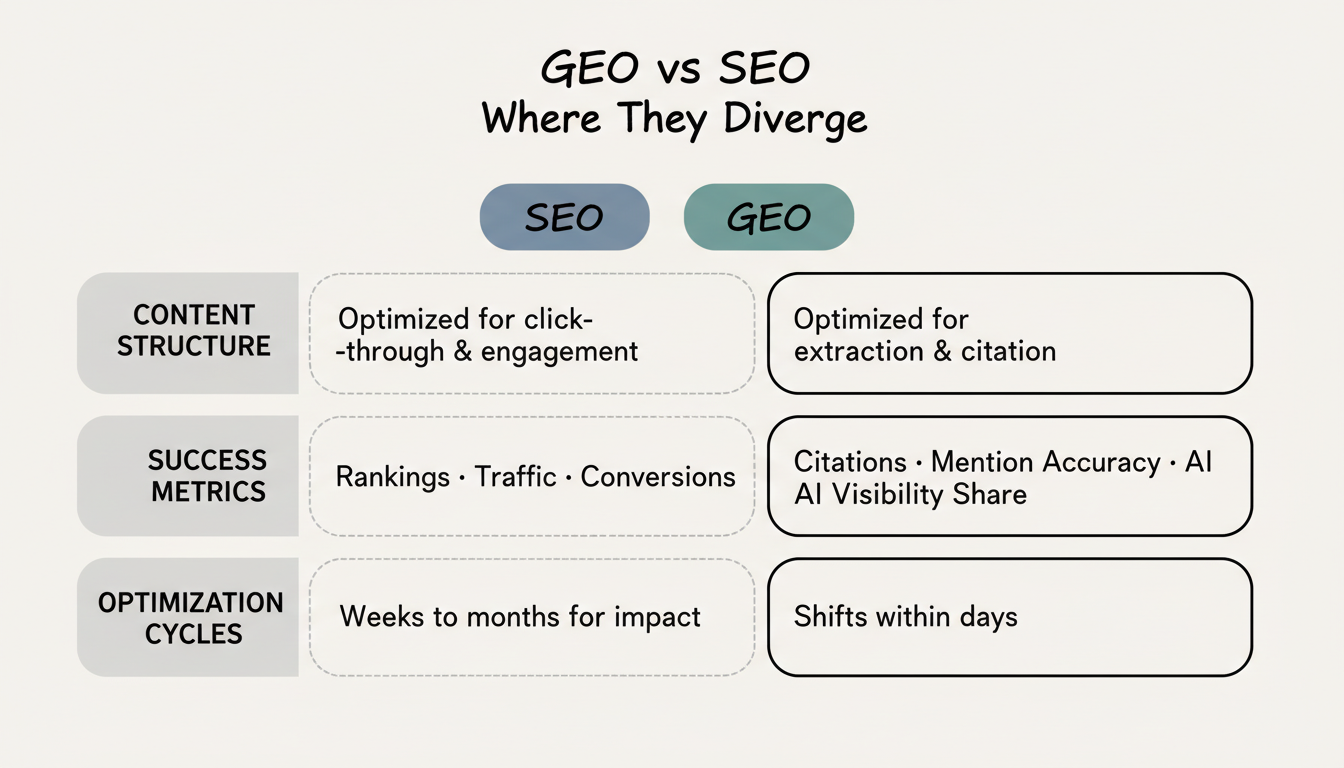
Content structure: SEO optimizes for click-through and engagement. GEO optimizes for extraction and citation. The same content may need structural elements serving both goals.
Success metrics: SEO measures rankings, traffic, and conversions. GEO measures citations, mention accuracy, and AI visibility share. Combined reporting requires both metric sets.
Optimization cycles: SEO changes take weeks to months for impact. GEO visibility can shift within days. Different monitoring cadences apply.
Building the Integrated Strategy
Step 1: Audit Current State
Before integrating GEO, understand your baseline. A comprehensive AEO marketing audit helps identify where your content currently stands with both traditional and AI-powered search platforms.
SEO audit questions:
- Which content performs best in traditional search?
- What technical foundation exists (site speed, mobile, structured data)?
- Where does competitive advantage come from?
GEO audit questions:
- Does your brand appear in AI responses for priority queries?
- Which competitors earn AI citations you don't?
- Is existing content structured for extraction?
Integration assessment:
- Which high-performing SEO content could serve GEO with minor modifications?
- Which technical investments would benefit both?
- Where do GEO opportunities exist that SEO alone won't capture?
Step 2: Prioritize Combined Opportunities
Not all content deserves equal GEO investment. Prioritize based on combined potential.
High-priority content:
Criteria | Why It Matters |
Strong SEO performance | Existing authority transfers to GEO |
Question-based topics | Natural fit for AI answer citations |
Competitive gaps | Opportunity to claim unclaimed territory |
Business value | Worth the investment of dual optimization |
Content meeting multiple criteria gets GEO optimization first. A page ranking #3 for a question-based query with high business value is an ideal GEO integration candidate.
Step 3: Modify Workflows
Integrate GEO into existing SEO processes rather than creating parallel workflows.
Content creation workflow adjustment:
- Research phase: Add AI query testing to keyword research. Check how AI platforms answer target queries.
- Planning phase: Include GEO structural requirements in content briefs. Specify extraction-friendly formats alongside SEO requirements.
- Creation phase: Writers produce content serving both goals - engaging for readers, extractable for AI.
- Review phase: Check both SEO elements (meta tags, internal links) and GEO elements (standalone paragraphs, quotable statements).
- Measurement phase: Track both ranking performance and AI citation visibility using AEO optimization metrics.
Technical optimization workflow adjustment:
- Add schema markup review to technical audits
- Include AI crawler access in robots.txt reviews
- Test page rendering for AI indexing alongside traditional crawl testing
Step 4: Allocate Resources Appropriately
Resource allocation depends on your current position and opportunity landscape.
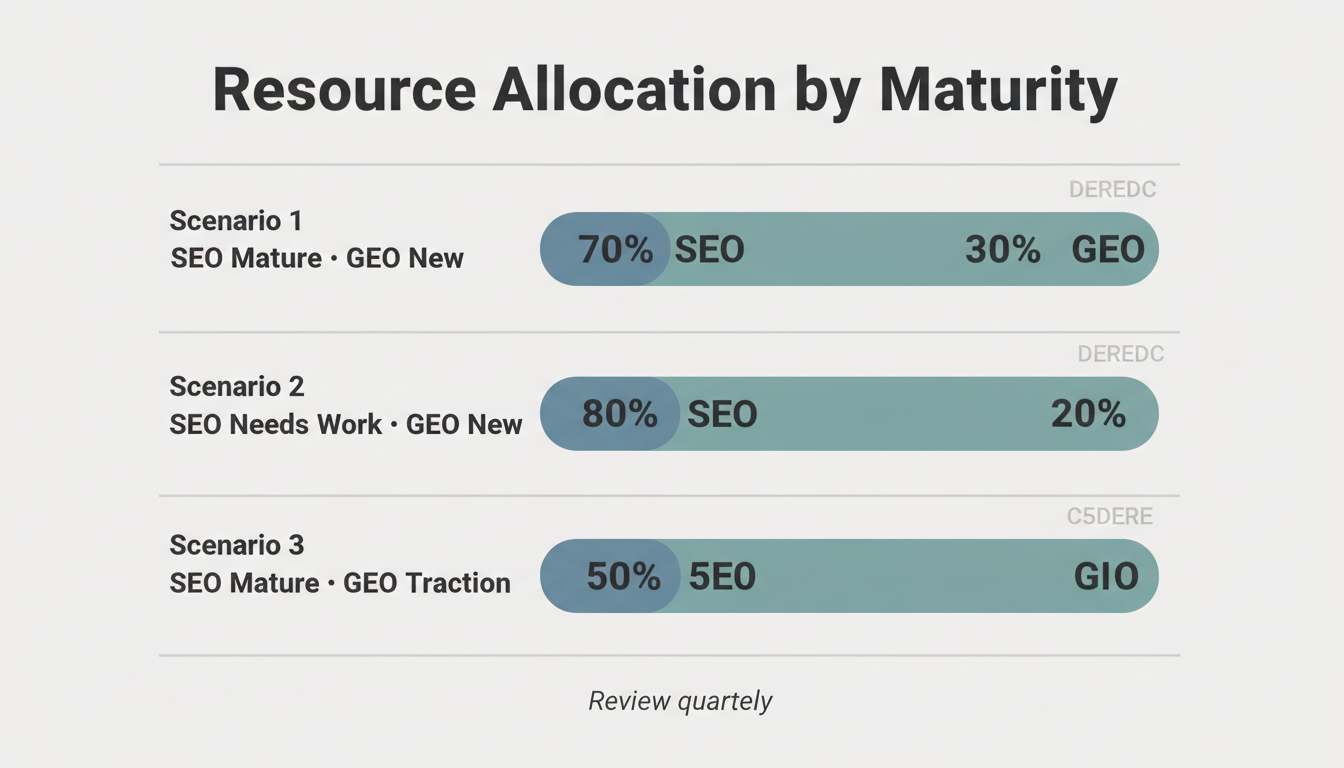
If SEO is mature, GEO is new:
Allocate 70% to SEO maintenance, 30% to GEO development. Your SEO foundation creates advantage - don't neglect it while building GEO capabilities.
If SEO needs work, GEO is new:
Allocate 80% to SEO fundamentals, 20% to GEO exploration. Strong SEO creates the authority signals GEO requires. Building GEO without SEO foundation limits results.
If SEO is mature, GEO shows traction:
Shift toward 50/50 allocation. Both channels produce results; maintain both.
Adjust quarterly based on results and opportunity evolution.
When to Prioritize GEO Over SEO
Certain situations warrant GEO-first approaches:
Informational queries your audience asks AI: If customers research your category through ChatGPT or Perplexity before searching Google, GEO visibility precedes SEO visibility in the buyer journey. Understanding how to rank on ChatGPT becomes essential for early-funnel visibility.
Topics with AI answer dominance: Some queries now get answered entirely by AI, with users never reaching traditional search. GEO is the only visibility path.
Competitive gaps in AI visibility: If competitors earn AI citations for queries where you're invisible, catching up may require prioritized GEO investment.
New content opportunities: Fresh topics without established ranking competition may be easier to win in AI responses than traditional search.
When to Prioritize SEO Over GEO
Other situations favor SEO emphasis:
Transactional queries: Users ready to buy typically search Google, not ask AI. SEO captures transaction-ready traffic more directly.
Local searches: Local SEO drives foot traffic and local business. AI local citations remain less developed.
Established ranking positions: Content ranking #1 with strong traffic shouldn't be restructured for GEO at the expense of ranking performance.
Visual-dependent content: Product pages, portfolio sites, and visual-first content benefit more from image SEO than text-based GEO.
Measuring Combined Success
Unified Reporting Framework
Track both SEO and GEO metrics in combined reports.
SEO metrics to maintain:
- Organic traffic and trends
- Ranking positions for priority keywords
- Conversion rates from organic
- Technical health scores
GEO metrics to add:
- Citation frequency for priority queries
- AI mention accuracy
- Competitive share of voice in AI responses
- AI-referred traffic (where trackable)
Attribution Considerations
Users may encounter your brand through AI, then search Google, then convert. This multi-touch journey complicates attribution.
Practical approach:
- Track both channels independently
- Look for correlation patterns (AI citation increases preceding organic traffic growth)
- Accept that precise attribution may be impossible
- Focus on overall visibility and business outcomes
Common Integration Mistakes
Over-Optimizing for GEO at SEO'S Expense
Restructuring content for AI extraction shouldn't sacrifice readability or SEO performance. If changes hurt rankings without proportional GEO gains, recalibrate.
Treating GEO as Separate Discipline
Isolated GEO teams create redundant work and strategic fragmentation. Integrate GEO into existing SEO roles and processes.
Ignoring Platform-Specific Differences
ChatGPT, Perplexity, and Google AI Overviews weight factors differently. A strategy assuming uniform optimization needs refinement.
Expecting Immediate Results
GEO visibility builds over time like SEO authority. Patience and consistent effort matter more than tactical intensity.
Starting Your Integration
Begin with these actions:
- Audit priority content for both SEO and GEO status
- Identify quick wins - high-SEO-performing content needing minor GEO adjustments
- Modify content workflows to include GEO requirements
- Establish combined reporting tracking both metric sets
- Review quarterly and adjust resource allocation based on results
The goal isn't choosing between GEO and SEO. It's building an integrated strategy where both reinforce each other and capture visibility across the evolving search landscape.
Why Integration Matters
The integration matters because the surfaces share the source. A clean, cited page serves the link and the box, so the build does not double. The honest program builds the base once, and the discipline of the groundwork is the edge, because the citation needs the readable source and the measurement is the guide.
Avoid splitting the team by channel. A program that treats SEO and GEO as separate budgets wastes the overlap, so the unified plan serves both. The combined view makes the work coherent instead of a bet on a single number, because the spread is the hedge and the structure is the asset that pays.
Building the Integrated Strategy
The build is the answer-first shape. A page that leads with the fact and follows with the proof earns the placement, so the order is the technique. The disciplined format makes the page citable instead of skipped, and the patience to build it is the quiet advantage most teams skip while they tune for the old results, because the extraction favors the shape and the structure is the asset.
Use the same cadence for both. The query panel that tracks the classic rank can also track the answer box, so the measurement joins the two. The honest program reads the whole picture, and the combined view justifies the effort to the stakeholders who fund it, because the use is the measure and the discipline is the edge.
When to Prioritize Each
Prioritize GEO when the answer is the entry. A query the assistant answers first needs the cited shape, so the bet follows the behavior. The honest read names the gap, and the clarity makes the program fundable, because the definition of the need is the first deliverable and the data is the guide.
Prioritize SEO when the click is the goal. A query that still drives the visit needs the rank, so the tactic follows the moment. The joined view makes the work coherent, and the silence on one side is the gap the competitor fills, because the tools serve different moments in the same loop and the fit is the lever.
Common Integration Mistakes
The mistake is the missing owner. A plan with no named person is a plan that does not run, so assign the human and the cadence. The ownership is the difference between tooling and theater, and the discipline of the assignment keeps the program honest, because the human who watches the data is the edge that compounds across every post the team publishes.
Another mistake is the thin answer. A page that wins the box but cannot satisfy the click loses the trust it just earned, so the answer must lead and the depth must follow. The honest snippet is the one the page can back up, and the mismatch costs the brand the next time, because the substance is the point and the discipline is the edge that pays.