
Last Updated: January 2026
As AI search has grown, two terms have emerged to describe optimization for these platforms: GEO (Generative Engine Optimization) and AEO (Answer Engine Optimization). While both refer to optimizing content for AI-powered search, they emphasize slightly different aspects.
This guide clarifies the distinction between GEO and AEO, when each term applies, and why the practices overlap significantly.
Defining GEO and AEO
What Is GEO?
Generative Engine Optimization (GEO) refers to optimizing content for generative AI systems - platforms that synthesize new responses rather than returning pre-existing content. The term emphasizes the generative nature of AI responses.
GEO targets visibility in:
- ChatGPT and Claude: Conversational AI assistants
- Google AI Overviews: AI-generated summaries in search
- Perplexity: AI-native search engine
- Microsoft Copilot: AI-integrated search and productivity tools
The "generative" framing highlights that these systems create original responses by synthesizing information from multiple sources.
What Is AEO?
Answer Engine Optimization (AEO) refers to optimizing content to appear in direct answer responses. The term emphasizes the user experience - people receive answers rather than links.
AEO targets visibility in:
- AI chatbots with search: ChatGPT, Claude, Gemini
- AI search engines: Perplexity, You.com
- Featured snippets and answer boxes: Google's direct answer features
- Voice assistants: Siri, Alexa, Google Assistant
The "answer" framing highlights that users seek direct responses rather than needing to click through to websites.
GEO vs AEO: Key Differences
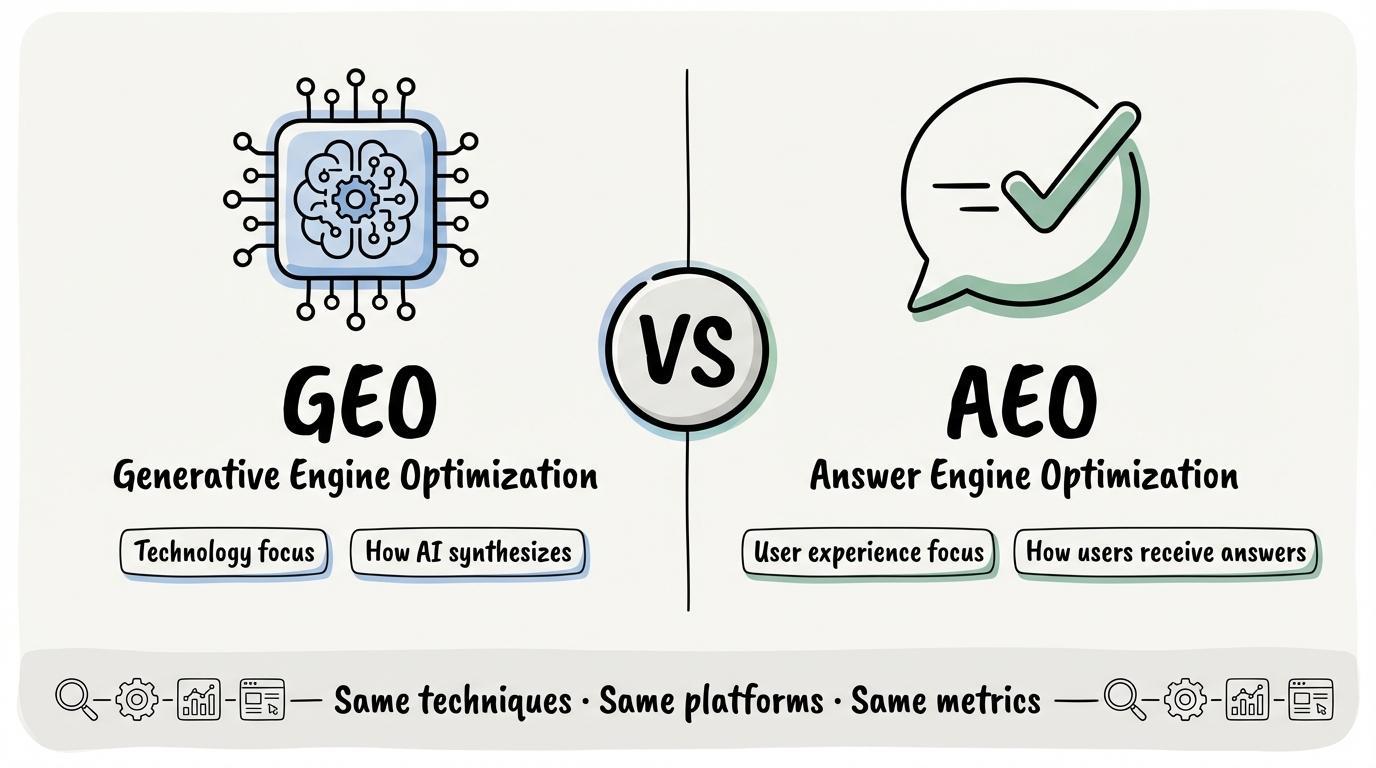
Aspect | GEO | AEO |
Full Name | Generative Engine Optimization | Answer Engine Optimization |
Emphasis | Generative AI systems | Direct answer delivery |
Origin | Academic and industry research | Marketing and SEO industry |
Scope | Primarily AI chatbots and overviews | Includes featured snippets and voice |
Focus | How AI generates responses | How users receive answers |
The Generative Focus
GEO emphasizes the technology behind AI responses. These systems generate new content by:
- Retrieving relevant source material
- Synthesizing information across multiple sources
- Creating original language to present findings
- Citing sources where appropriate
Optimizing for generative systems means understanding this synthesis process and structuring content to be selected and accurately represented. This approach shares foundational principles with AEO optimization strategies that focus on content structure and entity authority.
The Answer Focus
AEO emphasizes the user experience. Users querying these systems want direct answers, not lists of links to explore. This shift affects:
- How content should be structured (clear, extractable answers)
- What metrics matter (citation, not just ranking)
- How success is measured (appearing in answers, not just driving clicks)
AEO optimization focuses on making content the source when users seek answers.
Where GEO and AEO Overlap
Despite different framings, GEO and AEO describe fundamentally similar practices:
Same Optimization Techniques
Both GEO and AEO require:
- Extractable content structure: Short paragraphs that stand alone as quotes
- Question-answer formatting: FAQ sections matching user queries
- Specific, citable information: Statistics and facts with attribution
- Entity authority: Consistent brand presence across platforms
- Technical accessibility: Schema markup and crawler access
Understanding these shared techniques is essential when evaluating top generative engine optimization companies for implementation support.
Same Target Platforms
The primary platforms for both disciplines overlap almost entirely:
- ChatGPT with search capabilities
- Google AI Overviews
- Perplexity
- Microsoft Copilot
- Other AI-powered search experiences
Same Success Metrics
Both GEO and AEO measure success through:
- Citation frequency in AI responses
- AI referral traffic
- Share of voice versus competitors
- Citation accuracy
Which Term Should You Use?
In practice, GEO and AEO are often used interchangeably. The choice often depends on context:
When GEO Makes More Sense
- Discussing technical aspects of AI systems
- Academic or research contexts
- Emphasizing the AI technology behind responses
- Targeting practitioners focused on AI platforms specifically
When AEO Makes More Sense
- Discussing user behavior and experience
- Marketing and business contexts
- Emphasizing the shift from clicks to answers
- Targeting traditional SEO practitioners adapting to AI search
When Either Works
Most practical discussions of optimizing for AI search can use either term effectively. The underlying practices, techniques, and goals align regardless of terminology. For a comprehensive comparison of optimization approaches, explore our AEO platform comparison guide.
Related Terms
You may also encounter:
- LLM SEO: Optimization specifically for large language models
- AI Search Optimization: Broader term covering all AI search types
- Conversational Search Optimization: Focus on natural language query patterns
- SGE Optimization: Google-specific (Search Generative Experience)
All these terms describe aspects of the same fundamental shift: optimizing content for AI-powered search platforms that synthesize answers rather than returning ranked links. For deeper insights into these emerging practices, see our article on AI search optimization.
The Practical Takeaway
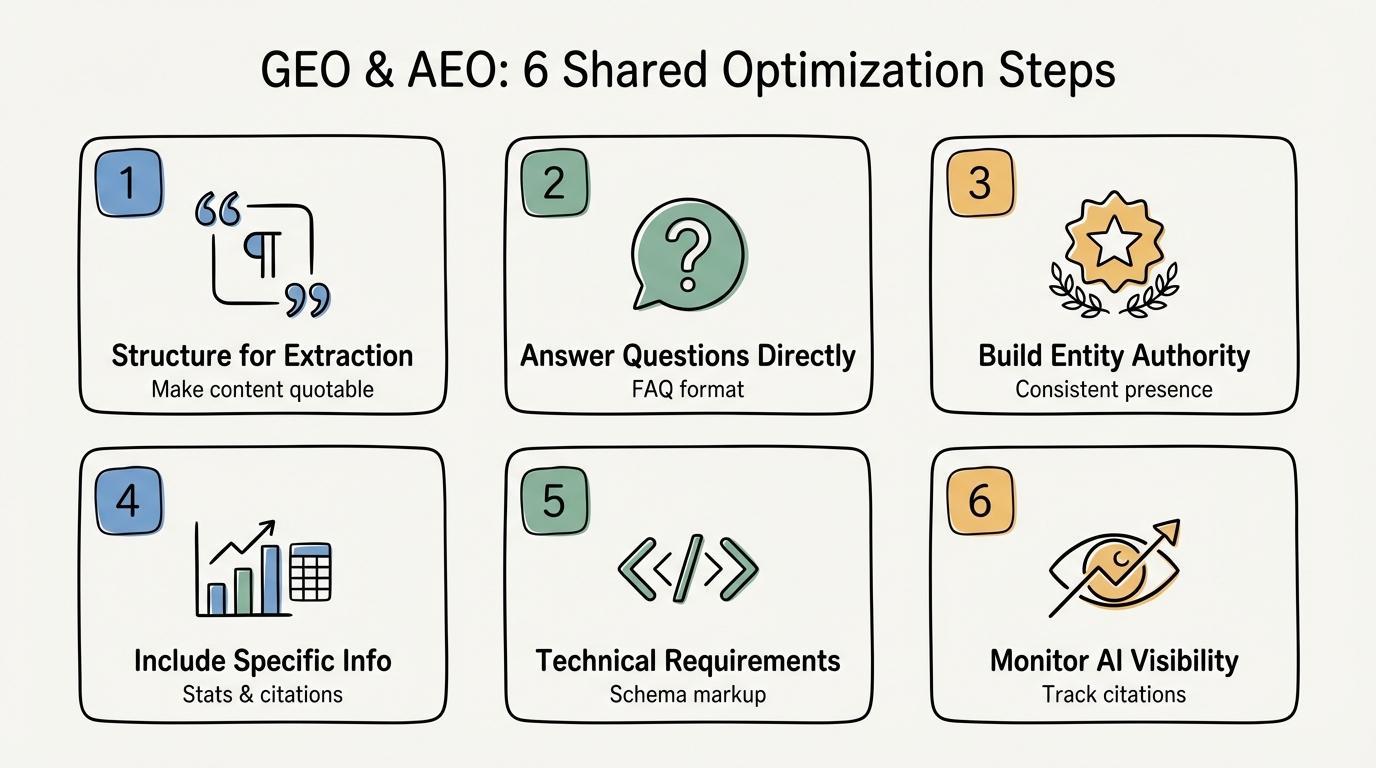
Whether you call it GEO or AEO, the optimization approach remains the same:
- Structure content for extraction: Make paragraphs quotable and standalone
- Answer questions directly: Create FAQ content matching user queries
- Build entity authority: Maintain consistent presence across platforms
- Include specific information: Add statistics and facts with attribution
- Implement technical requirements: Deploy schema, allow AI crawlers
- Monitor AI visibility: Track citations and AI referral traffic
The terminology matters less than understanding and implementing the underlying practices.
Key Takeaways
GEO and AEO describe the same fundamental practice - optimizing content for AI-powered search platforms. The terms emphasize different aspects (generative technology vs. answer delivery) but the techniques are nearly identical.
Use whichever term fits your context. Neither is more correct. GEO may resonate better in technical discussions; AEO may resonate better in business and marketing contexts.
Focus on the practices, not the label. Content extraction, entity authority, technical accessibility, and citation monitoring matter regardless of what you call them.
Defining GEO and AEO
GEO earns the model's quote; AEO earns the answer box, so the two share the answer-first shape but differ in the surface. The honest program names both, and the discipline of the scope is the edge, because the presence on each is the first step and the structure is the asset.
Avoid using the terms as if equal. AEO targets the box; GEO targets the citation, so the tactic follows the target. The clear definition lets the team pick the right build, and the clarity makes the work coherent instead of a guess, because the fit is the lever and the data is the guide.
Where They Overlap
The overlap is the structured, cited answer. A page that leads with the fact and supports it with schema serves both, so the build does not double. The balanced shape serves both readers, and the coherence earns the placement and the click rather than the skip, because the order is the signal and the discipline is the edge that pays.
Use one cadence for both. The query panel that tracks the box can also track the citation, so the measurement joins the two. The honest program reads the whole picture, and the combined view justifies the effort to the stakeholders who fund it, because the use is the measure and the upkeep is the value.
The Practical Takeaway
The takeaway is the answer-first page. A clean, schema'd post that leads with the fact is what both surfaces lift, so the bet follows the behavior. The honest read names the gap, and the clarity makes the program fundable, because the definition of the need is the first deliverable and the structure is the asset.
Measure the takeaway on a cadence. A fixed query list watched over time shows whether you hold the box and the quote, because the position is not permanent. The disciplined check catches the loss early, and the patience to monitor is the quiet edge most teams skip while they assume the win holds, because the measurement is the guide and the fit is the lever.
FAQs
Do GEO and AEO Require Different Strategies?
No. The optimization techniques for GEO and AEO overlap almost entirely. Both require extractable content, entity authority, technical accessibility, and similar measurement approaches. The terms describe the same practice from different perspectives.
Which Term Is More Widely Used?
Usage varies by industry and region. AEO appears more frequently in marketing and SEO discussions, while GEO appears more in academic and technical contexts. Both terms are growing in usage as AI search becomes more prominent.
Should I Hire a GEO Agency or an AEO Agency?
Look for capabilities rather than terminology. Agencies using either term should demonstrate the same core competencies: content restructuring, entity optimization, technical implementation, and AI visibility monitoring.