
The AI search landscape has introduced new terminology that confuses even experienced marketers. GEO and AEO sound similar and overlap significantly—but they target different mechanisms of AI-powered search. Understanding the distinction helps you allocate optimization efforts effectively.
This guide clarifies what each term means, where they differ, and how they work together.
Defining the Terms
What Is AEO (Answer Engine Optimization)?
AEO focuses on optimizing content to appear in answer engines—systems that provide direct answers to user queries rather than lists of links.
Answer engines include:
- Google AI Overviews (formerly SGE)
- Google Featured Snippets
- Voice assistants (Alexa, Siri, Google Assistant)
- Perplexity AI
- Bing Chat
AEO emerged from the shift toward zero-click searches. When Google started displaying answers directly in search results, optimizing for those answer boxes became a distinct discipline.
AEO goal: Get your content selected as the source for direct answers.
What Is GEO (Generative Engine Optimization)?
GEO focuses on optimizing content to be cited by generative AI systems—LLMs that synthesize responses from multiple sources rather than displaying a single answer. Understanding what is generative engine optimization GEO helps clarify how these systems evaluate and select content for citation.
Generative engines include:
- ChatGPT (with web search)
- Claude (with web search)
- Google Gemini
- Perplexity AI
- Microsoft Copilot
GEO addresses the unique challenge of earning citations when AI generates novel responses by combining information from various sources.
GEO goal: Get your content cited as a source in AI-generated responses.
AIO vs AEO vs GEO: Clearing Up the Terminology
The proliferation of acronyms in AI search optimization creates real confusion. Beyond GEO and AEO, you will encounter AIO (AI Overview Optimization) and GSO (Generative Search Optimization). These are not entirely separate disciplines—they describe overlapping approaches with different focal points.
AIO specifically targets Google AI Overviews, making it a Google-centric subset of the broader GEO category. GSO is largely synonymous with GEO and gained traction before the GEO term became standard. For a deeper look at how these relate to traditional search, see our comparison of AEO vs GEO vs SEO.
The timeline matters for understanding scope. AEO emerged during the voice search era of 2018–2020, when optimizing for Alexa, Siri, and Google Assistant answer boxes was the primary concern. GEO arrived with the LLM wave of 2023–2024, addressing the new challenge of earning citations in ChatGPT, Perplexity, and Gemini responses.
The clearest way to think about scope: AEO targets structured answer formats—featured snippets, answer boxes, and voice assistant responses where one source gets selected. GEO targets generative AI citations—the sources that LLMs reference when synthesizing multi-source responses. Both live under the broader umbrella of AI search optimization, and for a thorough comparison of the two approaches, our guide on answer engine optimization vs generative engine optimization covers the nuances in detail.
How AI Crawlers and Llms Discover Your Content
Before you can earn AI citations, AI systems need to find and process your content. Understanding how AI crawlers operate is foundational to both AEO and GEO strategy.
The major AI crawlers each serve different platforms. GPTBot crawls for OpenAI and ChatGPT. ClaudeBot collects data for Anthropic's Claude. PerplexityBot powers Perplexity's real-time retrieval-augmented generation (RAG) system. Google-Extended feeds Google Gemini and AI Overviews. Each crawler operates differently—some collect training data in bulk, while Perplexity's bot retrieves content in real time to answer specific queries.
A newer standard called LLMS.txt is emerging as the AI equivalent of robots.txt. While robots.txt controls which pages crawlers can access, LLMS.txt provides a structured summary of your site specifically designed for LLM consumption. It tells AI systems what your site covers, your key content areas, and your areas of authority. For more on how to make your content discoverable to these systems, see our guide on AI search ranking factors.
You can verify AI crawler activity by checking your server logs for the user-agent strings of these bots. This tells you which AI systems are already indexing your content and which are not.
The robots.txt decision is a strategic tradeoff. Blocking AI crawlers preserves your content exclusively for traditional search, but it means your site will not appear in AI-generated responses. Allowing AI crawlers increases your visibility in ChatGPT, Perplexity, and other generative platforms at the potential cost of reduced direct traffic when AI answers replace clicks.
Content structure matters more for AI parsing than for traditional SEO. AI systems extract meaning most effectively from content organized with clear headings, bulleted lists, comparison tables, and well-labeled data. Pages that are dense, unstructured prose are harder for AI to cite accurately. Implementing structured data for AI search further helps these systems parse and reference your content.
Knowledge Graph and Entity Optimization for AI Search
Both AEO and GEO benefit from strong entity presence. The Google Knowledge Graph—a database of billions of entities and their relationships—directly feeds AI Overviews and influences which sources generative AI systems trust.
Entity optimization means establishing your brand, authors, and products as recognized entities that AI systems can confidently reference. This starts with presence on authoritative entity databases: Wikipedia, Wikidata, Crunchbase, and schema.org markup on your own site. When LLMs encounter a brand they can verify across multiple authoritative sources, they are significantly more likely to cite that brand's content. If you are looking to establish this presence, our guide on how to get a Google Knowledge Panel walks through the process step by step.
Knowledge panel optimization serves as a trust signal for both answer engines and generative AI. When Google recognizes your brand with a knowledge panel, it signals entity authority that cascades into AI Overview source selection and LLM citation preferences.
LLMs use entity recognition to decide which sources to cite. If your content discusses a topic and your brand is a recognized authority on that topic, generative AI systems weight your content more heavily in their response synthesis.
Practical steps to strengthen entity presence: claim and optimize your Google Business Profile, ensure consistent NAP (name, address, phone) data across directories, build entity associations through comprehensive schema.org markup (Organization, Person, Article types), and earn authoritative mentions from recognized industry sources. These actions compound over time, gradually establishing your brand as a trusted entity that AI systems default to when generating responses in your domain.
How to Measure AEO vs GEO Performance Separately
One of the biggest gaps in AI search strategy is measurement. Most organizations track traditional SEO metrics but lack frameworks for measuring AEO and GEO performance independently. The two require different tools, different data sources, and different KPIs.
Measuring AEO Performance
AEO measurement centers on answer selection rates across traditional search interfaces. Track featured snippet wins using Google Search Console—filter for queries where your average position is between 0 and 1, indicating position-zero placement. Monitor voice search answer rates by testing your target queries on Google Assistant, Alexa, and Siri, and recording which queries return your content as the spoken answer. Track answer box appearance rate for your core question-based queries over time. Zero-click impression share in GSC (impressions without clicks at high positions) indicates your content is being displayed as an answer directly in search results. Use AEO tools and software to automate this tracking at scale.
Measuring GEO Performance
GEO measurement requires different tooling entirely. Use AI citation tracking tools to monitor when and where your content gets cited in AI-generated responses. In GA4, filter referral traffic by source containing "chatgpt.com", "perplexity.ai", or "copilot.microsoft.com" to isolate AI-driven visits. Measure share of voice in AI answers by systematically querying ChatGPT, Perplexity, and Gemini for your target keywords and recording citation frequency—this manual process can be partially automated with generative engine optimization tools. Monitor Google AI Overview citations separately, as they represent a hybrid of AEO and GEO. Brand mention monitoring across LLM outputs reveals how often AI systems reference your brand even without direct citations.
The following comparison highlights the distinct metrics for each approach:
| Metric Category | AEO Metrics | GEO Metrics |
|---|---|---|
| Primary KPI | Featured snippet win rate | AI citation frequency |
| Traffic Signal | Zero-click impressions (GSC) | AI referral traffic (GA4) |
| Voice/Assistant | Voice search answer rate | LLM brand mention rate |
| Competitive | Answer box share vs competitors | Share of voice in AI responses |
| Monitoring | Position 0 tracking | Cross-platform citation tracking |
Common GEO and AEO Mistakes to Avoid
Organizations adopting AI search optimization frequently make avoidable mistakes that undermine their results. Recognizing these pitfalls early saves months of wasted effort.
Treating GEO and AEO as the same strategy. Despite their overlap, GEO and AEO target different platforms with different selection mechanisms. Featured snippet optimization (AEO) rewards concise, structured answers. AI citation earning (GEO) rewards depth, authority, and entity recognition. Running identical tactics for both leaves performance on the table.
Ignoring content freshness signals. AI systems heavily weight recency. Pages without a visible dateModified, or with stale publication dates from years ago, get deprioritized in AI responses. Update your structured data timestamps whenever you make substantive content changes.
Missing author bios and E-E-A-T credentials. Generative AI systems evaluate author authority when selecting sources to cite. Pages without author attribution, credentials, or links to author profiles lose trust signals that competitors with strong E-E-A-T presence capture.
Not including outbound links to authoritative sources. LLMs use citation patterns as trust signals. Content that references and links to authoritative sources (research papers, government data, recognized industry publications) signals higher credibility than content making unsupported claims.
Blocking AI crawlers without understanding the tradeoff. Some publishers reflexively block GPTBot, ClaudeBot, and other AI crawlers in robots.txt. While this is a valid strategic choice, it means forfeiting all visibility in those AI platforms' responses—an increasingly significant traffic source.
Relying only on traditional SEO metrics. If you measure AI search success solely through Google Search Console rankings and organic traffic, you are missing the picture. AI citation rates, LLM referral traffic, and share of voice in AI responses are distinct metrics that require dedicated tracking.
GEO vs AEO by Industry: Different Strategies for Different Verticals
The relative importance of GEO and AEO varies significantly by industry, and a one-size-fits-all approach wastes resources.
Publishers and media. AEO is critical because featured snippets drive substantial traffic. However, GEO presents a double-edged sword: AI-generated answers that summarize your reporting can reduce clicks to your site. Publishers should optimize for AI citations (GEO) to maintain brand visibility while monitoring Google AI Overview SEO impact on their click-through rates. For publishers concerned about traffic loss, understanding the options for disabling Google AI Overviews provides strategic alternatives.
E-commerce. GEO matters increasingly for product discovery as AI shopping assistants (ChatGPT with shopping, Perplexity product search) gain adoption. AEO remains important for product-comparison queries where featured snippets capture high-intent traffic.
SaaS and B2B. GEO drives brand visibility during the research phase when buyers ask AI systems "what are the best tools for X." AEO captures decision-stage queries like "product A vs product B" where featured snippet placement influences purchase decisions.
Local businesses. AEO currently delivers more impact through voice search ("find a plumber near me") and local answer boxes. GEO is less relevant for local businesses today but will grow as AI assistants handle more local service queries.
Across all verticals, the trend is clear: AI-generated answers are absorbing an increasing share of search interactions, and the CTR impact of AI Overviews on traditional organic results is measurable and growing.
Key Differences
While both disciplines optimize for AI-powered search, they differ in important ways.
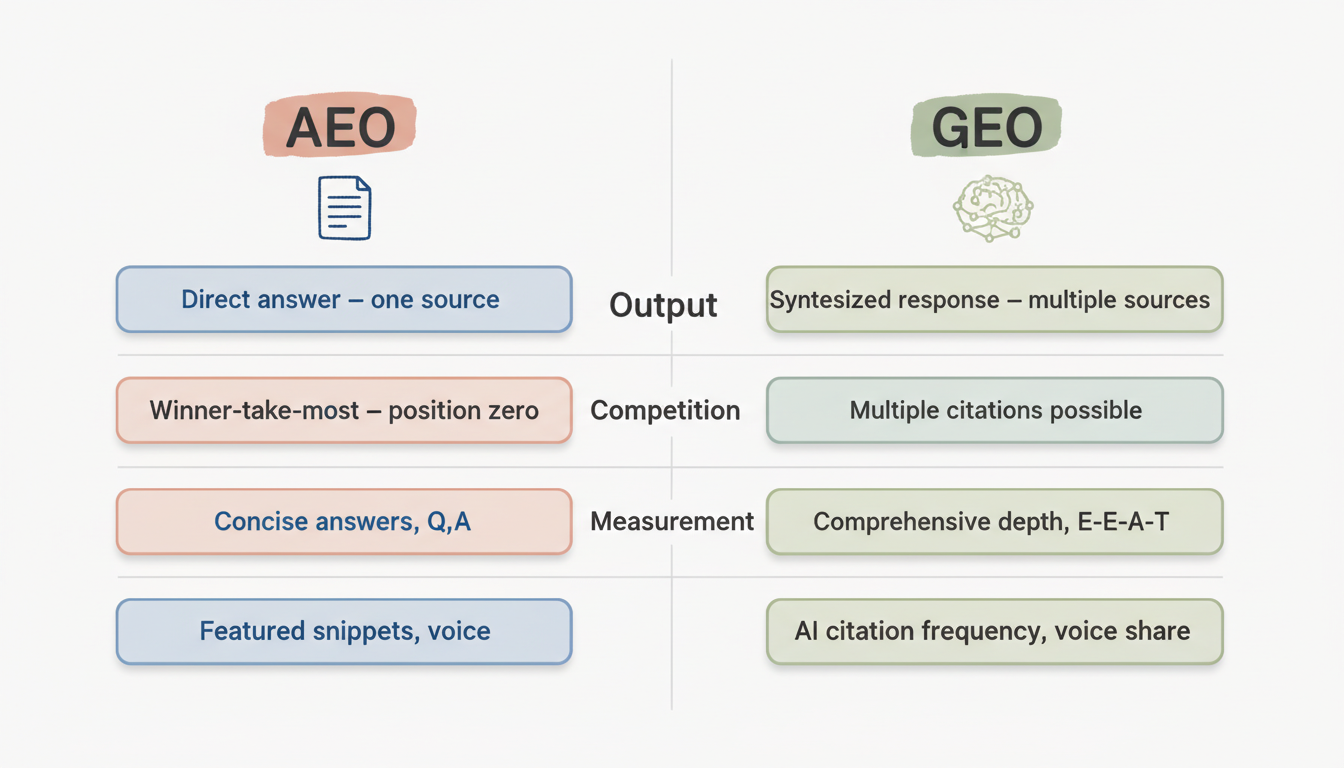
1. Output Format
AEO targets: Direct answers displayed prominently in search results. One source typically gets selected as "the" answer.
GEO targets: Synthesized responses where AI combines information from multiple sources, potentially citing several in a single response.
2. Competition Dynamics
AEO: Winner-take-most. Featured snippets display one answer. Being position zero means your competitor isn't there.
GEO: Multiple sources can be cited in the same response. AI might reference your content alongside competitors when synthesizing comprehensive answers. This makes understanding cross-platform AI search ROI essential for measuring success across different AI systems.
3. Content Requirements
AEO emphasizes:
- Concise, direct answers
- Question-matching structure
- Featured snippet optimization
- Clear, extractable statements
GEO emphasizes:
- Comprehensive depth
- Authority signals (E-E-A-T)
- Unique data and insights
- Citation-worthy expertise
4. Measurement Approach
AEO metrics:
- Featured snippet captures
- Answer box appearances
- Voice search responses
- Zero-click impression data
GEO metrics:
- AI citation frequency
- Mention accuracy and sentiment
- Share of voice in AI responses
- AI referral traffic
Where They Overlap
Despite differences, GEO and AEO share significant common ground.
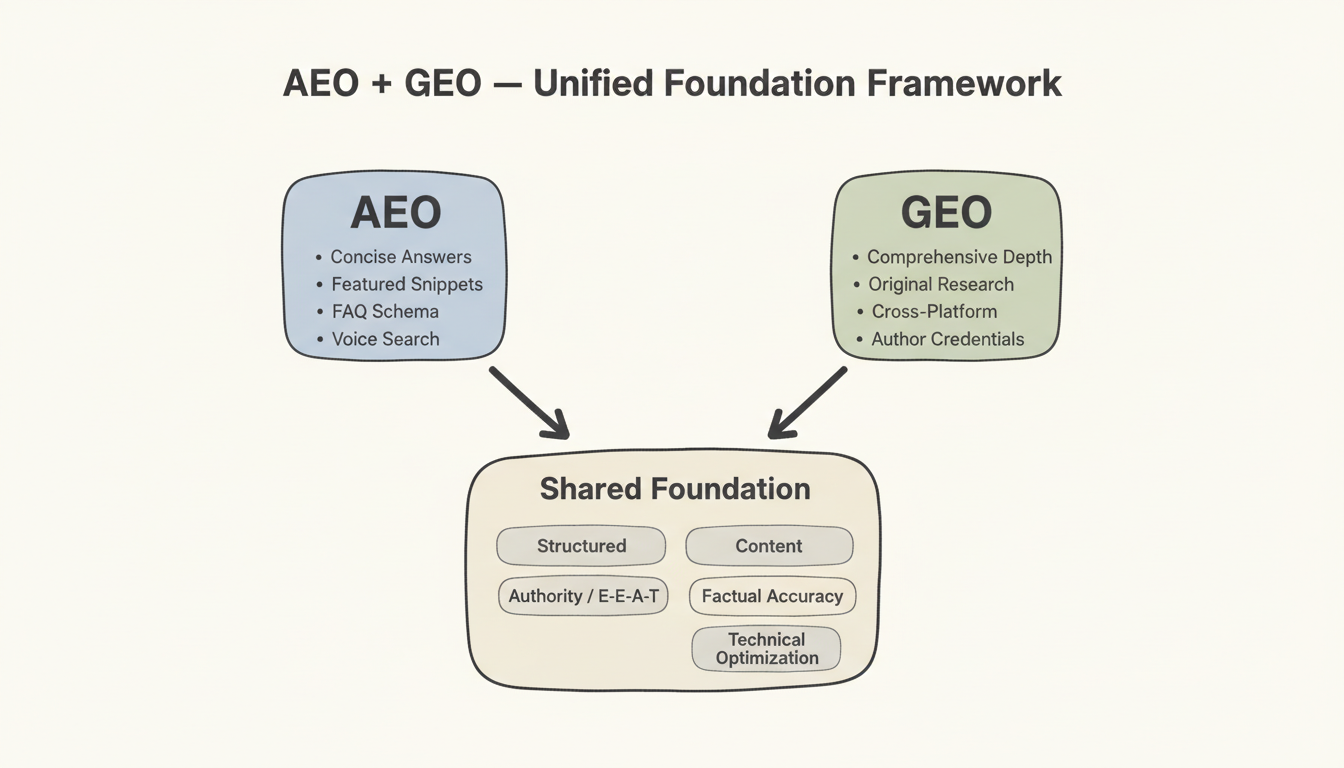
Shared Success Factors
Both disciplines benefit from:
Structured content – Clear headings, logical organization, and extractable paragraphs work for both answer selection and AI citation.
Authority signals – E-E-A-T matters whether Google selects your featured snippet or ChatGPT cites your expertise.
Factual accuracy – Both answer engines and generative AI prioritize accurate, trustworthy sources.
Technical optimization – Schema markup, fast loading, and crawler access benefit all AI systems. Implementing a free AI SEO tech stack can help establish this foundation without major budget investment.
Platform Overlap
Some platforms blur the distinction entirely. Perplexity functions as both an answer engine (providing direct responses) and a generative engine (synthesizing from multiple sources). Google AI Overviews combine answer-engine display with generative synthesis.
Optimizing for these hybrid platforms requires both AEO and GEO thinking.
Practical Application
When to Focus on AEO
Prioritize AEO when:
- Targeting queries with featured snippet opportunities
- Optimizing for voice search responses
- Competing for position zero in traditional search
- Answering simple, factual questions
AEO tactics include:
- Structuring content in Q&A format
- Using question words in headings
- Providing concise 40-60 word answers
- Implementing FAQ schema
When to Focus on GEO
Prioritize GEO when:
- Targeting complex queries requiring synthesis
- Building visibility in ChatGPT and Claude
- Establishing topical authority in AI responses
- Competing on expertise rather than format
GEO tactics include:
- Creating comprehensive, authoritative content
- Building cross-platform presence and citations
- Developing original research and data
- Strengthening author credentials and expertise signals
Unified Approach
Most organizations should pursue both. A unified strategy recognizes that:
- Content structured for featured snippets often gets cited by generative AI
- Authoritative content earns both answer selection and AI citations
- Technical optimization serves all AI-powered discovery
- The same content can succeed in both contexts with proper structure
The Terminology Debate
Industry practitioners use GEO and AEO inconsistently. Some use them interchangeably. Others treat AEO as a subset of GEO, or vice versa. For a comprehensive comparison of these approaches, see our guide on GEO vs SEO vs AI.
Practical guidance: Don't get caught up in terminology debates. Focus on the underlying questions:
- How do you get selected as the answer source?
- How do you earn citations in synthesized AI responses?
- What content and technical requirements achieve both?
The tactics matter more than the labels.
Future Convergence
As AI search evolves, the GEO/AEO distinction may blur further. Generative engines increasingly provide direct answers. Answer engines increasingly use generative synthesis.
Emerging pattern: All AI-powered search systems benefit from:
- Authoritative, trustworthy content
- Clear structure enabling extraction
- Comprehensive topic coverage
- Strong technical foundation
Optimize for these fundamentals, and terminology differences become less relevant.
Summary
AEO optimizes for answer engines that select and display direct answers—featured snippets, voice responses, answer boxes.
GEO optimizes for generative engines that synthesize responses from multiple sources—ChatGPT, Claude, Perplexity.
In practice: Both benefit from similar fundamentals. Authoritative, well-structured content optimized for AI comprehension works across both paradigms. Focus on quality and structure rather than optimizing separately for each term.
FAQs
Is GEO or AEO More Important in 2026?
Both matter, with relative importance depending on your audience. If your audience uses ChatGPT and Perplexity primarily, GEO deserves more focus. If they rely on Google search with AI Overviews, AEO may be more relevant. Most businesses benefit from a combined approach.
Can I Use the Same Content for GEO and AEO?
Yes. Well-structured, authoritative content performs across both contexts. The key is combining concise, extractable answers (AEO strength) with comprehensive depth and authority signals (GEO strength).
What Is the Difference Between GEO and AEO?
GEO (Generative Engine Optimization) optimizes content to be cited by AI-powered generative tools like ChatGPT, Perplexity, and Google AI Overviews. AEO (Answer Engine Optimization) optimizes for direct-answer formats like featured snippets, voice search results, and answer boxes. GEO focuses on earning AI citations through entity authority and content depth, while AEO focuses on structuring content to be selected as the single best answer.
Is GEO Replacing SEO?
GEO is not replacing SEO but expanding it. Traditional SEO still drives the majority of organic traffic, while GEO addresses the growing share of searches answered by AI. The best strategy combines SEO fundamentals with GEO-specific tactics like entity optimization, structured data, and AI crawler accessibility.
How Do I Optimize for AI Search Engines Like ChatGPT and Perplexity?
Focus on building entity authority (knowledge panels, Wikipedia presence), structuring content with clear headings and data tables, including original research and statistics, and ensuring AI crawlers can access your content. Use schema markup to help AI systems understand your content structure.
Can You Do AEO and GEO at the Same Time?
Yes, and most organizations should. Many tactics overlap: structured data, E-E-A-T signals, and content clarity benefit both. The key difference is measurement—track AEO via featured snippet wins and voice search, and track GEO via AI citation monitoring and LLM referral traffic.