
When users ask SearchGPT "What's the best CRM for small business?" or "Top marketing automation tools 2026," the AI doesn't generate recommendations from thin air. It synthesizes answers from authoritative comparison lists—roundups from trusted publishers, industry reviews, and curated "best of" content. Getting your product or service featured on these lists directly influences whether SearchGPT recommends you.
This isn't about gaming the system. It's about ensuring your legitimate offering appears in the comparison content that AI systems reference when making recommendations.
Why Comparison Lists Matter for SearchGPT Visibility
SearchGPT's recommendation engine relies heavily on consensus from trusted sources, similar to how Google AI Overviews synthesize information from multiple authoritative sources.
How SearchGPT handles "best" queries:
User Query: "Best project management software for remote teams"

SearchGPT Process:
├── Identifies query as recommendation request
├── Retrieves comparison/review content
├── Analyzes patterns across multiple lists
├── Weighs source authority
├── Synthesizes recommendation with cited sources
└── Presents top options with context
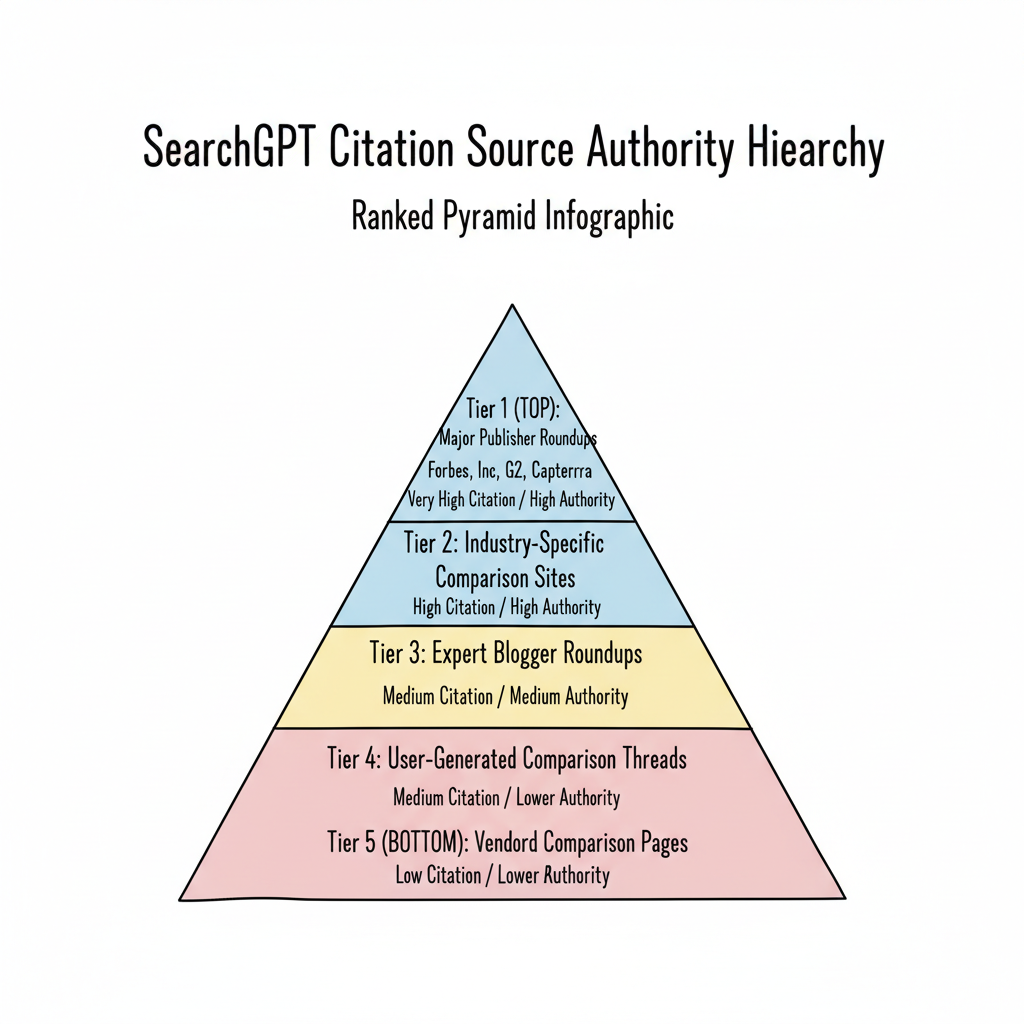
Citation source patterns for recommendation queries:
Source Type | Citation Frequency | Authority Weight |
Major publisher roundups (Forbes, G2, Capterra) | Very High | High |
Industry-specific comparison sites | High | High |
Expert blogger roundups | Medium | Medium |
User-generated comparison threads | Medium | Lower |
Vendor-created comparison pages | Low | Lower |
If your product appears on multiple authoritative comparison lists, SearchGPT is more likely to include you in recommendations.
Identifying High-Value Comparison List Opportunities
Not all comparison lists carry equal weight with AI systems.
Priority 1: Major Publisher Roundups
These carry the most authority for SearchGPT citations.
High-priority targets:
Publisher Type | Examples | Why They Matter |
Business publications | Forbes, Inc, Entrepreneur | High domain authority, broad reach |
Tech reviewers | TechRadar, PCMag, CNET | Deep product coverage |
Industry analysts | Gartner, Forrester, G2 | Professional credibility |
Vertical specialists | MarTech, HR Tech, FinTech pubs | Category expertise |
Finding relevant lists:
Search these patterns to discover opportunities:
- "[your category] best tools 2026 site:forbes.com"
- "top [your category] software comparison"
- "best [your category] for [target audience] roundup"
Priority 2: Review Aggregators
Review platforms aggregate user feedback and create comparison content.
Key platforms by category:
Category | Primary Platforms |
B2B Software | G2, Capterra, TrustRadius |
E-commerce tools | Shopify App Store, BigCommerce Marketplace |
Marketing tools | OMR Reviews, GetApp |
General business | Trustpilot, Better Business Bureau |
These platforms often appear in SearchGPT responses because they aggregate structured data from many users.
Priority 3: Industry-Specific Roundups
Niche authority matters for specialized queries. Understanding the SEO vs AEO key differences helps you target the right types of authoritative sources that AI systems trust.
Identifying niche opportunities:
- Search "[your industry] best [your category]"
- Note which sites consistently rank for comparison queries
- Analyze whether those sites accept submissions or feature requests
- Check if they update their lists regularly (outdated lists get less AI citation)
Outreach Strategy for Comparison List Inclusion
Getting listed requires proactive outreach, not passive waiting.
For Major Publisher Roundups
Research before outreach:
Research Element | What to Find |
Author/editor contact | LinkedIn, Twitter, publication contact page |
Update frequency | Does the list update annually, quarterly? |
Inclusion criteria | What criteria do they use for selection? |
Competitor presence | Are similar products already listed? |
Submission process | Formal process or editorial discretion? |
Outreach approach:
Subject: [Your Product] for [Publication]'s [Category] Roundup

Key elements:
├── Brief product introduction (2 sentences)
├── Why it fits their criteria
├── Unique differentiator from listed competitors
├── Offer: Demo, free access for review, data/stats
└── No pressure, informational tone
Timing matters:
- Publications often update "best of" lists Q4 for next year
- Reach out 2-3 months before their typical update cycle
- Follow up once, then wait for next cycle if no response
For Review Platforms
Review aggregators have formal processes.
Platform-specific tactics:
Platform | Listing Process | Optimization Focus |
G2 | Claim profile, request reviews | Review volume, recency |
Capterra | Create listing, verify | Complete profile, categories |
TrustRadius | Claim or create | Detailed product info |
Review generation for platform ranking:
- Implement post-purchase review request flows
- Make review submission easy (direct links to profile)
- Respond to all reviews (positive and negative)
- Update profile regularly with new features/pricing
For Industry Bloggers and Influencers
Smaller publishers can be more accessible.
Identification process:
- Search "[category] comparison" and "[category] alternatives"
- Identify non-major-publisher sites ranking on page 1
- Check site's domain authority and traffic (Ahrefs, Semrush)
- Verify they update content (check article dates)
Blogger outreach approach:
- Offer product access for honest evaluation
- Provide unique data or insights they can use
- Don't request specific placement—let merit drive inclusion
- Build relationship before asking for coverage
Positioning Your Product for Comparison Inclusion
Getting noticed requires clear positioning that comparison authors can articulate. This is where effective ChatGPT optimization tactics become crucial for ensuring AI systems can accurately represent your product.
Differentiation Clarity
Comparison list authors need clear reasons to include you.
Positioning elements to emphasize:
Element | Why It Matters | Example |
Primary use case | Helps authors categorize | "Best for agencies managing 10+ clients" |
Unique capability | Differentiates from incumbents | "Only tool with AI-powered X" |
Price positioning | Fits comparison structure | "Most affordable enterprise option" |
Target audience | Matches reader segments | "Built specifically for remote teams" |
Supporting Materials for Authors
Make it easy for comparison authors to include you accurately.
Materials to prepare:
- One-page product summary - Key features, pricing, ideal customer
- Comparison data - How you stack against competitors (factual, not promotional)
- Customer proof points - Stats, testimonials, case study summaries
- Visual assets - Screenshots, logos in multiple formats
- Review/rating summary - Aggregate scores from review platforms
Tracking Your Comparison List Presence
Monitor whether your efforts translate to SearchGPT visibility.
Manual Tracking Process
Weekly check protocol:
- Search recommendation queries related to your category
- Note whether SearchGPT includes your product
- Check which sources SearchGPT cites
- Track whether cited sources include your product
- Document changes over time
Tracking spreadsheet structure:
Query | SearchGPT Mentions You | Sources Cited | Your Product on Cited Sources |
"Best [category]" | Yes/No | [list] | Yes/No per source |
Correlation Analysis
Connect list presence to AI visibility.
What to track:
- New list inclusion → Monitor SearchGPT mention changes
- List position improvement → Check recommendation prominence
- Review score increases → Track citation frequency
- Competitor list additions → Note impact on your mentions
Common Mistakes to Avoid
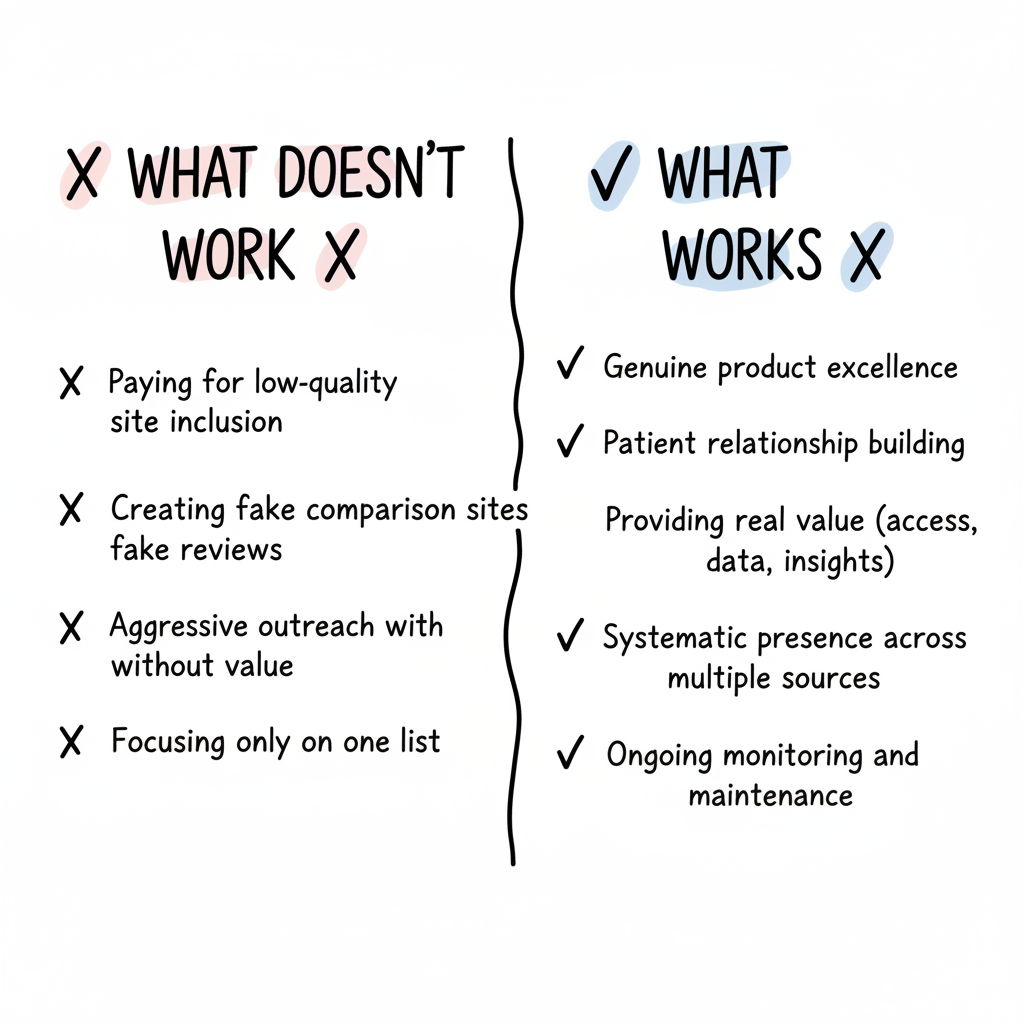
What doesn't work:
Mistake | Why It Fails |
Paying for inclusion on low-quality sites | AI systems filter low-authority sources |
Creating fake comparison sites featuring yourself | Pattern detection flags self-promotion |
Flooding review platforms with fake reviews | Platform penalties, AI detection |
Aggressive outreach without value | Damages relationships, wastes effort |
Focusing only on one list | Consensus across sources matters more |
What works:
- Genuine product excellence that earns mentions
- Patient relationship building with authors
- Providing real value (access, data, insights)
- Systematic presence across multiple authoritative sources
- Ongoing monitoring and relationship maintenance
Key Takeaways
Getting listed on authoritative comparison lists for SearchGPT visibility:
- Prioritize high-authority sources - Major publishers and review aggregators carry most weight
- Research before outreach - Understand update cycles, criteria, and submission processes
- Offer value, not just requests - Product access, unique data, genuine insights
- Complete review platform profiles - Structured data from G2, Capterra matters
- Position clearly - Authors need specific differentiators to justify inclusion
- Prepare supporting materials - Make accurate inclusion easy for authors
- Track systematically - Connect list presence to SearchGPT mention changes
- Avoid shortcuts - Fake reviews and paid placements backfire with AI systems
Comparison list presence isn't a one-time achievement. It requires ongoing relationship building, product excellence, and systematic tracking. The businesses that consistently appear in SearchGPT recommendations are those with genuine presence across multiple authoritative comparison sources.