
Broad match is the default keyword match type in Google Ads. It shows your ads on searches related to your keyword's meaning, including queries that do not contain your keyword terms. It reaches the widest audience of any match type, but it only performs when you pair it with Smart Bidding and disciplined negative keywords to control wasted spend.
Broad match has a reputation for burning budget, and in the wrong setup it does exactly that. But the modern version is a different tool than the one advertisers feared five years ago. This guide explains how broad match works in 2026, when it wins, when it wastes money, and the exact controls that keep it profitable. For a side-by-side of all three options, see our guide to Google Ads keyword match types.
TL;DR: What You Need to Know About Broad Match
- It is the default. New keywords are broad match unless you add symbols. Broad = plain text, phrase = "quotes", exact = [brackets].
- It matches on meaning, not word order. Broad can show your ad for related searches that share none of your keyword's words.
- Smart Bidding is mandatory. Broad match relies on Smart Bidding to set a bid for each individual query in real time. Without it, broad reaches too far for a flat bid.
- Use tCPA or tROAS, not "maximize" bidding. Maximize conversions or maximize revenue plus broad tends to spend the whole budget for a few extra conversions.
- Negative keywords are your main lever. The search terms report plus shared negative lists and brand exclusions are what keep broad from eating irrelevant traffic.
- The + modifier is dead. Broad match modifier (BMM) was retired in 2021. You can no longer create +keyword notation.
What Is Broad Match in Google Ads?
Broad match is the keyword match type that shows your ad on the widest range of searches. It is the default: when you add a keyword with no quotes or brackets, it is broad match. Google shows your ad on searches it judges related to your keyword's meaning and intent, not just the exact words. That includes synonyms, related activities, and queries that contain none of your keyword's terms.
This is the single most common point of confusion. Older guides describe broad match as "any word in your keyword, in any order." That framing is outdated. Modern broad match is a semantic, intent-based system. A keyword like running shoes can trigger ads for athletic footwear, best trainers for a marathon, or gym sneakers even though the wording differs.
What Signals Does Broad Match Use to Match Searches?
According to Google's documentation, broad match may also take these signals into account when deciding whether to show your ad:
- The user's recent search activity. What someone searched for just before helps Google read intent.
- The content of your landing pages and assets. Google reads your destination to understand what you actually offer.
- Other keywords in the same ad group. Google uses the rest of the ad group to infer the theme you are targeting.
Because of the third signal, tightly themed ad groups matter more with broad match than with any other match type. A messy ad group sends Google mixed signals and pulls in irrelevant queries. Note that some older documentation also referenced the user's location; location is part of the general auction-time context Smart Bidding uses, but it is not on Google's current list of documented broad match signals.
Broad Match vs Phrase Match vs Exact Match
The three match types trade reach for control. Broad casts the widest net; exact is the most precise. One rule saves a lot of wasted effort: broader match types already capture the searches that narrower ones would, so there is no need to duplicate the same keyword across match types.
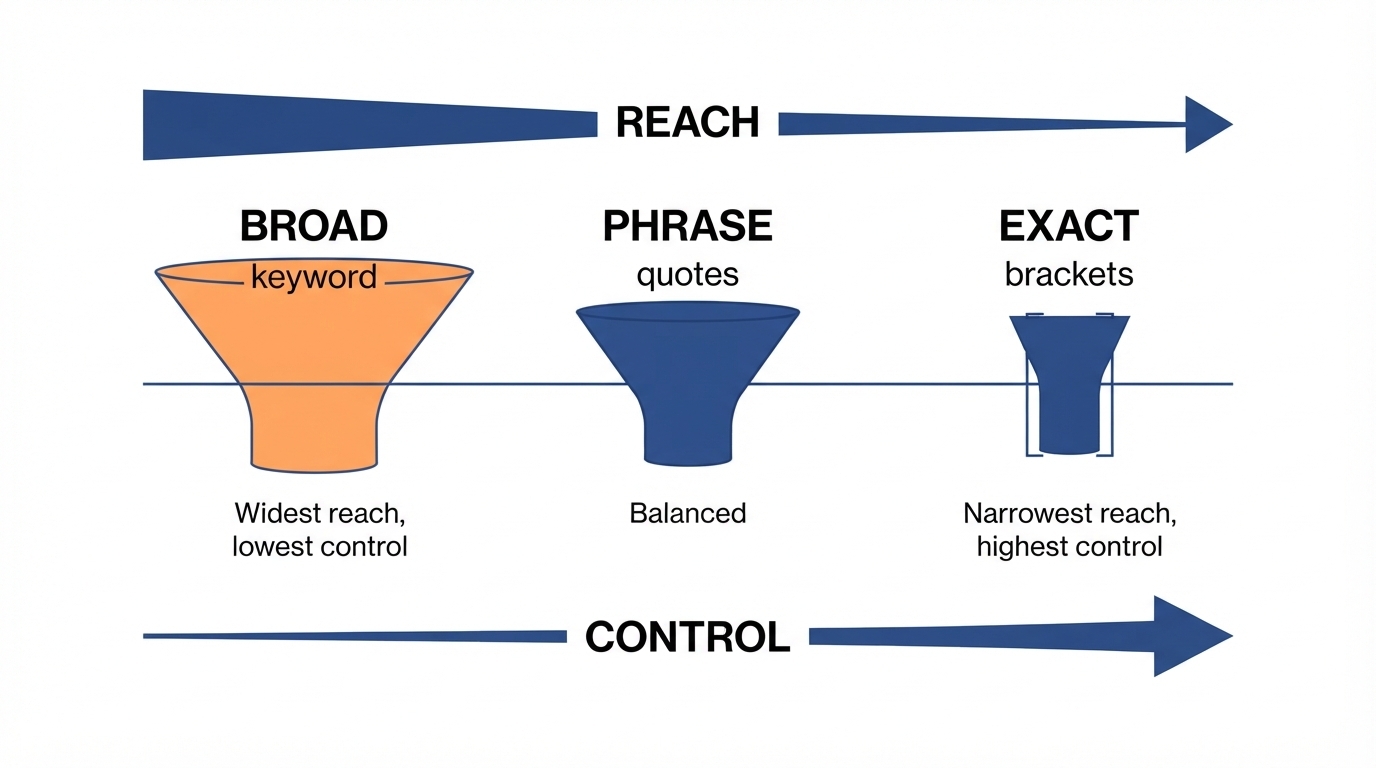
| Match type | Syntax | Reach | Control | Best for |
|---|---|---|---|---|
| Broad match | keyword | Widest (related meaning and intent) | Lowest | Finding new queries with Smart Bidding and strong conversion tracking |
| Phrase match | "keyword" | Medium (meaning of the phrase) | Medium | Balancing reach and relevance; the old BMM behavior lives here now |
| Exact match | [keyword] | Narrowest (that meaning only) | Highest | Protecting proven, high-intent terms and controlling cost |
In practice, most accounts see the strongest click-through and conversion rates from exact match, then phrase, then broad, once brand terms are excluded. That does not make broad bad; it makes broad a discovery engine that needs the right guardrails.
Why Does Broad Match Need Smart Bidding?
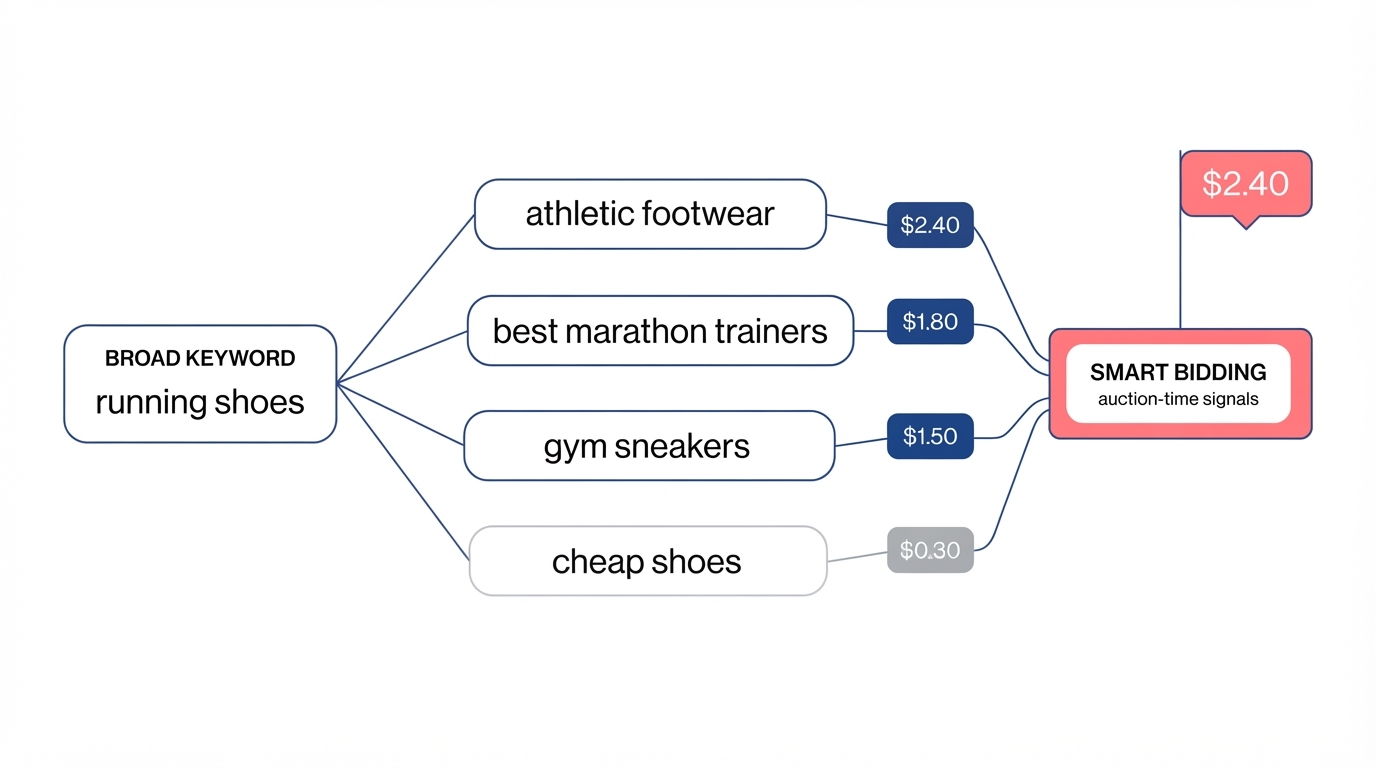
Broad match and Smart Bidding are a package. The reason is simple: broad reaches a huge, varied set of queries, and those queries are worth wildly different amounts to your business. A flat manual bid treats a high-intent buyer query and a vague research query the same, which is how broad burns money.
Smart Bidding solves this by bidding at the search-term level. It sets a unique bid for each individual query in the auction, using auction-time signals to predict how likely that specific search is to convert. That is what makes modern broad match viable where the old version was reckless. Google itself calls it critical to use Smart Bidding with broad match. If you are new to automated bidding, start with our guide to Google Ads Smart Bidding.
Which Bid Strategy Should You Use with Broad Match?
Pair broad match with a conversion-goal strategy, not a volume-maximizing one:
- Target CPA (tCPA): best for lead generation. You tell Google the cost per conversion you can afford, and it holds broad's reach to queries that can hit that target.
- Target ROAS (tROAS): best for ecommerce. It scales spend toward the return you set, which keeps broad focused on valuable queries.
- Avoid Maximize conversions or Maximize conversion value with broad unless you have a strict budget cap and are watching it closely. Maximize bidding plus broad often spends the entire budget chasing a few extra conversions, especially at larger spend levels.
The non-negotiable prerequisite: accurate conversion tracking. If you are not tracking conversions, or you are still bidding manually, do not use broad match. It has no way to learn what a good query looks like.
How Do You Stop Broad Match from Wasting Money?
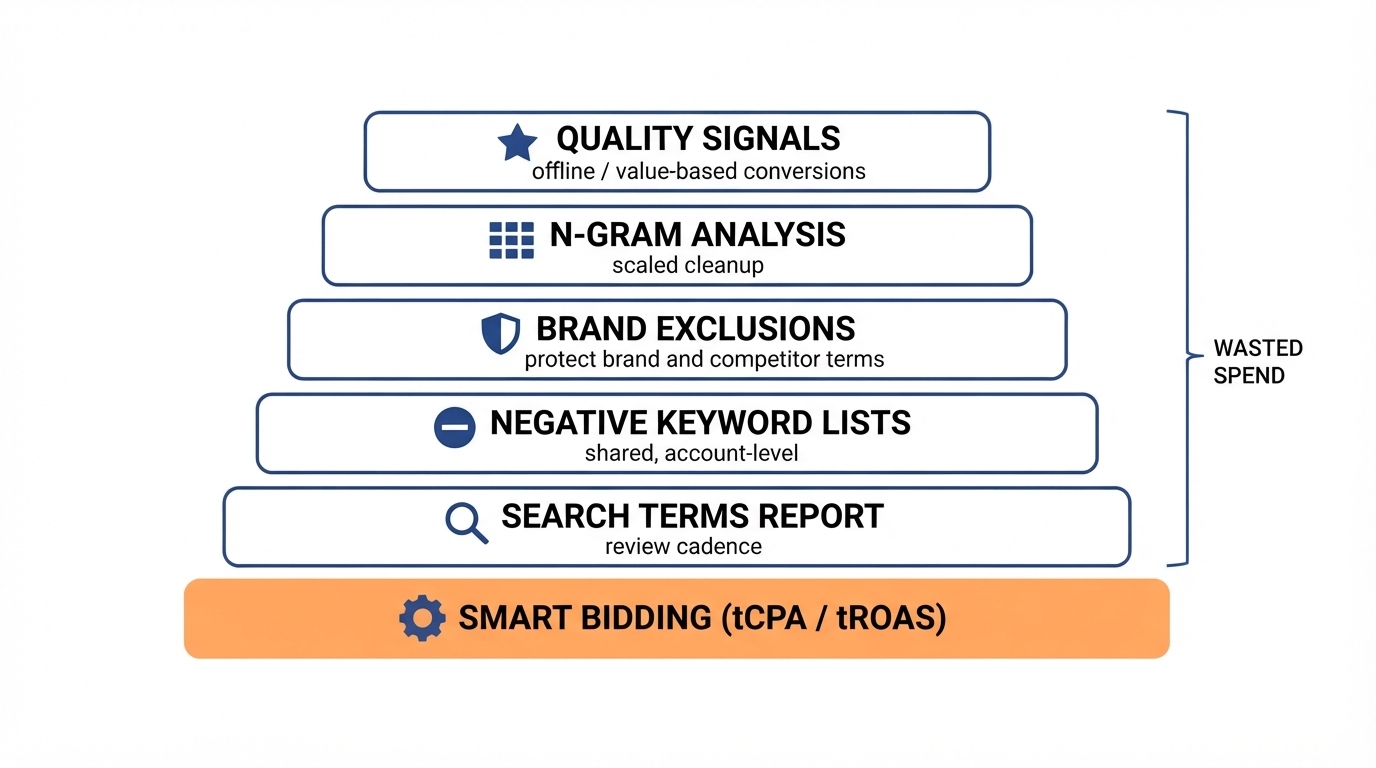
Treat wasted-spend control as a system, not a one-time cleanup. Layer these controls together and broad becomes predictable:
- Conversion-based Smart Bidding first. tCPA or tROAS is the foundation; everything else refines it.
- Mine the search terms report on a cadence. This report is your control surface. It shows the actual queries broad matched to, and it is where negative-keyword ideas come from. Review it weekly at first, then every two to four weeks as the campaign stabilizes.
- Add negative keywords, including shared negative lists. Build account-level negative keyword lists and apply them across campaigns so one exclusion protects everything. Remember that negative keyword match types work differently from positive ones: a negative does not automatically block synonyms, plurals, misspellings, or close variants, so add the variants you actually see.
- Use brand exclusions to protect brand and competitor terms. Broad can drift onto your own brand or a competitor's. Brand lists and brand exclusions keep that traffic out of your prospecting campaigns so your budget stays on new demand.
- Run n-gram analysis for scaled cleanup. Instead of scanning queries one by one, group the search terms report by recurring words and phrases (n-grams) to find the wasteful patterns fast.
- Feed quality signals, not just conversions. For lead gen, import offline conversions or values for qualified leads and closed deals. When Smart Bidding optimizes toward revenue or lead quality instead of raw form fills, broad stops chasing cheap, low-value clicks.
Judge broad match on lead quality and pipeline, not on click-through rate or even cost per lead in isolation. A slightly higher cost per lead that produces better-qualified prospects is a win. Pair these controls with a strong negative keyword strategy for the biggest impact.
What Happened to Broad Match Modifier (BMM)?
Broad match modifier, the +keyword notation that let you require certain words, was retired. Google began folding BMM behavior into phrase match in February 2021 and completed the change by July 2021. Two practical consequences:
- You can no longer create +modifier keywords. The syntax is gone for new keywords.
- Legacy BMM keywords now behave as phrase match. If you edit an old +keyword's text, it converts to phrase notation automatically.
Today's phrase match absorbed BMM: it offers the control of the old phrase match with more of the reach BMM used to provide. If you were relying on BMM for a balance of reach and precision, phrase match is now where that balance lives, and broad match plus Smart Bidding is where you go for maximum reach.
When Should You Use Broad Match (and When to Avoid It)?
Broad match is a discovery tool. Use it when the conditions are right, and hold off when they are not.
Use broad match when:
- You have accurate conversion tracking and enough conversion volume for Smart Bidding to learn.
- You are on tCPA or tROAS bidding.
- Your ad groups are tightly themed and your landing pages are relevant.
- You have high impression share on your core terms and want to discover new, related demand.
- You are in a lower-volume market or language where exact and phrase alone cannot fill the funnel.
Avoid or delay broad match when:
- You are not tracking conversions or you are bidding manually.
- Your account is brand new with little conversion data.
- You have one landing page serving many unrelated services, which confuses the landing-page signal.
- Your budget is small and cannot absorb a learning period.
A useful test: if Smart Bidding has not self-corrected a poorly matching ad group within about a month, step in manually with exclusions or move those terms to phrase or exact.
Is Broad Match Changing in 2026?
The direction of travel is clear: Google keeps pushing broad match paired with automated bidding and AI-driven query expansion, marketed under newer names for AI-powered search campaigns. The underlying advice does not change. Whatever Google calls the reach-expanding layer, the controls that protect your budget are the same: conversion-based Smart Bidding, shared negative lists, brand exclusions, a disciplined search terms cadence, and quality signals fed back into bidding. Master those and you can adopt each new expansion feature without losing control of spend.
Device performance often decides which match types pay off. See our Google Ads device targeting guide for setting bid adjustments that protect ROAS.
Frequently Asked Questions
Does Broad Match Still Need the + (Broad Match Modifier)?
No. Broad match modifier was retired in 2021, and you can no longer create +keyword notation. Legacy BMM keywords now behave as phrase match. For maximum reach, use plain broad match with Smart Bidding; for a balance of reach and control, use phrase match, which absorbed the old BMM behavior.
Why Does Broad Match Need Smart Bidding?
Because broad reaches a huge range of queries worth very different amounts, and Smart Bidding sets a unique bid for each individual search in real time using auction-time signals. A flat manual bid cannot tell a high-intent query from a vague one, which is why manual bidding plus broad wastes money. Google calls Smart Bidding critical for broad match.
Which Bid Strategy Should You Use with Broad Match?
Use Target CPA for lead generation or Target ROAS for ecommerce. Both are conversion-goal strategies that hold broad's reach to queries that can hit your target. Avoid Maximize conversions or Maximize conversion value with broad unless you have a strict budget cap, because that combination often spends the full budget for a few extra conversions.
How Do You Stop Broad Match from Wasting Money?
Layer controls: conversion-based Smart Bidding, weekly review of the search terms report, negative keywords and shared negative lists, brand exclusions, n-gram analysis for scaled cleanup, and offline or value-based conversion signals so bidding optimizes for quality. Judge broad on lead quality and pipeline, not on click-through rate alone.
Is Broad Match the Default Match Type, and What Is Its Syntax?
Yes. Any keyword you add without symbols is broad match. Broad match uses plain text with no punctuation, phrase match uses "quotation marks", and exact match uses [square brackets]. Because broader match types already cover the searches narrower ones would, you do not need to add the same keyword in multiple match types.
Key Takeaways
- Broad match is the default Google Ads match type and reaches searches by meaning and intent, not word order.
- It only works with Smart Bidding, which bids at the search-term level, and with tCPA or tROAS rather than maximize bidding.
- Control wasted spend as a system: search terms report cadence, shared negative lists, brand exclusions, n-gram analysis, and quality-based conversion signals.
- Broad match modifier (+keyword) was retired in 2021; that reach-and-control balance now lives in phrase match.
- Use broad for discovery when you have conversion tracking, data volume, and tight ad groups; avoid it when you cannot track conversions or must bid manually.