
The debate between Google Ads and Facebook Ads for dropshipping comes down to one question: are you capturing existing demand or creating new demand? The accounts that scale fastest don't choose one platform - they use both strategically, with Meta creating awareness and Google capturing high-intent buyers.
This guide breaks down when each platform works best for dropshipping, the pros and cons of each, and how to allocate your budget for maximum returns.
Dropshipping Ad Strategies
Successful dropshipping advertising in 2026 requires understanding how each platform fits into the customer journey.
Facebook Ads Strategy for Dropshipping
Facebook (Meta) ads excel at product discovery. You're reaching people who weren't searching for your product but might want it once they see it.
Best use cases:
- Introducing trendy or impulse-buy products
- Building brand awareness for new stores
- Retargeting website visitors and cart abandoners
- Testing multiple product concepts quickly
Typical Facebook dropshipping funnel:
- Prospecting: Broad targeting with engaging video or image ads
- Engagement: Target video viewers and page engagers
- Retargeting: Show product ads to website visitors
- Conversion: Cart abandonment sequences with urgency
According to dropshipping experts, start with CBO (Campaign Budget Optimization) campaigns optimized for purchases. Launch 5-7 unique creatives per product test, run for 7 days minimum before judging results, and scale winners gradually.
Google Ads Strategy for Dropshipping
Google Ads captures people actively searching for products. These buyers have existing intent - they know what they want and are looking to purchase.
Best use cases:
- Products people search for specifically (e.g., "wireless earbuds under $50")
- Commodity products where you compete on price
- Capturing branded searches once you build awareness
- Retargeting via Display Network
Typical Google dropshipping campaigns:
- Shopping Ads: Product listing ads that show in search results
- Search Ads: Text ads targeting product-related keywords
- Performance Max: AI-driven campaigns across all Google properties
- Display Retargeting: Banner ads following website visitors
Google Ads works best when shoppers already know what they want. If you're selling a unique or novel product, Google won't help because nobody's searching for it yet.
Platform Pros/Cons
Facebook Ads Pros
Advantage | Why It Matters |
Visual storytelling | Show products in action with video |
Broad reach | 3+ billion users across Meta platforms |
Impulse purchases | Catch buyers who didn't know they wanted your product |
Lookalike audiences | Find new customers similar to your buyers |
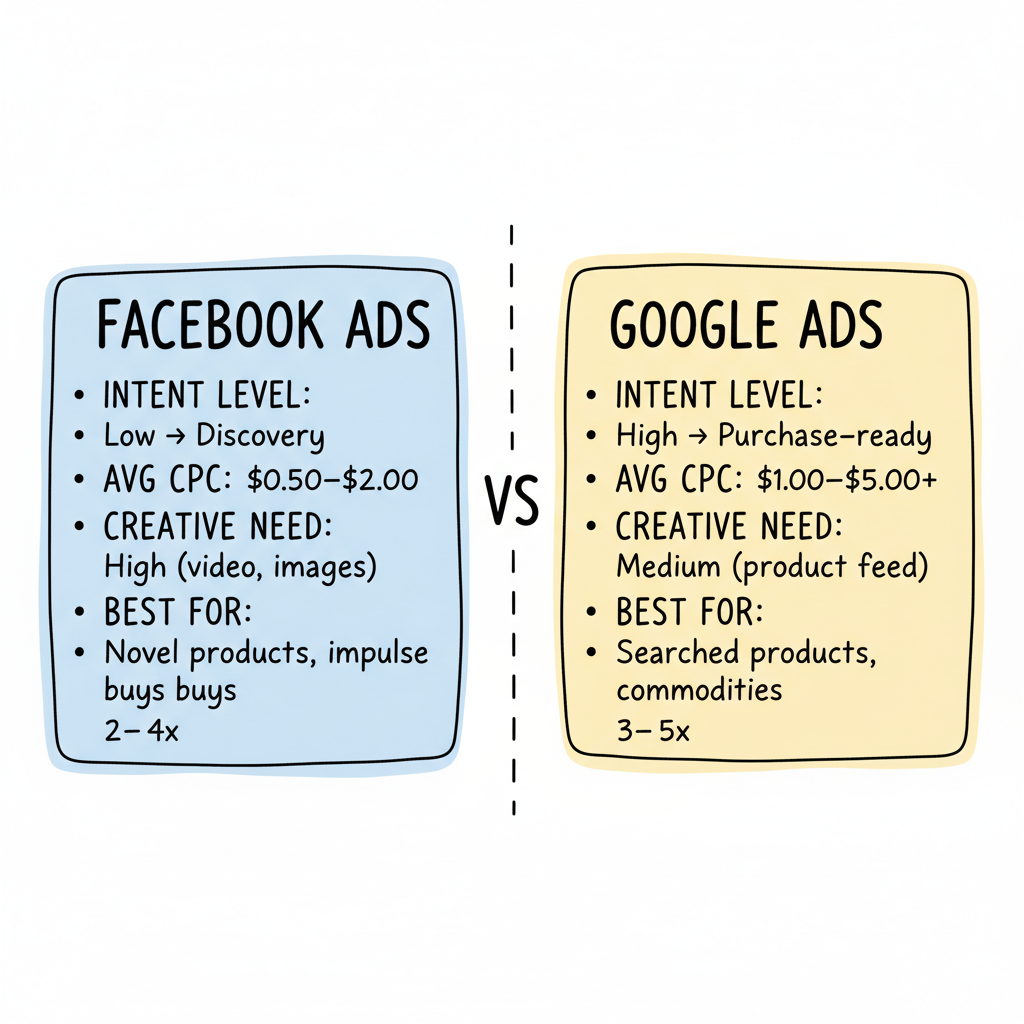
Lower initial CPC | Often $0.50-$2.00 vs Google's $1-$5+ |
Facebook Ads Cons
Disadvantage | Impact |
Lower purchase intent | More clicks needed per sale |
Algorithm learning period | 3-5 days before optimization kicks in |
Creative-dependent | Bad creative = bad results, period |
iOS privacy changes | Tracking accuracy remains challenging |
Google Ads Pros
Advantage | Why It Matters |
High purchase intent | Searchers are ready to buy |
Keyword targeting | Reach exact searches for your products |
Shopping ads | Visual product listings in search results |
Better tracking | Server-side tracking more reliable |
Less creative pressure | Text-based ads require less production |
Google Ads Cons
Disadvantage | Impact |
Higher CPC | Competitive keywords cost $2-$10+ |
Requires search volume | Can't advertise products nobody searches for |
Merchant Center complexity | Setup is more technical than Meta |
Stricter policies | Google doesn't allow arbitrage-style dropshipping |
Budget Tips for Dropshipping Advertising
How you allocate budget between platforms depends on your products, margins, and business stage.
Starting Budget Allocation
For new dropshipping stores with limited data, start with Facebook to create demand:
Stage | Rationale | ||
Testing (Week 1-4) | 80-100% | 0-20% | Build pixel data, test products |
Early scaling | 60-70% | 30-40% | Add Google Shopping once products validated |
Mature scaling | 40-50% | 50-60% | Capture branded + product searches |
Minimum Viable Budgets
According to industry recommendations:
- Facebook testing: $20-50/day per product for 7 days minimum
- Google Shopping: $30-50/day once you have converting products
- Combined mature budget: $3,000-$10,000+/month for serious scaling
Understanding how to calculate ROI on Facebook ads becomes essential as you scale beyond initial testing budgets.
Budget Red Flags
You're spending too little if:
- Campaigns don't exit learning phase (need ~50 conversions/week)
- You're making decisions on statistically insignificant data
- Ad frequency exceeds 3-4 before reaching sufficient audience
You're spending too much if:
- ROAS is below breakeven and not improving
- CPA is 2-3x your target with no creative wins
- You're scaling losers hoping they'll turn around
Platform Performance Comparison
Real-world dropshipping metrics vary widely, but here's what to expect:
Metric | Facebook Ads | Google Ads |
Average CPC | $0.50-$2.00 | $1.00-$5.00+ |
Average CVR | 1-3% | 2-4% |
Typical ROAS | 2-4x | 3-5x |
Time to results | 2-4 weeks | 1-2 weeks |
Creative needs | High (video, images) | Medium (product feed) |
Note: These are averages. Your results will depend on product margins, creative quality, and targeting precision. Many dropshippers find that the Facebook ads cost per day varies significantly based on competition and audience saturation.
When to Use Each Platform
Use Facebook Ads When:
- You have a unique or novel product
- Your product has strong visual appeal
- You're building a brand, not just selling commodities
- You want to test multiple products quickly
- Your target audience is broad (age 18-65, multiple interests)
If you're just getting started, learning how to create Facebook ads for beginners will help you avoid common pitfalls during the testing phase.
Use Google Ads When:
- People are already searching for your product category
- You compete on price or convenience
- You have established products with proven demand
- You want to capture branded searches
- Your product has clear search terms ("wireless charging pad")
Use Both When:
The highest-performing accounts combine both platforms:
- Facebook creates awareness: Cold audiences see product ads
- Google captures intent: Interested buyers search and find you
- Retargeting closes: Both platforms re-engage undecided shoppers
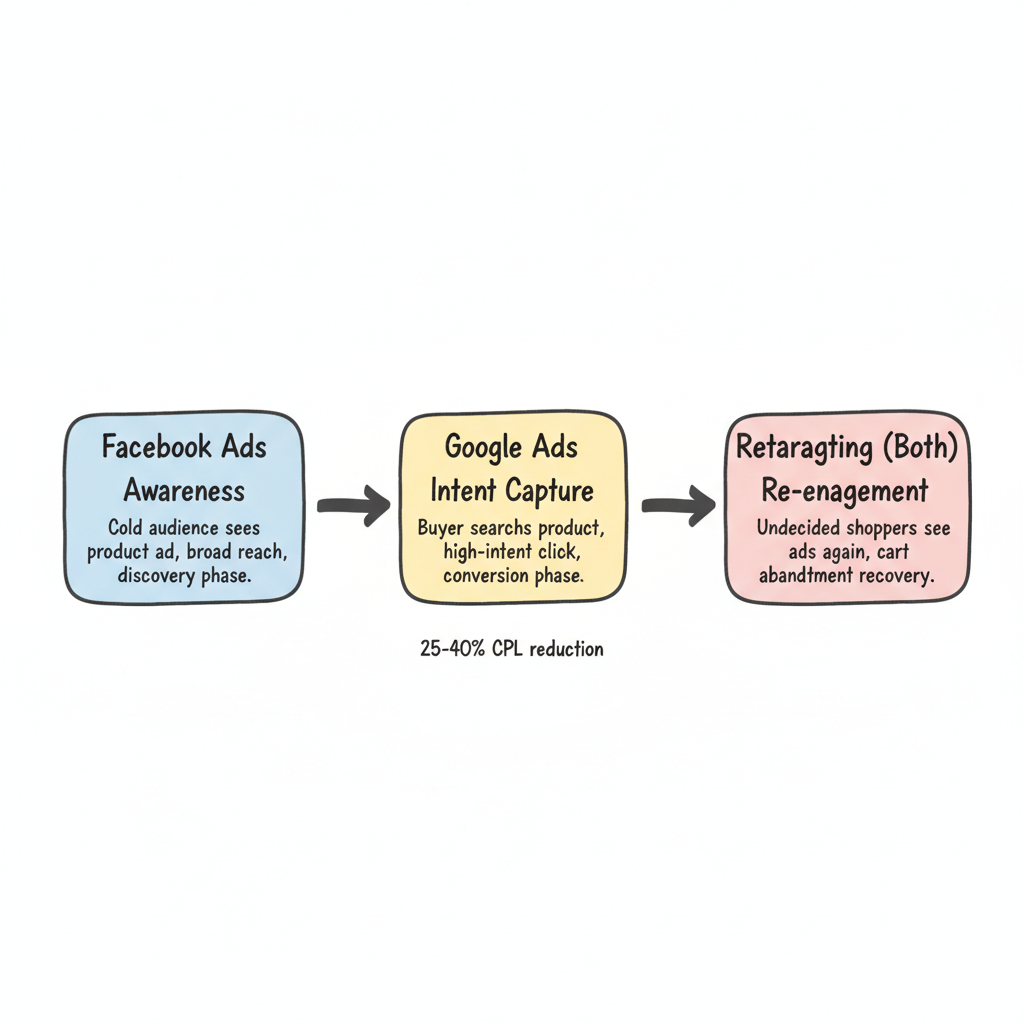
This combination has been shown to reduce CPL by 25-40% compared to single-platform strategies while improving lead quality and brand trust. For Shopify store owners specifically, understanding how to run Facebook ads for Shopify streamlines the integration between your store and ad platform.
Dropshipping Ad Strategies
The strategy is the intent match. A product query on search meets the buyer; an interest on social builds the buyer, so the two serve different moments. The honest plan runs each where it fits, and the discipline of the split is the edge, because the fit is the lever and the data is the guide.
Avoid one creative for both. A search ad and a social ad need different shapes, so the message follows the surface. The combined view makes the work coherent, and the silence on one side is the gap the competitor fills, because the tools serve different moments in the same loop and the structure is the asset.
Platform Pros and Cons
The pro of search is the intent; the con is the cost at scale. The pro of social is the reach; the con is the weaker signal, so the trade is the scope. The honest read names the gap, and the clarity makes the program fundable, because the definition of the need is the first deliverable and the fit is the lever that pays.
Use the budget to prove the better one. A small test on each platform shows the cost per result, so the spend follows the data. The disciplined test points to the gap, and the clarity lets the team improve the line instead of guessing at the cause, because the measurement is the guide and the upkeep is the value.
When to Use Each
Use search for the ready buyer; social for the new one. A query that shows intent earns the search spend; an audience that must learn earns the social spend, so the bet follows the moment. The honest read names the gap, and the clarity makes the work coherent instead of a single-channel reflex, because the spread is the hedge and the structure is the asset.
Set the metric per platform and report them together. The search reads on conversion; the social on discovery, so the dashboard that shows both tells the real story. The joined view justifies the mix, and the silence on one layer is the gap the competitor fills, because the tools serve different moments and the discipline is the edge.
Frequently Asked Questions
Which Is Better for Beginners: Google Ads or Facebook Ads for Dropshipping?
Facebook Ads is generally better for dropshipping beginners. It requires lower initial budgets, allows faster product testing, and doesn't require existing search demand. Start with Facebook to validate products, then add Google once you have winners.
How Much Should I Spend on Ads for a Dropshipping Store?
Start with $20-50 per day per product test on Facebook. Plan for $500-$1,500 in testing budget before expecting profitability. Once you find winning products, scale based on ROAS - if you're profitable at $50/day, gradually increase to $100, $200, and beyond.
Can I Run Dropshipping Ads on Google?
Yes, but with restrictions. Google allows dropshipping if you have legitimate supplier relationships and aren't doing arbitrage (buying from eBay to resell elsewhere). You need a professional website, clear shipping policies, and responsive customer service to maintain Google Merchant Center standing.
Key Takeaways
- Facebook Ads creates demand; Google Ads captures existing demand - use both for maximum results
- Start with Facebook (80%+ of budget) to test products, then add Google Shopping once products are validated
- Budget at least $20-50/day per product test for 7+ days to gather meaningful data
- The best dropshipping accounts combine Meta awareness campaigns with Google intent capture