
Google AI Overviews handle product queries differently than informational queries. When users search for product recommendations or buying advice, Google synthesizes information from a mix of review sites, retailers, and comparison content—creating unique citation patterns that e-commerce sites need to understand. This guide focuses specifically on how Google AI Overviews work for shopping-related queries and how to optimize products to appear in these results.
How Google AI Overviews Handle Product Queries
Google treats product and shopping queries differently than general informational searches.
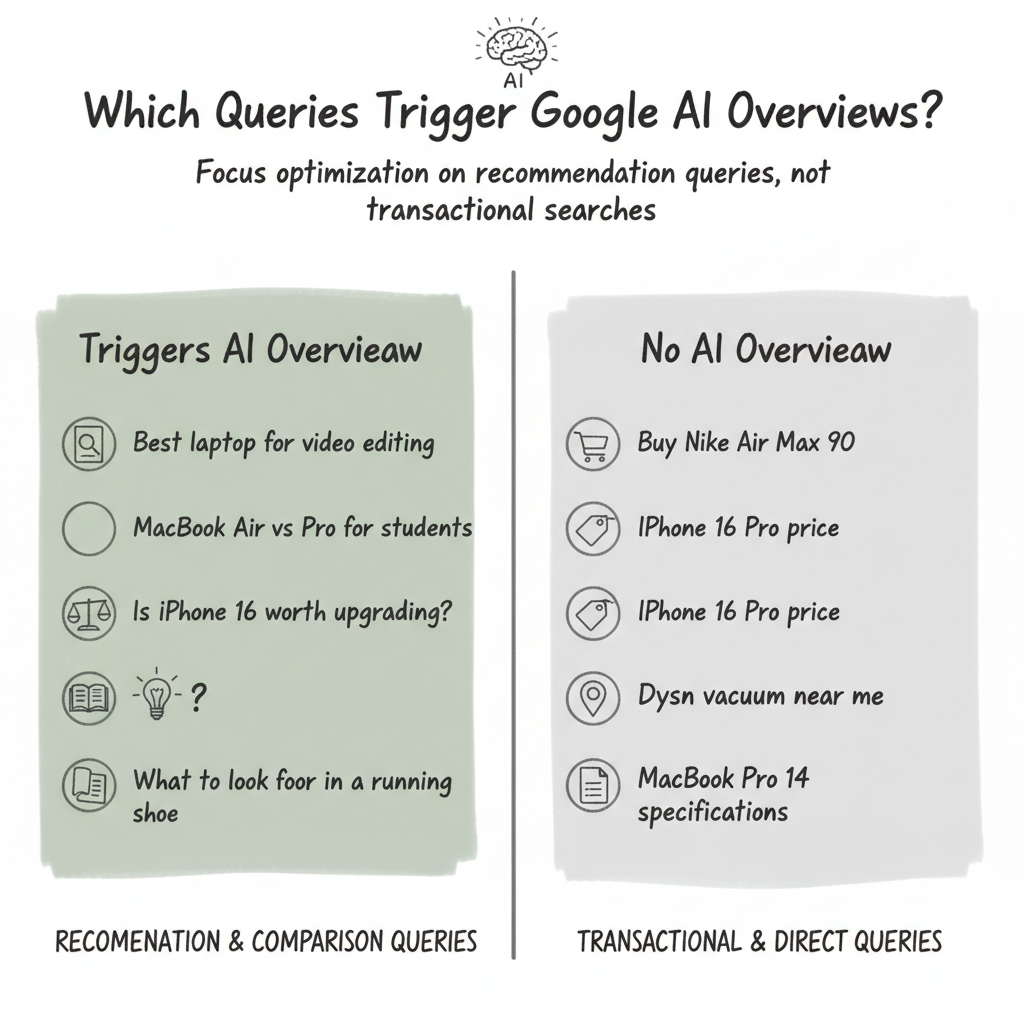
Product Query Types That Trigger AI Overviews
Not all shopping queries generate AI Overviews. Understanding which do helps prioritize optimization.
High AI Overview trigger rate:
Query Type | Example | Why AI Overview Triggers |
Best-for queries | "Best laptop for video editing" | Requires synthesis of options |
Comparison questions | "MacBook Air vs Pro for students" | Needs multi-source analysis |
Buying consideration | "Is the iPhone 16 worth upgrading to" | Requires opinion synthesis |
Feature explanations | "What to look for in a running shoe" | Educational + commercial |
Low AI Overview trigger rate:
Query Type | Example | Why No AI Overview |
Direct product search | "Buy Nike Air Max 90" | Transactional, shopping ads |
Price lookups | "iPhone 16 Pro price" | Knowledge panel handles |
Where to buy | "Dyson vacuum near me" | Local results preferred |
Specific model specs | "MacBook Pro 14 specifications" | Product panel sufficient |
Focus optimization efforts on queries that trigger AI Overviews rather than pure transactional searches.
Google'S Source Preference for Product AI Overviews
Google AI Overviews for product queries pull from specific source types.
Source citation patterns observed:
Product Recommendation Queries:
├── Review sites (Wirecutter, RTINGS): 35-45% of citations
├── Publisher buying guides: 20-30% of citations
├── Manufacturer/brand sites: 10-20% of citations
├── E-commerce product pages: 5-15% of citations
└── Reddit/forums: 5-10% of citations

Product Comparison Queries:
├── Dedicated comparison content: 40-50%
├── Review sites with vs content: 25-35%
├── Retailer comparison pages: 10-20%
└── Brand comparison landing pages: 5-10%
E-commerce product pages earn fewer direct citations than review content, but strategic content positions capture the opportunities that exist.
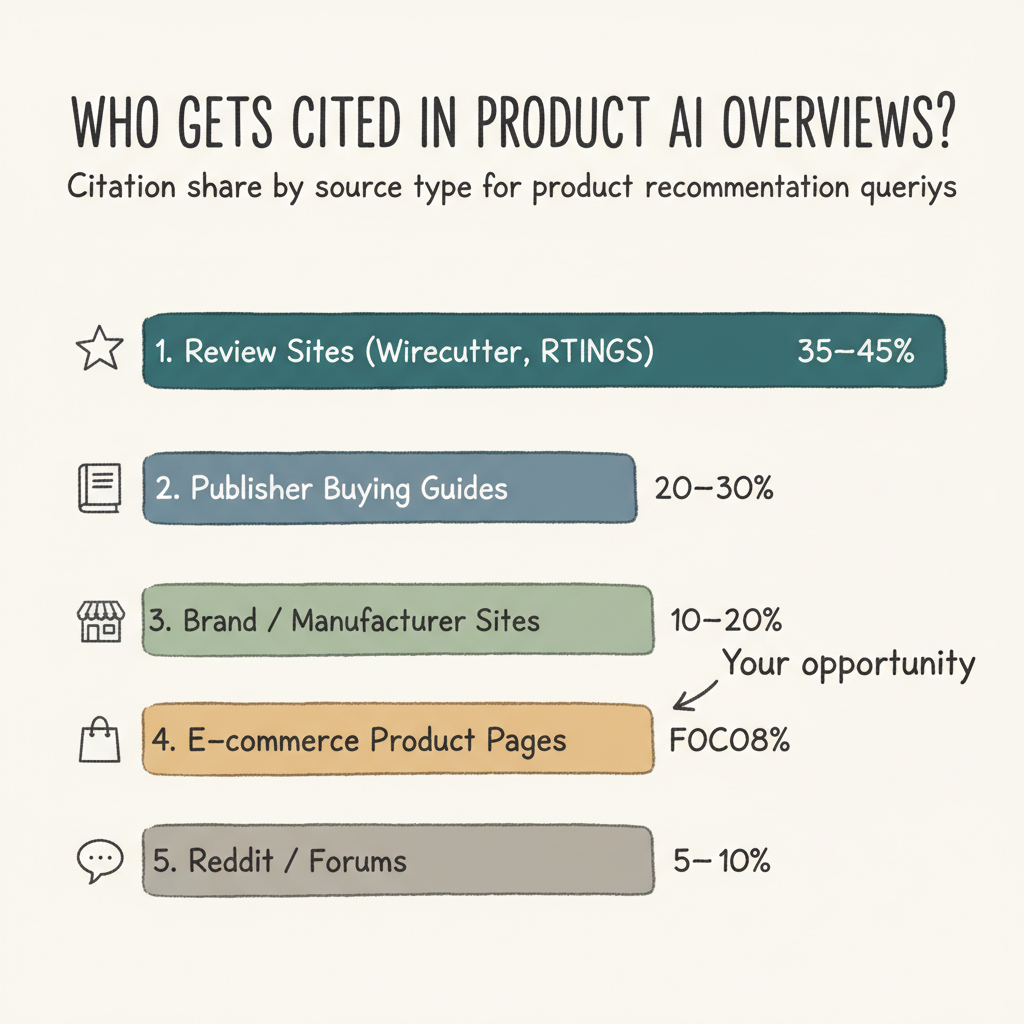 Understanding these patterns helps e-commerce sites identify where generative engine optimization efforts yield the highest returns.
Optimizing Product Pages for Google AI Overviews
Product page optimization for Google AI Overviews differs from general e-commerce SEO.
Content Elements Google Extracts
Google's AI extracts specific content types from product pages.
High-extraction elements:
Element | Extraction Likelihood | Optimization Approach |
Product benefits summary | High | Opening 2-3 sentences with key benefits |
Specification tables | High | Structured specs with comparison-ready format |
"Best for" statements | High | Explicit use case declarations |
Review summary stats | High | Aggregate ratings with context |
Pros/cons lists | Medium-High | Balanced, specific bullet points |
Low-extraction elements:
- Marketing copy without specifics
- Features without benefit context
- Generic descriptions applicable to any similar product
"Best For" Content Structure
Google AI Overviews frequently cite content that explicitly states who a product serves.
Implementation format:
Best For Section Example:

## Who Is [Product] Best For?

The [Product] works best for:
- **[User type 1]** who need [specific benefit] - [why]
- **[User type 2]** dealing with [specific situation] - [why]
- **[User type 3]** prioritizing [specific factor] - [why]

Not recommended for:
- [User type] because [specific reason]
- [Use case] due to [limitation]
This explicit use-case matching helps Google recommend your product for appropriate queries.
Comparison-Ready Specifications
Format specifications for comparison extraction.
Weak specification format:
Specs: 2.5 GHz processor, 16GB RAM, 512GB storageComparison-ready format:
Specification | Value | Context |
Processor | Apple M3 Pro, 12-core | Handles 4K video editing |
Memory | 16GB unified | Sufficient for most creative work |
Storage | 512GB SSD | Upgrade recommended for video |
Battery | 18 hours | Full workday without charging |
Adding context to specifications gives Google material for recommendation explanations. For e-commerce platforms like Shopify, implementing these structured formats becomes especially important as part of your Shopify AEO optimization strategy.
Category and Comparison Page Optimization
Category-level content captures broader AI Overview opportunities than individual product pages.
Buying Guide Integration
Category pages with integrated buying advice earn more AI Overview citations than pure product listings.
Effective structure:
Category Page Structure for AI Overviews:

1. Opening: Category overview + key buying factors (150-200 words)
2. Quick recommendation table (top picks by use case)
3. Buying criteria explanation (what matters, what doesn't)
4. Product recommendations by category
5. FAQ addressing common buyer questions
Quick recommendation table format:
Use Case | Top Pick | Why | Price Range |
Best overall | [Product] | [Key differentiator] | $XXX |
Budget pick | [Product] | [Value proposition] | $XXX |
Premium choice | [Product] | [Premium benefit] | $XXX |
Best for [specific need] | [Product] | [Specific advantage] | $XXX |
This format mirrors how Google AI Overviews present product recommendations.
Versus Content Pages
Create dedicated comparison pages for products commonly compared together.
High-citation comparison page elements:
- Clear verdict statement early (who should choose which)
- Side-by-side specification comparison
- Pros/cons for each option
- Use-case recommendations (Product A if X, Product B if Y)
- Price and value analysis
Google AI Overviews frequently cite well-structured versus content for comparison queries.
Technical Optimization for Google AI Overviews
Technical factors affect whether Google can properly extract and cite your product content.
Product Schema Enhancement
Standard e-commerce schema needs enhancement for AI Overview consideration.
Priority schema additions:
{
  "@type": "Product",
  "review": {
    "@type": "Review",
    "reviewBody": "Include actual review excerpts Google can extract",
    "positiveNotes": {
      "@type": "ItemList",
      "itemListElement": ["Pro 1", "Pro 2", "Pro 3"]
    },
    "negativeNotes": {
      "@type": "ItemList",
      "itemListElement": ["Con 1", "Con 2"]
    }
  },
  "audience": {
    "@type": "Audience",
    "audienceType": "Video editors, Content creators"
  }
}
The audience and positive/negative notes schema help Google match products to query intent. This structured data approach becomes even more critical when working with a generative engine optimization agency to maximize AI visibility.
Page Speed and Mobile Optimization
Google AI Overviews require content from well-performing pages.
Performance thresholds:
Metric | Target | Why It Matters |
LCP | <2.5s | Core ranking factor |
Mobile-friendly | Pass | Mobile-first indexing |
HTTPS | Required | Trust signal for AI citations |
No intrusive interstitials | Clean UX | Affects AI crawl quality |
Pages failing Core Web Vitals rarely appear in AI Overview citations. Mobile optimization deserves particular attention given the mobile vs desktop differences in Google AI Overviews.
Measuring Product AI Overview Performance
Track Google AI Overview visibility separately from general organic performance.
Manual Visibility Testing
Google Search Console doesn't report AI Overview appearances. Manual testing required.
Testing protocol:
- Identify 10-20 product queries relevant to your catalog
- Search in incognito mode weekly
- Record: AI Overview present? Your site cited? Position in sources?
- Track competitor appearances for same queries
Tracking spreadsheet columns:
Query | AI Overview? | Your Site Cited? | Position | Top Competitor Cited |
[query] | Yes/No | Yes/No | 1-5/N/A | [Domain] |
Traffic Correlation Analysis
While direct attribution is limited, correlation analysis reveals impact.
Indicators of AI Overview traffic:
- Direct traffic increases after AI Overview appearances
- Brand search volume growth
- Higher-intent visitor behavior (lower bounce, higher conversion)
- Traffic to specific pages matching AI Overview queries
Key Takeaways
Optimizing e-commerce products for Google AI Overviews:
- Focus on recommendation queries - "Best X for Y" queries trigger AI Overviews; pure transactional searches don't
- Create "best for" content explicitly - Tell Google who your product serves with structured use-case sections
- Format specs for comparison - Tables with context get extracted more than plain specification lists
- Build category buying guides - Category-level content captures broader queries than product pages
- Create versus pages - Comparison queries frequently generate AI Overviews and cite structured comparison content
- Enhance product schema - Add audience, pros/cons structured data beyond basic Product schema
- Monitor manually - No automated AI Overview tracking exists; manual testing reveals visibility
Product queries represent a growing AI Overview opportunity. E-commerce sites that structure content for Google's AI extraction capture visibility before competitors recognize the shift.