
Google AI Overviews now appear in over 200 countries and territories, reaching more than 1 billion users globally. But the feature doesn't work identically everywhere. Regional availability, language support, citation patterns, and display frequency all vary significantly—creating both challenges and opportunities for international SEO strategies.
Originally launched as the Search Generative Experience (SGE) in 2023, Google rebranded the feature to AI Overviews in 2024 and now powers it with its Gemini large language model (LLM). Understanding how AI Overviews differ by region helps marketers optimize effectively for global audiences rather than assuming uniform behavior across markets.
Regional Availability Status
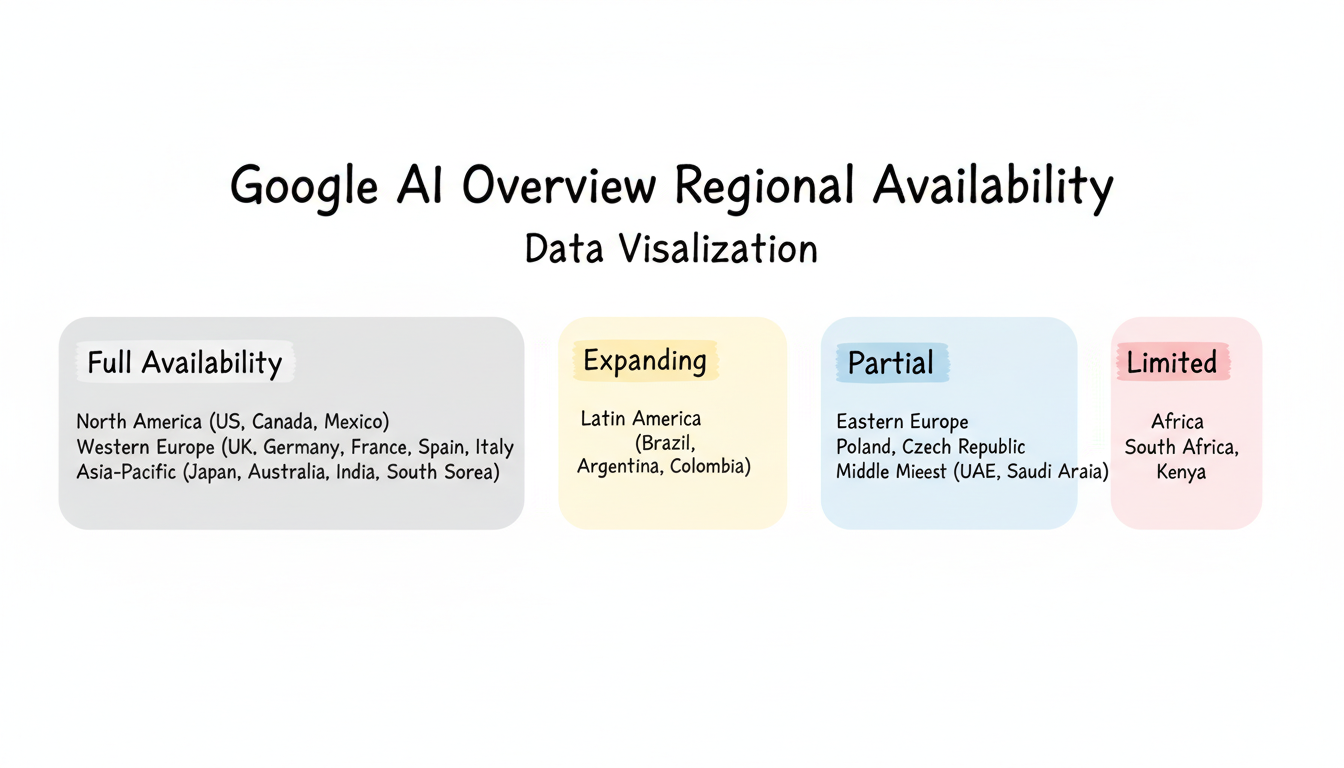
Google's AI Overview rollout followed a staged geographic expansion. The United States received access first in May 2024, followed by the United Kingdom, Canada, and Australia. Major European markets followed, with expansion accelerating through late 2024 and into 2025. By May 2025, Google announced AI Overviews had expanded to over 200 countries and territories—up from approximately 120 countries at the end of 2024—reaching more than 1 billion users globally.
Current availability (as of early 2026):
Region | Status | Notable Markets |
North America | Full availability | US, Canada, Mexico |
Western Europe | Full availability | UK, Germany, France, Spain, Italy |
Asia-Pacific | Full availability | Japan, Australia, India, South Korea |
Latin America | Expanding | Brazil, Argentina, Colombia |
Eastern Europe | Partial | Poland, Czech Republic |
Middle East | Partial | UAE, Saudi Arabia |
Africa | Limited | South Africa, Kenya |
Countries without AI Overview access still see traditional search results. This creates a divergent experience where the same query produces fundamentally different result types depending on user location.
Japan Rollout & Japanese-Language AI Overviews
Japan represents one of the most significant international markets for AI Overviews. Google launched AI Overviews in Japan in August 2024, making Japanese one of the first Tier 1 languages fully supported. Search data shows Japan-related queries account for roughly 40% of impressions on international AI Overview topics, reflecting strong user and marketer interest in the Japanese market.
Japanese-language AI Overviews demonstrate several distinct characteristics:
- High citation preference for Japanese-language domains (.co.jp, .jp) over translated English content
- Strong preference for locally authoritative sources such as government (.go.jp) and academic (.ac.jp) domains
- AI Overview trigger rates of approximately 8% of queries—lower than the US but growing steadily
- Complex query handling in Japanese is fully supported, including multi-step informational queries
For marketers targeting Japan, creating native Japanese content—rather than machine-translated pages—is essential for AI Overview citation. Google's Gemini model handles Japanese with high fluency, and the system prioritizes naturally written content over translations.
EU Regulatory Impact: The Digital Markets Act (DMA)
AI Overviews in European Union member states operate under constraints imposed by the Digital Markets Act (DMA), which took effect in March 2024. The DMA designates Google as a "gatekeeper" platform and imposes obligations around fair competition and user choice in search.
Key DMA impacts on AI Overviews in Europe:
- Google has been slower to expand AI Overview features in EU markets compared to the US, partly due to compliance requirements
- EU AI Overviews may display differently than in other regions, with additional transparency disclosures about AI-generated content
- The regulation influences how Google selects and displays citation sources, with potential requirements to surface a broader range of publishers
- YMYL topics (health, finance) face stricter AI Overview limitations in EU countries compared to the US
Marketers targeting EU audiences should monitor regulatory developments closely, as DMA enforcement actions could further change how AI Overviews function in European markets. The regulatory landscape makes Europe a more complex but potentially rewarding market for organizations that comply with local content standards.
AI Overviews History: From SGE to Gemini-Powered Search
AI Overviews evolved from Google's Search Generative Experience (SGE), which launched as an experimental feature in Google Search Labs in May 2023. SGE was initially available only to US users who opted into the experiment.
Key milestones in the evolution:
- May 2023: SGE launches in Search Labs (US only, opt-in)
- Late 2023: SGE expands to Japan, India, and select markets
- May 2024: Google rebrands SGE to "AI Overviews" and rolls it out to all US users by default
- Mid-2024: Expansion to UK, Canada, Australia, and major European markets
- Late 2024: AI Overviews available in approximately 120 countries
- May 2025: Expansion to 200+ countries and territories, 1 billion users milestone
The underlying technology also evolved. Early SGE results used a combination of Google's LLMs, while current AI Overviews are powered by Gemini—Google's most capable large language model. Gemini enables more nuanced responses, better multilingual support, and improved source attribution compared to earlier SGE implementations. Unlike traditional Featured Snippets, which extract a single passage from one source, AI Overviews synthesize information from multiple sources and generate original summary text.
Language Variations
AI Overviews support multiple languages, but capability varies by language. English AI Overviews show the highest sophistication, with other major languages following. Organizations implementing an AEO marketing plan should account for these language-specific differences when developing global strategies.
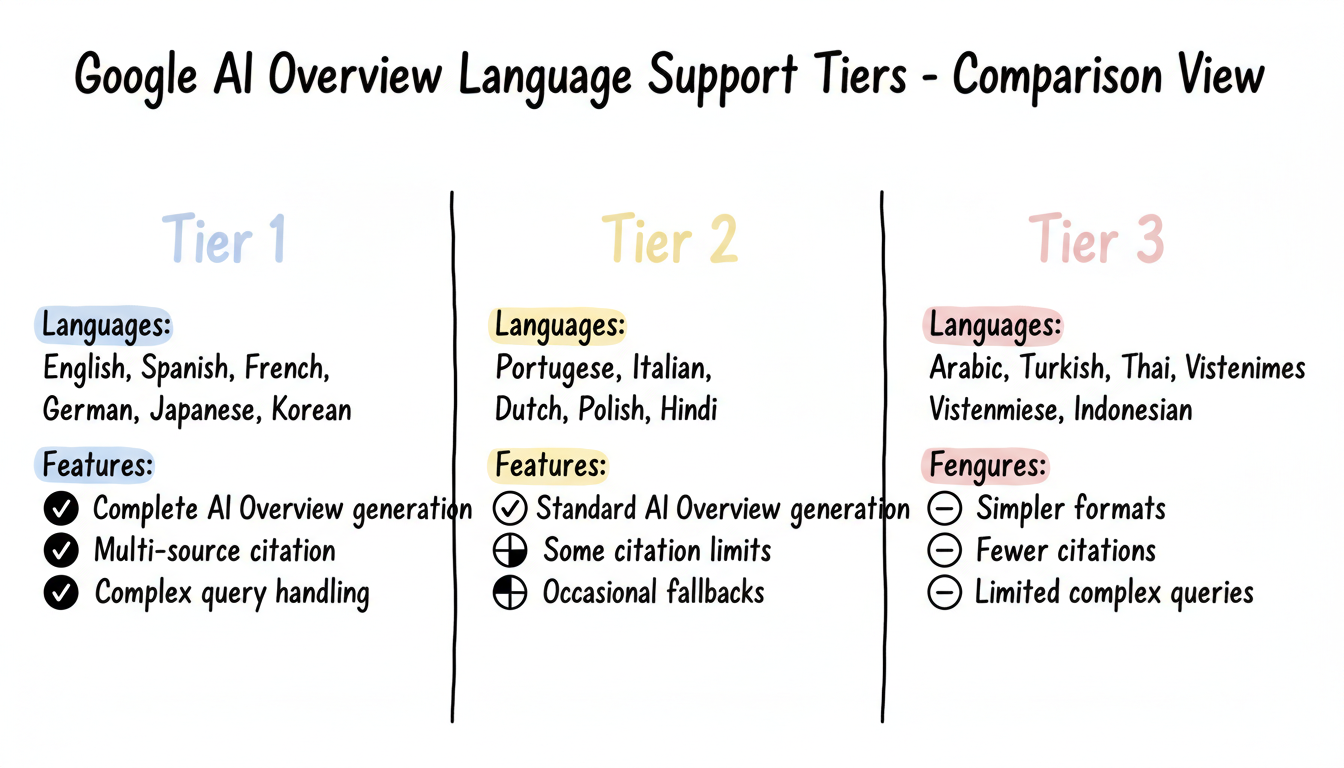
Language support tiers:
Tier 1 (Full capability): English, Spanish, French, German, Japanese, Korean
- Complete AI Overview generation
- Multi-source citation
- Complex query handling
Tier 2 (Strong capability): Portuguese, Italian, Dutch, Polish, Hindi
- Standard AI Overview generation
- Some citation limitations
- Complex queries occasionally fall back to traditional results
Tier 3 (Basic capability): Arabic, Turkish, Thai, Vietnamese, Indonesian
- Simpler AI Overview formats
- Fewer citations per response
- Limited complex query support
The language of the query—not the user's location—primarily determines which language tier applies. A German user searching in English sees English-tier AI Overviews.
Country-Specific Differences
Beyond availability and language, AI Overview behavior differs by country in several measurable ways.
Citation Source Preferences
AI Overviews favor geographically relevant sources when available. A query about "best accounting software" in the UK more frequently cites UK-based sources than US sources, even when US content would rank higher in traditional organic results.
This geographic preference creates opportunities for local content that might not compete globally but performs well within specific markets. Understanding the difference between AEO and GEO helps marketers determine which optimization strategies work best for their target regions.
Display Frequency Variation
The percentage of queries triggering AI Overviews varies by country:
- United States: ~15% of queries
- United Kingdom: ~12% of queries
- Germany: ~10% of queries
- Japan: ~8% of queries
- Brazil: ~6% of queries
These variations reflect both market maturity and Google's confidence in AI Overview quality for different language/region combinations.
Content Sensitivity Differences
YMYL (Your Money or Your Life) topics show varying AI Overview treatment by country. Medical and financial queries see AI Overviews more frequently in some markets than others, likely reflecting regulatory considerations and liability concerns.
International SEO Considerations
These regional variations demand specific optimization approaches for global content strategies.
Market-Specific Monitoring
Organizations targeting multiple countries need monitoring for each market rather than assuming uniform visibility. Strong AI Overview performance in the US doesn't guarantee similar results in Germany or Japan.
Tools like Semrush and Ahrefs offer country-specific tracking, but manual spot-checks remain valuable for verifying AI Overview citation in specific markets.
Local Authority Building
Because AI Overviews prefer geographically relevant sources, building local authority matters more than ever for international strategies. Consider:
- Country-specific domains (example.de, example.fr) when targeting individual markets
- Local backlinks from recognized regional publications
- Content addressing country-specific regulatory or cultural contexts
- Local business listings and citations where relevant
Language-Appropriate Content
Creating content in local languages—not just translated content—improves AI Overview citation probability. AI systems recognize natural language patterns and may deprioritize content that reads as translated.
For Tier 1 languages, invest in native-speaker content creation. For Tier 2 and 3 languages, evaluate whether AI Overview opportunity justifies the investment versus focusing resources on higher-tier markets. Reviewing GEO SEO examples from successful international campaigns can provide valuable insights into effective localization approaches.
Hreflang and AI Overviews
Hreflang implementation remains important for international SEO, with specific implications for AI Overview visibility.
Hreflang Best Practices for AI Overviews
Correct implementation signals geographic relevance:
- Properly implemented hreflang helps Google understand which content serves which markets
- AI Overviews may reference the appropriate regional version when hreflang is correctly configured
- Misconfigured hreflang can cause the wrong regional content to appear in AI Overviews
Common hreflang issues affecting AI Overviews:
- Missing self-referential hreflang tags
- Inconsistent implementation across language versions
- Conflicting signals between hreflang and geographic targeting in Search Console
X-Default Considerations
The x-default hreflang value specifies the fallback version for users in markets without specific targeting. For AI Overview optimization, ensure x-default points to your strongest, most authoritative content version—typically English for most organizations.
Localization Best Practices
Effective localization for AI Overview visibility extends beyond translation. Organizations should understand what AEO is and how it differs from traditional SEO when developing international content strategies.
Content Localization Checklist
Cultural adaptation:
- Local examples, case studies, and references
- Currency and measurement conversions
- Culturally appropriate imagery and examples
- Local regulatory and legal context where relevant
Technical localization:
- Proper date formats for target market
- Local schema markup (LocalBusiness where applicable)
- Server location or CDN presence in target markets
- Country-specific structured data
Authority localization:
- Backlinks from country-specific domains
- Citations in local industry publications
- Social proof from regional customers or partners
Prioritization Framework
Not all markets justify equal localization investment. Prioritize based on:
- Market size: Search volume and potential revenue
- AI Overview maturity: Tier 1 languages offer more opportunity
- Competition: Less competitive markets may offer faster wins
- Existing presence: Build on markets where you have foundation
FAQs About International AI Overviews
Q: Is Google AI Overview available worldwide? A: As of 2026, Google AI Overviews are available in over 200 countries and territories, reaching more than 1 billion users globally. However, availability does not mean identical functionality—display frequency, citation behavior, and supported features vary by region and language. Some markets still see limited AI Overview triggers compared to the US.
Q: What countries is the AI Overview available in? A: AI Overviews are available in 200+ countries and territories as of May 2025. Full availability exists in North America (US, Canada, Mexico), Western Europe (UK, Germany, France, Spain, Italy), and Asia-Pacific (Japan, Australia, India, South Korea). Latin America, Eastern Europe, the Middle East, and Africa have expanding or partial coverage. Google has not published an exhaustive country-by-country list, but coverage now spans the vast majority of markets where Google Search operates.
Q: Do AI Overviews work the same in all countries? A: No. Display frequency, citation patterns, and source preferences all vary by country and language. US and UK markets show highest AI Overview sophistication. EU countries are additionally subject to Digital Markets Act regulations that influence how AI Overviews display.
Q: Should I create separate content for each country? A: For major markets with significant business potential, yes. Localized content with country-specific authority signals outperforms translated content for AI Overview citation.
Q: How do I track AI Overview performance internationally? A: Use country-specific rank tracking tools, configure Google Search Console for each target market, and conduct manual spot-checks in different geographic locations using VPN tools.
Q: Will AI Overviews expand to more countries? A: Google continues expansion. Markets currently without AI Overviews will likely gain access throughout 2026, though timing varies by language and regional considerations.
Q: Does hreflang directly affect AI Overview selection? A: Hreflang helps Google understand geographic relevance, which influences source selection for AI Overviews. Correct implementation supports appearing in appropriate regional AI Overviews.
Google AI Overviews present a global opportunity complicated by significant regional variation. With availability now spanning 200+ countries and territories and more than 1 billion users, organizations pursuing international visibility must understand that AI Overview optimization isn't one-size-fits-all—market-specific strategies, local authority building, and proper technical implementation all contribute to success across different countries and languages.