
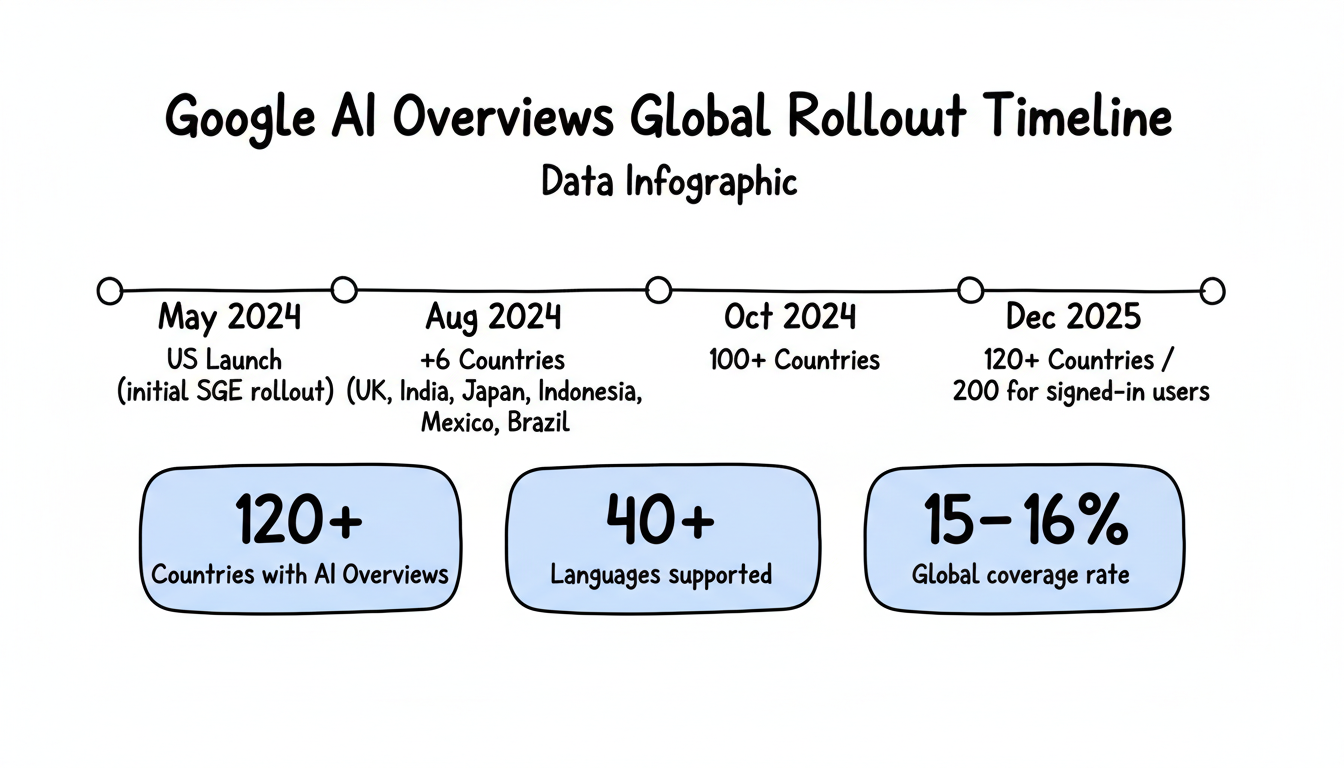
Google AI Overviews have expanded dramatically since their US launch in May 2024, now reaching 120+ countries with support for 40+ languages. However, significant variations exist in availability, behavior, and optimization requirements across regions. Organizations targeting international audiences need strategies that account for these differences rather than assuming uniform global deployment.
Current Global Availability
AI Overviews have expanded rapidly but unevenly across global markets.
Rollout progression:
- May 2024: US launch (initially as SGE)
- August 2024: Expanded to UK, India, Japan, Indonesia, Mexico, Brazil
- October 2024: 100+ countries reached
- December 2025: 120+ countries, 200 countries for signed-in users
- 40+ languages now supported
Language support includes:
- Major European languages (English, Spanish, French, German, Portuguese, Italian)
- Asian languages (Japanese, Korean, Chinese, Hindi, Indonesian, Vietnamese, Thai)
- Middle Eastern languages (Arabic, Hebrew, Turkish)
- African languages (Swahili and others)
The expansion continues, but feature parity across regions remains inconsistent.
Regional Rollout Patterns
Google follows predictable patterns when rolling out AI Overview updates.
Typical rollout sequence:
- United States and Canada (initial launch)
- United Kingdom and Western Europe
- Asia-Pacific markets and Australia
- Latin America, Eastern Europe, Middle East
- Additional emerging markets
Understanding this pattern helps organizations anticipate when new features will reach their target markets. Updates often take 2-4 weeks to propagate from US launch to global availability.
European Union Variations
The EU presents unique considerations due to regulatory requirements.
EU-specific implementations:
- AI Overviews limited to signed-in users 18+ in EU markets
- Additional guardrails for health and financial queries
- GDPR compliance affects data processing and personalization
- Digital Services Act influences transparency requirements
Optimization implications:
- Younger demographics may not see AI Overviews in EU
- Anonymous browsing excludes AI Overview exposure
- Content targeting EU audiences faces higher scrutiny standards
- Privacy-focused users represent different discovery patterns
Organizations targeting EU markets should maintain strong traditional SEO alongside AI optimization given these access limitations. Understanding the differences between AI SEO vs traditional SEO becomes particularly important in these regulated markets.
Coverage Variations by Region
AI Overview coverage - the percentage of queries triggering AI responses - varies significantly by region.
Coverage observations:
- US coverage peaked at approximately 24.61% in July 2025
- Coverage has stabilized around 15-16% globally
- Some regions see higher coverage for informational queries
- Commercial and local queries vary by market maturity
Factors affecting regional coverage:
- Query language and phrasing patterns
- Local content availability and quality
- Regional search behavior differences
- Market-specific vertical implementations
Coverage differences mean optimization ROI varies by target market.
Language-Specific Considerations
AI Overview behavior differs based on query language.
Language factors:
- English-language queries show highest AI Overview sophistication
- Non-English languages may have simpler AI responses
- Translation quality affects citation accuracy for multilingual content
- Local language content often preferred over translated content
Multilingual optimization:
- Create native-language content rather than relying on translation
- Research keywords in target languages directly
- Understand local search intent patterns
- Consider regional terminology and phrasing differences
Organizations with multilingual audiences should optimize each language version independently rather than translating from a single source. This approach aligns with proven generative engine optimization strategies that emphasize content quality and relevance.
AI Overview Ads International Expansion
Advertising within AI Overviews has expanded to select markets.
AI Overview ads availability (December 2025):
- United States
- Australia
- Canada
- India
- Indonesia
- Kenya
- Malaysia
- New Zealand
- Nigeria
- Pakistan
- Philippines
- Singapore
Implications for optimization:
- Ad-supported markets may show different organic citation patterns
- Commercial queries in these markets face paid competition
- Non-ad markets may offer more organic visibility opportunity
- Future expansion likely to major European and Asian markets
Monitor ad expansion announcements for your target markets.
Regional Content Strategy
Effective international AI optimization requires region-specific approaches.
Regional strategy elements:
Market research: Understand which queries trigger AI Overviews in each target market. Coverage and triggers vary significantly.
Local authority building: Regional publications, local partnerships, and country-specific citations strengthen authority signals in each market.
Cultural alignment: Content must align with regional expectations, communication styles, and information-seeking patterns.
Regulatory awareness: Health, financial, and legal content faces varying restrictions by jurisdiction.
Monitoring International Performance
Track AI visibility across target markets systematically. Understanding AI Overview source selection patterns helps identify which content types succeed in different regions.
Monitoring approaches:
- Use VPN or geo-targeting tools to observe regional results
- Monitor branded search volume by country
- Track regional traffic patterns from AI referrals
- Compare coverage across target markets periodically
Platform limitations:
- Google Search Console provides limited AI Overview data by region
- Manual testing remains necessary for comprehensive monitoring
- Third-party tools vary in international coverage
- Attribution challenges multiply across markets
Establish monitoring baselines for each priority market rather than relying on global aggregates.
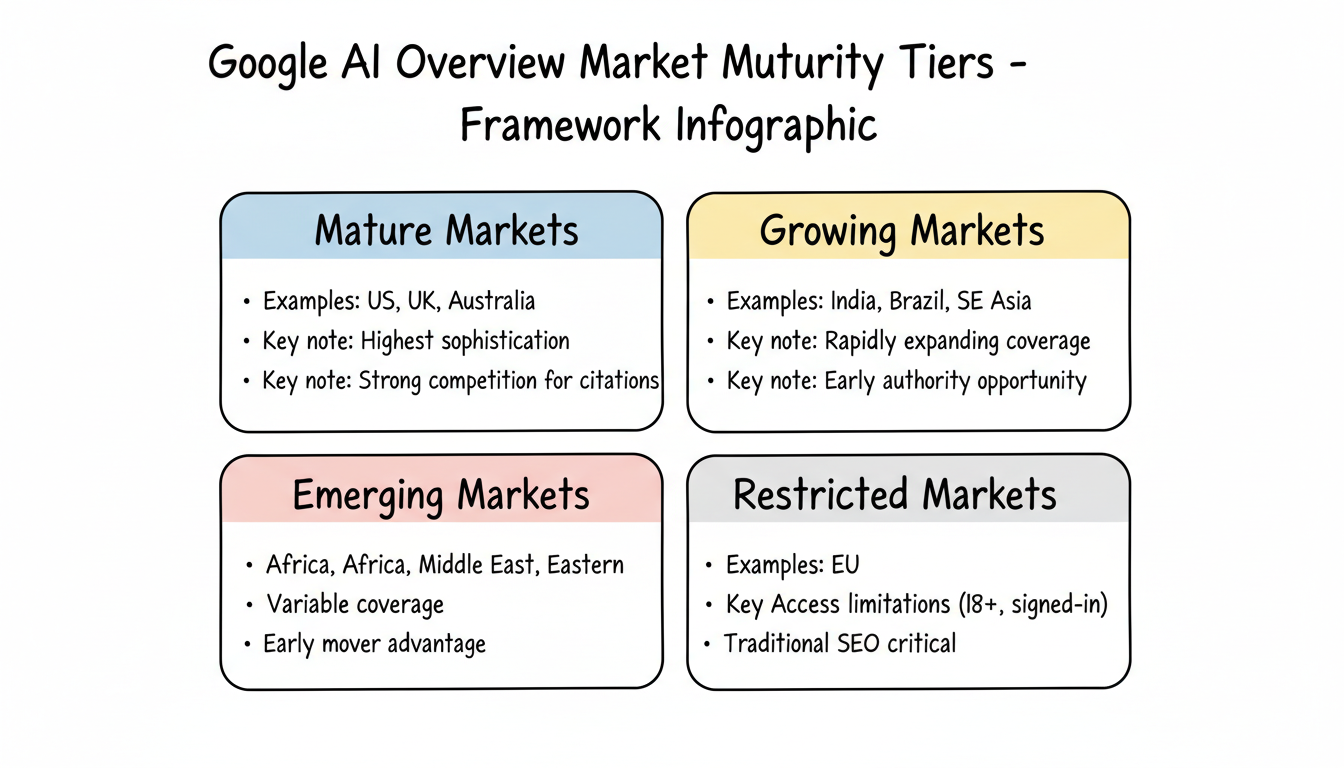
Optimization Priorities by Market Type
Different market types require different optimization emphasis.
Mature markets (US, UK, Australia):
- Highest AI Overview sophistication
- Strong competition for citations
- Established authority signals matter most
- Content depth and freshness critical
Growing markets (India, Brazil, Southeast Asia):
- Rapidly expanding AI coverage
- Earlier adoption stage
- Opportunity for authority establishment
- Mobile optimization particularly important
Emerging markets (Africa, Middle East, Eastern Europe):
- Variable coverage
- Less competitive landscape
- Strong potential for early mover advantage
- Local language content scarcity creates opportunities
Restricted markets (EU, certain regulated sectors):
- Access limitations affect reach
- Traditional SEO remains critical
- Compliance requirements influence content approach
- Multi-channel strategy essential
Technical Implementation for International
Technical requirements for international AI optimization.
Technical priorities:
- Hreflang implementation for language/region targeting
- Fast page loads across global CDN
- Structured data in appropriate languages
- Mobile-first design for markets with high mobile usage
Content delivery:
- Consider regional hosting for performance
- Implement proper language declarations
- Ensure crawlability from all target regions
- Monitor regional indexing status
Future International Expansion
Anticipate continued global expansion of AI Overview capabilities. Organizations may benefit from consulting an AEO marketing consultant to navigate these complex international optimization requirements.
Expected developments:
- Additional language support
- Feature parity improvements across regions
- Expanded advertising availability
- Regional customization increases
Preparation strategies:
- Build authority in target markets before features arrive
- Create content in languages currently underserved
- Establish regional partnerships proactively
- Monitor announcements for rollout timing
Organizations investing in international AI optimization before full global parity position themselves for advantage as features expand.
Current Global Availability
The availability is uneven. The overview rolls out by market, so a page that wins the box in one region may not in another, and the honest program plans per market. The disciplined read names the gap, and the clarity makes the work fundable, because the definition of the need is the first deliverable and the data is the guide.
Avoid assuming one global result. A strategy built for one region misses the others, so the plan spreads across the markets that matter. The distributed plan protects the reach, and the clarity makes the work coherent instead of a bet on a single box, because the spread is the hedge and the structure is the asset.
Regional Rollout Patterns
The pattern is the phased launch. A market that gets the feature later needs the content ready before the switch, so the prep follows the timeline. The honest base is the one the system can read, and the discipline of the groundwork is the edge, because the citation needs the readable source and the measurement is the guide.
Use the pattern to set the priority. A market near the launch earns the build first, so the bet follows the moment. The disciplined score points to the gap, and the clarity lets the team improve the line instead of guessing at the cause, because the data is the guide and the fit is the lever that pays.
Language-Specific Considerations
The language is the structure. A page in the local tongue with the local schema is the one the model quotes, so the translation is the build. The honest content is the one the system can read, and the discipline of the format makes the page citable instead of skipped, because the extraction favors the shape and the structure is the asset.
Avoid the machine-only translation. A page that reads as a literal render loses the nuance the user expects, so the local edit matters. The disciplined rewrite is what protects the trust, and the patience to localize is the quiet edge most teams skip while they auto-translate and walk away, because the substance is the point and the upkeep is the value.
FAQs
Are AI Overviews Available in All Countries?
AI Overviews are available in 120+ countries directly and 200 countries for signed-in Google users. However, coverage varies significantly - some regions see AI responses for many queries while others see them rarely. Availability doesn't guarantee consistent appearance across query types.
Do AI Overviews Work the Same in All Languages?
No. English-language queries generally show the most sophisticated AI Overview responses. Other major languages have good support, but response quality and citation patterns may differ. Some languages have limited AI Overview functionality or simpler implementations.
Should I Optimize Differently for Different Regions?
Yes. Regional optimization should account for local coverage patterns, language-specific content requirements, regulatory considerations, and competitive landscapes. A strategy effective in the US may not transfer directly to EU or Asian markets.