
Google AI Overviews have fundamentally changed local search, appearing for approximately 57% of local-intent queries according to recent research. For local businesses, this shift means being cited in AI-generated recommendations has become as important as ranking in the traditional local pack. Understanding how AI Overviews surface local businesses—and optimizing accordingly—separates thriving local businesses from those losing visibility.
How AI Overviews Change Local Search
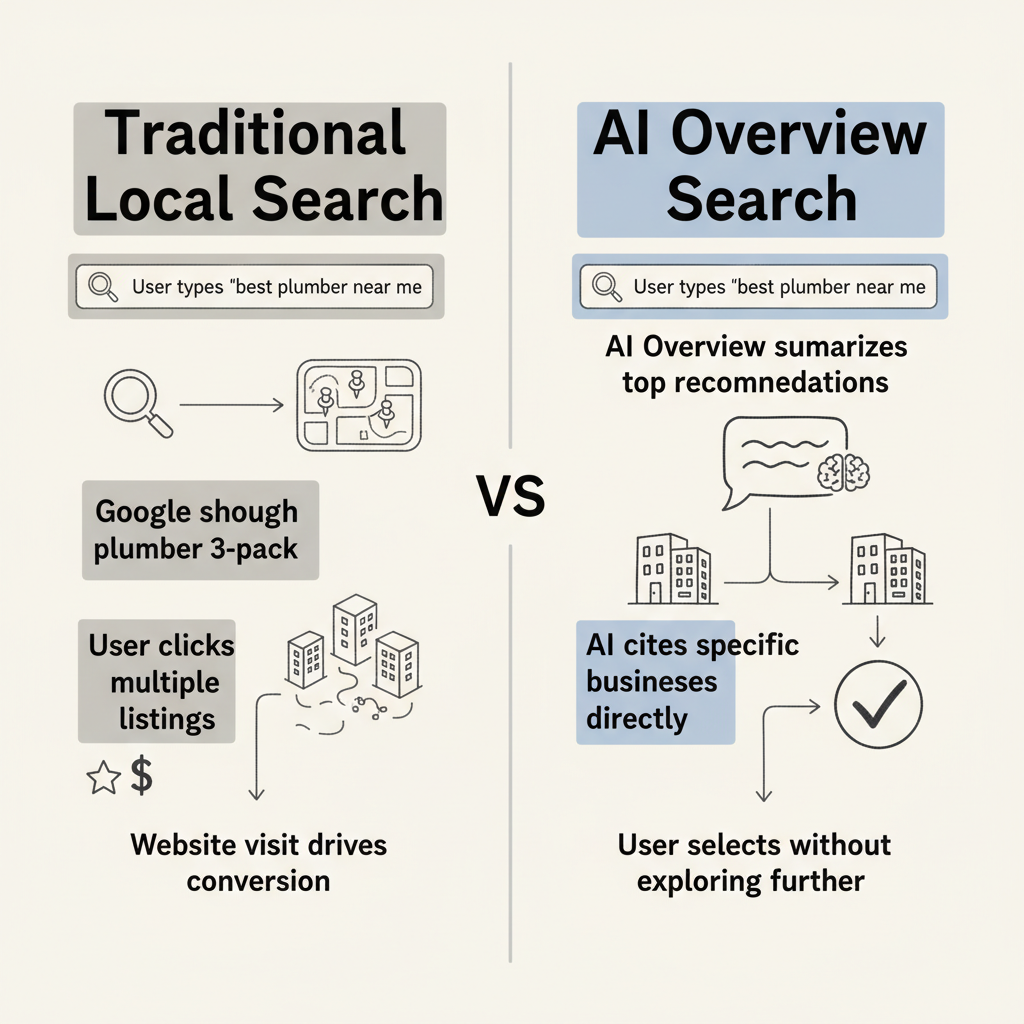
AI Overviews represent a paradigm shift from traditional local search results.
Traditional local search experience:
- User queries "best plumber near me"
- Google displays local 3-pack with map
- User clicks through to compare options
- Website visit drives conversion
AI Overview local search experience:
- User queries "best plumber near me"
- AI Overview summarizes top recommendations directly
- AI may cite specific businesses before showing local pack
- User may select business without exploring further options
Research indicates local AI search results show approximately 85% domain volatility—the businesses cited change frequently. This volatility creates both challenges for maintaining visibility and opportunities for businesses currently outside top positions.
Entity-Based Ranking and Generative Engine Optimization
AI Overviews do not rank pages—they rank entities. Google's AI builds knowledge graphs that connect businesses to services, locations, and reputations. When a user asks for "best Italian restaurant downtown," the AI does not simply scan title tags. It evaluates an entity graph: the restaurant's name, cuisine type, geographic coordinates, review sentiment, menu items, and corroborating mentions across the web.
This entity-centric model means local businesses must think beyond traditional keyword optimization. Generative Engine Optimization (GEO) is the emerging framework for structuring content and data so that generative AI systems—Google's AI Overviews, Bing Copilot, ChatGPT search, and Perplexity—can confidently cite your business. GEO complements traditional Answer Engine Optimization (AEO) by focusing specifically on how large language models retrieve and synthesize information.
Core GEO principles for local businesses:
- Entity consistency: Your business name, address, phone number, services, and descriptions must form a coherent entity across every platform—GBP, website, directories, and social profiles
- Corroboration depth: AI systems gain confidence when multiple independent sources confirm the same facts about your business. A single GBP listing is not enough; the AI looks for confirming signals from Yelp, industry directories, news mentions, and review platforms
- Structured data as entity definition: Schema markup is how you explicitly tell AI systems what your business entity is, what it offers, and where it operates
- Topical authority: Publishing clusters of related content—service pages, FAQ pages, location guides, and blog posts—signals that your business is a genuine authority in its domain, not just a one-page listing
Businesses that build strong entity graphs get cited more frequently because AI systems can verify their claims across multiple sources with high confidence.
Google Business Profile: The Foundation of Local AI Visibility
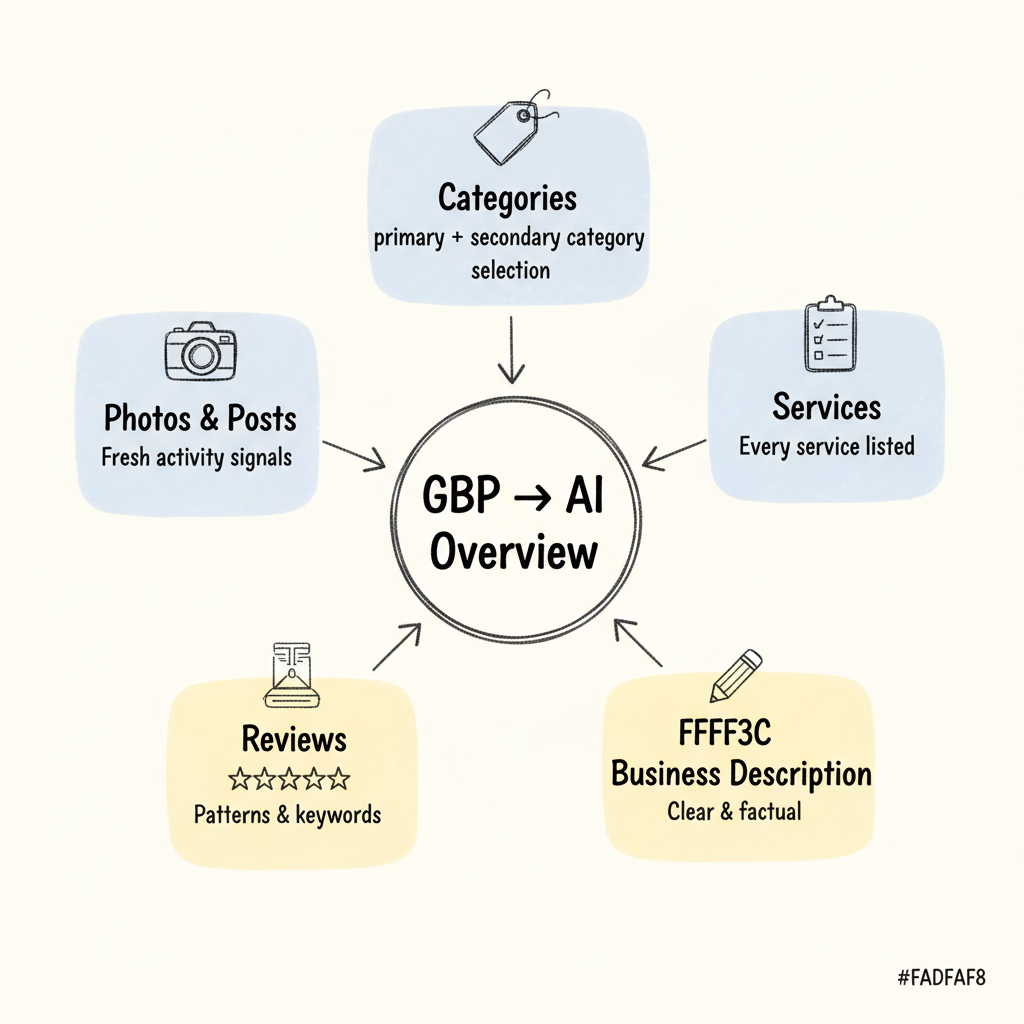
Your Google Business Profile (GBP) now feeds directly into AI Overviews. When Google's AI generates local recommendations, it pulls from GBP descriptions, reviews, services, and activity. Optimizing your profile is no longer just about the map pack—it's about being the business AI recommends. Google evaluates local businesses along three foundational pillars: proximity to the searcher, relevance to the query, and prominence based on reputation and authority signals.
Critical GBP elements for AI visibility:
Primary and secondary categories: Your primary category is the top factor influencing local pack rankings and AI recommendations. Research shows businesses using four additional categories achieve the highest average map rankings. Select categories that precisely define your business.
Services section: This becomes structured data that AI can reference easily. List every service you offer with clear descriptions. AI systems parse this information when determining which businesses to recommend for specific service queries.
Business description: Write for AI clarity, not marketing fluff. Clean, factual statements about what you do, where you operate, and who you serve help AI systems confidently recommend your business. Understanding the principles of E-E-A-T in answer engine optimization can help you craft business descriptions that demonstrate expertise and trustworthiness.
Reviews and review content: AI reads review patterns. It learns what customers say about you, the words they repeat, and how often they mention specific services. These conversational clues become signals that influence how AI talks about your business.
Photos and post activity: Post updates to your GBP at least once per week. Regular activity signals an active, trustworthy business. Fresh content demonstrates you are currently operating and engaged with customers.
Data Consistency: The AI Trust Factor
AI systems rely on consistency and verifiability across multiple sources. Any conflict in your Name, Address, and Phone (NAP) details or service descriptions introduces ambiguity that degrades trustworthiness.
Data harmonization requirements:
GBP and website alignment: If your website lists four services but your GBP shows six, AI may not provide a confident summary. Ensure complete consistency across all platforms.
Citation accuracy: Your business information across directories, social profiles, and third-party sites must match exactly. AI models, like traditional algorithms, hesitate to cite conflicting data.
Service description consistency: Use identical service names and descriptions across your GBP, website, and citations. Variations create uncertainty for AI systems.
The 2026 Local Search Ranking Factors survey identifies citations as one of the top factors for AI search visibility (13% weight)—demonstrating the importance of structured and unstructured mentions across third-party sources.
Local Content Strategy for AI Citations
On-page signals remain the most important factor group for local AI search visibility (24% according to industry research). Creating dedicated pages for each service strengthens your AI citation potential.
Local content optimization:
Service-specific pages: Create individual pages for each service you offer, optimized for local intent. These become citable sources when AI summarizes service options in your area. For businesses new to this approach, exploring DIY AEO optimization strategies can help you build service pages that answer engine systems recognize.
Location pages: For businesses serving multiple areas, develop location-specific pages with unique, relevant content about each service area. Avoid thin duplicate content that fails to demonstrate genuine local relevance.
FAQ content: Answer common questions about your services, pricing, availability, and service areas. AI systems often extract FAQ content when generating local recommendations.
Content clustering: Organize related pages into topical clusters rather than treating each page as an isolated asset. A plumbing business, for example, should link its emergency repair page, water heater installation page, and drain cleaning page together under a central services hub. This internal linking structure helps AI systems understand the full scope of your expertise and increases the likelihood of citation across multiple query types.
Local schema markup: Implement LocalBusiness schema with accurate service area definitions, business hours, and accepted payment methods. Go beyond basic LocalBusiness properties by adding Service schema for each offering, OfferCatalog to group services, GeoCoordinates for precise location data, and sameAs properties linking to all your verified profiles. Structured data helps AI systems understand and cite your business information accurately. Proper schema validation and testing for AI search ensures your markup is interpreted correctly by answer engines. Conduct a schema audit quarterly to catch drift between your markup and actual business information.
How to Get Cited in AI Overviews
Getting cited in AI Overviews requires a different approach than ranking in traditional search results. AI systems synthesize information from multiple sources to generate recommendations, so your optimization strategy must focus on making your business the most verifiable, well-documented, and consistently described option in your category.
Step 1 — Establish your entity foundation: Ensure your business has a complete, accurate Google Business Profile with all categories, services, and attributes filled in. Your website must mirror this information exactly. Implement LocalBusiness schema with Service, OfferCatalog, GeoCoordinates, and sameAs properties pointing to every verified profile.
Step 2 — Build corroboration across platforms: AI systems cross-reference multiple sources before citing a business. Claim and optimize your profiles on Yelp, Tripadvisor, Instagram, Facebook, Apple Maps, Bing Places, and industry-specific directories. Each profile should contain consistent NAP data, service descriptions, and business hours. The more independent sources that confirm the same facts about your business, the higher the AI's confidence in citing you.
Step 3 — Create citation-worthy content: Publish service pages that directly answer the questions AI systems process. Structure content with clear headings, concise definitions, and specific details like pricing ranges, service areas, and turnaround times. AI extracts factual, specific statements—not vague marketing language.
Step 4 — Earn authoritative mentions: Pursue inclusion in "best of" roundup articles, local news coverage, chamber of commerce listings, and industry association directories. These unstructured citations carry significant weight because AI treats editorial mentions as independent verification of your business quality.
Step 5 — Solicit keyword-rich reviews: Ask satisfied customers to mention the specific service they received, the problem that was solved, and the location. A review stating "They fixed our leaking roof in downtown Portland within 24 hours" provides far more AI-extractable signal than "Great service, highly recommend." Provide customers with a simple prompt: "Would you mind sharing what service we provided and how it helped?"
Step 6 — Monitor and iterate: Track your AI citation presence by running your target queries in incognito mode weekly. Note which competitors are being cited and analyze what they have that you lack—often it comes down to more reviews, better schema, or stronger third-party corroboration. Adjust your strategy based on observed gaps.
Multi-Platform Visibility Beyond Google
AI Overviews do not rely solely on Google's own index. Google's AI cross-references third-party platforms when building local recommendations, and other AI search systems—Bing Copilot, ChatGPT, Perplexity—draw from an even broader set of sources. A business that exists only on Google is invisible to half the AI ecosystem.
Platform-specific optimization:
Yelp: Maintain a complete profile with current photos, accurate hours, and responses to reviews. Yelp data feeds into multiple AI systems including Apple's Siri and various chatbot integrations. Ensure your Yelp business description matches your GBP description and website copy.
Tripadvisor: Essential for hospitality, dining, and tourism businesses. Tripadvisor content appears in AI recommendations for travel-related queries. Keep your listing current with seasonal hours, menu updates, and management responses to reviews.
Instagram: AI systems increasingly reference Instagram business profiles for visual verification and activity signals. Maintain a consistent posting cadence, use location tags, and ensure your Instagram bio contains your exact business name and service area.
Apple Business Connect: Optimize your Apple Maps listing for Siri-powered recommendations and Apple Intelligence search features. This is a growing channel that many local businesses overlook.
Bing Places: Microsoft's AI products, including Copilot, draw heavily from Bing Places data. A claimed and optimized Bing Places profile ensures visibility across Microsoft's AI ecosystem.
Industry-specific directories: Identify the top three directories in your industry—Avvo for attorneys, Healthgrades for healthcare providers, Houzz for home services—and maintain complete, current profiles. These authoritative vertical platforms carry outsized weight in AI recommendations for specialized queries.
Reviews: The AI Visibility Multiplier
Reviews influence local rankings directly—Google has confirmed this. For AI visibility, review signals carry approximately 16% weight in determining which businesses get cited.
Review optimization for AI:
Quantity and recency: Both matter for AI extraction. Consistent review flow demonstrates ongoing customer satisfaction. Stale review profiles signal potential issues.
Review content quality: AI extracts information from review text. Reviews mentioning specific services, experiences, and outcomes provide citation-worthy content. Encourage detailed reviews rather than generic ratings.
Review response: Responding to reviews signals engagement and provides additional content for AI to evaluate. Address concerns professionally—AI systems evaluate sentiment patterns.
Keyword-rich review solicitation: Guide customers toward leaving specific, detailed feedback by providing a simple prompt after service completion. Ask them to mention the service they received, the location, and the outcome. For example: "We would appreciate a review—if you could mention [the service] and how it went, that helps other customers find us." Avoid scripted or incentivized reviews, which violate platform policies and can trigger penalties.
Monthly review campaigns: Rather than sporadic review requests, run a structured monthly solicitation campaign. Contact recent customers via email or text with a direct link to your GBP review page. A steady cadence of three to five new reviews per month maintains the freshness signals AI systems evaluate.
Local Link Building and Citations
Links and citations each carry approximately 13% weight for local AI search visibility. Building your off-site presence through linked and unlinked mentions establishes your brand as a trusted source.
Effective local link strategies:
Local directory presence: Ensure accurate listings across major directories and industry-specific platforms. These structured citations provide verification signals.
"Best of" lists: Inclusion on third-party "best of" lists and roundup articles significantly impacts AI search visibility. These unstructured citations often get cited directly in AI recommendations.
Local partnerships: Links from local business associations, chambers of commerce, and community organizations strengthen local authority signals.
Industry associations: Membership and links from professional organizations validate expertise claims.
Monitoring AI Overview Performance
Traditional rank tracking doesn't capture AI Overview visibility. New monitoring approaches are necessary. Implementing comprehensive AI search analytics tracking helps measure your visibility across multiple answer engines beyond just Google.
Monitoring strategies:
Manual query testing: Run your core local queries in incognito mode and observe whether your business appears in AI-generated summaries. Track changes over time.
Geo-grid tracking: Advanced tools show how your business ranks across multiple locations within your service area. AI recommendations may vary by user location.
Review sentiment tracking: Monitor patterns in customer language that may influence AI perception of your business.
Competitive monitoring: Track which competitors appear in AI recommendations for your target queries. Identify what differentiates cited businesses.
Multi-Location Considerations
Businesses with multiple locations face unique AI optimization challenges.
Multi-location strategies:
Individual location optimization: Each location needs its own fully optimized GBP with unique descriptions, photos, and activity. AI evaluates locations independently.
Location-specific content: Avoid duplicating content across location pages. Create genuinely unique content demonstrating local expertise and community connection.
Review distribution: Encourage reviews for each location rather than concentrating on a single profile. AI recommendations consider location-specific signals.
Consistent branding with local variation: Maintain brand consistency while allowing local authenticity. AI values both trustworthy brand signals and genuine local presence.
The Zero-Click Local Reality
Nearly 60% of searches now end without a click. AI Overviews, knowledge panels, and local packs deliver answers directly. For local businesses, this means visibility within AI-generated content has become a primary goal—even if no click results.
Adapting to zero-click:
Presence over traffic: Success metrics must expand beyond website visits. Being recommended by AI builds awareness and consideration even without clicks.
Phone calls and directions: Local businesses often convert through calls and map directions rather than website visits. AI recommendations drive these actions directly.
Brand recognition: Consistent AI citation builds familiarity. When users do need your services, they recognize your business from previous AI recommendations.
FAQs
Do I Need a Website for AI Overview Visibility?
A website strengthens AI visibility significantly but isn't strictly required. Your GBP can appear in AI recommendations based on profile optimization, reviews, and citations alone. However, service-specific website pages provide additional citable content that improves citation likelihood for diverse queries.
How Quickly Do AI Overview Local Rankings Change?
Local AI results show high volatility—approximately 85% domain turnover according to research. This means optimization improvements can surface relatively quickly, but maintaining visibility requires ongoing attention. The businesses AI cites can change significantly within weeks.
Should I Optimize Differently for AI Overviews Versus Local Pack?
Many fundamentals overlap, but some distinctions exist. AI Overviews weight on-page content more heavily, while the local pack emphasizes proximity. Optimize GBP thoroughly for both, but invest additional effort in website content and service pages specifically for AI visibility.
How Do I Trigger Google AI Overview for My Business?
You cannot force an AI Overview to appear—Google decides when to generate one based on query intent and available information. However, you can increase the likelihood of being cited by building a strong entity presence: complete GBP profile, consistent NAP across platforms, structured schema markup, keyword-rich reviews, and corroborating mentions on third-party sites. Queries that include service-specific and location-specific terms are more likely to trigger AI Overviews that cite local businesses.
Does Google AI Mode Replace the Local Pack?
Google AI Mode, powered by Gemini 2.0, does not replace the local pack but changes how it is accessed. In AI Mode, the local pack may appear embedded within or below the AI-generated response rather than in its traditional position. Businesses optimized for both traditional local signals and AI citation signals maintain visibility regardless of how Google presents its results.