
Google AI Overviews now appear for approximately 39% of informational queries - and that percentage climbs to 67% for queries with eight or more words. Getting cited in these AI-generated summaries has become a meaningful traffic and visibility opportunity.
The good news: you don't need a complete content overhaul to improve AI Overview performance. These 10 quick wins deliver results with focused, tactical changes.
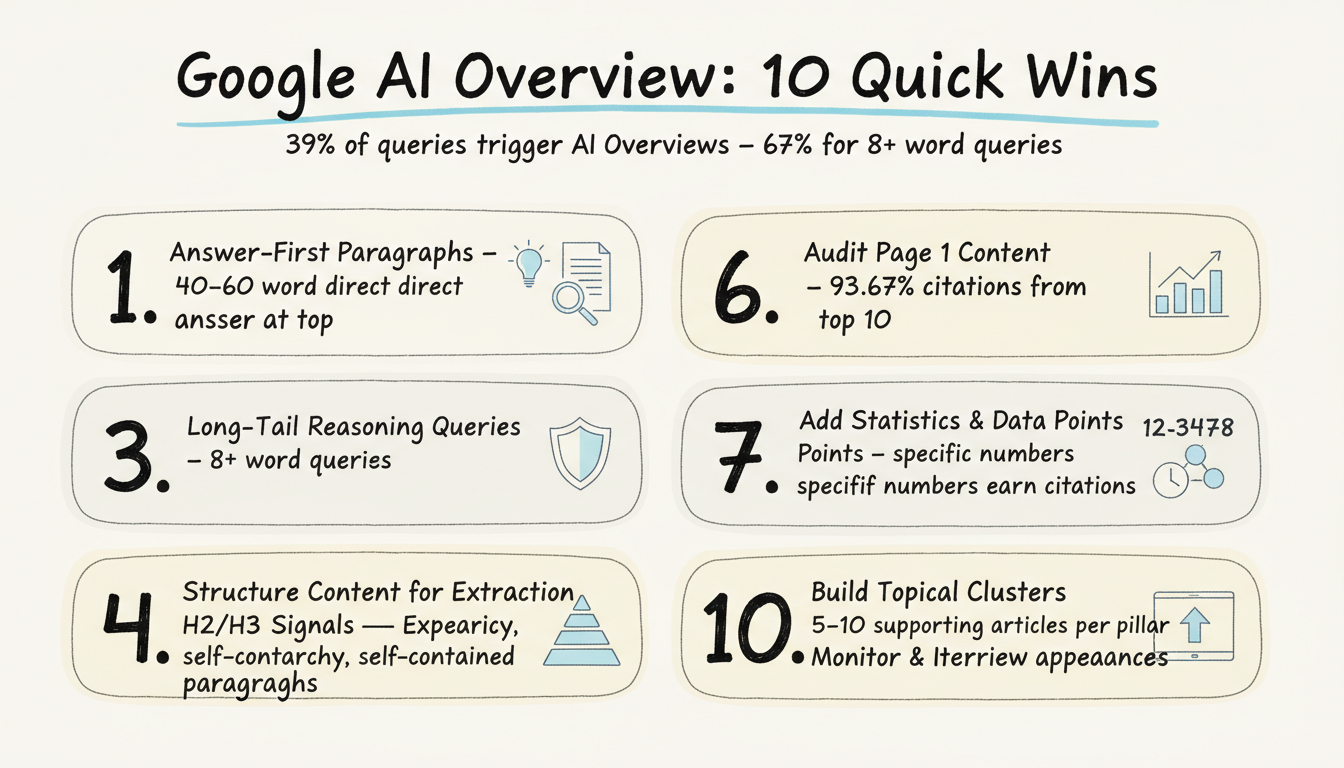
1. Add Answer-First Paragraphs
AI Overviews pull content that directly answers the query. Move your clearest, most definitive answer to the top of each page.
Quick implementation:
- Identify the primary question your page answers
- Write a 40-60 word paragraph that directly answers it
- Place this immediately after your H1 heading
- Avoid hedging language - be direct and specific
Pages with answer-first structure get cited more frequently because AI systems can easily extract the response without parsing through introductory content.
2. Implement FAQ Schema Markup
FAQ schema signals question-answer content to Google's systems. Pages with FAQ markup show 43% higher citation rates in AI Overviews compared to unstructured equivalents.
Quick implementation:
- Add FAQPage schema to pages with Q&A sections
- Include 3-5 genuine questions users ask
- Keep answers concise (50-75 words optimal)
- Validate with Google's Rich Results Test
Schema markup takes 15 minutes to implement but provides ongoing AI visibility benefits.
3. Target Long-Tail Reasoning Queries
Short queries rarely trigger AI Overviews. Implementing long-tail keywords for featured snippet success is a proven strategy - especially for queries requiring explanation or comparison that trigger AI responses far more frequently.
Quick implementation:
- Identify 8+ word queries in your Search Console data
- Create content sections specifically addressing these queries
- Use the exact query phrasing in H2 or H3 headings
- Provide comprehensive answers that satisfy the complete query
Focus content efforts on queries where AI Overviews actually appear rather than high-volume head terms.
4. Strengthen E-E-A-T Signals
Google's AI systems weight Experience, Expertise, Authoritativeness, and Trustworthiness heavily when selecting citation sources. Strengthen these signals for higher citation rates.
Quick implementation:
- Add author bylines with credentials to all content
- Include first-person experience ("In our testing..." or "When we implemented...")
- Link to author bio pages with professional background
- Reference primary sources and studies
Content demonstrating genuine expertise gets cited over generic informational pages. Many organizations working with an ai-seo-agency-guide-2026 prioritize E-E-A-T improvements as their first optimization step.
5. Structure Content for Extraction
AI systems extract content in predictable patterns. Structure pages to make extraction easy.
Quick implementation:
- Use clear H2 and H3 heading hierarchy
- Write self-contained paragraphs that make sense independently
- Format lists and steps as numbered or bulleted items
- Include comparison tables where relevant
Well-structured content gets cited more accurately because AI systems can extract clean, coherent snippets.
6. Audit Existing Page 1 Content
Research shows 93.67% of AI Overview citations come from pages already ranking in the top 10. Your best AI Overview opportunities are pages that rank well but aren't yet being cited.
Quick implementation:
- List your pages ranking positions 1-10 for target queries
- Search those queries and note which trigger AI Overviews
- Identify pages ranking well but not appearing in AI responses
- Apply these optimization tips to those specific pages first
Prioritize pages with existing ranking strength - they're closest to AI citation.
7. Add Statistics and Data Points
AI Overviews frequently cite pages containing specific statistics, research findings, and quantifiable data. Content with concrete numbers earns more citations than general discussion.
Quick implementation:
- Add relevant statistics to each major content section
- Include publication dates for data freshness signals
- Cite original research sources
- Create original data through surveys, analysis, or testing
A page with "conversion rates improved 34%" gets cited over one saying "conversion rates improved significantly."
8. Update Content Freshness Signals
AI systems prefer recent information. Outdated content gets passed over for fresher alternatives - even when the underlying information remains accurate.
Quick implementation:
- Update publication dates when making meaningful revisions
- Replace old statistics with current data
- Remove references to past years ("in 2023...")
- Add recent examples and case studies
Quarterly content refreshes maintain citation eligibility for high-priority pages.
9. Build Topical Authority Through Clusters
Isolated pages struggle to earn AI citations. AI systems favor sources demonstrating comprehensive topic coverage through interconnected content.
Quick implementation:
- Identify your pillar pages for core topics
- Create 5-10 supporting articles linking to each pillar
- Use internal links to connect related content
- Ensure consistent entity references across the cluster
Topical clusters signal expertise that single pages cannot demonstrate alone. Organizations measuring aeo-optimization-metrics often find topical authority correlates strongly with citation rates.
10. Monitor and Iterate Weekly
AI Overview citations fluctuate more than traditional rankings. What gets cited this week may not appear next week. Active monitoring enables rapid response.
Quick implementation:
- Track AI Overview appearances for priority queries weekly
- Note which competitors appear when you don't
- Analyze cited content structure and format
- Apply successful patterns to your own content
Tools like Semrush AI Toolkit, Otterly AI, and manual query testing provide visibility into citation patterns. Companies evaluating cross-platform-ai-search-roi-analysis use these monitoring tools to track performance across multiple AI platforms.
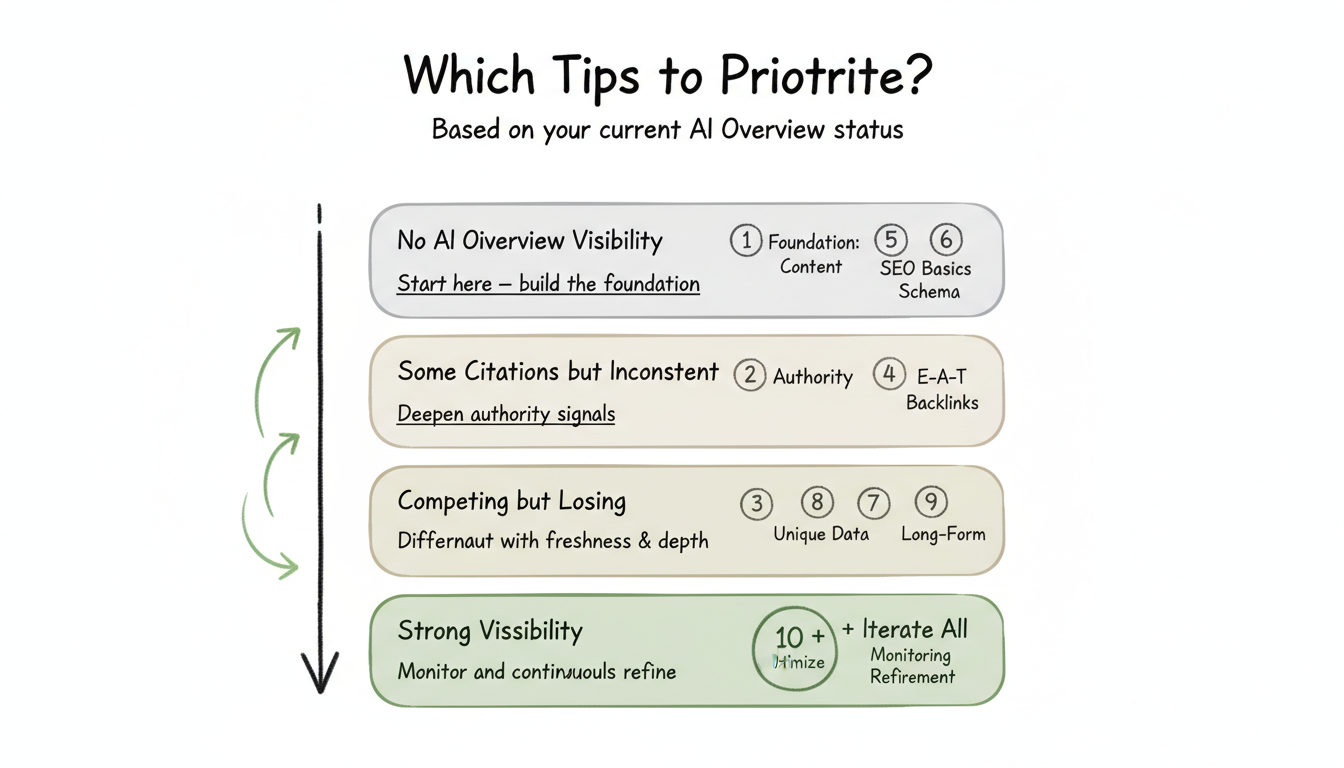
Prioritization Framework
Not all tips deliver equal impact. Prioritize based on your current state:
Current State | Priority Actions |
No AI Overview visibility | Tips 1, 5, 6 (foundation) |
Some citations but inconsistent | Tips 2, 4, 7 (strengthen) |
Competing but losing to competitors | Tips 3, 8, 9 (differentiate) |
Strong visibility, seeking gains | Tips 10, iterate on all (optimize) |
Implementation Timeline
These quick wins can be implemented progressively:
Week 1: Audit existing Page 1 content (Tip 6), add answer-first paragraphs to top 5 pages (Tip 1)
Week 2: Implement FAQ schema on pages with Q&A sections (Tip 2), strengthen E-E-A-T signals (Tip 4)
Week 3: Add statistics and data points (Tip 7), structure content for extraction (Tip 5)
Week 4: Target long-tail queries (Tip 3), update freshness signals (Tip 8)
Ongoing: Build topical clusters (Tip 9), monitor and iterate (Tip 10)
Answer-First Paragraphs
The answer-first paragraph is the technique. A page that states the fact in the first lines is the one the model lifts, so the order is the lever. The honest content is the one the system can read, and the discipline of the format makes the page citable instead of skipped, because the extraction favors the shape and the structure is the asset.
Avoid burying the answer. A page that makes the reader scroll to the fact loses the box, so the lead carries the response. The disciplined lead is what earns the placement, and the patience to write it is the quiet edge most teams skip while they warm up the post, because the substance is the point and the fit is the lever.
FAQ Schema Markup
The schema is the machine signal. A page tagged with the FAQ markup is the one the engine can read, so add the structured data as a default. The disciplined markup makes the content citable, and the patience to tag it is the quiet edge that compounds across every post, because the signal is the asset that pays and the data is the guide.
Use the schema with the real answer. A tagged page with a thin reply wastes the markup, so the content must back the tag. The honest snippet is the one the page can support, and the mismatch costs the brand the next time, because the substance is the point and the clarity is the asset.
Structure for Extraction
The structure is the list and the table. A scannable shape is what the extraction prefers, so build the answer in the form the system lifts. The honest format is the one the model can quote, and the discipline of the shape is the quiet advantage most teams skip while they write prose walls that the engine skips, because the fit is the lever and the upkeep is the value.
Monitor the result weekly. A fixed query list watched over time shows whether you hold the box, because the position is not permanent. The disciplined check catches the loss early, and the patience to monitor is the quiet edge most teams skip while they assume the win holds, because the measurement is the guide and the structure is the asset.
FAQs
How Quickly Do AI Overview Optimizations Take Effect?
Changes typically appear in AI Overview citations within 2-4 weeks after Google recrawls and reprocesses your content. Schema markup changes may show impact faster. Monitor weekly to track progress.
Do These Tips Work for All Industries?
Yes, these optimization principles apply across industries. However, AI Overview trigger rates vary by query type - informational and educational content sees higher AI Overview frequency than transactional or navigational queries.