
Google AI Overview SEO Impact: 2026 Data and Statistics
Google AI Overviews have fundamentally changed the SEO landscape. With AI Overviews appearing in over 25% of US searches and reaching an estimated 2 billion users monthly, the Google AI overview SEO impact on organic traffic can no longer be ignored.
The data tells a clear story: some sites are losing significant traffic while others are gaining by adapting their strategies. This analysis examines the real SEO impact of Google AI Overviews using traffic data, click-through rate studies, and industry-specific case studies.
Key Takeaways
Understanding the Google AI overview SEO impact requires tracking both traditional organic rankings and AI Overview citation rates, as both surfaces now determine search visibility.
- The Google AI overview SEO impact is measurable: CTRs for position-1 rankings dropped 34.5% according to Ahrefs, with the Pew Research Center confirming a 46.7% relative decline across 68,000 queries.
- AI Overviews rarely appear for local keywords and transactional queries, making those content types relatively protected.
- Measuring the performance of your site against AI Overview exposure requires tracking both traditional rankings and AI citation rates.
- SEO best practices now include structured schema markup, original research, and brand authority signals to earn AI Overview citations.
- How AI features work in Search differs by intent: informational queries trigger AI Overviews 39.4% of the time vs. just 12% for navigational queries.
- The length of AI Overviews is declining over time as Google refines the feature, which may reduce the zero-click impact going forward.
AI Overview Rollout Timeline and Current Reach
Google AI Overviews launched in the US in May 2024 and have expanded rapidly:
Timeline:
- May 2024: US launch with limited query coverage
- Late 2024: Expanded to 100+ countries
- 2025: Integration deepened, AI Overviews became standard for informational queries
- January 2026: Present in 25.8% of all US searches
Current Statistics:
- 2 billion estimated monthly users
- 25% of informational queries trigger AI Overviews
- 51.6% of health-related queries show AI Overviews
- 65.9% of long informational queries (7+ words) include AI Overviews
According to Gartner projections, by the end of 2026, 25% of organic search traffic will shift to AI chatbots and voice assistants—a structural change affecting every industry. Understanding the aeo-optimization-timeline helps businesses prepare for these shifts and implement strategies at the right stages.
Traffic Impact Studies: What the Data Shows
Multiple studies have quantified the Google AI overview SEO impact on organic traffic. The results are significant but nuanced.
The research consensus points to a tiered impact: position-1 rankings face the sharpest CTR declines at 34.5%, but even lower-ranked pages experience measurable drops. The most rigorous controlled study (Pew Research Center, 68,000 queries) confirms a 46.7% relative decline in clicks when AI Overviews appear, providing the clearest picture of true behavioral impact beyond SERP feature co-occurrence estimates.
Key Traffic Impact Findings
Research across millions of keywords consistently shows AI Overviews reduce organic click-through rates, with the impact ranging from 15.49% (all positions average) to 46.7% (controlled Pew Research study).
Metric | Impact | Source |
Organic CTR decline | 34.5% decrease for #1 rankings | Semrush 10M keyword study |
Overall CTR drop | 61-65% decline when AI Overviews appear | Seer Interactive |
Zero-click searches | 60-65% of queries end without a click | 2026 industry data |
Reported traffic loss | 20-40% for affected sites | WordStream analysis |
Controlled click-rate decline | 46.7% relative decline (8% vs 15% click rate) | Pew Research Center (68K queries) |
Position 1 CTR decline | 34.5% decrease (300K keywords) | Ahrefs study |
Average CTR decline (all positions) | 15.49% average drop (700K keywords) | Amsive Digital study |
Featured snippet + AIO compounding | 37.04% CTR drop when both co-occur | Amsive Digital study |
The 34.5% CTR Decline
According to the Semrush AI Overviews study analyzing over 10 million keywords, pages ranking #1 experienced an average 34.5% CTR decline when AI Overviews appeared for their target queries.
However, the relationship is more complex than simple traffic loss. The same study found that when tracking identical keywords before and after AI Overview implementation, zero-click rates actually decreased slightly (from 33.75% to 31.53%)—suggesting AI Overviews may be replacing other zero-click features rather than creating entirely new behavior.
Pew Research Center: Controlled Study Findings
The Pew Research Center’s controlled study of 68,000 real queries found an 8% click rate when AI Overviews appeared versus 15% without—a 46.7% relative decline.
The Pew Research Center conducted one of the most rigorous independent studies on AI Overview impact, tracking 68,000 real search queries across 327 information-seeking tasks. Their controlled methodology compared user behavior with and without AI Overviews present, finding an 8% click rate when AI Overviews appeared versus 15% without—a 46.7% relative decline in clicks.
Unlike keyword-level estimates from SEO tools, the Pew study observed actual user behavior in real search sessions. This makes it particularly valuable for understanding the true scope of traffic displacement, as it accounts for user intent and search context rather than relying solely on SERP feature presence data.
Ahrefs and Amsive: Complementary Large-Scale Studies
The widely cited 34.5% CTR decline figure originates from an Ahrefs study analyzing 300,000 keywords, led by researcher Ryan Law. Their methodology tracked position-level CTR changes before and after AI Overview deployment, providing the most granular view of how different ranking positions are affected.
Amsive Digital's complementary study of 700,000 keywords found a 15.49% average CTR drop across all positions. Critically, Amsive found a compounding effect: when featured snippets and AI Overviews co-occur, CTR drops 37.04%. Pages previously benefiting from featured snippet visibility are now doubly penalized, and non-branded queries face a steeper -19.98% CTR decline than the overall average.
Screen Real Estate Matters
AI Overviews consume 42% of desktop screen space and 48% on mobile. This pushes traditional organic results below the fold, directly impacting visibility and click probability. The differences between google-ai-overview-mobile-vs-desktop-differences reveal important optimization considerations for both platforms.
On mobile devices—where 81% of AI Overview queries occur—users often don't scroll past the AI-generated answer at all.
Winners and Losers: Which Sites Gained or Lost Traffic
Not all sites experience the Google AI overview SEO impact equally. Understanding the pattern helps inform strategy.
Sites Losing Traffic
Content publishers relying on informational queries:
- Sites built around “what is” and “how to” content face the highest exposure
- Health information sites report significant declines (51.6% AI Overview rate for health queries)
- Recipe sites see AI Overviews answer cooking questions directly
Sites with thin or commodity content:
- Content that simply aggregates publicly available information
- Pages that don’t offer unique analysis or perspective
- Listicles without original research or testing
News publishers: According to analysis of the December 2025 core update, major news publishers were heavily impacted, including in Google Discover traffic.
Sites Gaining Traffic
Pages cited within AI Overviews: Sites that earn citations inside AI Overviews can actually see CTR increases of up to 35%. Being the source Google cites provides significant visibility advantage. Understanding ai-search-citations-guide helps optimize for these valuable mentions.
Brands with strong authority signals: Brands mentioned in AI responses experience 91% higher paid CTR—the halo effect extends beyond organic.
Sites optimizing for AI visibility: Early adopters of answer engine optimization report up to 527% year-over-year growth in AI-driven search traffic. Implementing comprehensive aeo-optimization-strategies drives these impressive results.

Click-Through Rate Analysis: AI Overviews vs Organic
The CTR impact varies significantly by query type, industry, and whether your site appears in the AI Overview.
CTR by Position (with AI Overviews Present)
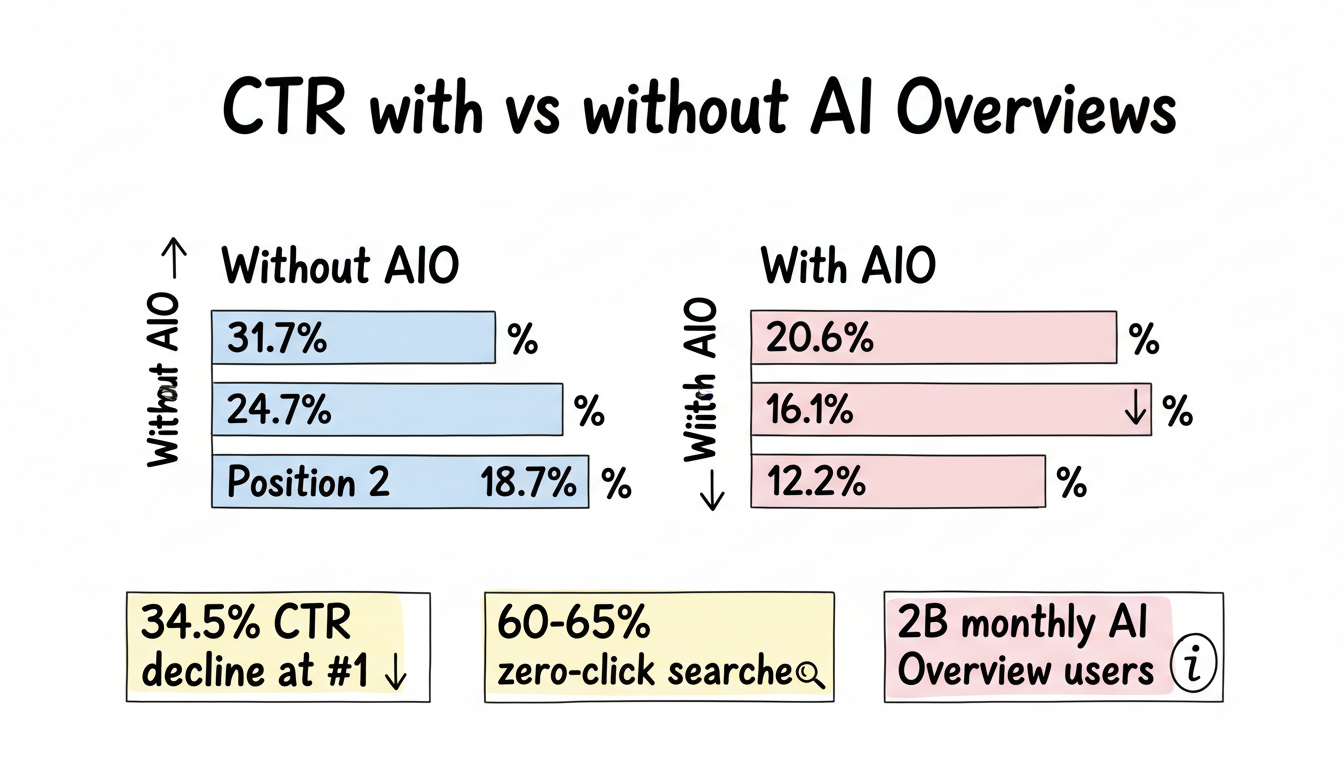
AI Overviews cut CTR roughly equally across the top 3 positions, with each position losing approximately 34.5-34.8% of its previous click-through rate.
Position | CTR Without AIO | CTR With AIO | Change |
Position 1 | ~31.7% | ~20.6% | -34.5% |
Position 2 | ~24.7% | ~16.1% | -34.8% |
Position 3 | ~18.7% | ~12.2% | -34.8% |
The Citation Premium
Sites cited within AI Overviews gain a +35% CTR boost, making an AI Overview citation more valuable than a #1 organic ranking.
The citation premium: When your site is cited in the AI Overview, the dynamic reverses. Cited sources can see a +35% CTR boost compared to pre-AIO performance—making AI Overview citations more valuable than ranking #1.
When your site is cited in the AI Overview, the dynamic reverses:
- Cited sources: Can see +35% CTR compared to pre-AIO performance
- Non-cited competitors: Experience full CTR decline
- Net effect: Being cited is now more valuable than ranking #1
Branded vs Non-Branded Query Impact
Branded queries gain an 18.68% CTR boost from AI Overviews, while non-branded queries lose 19.98%—a key strategic divergence for content planning and budget allocation.
Amsive Digital's 700,000-keyword study revealed a critical strategic split in how AI Overviews affect different query types. Branded queries—searches that include a company or product name—actually see an 18.68% CTR boost when AI Overviews appear. This brand reinforcement effect occurs because AI Overviews often cite the brand’s own content when answering branded queries, effectively doubling the brand’s SERP visibility.
Non-branded queries tell the opposite story, experiencing a -19.98% CTR decline. For searches like “best project management software” or “how to reduce customer churn,” AI Overviews absorb clicks that would have gone to organic results.
The strategic implication is significant: companies with strong branded search volume are partially insulated from AI Overview traffic loss. Investing in brand awareness through digital PR, thought leadership, and multi-platform presence directly protects organic traffic in the AI Overview era.
Query Type Impact
WebFX’s 2026 benchmarks reveal AI Overview rates by search intent:
Search Intent | AI Overview Rate | Long Query Rate (7+ words) |
Informational | 39.4% | 65.9% |
Commercial | 22.2% | 46.1% |
Transactional | 16.5% | 31.8% |
Navigational | 12.0% | 23.1% |
Strategic Implication: Transactional and navigational content faces lower AI Overview exposure—a potential refuge for click-dependent business models. Leveraging paragraph-featured-snippets-ai-search optimization can help capture visibility in both traditional and AI-driven results.
Industry-Specific Impact (E-Commerce, News, SaaS, Etc.)
The Google AI overview SEO impact varies dramatically by industry, creating different strategic imperatives.
AI Overview Rate by Industry
B2B Technology faces the highest AI Overview exposure at 70%, while e-commerce queries see AI Overviews just 4% of the time, making them relatively protected.
Industry | AI Overview Rate | YoY Change |
Health | 51.6% | +15% |
B2B Technology | 70% | +34% |
Insurance | 63% | +46% |
Entertainment | 37% | +35% |
Finance & Insurance | 32.1% | +12% |
Jobs & Education | 33.0% | +8% |
E-commerce | 4% | -25% |
E-Commerce: Relatively Protected
Good news for online retailers: e-commerce queries rarely get AI Overviews. Only 4% of e-commerce searches trigger AI Overviews in 2026—down from 29% when first rolled out.
Google appears to recognize that product searches require clicking to complete transactions, preserving the commercial SERP structure.
However, e-commerce sites still report a 22% drop in search traffic from AI-generated suggestions in broader informational queries that precede purchases.
Leading e-commerce brands now invest in product-specific buying guides featuring original testing results, expert-authored comparisons, and interactive recommendation tools that AI Overviews cite as authoritative sources but cannot replicate. This approach earns AI Overview citations that attract high-intent visitors with significantly higher purchase conversion rates than generic informational traffic.
B2B Technology: Heavily Impacted
The B2B technology sector saw the most dramatic increase in AI Overview presence—from 36% to 70% of SERPs. Companies relying on top-of-funnel informational content need immediate strategy adaptation. Many are turning to mid-tier-ai-seo-software solutions to manage optimization at scale.
Health and Medical: Maximum Exposure
Health-related queries face 51.6% AI Overview rates. Medical publishers, wellness sites, and health information providers must prioritize AI citation strategies or face continued traffic erosion.
News Publishers: Double Impact
News sites face both AI Overview competition and broader impacts from Google’s December 2025 core update. Sites dropping in traditional rankings also lost AI Overview visibility, creating compounding losses.
Publishers adapting fastest are those investing in original investigative journalism, exclusive data releases, and breaking-news coverage that AI Overviews cannot synthesize from aggregated public sources. Subscription-gated premium content and proprietary research datasets provide structural protection from AI summarization, creating lasting advantages over commodity content competitors.
Case Studies: Real Traffic Changes from AI Overviews
Real-world data from publishers, SaaS companies, and retailers shows the Google AI overview SEO impact varies widely based on content type and adaptation speed.
The common thread across successful adaptations: organizations that shifted to proactive AI visibility strategies within 6 months of AI Overview expansion significantly outperformed peers. Early movers gained citation authority that compounds over time, while delayed responders face increasingly competitive landscapes for AI Overview inclusion.
Case Study 1: Health Information Publisher
Situation: Mid-sized health information site heavily dependent on “symptom” and “treatment” queries.
Impact:
- 38% decline in organic traffic (June 2024 - January 2026)
- Informational queries hit hardest
- Branded searches remained stable
Adaptation:
- Shifted content focus from general symptoms to specific treatment protocols
- Added physician authorship and credentials prominently
- Created video content that AI Overviews can’t fully replicate
Result: Stabilized traffic at 72% of pre-AIO levels, with higher conversion rates on remaining traffic.
Case Study 2: B2B SaaS Company
Situation: SaaS company ranking well for “how to” and comparison queries.
Impact:
- 45% CTR decline on target keywords
- Competitor cited in AI Overviews for key product category
Adaptation:
- Created original research reports with unique data
- Implemented comprehensive schema markup
- Built authority through industry publication citations
Result: Earned AI Overview citations for 23% of target keywords, recovering and exceeding previous traffic levels. The company also adopted conversational-content-writing-aeo techniques to better align with AI search patterns.
Case Study 3: E-Commerce Retailer
Situation: Online retailer dependent on informational content for top-of-funnel traffic.
Impact:
- Educational blog traffic down 31%
- Product page traffic stable
- Overall organic revenue unchanged
Adaptation:
- Reduced investment in purely informational content
- Shifted to product-focused buying guides with unique testing
- Expanded video and visual content
Result: Reduced content costs 40%, maintained revenue, improved content ROI.
Long-Term Implications for SEO Strategy
Gartner projects 25% of organic traffic will shift to AI by end of 2026, signaling a permanent restructuring that demands strategic adaptation across all industries.
This shift is not evenly distributed. B2B technology, health, and education sectors face the sharpest transitions, while e-commerce and transactional content retain more traditional click behavior. Understanding your industry’s specific AI Overview exposure rate is the essential first step in building an effective adaptation roadmap and prioritizing content investments.
The New SEO Reality
Visibility now happens in two places:
- Traditional SERP rankings (declining importance for informational queries)
- AI Overview citations (growing importance, especially for research phases)
Success metrics must evolve:
- Track AI Overview citation rate alongside rankings
- Monitor brand mentions in AI responses
- Measure “share of AI conversation” versus competitors
Implementing an ai-search-analytics-dashboard provides comprehensive visibility into performance across both traditional and AI-driven search channels.
Structural Changes to Expect
Gartner’s 2026 prediction—25% of organic traffic shifting to AI—appears to be on track. This isn’t temporary disruption but permanent restructuring.
Industries that will adapt fastest:
- E-commerce (already protected, experienced with diversification)
- SaaS (strong motivation, technical capability)
- Professional services (relationship-driven, less click-dependent)
Industries facing the longest adjustment:
- Content publishers dependent on ad revenue
- Affiliate sites relying on informational traffic
- News organizations (facing multiple simultaneous challenges)
Understanding the searchgpt-vs-chatgpt-search-technical-differences helps businesses prepare for the expanding AI search landscape beyond just Google.
How to Adapt: Future-Proofing Your SEO
Adapting to the Google AI overview SEO impact requires auditing keyword exposure, implementing schema markup, creating original research, and tracking AI citation rates alongside traditional rankings.
Organizations seeing the fastest recovery treat AI Overview optimization as a distinct practice from traditional SEO, with dedicated resources for citation monitoring, schema maintenance, and original content production. Teams treating it as a side project consistently cede competitive ground to more focused rivals investing systematically in AI visibility.
Immediate Actions
1. Audit Your AI Overview Exposure Identify which of your target keywords trigger AI Overviews using tools like Semrush or Ahrefs. Prioritize defense for high-value, high-exposure keywords. Specialized geo-optimization-tools can help analyze local market variations in AI Overview presence.
2. Analyze Citation Patterns For keywords showing AI Overviews, identify which sources Google cites. Understand the content characteristics that earn citations:
- Original data and research
- Clear expertise signals (authorship, credentials)
- Structured, easily-parsed content
- Comprehensive coverage of the topic
3. Implement Schema Markup Structured data helps Google understand and potentially cite your content. Focus on:
- FAQ schema for question-based content
- HowTo schema for instructional content
- Article schema with proper authorship
- Organization schema for authority signals
Technical Requirements for AI Feature Visibility
Technical requirements for appearing in AI features include structured data markup, fast page speed, mobile optimization, and clear authorship signals. Google's documentation identifies these as key factors for how AI features work in Search and which pages earn citations.
- Schema markup: BlogPosting, FAQPage, and HowTo schemas increase eligibility for AI Overview citations
- Page authority: Pages in the top 20 organic results are featured in AI Overview sources 97% of the time
- E-E-A-T signals: Author credentials, original research, and citations from trusted sources improve AI Overview inclusion likelihood
Strategic Shifts
1. Diversify Query Intent Reduce dependence on purely informational queries. Build content targeting:
- Transactional intent (16.5% AIO rate vs 39.4% informational)
- Commercial investigation (22.2% AIO rate)
- Navigational queries (12.0% AIO rate)
2. Create Uncopyable Content AI Overviews struggle to replicate:
- Original research with unique data
- Expert interviews and perspectives
- Interactive tools and calculators
- Video and visual content
- Real-world testing and reviews
3. Build Brand Authority Brand mentions in AI responses correlate with existing brand strength. Invest in:
- Digital PR and earned media
- Industry thought leadership
- Platform diversification (YouTube, Reddit, podcasts)
Developing a searchgpt-social-monitoring-reddit-quora-strategy helps establish authority signals across platforms AI search engines monitor.
4. Track New Metrics Expand your KPI dashboard:
- AI citation rate
- Brand mention tracking in AI responses
- Assisted conversions (traffic that researched via AI before converting)
- Share of AI conversation versus competitors
Many businesses are implementing searchgpt-citation-tracking-measuring-visibility systems to monitor performance across multiple AI platforms. Those lacking internal expertise often partner with an aeo-agency for specialized support.
Frequently Asked Questions
Common questions about Google AI Overviews and their impact on organic search traffic, CTR trends, and SEO strategy in 2025 and 2026.
How Do Google AI Overviews Impact SEO Traffic in 2025 and 2026?
Google AI Overviews reduce organic CTR by 15-46% depending on query type, with the most rigorous studies confirming a 46.7% relative decline in clicks across 68,000 real queries.
Multiple large-scale studies confirm significant CTR declines. The Pew Research Center found a 46.7% relative decline in click rates (8% with AIO vs 15% without) across 68,000 queries. Ahrefs measured a 34.5% CTR drop for position-1 rankings across 300,000 keywords, while Amsive Digital found a 15.49% average decline across 700,000 keywords. The impact intensified through 2025 as AI Overviews expanded to 25.8% of US searches by January 2026, with informational queries experiencing the highest exposure rates.
How Often Do AI Overviews Appear in Search Results in 2026?
As of January 2026, AI Overviews appear in 25.8% of all US searches, with informational queries triggering them 39.4% of the time and e-commerce queries just 4%.
As of January 2026, AI Overviews appear in 25.8% of all US searches and reach approximately 2 billion users monthly. The frequency varies significantly by search intent: informational queries trigger AI Overviews 39.4% of the time (65.9% for long queries of 7+ words), commercial queries at 22.2%, transactional at 16.5%, and navigational at just 12.0%. Industry-wise, B2B technology queries see AI Overviews 70% of the time, while e-commerce queries see them only 4%.
What Are the Best SEO Practices for Google AI Overviews in 2026?
The most effective SEO practices for AI Overviews are creating original research, implementing comprehensive schema markup, and building brand authority to earn AI Overview citations worth up to a +35% CTR boost.
The most effective strategies include: creating original research with unique data that AI Overviews cite as sources, implementing comprehensive schema markup (FAQ, HowTo, Article schemas), building brand authority through digital PR and thought leadership, diversifying toward transactional and commercial queries that face lower AI Overview exposure, and tracking AI citation rates alongside traditional ranking metrics. Sites earning AI Overview citations can see up to +35% CTR gains.
Do Branded Queries Perform Better with AI Overviews?
Yes—branded queries see an 18.68% CTR boost when AI Overviews appear, while non-branded queries face a 19.98% CTR decline.
Yes. Amsive Digital's study of 700,000 keywords found that branded queries experience an 18.68% CTR boost when AI Overviews appear, compared to a -19.98% decline for non-branded queries. This brand reinforcement effect occurs because AI Overviews often cite the brand’s own content when answering branded searches, effectively increasing SERP visibility. Investing in brand awareness directly protects against AI Overview traffic loss.
Next Steps
Use this data to prioritize your Google AI overview SEO impact response with concrete next steps.
- Run an AI Overview exposure audit across your top 50 keywords using Semrush or Ahrefs
- Implement FAQPage and HowTo schema markup on your highest-traffic informational pages
- Create at least one original research piece per quarter with unique data your competitors can't replicate
- Set up AI citation tracking to monitor when and where your brand appears in AI-generated answers
- Shift content investment toward transactional and commercial queries, which face lower AI Overview exposure rates
Conclusion
The evidence is clear, the direction is set, and the window to act is now.
The Google AI overview SEO impact has permanently changed organic search. The data confirms significant CTR declines (34.5%+ for top rankings), massive zero-click increases (60-65%), and industry-specific impacts ranging from minimal (e-commerce at 4%) to severe (B2B tech at 70%).
But this isn’t a story of universal loss. Sites earning AI citations see traffic gains. Brands with strong authority signals benefit from the halo effect. Companies adapting strategies early report growth exceeding pre-AIO levels.
The key to managing the Google AI overview SEO impact is recognizing that SEO now operates on two surfaces: traditional rankings and AI visibility. Success in 2026 requires optimizing for both—and tracking metrics that capture value from AI-influenced journeys, not just direct clicks. Whether you’re exploring ai-search-engine-optimization fundamentals or implementing advanced generative-engine-optimization-guide tactics, the time to adapt is now.