
Google AI Overviews Optimization: Official Platform Guide
Google AI Overviews represent a fundamental shift in how search results appear. Rather than relying on speculation or third-party theories, this Google AI Overviews official platform guide consolidates Google's official documentation, stated guidelines, and public communications about how AI Overviews work and what content creators should focus on to earn visibility.
Understanding what Google officially recommends—versus what SEO practitioners theorize—provides the clearest path to sustainable AI Overview visibility. This Google AI Overviews official platform guide focuses exclusively on Google's documented positions rather than third-party speculation.
What Google Officially States About AI Overviews
Google has released extensive documentation about AI Overviews through official blog posts, help center articles, developer documentation, and public statements from search leadership.
Google'S Definition
According to Google's official documentation, AI Overviews are "AI-powered snapshots of key information" designed to help users "quickly find what they're looking for."
Key official characteristics:
Aspect | Google's Official Position |
Purpose | Help users understand topics faster and discover relevant content |
Source attribution | Links to supporting sources included in or below overviews |
Query types | Complex questions requiring synthesis across multiple sources |
Content basis | Information from high-quality web sources |
Google explicitly states that AI Overviews are not meant to replace traditional search results but to complement them for queries where synthesized answers help users. This aligns with broader answer engine optimization principles focused on providing direct, authoritative responses.
Official Availability and Rollout
Google has documented AI Overview availability across markets:
Current status (as of 2026):
- United States: Fully available
- Additional markets: Expanding to 100+ countries
- Languages: English initially, expanding to additional languages
- Device coverage: Desktop and mobile
Google's official Search Central blog provides updates on availability changes. Check Google's documentation directly for current market coverage.
How AI Overviews Work Under the Hood: RAG and Gemini 2.0
AI Overviews run on Retrieval-Augmented Generation (RAG) using Gemini 2.0, retrieving live web content and synthesizing cited answers in real time.
Understanding how AI features work in Search starts with the underlying retrieval and generation architecture. AI Overviews are powered by a technique called Retrieval-Augmented Generation (RAG) running on Google's Gemini 2.0 model.
Rather than relying solely on pre-trained knowledge, the system retrieves relevant web content in real time and feeds it to Gemini, which synthesizes a coherent answer. This is the same foundational approach Google first introduced as the Search Generative Experience (SGE) at I/O 2023 before rebranding it to AI Overviews in May 2024.
Google uses a process called grounding to attach citations to specific source pages, ensuring each claim in an AI Overview links back to verifiable web content. For complex queries, AI Overviews employ query branching (also known as query fan-out)—the system decomposes a single question into multiple sub-queries, retrieves results for each in parallel, and then synthesizes a unified answer. Pages that appear authoritatively across multiple sub-queries are more likely to be cited as sources.
Gemini 2.0 supports a context window of up to one million tokens, allowing the system to process large volumes of retrieved content before generating a response. This architecture means that comprehensive, well-structured pages covering multiple facets of a topic have a structural advantage in being selected as citation sources.
AI Mode: Google'S Next Evolution in AI Search
Google AI Mode is a separate, opt-in conversational search experience also powered by Gemini 2.0. Unlike AI Overviews—which appear automatically above traditional results—AI Mode is a dedicated interface where users can ask follow-up questions, explore topics in depth, and receive more personalized responses.
AI Mode uses the same query fan-out technique as AI Overviews but applies it more aggressively, issuing multiple related searches simultaneously across subtopics and synthesizing the results into a single, comprehensive answer. The system draws on Google's Knowledge Graph, real-time data sources, and shopping data for billions of products.
As of early 2026, AI Mode is available in more than 180 countries and accessible directly from the Google homepage. Google is also testing ads within AI Mode, with broader rollout expected throughout 2026. For content creators, AI Mode's deeper query decomposition means that topically comprehensive pages with strong E-E-A-T signals are more likely to surface as cited sources.
Google'S Stated Quality Guidelines
Google has published specific guidance on content quality for AI systems, extending existing quality guidelines to AI-powered features. Understanding these guidelines is essential for any Google AI Overview SEO strategy.
E-E-A-T in AI Overviews
Google's official Search Quality Rater Guidelines define E-E-A-T (Experience, Expertise, Authoritativeness, Trustworthiness) as fundamental to content quality assessment.
Google's official E-E-A-T components:
Component | Google's Definition | Official Guidance |
Experience | First-hand experience with the topic | "Content that demonstrates first-hand experience can be more trustworthy" |
Expertise | Knowledge and skill in the topic area | "Expertise of the content creator matters, especially for YMYL topics" |
Authoritativeness | Reputation as a go-to source | "Is this creator or website known as a go-to source for the topic?" |
Trustworthiness | Overall trustworthiness assessment | "Trust is the most important member of the E-E-A-T family" |
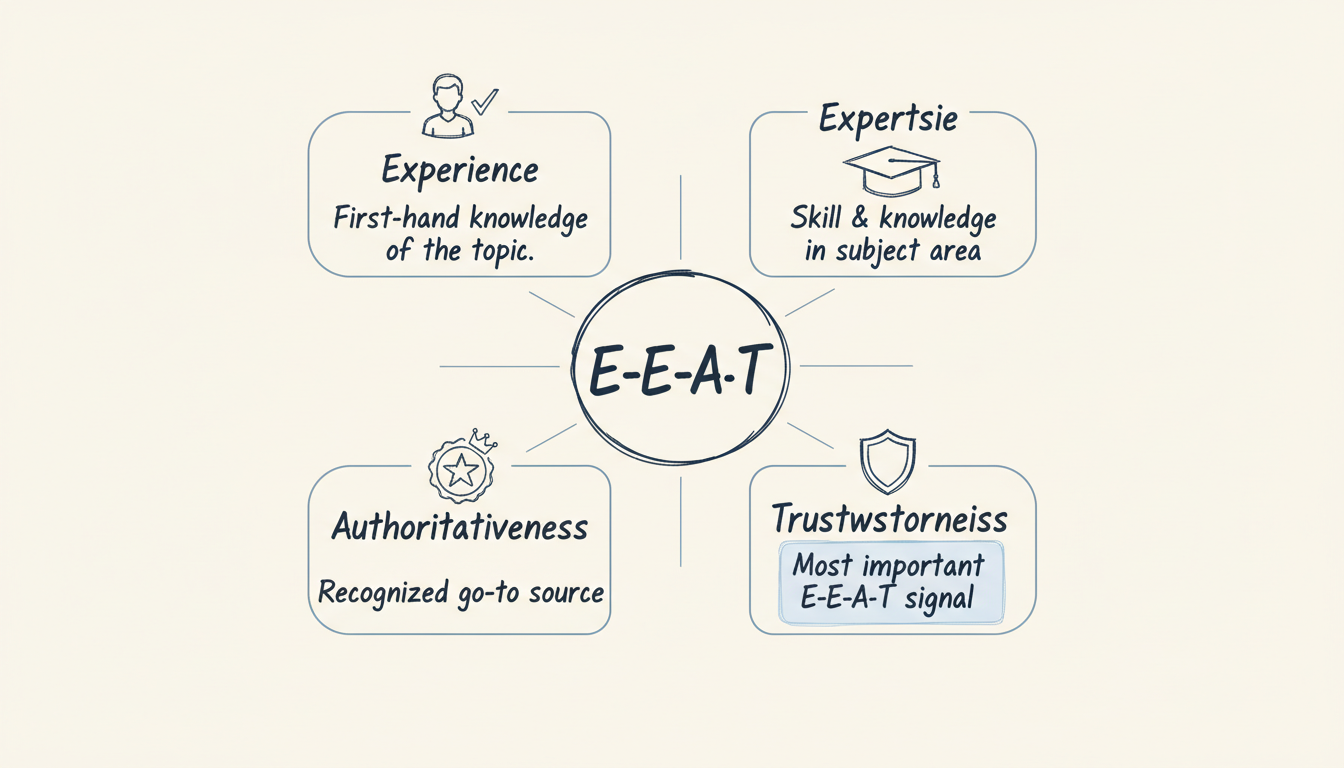
"Trust is the most important member of the E-E-A-T family." — Google Search Quality Rater Guidelines
Google states that E-E-A-T applies to all content but is particularly important for "Your Money or Your Life" (YMYL) topics including health, finance, safety, and civic information.
Helpful Content System
Google's Helpful Content System, documented in Search Central, directly impacts AI Overview eligibility.
Official helpful content criteria:
Google's documentation specifies content should:
- Be created for people first - Not primarily for search engine ranking
- Demonstrate first-hand expertise - Actual knowledge, not just keyword inclusion
- Have a primary purpose or focus - Clear site-level topical focus
- Leave readers satisfied - Feeling they've learned enough about a topic
- Deliver what the title promises - No clickbait or misleading headlines
Content that Google officially discourages:
- Content produced mainly for search engines
- Content that summarizes others without adding value
- Content on topics simply because they seem trending
- Content that makes readers feel they need to search again
- Content written to word counts rather than quality
"Create content primarily for people, not to rank in search engines." — Google Helpful Content Guidelines
This connects directly to AEO strategy and SEO best practices that prioritize user intent over keyword stuffing.
YMYL Content Standards
Google maintains elevated standards for YMYL (Your Money or Your Life) content in AI Overviews.
Google's official YMYL categories:
Category | Examples | Standard |
Health and safety | Medical, drug, mental health information | Highest scrutiny |
Financial information | Financial advice, investment, taxes | Expert sources prioritized |
Civic information | Voting, government, legal information | Verified official sources |
News and current events | Breaking news, public interest topics | Journalistic standards |
Groups of people | Information about protected groups | Factual, respectful content |
For YMYL topics, Google officially states that expertise and authoritativeness carry additional weight in AI Overview source selection.
Technical Requirements from Google Documentation
Google provides specific technical guidance for ensuring content is accessible to AI systems. Following these standards is fundamental for generative engine optimization strategies.
Structured Data Guidelines
Google's official structured data documentation specifies requirements for AI feature eligibility.
Google-endorsed schema types:
Schema Type | Official Status | Documentation Location |
Article | Fully supported | developers.google.com/search/docs/appearance/structured-data/article |
FAQPage | Fully supported | developers.google.com/search/docs/appearance/structured-data/faqpage |
HowTo | Fully supported | developers.google.com/search/docs/appearance/structured-data/how-to |
Product | Fully supported | developers.google.com/search/docs/appearance/structured-data/product |
Review | Fully supported | developers.google.com/search/docs/appearance/structured-data/review |
Official implementation requirements:
Google's documentation specifies:
- Use JSON-LD format (recommended by Google)
- Include all required properties for each type
- Ensure structured data matches visible page content
- Avoid marking up hidden or invisible content
- Follow the specific guidelines for each schema type
Implementing schema correctly supports what is knowledge graph SEO objectives by helping Google understand entity relationships.
Crawling and Indexing Requirements
Google's official documentation on crawling applies to AI Overview eligibility.
Official technical requirements:
Requirement | Google's Documentation |
Googlebot access | Allow Googlebot in robots.txt |
Page indexability | No noindex directive on eligible pages |
Mobile-friendliness | Pages must be mobile-friendly |
Page experience | Core Web Vitals and security (HTTPS) |
Content accessibility | Text content accessible without JavaScript barriers |
Google's robots.txt guidance for AI:
Google has documented that Googlebot crawls content for AI features. Sites blocking Googlebot also block AI Overview eligibility. Google-Extended is a separate control specifically for AI training, not AI Overview inclusion.
# Google's documented user-agents
User-agent: Googlebot
Allow: /

# Separate AI training control (does not affect AI Overviews)
User-agent: Google-Extended
Disallow: / (if opting out of training data)
Opt-Out and Visibility Controls for AI Overviews
Google provides preview controls that affect whether your content appears in AI Overviews. These are the same directives used for traditional search snippets, and they apply to AI Overviews and AI Mode as well.
Available controls:
Directive | Effect on AI Overviews | Trade-Off |
nosnippet (meta robots) | Blocks content from AI Overviews entirely | Also removes traditional search snippets |
data-nosnippet (HTML attribute) | Excludes specific page sections from AI Overviews | Granular control; rest of page remains eligible |
max-snippet (meta robots) | Limits snippet character length used in AI Overviews | Also limits traditional snippet length |
Troubleshooting preview controls begins with checking which directives are active on your page and verifying they work as expected using the Rich Results Test.
A key limitation: Google does not currently offer a way to opt out of AI Overviews specifically while maintaining full traditional snippet visibility. Google has indicated it is exploring dedicated controls for AI search features, but no timeline has been confirmed. For most publishers seeking AI Overview visibility, these controls are primarily useful for excluding sensitive sections rather than opting out entirely.
Google's official Page Experience documentation affects AI Overview eligibility.
Core Web Vitals thresholds (official):
Metric | Good | Needs Improvement | Poor |
LCP (Largest Contentful Paint) | ≤2.5s | 2.5s-4s | >4s |
INP (Interaction to Next Paint) | ≤200ms | 200ms-500ms | >500ms |
CLS (Cumulative Layout Shift) | ≤0.1 | 0.1-0.25 | >0.25 |
Google states that page experience signals are among many factors considered but are not the sole determinant of AI Overview inclusion.
Google'S Content Format Guidance
Official Google documentation provides guidance on content formatting that AI systems can effectively process. These principles directly support featured snippet optimization AI efforts.
Clear Content Structure
Google's helpful content guidelines emphasize structural clarity.
Officially recommended practices:
- Use descriptive headings - Headings should summarize section content
- Lead with key information - Important points early in sections
- Use lists appropriately - For items that benefit from list format
- Include supporting details - Context that helps readers understand fully
- Cite sources when appropriate - Especially for factual claims
Answering Questions Directly
Google's documentation on featured snippets (which preceded AI Overviews) emphasizes direct answers.
Google's guidance on question-answering content:
- Answer the question clearly near the beginning
- Provide supporting context and detail
- Use formatting that helps readers scan
- Include the question being answered (via heading or otherwise)
- Ensure accuracy and currency of information
This approach complements strategies for long-tail keywords for featured snippet success by providing comprehensive yet focused answers.
Factual Accuracy Requirements
Google has emphasized factual accuracy across multiple official communications.
Official position on accuracy:
- AI Overviews prioritize corroborated information
- Multiple reliable sources strengthen inclusion likelihood
- Factual claims should be verifiable
- Content should be updated when information changes
- Misinformation may result in reduced visibility
Understanding AI overview citation analysis can help content creators identify patterns in source selection.
Google'S Official Testing and Validation Tools
Google provides official tools for validating content alignment with their guidelines. These tools are critical for implementing an effective AEO implementation roadmap.
Search Console Reports
Google Search Console provides official data on search performance.
Relevant reports for AI Overview optimization:
Report | Purpose | Access |
Search results | Traffic and impression data | Search Console → Performance |
Page experience | Core Web Vitals assessment | Search Console → Experience |
Enhancements | Structured data validation | Search Console → Enhancements |
Indexing | Crawling and indexing status | Search Console → Indexing |
Tracking AI Overview Visibility
Search Console does not report AI Overview appearances directly, so third-party tools like Ahrefs, Semrush, and Botify are needed to track AI Overview citation visibility.
Measuring the performance of your site in AI search requires combining Search Console data with third-party tools. A notable limitation of Google Search Console is that it does not provide separate reporting for AI Overview appearances. There is no way to see which of your queries triggered AI Overviews or whether your content was cited within them directly through Search Console.
Third-party tools such as Ahrefs, Semrush, and Botify have built AI Overview tracking features that monitor which keywords trigger AI Overviews and whether your domain appears as a cited source. These tools fill the reporting gap that Search Console currently leaves open.
Understanding AI Overview trigger patterns helps inform content strategy: AI Overviews primarily appear for informational queries, complex multi-faceted questions, and topics where synthesized answers add value. Research indicates that pages generally need to rank within the top 35 organic positions to be eligible for citation in an AI Overview.
Rich Results Test
Google's Rich Results Test validates structured data implementation.
Official testing process:
- Enter page URL at search.google.com/test/rich-results
- Review detected structured data
- Check for errors and warnings
- Verify eligibility for rich result types
Pagespeed Insights
Google's PageSpeed Insights provides Core Web Vitals assessment.
Testing for AI Overview readiness:
- Enter URL at pagespeed.web.dev
- Review Core Web Vitals scores
- Check both mobile and desktop results
- Address issues flagged as "needs improvement" or "poor"
Google'S Official Communications Channels
Stay informed through Google's official information sources.
Primary Documentation Sources
Google publishes AI Overview guidance across these primary channels, each serving a distinct purpose for webmasters and developers.
Source | Content Type | URL Pattern |
Google Search Central Blog | Announcements, guidance | developers.google.com/search/blog |
Search Central Help | Documentation | support.google.com/webmasters |
Structured Data Docs | Technical specs | developers.google.com/search/docs/appearance/structured-data |
Search Quality Guidelines | Rater guidelines (public) | Published PDF from Google |
Official Representatives
Google communicates AI Overview updates through:
- Search Central blog posts (official announcements)
- Google Search Liaison (social media communications)
- Search Central Live events (video content)
- I/O developer conferences (feature announcements)
Compliance vs. Optimization
This Google AI Overviews official platform guide examines Google's official position on AI Overview optimization.
What Google Endorses
Google's official guidance focuses on quality fundamentals.
Officially supported practices:
Practice | Google's Position | Documentation |
Creating helpful content | Explicitly encouraged | Helpful Content documentation |
Demonstrating expertise | Core quality signal | E-E-A-T guidelines |
Implementing structured data | Officially supported | Schema.org documentation |
Ensuring accessibility | Required | Page Experience documentation |
Maintaining accuracy | Expected | Quality Guidelines |
Many AEO tools focus on measuring these officially supported signals rather than attempting to reverse-engineer Google's algorithms.
What Google Does Not Endorse
Google has not officially endorsed "AI Overview optimization" as a separate discipline.
Google's implicit guidance:
- No specific "AI Overview" optimization guidelines exist
- Helpful content guidelines apply to all search features
- Gaming behavior risks penalties (per spam policies)
- Focus on users, not specific result types
This means that Google's official position is that the best approach to AI Overview visibility is following existing quality guidelines rather than attempting to reverse-engineer AI Overview selection. Understanding what is AEO in marketing helps contextualize these practices within broader digital strategies.
Impact on Organic Click-Through Rates
AI Overviews reduce organic CTR by 34.5-61% for affected queries, but pages cited within AI Overviews earn approximately 35% more clicks than non-cited competitors.
While Google's official position focuses on helpfulness, independent research has documented significant changes in click-through behavior since AI Overviews launched. Multiple studies show that when AI Overviews appear, organic CTR drops between 34.5% and 61%, depending on the query type and study methodology. Searches triggering AI Overviews now show an average zero-click rate of approximately 83%, compared to around 60% for traditional queries without AI Overviews.
However, there is an important counterpoint for content creators pursuing AI Overview visibility: research indicates that brands cited within AI Overviews earn approximately 35% more organic clicks compared to those not cited. This suggests that while AI Overviews reduce total clicks to traditional results, being cited as a source within an AI Overview can actually increase a page's relative traffic share.
Google's information gain signal also plays a role here. Content that provides original data, unique research findings, or first-hand experience is more likely to be selected as a source—aligning with E-E-A-T principles. AI Overviews currently appear in approximately 13-19% of all Google searches, with this percentage growing as the feature expands to more query types and international markets.
Advertising Within AI Overviews
Google has introduced advertising placements within AI Overviews. Ads can appear above, below, or inline within the AI-generated summary. Both text ads and shopping ads from existing Google Search, Shopping, and Performance Max campaigns are eligible for these placements—no separate campaign setup is required.
As of late 2025, approximately 40% of AI Overview results include advertising, up significantly from around 3% at the start of 2025. Google is also testing ad placements within AI Mode. For advertisers, this means existing well-structured campaigns with proper product feeds and Performance Max configurations are automatically eligible for AI Overview ad placements.
Implementation Framework Based on Official Guidance
This Google AI Overviews official platform guide helps you translate Google's official documentation into actionable steps.
Audit Against Official Standards
Review your content against Google's documented criteria:
Area | Official Requirement | Audit Question |
Helpfulness | People-first content | Does this help users accomplish their goal? |
Expertise | Demonstrated knowledge | Does content show genuine expertise? |
Accuracy | Factual information | Are claims accurate and verifiable? |
Accessibility | Technical access | Can Googlebot access and parse this content? |
Experience | Page experience signals | Do Core Web Vitals meet thresholds? |
For organizations considering external help, evaluating enterprise AEO services or weighing in-house vs agency AI search approaches can accelerate implementation.
Prioritize Based on Google'S Emphasis
Google's stated priorities (from documentation weight):
- Helpful, reliable content - Most emphasized in all documentation
- E-E-A-T demonstration - Central to quality guidelines
- Technical accessibility - Baseline requirement
- Structured data - Explicitly supported enhancement
- Page experience - Stated factor among many
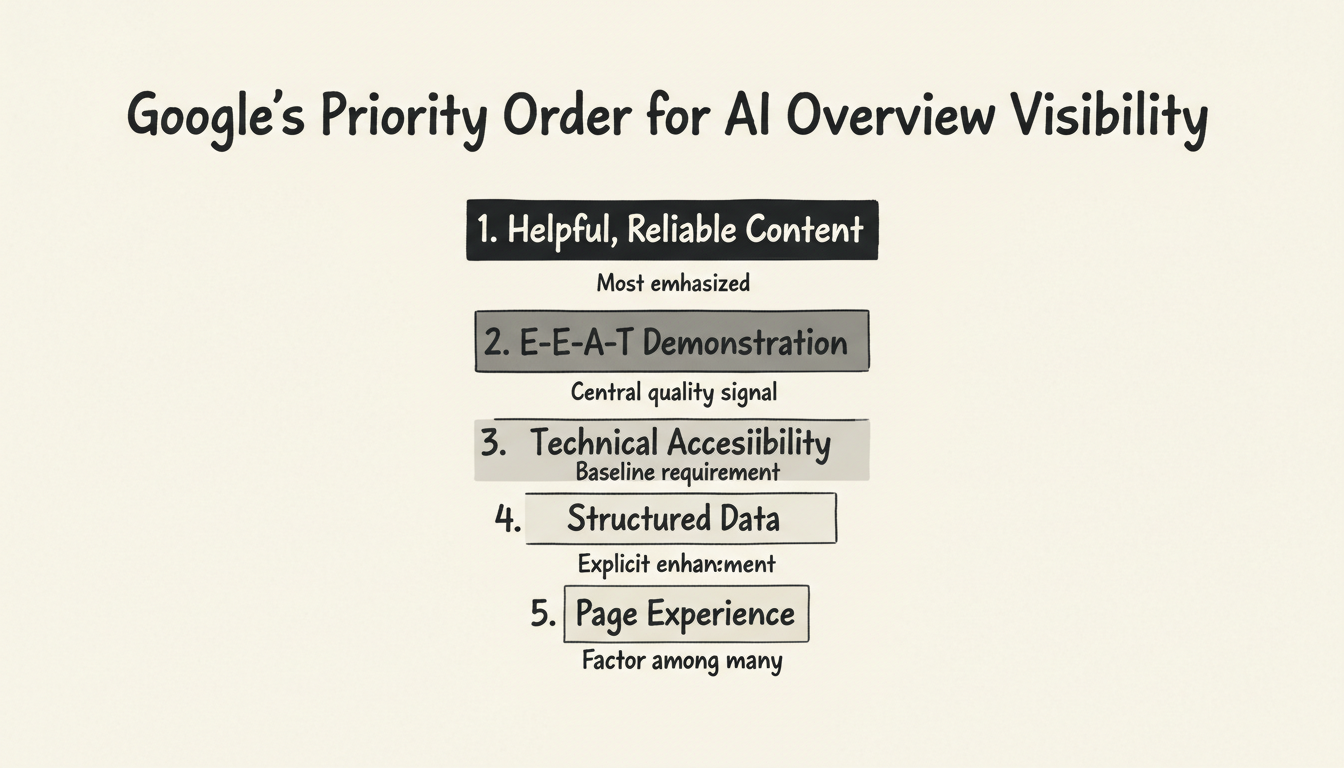
Examining AEO success stories case studies reveals how organizations prioritize these elements effectively.
Monitor Official Updates
Google's AI features continue evolving. Official sources provide the most accurate information on changes.
Monitoring cadence:
- Search Central Blog: Check weekly
- Search Console: Review monthly
- Quality Guidelines: Review when updated
- I/O conferences: Watch for annual announcements
Frequently Asked Questions
These answers address common questions about how Google AI Overviews work, opt-out options, AI Mode differences, and ad placements.
What Is the RAG Mechanism Behind Google AI Overviews?
AI Overviews use Retrieval-Augmented Generation (RAG) powered by Gemini to retrieve real-time web content and synthesize cited answers. The grounding process ensures responses reference real source pages rather than relying solely on training data.
How Do I Opt Out of Google AI Overviews?
Use the nosnippet meta robots directive to block content from AI Overviews, though this also removes traditional snippets. The data-nosnippet HTML attribute excludes specific sections while keeping the rest eligible. Google is exploring dedicated AI-specific opt-out controls.
What Is Google AI Mode and How Does It Differ from AI Overviews?
AI Mode is an opt-in conversational search experience powered by Gemini 2.0, distinct from automatic AI Overviews. It supports follow-up questions, uses query fan-out across multiple sources, and is available in 180+ countries as of early 2026.
Do Ads Appear in Google AI Overviews?
Yes. Google shows text ads and shopping ads within, above, or below AI Overviews. These ads come from existing Google Search, Shopping, and Performance Max campaigns—no separate setup is required. As of late 2025, approximately 40% of AI Overview results include advertising.
Key Takeaways: Google'S Official Position
This Google AI Overviews official platform guide provides the foundation for your strategy. Base your AI Overview approach on Google's documented guidance:
- Helpful content comes first - Google's most consistent message across all documentation
- E-E-A-T matters for visibility - Especially for YMYL topics requiring expertise and trust
- Technical fundamentals remain essential - Crawlability, indexability, page experience
- Structured data supports understanding - Use Google-endorsed schema types correctly
- No gaming approach endorsed - Google explicitly discourages optimization for specific result types
- Official sources provide truth - Check Google's documentation, not speculation
- RAG and Gemini 2.0 power the system - Understanding how AI Overviews retrieve and synthesize content helps inform content strategy
- AI Mode extends conversational search - Opt-in, deeper AI search complements automatic AI Overviews
- Citation drives relative traffic gains - Being cited in AI Overviews can increase your traffic share even as total clicks decline
Google's official guidance essentially states: create genuinely helpful content demonstrating real expertise, ensure technical accessibility, and focus on serving users rather than optimizing for specific search features.
Following Google's documented standards provides the most sustainable path to AI Overview visibility—because those standards reflect what Google's systems are designed to surface. Return to this Google AI Overviews official platform guide whenever Google updates its AI search policies.