
Google AI Overviews have fundamentally reshaped search. These AI-generated summaries now appear for over 47% of search queries, synthesizing information from multiple sources and presenting it directly in search results. For businesses, earning citations in AI Overviews has become the new position zero—visible before traditional organic results and commanding attention that determines whether users click through or move on.
This playbook provides the complete strategy for optimizing your content for AI Overview visibility in 2026.
Understanding AI Overviews: The New Search Reality
AI Overviews represent Google's largest transformation since PageRank. Rather than simply listing websites, Google now reads, synthesizes, and summarizes content to answer queries directly.
How AI Overviews Work
Google's AI Overviews operate through a multi-step process:
- Query interpretation: Understanding user intent beyond keywords
- Source identification: Selecting authoritative pages to cite
- Content synthesis: Combining information from multiple sources
- Answer generation: Creating a comprehensive summary
- Citation attribution: Linking to source pages
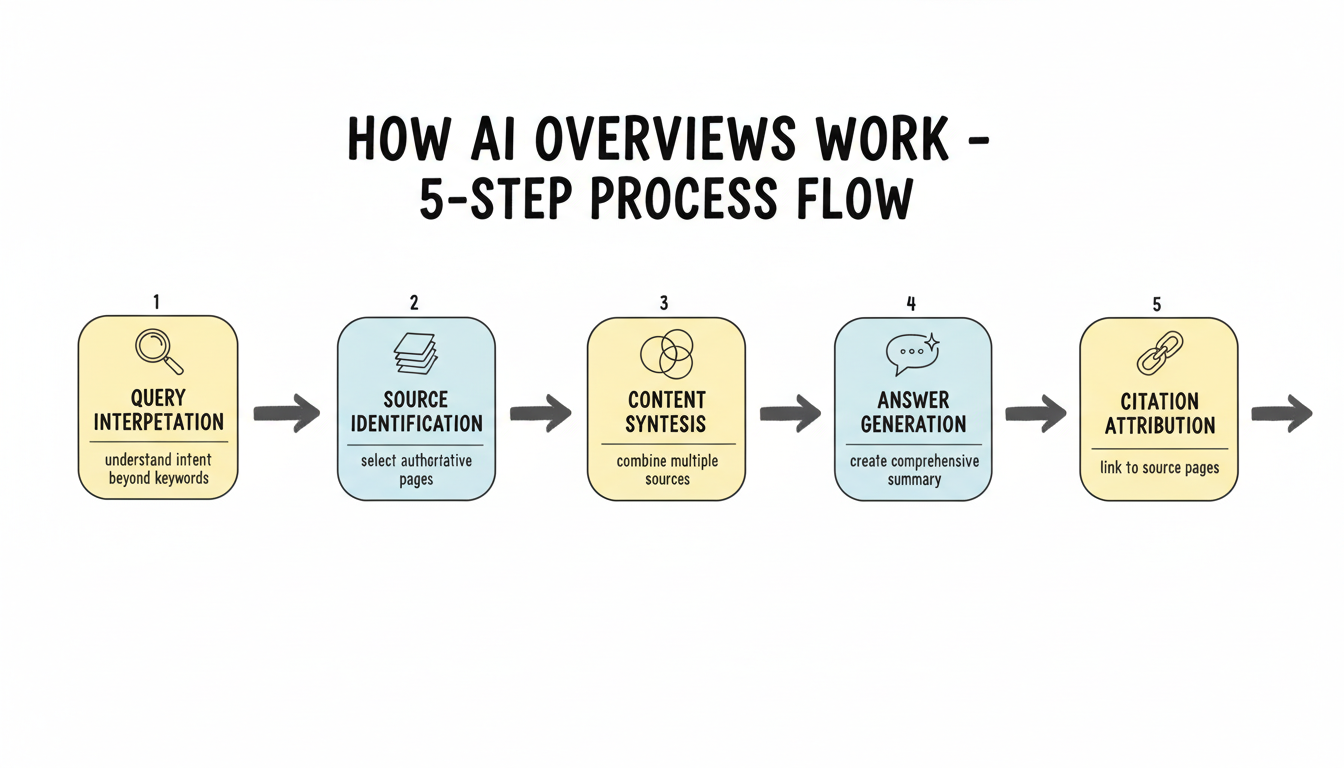
The AI doesn't copy content—it understands and reframes it. This means optimization requires helping AI comprehend your content, not just matching keywords. When implementing changes, consider working with aeo-implementation-services to ensure your strategy aligns with current best practices.
The Citation Opportunity
Research from Princeton and Georgia Tech reveals the stakes:
Content Type | Average Visibility Score |
Unoptimized content | 19.3 |
Optimized content | 40+ |
Top-performing content | 60+ |
Optimized content achieves more than double the visibility of unoptimized alternatives. This isn't marginal improvement—it's the difference between visibility and invisibility.
AI Overviews vs. Featured Snippets
Aspect | Featured Snippets | AI Overviews |
Source count | Single source | Multiple sources synthesized |
Content display | Extracted verbatim | AI-generated summary |
User experience | Direct answer | Conversational response |
Click behavior | May satisfy or drive click | Drives exploration |
Optimization approach | Answer box targeting | Comprehensive authority |
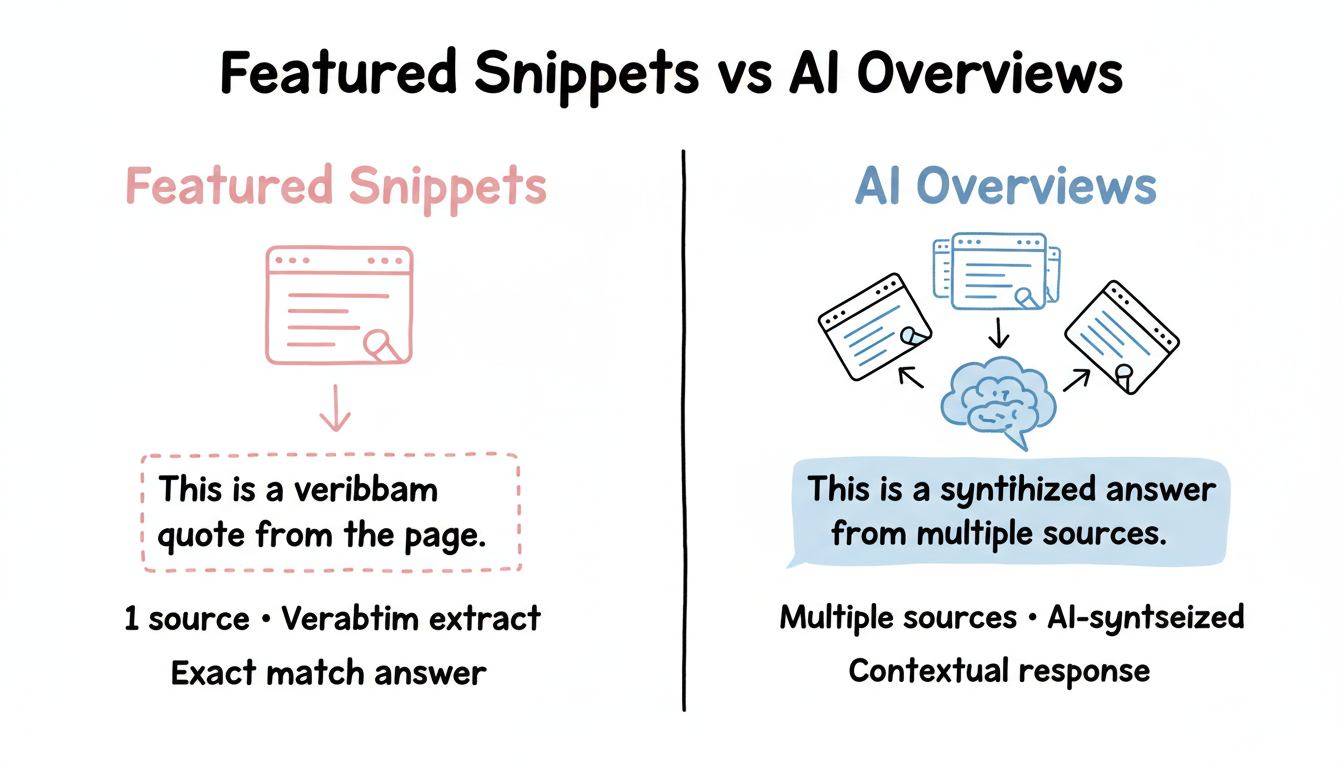
Understanding this distinction matters: AI Overviews don't extract your text—they understand and reframe it. Your optimization strategy must account for this fundamental difference. To understand how this fits within the broader search landscape, explore the differences between aeo-vs-seo-vs-geo.
The Foundation: Organic Rankings Still Matter
Before diving into AI-specific optimization, acknowledge the foundation: 80% of AI Overview citations come from pages ranking in the top 10 organic positions, with the majority from the top 3.
Why Rankings Predict Citations
Google's AI trusts the same signals that determine organic rankings:
Ranking Signal | AI Relevance |
Topical authority | Demonstrates expertise Google's AI can trust |
Page authority | Indicates content quality and reliability |
User engagement | Signals content satisfies searcher intent |
Technical performance | Ensures content is accessible and parseable |
E-E-A-T signals | Establishes credibility for citation |
If you're not ranking organically, AI Overview optimization alone won't save you. Strengthen your traditional SEO foundation first.
The Ranking-Citation Relationship
Organic Position | Citation Probability |
Position 1-3 | High (60%+ of citations) |
Position 4-10 | Moderate (30% of citations) |
Position 11-20 | Low (10% of citations) |
Beyond page 1 | Rare |
Your first priority: achieve organic rankings. Then optimize specifically for AI citation. Understanding the relationship between traditional search visibility and AI citation requires a comprehensive view of seo-vs-geo-vs-aeo strategies.
Content Structure for AI Comprehension
AI systems process content differently than humans. Optimizing structure helps AI understand, extract, and cite your information.
The Inverted Pyramid: Front-Load Your Answers
AI Overviews favor content that provides direct answers quickly. Structure content like journalism:
Optimal structure:
- Direct answer (first paragraph): Answer the query immediately
- Supporting context (next section): Expand with essential details
- Comprehensive coverage (body): Provide depth and nuance
- Additional resources (end): Offer related information
Example for "What is AI Overview optimization?":
AI Overview optimization is the practice of structuring content to maximize citations in Google's AI-generated search summaries. It combines traditional SEO fundamentals with specific techniques that help AI systems understand, trust, and reference your content when generating responses to user queries.
[Supporting sections follow with detailed techniques, examples, and implementation guidance]
Content Elements AI Prefers
Research reveals specific content patterns that earn citations:
Element | Why AI Prefers It |
Definitions | Clear, quotable explanations |
Step-by-step guides | Structured, actionable information |
Comparison tables | Organized, scannable data |
Bulleted lists | Digestible information chunks |
FAQ sections | Question-answer pairs ready for extraction |
Statistics with sources | Verifiable claims with attribution |
Leveraging answer-engine-optimization-tools can help identify which content elements are performing best for your target queries.
Optimal Content Length
Different query types require different depths:
Query Type | Recommended Length | AI Overview Behavior |
Definitional | 1,200-1,500 words | Extracts concise definitions |
How-to | 1,800-2,500 words | Synthesizes steps and tips |
Comparison | 2,000-3,000 words | Pulls structured comparisons |
Comprehensive guide | 3,000-4,000 words | References across sections |
Longer isn't always better. Match depth to query complexity.
Formatting for AI Parsing
Structure content so AI can navigate it efficiently:
Headers and hierarchy:
- Use H2 for major topics, H3 for subtopics
- Make headers descriptive and keyword-relevant
- Ensure logical flow from section to section
Paragraphs:
- Keep paragraphs to 2-4 sentences
- One idea per paragraph
- Lead with the key point
Lists and tables:
- Use tables for comparisons
- Use numbered lists for sequences
- Use bullets for non-sequential items
Emphasis:
- Bold key terms and definitions
- Use formatting to highlight important points
- Don't overuse—emphasis loses meaning when everything is emphasized
Schema Markup: The Technical Foundation
Schema markup provides explicit signals about your content's meaning and structure. For AI Overviews, it's increasingly essential. Implementing proper schema is a core component of technical-aeo-optimization.
Priority Schema Types
Schema Type | Best For | AI Benefit |
Article | Blog posts, guides | Content type identification |
FAQPage | FAQ sections | Direct Q&A extraction |
HowTo | Instructional content | Step extraction |
Organization | About pages | Entity establishment |
Person | Author pages | E-E-A-T signals |
Product | Product pages | Commercial query matching |
Implementation Examples
Article schema:
{
  "@context": "https://schema.org",
  "@type": "Article",
  "headline": "Google AI Overviews Optimization Guide",
  "author": {
    "@type": "Person",
    "name": "Author Name",
    "url": "https://yoursite.com/author/name"
  },
  "datePublished": "2026-01-13",
  "dateModified": "2026-01-13",
  "publisher": {
    "@type": "Organization",
    "name": "Your Company",
    "logo": {
      "@type": "ImageObject",
      "url": "https://yoursite.com/logo.png"
    }
  }
}
FAQPage schema:
{
  "@context": "https://schema.org",
  "@type": "FAQPage",
  "mainEntity": [{
    "@type": "Question",
    "name": "How do I optimize for AI Overviews?",
    "acceptedAnswer": {
      "@type": "Answer",
      "text": "Optimize for AI Overviews by structuring content clearly, implementing schema markup, building topical authority, and ensuring technical SEO excellence."
    }
  }]
}
For structured how-to content, understanding howto-schema-ai-search implementation can significantly improve your citation potential.
Schema Implementation Best Practices
Practice | Why It Matters |
Use JSON-LD format | Google's preferred format |
Include all recommended properties | More complete signals |
Validate before deployment | Catch errors that prevent parsing |
Keep schema accurate | Misleading schema damages trust |
Update dateModified | Freshness signals matter |
Many organizations benefit from optimizing-faq-schema-google-ai-overviews as a quick win for increasing citations.
E-E-A-T: The Trust Foundation
Experience, Expertise, Authoritativeness, and Trustworthiness determine whether Google's AI considers your content citation-worthy.
Building E-E-A-T Signals
Experience indicators:
- First-hand case studies
- Original research and data
- Practical implementation examples
- Real screenshots and evidence
Expertise signals:
- Author credentials and bios
- Detailed technical accuracy
- Industry-specific terminology used correctly
- Depth that demonstrates understanding
Authority markers:
- Authoritative citations and references
- Industry recognition and awards
- Published thought leadership
- Backlinks from respected sources
Trust elements:
- Transparent authorship
- Clear contact information
- Privacy policy and terms
- Secure site (HTTPS)
- Accurate, verifiable claims
Author Optimization
Individual author signals increasingly matter:
Element | Implementation |
Author pages | Dedicated pages with credentials, experience, published work |
Author schema | Person schema with sameAs links to profiles |
Bylines | Clear attribution on every article |
Author consistency | Same author for related content clusters |
External profiles | LinkedIn, industry publications, speaking engagements |
Citation and Reference Strategy
How you cite others affects how AI perceives you:
Best practices:
- Cite primary sources when possible
- Reference authoritative institutions
- Link to supporting data and research
- Attribute quotes and statistics properly
- Update references when sources change
Technical SEO for AI Overviews
Technical excellence ensures your content is accessible and parseable by AI systems.
Core Web Vitals Requirements
Google's December 2025 update elevated Core Web Vitals from ranking factor to ranking threshold:
Metric | Target | Impact |
LCP | Under 2.5 seconds | Pages filtered if failing |
INP | Under 200 milliseconds | Interactivity now critical |
CLS | Under 0.1 | Visual stability required |
Sites failing Core Web Vitals are filtered before AI citation consideration.
Crawlability Essentials
Element | Requirement |
Robots.txt | Allow AI crawler access to valuable content |
Canonical tags | Prevent duplicate content confusion |
XML sitemap | Include all citation-worthy pages |
Server response | TTFB under 600ms |
Render method | SSR preferred over client-side rendering |
Mobile-First Considerations
With mobile-first indexing standard:
- Responsive design (not separate mobile site)
- Touch targets minimum 48x48 pixels
- Readable text without zooming
- Fast mobile page speed
- No intrusive interstitials
For comprehensive guidance on adapting your strategy for mobile devices, see our guide on mobile-aeo-optimization.
Emerging Technical Standards
New in 2026:
llms.txt files: Emerging standard for guiding AI crawlers to important content.
MCP server protocols: Help AI systems understand site structure and priorities.
While not yet mandatory, early adopters may gain advantage as these standards mature.
Content Freshness and Updates
AI Overviews favor recent, maintained content. Monitoring google-ai-overview-update-frequency helps you time your content updates strategically.
Freshness Signals That Matter
Signal | Implementation |
dateModified | Update schema when content changes |
Last updated | Display date clearly on page |
Recent information | Include 2025-2026 data and examples |
Active maintenance | Regular review and updates |
Current screenshots | Recent UI and interface images |
Update Strategy
Content Type | Update Frequency |
News/trends content | Monthly or more |
How-to guides | Quarterly |
Evergreen fundamentals | Semi-annually |
Product comparisons | When products change |
Statistics and data | When new data available |
Balancing Freshness and Authority
Updated content earns freshness signals, but constant changes can disrupt ranking authority. Balance by:
- Making substantive updates, not cosmetic changes
- Preserving URL structure when updating
- Maintaining internal link equity
- Keeping historical content accessible when relevant
Measuring AI Overview Performance
Track progress with appropriate metrics. Before investing in tools, compare free-vs-paid-aeo-tools to determine which level of monitoring your strategy requires.
Key Performance Indicators
Metric | What It Shows | How to Track |
AI Overview appearances | Raw visibility | Search Console AI Mode filter |
Citation frequency | How often you're cited | Manual search sampling |
Citation position | Where in AI Overview you appear | Manual observation |
Click-through rate | Traffic from citations | Analytics with AI referrer tracking |
Competitive share | Your visibility vs. competitors | AEO tracking tools |
Implementing competitive-ai-search-benchmarking helps you understand how your performance compares to industry standards.
Tracking Tools
Tool | Capability |
Google Search Console | AI Mode filter (new in 2025) |
Semrush AI Toolkit | Competitive tracking |
Otterly.AI | Multi-platform visibility |
SE Visible | Citation analysis |
Manual sampling | Direct observation |
Attribution Challenges
AI Overview attribution remains imperfect:
- Not all citations are clickable
- Some users read without clicking
- AI may synthesize without explicit citation
- Multi-source answers fragment attribution
Accept that measurement will be approximate. Focus on trends rather than absolute numbers.
Implementation Roadmap
Follow this phased approach. Organizations planning major optimization initiatives should review our ai-search-optimization-timeline-roadmap for realistic expectations about timing and resource allocation.
Phase 1: Foundation (Weeks 1-4)
Priority actions:
- Audit current organic rankings for target queries
- Assess Core Web Vitals and fix critical issues
- Implement basic schema markup (Article, Organization)
- Establish author pages with Person schema
- Review and improve E-E-A-T signals
Success criteria: Core technical requirements met, baseline rankings established
Consider engaging aeo-audit-services to identify gaps before beginning your optimization work.
Phase 2: Content Optimization (Weeks 5-8)
Priority actions:
- Restructure top content with inverted pyramid
- Add FAQ sections with schema to key pages
- Create tables, lists, and structured elements
- Front-load answers in opening paragraphs
- Update dateModified and freshness signals
Success criteria: Top 10 pages restructured for AI comprehension
Phase 3: Authority Building (Weeks 9-12)
Priority actions:
- Develop content clusters around priority topics
- Build internal linking between related content
- Pursue relevant backlinks and citations
- Create original research or data
- Establish thought leadership content
Success criteria: Topical authority demonstrable in target areas
Phase 4: Monitoring and Refinement (Ongoing)
Priority actions:
- Track AI Overview appearances weekly
- Monitor competitor citation patterns
- Update content based on performance
- Test new optimization techniques
- Adapt to Google's algorithm updates
Success criteria: Improving citation frequency over time
Common Optimization Mistakes
Mistake | Problem | Solution |
Ignoring organic rankings | No foundation for citation | Strengthen traditional SEO first |
Keyword stuffing | Degrades AI comprehension | Write naturally for understanding |
Thin content | Insufficient depth for citation | Provide comprehensive coverage |
Missing schema | Reduced AI signals | Implement relevant schema types |
Outdated information | Freshness penalty | Regular content updates |
Poor mobile experience | Filtered from consideration | Mobile-first optimization |
No author attribution | Weak E-E-A-T signals | Clear authorship with credentials |
FAQs
How Long Does It Take to Appear in AI Overviews?
Results vary based on starting position. Sites already ranking organically may see AI Overview citations within 4-8 weeks of optimization. Sites without ranking foundation need 3-6 months to build organic visibility first, then additional time for AI citation optimization to take effect.
Can Small Businesses Compete for AI Overview Citations?
Yes, especially for niche and long-tail queries. Large brands dominate broad queries, but small businesses with deep expertise in specific topics can earn citations by providing the most comprehensive, authoritative content on focused subjects.
Does AI Overview Optimization Replace Traditional SEO?
No—it builds upon it. Traditional SEO establishes the ranking foundation that makes AI citation possible. AI Overview optimization adds specific techniques for earning citations once organic visibility exists. You need both. For a detailed comparison, see our analysis of seo-aeo-geo-comparison.
How Do AI Overviews Affect Website Traffic?
Impact varies by query type. Informational queries may see reduced clicks as AI satisfies the query directly. However, complex queries often drive exploration, and AI citations establish credibility that influences later conversions. Track full user journey, not just immediate clicks.
Should I Create Content Specifically for AI Overviews?
Create content that serves users comprehensively—this naturally aligns with AI citation criteria. Don't create thin content targeting AI extraction. Instead, apply AI optimization principles to substantive content that demonstrates genuine expertise.