
Google Knowledge Panels provide prominent brand visibility in search results, displaying key information about businesses, people, and organizations. When Knowledge Panel errors occur, they can misrepresent your brand, display incorrect information, or disappear entirely - undermining your entity authority and AI search visibility.
This guide covers the most common Knowledge Panel errors and proven fixes to restore accurate brand representation in Google search.
Understanding Knowledge Panel Errors
Knowledge Panels are auto-generated by Google's systems based on information gathered from across the web. Unlike Google Business Profiles, you don't directly control Knowledge Panel content - which makes errors particularly challenging to address.
Why Knowledge Panel Errors Matter
Knowledge Panel accuracy affects more than traditional search:
- Brand perception: Incorrect information misleads potential customers
- AI citations: AI systems reference Knowledge Graph data for answers
- Entity recognition: Errors can weaken your entity authority signals
- Competitive position: Competitors with accurate panels gain advantage
Common Error Categories
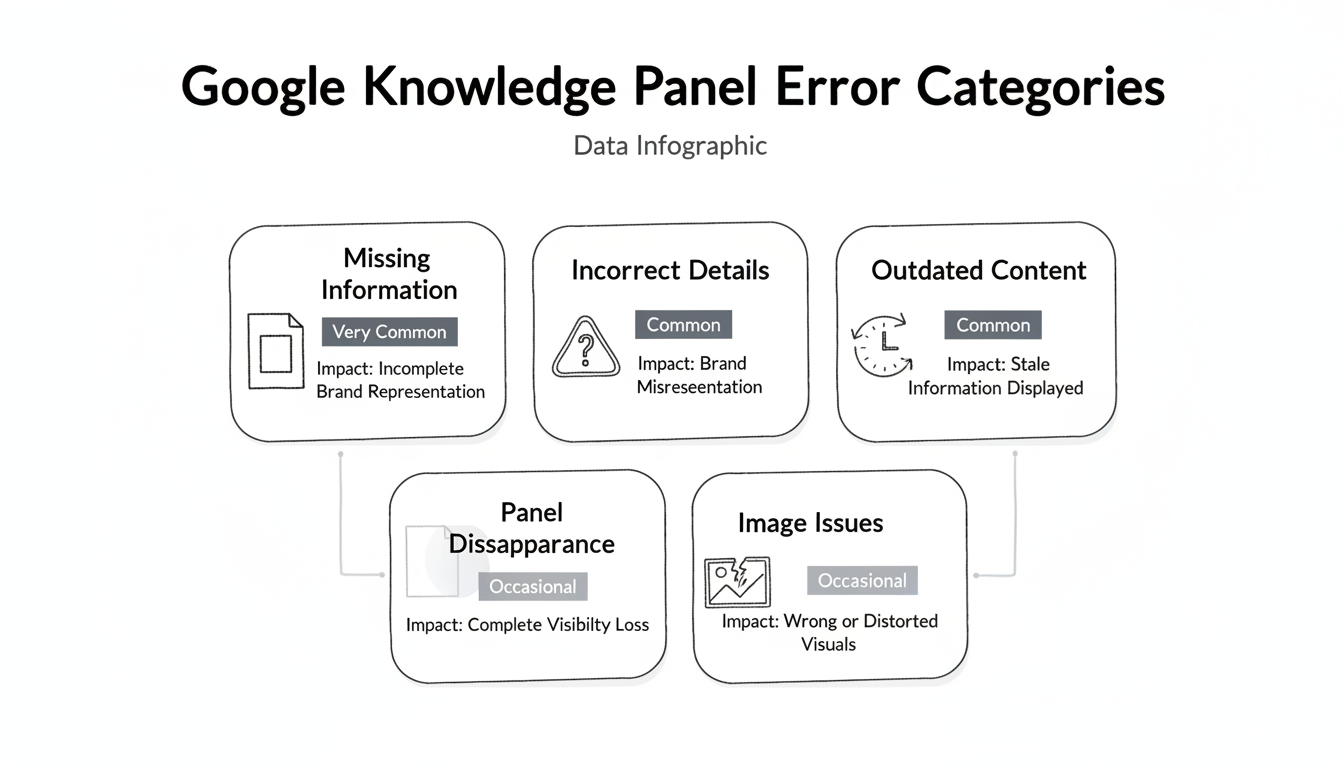
Error Type | Frequency | Impact |
Missing information | Very common | Incomplete brand representation |
Incorrect details | Common | Brand misrepresentation |
Outdated content | Common | Stale information displayed |
Panel disappearance | Occasional | Complete visibility loss |
Image issues | Occasional | Wrong or distorted visuals |
Most Common Knowledge Panel Errors
1. Schema Markup Mismatches
Schema markup tells Google about your entity, but mismatches between schema and page content cause errors.
Common issues:
- Organization name in schema differs from displayed name
- Address information inconsistent with page content
- Schema claiming expertise areas not covered in content
Fix approach:
- Audit all schema markup on your site
- Ensure schema values match visible page content exactly
- Remove schema properties you can't support with content
- Test with Google's Rich Results Test tool
2. Incomplete Schema Implementation
Partial schema implementation prevents Google from building complete entity understanding.
Signs of incomplete implementation:
- Knowledge Panel missing key sections
- Limited information displayed despite having content
- Inconsistent panel appearances across queries
Fix approach:
- Implement complete Organization schema with all relevant properties
- Add Person schema for key leadership with credentials
- Include sameAs properties linking to social profiles
- Add knowsAbout properties defining expertise areas
3. Duplicate Schema Conflicts
Multiple schema implementations - often from different plugins or tools - create conflicting signals.
Common causes:
- Multiple SEO plugins generating schema
- Theme schema conflicting with plugin schema
- Manual schema additions duplicating automated schema
Fix approach:
- Use browser developer tools to view all schema on pages
- Identify all sources generating schema markup
- Consolidate to single schema source
- Remove duplicate or conflicting implementations
4. NAP Inconsistencies
Name, Address, and Phone (NAP) inconsistencies across the web confuse entity recognition. Understanding how AI SEO works reveals why consistent entity signals matter for both traditional and AI-powered search.
Impact:
- Google may display wrong address or phone
- Multiple Knowledge Panels may appear for same entity
- Local search visibility suffers
Fix approach:
- Audit NAP information across all platforms
- Create master NAP reference document
- Update all citations to match exactly
- Monitor for new inconsistencies monthly
5. Knowledge Panel Image Errors
Image issues range from wrong photos to display bugs like squished or distorted images.
Common image issues:
- Incorrect logo or photos displayed
- Images from unrelated entities
- Display bugs affecting image proportions
- Missing images entirely
Fix approach:
- Submit suggested images through Knowledge Panel claim
- Ensure high-quality images on verified properties
- Use consistent imagery across platforms
- Report display bugs through Google feedback
6. Panel Disappearance
Knowledge Panels can disappear due to policy violations, algorithm changes, or weakened entity signals.
Potential causes:
- Policy violations flagged by Google
- Significant website changes disrupting signals
- Algorithm updates affecting entity recognition
- Weakened authority signals
Fix approach:
- Check for Google policy violation notices
- Review recent website or business changes
- Strengthen entity signals across properties
- Rebuild citations and brand mentions
Verification and Claiming Process
Verified Knowledge Panels give you limited control to suggest edits.
How to Claim Your Knowledge Panel
Requirements:
- Official presence on Google properties (YouTube, Search Console)
- Verifiable connection to the entity
- Legitimate business or personal entity
Process:
- Search for your entity on Google
- Click "Claim this knowledge panel" at panel bottom
- Verify through connected Google account
- Submit verification request
What Verification Enables
Action | Verified | Unverified |
Suggest edits | Yes | No |
Update images | Yes | Limited |
Add social links | Yes | No |
Request reviews | Yes | No |
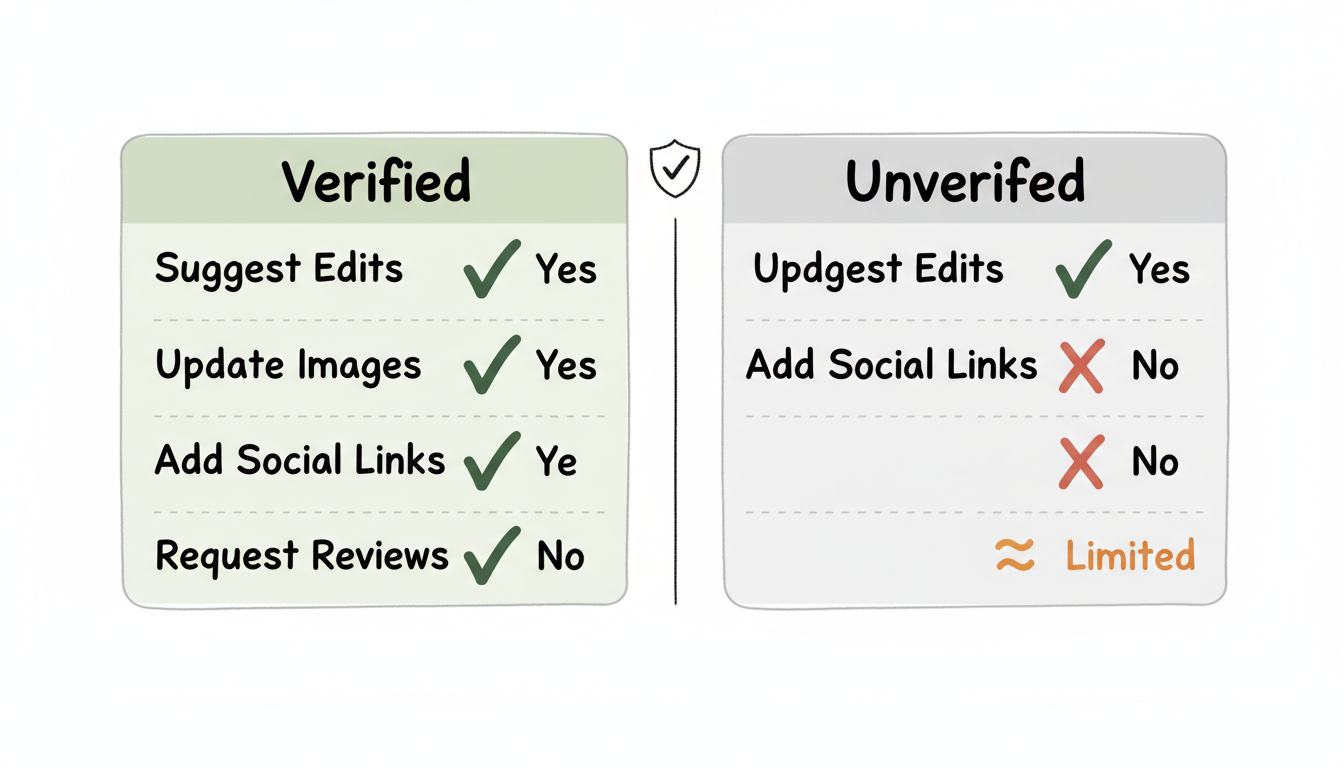
Verification doesn't guarantee changes - Google reviews all suggestions and may reject them.
Fixing Knowledge Panel Errors
Immediate Actions
For verified panels:
- Log into your verified account
- Navigate to Knowledge Panel in search results
- Use "Suggest an edit" for each incorrect field
- Provide supporting documentation for changes
- Wait for Google review (can take weeks)
For unverified panels:
- Click feedback option on Knowledge Panel
- Report specific factual errors
- Provide source URLs supporting corrections
- Submit and monitor for changes
Long-Term Fixes
Strengthen entity signals:
- Maintain consistent information across all platforms
- Build citations from authoritative sources
- Create Wikipedia presence if eligible
- Publish content reinforcing entity attributes
Improve schema implementation:
- Audit and fix all schema markup
- Implement comprehensive entity schema
- Test regularly with validation tools
- Update schema as entity evolves
Proper implementation helps avoid platform tactics conflict resolution issues where different systems provide contradictory signals.
Prevention Strategies
Strategy | Implementation | Benefit |
NAP monitoring | Monthly audits | Catch inconsistencies early |
Schema testing | Weekly validation | Prevent markup errors |
Citation tracking | Quarterly review | Maintain signal strength |
Panel monitoring | Regular searches | Detect changes quickly |
Knowledge Panels and AI Search
Knowledge Panel accuracy increasingly affects AI search visibility. AI systems reference Knowledge Graph data when generating responses about entities, and the Google AI Overview SEO impact shows how entity authority influences AI-generated content.
AI implications:
- Accurate panels support correct AI citations
- Entity authority signals transfer to AI systems
- Knowledge Graph relationships influence AI understanding
- Schema markup affects AI Overview appearances
Fix Knowledge Panel errors not just for traditional search, but to establish accurate entity representation that AI systems will reference. Using AI search citation tracking tools can help monitor how AI systems reference your Knowledge Panel data.
Understanding the Errors
The error is the wrong fact. A panel that shows the stale name or the wrong link misleads the user, so the correction is the baseline. The honest value is the proven asset, and the discipline of fixing it is the edge, because the proof is the asset that opens the door and the data is the guide.
Avoid ignoring the panel. A brand that lets the error stand loses the trust the box could build, so the claim is the gate. The disciplined close is what makes the work real, and the patience to finish the loop is the edge most teams skip while they notice and walk away, because the completion is the point and the structure is the asset.
Verification and Claiming
The claim is the control. A profile the owner verifies can be corrected, so the verification is the step. The honest content is the one the system can read, and the discipline of the format makes the panel citable instead of skipped, because the extraction favors the shape and the structure is the asset.
Use the claim to fix the error. A verified owner can edit the fact, so the correction follows the control. The disciplined loop is what makes the work real, and the patience to finish it is the edge most teams skip while they claim and stop, because the completion is the point and the discipline is the edge that pays.
Panels and AI Search
The panel feeds the answer. A clean, cited profile is the one the model quotes, so the structured fact is the build. The honest program reads the whole picture, and the combined view justifies the effort to the stakeholders who fund it, because the use is the measure and the upkeep is the value.
Monitor the panel on a cadence. A fixed list of the brand facts watched over time shows whether the error returns, because the position is not permanent. The disciplined check catches the loss early, and the patience to monitor is the quiet edge most teams skip while they assume the fix holds, because the measurement is the guide and the fit is the lever.
FAQs
How Long Do Knowledge Panel Fixes Take?
Google typically reviews suggestions within 2-4 weeks, though complex changes may take longer. Some fixes through improved schema and signals may take months to reflect.
Can I Remove Incorrect Knowledge Panel Information?
You can suggest corrections through verification or feedback, but Google decides what to display. Providing documentation supporting your suggested changes improves approval chances.
Why Did My Knowledge Panel Disappear?
Panel disappearance usually results from weakened entity signals, algorithm changes, or policy violations. Strengthen entity presence across platforms and check for any Google notices.
Do I Need Wikipedia for a Knowledge Panel?
No. While Wikipedia strengthens entity recognition, Knowledge Panels can appear without it. Consistent information across authoritative sources, proper schema, and verified Google properties all contribute.