
Google Search Console remains the most accessible tool for understanding how your content performs in search - including AI-generated results. While GSC wasn't built specifically for Answer Engine Optimization, it provides critical signals that reveal your visibility across Google's AI Overviews and featured snippets.
Here's how to leverage GSC for AEO tracking in 2026.
Why GSC Matters for AEO
According to Pansofic's analysis of GSC for AI search, Google Search Console has become the "control tower for organic presence in AI-driven search platforms." GSC impressions now include AI Overviews, meaning your existing dashboard tracks more than just traditional blue link visibility.
GSC's AEO value:
- Free access to Google's own performance data
- Impressions include AI Overview appearances
- Featured snippet tracking correlates with AI citations
- Query data reveals what questions trigger AI responses
- CTR patterns indicate when AI answers satisfy queries
GSC won't tell you everything about AI visibility, but it reveals more than most teams realize.
Understanding AI Overview Signals in GSC
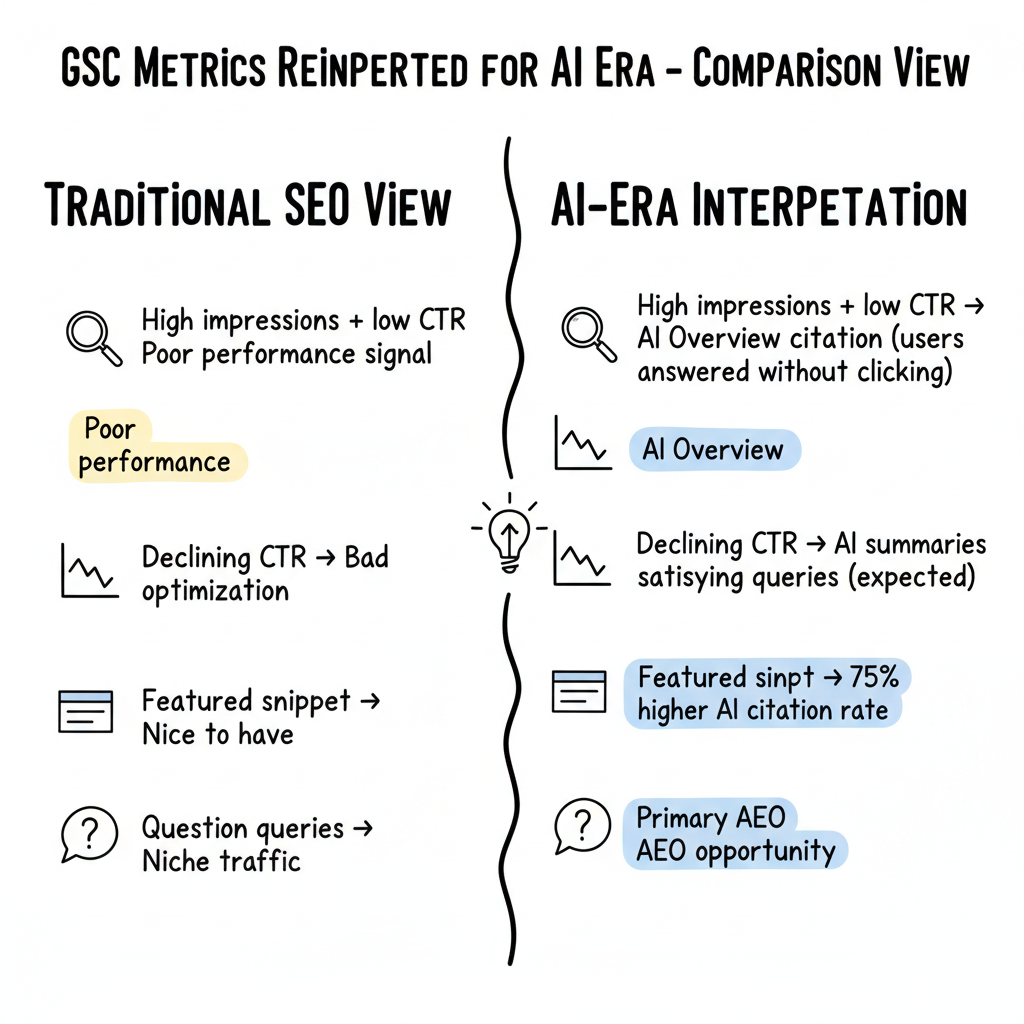
According to RevvGrowth's guide to AI search metrics, GSC data requires reinterpretation for the AI era. Traditional metrics mean different things when AI Overviews dominate results.
Metric reinterpretation:
Traditional View | AI-Era Interpretation |
High impressions, low CTR | Your content may be cited in AI Overviews (users get answers without clicking) |
Declining CTR over time | AI summaries may be answering queries - not necessarily poor optimization |
Featured snippet ownership | 75% higher likelihood of being primary AI Overview citation |
Question-based query growth | Indicates AEO opportunity for those query patterns |
According to ClickRank's featured snippet research, content that owns featured snippets has a 75% higher chance of becoming the primary citation in AI-generated responses.
Track Featured Snippet Performance
Featured snippets serve as the bridge between traditional SEO and AI visibility. GSC provides direct insight into snippet ownership, which correlates strongly with performance in Google AI Overviews optimization.
Featured snippet tracking in GSC:
- Go to Performance to Search results
- Filter by Search appearance to Featured snippets
- Analyze which queries trigger snippet visibility
- Track impression and CTR trends for snippet queries
What to monitor:
- Total featured snippet impressions over time
- CTR for snippet queries (expect lower than average - users often get answers without clicking)
- Position changes that might indicate snippet loss
- New queries gaining snippet visibility
According to SEO.com's snippet research, Google constantly tests snippet holders - tracking GSC weekly reveals when competitors capture your snippets.
Set Up AI-Relevant Query Filters
Not all GSC queries matter equally for AEO. Create custom filters to focus on AI-relevant traffic.
Priority query patterns:
- Question queries (who, what, where, when, why, how)
- Comparison queries ([X] vs [Y])
- Definition queries (what is [topic])
- Process queries (how to [action])
- Recommendation queries (best [category])
Filter setup process:
- Export query data from GSC
- Categorize queries by pattern type
- Track each category's performance separately
- Identify which patterns show AI Overview behavior
According to Conductor's 2026 AEO/GEO Benchmarks Report, question-based queries are most likely to trigger AI Overviews - prioritize these in your monitoring.
Monitor Answer Volatility
According to Julius Trujillo's analysis of AI SEO patterns, "Answer Volatility" describes Google's constant testing of different snippet holders. GSC reveals this through position fluctuations.
Volatility indicators in GSC:
- Daily position changes for stable queries
- Impression spikes followed by drops
- CTR variance on consistent-volume queries
- New competitors appearing for established queries
Monitoring cadence:
- Daily: Check position changes for top 20 queries
- Weekly: Review snippet ownership changes
- Monthly: Analyze trends and pattern shifts
- Quarterly: Full competitive audit
Track volatility to know when your AI visibility is at risk.
Integrate GSC with GA4 for Conversion Analysis
According to AgencyAnalytics' guide to AI traffic tracking, GSC data becomes more valuable when combined with GA4 conversion data. This reveals whether AI visibility drives business outcomes.
Integration approach:
- Link GSC to GA4 in property settings
- Create segments for question-based query traffic
- Track conversion rates for AI-relevant queries
- Compare behavior of snippet traffic vs. standard traffic
Key metrics to connect:
- GSC impressions to GA4 sessions to conversions
- Featured snippet queries to landing page engagement
- Question query traffic to lead generation rates
This connection answers the critical question: Does AI visibility drive revenue?
Track Emerging AEO Metrics
According to NoGood's future of search marketing analysis, traditional SEO metrics need expansion for AEO. While GSC doesn't provide all these natively, it supports derived measurements.
AEO metrics to derive from GSC:
- Citation proxy: Featured snippet impressions as indicator of AI citation potential
- Answer coverage: Percentage of question queries where you hold snippets
- Visibility trend: Month-over-month change in snippet impressions
- Competitive share: Your snippet count vs. estimated competitor snippets
Metrics requiring external tools:
- Direct citation frequency in AI responses
- LLM referral traffic attribution
- Branded search lift from AI mentions
- Cross-platform visibility (Perplexity, ChatGPT)
GSC provides the foundation - supplement with dedicated AEO tools for complete visibility.
Optimize Based on GSC Signals
According to ALM Corp's SEO trends report, GSC data should drive content optimization for AI search. Use signals to prioritize improvements. Understanding the difference between SEO, AEO, and GEO helps contextualize which optimization actions align with your visibility goals.
Optimization priorities by signal:
GSC Signal | Optimization Action |
High impressions, no snippet | Restructure content for snippet capture |
Snippet owned, low CTR | Content satisfies query (good for AEO) |
Position 4-10 for question queries | Opportunity to improve and capture snippet |
New question queries appearing | Create dedicated content for emerging queries |
Declining snippet impressions | Refresh content, check competitor improvements |
Use GSC as your early warning system for AI visibility changes.
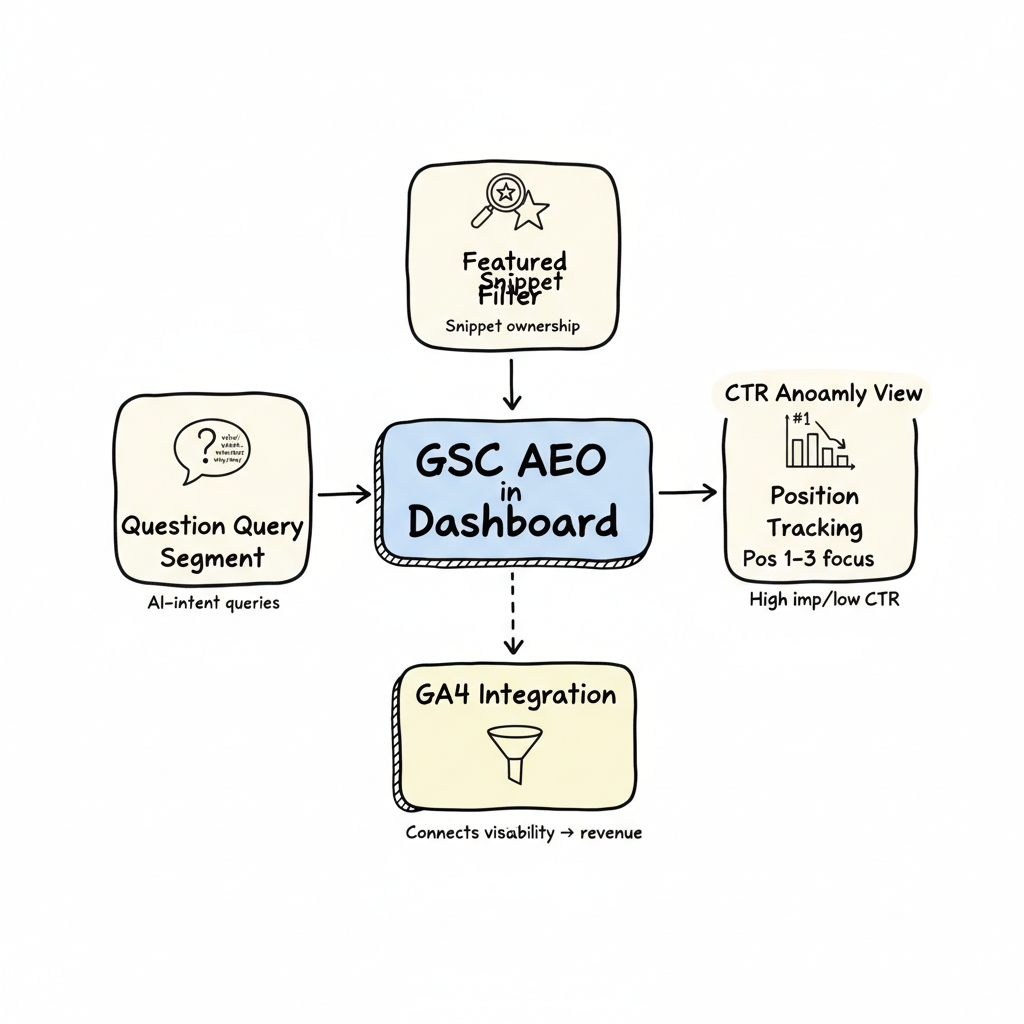
Create an AEO Dashboard in GSC
Build a focused view for AEO monitoring within GSC.
Dashboard components:
- Featured snippet filter - Search appearance filtered to snippets only
- Question query segment - Queries containing who/what/where/when/why/how
- Position tracking - Focus on positions 1-3 where snippets appear
- CTR anomaly view - High impression/low CTR queries (potential AI citations)
Export and analysis:
- Weekly CSV exports for trend tracking
- Compare to previous period consistently
- Flag significant changes for investigation
- Document optimization actions and outcomes
According to VezaDigital's GSC optimization guide, consistent monitoring cadence matters more than sophisticated tools.
Avoiding GSC Data Traps That Mislead AEO Teams
Teams often misread GSC and make wrong AEO calls. A sudden CTR drop looks like a ranking loss but usually means an AI Overview began answering the query. A zero-click spike on a snippet query is not failure - it is the snippet doing its job. Avoid averaging all queries together; blending question and transactional traffic hides the AI signal. Read GSC weekly at the query level, not monthly at the aggregate, or the volatility that matters disappears.
Reporting AEO Progress to Stakeholders with GSC
Leadership needs a simple story, and GSC supplies it without extra tools. Build a one-page monthly view that shows featured-snippet impression trend, question-query coverage, and snippet CTR anomaly count. Pair it with a GA4 line for conversions from snippet traffic so the narrative covers both visibility and revenue. Frame wins as "we now hold the answer box for X high-intent queries" rather than raw impression volume, which keeps the program funded through algorithm shifts.
Using GSC Coverage and Rich Results for AEO Readiness
AEO visibility starts with indexability. The Coverage report reveals pages excluded or crawled-but-blocked that can never earn an AI citation, and the Rich Results status confirms your FAQ and HowTo markup is parsed correctly. Fix noindex and canonical errors before optimizing copy, because a page Google will not serve cannot be a source. Run the coverage check quarterly - new templates and redirects silently drop pages out of the index over time.
Key Takeaways
Google Search Console provides valuable AEO insights when interpreted correctly:
- GSC tracks AI Overviews - Impressions now include AI-generated result appearances
- Featured snippets predict AI citations - Snippet holders have 75% higher AI citation rates
- Low CTR isn't always bad - May indicate AI summaries satisfying queries without clicks
- Question queries matter most - Filter and prioritize queries that trigger AI responses
- Answer volatility is trackable - Position changes reveal snippet competition
- GSC + GA4 shows business impact - Connect visibility to conversions for ROI analysis
- Consistent monitoring required - Weekly cadence catches changes before competitors do
GSC won't replace dedicated AEO tools, but it provides free, authoritative data that should anchor any AI search citation strategy.