
When you ask ChatGPT a question, it doesn't simply recall memorized information. When Perplexity delivers an answer with citations, it's actively pulling from the web in real-time. Understanding how these systems actually work reveals why certain content gets cited and other content gets ignored.
Here's the technology behind AI answer engines - and what it means for your visibility strategy.
The Core Technology: Retrieval-Augmented Generation
Most answer engines rely on Retrieval-Augmented Generation (RAG), a framework that combines information retrieval with AI text generation. The RAG market reached $1.2 billion in 2023 and continues growing at nearly 50% annually as enterprises adopt it for AI applications.
RAG solves a fundamental problem: Large Language Models (LLMs) know a lot from training data, but they can't access your internal documents, yesterday's news, or the latest information. RAG connects LLMs to external knowledge bases at runtime, grounding responses in current, relevant data.
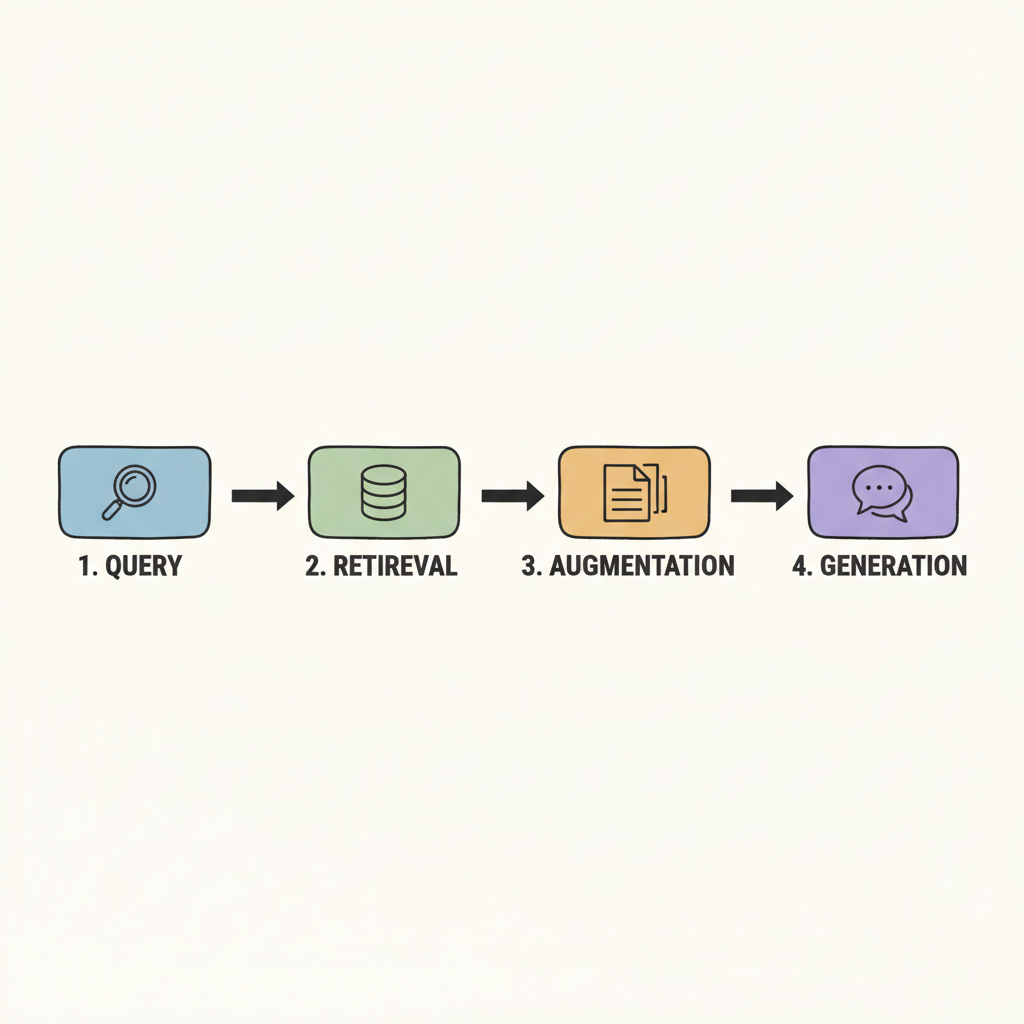
The basic RAG process:
- Query processing: User asks a question
- Retrieval: System searches knowledge bases for relevant documents
- Augmentation: Retrieved documents become context for the LLM
- Generation: LLM generates a response grounded in the retrieved context
This architecture explains why answer engines can cite current information - they're not relying solely on what the model "remembers" from training.
How Different Platforms Implement RAG
Not all answer engines work identically. Their architectures determine citation behavior, which makes understanding ai-search-ranking-factors essential for content optimization.
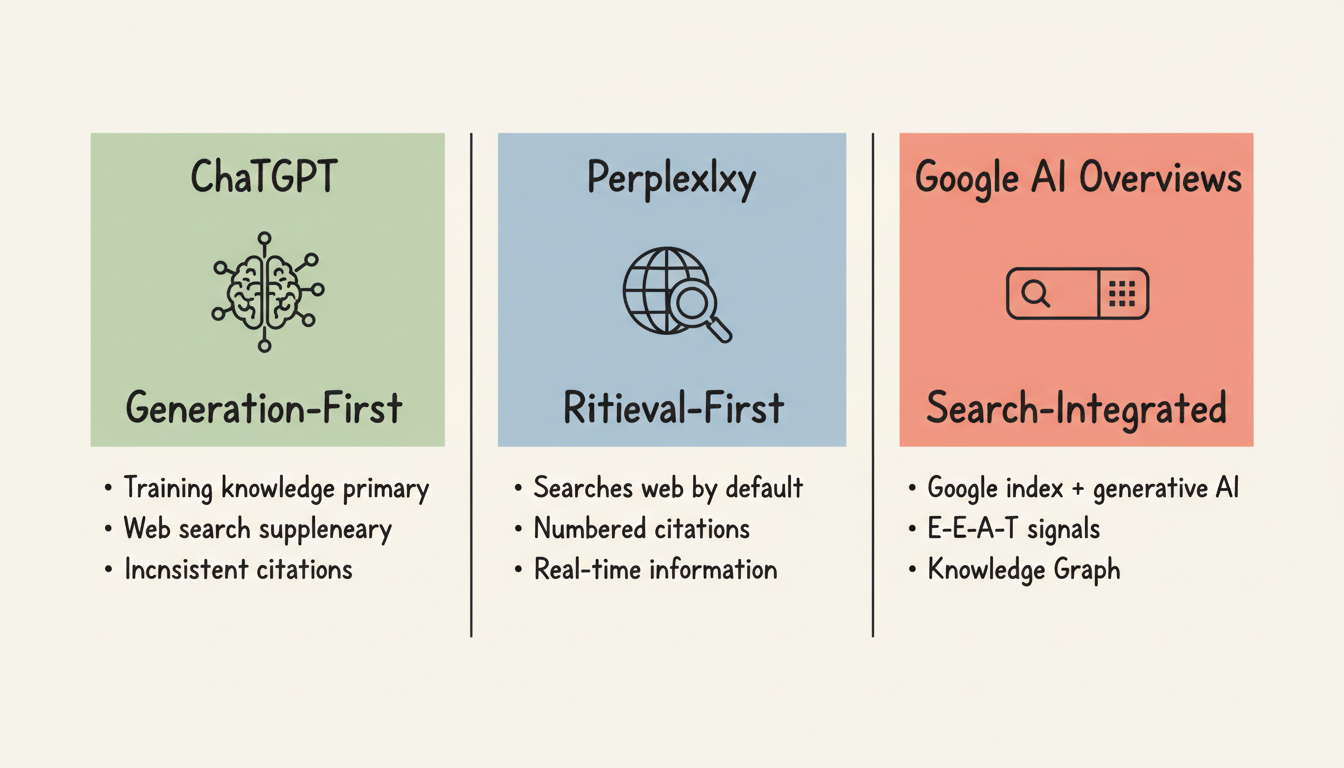
ChatGPT'S Approach
ChatGPT operates primarily as a "generation-first" system. It generates responses mainly from its trained knowledge (parametric memory), adding web search when explicitly needed or when queries require current information.
Key characteristics:
- Web browsing is supplementary, not default
- Citations appear inconsistently
- Draws heavily from training data for general knowledge
- Excels at synthesis and creative tasks
When ChatGPT does retrieve external information, it evaluates sources based on authority signals, content clarity, and relevance to the query. For businesses looking to improve their ChatGPT SEO presence, understanding this generation-first approach is critical.
Perplexity'S Approach
Perplexity operates as a "retrieval-first" system. It searches the web by default for every query, then synthesizes findings into structured answers with persistent citations.
Key characteristics:
- Searches web by default for all queries
- Numbered citations persist throughout responses
- Prioritizes source transparency
- Real-time information access
Perplexity's architecture makes traditional SEO fundamentals directly relevant - content that ranks well in web search becomes available for Perplexity to cite. Organizations focusing on Perplexity AI search optimization can leverage this retrieval-first behavior to improve citation rates.
Google AI Overviews
Google AI Overviews combine Google's search infrastructure with generative AI. They pull from Google's indexed web content, evaluate sources using established search quality signals, and generate synthesized summaries.
Key characteristics:
- Leverages Google's search index and ranking signals
- Integrates with traditional search results
- Draws from Knowledge Graph data
- Applies E-E-A-T quality evaluation
What Makes Content "Citable"
AI systems evaluate multiple factors when deciding which sources to cite:
Machine-Readable Structure
Your content needs structured data that tells AI systems exactly what each piece of information represents. JSON-LD schema markup helps answer engines parse and understand content meaning.
Without proper structure, AI systems may understand your content less accurately - or skip it entirely when assembling responses. Using person schema knowledge graph markup can help establish entity relationships that AI systems recognize.
Clear, Extractable Answers
AI models prefer concise, fact-based answers they can extract directly. Research shows that a 40-60 word direct answer beats a 500-word narrative for citation probability.
The answer-first format works because AI systems scan for extractable statements. When your key insight is buried in paragraph eight, it may never surface in AI responses.
Source Authority
Answer engines evaluate domain authority, content freshness, and consistency across multiple sources. When multiple authoritative sources echo the same information, AI systems gain confidence in citing that data.
Authority signals include:
- Domain reputation and history
- Backlink profile quality
- Content freshness and update frequency
- Consistency across platforms (website, listings, reviews)
Entity Verification
AI systems verify that entities (brands, people, organizations) exist and are credible. They cross-reference information across Wikipedia, Wikidata, business directories, and other authoritative databases.
If your entity information is inconsistent across the web, AI systems may trust your content less - even if the content itself is accurate.
The Evolution: From RAG to Context Engines
RAG technology continues evolving. Industry analysts describe a shift from "Retrieval-Augmented Generation" toward "Context Engines" with intelligent retrieval as the core capability.
Where RAG is heading:
- Expanded data scope beyond text (images, video, structured data)
- More sophisticated relevance scoring
- Better handling of multi-step queries
- Integration with AI agents that take actions
For content creators, this evolution means structured, authoritative content becomes even more valuable. As AI systems get smarter about evaluating sources, quality signals matter more - not less.
Practical Implications
Understanding answer engine technology reveals optimization priorities:
Structure content for extraction: Use clear headings, direct answer paragraphs, and schema markup that helps AI systems parse your content accurately.
Build verifiable authority: Establish consistent entity information across the web. Make it easy for AI systems to verify your credibility.
Optimize for both retrieval and generation: Retrieval-first systems (Perplexity) reward strong SEO. Generation-first systems (ChatGPT) reward comprehensive, authoritative content in their training data.
Maintain freshness: Real-time retrieval systems favor current content. Update important pages regularly to remain citable.
How to Make Your Content Retrievable
Retrieval-first engines rank pages much like classic search, so the fundamentals still matter: clean crawlability, fast load, and a page that clearly covers the query. Publish the answer high on the page, then support it with detail, so the retrieved chunk is self-contained.
Add FAQ and HowTo schema where they fit, and keep entity names consistent with your other listings. When the retriever pulls a fragment, it should match the entity the generator already trusts from other sources. Consistency is what turns a ranking into a citation.
How Generation-First Systems Decide What to Say
ChatGPT and similar models lean on parametric memory for general topics and reach the web only when a query is current or explicitly asks. To influence training-era knowledge, earn durable authority: original research, cited definitions, and pages that other reputable sites reference.
You cannot prompt these systems directly, but you can shape the corpus they learn from. Guest contributions, press, and documentation that others quote become part of the model's world. Treat off-site authority as part of answer-engine optimization, not a separate discipline.
Measuring Answer-Engine Visibility
Track two layers. First, classic rankings and snippets for your priority questions - those feed retrieval. Second, citation tests: ask the same questions in Perplexity, ChatGPT, and Google AI Overviews monthly and record whether your brand appears with a link.
Report a simple citation rate per cluster and watch it move as you add structure and freshness. When a platform stops citing you for a query you rank for, check entity consistency and recency first - those are the most common causes of a retrievable-but-uncited page.
FAQs
Do Answer Engines Use Google'S Search Results?
Some do. Perplexity and other retrieval-first systems often leverage search engine results to find content. This means traditional SEO directly impacts visibility in these platforms. ChatGPT's browsing feature also uses search, though it's not always engaged.
How Do AI Systems Decide Which Sources to Cite?
AI systems evaluate content structure, source authority, information freshness, and entity consistency. They look for clear, extractable answers from trustworthy sources. The specific weighting varies by platform and query type.
Can I Optimize for All Answer Engines with One Strategy?
Core practices - structured data, clear answers, authority signals - benefit all platforms. But platform-specific tactics matter: Perplexity rewards strong SEO and freshness, while ChatGPT rewards comprehensive authority that influences training data.