
Google's AI Overviews now appear for over 80% of informational queries, fundamentally changing how content gets discovered. Understanding how Google's algorithm selects sources for these AI-generated summaries has become essential for maintaining search visibility in 2026.
While Google hasn't published an official algorithm specification for AI Overview source selection, extensive analysis of citation patterns reveals clear preferences that determine which content earns visibility in these prominent placements.
The AI Overview Source Selection Process
AI Overviews operate using advanced natural language processing models that evaluate content across multiple dimensions simultaneously. Unlike traditional ranking where position determines visibility, AI Overviews synthesize information from multiple sources - meaning your content competes not just with other websites but with the AI's ability to create comprehensive answers by combining various sources.
The selection process happens in real-time for each query. Google's systems scan indexed content, evaluate source credibility, assess answer completeness, and synthesize the most helpful response. This dynamic process means content quality and relevance matter more than ever.
Primary Source Selection Factors
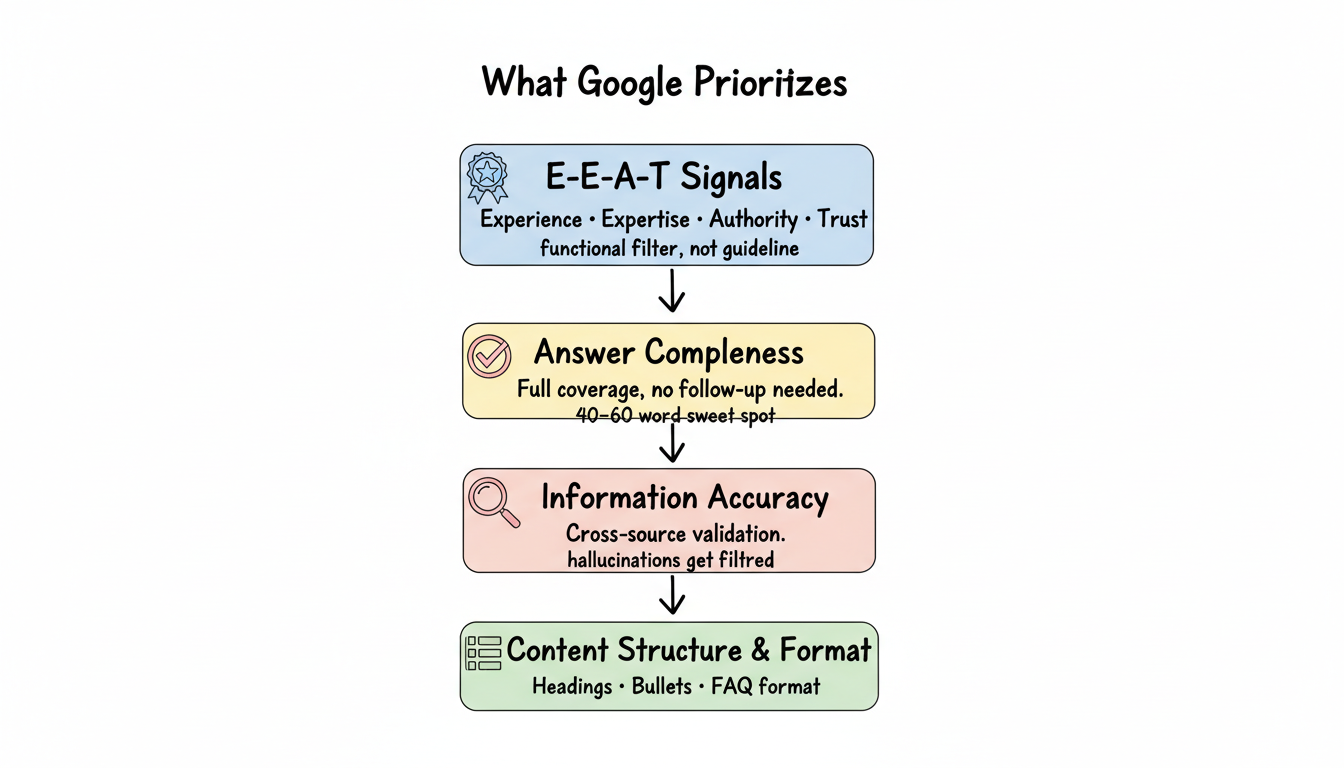
1. E-E-A-T Signals
Experience, Expertise, Authoritativeness, and Trustworthiness have shifted from quality rater guidelines to functional ranking filters. In 2026, content without clear E-E-A-T signals increasingly fails to appear in AI Overviews regardless of other optimization efforts.
Experience has become particularly critical. Google's algorithms actively identify content created by people with demonstrated first-hand knowledge. This directly combats generic AI-generated content flooding search results. Signs of genuine experience include:
- Specific details only someone who used a product or service would know
- Screenshots, original images, and documentation
- Personal anecdotes that provide unique perspective
- Practical tips derived from actual implementation
Expertise signals include author credentials, consistent publishing history, and depth of coverage. Pages cited in AI Overviews typically come from sites demonstrating topical authority through comprehensive content libraries rather than isolated articles.
Authoritativeness manifests through domain recognition, backlinks from respected sources, and industry mentions. Understanding entity optimization for AI search can help establish your brand as an authoritative source that AI systems recognize.
Trustworthiness encompasses accuracy verification, transparent sourcing, and website security. Content contradicting established facts gets filtered during selection.
2. Answer Completeness
AI Overviews prioritize sources that fully address user questions without requiring additional searches. The algorithm evaluates whether content:
- Covers all aspects of the query
- Anticipates follow-up questions
- Provides sufficient depth on each subtopic
- Includes supporting evidence and examples
Partial answers rarely get featured because AI systems prefer sources that reduce the need for users to click through to multiple websites. Content structured to comprehensively address topics from multiple angles receives preference.
3. Information Accuracy
Google's AI verifies factual claims by cross-referencing multiple sources. Content that introduces errors - particularly the "hallucinations" common in AI-generated text - gets filtered during the selection process.
Accuracy verification mechanisms include:
- Cross-source validation: Claims must align with information from other authoritative sources
- Citation presence: Content with specific references to studies, data, or original sources scores higher
- Factual consistency: Internal contradictions or outdated statistics trigger credibility penalties
4. Content Structure and Format
How information is organized significantly impacts citation probability. AI systems prefer content that:
- Uses clear heading hierarchies that signal topic organization
- Presents information in scannable formats (bullets, numbered lists, tables)
- Places direct answers near the beginning of relevant sections
- Includes FAQ sections with concise, specific responses
The 40-60 word answer sweet spot remains relevant - Google frequently pulls responses of this length for featured snippets and AI Overview citations. Leveraging proven AEO content templates can help structure your content for maximum AI citation potential.
Secondary Selection Factors
Domain Authority and Topical Relevance
Sites with established authority in their niche receive preference over sites covering topics outside their demonstrated expertise. A B2B SaaS company writing about marketing automation will more likely be cited than a general blog without established authority in that space.
Domain signals include:
- Backlink profiles from relevant industry sources
- Content depth across related topics (topic clusters)
- Historical publishing consistency
- Recognition from other authoritative entities
Content Freshness
For topics where recency matters, Google's AI prioritizes recently published or updated content. Understanding content freshness signals for answer engines helps maintain relevance across AI platforms.
Freshness signals include:
- Publication dates and last-modified timestamps
- References to current events, statistics, or developments
- Regular content updates and maintenance
- Coverage of emerging trends before competitors
User Intent Matching
AI Overviews don't trigger for all query types. Transactional searches ("buy project management software") and navigational queries ("LinkedIn login") typically bypass AI Overviews entirely. The algorithm selects sources that match informational intent with appropriate depth.
Content optimized for the wrong intent - commercial content appearing for informational queries - gets filtered regardless of other quality signals.
What Disqualifies Sources
Understanding disqualification factors helps avoid common pitfalls:
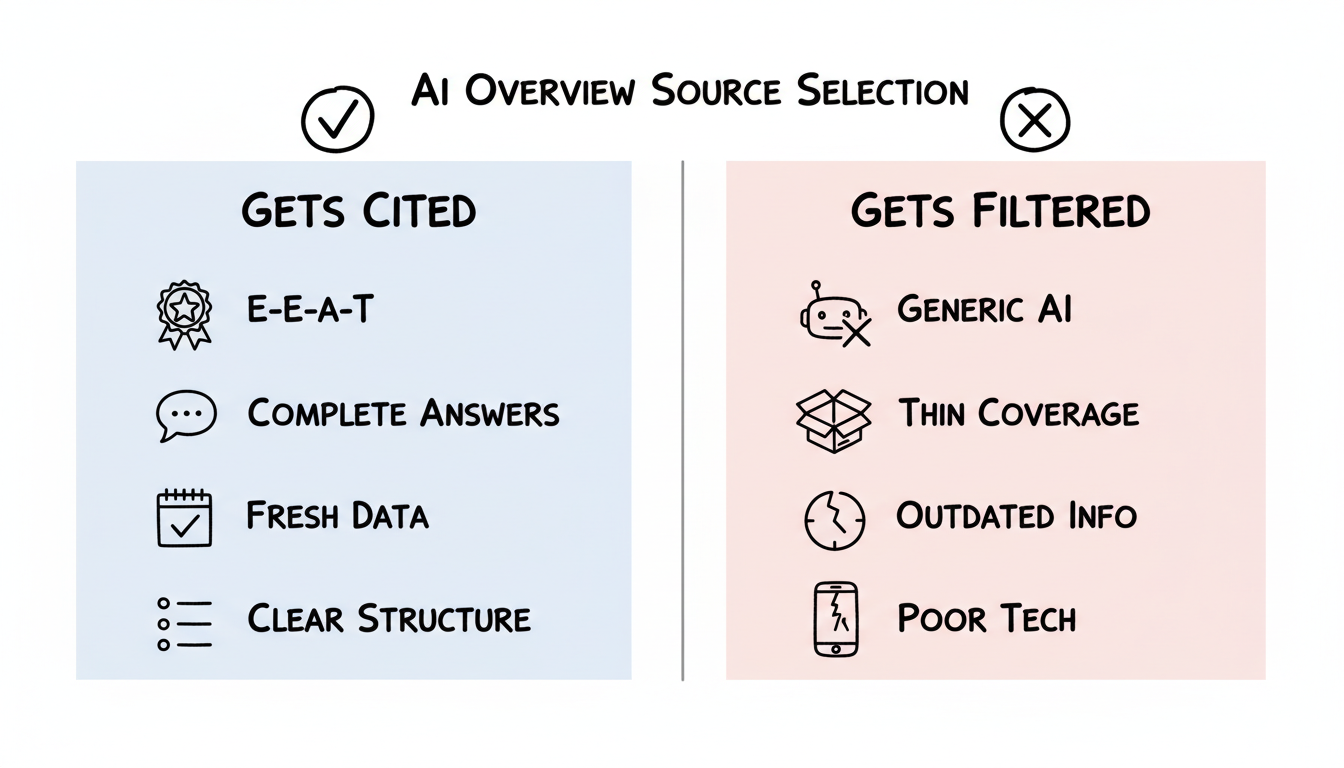
Generic AI Content: Google's detection mechanisms identify AI-generated content through linguistic patterns, consistent depth across sections, and lack of specific citations. Sites publishing high volumes of AI content without human expertise signals face systematic devaluation.
Thin or Superficial Coverage: Content that scratches the surface without providing genuine insight loses to comprehensive alternatives. AI systems can recognize when content adds no unique value to existing information.
Outdated Information: Statistics, pricing, features, and other time-sensitive information must remain current. AI Overviews avoid citing sources with clearly outdated facts.
Poor Technical Foundation: Sites with slow load times, poor mobile experience, or problematic Core Web Vitals (especially INP - Interaction to Next Paint) receive lower selection priority. Google's December 2025 update weighted interactivity heavily.
Monitoring Your AI Overview Performance
Google Search Console now includes "AI Mode" reporting, allowing visibility into:
- Queries triggering AI Overviews where your content could appear
- Citation counts from AI Overview placements
- Click-through rates from AI-generated summaries
- Content gaps where competitors receive citations
Tracking these metrics reveals optimization opportunities and validates strategy effectiveness.
Optimization Strategies for Source Selection
To increase AI Overview citation probability:
- Build topical authority: Create comprehensive content clusters with pillar pages and supporting articles that demonstrate deep expertise
- Lead with answers: Structure content to provide direct, complete answers within the first few paragraphs
- Include original research: Studies, surveys, and proprietary data create information AI cannot synthesize from other sources
- Maintain accuracy: Regularly audit content for outdated statistics, broken links, and factual errors
- Demonstrate experience: Include specific examples, case studies, and first-hand insights that generic content cannot replicate
- Optimize structure: Use clear headings, concise paragraphs, and formats AI systems easily parse
The Evolving Algorithm Landscape
Google's AI Overview algorithm continues evolving. The December 2025 core update specifically targeted AI content quality, broadened E-E-A-T requirements beyond YMYL topics, and enhanced behavioral signal weight. Sites investing in genuine expertise and user-focused content increasingly dominate these placements. Implementing universal AI search tactics ensures your content performs well across multiple AI platforms, not just Google.
Running a Self-Audit Against the Selection Factors
You do not need Google's internals to estimate your citation odds. Score each target page on the four primary factors: does it show first-hand experience, does it fully answer the query, are claims cross-sourced and current, and is it structured for fast parsing? Flag any page scoring low on two or more and prioritize it for rewrite. Run this audit quarterly on your top-20 informational URLs; the exercise surfaces thin sections and missing citations before an AI Overview shift buries the page.
Structured Data and Schema Signals
While schema is not a direct citation lever, it strengthens the structural factor Google weights. Implement Article, FAQ, and HowTo markup so the crawler parses intent and answer boundaries cleanly, and keep author and organization schema populated to reinforce E-E-A-T. Avoid markup that contradicts the visible text - mismatched structured data triggers trust penalties. Treat schema as reinforcement for genuinely complete content, not a substitute for it; the sources that win still earn the spot through substance and accuracy.
Why Citation Behavior Differs Across AI Platforms
Google is not the only answer engine, and each weighs signals differently. Perplexity favors recently published, heavily cited sources and links them inline, while ChatGPT draws on a trained corpus with lighter live retrieval unless browsing is on. A page optimized only for Google's E-E-A-T emphasis may underperform where a competitor leads on freshness or linkage. Maintain a baseline of accurate, well-structured, original content so you remain citeable wherever the query lands, and track each platform separately rather than assuming one optimization fits all.
The shift represents a fundamental change: ranking on page one no longer guarantees visibility when AI synthesizes answers from multiple sources. Success requires becoming the source AI systems trust to cite.