
Understanding how much to run ads on Facebook starts with knowing the platform's minimum requirements. Whether you are testing the waters with a small budget or planning a larger campaign, Meta has specific spending thresholds you need to meet before your ads can run.
This guide covers the minimum budget requirements for Facebook advertising in 2026, recommended budgets by campaign goal, and strategies for getting results even with limited spend.
Minimum Budget Requirements
Meta enforces minimum spending amounts to ensure the platform can effectively optimize your ad delivery. Here are the current requirements:
Daily Budget Minimums
According to Meta's official documentation, the minimum daily budget depends on your billing currency and optimization goal:
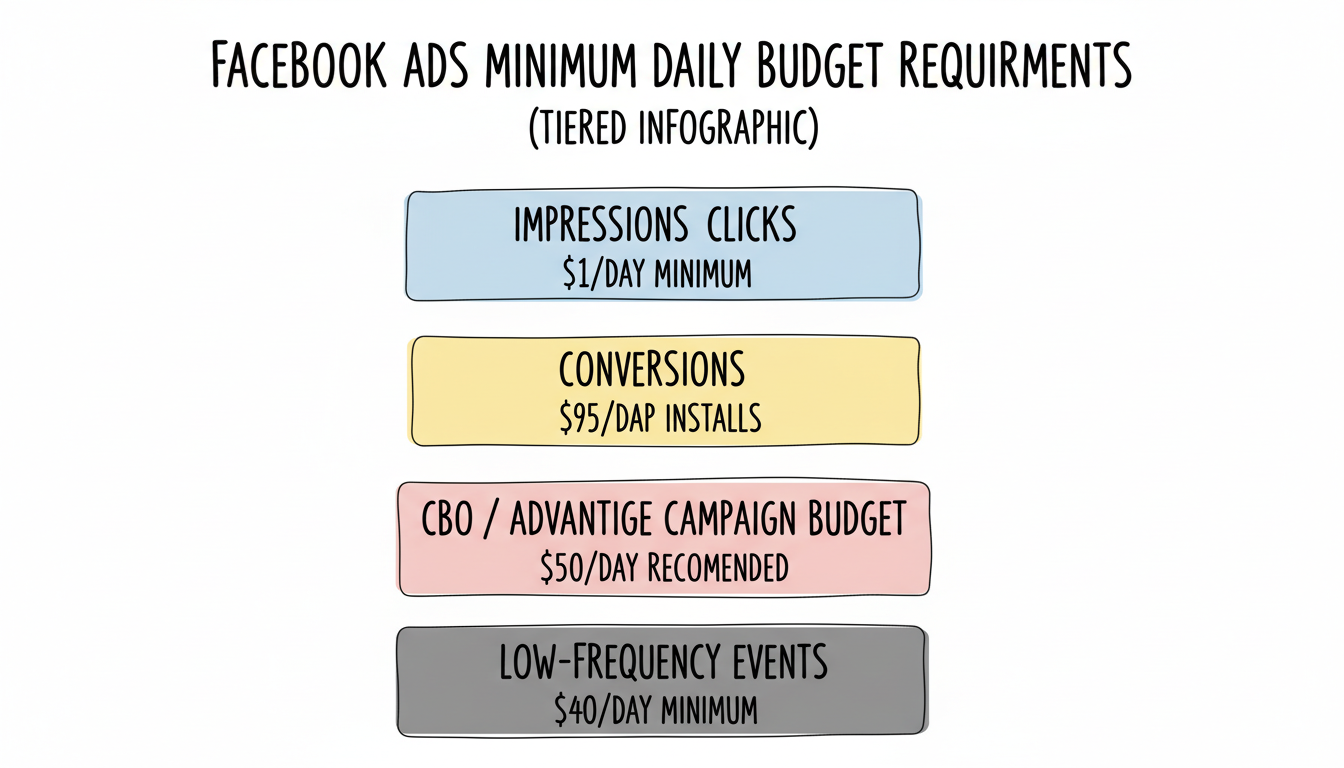
Optimization Type | Minimum Daily Budget |
Impressions | $1/day |
Clicks, Likes, Video Views | $1/day |
Conversions, App Installs | $5/day |
Low-frequency events | $40/day |
For most advertisers optimizing for conversions, the practical minimum is $5 per day per ad set.
Campaign Budget Optimization (CBO) Minimums
When using Advantage Campaign Budget (formerly CBO), Meta requires higher minimums. Industry testing shows you need at least $50 per day at the campaign level for CBO to distribute budget effectively across ad sets.
Lifetime Budget Minimums
If you prefer lifetime budgets over daily budgets:
- Minimum lifetime budget = Daily minimum x number of scheduled days
- For a 7-day campaign optimizing for conversions: $5 x 7 = $35 minimum
Budget by Goal
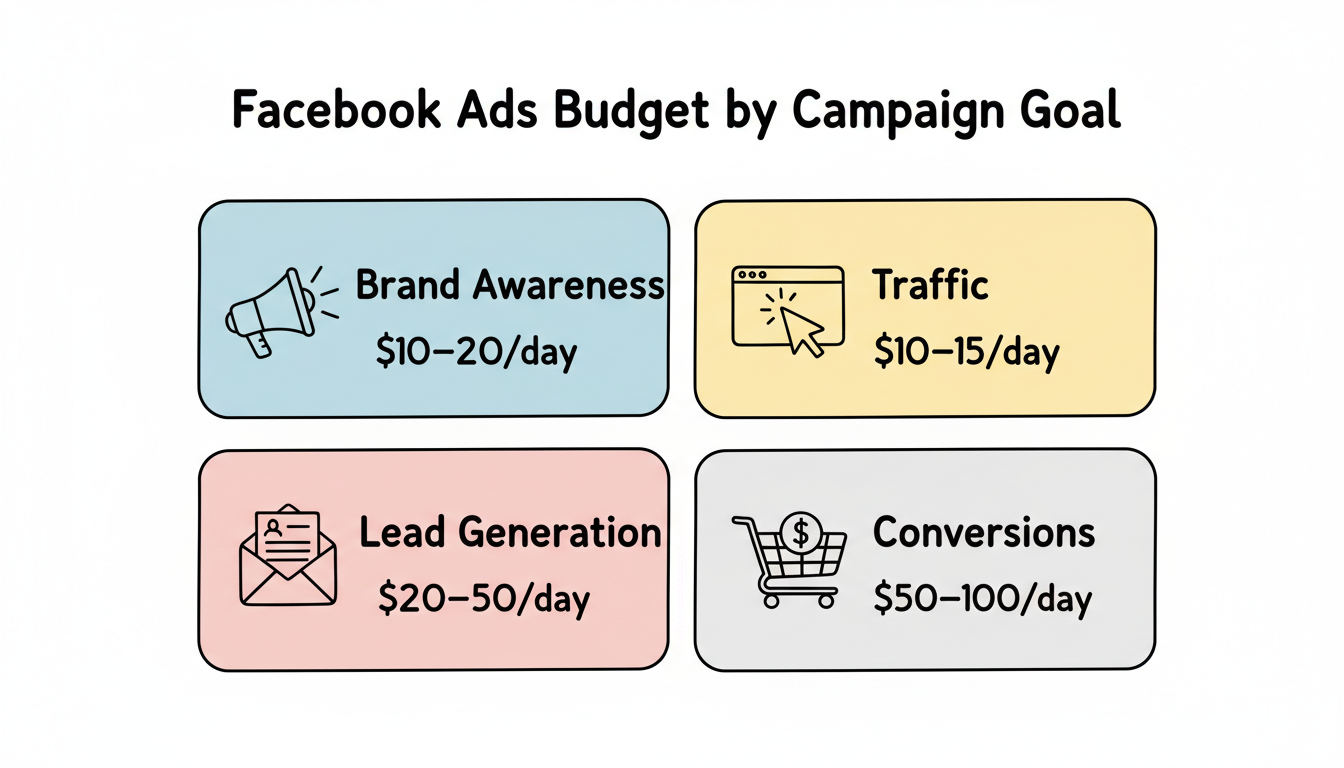
Your optimal budget depends heavily on what you want to achieve. Here are recommended starting budgets based on campaign objectives:
Brand Awareness and Reach
Recommended minimum: $10-20/day
For awareness campaigns, you pay for impressions rather than actions. Lower budgets can still generate meaningful reach because you are not waiting for specific conversion events.
Traffic Campaigns
Recommended minimum: $10-15/day
Traffic optimization is relatively efficient, with average CPCs ranging from $0.50 to $2.00. A $10/day budget can drive 5-20 clicks depending on your industry and targeting.
Lead Generation
Recommended minimum: $20-50/day
Lead campaigns require more budget because you need sufficient data for Meta to optimize. According to Meta's best practices, campaigns should generate at least 50 conversion events per week to exit the learning phase.
Budget formula: Target Cost Per Lead x 50 / 7 days = Minimum daily budget
If your target CPL is $10, you need at least $71/day ($10 x 50 / 7).
Conversions and Sales
Recommended minimum: $50-100/day
Conversion campaigns have the highest budget requirements because:
- Purchase events happen less frequently than clicks
- Meta needs sufficient conversion data to optimize
- Competition for conversion-ready audiences is higher
For ecommerce, experienced advertisers recommend budgeting at least 2-3x your target CPA daily to gather enough data for optimization. Understanding how to increase ROI Facebook ads becomes crucial when working with these larger budgets.
Starting Budget Tips
1. Start with Ad Set Budget (ABO) for Testing
When testing new audiences or creative with limited budget, use Ad Set Budget Optimization (ABO) rather than CBO. ABO lets you:
- Control exactly how much each ad set spends
- Test multiple audiences without budget being pulled to one winner
- Work with lower overall budgets ($5-10 per ad set)
2. Focus Your Targeting
Smaller budgets perform better with focused targeting:
- Narrow geographic areas instead of entire countries
- Specific interest combinations rather than broad audiences
- Custom audiences from your existing customer data
A $20/day budget targeting one city will outperform the same budget spread across a country.
3. Limit Variables
When budget is tight, reduce the number of things you test simultaneously:
- Run 2-3 ad variations instead of 10
- Test one audience at a time
- Use a single placement (like Feed only) rather than all placements
4. Use the Learning Phase Wisely
Every campaign enters a learning phase where Meta gathers data. During this period:
- Expect higher and more volatile costs
- Avoid making changes that reset learning
- Plan for 50 optimization events before evaluating performance
With a $20/day budget and $10 CPA, expect 2-3 weeks to exit learning phase. Many businesses choose to work with a Facebook ads management agency to navigate these complexities more efficiently.
5. Consider Weekly Instead of Daily Perspective
Rather than thinking about daily minimums, calculate what you can spend weekly:
- $100/week allows meaningful testing of 1-2 ad sets
- $250/week enables testing multiple audiences
- $500/week approaches serious optimization territory
Scaling Your Budget
Once you find winning combinations, scale gradually to maintain performance.
The 20% Rule
Increase budgets by no more than 20% every 3-4 days. Sudden increases can:
- Reset the learning phase
- Spike your CPAs temporarily
- Reduce delivery efficiency
When to Scale
Only increase budget when:
- CPA has been stable for 5-7 days
- You are generating 50+ conversions per week
- ROAS meets your profitability targets
Horizontal vs Vertical Scaling
Vertical scaling: Increase budget on existing campaigns (follow 20% rule)
Horizontal scaling: Duplicate winning ad sets to new audiences or create new campaigns
Horizontal scaling often works better for smaller budgets because you are not overwhelming a single audience. Implementing a solid meta ads scaling strategy becomes essential as your campaigns grow.
Reading Your Spend Signals: When to Pause or Scale
Raw spend is a poor signal; what you watch is whether the cost per result holds as you add budget. When CPA climbs more than 15-20% as you scale, you have hit audience saturation and should pause the increase, not push harder. A stable CPA with rising volume means scale safely. Watch the seven-day rolling average, not daily swings, because day-of-week variance masks the real trend on small accounts.
Budget Allocation Across Campaign Objectives
Split your budget by job, not by channel default. Reserve a core for proven conversion campaigns, a smaller slice for prospecting and fresh audiences, and a testing pool of 10-15% for new creative and placements. A common error is funding every objective equally, which starves the winner and over-feeds the experiment. Rebalance monthly toward whatever objective is delivering pipeline, and cap anything that has not paid back after a defined test window.
Creative Fatigue and Budget Efficiency
Stale creative is the silent budget killer. The same ad that converts at a great CPA in week one can double its cost by week four as frequency climbs and the audience tunes out. Refresh creative every two to three weeks, rotate hooks, and retire variants once frequency passes a sensible threshold. Treating creative as a recurring cost - not a one-time asset - keeps your effective CPA down and your budget working instead of recycling through worn-out ads.
Frequently Asked Questions
What Is the Absolute Minimum to Run Facebook Ads?
The technical minimum is $1/day for impression or click-based campaigns. However, for conversion-focused campaigns, Meta requires $5/day minimum. Practically, most advertisers need $10-20/day minimum to see meaningful results.
Can I Run Facebook Ads with $5 a Day?
Yes, but results will be limited. A $5/day budget works best for simple objectives like video views, page engagement, or very targeted local awareness campaigns. For lead generation or sales, you will likely need at least $20-50/day to gather enough data for optimization. For more context, check out the complete Facebook ads cost complete guide.
How Long Should I Run Ads Before Seeing Results?
Plan for at least 7-14 days before evaluating campaign performance. Meta's learning phase requires approximately 50 optimization events, which takes time with smaller budgets. Avoid making changes during the first week unless something is clearly broken.
Key Takeaways
- Facebook's minimum daily budget is $1 for engagement campaigns and $5 for conversion campaigns
- Campaign Budget Optimization requires at least $50/day to distribute budget effectively
- Budget your target CPA x 50 / 7 to exit the learning phase within a week
- Start with Ad Set Budget Optimization (ABO) when testing with limited funds
- Scale budgets by no more than 20% every 3-4 days to maintain performance