
How to Get a Google Knowledge Panel
A Google Knowledge Panel establishes immediate credibility when someone searches your name or brand. That information box appearing beside search results signals that Google recognizes you as a notable entity—not just another website competing for attention. In 2026, with AI systems increasingly referencing Knowledge Graph data, earning a Knowledge Panel matters more than ever.
This guide walks through the specific steps required to get a Google Knowledge Panel, from establishing entity eligibility to claiming and verifying your panel. Whether you are starting from scratch or troubleshooting an existing effort, learning how to get Google Knowledge Panel recognition is a process that requires consistent signals across authoritative sources.
What Is a Google Knowledge Panel?
What are knowledge panels? Knowledge Panels are information boxes that appear on Google search results when you search for entities—people, places, organizations, and things that Google's Knowledge Graph recognizes. The panel displays key facts: photos, descriptions, social profiles, and related entities.
What is an entity? In Google's context, an entity is any distinct, well-defined concept—a person, business, place, or thing—that can be uniquely identified and described with structured data.
For brands, a Knowledge Panel shows company information, logos, founding date, leadership, and related companies. For individuals, it displays biographical information, accomplishments, social profiles, and professional affiliations.
Knowledge Panels pull information from Google's Knowledge Graph database, which synthesizes data from authoritative sources across the web. Appearing in a Knowledge Panel means Google has determined you're notable enough to exist as a recognized entity in their system.
Knowledge Panel Eligibility Requirements
Google doesn't grant Knowledge Panels to everyone who wants one. Meeting eligibility requirements is the first hurdle.
Notability Standards
Google follows guidelines similar to Wikipedia's notability standards. You need significant coverage in independent, reliable sources. This means:
- Multiple news articles from recognized publications
- Coverage that goes beyond routine announcements
- Independent sources (not press releases you distributed)
- Substantial treatment of the subject (not passing mentions)
A single article doesn't establish notability. Google looks for consistent coverage across multiple sources over time.
Google's threshold for notability mirrors Wikipedia's: you need significant, independent coverage from recognized publications—not press releases or paid placements—before a Knowledge Panel becomes a realistic outcome.
Entity Clarity
Google must understand what kind of entity you are. Ambiguous entities that could be confused with others face difficulty getting panels. Your brand name, personal name, or organization name needs to be distinct or clearly disambiguated in available sources.
Verifiable Information
The information Google would display must be verifiable from authoritative sources. If basic facts about you—founding dates, locations, key people, descriptions—can't be confirmed from reliable sources, Google can't confidently create a panel.
How to Check Your Entity Status in Google'S Knowledge Graph
Before investing effort into building a Knowledge Panel, check whether Google already recognizes your entity. Knowing your current entity status helps you understand how to get Google Knowledge Panel results more efficiently.
The Knowledge Graph Search API lets you query Google's entity database directly and returns a confidence score between 0.0 and 1.0 indicating how strongly Google associates a search term with a known entity.
Each recognized entity in Google's Knowledge Graph receives a unique identifier called a KGMID (Knowledge Graph Machine ID). This identifier, formatted like /m/012345 or /g/abcdef, is Google's internal reference for your entity. If your entity has a KGMID, Google already recognizes it—even if no Knowledge Panel has appeared yet.
Several free tools make checking your entity status straightforward. The Kalicube Knowledge Graph Explorer, created by Jason Barnard (widely recognized as the leading authority on Knowledge Panels and entity SEO), lets you search for any entity and see its KGMID, confidence score, and Knowledge Graph data. Carl Hendy's Knowledge Graph Search tool provides similar functionality with a clean interface for quick lookups.
A confidence score above 0.5+ generally indicates strong entity recognition. Scores below 30% of the maximum signal insufficient corroboration. Below that, you need more corroborating sources before a Knowledge Panel will appear. If your entity returns no results at all, focus on the foundational steps in this guide before expecting panel creation.
Knowledge Panel vs Google Business Profile vs Featured Snippet
Knowledge Panels are often confused with other Google search features. Understanding the differences helps you target the right strategy.
| Feature | Knowledge Panel | Google Business Profile | Featured Snippet |
|---|---|---|---|
| Source | Knowledge Graph (aggregated from authoritative sources) | Business owner submits information directly | Extracted from a specific webpage |
| Trigger | Brand/entity name searches | Local or brand + location searches | Question or informational queries |
| Control Level | Limited (suggest edits after claiming) | High (direct management of listing) | None (Google selects automatically) |
| Eligibility | Notable entities recognized in Knowledge Graph | Any verified local business | Any page with relevant, well-structured content |
| Content Type | Entity facts, images, social links, related entities | Business hours, reviews, location, photos | Text excerpt, list, or table answering a query |
A local business might have both a Google Business Profile and a Knowledge Panel—they serve different purposes. The Business Profile handles local search and customer interactions, while the Knowledge Panel establishes broader entity recognition across Google's ecosystem.
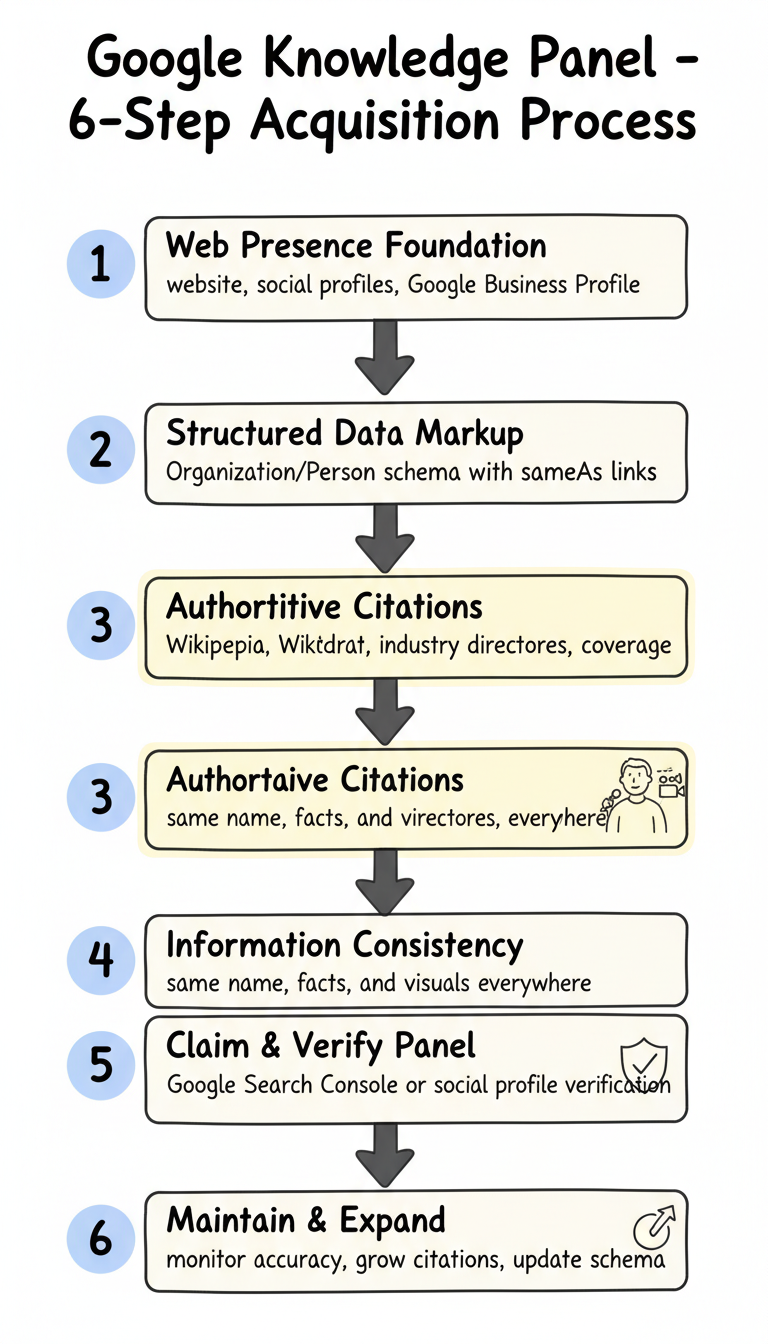
Step 1: Establish Your Web Presence Foundation
Before pursuing a Knowledge Panel, ensure your foundational web presence supports entity recognition. Similar to how you optimize for AI-powered search engines, establishing clear entity signals across your web presence helps both traditional search engines and AI systems recognize your brand.
Create Comprehensive Official Properties
Your official website should contain detailed information about the entity:
- Complete "About" page with history, mission, and key details
- Team or leadership pages with biographical information
- Contact information with verifiable addresses
- Clear entity type identification (company, nonprofit, individual)
Build Social Media Profiles
Establish profiles on major platforms with consistent information:
- LinkedIn (personal and company pages)
- Twitter/X
- YouTube (if applicable)
Each profile should use the same entity name, description, and key facts. Inconsistency fragments your identity and confuses Google's entity recognition.
Claim Google Business Profile
For businesses, claiming and verifying your Google Business Profile is essential. This provides direct confirmation to Google that your entity exists and the basic facts about it.
Step 2: Implement Structured Data Markup
Schema markup explicitly tells Google what entities exist on your pages and their attributes. Just as clear definitions improve content for answer engine optimization, structured data helps search engines understand exactly what your entity represents.
Organization Schema
For businesses, implement Organization schema with complete properties:
{
  "@context": "https://schema.org",
  "@type": "Organization",
  "name": "Your Company Name",
  "legalName": "Your Company Legal Name",
  "url": "https://yourcompany.com",
  "logo": "https://yourcompany.com/logo.png",
  "foundingDate": "2015",
  "founders": [{"@type": "Person", "name": "Founder Name"}],
  "address": {...},
  "sameAs": [
    "https://linkedin.com/company/yourcompany",
    "https://twitter.com/yourcompany"
  ]
}
For individuals seeking personal Knowledge Panels:
{
  "@context": "https://schema.org",
  "@type": "Person",
  "name": "Your Name",
  "jobTitle": "Your Title",
  "worksFor": {"@type": "Organization", "name": "Company"},
  "alumniOf": {"@type": "Organization", "name": "University"},
  "sameAs": [
    "https://linkedin.com/in/yourprofile",
    "https://twitter.com/yourhandle"
  ]
}
The sameAs property links your entity to other authoritative sources. Include links to Wikipedia, Wikidata, LinkedIn, verified social profiles, and industry databases. These connections help Google understand that references across different sources represent the same entity.
Step 3: Build Authoritative Citations
Google builds Knowledge Graph entries from authoritative external sources. Your own website isn't enough—you need independent citations.
Wikipedia Presence
Wikipedia is the most influential source for Knowledge Graph data. If you meet Wikipedia's notability guidelines, create or improve your Wikipedia article:
- Follow Wikipedia's editing guidelines strictly
- Don't write about yourself directly (conflict of interest)
- Ensure all claims have reliable source citations
- Focus on factual, neutral content
Wikipedia has strict rules about self-promotion. Violations can result in article deletion and editor bans.
Wikidata Entry
Wikidata is easier to work with than Wikipedia. Creating a Wikidata entry for your entity provides structured data that Google directly ingests. You can create Wikidata entries without meeting Wikipedia's notability standards.
Include comprehensive properties:
- Instance of (type of entity)
- Official website
- Social media links
- Key dates and facts
- Related entities
Industry Databases and Directories
Get listed in authoritative industry sources:
- Crunchbase for companies
- LinkedIn company pages
- Industry association directories
- Professional certification databases
- Government business registries
Each listing reinforces your entity's existence and attributes.
Media Coverage
Generate news coverage that establishes notability:
- Press coverage of company milestones
- Expert commentary and thought leadership
- Industry awards and recognition
- Speaking engagements and conference participation
The coverage must be in recognized publications, not paid placements or press release distribution.
Knowledge Panels for Artists, Musicians, and Creators
Artists and musicians have a distinct path to Knowledge Panels because the music industry maintains its own structured databases that feed directly into Google's Knowledge Graph. If you're a musician or creator, these platform-specific steps are often more effective than general business strategies.
Music-Specific Platforms
MusicBrainz is the most critical database for musicians seeking Knowledge Panels. This open music encyclopedia provides structured metadata that Google ingests directly. Create a complete MusicBrainz entry with your discography, aliases, genres, and associated acts.
Spotify for Artists and Apple Music for Artists both provide verified artist profiles that contribute to entity recognition. Claim your profiles on both platforms, ensure your artist bio is complete, and link to your official website. Discogs is another important database, especially for producers and DJs—its detailed release data strengthens your entity's musical identity.
Building Creator Entity Signals
Beyond music databases, creators should establish presence on platforms for their medium: Behance or Dribbble for visual artists, IMDb for film and TV creators, and Bandsintown for live performers. Each verified platform presence creates another corroborating signal for Google.
Getting a Knowledge Panel Without Wikipedia
Wikipedia is the strongest single signal for Knowledge Panel creation, but it's not the only path. Many brands want to know how to get Google Knowledge Panel status without Wikipedia—and it is achievable through corroboration.
Many entities earn Knowledge Panels without a Wikipedia article by building what Jason Barnard calls "corroboration"—approximately 30+ consistent, authoritative sources that all confirm the same entity information.
The key concept is your Entity Home: the single page on your website that serves as the canonical, definitive source of information about your entity. This page should contain comprehensive details—founding date, leadership, mission, key facts—and be clearly structured with schema markup. Google treats this as the authoritative starting point for understanding who or what you are.
Without Wikipedia, focus on stacking alternative authority signals: a detailed Wikidata entry, Crunchbase profile, Bloomberg company listing, government business registries, industry association memberships, and profiles on platforms relevant to your field. Each source that independently confirms your entity's basic facts pushes your confidence score higher in Google's Knowledge Graph. Domain authority of your website also plays a role—entities on established, authoritative domains have an easier path to recognition.
Without Wikipedia, the path to a Knowledge Panel runs through corroboration: approximately 30 or more consistent, authoritative sources all confirming the same entity facts. Your Entity Home page is the anchor—every citation should point back to it.
Step 4: Ensure Information Consistency
Entity recognition requires consistent information across all sources—a critical factor as you work to how to get Google Knowledge Panel status. New businesses should be consistent from the start.
Existing businesses need to continue building their authority through ongoing citation acquisition and structured data updates. Get started by building your home entity page as a canonical reference before auditing these signals:
Name Consistency
Use the exact same entity name everywhere. "ABC Company," "ABC Company Inc.," and "ABC Co." fragment your identity. Choose one canonical name and use it consistently.
Fact Consistency
Founding dates, locations, descriptions, and key facts must match across all sources. Conflicting information prevents confident entity recognition.
Visual Consistency
Use the same logo and imagery across platforms. Visual consistency supports brand recognition and entity disambiguation.
Step 5: Claim and Verify Your Panel
Once Google creates a Knowledge Panel for your entity, you can claim it for management capabilities. This step—learning how to get Google Knowledge Panel verification—gives you direct influence over the information displayed.
Finding Your Panel
Search for your entity name. If a Knowledge Panel appears, look for "Claim this knowledge panel" at the bottom. If no panel exists yet, continue building your presence and citations.
Verification Process
Google offers multiple verification methods:
- Google Search Console: Verify through your website ownership
- Official social profiles: Verify through linked social accounts
- YouTube channel: For creators with verified YouTube presence
- Google Business Profile: For business entities
- Third-party verification: Platforms like Twitter/X with verified status can serve as additional identity confirmation
Complete the verification process to gain panel management access.
Panel Management
Once verified, you can:
- Suggest edits to displayed information
- Add or update images
- Report inaccuracies
- Connect additional social profiles
Google reviews suggested changes but doesn't guarantee acceptance. Changes must align with information from authoritative sources.
Step 6: Maintain and Expand Your Panel
Knowledge Panels require ongoing attention.
Monitor for Accuracy
Regularly check your panel for incorrect information. Report inaccuracies through the panel management interface.
Expand Authoritative Sources
Continue building citations from authoritative sources. More reliable sources strengthen your entity's position in the Knowledge Graph. Our entity SEO guide covers advanced citation building strategies. Understanding what an answer engine is helps you recognize which platforms now reference Knowledge Graph data beyond traditional search.
Update Structured Data
Keep schema markup current as information changes. Outdated structured data can conflict with other sources.
What to Do If Your Knowledge Panel Disappears
Knowledge Panels can vanish without warning, and understanding why helps you recover faster. The most common causes include:
- Entity Home disruption: If you deleted, redesigned, or moved the primary page Google associates with your entity, the panel may drop while Google reassesses your entity status
- Knowledge Graph cleanup: In June 2025, Google removed over 3B low-quality entities—3x more than any prior cleanup—from the Knowledge Graph to improve AI accuracy. Entities with weak or inconsistent corroboration were most affected
- Policy violations: Manipulative structured data, spammy backlinks, or misleading entity information can trigger removal
- Entity confusion: If a new entity with a similar name gains prominence, Google may temporarily remove or merge panels to resolve disambiguation
To recover a disappeared panel, first verify your Entity Home page is live and properly structured. Resubmit your structured data through Google Search Console and check for manual actions. If you had a verified panel, use the panel management interface to file feedback. For merged or confused entities, ensure your sameAs properties and Wikidata entry clearly disambiguate your entity from similar names.
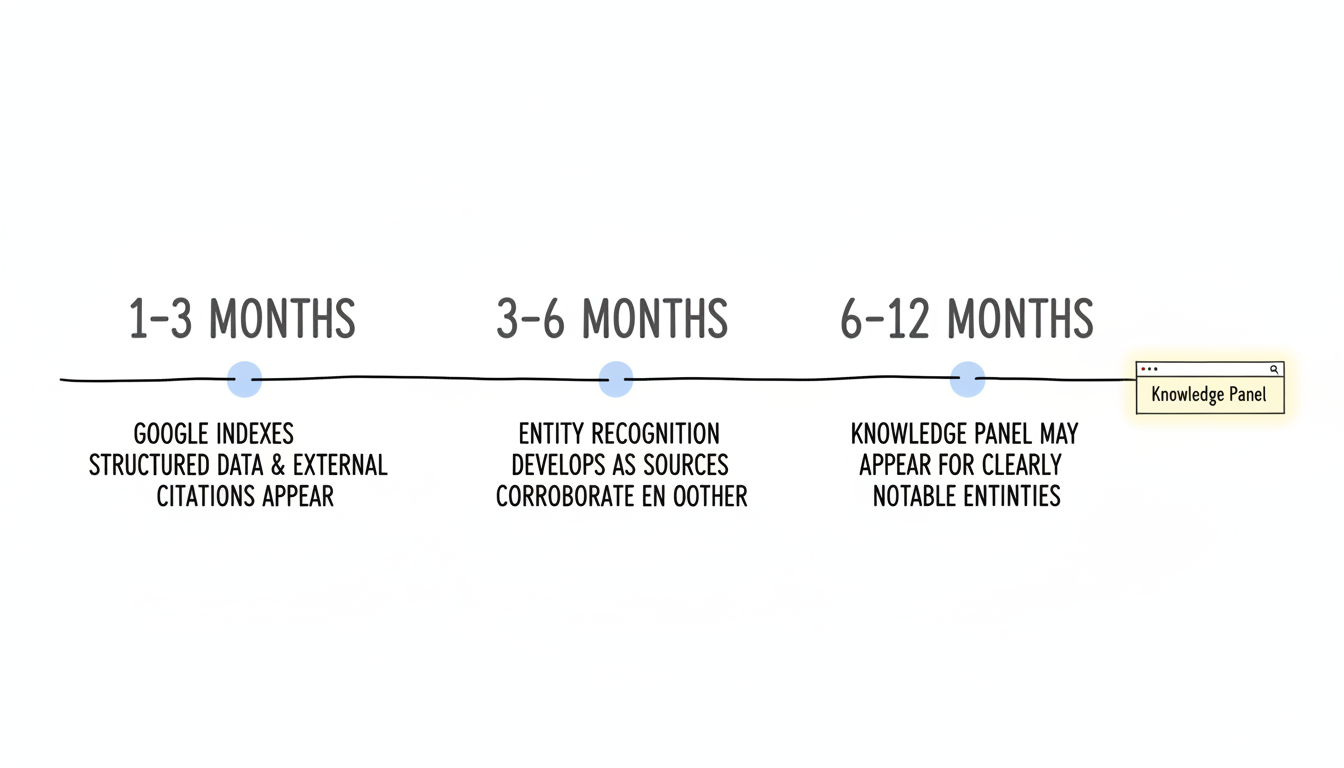
Timeline Expectations
Knowledge Panel creation isn't instant. Expect:
- 1-3 months: Google indexes your structured data and citations
- 3-6 months: Entity recognition develops if eligibility requirements are met
- 6-12 months: Panel may appear for clearly notable entities (70% of Wikipedia-listed entities get one within this window)
Some entities wait years before panels appear. Others with strong existing notability get panels quickly. The timeline depends on how clearly you meet Google's criteria.
Why Knowledge Panels Matter in 2026
Beyond search visibility, Knowledge Panels signal entity recognition that AI systems reference. How knowledge panels benefit your business: they improve visibility in AI-generated answers, build customer trust, and reinforce E-E-A-T signals across all your content.
Understanding how to get Google Knowledge Panel presence is increasingly important as AI Overviews, ChatGPT, and Perplexity all draw from Knowledge Graph data when answering brand-related queries. ChatGPT, Perplexity, and Google's AI features draw from Knowledge Graph data. Entities with established Knowledge Panel presence appear more frequently and accurately in AI-generated answers. This makes Knowledge Panels a critical component of generative engine optimization best practices.
AI Overviews and Knowledge Graph Integration
Google's AI Overviews—the AI-generated summaries at the top of many search results—pull entity data from the Knowledge Graph. When an AI Overview references a company or person, it draws on the same structured entity data that powers Knowledge Panels.
Entities with strong Knowledge Graph presence are cited 2x more frequently and more accurately in these AI-generated answers.
The 2025 Knowledge Graph Cleanup
In June 2025, Google executed its largest Knowledge Graph cleanup, removing over 3 billion low-quality entities to improve AI accuracy. Entities with weak or inconsistent corroboration were most affected.
This cleanup made surviving entities significantly more valuable. For entities removed, it raised the bar for re-entry—making consistent corroboration across authoritative sources even more critical.
GEO and Entity-Level Visibility
Generative Engine Optimization (GEO) optimizes for AI-generated results across Google, ChatGPT, Perplexity, and other AI systems. A Knowledge Panel is the foundation of any GEO strategy—Google's confirmation that your entity is real, notable, and understood.
Without entity recognition in the Knowledge Graph, AI systems have no structured data to reference when generating answers about your brand.
Building E-E-A-T and Entity Recognition
Google's E-E-A-T framework (Experience, Expertise, Authoritativeness, Trust) directly connects to entity recognition. A Knowledge Panel demonstrates that Google considers your entity authoritative enough to warrant structured representation.
This entity-level trust signal reinforces the E-E-A-T evaluation of all content associated with your brand, creating a positive feedback loop between entity recognition and content credibility.
Investing in Knowledge Panel qualification isn't just about the panel itself—it's about establishing the entity presence that modern search systems recognize and reference.
Key Takeaways
The following points distill the essential steps and insights from this guide on how to get Google Knowledge Panel recognition for your brand.
- Google does not offer a paid or direct path to a Knowledge Panel—it must be earned through entity recognition.
- Build corroboration across 30 or more authoritative sources to establish the confidence score needed for panel creation.
- Implement Organization or Person schema with sameAs links to accelerate entity disambiguation.
- Wikipedia is powerful but not required—a detailed Wikidata entry and 20+ independent citations can achieve the same result.
- After Google creates your panel, claim it through Search Console to gain management access.
- In June 2025, Google removed 3 billion low-quality entities from the Knowledge Graph—only consistently corroborated entities survived.
Frequently Asked Questions
Common questions about getting, claiming, and managing a Google Knowledge Panel—answered concisely.
How Do I Get My Google Knowledge Panel?
You cannot directly create a Google Knowledge Panel—Google automatically generates panels for entities it recognizes as notable. To earn one, build a strong web presence, implement structured data markup, create citations on Wikipedia and Wikidata, and ensure all entity information is verifiable from independent sources.
What Is a Google Knowledge Panel?
A Google Knowledge Panel is an information box that appears on the right side of Google search results when someone searches for a recognized entity—a person, company, organization, or thing. It displays key facts like descriptions, images, social profiles, and related entities, pulling data from Google's Knowledge Graph database.
Should I Claim My Google Knowledge Panel?
Yes. Claiming your Knowledge Panel through Google's verification process gives you the ability to suggest edits, update images, and report inaccuracies. While Google reviews all suggested changes and doesn't guarantee acceptance, claiming your panel is the only way to have any direct influence over the information displayed.
Where Did My Google Knowledge Panel Go?
Knowledge Panels can disappear when your Entity Home is moved or deleted, Google's Knowledge Graph cleanup removes weak entities, policy violations occur, or entity confusion triggers re-evaluation. Verify your Entity Home is live, resubmit structured data in Search Console, and check for manual actions.
Are Knowledge Panels Available for Everyone?
No. Knowledge Panels are not available for everyone—Google only creates them for entities it recognizes as notable in its Knowledge Graph. Individuals, businesses, and organizations must meet notability thresholds through significant independent coverage, verifiable information, and consistent citations across authoritative sources before Google will generate a panel.
Can I Get a Knowledge Panel for Free?
Yes, Knowledge Panels are entirely free ($0 cost). Google creates them automatically based on entity recognition—there is no paid option to purchase or expedite one. The real investment is the time spent building web presence, citations, and structured data.
Does Wikipedia Guarantee a Knowledge Panel?
No. Wikipedia significantly increases your chances since it's a primary Knowledge Graph source, but it doesn't guarantee a panel. Entities can earn Knowledge Panels without Wikipedia by building 30+ corroborating sources that consistently confirm entity information across authoritative platforms.