
Last Updated: January 2026
AI search engines like ChatGPT, Perplexity, and Google AI Overviews have changed how people find information. Instead of returning lists of links, these platforms generate direct responses by synthesizing content from across the web. Optimizing for AI search engines requires specific approaches that differ from traditional SEO.
This guide explains practical steps for improving your visibility in AI-generated responses.
How AI Search Engines Find Content
Understanding how AI search works helps inform optimization strategies.
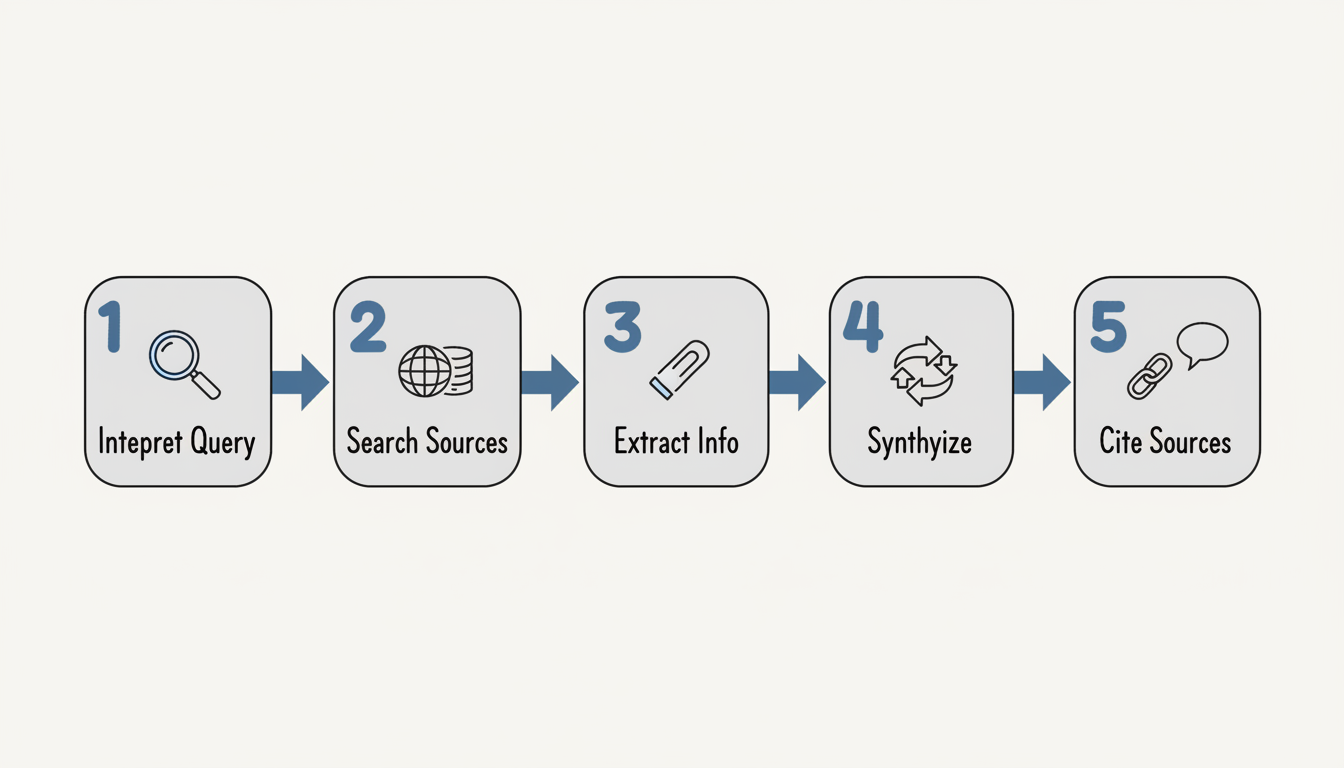
The AI Response Process
When users ask AI search engines questions, these platforms:
- Interpret the query: Understand what the user is actually asking
- Search for sources: Crawl or reference indexed content related to the query
- Extract relevant information: Pull specific facts, statements, and data
- Synthesize a response: Combine extracted information into a coherent answer
- Cite sources: Reference where information came from (when configured to do so)
Your optimization goal is making your content easy for each of these steps.
What AI Engines Evaluate
AI search engines favor content that:
- Directly answers questions users are asking
- Contains accurate, verifiable information that can be trusted
- Comes from authoritative sources with demonstrated expertise
- Is structured clearly so specific statements can be extracted
- Stays current with updated information
These factors differ somewhat from traditional ranking signals.
Technical Optimization Steps
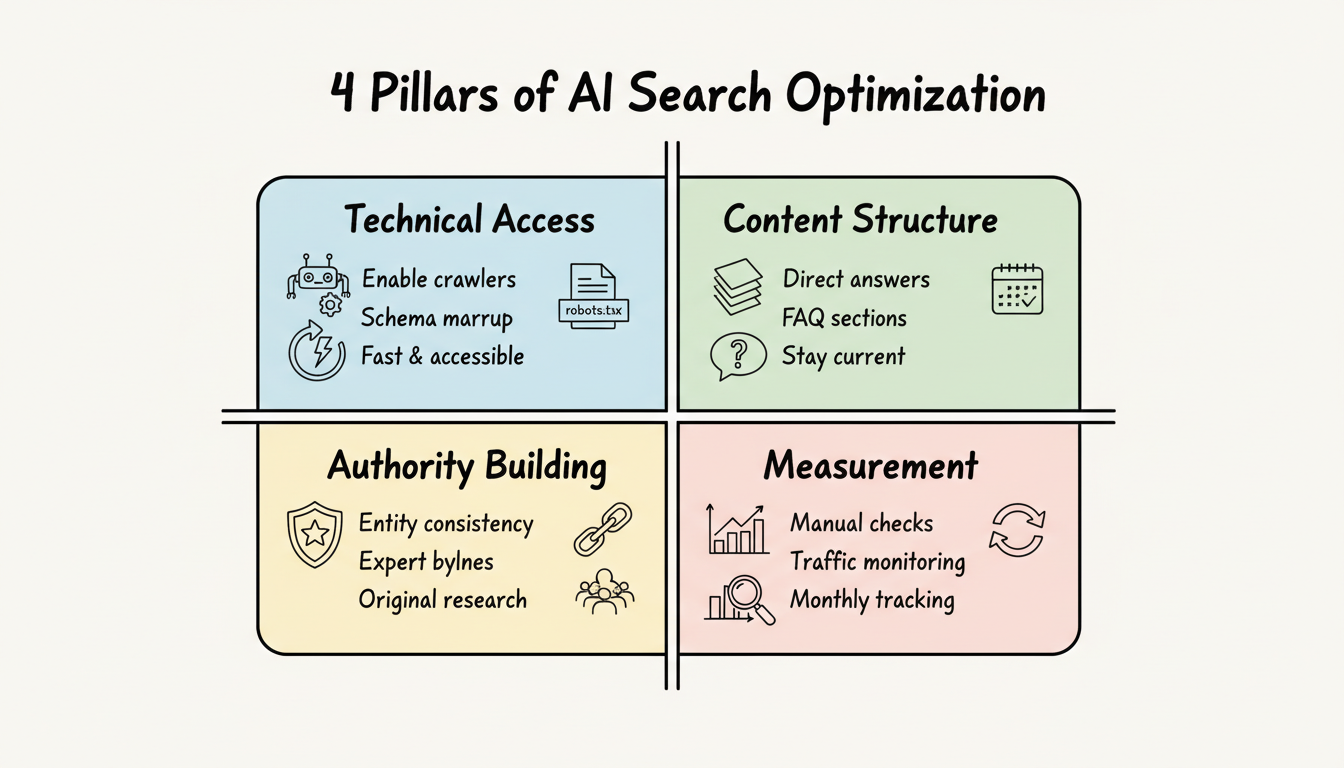
Start with technical foundations that enable AI access.
Enable AI Crawlers
AI platforms use specific crawlers to access content. Check your robots.txt file to ensure these aren't blocked:
User-agent: GPTBot
Allow: /

User-agent: ChatGPT-User
Allow: /

User-agent: PerplexityBot
Allow: /

User-agent: ClaudeBot
Allow: /
If you've blocked these crawlers, AI platforms cannot include your content in responses.
Ensure Content Accessibility
AI crawlers need direct access to content:
- Avoid JavaScript-only rendering: Content should be available in initial HTML
- Don't require login or authentication for content you want cited
- Maintain fast page load times: Slow pages may not be fully crawled
- Use clean URL structures: Avoid complex parameters or session IDs
Test by viewing your pages with JavaScript disabled to see what crawlers encounter.
Implement Schema Markup
Structured data helps AI systems understand your content:
FAQ Schema: Marks question-answer pairs for easy extraction
{
  "@type": "FAQPage",
  "mainEntity": [{
    "@type": "Question",
    "name": "Your question here",
    "acceptedAnswer": {
      "@type": "Answer",
      "text": "Your answer here"
    }
  }]
}
Article Schema: Provides context about your content
- Author information and credentials
- Publication and update dates
- Organization attribution
Organization Schema: Establishes entity identity across your site.
Content Optimization Steps
Structure content for AI extraction and citation.
Write Clear, Direct Answers
AI engines extract specific statements to cite. Many businesses implementing AI SEO services find that restructuring content for extraction significantly improves citation rates. Optimize by:
- Leading with answers: Put the direct answer in your first sentence after each heading, then elaborate
- Keeping paragraphs short: Under 80 words allows extraction of complete statements
- Making statements standalone: Each paragraph should make sense if quoted independently
- Including specifics: Numbers, data, and concrete details get cited more frequently
Before: "There are many factors that influence pricing in this industry, and it really depends on what you're looking for and your specific situation."
After: "Industry pricing typically ranges from $5,000 to $25,000 depending on scope. Small projects start around $5,000, while comprehensive programs reach $25,000 or more."
Use Question-Based Headings
Format headings as questions users actually ask:
- "How much does [topic] cost?"
- "What is [concept]?"
- "How do you [action]?"
- "Why does [thing] matter?"
This alignment increases chances that your content matches query interpretation.
Include FAQ Sections
Dedicated FAQ sections perform well for AI citation:
- Compile questions your audience actually asks
- Provide concise, direct answers (under 100 words each)
- Cover related questions beyond your main topic
- Update with new questions as they emerge
FAQs give AI engines pre-formatted question-answer pairs.
Maintain Freshness
AI engines evaluate content recency:
- Include visible "Last Updated" dates
- Update important content quarterly or when topics change
- Remove or correct outdated information
- Cover recent developments in your topic area
Stale content loses citation priority over time.
Authority Building Steps
AI engines assess source trustworthiness when selecting citations.
Establish Entity Consistency
Ensure your brand information matches across platforms:
- Google Business Profile
- LinkedIn company page
- Wikipedia (if applicable)
- Industry directories
- Social media profiles
Inconsistent information confuses AI systems about your identity.
Demonstrate Expertise
Build signals that indicate topic authority:
- Author credentials: Include expert bylines with relevant qualifications
- Comprehensive coverage: Address topics thoroughly across multiple pages
- External validation: Earn mentions from recognized industry sources
- Original research: Publish unique data or analysis others reference
Build Traditional Authority
Strong SEO performance supports AI citation. Content ranking well in traditional search often gets cited more frequently by AI engines. Understanding what is AEO in marketing helps bridge the gap between traditional optimization and AI-specific approaches. Maintain solid SEO foundations while adding AI-specific optimization.
Measuring Your AI Search Visibility
Track whether optimization efforts work.
Manual Checking
Test your visibility directly:
- Identify questions your content should answer
- Ask these questions in ChatGPT, Perplexity, and Google AI Overviews
- Note whether your brand or content gets cited
- Document competitive citations for comparison
- Repeat monthly to track changes
Traffic Monitoring
Watch referral traffic from AI platforms in your analytics. Look for traffic from:
- chat.openai.com (ChatGPT)
- perplexity.ai
- AI-attributed Google referrals
Growing AI referral traffic indicates improving visibility. Consider conducting an AI overview impact analysis to quantify changes in visibility and traffic patterns.
Key Takeaways
Technical access comes first. If AI crawlers can't reach your content, optimization efforts are wasted. Verify crawler access before other work.
Content structure matters significantly. AI engines extract specific statements. Short, direct, standalone paragraphs get cited more than dense text.
Authority influences citation. AI engines consider source trustworthiness. Build entity consistency and expertise signals through comprehensive AEO strategy framework implementation.
Measurement enables improvement. Without tracking visibility, you can't know what works. Build manual and automated monitoring habits.
Structuring Pages for Multimodal AI Extraction
AI engines now pull from more than prose. Label images with descriptive alt text that states the point, not "image1", because vision-capable models read it. Keep tables and lists semantically clean so a fact can be lifted as a row rather than re-parsed from a paragraph. Add concise captions under diagrams that restate the takeaway in a sentence a model can quote. The goal is the same as text extraction - let any unit of content stand alone and stay accurate when lifted out of context - but applied to every element on the page, not just the words.
Citation Hygiene and Link Strategy
What you link to shapes how AI judges your trust. Cite primary sources - studies, official docs, original data - rather than secondary blog posts, because the citation chain is part of the credibility signal. Use descriptive anchor text that names the destination so an extracted sentence keeps its context. Avoid broken or redirected links; a source AI cannot verify weakens the claim it supports. Internal links to your own pillar content also help engines map your topical depth, so connect each post into the cluster it belongs to instead of leaving it isolated.
Pitfalls That Suppress AI Citations
The same habits that hurt traditional SEO hit AI visibility harder. Thin pages that restate what every competitor says add no extractable value and get skipped. Keyword-stuffed, artificially repetitive phrasing reads as low-quality to a model trained to detect it. Blocking crawlers in robots.txt or gating content behind a login removes you from the source pool entirely. And mismatched structured data - schema that contradicts the page - erodes the exact trust you are trying to build. Clean technical access, original substance, and consistent markup are what keep a page in the cited set as the algorithms shift.
FAQs
How Long Does AI Search Optimization Take to Show Results?
Technical changes like crawler access can impact visibility within weeks. Content restructuring typically shows changes in 1-3 months as AI systems re-crawl and re-evaluate your content. Authority building takes 6-12 months for meaningful impact.
Does Traditional SEO Still Matter for AI Search?
Yes. AI search engines often reference content that performs well in traditional search. Strong SEO foundations support AI citation success. The disciplines are complementary rather than competitive.
Which AI Search Engine Should I Prioritize?
Focus on ChatGPT and Perplexity first due to their search volumes. Google AI Overviews matter for users who start on Google. Optimization tactics largely overlap across platforms, so improvements benefit all.