
Looking to grow your brand on Instagram but don't have time to manage campaigns yourself? An Instagram ads agency handles everything from strategy to execution—so you can focus on your business while experts drive results.
In this guide, we'll explain what Instagram advertising services include, why Instagram is worth the investment in 2026, how professional agencies approach campaign management, and what results you can expect.
Instagram Advertising Services
A full-service Instagram ads agency provides end-to-end campaign management. Here's what professional Instagram advertising services typically include:
Strategy Development
Before launching any ads, agencies develop a comprehensive strategy:
- Audience research – Identifying your ideal customers on Instagram
- Competitor analysis – Understanding what's working in your space
- Goal setting – Defining KPIs (conversions, ROAS, reach, engagement)
- Budget planning – Allocating spend across campaigns and objectives
- Creative direction – Planning ad formats and messaging themes
Campaign Setup and Management
The technical execution of your campaigns:
- Account structure – Organizing campaigns, ad sets, and ads effectively
- Pixel and tracking – Ensuring accurate conversion tracking via Meta Pixel and Conversions API
- Audience building – Creating custom, lookalike, and interest-based audiences
- Ad creation – Developing creatives optimized for Instagram placements
- A/B testing – Testing variables to improve performance continuously
Creative Production
Great Instagram ads require scroll-stopping creative:
- Static images – Eye-catching visuals designed for feed and Stories
- Video ads – Short-form content for Reels and Stories placements
- Carousel ads – Multi-image sequences for product showcases
- UGC content – Authentic creator-style content that performs
- Copy and CTAs – Compelling messaging that drives action
Video Production
Video is the highest-performing format on Instagram in 2026. Our Instagram ads agency invests heavily in video production capabilities including scripting, shooting, and editing optimized for each placement—9:16 vertical for Reels and Stories, 1:1 square for Feed, and 16:9 landscape for in-stream. Whether leveraging in-house production resources or partner studio capabilities, every video asset is built to stop the scroll and drive action within the first three seconds.
Optimization and Reporting
Ongoing management that improves results over time:
- Daily monitoring – Watching key metrics and adjusting bids
- Performance optimization – Scaling winners, pausing underperformers
- Creative refresh – Preventing ad fatigue with new content
- Regular reporting – Transparent updates on spend, results, and insights
- Strategic recommendations – Data-driven suggestions for improvement
Why Instagram Ads
Instagram remains one of the most effective advertising platforms in 2026. Here's why brands invest in Instagram advertising:
Massive, Engaged Audience
According to Instagram statistics for 2026, the platform has over 2 billion active users worldwide. That's a massive audience actively engaging with content daily.
But reach isn't everything—Instagram users are highly engaged. Research shows that Instagram profiles achieve engagement rates between 2% and 7%, significantly higher than most social platforms.
Unmatched Visual Impact
Instagram is built for visual storytelling. As noted by business experts, Instagram's business benefits include “high-impact visual formats (Reels, Stories, Carousels) that drive engagement” and “shoppable posts that shorten the path to purchase.”
Unlike text-heavy platforms, Instagram ads blend naturally with organic content—users actually want to see visually compelling ads.
Precise Targeting
Through Meta's advertising infrastructure, Instagram offers sophisticated targeting:
- Demographics – Age, gender, location, language
- Interests – Based on Instagram activity and engagement
- Behaviors – Shopping habits, device usage, travel patterns
- Custom audiences – Target your existing customers or website visitors
- Lookalike audiences – Find new users similar to your best customers
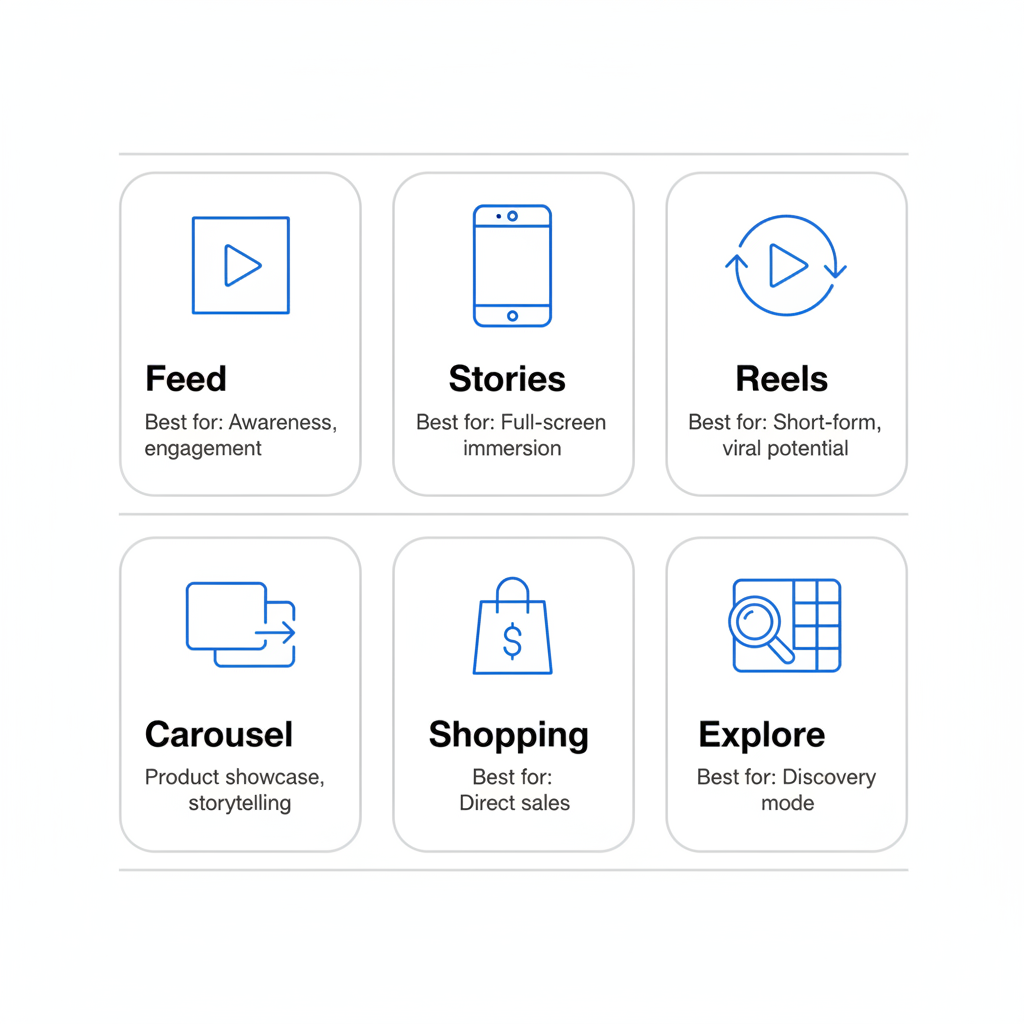
Multiple Ad Formats
Instagram supports diverse ad formats for different objectives:
Format | Best For |
Feed Ads | Brand awareness, engagement |
Stories Ads | Full-screen immersive experiences |
Reels Ads | Short-form video, viral potential |
Carousel Ads | Product showcases, storytelling |
Shopping Ads | Direct product sales |
Explore Ads | Reaching users in discovery mode |
Direct Path to Purchase
According to Instagram statistics, each Instagram ad has the potential to reach 1.32 billion people—that's 16.5% of the world's population. Combined with shoppable posts and direct checkout features, Instagram shortens the path from discovery to purchase.
Our Process
Here's how a professional Instagram ads agency approaches campaign management:
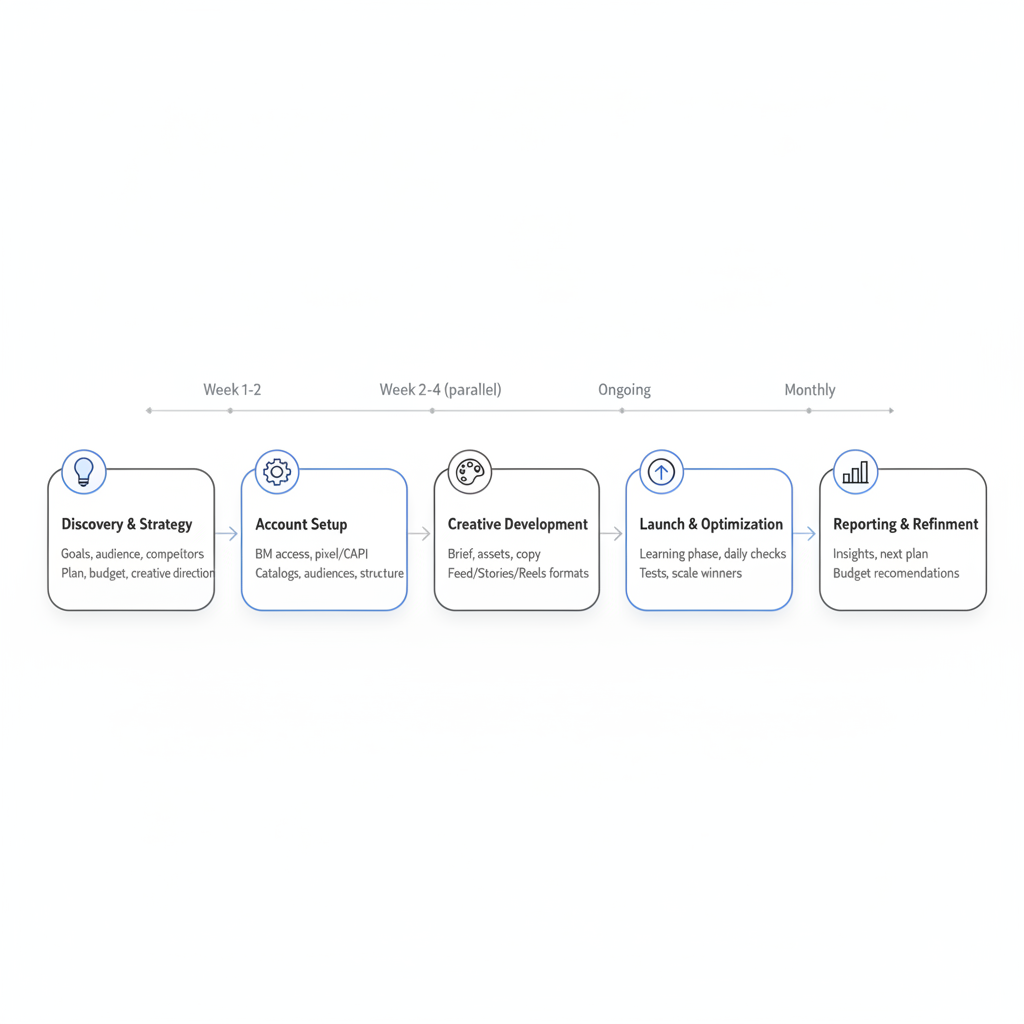
Phase 1: Discovery and Strategy
Week 1-2
We start by understanding your business. During Discovery, you'll be assigned a dedicated account manager who serves as your primary point of contact throughout the engagement:
- Business goals audit – What does success look like?
- Current performance review – What's working? What's not? This includes an organic content audit to evaluate how your existing Instagram presence can complement and amplify paid campaigns.
- Audience definition – Who are your ideal customers?
- Competitive landscape – What are competitors doing on Instagram?
- Creative assessment – What assets do you have? What do we need?
Deliverable: Strategic plan with recommended approach, audiences, and budget allocation.
Phase 2: Account Setup
Week 2-3
Technical foundation for success:
- Business Manager setup – Proper account structure and access
- Pixel installation – Event tracking for accurate measurement
- Catalog connection – For product-based businesses
- Audience creation – Building initial targeting segments
- Campaign structure – Organizing by objective and funnel stage
Deliverable: Fully configured account ready for launch.
Phase 3: Creative Development
Week 2-4 (parallel with setup)
Creating ads that convert:
- Creative brief – Documenting messaging, style, and requirements
- Asset production – Designing images, editing videos
- Copy development – Writing headlines, body text, CTAs
- Format adaptation – Sizing for Feed, Stories, Reels
- Client review – Approval before launch
Deliverable: 5-10+ ad variations ready for testing.
Phase 4: Launch and Optimization
Ongoing
Active campaign management:
- Controlled launch – Starting with test budgets
- Learning phase monitoring – Ensuring proper algorithm training
- Performance tracking – Daily review of key metrics
- Optimization actions – Adjusting bids, audiences, placements
- Creative testing – Introducing new variations weekly
- Scaling decisions – Increasing budget on winners
Deliverable: Weekly performance reports with insights.
Phase 5: Reporting and Strategy Refinement
Monthly
Comprehensive analysis and planning:
- Monthly performance review – Results vs. goals
- Insight extraction – What worked and why
- Next month planning – Updated strategy based on learnings
- Creative refresh – Preventing ad fatigue
- Budget recommendations – Scaling or reallocation suggestions
- Content calendar alignment – Coordinating paid campaigns with your organic posting schedule to maximize reach and consistency
- Community engagement monitoring – Tracking comment sentiment, DM inquiries generated from ads, and audience feedback to inform future campaigns
Deliverable: Monthly report with strategic recommendations.
Results
What can you expect from professional Instagram ads management? While results vary by industry and investment level, here are typical outcomes:
Performance Benchmarks
Metric | Typical Range |
CTR (Click-through rate) | 0.5% - 1.5% |
CPM (Cost per 1,000 impressions) | $5 - $15 |
CPC (Cost per click) | $0.50 - $2.00 |
Conversion rate | 1% - 5% |
ROAS (E-commerce) | 2x - 8x |
What Professional Management Adds
According to social media advertising research, agencies bring expertise that in-house teams often lack:
Time savings – Agencies handle daily management, freeing your team for other priorities.
Platform expertise – Specialists stay current on algorithm changes, new features, and best practices. Similar to how to run meta ads effectively, experienced agencies understand Meta's ecosystem deeply.
Creative resources – Access to designers, copywriters, and video editors.
Testing infrastructure – Systematic A/B testing that improves results over time. This is especially important when you're learning how to run effective Facebook ads across the entire Meta platform.
Cross-platform strategy – The best Instagram ads agencies manage Facebook and Instagram campaigns holistically, not as separate silos. Unified campaign management across Meta's platforms ensures consistent messaging, shared audience insights, and optimized budget allocation between placements.
Objective perspective – Fresh eyes on your brand and campaigns.
Signs You Need an Agency
Consider hiring an Instagram ads agency if:
- You're spending $5,000+ monthly but results are inconsistent
- You don't have in-house expertise on Meta's advertising platform
- Your team doesn't have time to manage campaigns properly
- You're scaling and need professional infrastructure
- You've hit a performance plateau and need fresh strategies
What to Look for in an Agency
When evaluating Instagram advertising agencies:
Meta Partnership – Official Meta Partners have proven expertise and platform access.
Industry experience – Look for experience in your vertical. Whether you need a Facebook ads agency New York or one specialized in your niche, relevant experience matters. The best Facebook ads agencies often excel at Instagram too, given both platforms share Meta's advertising infrastructure.
Transparent reporting – You should see exactly where your money goes.
Creative capabilities – Can they produce high-quality ad content?
Communication – How often will you hear from them? Who's your contact?
Pricing structure – Understand what's included and what costs extra. Use a Facebook ads cost calculator to estimate total investment including agency fees.
Instagram Ads Case Studies and Results
Results matter more than promises. Here are real examples of what our Instagram ads agency has achieved for clients across different verticals.
Ecommerce: DTC Skincare Brand
Challenge: A direct-to-consumer skincare brand was spending $15,000/month on Instagram ads with a 1.8x ROAS—barely breaking even after product costs and shipping. Their creative was stale, audiences were fatigued, and they had no retargeting infrastructure beyond basic website visitor campaigns.
Strategy: We rebuilt their account structure around a full-funnel approach. Top-of-funnel Reels ads featuring UGC creator content drove awareness. Mid-funnel carousel ads showcased before-and-after results. Bottom-funnel dynamic product ads recovered abandoned carts with urgency messaging. We also implemented engagement-based lookalike audiences from their highest-performing organic Reels.
Results: Within 4 months, we scaled the brand from $42,000 to $127,000 in monthly revenue while achieving a 6.2x ROAS. Cost per acquisition dropped 54%, and we increased ad spend to $28,000/month profitably.
Timeline: 4 months from kickoff to scaled results.
B2B SaaS: Lead Generation Campaign
Challenge: A mid-market SaaS company had written off Instagram as “not a B2B platform.” Their previous attempts generated leads at $180+ CPL with poor quality—sales rejected over 60% of leads as unqualified.
Strategy: We deployed Instagram lead gen ads with custom higher-intent forms that included qualifying questions about company size, budget, and timeline. CRM integration with HubSpot enabled automated lead scoring and instant follow-up sequences. Creative featured short customer testimonial clips and platform demo snippets in Reels format, targeting decision-makers by job title and company size.
Results: Reduced cost per qualified lead by 47% to $96 CPL. Lead quality improved dramatically—sales acceptance rate rose from 40% to 78%. The campaign generated an average of 85 qualified leads per month at steady state.
Timeline: 60 days to optimize lead quality; 90 days to reach steady-state volume.
Local Service: Multi-Location Fitness Brand
Challenge: A fitness brand with 8 locations needed to drive membership sign-ups in specific geographic areas. Previous campaigns used broad targeting and generic creative, resulting in high impression volume but low conversion rates and $45+ cost per lead.
Strategy: We built location-specific campaigns with radius targeting around each gym. Creative featured real members and trainers from each location for authenticity. Instagram Stories ads with swipe-up lead forms captured contact info with minimal friction. We layered engagement retargeting—anyone who watched 50%+ of a gym tour video received a limited-time offer ad within 72 hours.
Results: Generated 320+ qualified leads per month across all locations at $12 average CPL. Membership conversion rate from lead to sign-up reached 23%, and the brand expanded to 2 additional locations based on the campaign's geographic demand data.
Timeline: 6 weeks to optimize per-location targeting; 3 months to full scale.
Influencer Marketing and Creator Partnerships
Influencer marketing is no longer separate from paid advertising—it's a core component of any high-performing Instagram ads agency strategy. Brands that combine organic creator content with paid amplification consistently outperform those running traditional ads alone.
Influencer Identification and Vetting
Finding the right creators starts with data, not follower counts. We evaluate potential partners based on audience demographics, engagement authenticity, content quality, and brand alignment. Micro-influencers (10K-100K followers) often deliver better ROI than mega-influencers because their audiences are more engaged and trust their recommendations.
Partnership Management
Managing influencer relationships requires structure. This includes negotiation and contracting, detailed content briefs that align creator output with campaign objectives, approval workflows that maintain brand standards without stifling authenticity, and ongoing relationship management for long-term partnerships that compound results over time.
Paid Amplification of Creator Content
The real power of influencer marketing comes from combining organic reach with paid distribution. Through Meta's Branded Content Ads (Partnership Ads), we whitelist influencer posts and run them as paid ads—reaching audiences far beyond the creator's followers. This approach typically sees 30-50% higher engagement rates than brand-created ads because the content feels native and authentic.
UGC at Scale
Not every campaign needs a full influencer partnership. UGC-style content—authentic, creator-produced creative shot in a casual, relatable style—can be sourced at scale through creator networks. This gives your Instagram ads agency a steady pipeline of fresh, high-performing creative without the overhead of traditional influencer deals.
Performance Tracking
Attribution and ROI measurement for influencer-driven campaigns requires proper tracking infrastructure. We implement unique UTM parameters, dedicated landing pages, and promo codes per creator to measure true impact. Combined with Meta's conversion tracking, this provides a clear picture of which partnerships drive actual revenue. For broader context on how creator content fits into your overall marketing approach, explore these social media strategies for growth.
Instagram Lead Generation Ads
Instagram lead gen ads are one of the most underutilized tools in the platform's arsenal. For businesses that need leads rather than direct sales, these native in-app forms remove friction and drive significantly higher conversion rates than sending traffic to external landing pages.
How Instagram Lead Gen Ads Work
When a user taps your ad, a lead form opens directly within Instagram—no browser redirect, no page load time. The form pre-fills with information from the user's Facebook/Instagram profile (name, email, phone number), making submission nearly effortless. This native experience keeps users in the app and typically converts 2-3x better than equivalent landing page funnels.
Lead Form Design Best Practices
Form design directly impacts both volume and quality. Best practices include strategic question sequencing (start with easy questions, progress to qualifying ones), using conditional logic to branch based on answers, limiting pre-filled fields to reduce junk submissions, and adding custom questions that filter for intent. A well-designed form balances conversion rate with lead quality—too few fields generates volume but wastes sales time; too many fields kills conversion rate.
CRM Integration and Automation
The real value of Instagram lead gen ads comes from what happens after submission. Real-time lead sync to your CRM—whether Salesforce, HubSpot, or via Zapier—ensures instant follow-up. Research shows that contacting a lead within 5 minutes increases qualification rates by 400%. Our Instagram ads agency configures automated sequences that trigger immediately upon form submission, including confirmation emails, SMS follow-ups, and sales team notifications. For more on maximizing your CRM setup, see these tips to maximize your CRM investment.
Lead Quality Optimization
Volume means nothing if leads don't convert. Higher-intent form configurations—using more qualifying questions, custom disclaimers, and review screens before submission—filter out casual browsers and deliver leads that your sales team actually wants to call. We continuously test form variations to find the optimal balance between volume and quality for each client's sales process.
B2B vs. B2C Lead Gen Strategies
B2B and B2C lead generation require fundamentally different approaches on Instagram. B2B campaigns target by job title, company size, and industry—using lead magnets like whitepapers, webinars, and free trials. B2C campaigns leverage broader interest targeting with offers like consultations, quotes, and exclusive promotions. The form design, follow-up cadence, and qualification criteria differ significantly between the two models.
Retargeting and Remarketing Campaigns
Retargeting is where Instagram advertising delivers its highest ROI. Most first-time visitors don't convert—retargeting brings them back when they're ready to buy. A skilled Instagram ads agency builds layered retargeting funnels that guide prospects from awareness through purchase.
Website Visitor Retargeting
Meta Pixel-based audiences let you re-engage anyone who visited your website. The key is segmentation by time window—7-day visitors see urgency messaging, 30-day visitors see social proof, and 90-day visitors see re-engagement offers. Page-specific retargeting (product pages, pricing pages, checkout pages) allows highly relevant messaging that matches where each visitor dropped off. For creative inspiration on retargeting ads, check out these meta ads examples that convert.
Cart Abandonment Recovery
For ecommerce brands, cart abandonment retargeting is often the single highest-ROI campaign type. Dynamic product ads automatically show the exact items a shopper left behind, paired with sequential messaging—a reminder within 24 hours, a social proof ad at 48 hours, and a limited-time incentive at 72 hours. Well-executed cart recovery campaigns typically achieve 8-15x ROAS.
Engagement-Based Retargeting
Instagram provides rich engagement signals beyond website visits. You can build audiences from users who visited your Instagram profile, watched a percentage of your videos, opened a lead form without submitting, saved your posts, or engaged with your content. These warm audiences convert at significantly higher rates than cold traffic because they've already expressed interest in your brand.
Customer List Retargeting
CRM upload audiences let you target existing customers and email subscribers directly on Instagram. This is powerful for cross-selling, upselling, loyalty campaigns, and win-back sequences for lapsed customers. Match rates on Meta typically range from 40-70% depending on data quality.
Funnel-Stage Targeting
Different funnel stages require different creative and offers. Awareness audiences see educational content and brand storytelling. Consideration audiences see product demonstrations, comparisons, and testimonials. Conversion audiences see direct offers, urgency messaging, and social proof. Each stage gets tailored ad copy, creative format, and call-to-action aligned with the prospect's readiness to buy.
Exclusion Audiences
Smart retargeting isn't just about who you target—it's about who you exclude. Suppressing recent purchasers (7-30 day windows), excluding converted leads from acquisition campaigns, and removing employees or existing customers from prospecting reduces wasted spend and improves frequency management across your account.
Instagram Ecommerce and Shoppable Posts
Instagram has evolved from a discovery platform into a full commerce engine. For ecommerce brands, an Instagram ads agency that understands the platform's shopping infrastructure can dramatically shorten the path from inspiration to purchase.
Instagram Shop Setup
Setting up Instagram Shopping requires proper product catalog configuration through Meta Commerce Manager. This includes syncing your product feed (from Shopify, WooCommerce, BigCommerce, or manual upload), categorizing products, ensuring policy compliance, and choosing between in-app checkout and website redirect. Proper setup ensures your products appear correctly across all shopping surfaces.
Shoppable Posts and Product Tags
Product tagging transforms every organic and paid post into a storefront. Tagging products in Feed posts, Stories, and Reels lets users tap to view product details, pricing, and purchase options without leaving the content. Brands that consistently tag products see 37% higher product page visits compared to those relying solely on link-in-bio strategies.
Dynamic Product Ads
Dynamic product ads automatically serve personalized product recommendations based on each user's browsing and purchase history. Your product catalog feeds the ad system, which matches the right products to the right people—showing recently viewed items, complementary products, or bestsellers in categories they've browsed. This automation delivers relevance at scale without manual ad creation for each product.
Collection Ads
Collection ads pair a hero image or video with a product grid below, creating a curated shopping experience within the ad unit. These are particularly effective for seasonal launches, category showcases, and lifestyle-driven product discovery. Users can browse multiple products without leaving Instagram, reducing the steps to purchase.
Checkout Optimization
The choice between Instagram's in-app checkout and redirecting to your website impacts conversion rates significantly. In-app checkout reduces friction but limits data capture and post-purchase experience control. Website redirect provides full analytics and retargeting capabilities but adds load time and steps. The right approach depends on your business model, average order value, and how critical post-purchase email flows are to your customer lifecycle.
Landing Page Optimization for Instagram Ads
The best Instagram ad in the world fails if the landing page doesn't convert. Post-click experience is where many brands lose money—high CPCs driven by poor landing page performance that wastes ad spend. A comprehensive Instagram ads agency optimizes the entire funnel, not just the ad itself.
Mobile-First Landing Pages
Over 98% of Instagram traffic comes from mobile devices. Your landing pages must be designed mobile-first, not adapted from desktop. This means fast load times (under 3 seconds), thumb-friendly CTA buttons, minimal form fields, compressed images, and a single clear action per page. Every additional second of load time reduces conversions by approximately 7%.
Message Match
Visual and copy consistency between your ad creative and landing page is critical for conversion. If your ad features a specific product image and discount offer, the landing page hero must mirror that exact imagery and offer. Mismatched experiences create cognitive dissonance and dramatically increase bounce rates. For a proven framework on structuring high-converting pages, review this landing page structure to drive leads.
Conversion Rate Optimization
Systematic CRO turns good landing pages into great ones. Key elements include strategic social proof placement (reviews, testimonials, trust badges near CTAs), form length optimization (fewer fields for top-of-funnel, more qualifying fields for high-value offers), urgency elements that are genuine (limited inventory, time-sensitive pricing), and clear value propositions above the fold. Even small improvements compound—a 1% conversion rate lift on $50K monthly spend can mean thousands in additional revenue. For more conversion optimization strategies, see how to double your conversion rates.
A/B Testing Post-Click
Most advertisers A/B test their ads but never test their landing pages. Testing headline variations, hero images, CTA button copy, form placement, and social proof elements on the landing page often yields larger performance gains than ad-level optimization because post-click conversion rates have a wider variance and more room for improvement.
Platform-Specific Considerations
Instagram opens links in an in-app browser, which behaves differently from native mobile browsers. This affects cookie persistence, tracking accuracy, and user experience. Deep linking configuration ensures users with your app installed go directly to the relevant in-app experience. Understanding these technical nuances prevents tracking gaps and provides a seamless user journey from ad to conversion.
Instagram Advertising Costs in 2026
Understanding Instagram advertising costs helps you budget realistically and evaluate agency performance. Costs vary significantly by industry, objective, audience, and time of year—but here are the benchmarks and frameworks that matter.
Average Instagram Ad Costs
Metric | Average Range | Notes |
CPM | $5 - $15 | Higher for competitive audiences (finance, insurance) |
CPC | $0.50 - $2.00 | Varies by ad quality and relevance score |
CPL (Lead Gen) | $5 - $50 | Depends on form length and targeting |
CPA (Ecommerce) | $10 - $75 | Heavily influenced by AOV and product type |
What Affects Instagram Ad Costs
Several factors drive cost variation. Audience competition is the biggest—targeting high-income professionals in finance costs 3-5x more than broad interest targeting. Ad quality and relevance score directly impact delivery costs; higher-quality ads earn lower CPMs. Placement selection matters too—Reels and Stories placements often cost less than Feed. Seasonality creates spikes during Q4 (holiday shopping), back-to-school, and Valentine's Day. Campaign objective affects pricing as well—conversion-optimized campaigns cost more per impression but less per result.
Monthly Budget Recommendations
Realistic monthly investment tiers for Instagram advertising:
- Starter ($1,000-$3,000/month): Best for testing and learning. Enough to run 2-3 campaigns, identify winning audiences, and establish baseline metrics. Expect limited reach but valuable data.
- Growth ($3,000-$10,000/month): The sweet spot for most businesses. Supports full-funnel campaigns (awareness + retargeting), creative testing, and meaningful optimization. Most businesses see positive ROI at this tier with professional management.
- Scale ($10,000+/month): For brands ready to aggressively grow. Supports multiple campaign types, influencer amplification, dynamic product ads, and advanced audience segmentation. Professional agency management is essential at this spend level to maintain efficiency.
Agency Fees on Top of Ad Spend
Agency management fees are separate from your ad spend budget. Common structures include flat monthly retainers ($1,500-$10,000+ based on scope and spend level), percentage of ad spend (typically 10-20%), or hybrid models combining a smaller retainer with a performance percentage. When evaluating total investment, factor in both ad spend and management fees. Most agencies require minimum ad spend commitments ($3,000-$5,000/month) to ensure enough budget for proper testing and optimization.
How to Reduce Instagram Ad Costs
The most effective way to lower Instagram ad costs is improving ad quality—higher relevance scores earn lower CPMs. Specific tactics include refreshing creative frequently (every 2-3 weeks) to combat ad fatigue, refining audiences based on conversion data rather than assumptions, implementing retargeting (which consistently delivers the lowest cost per result), testing new placements like Reels which often have lower competition, and optimizing landing pages to improve conversion rates—which effectively lowers your cost per acquisition even if CPCs stay the same.
Frequently Asked Questions
How Much Do Instagram Ads Agencies Charge?
Pricing varies widely. Common models include: monthly retainer ($1,500-$10,000+ depending on scope), percentage of ad spend (10-20% of your budget), or hybrid (smaller retainer plus percentage). Total investment depends on your ad budget—most agencies require minimum $3,000-$5,000 monthly ad spend to see meaningful results. Understanding meta advertising cost helps you budget appropriately for both ad spend and agency fees.
Can I Run Instagram Ads Without an Agency?
Yes, you can manage Instagram ads yourself through Meta Ads Manager. However, agencies bring expertise, time, and resources that typically improve results. If you're spending under $2,000/month, self-management may be fine. Above $5,000/month, professional management often pays for itself through improved efficiency and ROAS.
How Long Until I See Results from Instagram Ads?
Expect 2-4 weeks to exit the learning phase and see initial performance data. Meaningful optimization takes 60-90 days as the algorithm learns and agencies refine targeting and creative. Major results—like significant ROAS improvement or scaled revenue—typically emerge within 3-6 months of consistent investment.
What'S the Difference Between Instagram Ads and Facebook Ads?
Both run through Meta Ads Manager and share the same targeting infrastructure. The difference is placement—Instagram ads appear on Instagram (Feed, Stories, Reels, Explore), while Facebook ads appear on Facebook properties. Most agencies run campaigns across both platforms, letting Meta optimize delivery based on performance.
How Much Do Instagram Ads Cost per Month?
Monthly Instagram advertising costs depend on your goals, industry, and audience size. Most businesses invest between $1,000 and $50,000+ per month in ad spend alone. At the starter level ($1,000-$3,000), you can test audiences and creative but reach is limited. The growth tier ($3,000-$10,000) supports full-funnel campaigns and meaningful optimization. At scale ($10,000+), you can run multiple campaign types including retargeting, dynamic product ads, and influencer amplification. Add agency management fees (typically $1,500-$10,000/month or 10-20% of spend) on top. Most businesses begin seeing positive ROI at $3,000+/month with professional management. See the Instagram Advertising Costs in 2026 section above for detailed benchmarks and budget recommendations.
Do Instagram Ads Agencies Also Manage Influencer Campaigns?
Yes, most full-service Instagram ads agencies handle influencer marketing as part of their offering. This typically includes influencer identification and vetting based on audience demographics and engagement quality, outreach and contract negotiation, content brief development, and paid amplification of creator content through Meta's Branded Content Ads. The most effective approach combines organic influencer reach with paid distribution—whitelisting creator posts as ads to reach audiences far beyond their follower base. See our Influencer Marketing and Creator Partnerships section for more detail.
What Industries Get the Best Results from Instagram Ads?
Ecommerce and DTC brands, beauty, fashion, food and beverage, fitness, travel, and real estate consistently perform strongest on Instagram due to their visual product appeal and impulse-purchase potential. However, B2B and SaaS companies can also achieve strong results using Instagram lead gen ad formats—we've seen B2B clients reduce cost per qualified lead by 40-50% compared to other channels. The key is matching your ad format and creative approach to your business model rather than assuming Instagram is only for consumer brands. Our case studies include examples across both B2C and B2B verticals.
Can Instagram Ads Generate Leads, Not Just Sales?
Absolutely. Instagram lead gen ads use native in-app forms that pre-fill user information (name, email, phone) from their profile, resulting in significantly higher completion rates than external landing page forms. These leads sync directly with CRMs like Salesforce and HubSpot for automated follow-up sequences. The key to quality is form design—adding qualifying custom questions filters out casual browsers while keeping submission friction low. Both B2B and B2C businesses use Instagram lead gen ads successfully for consultations, quotes, demo requests, event registrations, and more. See our Instagram Lead Generation Ads section for the full strategy breakdown.