
With TikTok's ad revenue projected to reach $43.96 billion by 2026, brands are pouring money into the platform. But is TikTok advertising actually worth it for your business?
The answer depends on your industry, audience, and goals. This guide breaks down TikTok's real ROI potential with current benchmarks, success stories, and a practical framework to help you decide whether TikTok ads deserve a place in your marketing budget.
TikTok Advertising ROI Overview
TikTok has matured from an experimental channel into a serious advertising platform. The data shows strong performance for brands that fit the platform's strengths.
ROAS Benchmarks for 2026
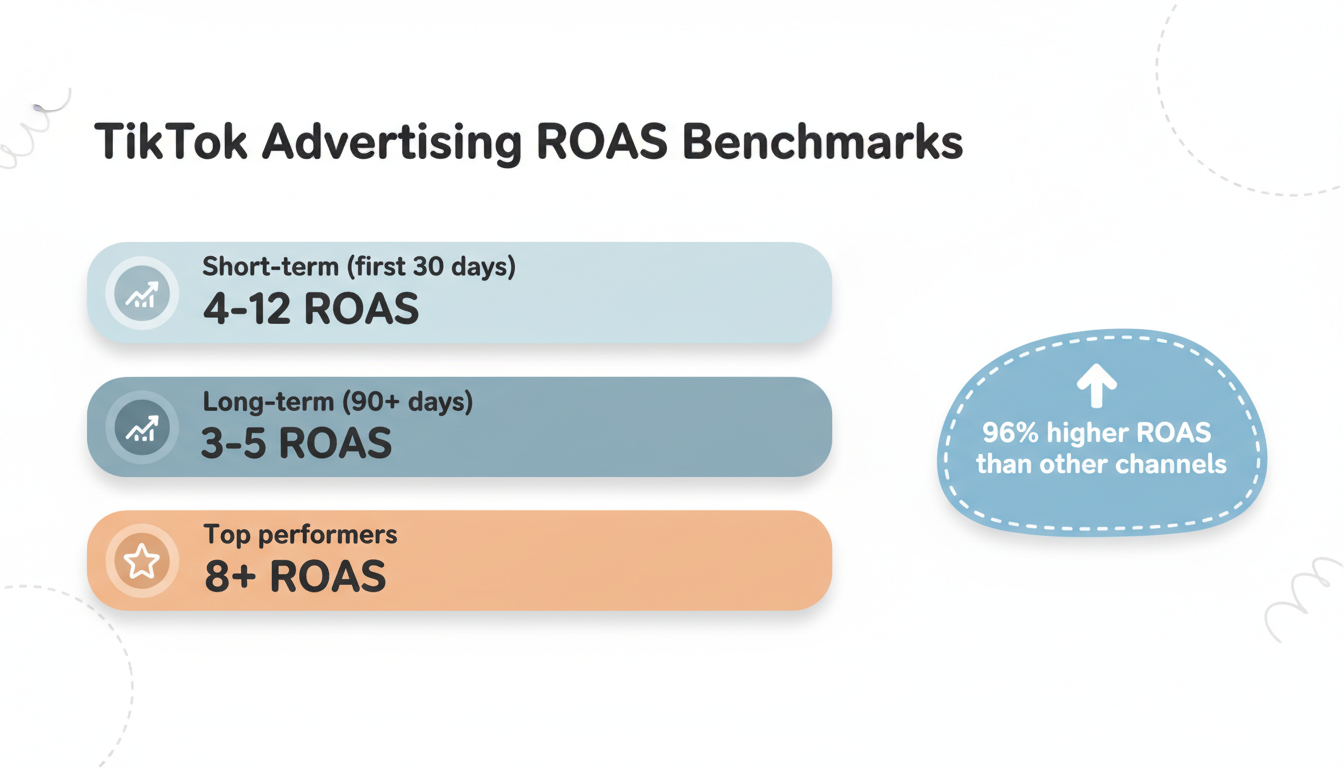
Return on Ad Spend (ROAS) varies significantly based on campaign maturity and optimization:
Timeframe | ROAS Range | Notes |
Short-term (first 30 days) | 4 – 12 | Initial testing phase |
Long-term (90+ days) | 3 – 5 | Sustainable performance |
Top performers | 8+ | Optimized creative and targeting |
According to Nielsen research, TikTok delivers 96% higher ROAS than other digital channels on average. For more detailed benchmarks across different industries, check out our TikTok ROAS benchmarks analysis. This positions TikTok as one of the most efficient paid media options available.
Platform Performance Metrics
TikTok's unique position in the advertising landscape comes from several factors:
- Discovery intent: 56% of users open TikTok specifically to discover something new
- Product discovery: 15% of all product discoveries happen on TikTok
- Purchase influence: 67% of users say TikTok inspires them to shop
- Ad engagement: TikTok ads achieve 6% average engagement rates, significantly higher than other platforms
Cost Efficiency
Compared to Meta and Google, TikTok often delivers lower costs. To understand the full pricing landscape, read our comprehensive TikTok ads pricing guide for 2026:
Platform | Average CPM | Average CPC |
TikTok | $3.50 | $0.50 – $1.50 |
Meta (Facebook/Instagram) | $6.59 | $0.70 – $2.00 |
Google Display | $4.00 – $8.00 | $1.00 – $3.00 |
This cost advantage means your testing budget goes further on TikTok, allowing more creative experimentation before scaling winners.
TikTok Ad Formats and Their ROI Potential
Not all TikTok ad formats deliver the same returns. Understanding the strengths of each format helps you allocate budget where it drives the most value. For creative inspiration across these formats, explore the TikTok Creative Center guide.
Spark Ads (Highest ROI Format)
Spark Ads are TikTok's native ad format that boosts existing organic posts -- either your brand's own TikTok content or creator posts -- as paid advertisements. They appear as native For You Page (FYP) content and retain all social proof including likes, comments, and shares.
Spark Ads deliver 142% higher engagement rates compared to standard In-Feed Ads, according to TikTok for Business. This performance advantage comes from their native appearance: users interact with them the same way they engage with organic content. Spark Ads are best suited for UGC-driven brands, DTC e-commerce, and creator partnership campaigns.
In-Feed Ads
In-Feed Ads are the standard video ad format appearing directly in users' For You Page feed. These full-screen vertical videos run 5-60 seconds with sound on by default, matching the native TikTok experience.
Typical In-Feed Ad costs run $3-6 CPM and $0.50-$1.50 CPC, making them accessible for most budgets. They work best for driving traffic, conversions, and app installs at scale. For conversion-focused campaigns, use oCPA (Optimized Cost Per Action) bidding to let TikTok's algorithm optimize delivery toward your target action. For a full breakdown of costs across formats, see our TikTok ads cost breakdown for 2026.
Topview and Brand Takeover Ads
TopView ads are the first ad users see when opening TikTok, running up to 60 seconds with autoplay and sound. Brand Takeover ads display a full-screen static image or video on app open, limited to one advertiser per day per category.
These are premium placements with premium pricing: Brand Takeovers typically cost $50,000-$150,000 per day. They deliver massive reach and are best suited for product launches and large-scale brand awareness campaigns where share of voice matters more than direct-response efficiency.
Branded Hashtag Challenges
Branded Hashtag Challenges are sponsored campaigns that encourage user-generated content participation around a specific theme or activity. The typical investment starts at $150,000 or more for a 6-day campaign.
The ROI angle for hashtag challenges is earned media value: user participation creates free content that extends your campaign reach well beyond the paid period. Adding Branded Effects (interactive AR experiences) as an add-on can further boost participation rates and shareability.
Ad Format Comparison
Format | Typical CPM | Best Objective | Min Budget | ROI Potential |
Spark Ads | $3-6 | Conversions, engagement | $50/day | Highest (native feel) |
In-Feed Ads | $3-6 | Traffic, conversions | $50/day | High |
TopView | Premium | Brand awareness | ~$65,000 | Medium (awareness) |
Brand Takeovers | Premium | Reach, launches | ~$50,000/day | Medium (awareness) |
Branded Hashtag Challenges | Premium | UGC, engagement | ~$150,000 | Variable (earned media) |
TikTok Ads vs Facebook Ads: Which Platform Delivers Better ROI?
One of the most common questions advertisers face is whether to invest in TikTok or Facebook. The answer depends on your audience, objectives, and where you are in the marketing funnel.
Head-To-Head Performance Comparison
TikTok and Meta differ across every major performance metric. TikTok delivers lower CPMs ($3.50 average vs Meta's $6.59) and significantly higher engagement rates, making it more cost-efficient for awareness and discovery campaigns. Average CTR on TikTok runs 1.0-3.0% compared to Meta's 0.9-1.5%.
Facebook's advantages lie in targeting maturity: Lookalike Audiences, detailed Custom Audiences, and deeper retargeting capabilities drive higher conversion rates (CVR) for bottom-of-funnel campaigns. Facebook also maintains stronger B2B reach and broader demographic coverage.
One important nuance: attribution windows differ between platforms. TikTok defaults to 7-day click-through and 1-day view-through attribution, similar to Meta's standard settings. However, the platforms count conversions differently, so comparing ROAS numbers directly requires careful normalization.
When to Choose TikTok Over Facebook
TikTok outperforms Facebook when your target audience skews under 35, your products are visually compelling, and your brand can produce UGC-friendly content. The platform also wins when you're experiencing diminishing returns on Meta with rising CPMs.
User sentiment data supports TikTok's unique position: 83% of TikTok users find the platform's ads entertaining, and 68% say TikTok ads feel different from advertising on other platforms, according to TikTok Marketing Science research. This receptivity translates directly into higher engagement and lower scroll-past rates.
When to Choose Facebook Over TikTok
Facebook remains the stronger choice for B2B campaigns, audiences aged 45 and older, products with long sales cycles, and businesses that depend heavily on detailed Custom Audience and Lookalike Audience segmentation. Facebook's retargeting depth -- including cross-platform tracking via the Meta Pixel and Conversions API -- gives it an edge for mid-to-bottom funnel optimization.
Best Strategy: Use Both
Most brands achieve the best overall ROI by using TikTok for top-of-funnel discovery and Facebook for retargeting and conversion. TikTok drives awareness and introduces your brand to new audiences through the path to purchase, while Facebook captures that demand with retargeting sequences.
This dual-platform approach means your TikTok ROAS in isolation may look lower than Facebook's, but the combined customer acquisition cost often drops. For a more detailed platform comparison including Instagram, see our TikTok ads vs Instagram ads 2026 analysis.
TikTok Targeting and Retargeting Strategies for Maximum ROI
Effective targeting is the difference between profitable TikTok campaigns and wasted spend. The platform offers several audience-building tools that rival Meta's capabilities.
Custom Audiences and Retargeting
TikTok Custom Audiences let you retarget users based on customer list uploads, TikTok Pixel website visitor data, in-app activity, and engagement with your TikTok content. Key retargeting use cases include cart abandoners, video viewers (segmented by 25%, 50%, or 75% completion), and page visitors.
Retargeting audiences on TikTok typically deliver 2-3x higher conversion rates (CVR) than prospecting campaigns, making them essential for maximizing overall campaign ROAS. Configure Custom Audiences in TikTok Ads Manager under the Audiences section.
Lookalike Audiences
TikTok's Lookalike Audiences use algorithmic expansion from seed audiences -- such as Custom Audiences or pixel event data -- to find new users who share similar characteristics. You can choose Narrow (1%), Balanced (5%), or Broad (10%) audience sizes.
Unlike Meta, where narrow Lookalike Audiences often outperform broader ones, TikTok's algorithm tends to perform better with larger audience pools. Start with Broad targeting and let the algorithm optimize. The primary scaling lever for most advertisers is proven creative combined with Lookalike Audiences based on purchasers.
Interest and Behavior Targeting
TikTok offers interest categories, behavioral signals, and creator interaction targeting for prospecting campaigns. However, broad targeting often outperforms detailed interest targeting on TikTok due to the strength of the FYP algorithm in identifying high-intent users.
The recommended approach: start with broad targeting during your initial testing phase, then layer in Lookalike Audiences and retargeting as you accumulate pixel data. This lets TikTok's algorithm do what it does best while you build the audience infrastructure for scaling.
Attribution and Measurement: Understanding Your True TikTok ROI
The ROAS numbers throughout this article depend heavily on how you measure them. Understanding attribution windows and advanced metrics prevents misinterpreting your campaign performance.
TikTok Attribution Windows Explained
TikTok's default attribution window is 7-day click-through and 1-day view-through. This means any conversion within 7 days of a click or 1 day of a view gets attributed to your TikTok campaign.
Changing from 7-day to 1-day click attribution can reduce reported ROAS by 30-50%, which is important context when comparing TikTok performance against other channels. Use 7-day click for campaign optimization (it gives TikTok's algorithm more signal), but validate with 1-day click for apples-to-apples comparison with Meta.
New Customer Metrics: NCROAS and NCPA
NCROAS (New Customer Return on Ad Spend) calculates ROAS using only revenue from new customers, while NCPA (New Customer Cost Per Acquisition) measures the cost to acquire each new buyer. Standard ROAS can be inflated when retargeting campaigns convert existing customers who would have purchased anyway.
For TikTok, where much of the value comes from reaching entirely new audiences, NCROAS is a more accurate measure of platform ROI. Healthy NCROAS benchmarks for DTC brands on TikTok are 2:1-3:1 -- lower than blended ROAS, but representing genuinely incremental revenue.
Third-Party Attribution Tools
For the most accurate measurement, supplement TikTok's native reporting with third-party tools. Triple Whale is the leading attribution platform for DTC brands, offering server-side tracking that compensates for iOS privacy changes and cross-platform attribution modeling.
TikTok Shop's native Product Tagging provides built-in attribution via product links in videos, useful for brands selling directly on the platform. For non-Shop campaigns, use UTM parameters combined with server-side events for the most accurate measurement.
One additional consideration: TikTok ads typically experience creative fatigue faster than Meta ads, with performance declining after 7-14 days versus 21-30 days on Meta. Monitor creative performance weekly and have a pipeline of fresh content ready to rotate in.
Success Stories and Case Studies
Real results from brands demonstrate TikTok's ROI potential across different verticals.
Jones Road Beauty: $7,000/Day to 5.8x NCROAS
Jones Road Beauty, the DTC beauty brand founded by Bobbi Brown, provides one of the most compelling TikTok advertising success stories. The brand scaled TikTok ad spend from $500/day to $7,000/day while maintaining a 5.8x NCROAS -- meaning every dollar spent generated $5.80 in revenue from entirely new customers.
Their strategy centered on Spark Ads using creator UGC content, paired with Lookalike Audiences built from purchaser data. By using Triple Whale for attribution, Jones Road Beauty confirmed that TikTok was their most efficient new customer acquisition channel, outperforming both Meta and Google for incremental revenue.
E-Commerce and DTC Brands
E-commerce brands consistently see strong TikTok performance with Spark Ads and In-Feed Ads driving the majority of DTC conversions. For a detailed breakdown of how e-commerce brands achieve these results, explore our TikTok advertising case study for e-commerce:
Fashion and Apparel:
- ROAS range: 4:1 – 6:1
- TikTok Shop integration drives 50% higher conversion rates versus link-out ads
Beauty and Cosmetics:
- ROAS range: 4:1 – 7:1
- UGC and creator content outperforms studio-produced ads by 2-3x
Consumer Electronics:
- ROAS range: 3:1 – 5:1
- Product demonstration videos drive highest engagement
TikTok Shop Performance
Brands using TikTok Shop see additional lift, with Product Tagging providing native attribution for in-platform purchases:
- Average order value 15-25% higher than external checkout
- Reduced cart abandonment due to native checkout
- Live shopping events can generate 10x daily sales volume
App Install Campaigns
Mobile apps achieve competitive CPIs on TikTok, with In-Feed Ads serving as the primary format for app install campaigns. If you're running app campaigns, our TikTok advertising for apps and user acquisition guide provides campaign-specific strategies:
- Gaming apps: $1.50 – $4.00 CPI
- Utility apps: $2.00 – $5.00 CPI
- Shopping apps: $1.00 – $3.00 CPI
The platform's young, mobile-native audience converts well for app install objectives.
When TikTok Ads Work Best
TikTok advertising delivers strongest results in specific scenarios.
Ideal Product Characteristics
Your product is well-suited for TikTok if it:
- Has visual appeal: Products that look interesting on video perform best
- Solves a clear problem: Demo-able benefits drive conversions
- Targets ages 18-44: TikTok's core demographic
- Has impulse purchase potential: Products under $100 convert fastest
- Works for UGC: Products creators can authentically recommend
Ideal Business Scenarios
TikTok ads work best when you:
- Have creative capacity: TikTok requires constant content refresh (every 2-3 weeks)
- Can move fast: Trend-jacking opportunities require quick turnaround
- Accept native aesthetics: Polished ads underperform authentic content
- Have testing budget: Plan for $1,500-3,000 minimum to gather meaningful data
- Can handle volume: Viral moments can spike demand unexpectedly
Industries with Proven Success
Based on industry benchmark data, these verticals consistently perform well. For fashion brands specifically, our TikTok advertising for fashion brands guide covers style-specific strategies:
Industry | Expected ROAS | Key Success Factors |
E-commerce/Retail | 3:1 – 5:1 | Product demos, UGC, TikTok Shop |
Fashion | 4:1 – 6:1 | Try-on videos, outfit inspiration |
Beauty | 4:1 – 7:1 | Tutorials, before/after content |
Food & Beverage | 3:1 – 5:1 | Recipe content, taste tests |
Home Goods | 4:1 – 6:1 | Organization, transformation videos |
Fitness | 3:1 – 5:1 | Workout content, results showcases |
When TikTok Ads Might Not Work
TikTok isn't the right platform for every business. Consider alternatives if:
Audience Mismatch
- Your target is 55+: While TikTok's audience is aging, it's still predominantly younger
- B2B enterprise sales: Long sales cycles and committee decisions don't fit TikTok's model
- Highly regulated industries: Financial services, healthcare, and legal face creative restrictions
Product Limitations
- High-consideration purchases: Items requiring extensive research (cars, homes, enterprise software)
- Non-visual services: Abstract offerings that don't translate to video
- Luxury with exclusivity messaging: TikTok's democratic vibe can conflict with aspirational positioning
Resource Constraints
- Limited creative bandwidth: If you can't produce new content weekly
- Small testing budgets: Under $1,000/month limits learning
- Slow approval processes: TikTok trends move faster than most corporate review cycles
Warning Signs During Testing
If you experience these during initial campaigns, TikTok may not be viable:
- CPMs consistently above $15 after optimization
- CPA 3x higher than other channels after learning phase
- Creative fatigue within 1 week despite refresh
- Audience targeting yields irrelevant engagement
Calculating Your Potential ROI
Use this framework to estimate TikTok's ROI potential for your business.
Step 1: Establish Baseline Metrics
Gather your current performance data:
- Average order value (AOV)
- Conversion rate from paid traffic
- Customer lifetime value (LTV)
- Current best-performing channel ROAS
Step 2: Apply TikTok Benchmarks
Use industry benchmarks to project performance:
Projected Monthly Revenue = (Monthly Budget / Average CPM × 1000) × CTR × Conversion Rate × AOVExample Calculation:
- Monthly budget: $3,000
- CPM: $6.00 (conservative estimate)
- CTR: 1.5% (TikTok average)
- Conversion rate: 2% (industry average)
- AOV: $75
Impressions: $3,000 / $6.00 × 1000 = 500,000
Clicks: 500,000 × 1.5% = 7,500
Conversions: 7,500 × 2% = 150
Revenue: 150 × $75 = $11,250
ROAS: $11,250 / $3,000 = 3.75
Your first 30-60 days will have higher costs:
- Weeks 1-2: Expect 50% higher CPA while algorithm learns
- Weeks 3-4: Performance should stabilize
- Month 2+: Optimization should improve metrics 15-30%
Step 4: Consider Long-Term Value
TikTok often shows stronger halo effects than other platforms:
- Brand awareness lift from organic reach
- User-generated content from customers
- Search volume increases for branded terms
Making the Decision
Decision Framework
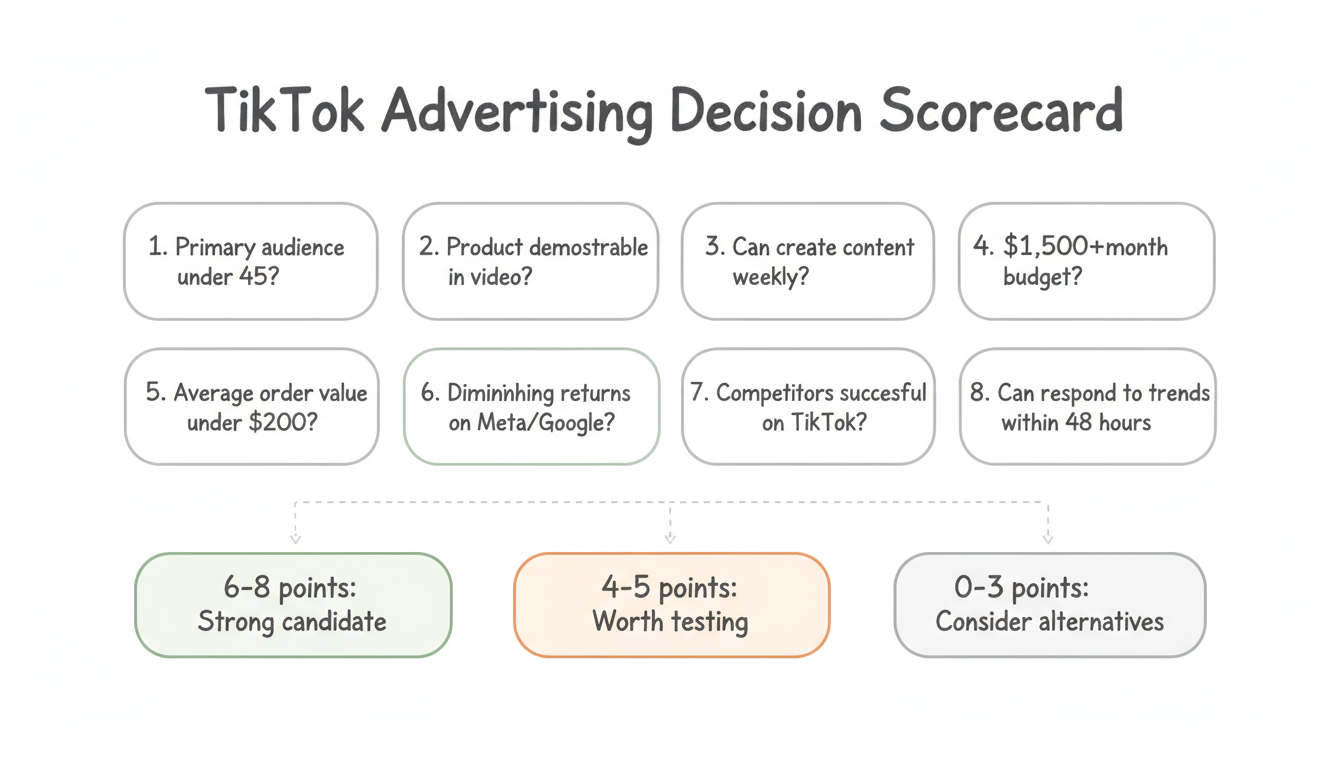
Answer these questions to determine if TikTok is worth testing:
Score 1 point for each "Yes":
- Is your primary audience under 45?
- Can your product be effectively demonstrated in video?
- Do you have capacity to create new content weekly?
- Can you invest at least $1,500/month for 2-3 months?
- Is your average order value under $200?
- Are you seeing diminishing returns on Meta/Google?
- Do competitors advertise successfully on TikTok?
- Can your team respond to trends within 48 hours?
Scoring:
- 6-8 points: Strong candidate for TikTok ads
- 4-5 points: Worth testing with cautious budget
- 0-3 points: Consider alternative channels first
Recommended Testing Approach
If you decide to test TikTok, our complete guide to TikTok advertising in 2026 provides a comprehensive roadmap. Here's where to start:
- Budget: Start with $1,500-3,000 over 60 days
- Creative: Launch with 4-6 Spark Ads or In-Feed Ads variations using creator UGC or native-style content. Incorporate trending sounds and effects to boost organic distribution of your ads.
- Targeting: Use broad targeting initially in TikTok Ads Manager; layer in Lookalike Audiences based on pixel events after week 2
- Objective: Start with traffic or engagement, move to conversions. Use oCPA bidding for conversion campaigns to let TikTok's algorithm optimize delivery.
- Timeline: Commit to full 60-day evaluation before deciding
- Attribution: Track attribution carefully -- set up 7-day click-through window, and use NCROAS to measure true new customer acquisition
Before launching campaigns, ensure you've properly configured your TikTok pixel setup for accurate conversion tracking. For creative inspiration, browse the TikTok Creative Center to find top-performing ads in your category.
Key Success Metrics to Track
During your test period, monitor performance through TikTok ads reporting and analytics:
- Week 1-2: CTR, CPM, engagement rate
- Week 3-4: CPC, website actions, early conversions
- Month 2: CPA, ROAS, conversion rate trends
A successful test shows improving trends across these metrics, even if absolute numbers don't match other channels yet.
Frequently Asked Questions
Is TikTok Advertising Effective for Small Businesses?
TikTok can be highly effective for small businesses, particularly those with visually appealing products targeting ages 18-44. The platform's lower CPMs mean smaller budgets go further. However, small businesses should budget at least $1,500 for initial testing and have capacity to create authentic, platform-native content regularly.
What ROAS Should I Expect from TikTok Ads?
TikTok ROAS varies by industry but typically ranges from 3:1 to 5:1 for e-commerce brands after optimization. Short-term ROAS during initial testing can reach 4-12, while long-term sustainable ROAS usually settles between 3-5. Top-performing accounts with optimized creative and targeting can achieve 8+ ROAS.
How Long Does It Take to See Results from TikTok Advertising?
Most advertisers need 4-6 weeks to exit the learning phase and see stable performance. Initial results (engagement, traffic) appear within days, but meaningful conversion data typically requires 2-4 weeks. Full optimization usually takes 60-90 days of consistent investment and creative iteration.
What Are Spark Ads and Why Do They Outperform Other TikTok Ad Formats?
Spark Ads are TikTok's native ad format that lets brands boost existing organic posts (their own or creators') as paid ads. They outperform standard In-Feed Ads by 142% on engagement because they retain social proof like likes, comments, and shares. Spark Ads appear naturally in the For You Page, making them feel less like ads and more like organic content.
How Do TikTok Ads Compare to Facebook Ads for ROI?
TikTok typically offers lower CPMs ($3.50 avg vs Meta's $6.59) and higher engagement rates, making it more cost-efficient for awareness and discovery. Facebook excels at detailed retargeting with Custom and Lookalike Audiences and generally delivers higher conversion rates for B2B. Most brands achieve the best overall ROI by using TikTok for top-of-funnel discovery and Facebook for mid-to-bottom funnel conversion.
What Is NCROAS and Why Does It Matter for TikTok Advertising?
NCROAS (New Customer Return on Ad Spend) measures revenue from only new customers divided by ad spend. Unlike standard ROAS, which can be inflated by retargeting existing buyers, NCROAS isolates your true customer acquisition efficiency. For TikTok, where much of the value comes from reaching new audiences, NCROAS is a more accurate measure of platform ROI. Healthy NCROAS for DTC brands on TikTok is typically 2:1-3:1.
Is TikTok Better Than Facebook for Advertising?
TikTok and Facebook serve different strengths. TikTok excels at discovery, brand awareness, and reaching younger audiences with lower CPMs. Facebook offers broader targeting options, better B2B capabilities, and often higher conversion rates. For a full breakdown, see our TikTok ads vs Facebook ads comparison above, or read our TikTok ads vs Instagram ads analysis for platform-specific details. Most brands see best results using both platforms with different objectives.
What'S the Minimum Budget to Test TikTok Ads Effectively?
To gather meaningful data, plan for $1,500-3,000 over 60 days minimum. TikTok's minimum daily budget is $50 per campaign and $20 per ad group. Budgets below $1,000/month typically don't provide enough data for the algorithm to optimize effectively or for you to identify winning creative.