
LinkedIn advertising has become a staple for B2B marketers-but it's not without controversy. High costs, steep learning curves, and mixed results leave many wondering: is LinkedIn advertising actually worth it?
This honest review breaks down the pros, cons, and who should (and shouldn't) advertise on LinkedIn in 2026.
LinkedIn Advertising Overview
Platform: LinkedIn Campaign Manager Best for: B2B companies targeting professionals by job title, company, industry Cost range: $5-15 CPC, $30-60 CPM, $50-200+ CPL Ad formats: Sponsored Content, Message Ads, Text Ads, Dynamic Ads Minimum budget: $10/day (though $50-100/day recommended for meaningful testing)
The Pros of LinkedIn Advertising
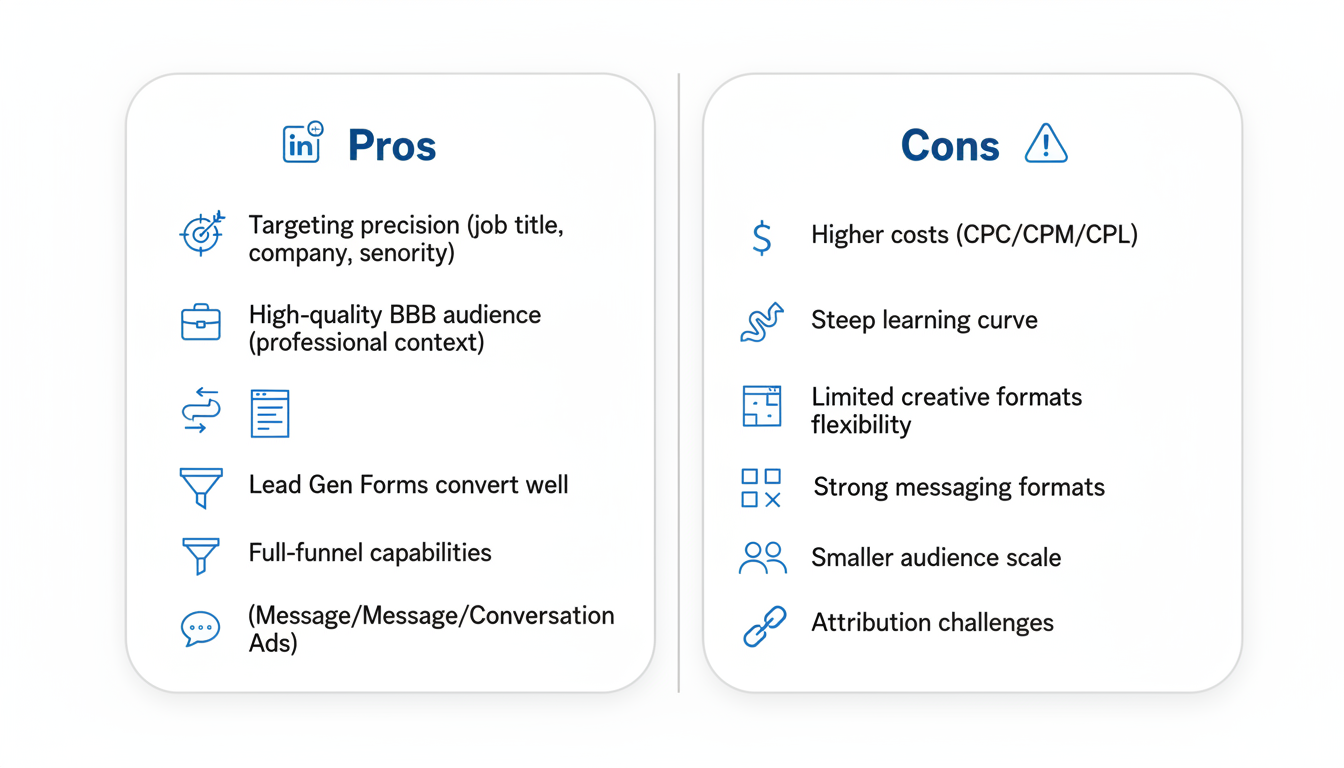
1. Unmatched Professional Targeting
LinkedIn's greatest strength is its targeting precision. You can reach people by:
- Job title: Target "VP of Marketing" specifically
- Company name: Run ABM campaigns to named accounts
- Industry: Focus on tech, finance, healthcare, etc.
- Seniority: Reach decision-makers, not practitioners
- Company size: Target mid-market or enterprise specifically
- Skills: Find people with specific expertise
No other platform offers this level of professional targeting accuracy. Facebook and Google rely on inferred data; LinkedIn has verified, self-reported professional information.
2. High-Quality B2B Audience
LinkedIn's 1 billion members include professionals actively engaged in business context. When someone is on LinkedIn, they're in a professional mindset-more receptive to B2B messaging than when scrolling Instagram or watching YouTube.
According to Hootsuite's research, viewers of LinkedIn's new video formats are 18% more likely to become leads compared to other placements.
3. Lead Gen Forms Work
LinkedIn Lead Gen Forms achieve 2-3x higher conversion rates than traditional landing pages. Pre-filled fields reduce friction significantly, and lead quality tends to be higher because data comes directly from LinkedIn profiles. For companies focused on best LinkedIn ads lead generation practices, these native forms are often the top-performing conversion mechanism.
4. Full-Funnel Capabilities
LinkedIn supports campaigns across the entire funnel:
- Awareness: Brand campaigns, video views
- Consideration: Website traffic, engagement
- Conversion: Lead generation, website conversions
You can build complete B2B marketing funnels within a single platform.
5. Strong Messaging Features
According to industry benchmarks, Message Ads achieve 40-55% open rates-among the highest in digital advertising. Conversation Ads deliver 3x higher reply rates than traditional InMail.
6. Improving Ad Tools
LinkedIn's 2026 Campaign Manager includes:
- AI-powered creative optimization
- Better forecasting tools
- Enhanced attribution reporting
- Accelerate Ads for faster campaign setup
The platform continues closing the gap with Meta and Google on advertising capabilities.
The Cons of LinkedIn Advertising
1. Significantly Higher Costs
This is LinkedIn's biggest drawback. Understanding LinkedIn ads cost is critical before committing budget. Expect:
- CPC: $5-15 (vs $1-3 on Facebook)
- CPM: $30-60 (vs $5-15 on Facebook)
- CPL: $50-200+ (vs $20-50 on Facebook)
For companies with tight budgets, LinkedIn's cost structure can be prohibitive. A $1,000 test budget might generate only 50-100 leads on Meta but just 10-20 on LinkedIn.
2. Steep Learning Curve
Campaign Manager isn't as intuitive as Meta Ads Manager. The interface has improved but still requires significant learning to master:
- Complex targeting combinations
- Multiple ad formats with different specs
- Bidding strategies that differ from other platforms
- Attribution that doesn't always integrate smoothly
3. Limited Creative Flexibility
Compared to Meta, LinkedIn creative options are constrained. Marketers must carefully navigate LinkedIn ad specs sizes and format restrictions:
- Fewer ad format variations
- Less creative testing automation
- Stricter character limits
- Limited dynamic creative options
Creative fatigue sets in faster when you have fewer ways to vary messaging and visuals.
4. Smaller Audience Scale
With 1 billion members, LinkedIn is massive-but compared to Facebook's 3+ billion or Google's entire search volume, it's smaller. Niche B2B targeting can result in audiences too small for meaningful scale.
5. Attribution Challenges
LinkedIn operates as a walled garden, limiting data sharing with external platforms. Cross-channel attribution requires workarounds, and LinkedIn's native attribution may not match your other reporting tools.
6. Inbox Fatigue for Messaging
Message Ads are powerful but overused. Decision-makers receive numerous sponsored messages, leading to declining engagement as the format matures.
LinkedIn Advertising Performance Benchmarks (2026)
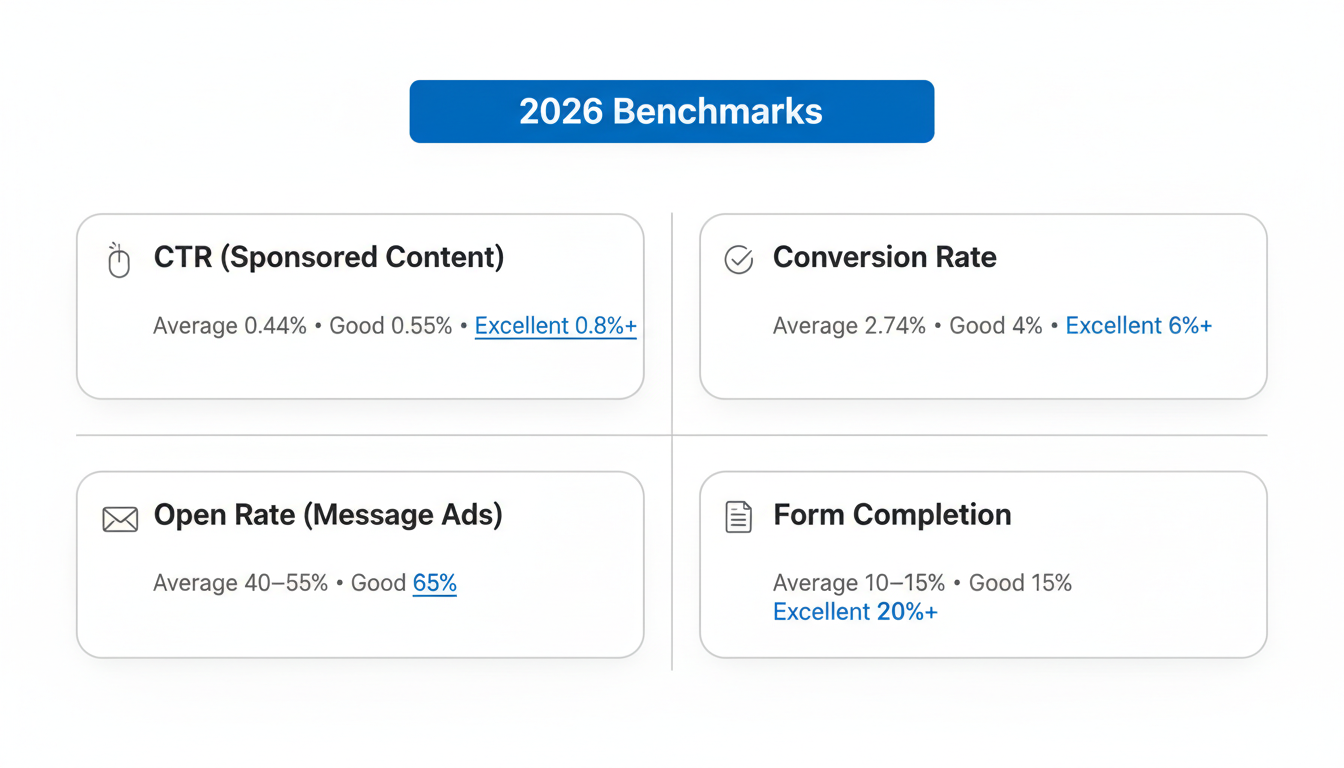
Metric | Average | Good | Excellent |
CTR (Sponsored Content) | 0.44% | 0.55% | 0.8%+ |
Conversion Rate | 2.74% | 4% | 6%+ |
Open Rate (Message Ads) | 40-55% | 55% | 65%+ |
Form Completion | 10-15% | 15% | 20%+ |
Source: LinkedIn Benchmarks Report
Who Should Use LinkedIn Advertising
Ideal For:
B2B companies targeting specific roles: If you need to reach "IT Directors at mid-market financial services companies," LinkedIn is unmatched.
High ACV products: When customer lifetime value is $10,000+, LinkedIn's higher CPL is easily justified.
Account-based marketing: Targeting named accounts is LinkedIn's specialty.
Enterprise sales: Reaching C-suite and senior decision-makers works better on LinkedIn than any other platform.
Professional services: Consultants, agencies, and service providers find qualified prospects here. Many organizations work with a specialized LinkedIn ad agency guide to maximize returns given the platform's complexity.
Not Ideal For:
B2C companies: Limited consumer targeting makes LinkedIn inefficient for most B2C.
Low ACV products: If your product costs $50/month, LinkedIn CPLs of $150+ don't make economic sense.
Limited budgets: Under $3,000/month makes meaningful testing difficult.
Mass-market offerings: If everyone is your customer, LinkedIn's targeting precision isn't useful.
LinkedIn vs. Alternatives
LinkedIn vs. Meta Ads
Factor | Meta | |
B2B targeting | Excellent | Limited |
Cost | High | Low |
Scale | Moderate | Massive |
Creative flexibility | Limited | Extensive |
Best for | BOFU, ABM | TOFU, Scale |
According to 2026 ABM benchmarks, Meta excels at awareness and nurture (TOFU/MOFU), while LinkedIn wins at conversion and deal acceleration (BOFU).
LinkedIn vs. Google Ads
Factor | ||
Intent | Professional context | Active search |
Targeting | Job-based | Keyword-based |
Cost | High | Variable |
Best for | Awareness, nurture | Demand capture |
Our Verdict: Is LinkedIn Advertising Worth It?
Yes, if:
- You're targeting B2B decision-makers
- Your ACV supports $50-200+ cost per lead
- You have $3,000+/month to invest
- You need precise professional targeting
- You're running ABM campaigns
No, if:
- You're targeting consumers
- Your budget is under $1,500/month
- Your product has low lifetime value
- You need mass-market scale
- You can't accept higher CPLs
For most B2B companies with sufficient budget and clear professional audience definitions, LinkedIn advertising delivers ROI that other platforms can't match. The high costs are a feature, not a bug-they filter out competition and deliver genuinely qualified prospects.
Reading the Cost Math for Your Business
The "expensive" critique of LinkedIn only makes sense against the value of what you sell, so the real question is unit economics, not sticker price. Take a concrete case: if your average customer is worth $20,000 in lifetime value and LinkedIn delivers a qualified lead at $150, a 10 percent lead-to-customer rate produces a $1,500 cost per acquisition against $20,000 of revenue -- a return that few channels match. The same $150 cost per lead is disastrous for a $30-per-month product, where the math never closes. Before judging the platform, compute your own allowable cost per lead from deal value, close rate, and margin, then compare it to the benchmarks in this review. LinkedIn is "expensive" only when the audience it reaches is worth less than the click costs; for the right offer it is the cheapest qualified conversation you can buy. That reframe turns the con list into a targeting filter rather than a verdict.
Where LinkedIn Outperforms and Underperforms
The honest split is by funnel stage and by role. LinkedIn wins decisively at the top and bottom of B2B funnels -- building awareness among specific accounts and capturing high-intent decision-makers with Lead Gen Forms -- and it is unrivaled for account-based marketing where the target list is fixed. It underperforms for broad demand generation to a consumer audience, for cheap high-volume lead harvesting, and for creative-led brand plays that need the visual freedom Meta affords. It also underperforms when used as a set-and-forget channel; the platform rewards weekly optimization and creative refresh, and advertisers who treat it like a vending machine see the high CPCs without the qualified pipeline. The verdict in this review -- yes for B2B with budget and fit, no otherwise -- holds, but the nuance is that even within a "yes" business, LinkedIn should own specific stages, not the entire gap between awareness and revenue.
Building a Test Before You Commit
Because the cost of being wrong on LinkedIn is real, the rational move is a bounded test before any annual commitment. Set aside a 90-day window with a defined monthly budget at or above the $3,000 floor this review cites, install the Insight Tag and conversion tracking before day one, and run two campaign types in parallel -- one Lead Gen Form to a strong offer and one Website Visits or Engagement campaign to build retargeting audience. Agree the success metrics up front: cost per qualified lead and downstream close rate, not impressions. At the end of the window, you have a fact-based answer to "is it worth it for us" that no review, including this one, can provide, because the variable that decides it is your offer, your ICP, and your close process. Treat the test as the real product of your research phase; the ads are just the instrument.
Frequently Asked Questions
Is LinkedIn Advertising Effective in 2026?
Yes, for B2B companies. LinkedIn advertising delivers 2.74% average conversion rates and unmatched professional targeting. Effectiveness depends on your audience fit-LinkedIn excels at reaching specific job titles and companies but isn't suitable for B2C or mass-market campaigns.
Why Is LinkedIn Advertising So Expensive?
LinkedIn's professional audience is highly valuable to B2B marketers, creating intense competition for limited inventory. Unlike Facebook's 3+ billion users, LinkedIn's 1 billion professionals mean smaller auction pools. Additionally, LinkedIn's data accuracy justifies premium pricing-you're paying for verified professional information, not inferred demographics.
How Much Should I Spend on LinkedIn Ads?
Plan for $3,000-5,000/month minimum for meaningful testing. At $50-200 per lead, smaller budgets don't generate enough data to optimize. Most successful B2B advertisers spend $10,000-50,000/month on LinkedIn, scaling to $100,000+ for enterprise programs.