
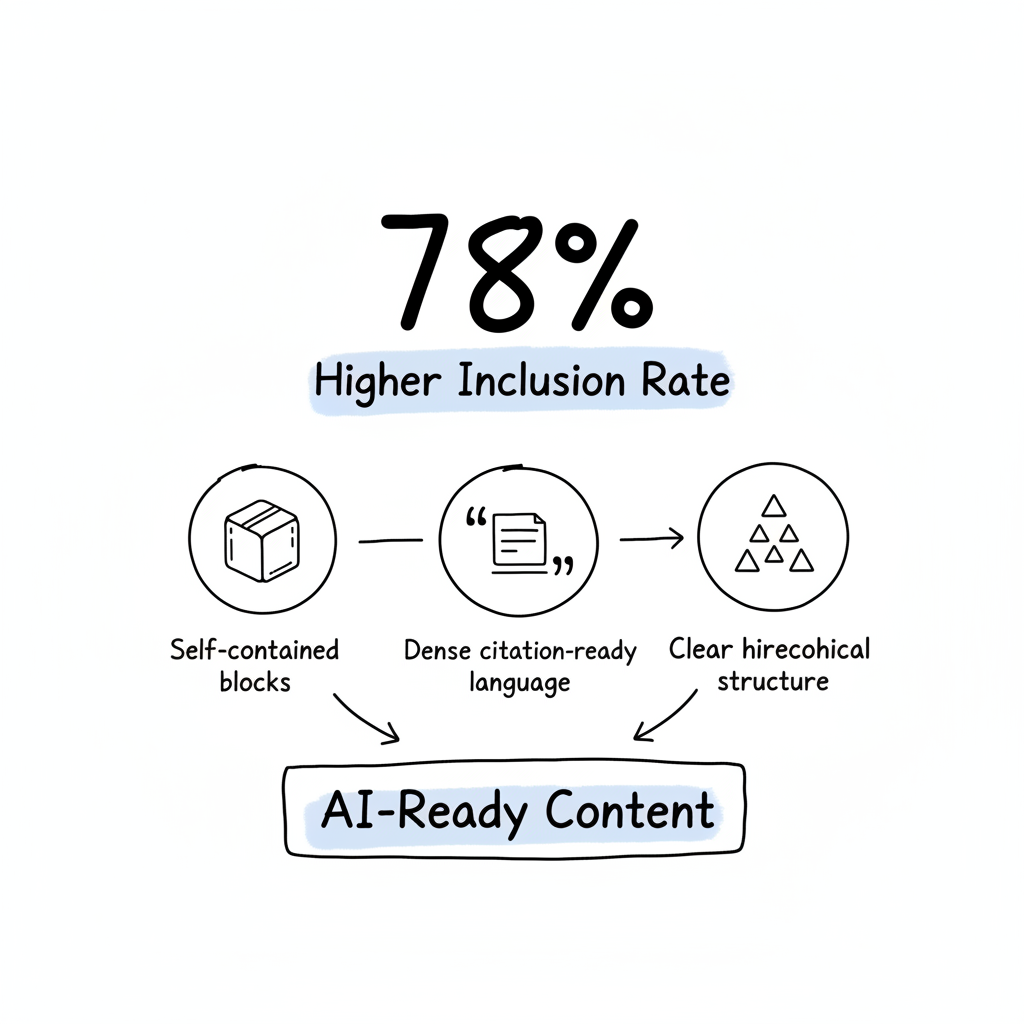
AI systems don't read content the way humans do. They scan for extractable information - structured, self-contained blocks they can quote directly. Research shows that properly formatted lists achieve up to 78% higher inclusion rates in AI-generated responses than unstructured paragraphs.
Here's how to format your content so LLMs actually cite it.
Why List Formatting Matters for AI Citations
Princeton and Georgia Tech researchers tested Generative Engine Optimization (GEO) methods across 10,000 queries and 9 authoritative sources. Their findings revealed that content structure directly impacts citation probability.
Key research findings:
- Citation optimization: 115.1% visibility increase for rank #5 sites using proper formatting
- Quotation addition: 37% improvement on Perplexity
- Statistics inclusion: 22% improvement in citation rates
- Fluency optimization: 15-30% visibility boost across platforms
The pattern is clear: AI systems prefer content they can extract cleanly. Lists, tables, and structured blocks make extraction easy.
The 78% Inclusion Rate Formula
Content formatted as lists gets included in AI responses 78% more often than equivalent information buried in paragraphs. The formula combines three elements:
1. Self-contained blocks: Each list item delivers complete, quotable information without requiring surrounding context.
2. Dense, citation-ready language: Every item packs maximum information into minimum words - exactly what AI systems want to quote.
3. Clear hierarchical structure: Headers, subheaders, and list levels tell AI systems how information relates.
When your content checks all three boxes, AI platforms can grab and cite it instantly.
Bullet Points vs. Numbered Lists
Different list types serve different purposes for AI citation:
Bullet points work best for:
- Feature lists and benefits
- Unordered options or alternatives
- Quick reference information
- Characteristics and attributes
Numbered lists work best for:
- Step-by-step processes
- Rankings and comparisons
- Sequences that require order
- Prioritized recommendations
AI systems recognize these patterns. A numbered list signals "follow these steps in order." A bullet list signals "here are equivalent options." Match your format to your content's natural structure.
Formatting Techniques That Increase Citations
Research-backed techniques that improve LLM extraction:
Lead with the Key Information
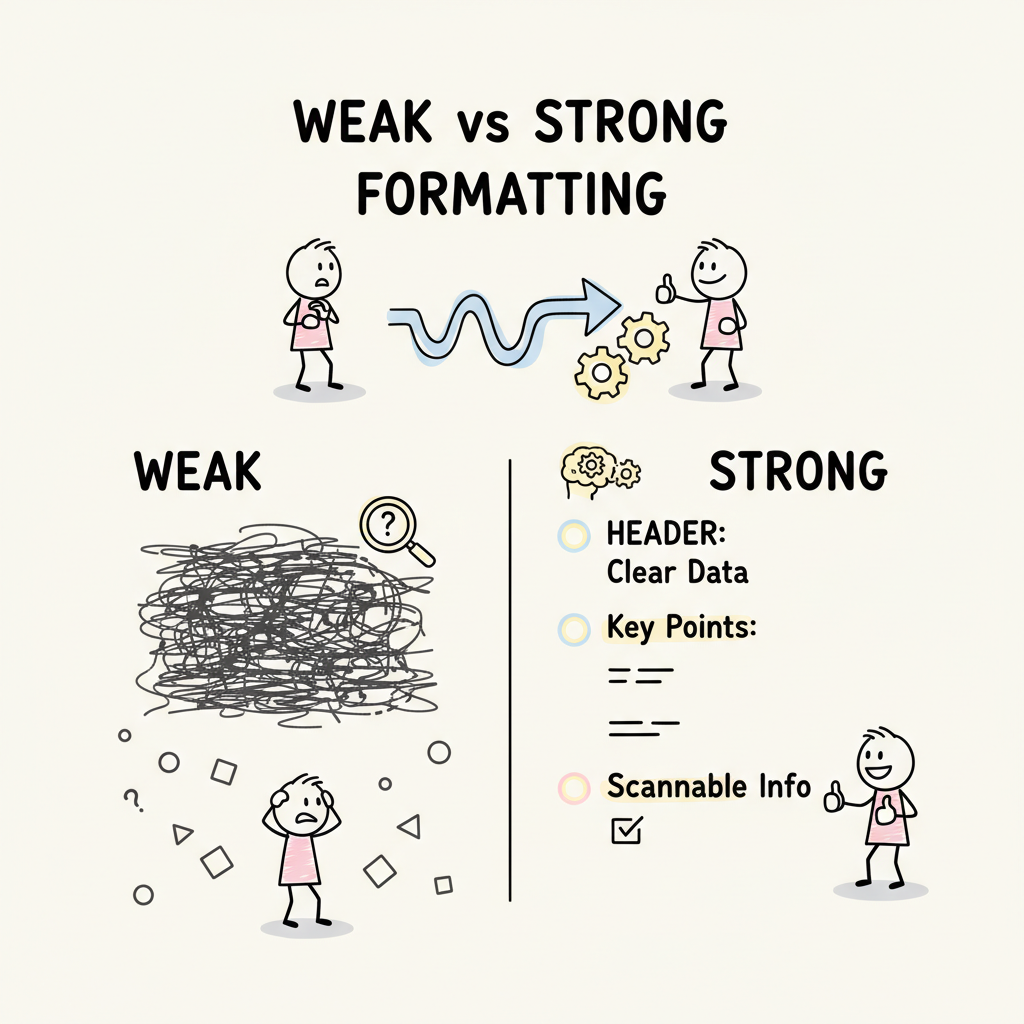
Weak formatting: "When considering the various aspects of implementing AEO strategies, one should note that the typical cost ranges from $50,000 to $500,000 annually for enterprise implementations."
Strong formatting:
- Enterprise AEO cost: $50,000-500,000 annually
- Mid-market range: $10,000-75,000 annually
- SMB investment: $2,000-15,000 annually
The second version gives AI exactly what it needs to cite.
Include Specific Numbers
AI systems favor concrete data over vague claims. Statistics in list format are particularly citation-friendly:
- Zero-click searches: 45%+ of all queries in 2026
- ChatGPT daily queries: 200+ million
- GEO visibility boost: 30-40% improvement
- Citation optimization impact: 115% increase for lower-ranking sites
Numbers make your content verifiable and quotable.
Mirror Question Phrasing in Headers
When headers match how users phrase questions, AI systems connect content to queries more easily:
- "How much does AEO cost?" AEO Cost Breakdown
- "What tools are best for AEO?" Top AEO Tools by Category
- "How do I optimize for ChatGPT?" ChatGPT Optimization Steps
What to Avoid
Not all list formatting helps. Some practices actively hurt citation rates:
Keyword stuffing: Negative impact confirmed by research. AI systems recognize and penalize unnatural keyword repetition.
Lists without substance: Empty bullet points that don't add value get skipped. Each item must contribute meaningful information.
Inconsistent formatting: Mixing styles within a single list confuses AI parsing. Maintain parallel structure throughout.
Overly long list items: If a bullet point runs 3+ sentences, it's a paragraph pretending to be a list. Keep items concise.
Table Formatting for Maximum Impact
Tables combine the benefits of lists with visual structure AI systems can parse. When you're implementing on-page AEO optimization, tables are particularly effective for presenting structured data:
Format Type | Best Use Case | Citation Impact |
Bullet list | Features, options | High |
Numbered list | Steps, processes | High |
Table | Comparisons, data | Very high |
Inline list | Quick references | Medium |
Tables work especially well for comparisons, specifications, and data presentation. They're easily extractable and naturally cite-ready.
Implementation Checklist
Apply these techniques to improve your content's AI citation rate:
- Convert long paragraphs to bullet points where appropriate
- Use numbered lists for sequential information
- Lead each list item with the most important information
- Include specific statistics and data points
- Create tables for comparative information
- Match header phrasing to common question formats
- Keep individual list items under 30 words when possible
- Maintain consistent formatting within each list
Structuring Lists for Multi-Platform Consistency
A list that earns a citation on Perplexity can be skipped by Google AI Overviews if the platform parses structure differently, so write for the lowest common parser. Keep each list item self-contained - no pronoun references to the item above it - and avoid nested lists deeper than two levels, because deep nesting is where extractors lose the parent context. When the same information appears in a bullet list and a table on the page, make them agree exactly, since contradictory structured blocks on one page teach the models that your content is unreliable. Consistency across formats is what lets a single piece of content get quoted correctly wherever it surfaces.
Measuring Whether List Formatting Is Working
You cannot tune what you do not measure, and citation performance is measurable even without a vendor tool. Track the share of your pages that appear in AI answers for the queries they target by sampling those queries weekly across ChatGPT, Perplexity, and Google AI Overviews, and note when a list-heavy page starts showing up where a paragraph-heavy one did not. Pair that with a before-and-after: reformat five existing posts and watch whether their inclusion rate moves over the next month. The signal is noisy at the level of one query, but across a sample of fifty the direction is clear, and that direction tells you which formatting rule is actually paying off for your category.
Pairing Lists with Schema Markup
Lists help extractors read your content; schema markup tells them what the content is. A how-to list gains authority when wrapped in HowTo schema, a comparison list when tagged as a table or ItemList, and a stats list when the numbers appear in the structured data as well as the prose. The two layers are complementary: the visible list is what gets quoted, and the schema is what lets a platform trust the quote. Add schema to your highest-value list pages first, because those are the pages where a citation directly drives a qualified visit, and reserve the manual markup effort for the posts that already earn the most impressions.
Avoiding the Over-Formatting Trap
The lesson of the research is not that lists win every time, and a page that is nothing but bullet points loses the narrative authority that AI systems also weigh. Use lists for extractable facts and keep a paragraph or two of reasoning around them so the content demonstrates understanding, not just data. The balance is the signal: structured blocks for what should be quoted, prose for why it matters. A page that leads with a strong list, supports it with explanation, and closes with a table where comparison helps tends to earn citations without reading like a template, which is the outcome the formatting is meant to produce in the first place.
FAQs
Do All AI Platforms Prefer Lists Equally?
Most do. Perplexity, ChatGPT, and Google AI Overviews all show preference for structured, extractable content. The specific impact varies - Perplexity shows stronger preference for quotations (37% improvement), while other platforms respond more to statistics and citations.
Can I Overuse Lists?
Yes. Content that's nothing but lists loses narrative flow and may fail to establish the contextual expertise AI systems also evaluate. Balance structured lists with explanatory content that demonstrates deep understanding.
Should I Reformat Existing Content?
Prioritize high-value pages first. Focus on content targeting questions users commonly ask AI platforms - how-to guides, comparisons, and reference material benefit most from list formatting optimization. For comprehensive guidance on optimizing different content types, review our LLM optimization guide.