
Marketing agency pricing has no industry standard. Two agencies offering identical services can charge wildly different amounts, structured in completely different ways. Understanding the models before you enter a negotiation protects your budget and helps you avoid structures that are efficient for the agency but misaligned with your actual goals.
As part of our complete guide to choosing a marketing agency, pricing evaluation isn't just about cost--it's about understanding what model creates the right incentives for the relationship you're trying to build.
What Are the Most Common Marketing Agency Pricing Models in 2026?
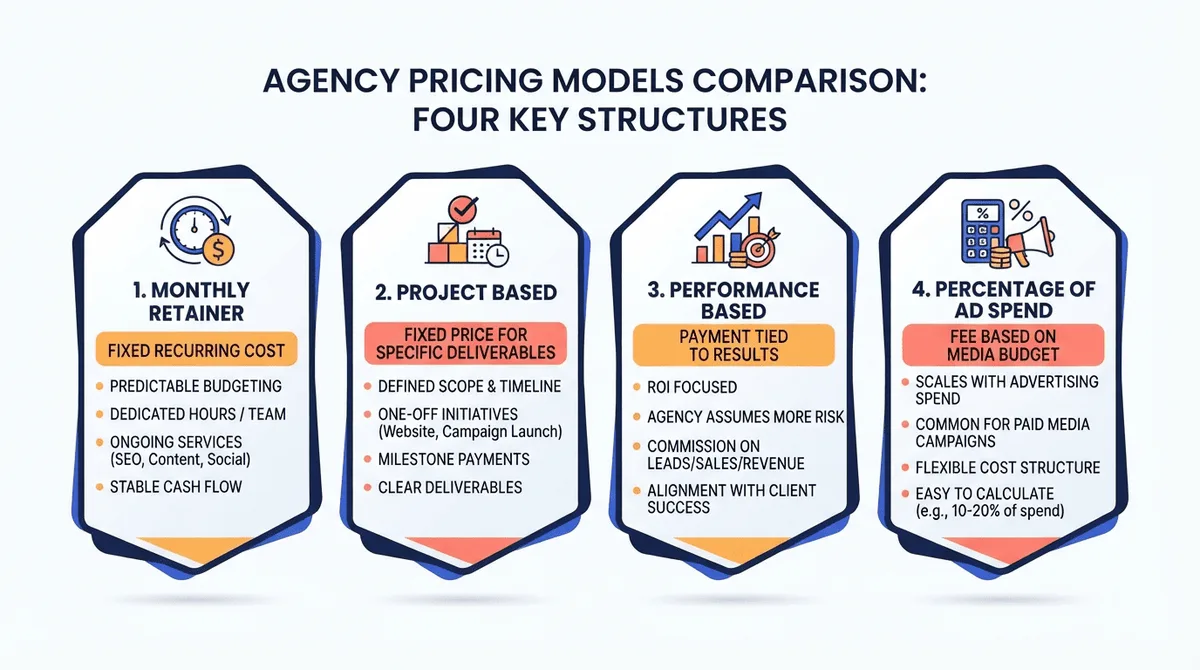
Four pricing structures dominate the agency market. Each has legitimate use cases and specific traps to watch for.
Monthly retainer: A fixed monthly fee for an agreed scope of services. The most common model for ongoing relationships--paid media management, SEO, content, and fractional CMO engagements. Retainers provide cost predictability for your budget and revenue predictability for the agency. The risk: a retainer without clearly defined deliverables becomes a "relationship fee" with unclear accountability.
Project-based pricing: A flat fee for a defined scope of work--an audit, a campaign build, a content production run, a website launch. Works well for one-time engagements or when you need to test an agency's capabilities before committing to a retainer. The risk: scope creep; projects that expand without corresponding price adjustments.
Performance-based pricing: The agency's compensation is tied (partially or fully) to results--cost per lead, revenue generated, ROAS achieved. Appears to align incentives but introduces complexity. Metrics can be gamed, attribution disputes arise, and agencies often won't accept pure performance models because the risk exposure is too high without some baseline revenue guarantee.
Percentage of ad spend: Common for paid media agencies--typically 10-20% of total media spend under management. Scales with your budget, which can misalign incentives (the agency earns more when you spend more, regardless of efficiency). Works best with a floor and ceiling: a minimum retainer plus a percentage cap.
Most sophisticated agencies blend these models--a base retainer covering strategy and account management, plus a percentage of ad spend for media management, plus performance bonuses tied to specific KPIs.
Comparison: Retainer vs. Project-Based vs. Performance-Based Pricing for Startups
| Pricing Model | Best For | Startup Risk | Typical Range |
|---|---|---|---|
| Monthly retainer | Ongoing channel management, SEO, content | Lock-in without clear deliverables | $2,500-$25,000+/month |
| Project-based | Audits, one-time builds, testing | Scope creep, no ongoing accountability | $2,000-$50,000/project |
| Performance-based | Lead gen with trackable conversion events | Metric gaming, attribution disputes | Varies; often hybrid |
| % of ad spend | Paid media management | Spend inflation incentive | 10-20% of media spend |
A deeper dive into retainer vs. project-based engagements covers the structural tradeoffs in more detail. For early-stage startups testing a new channel or agency, project-based engagements offer lower commitment while you validate fit. For growth-stage startups with validated channels that need consistent management, retainers are more efficient.
For the retainer vs performance comparison specifically for lead-gen engagements, see our dedicated guide to retainer versus performance-based lead generation.
How to Determine What Your Startup Should Pay a Marketing Agency
Typical US market ranges: SEO agencies run $3,000-$12,000/month for startups; paid media agencies charge $2,500-$10,000/month plus 10-15% of spend; full-service growth agencies covering paid, SEO, and analytics run $8,000-$25,000/month; fractional CMO engagements run $4,000-$15,000/month.
The right question is not what is cheapest but what level of investment is proportional to your growth targets. A startup running $100K/month in ad spend with a $3,000/month agency is mismatched. Measuring whether your agency spend is paying off requires baseline CAC and pipeline metrics before you sign so you have a reference point.
Common Pricing Mistakes That Cost Startups More Than They Realize
Choosing the lowest retainer without evaluating deliverables. Compare cost-per-deliverable, not total cost. A $3K/month retainer with two blog posts and a monthly report provides less value than a $6K retainer with technical SEO and weekly optimization.
Underestimating scope. Before signing, ask: "What would NOT be included at this price?" Project-based contracts that don't define scope become expensive when the agency bills for work you thought was included.
Optimizing for the lowest upfront cost. Below-market rates usually mean junior talent or minimal strategic input. Pricing red flags that signal a bad agency fit include rates dramatically below market for the claimed scope.
Paying for ad spend through the agency. Always maintain direct ownership of ad accounts and pay platforms directly. Agency-managed accounts reduce your visibility into actual spend vs. fees.
Criteria Checklist: Matching Your Growth Stage to the Right Pricing Model
Pre-Seed / Seed Stage
- Monthly budget under $10,000 total: project-based or month-to-month retainer
- Focus on validated learning, not scale
- Prioritize agencies with startup-specific track records over large retainer commitments
- Avoid long-term contracts until you've validated the channel
Series A
- Monthly budget $10,000-$30,000: retainer-based with clearly defined deliverables
- % of ad spend model appropriate for paid channels with $20,000+/month in media spend
- Begin building performance benchmarks into the contract
- Consider hybrid retainer + performance bonus structure
Series B+
- Monthly budget $30,000+: full-service retainer plus performance components
- Agency should operate as a growth partner with board-level reporting capability
- What pricing terms to negotiate in your contract becomes more sophisticated at this stage--SLAs, performance benchmarks, and detailed deliverable specifications matter more
- Comparing agency costs to in-house hiring costs becomes relevant as you evaluate whether to build a dedicated team or continue with an agency
How to Negotiate Agency Pricing Without Damaging the Relationship
Negotiation is expected in agency engagements, but the approach matters. Agencies that feel squeezed on price will reduce the seniority of the team assigned to your account or limit the strategic hours they invest. The better approach is to negotiate on scope, not on rate. If the quoted retainer is above your budget, ask the agency to propose a reduced scope at your target price rather than demanding a discount on the full scope.
Another effective tactic is to propose a 90-day initial engagement at a project-based rate with a clear path to a retainer if the relationship works. This reduces the agency's risk of a long-term commitment at a below-market rate and gives you a structured evaluation period. Both sides win when the pricing model creates mutual accountability rather than adversarial negotiation.
FAQ
What Is a Typical Marketing Agency Retainer for Startups?
$2,500-$15,000/month depending on scope and agency type. Full-service growth agencies for Series A startups commonly run $8,000-$20,000/month. Entry-level retainers with limited scope start around $2,500/month.
What Is Performance-Based Agency Pricing?
Agency compensation tied to measurable outcomes -- cost per lead, revenue, or ROAS. Rarely used as a standalone model because attribution disputes are common and agencies require some baseline compensation regardless of results.
How Do Agencies Charge for Paid Media Management?
A base management retainer plus 10-20% of total ad spend. Confirm whether the fee covers strategy, optimization, reporting, and creative production or just account management.
Should Startups Use Project-Based or Retainer Pricing?
Project-based for testing an agency or one-time engagements. Retainer once you have validated the relationship and need consistent ongoing management.
Key Takeaways
- The four main pricing models--monthly retainer, project-based, performance-based, and percentage of ad spend--each carry different incentive structures and risk profiles
- Monthly retainers are most common for ongoing engagements; the risk is paying for vague deliverables without clear accountability
- Typical ranges: SEO agencies run $3,000-$12,000/month; full-service growth agencies $8,000-$25,000/month; paid media management adds 10-20% of ad spend to base retainer
- Avoid paying below-market retainers without understanding why the price is low--junior talent and offshore execution are common cost reduction methods that affect quality
- Always maintain direct ownership of ad accounts; never run spend through the agency's accounts
- Match the pricing model to your stage: project-based for validation, retainer for scale, performance components once baselines are established