
The Complete Meta Ads Course Guide: Best Options for 2026
Want to master Meta advertising but feeling overwhelmed by the options? Whether you're a complete beginner or an experienced marketer looking to sharpen your skills, choosing the right Meta ads course can dramatically accelerate your learning curve and help you run more profitable campaigns.
In this guide, we'll break down the best free and paid Facebook advertising courses available in 2026, compare their features, and help you build a clear learning path that matches your goals. If you're brand new to Meta's advertising platform, start with our guide on what are Meta ads before diving into courses.
Get our free Meta Ads Course: 2026 Edition here
Free vs Paid Courses: Which Should You Choose?
Choosing between free and paid Meta ads courses depends on your goals and budget. Free options cover fundamentals; paid courses provide structure, certifications, and advanced campaign strategies.
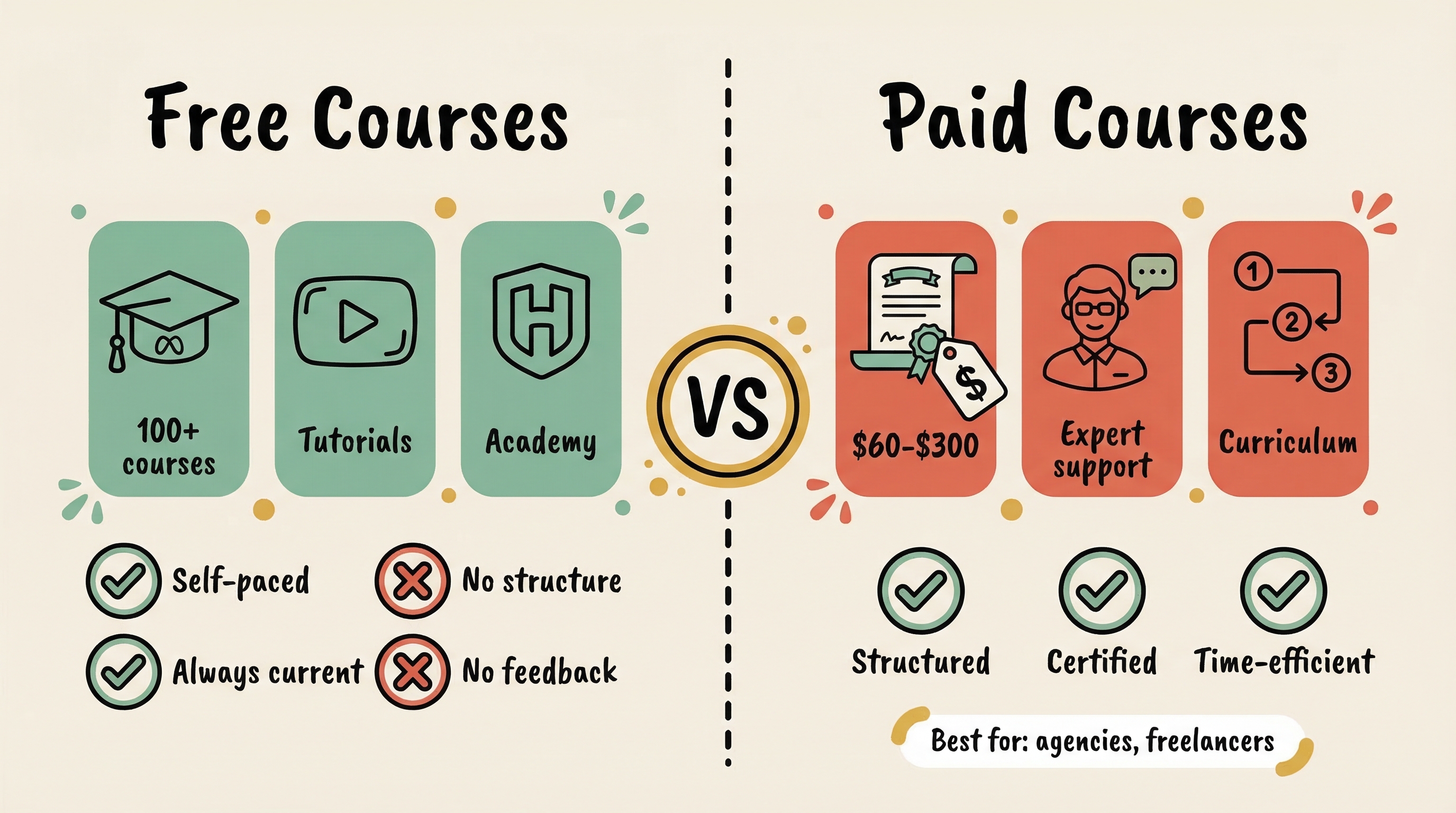
Before diving into specific recommendations, let's address the elephant in the room: should you invest in paid courses, or are free options sufficient?
Free Courses: The Pros
Free courses have improved dramatically in recent years. Meta Blueprint, Meta's official learning platform, offers over 90 free e-learning courses covering everything from basic ad creation to advanced campaign optimization. Created by Meta, these courses are accurate and updated with the latest platform changes.
Other free options include:
- YouTube tutorials from established advertisers
- HubSpot Academy social media marketing courses
- Semrush Academy and Ahrefs Academy for broader digital marketing context
The limitation? Free courses often lack structure, hands-on projects, and personalized feedback. You're responsible for piecing together your own curriculum.
Paid Courses: When They Make Sense
Paid courses become worthwhile when you need:
- Structured learning paths that build skills systematically
- Real campaign examples and case studies
- Instructor support or community access
- Certifications that boost your professional credibility
- Time efficiency - curated content saves research time
For freelancers, agency owners, or anyone managing significant ad budgets, the time saved and skills gained often justify investments of $60-$300 USD. Understanding how much to run ads on Facebook can help you evaluate whether course investments will pay off.
Whether you invest $60-$300 in a premium Meta ads course or use free resources like Meta Blueprint, the skills you gain can directly reduce wasted ad spend and increase campaign ROAS.
Advantage+ Campaigns: What to Look for in 2026
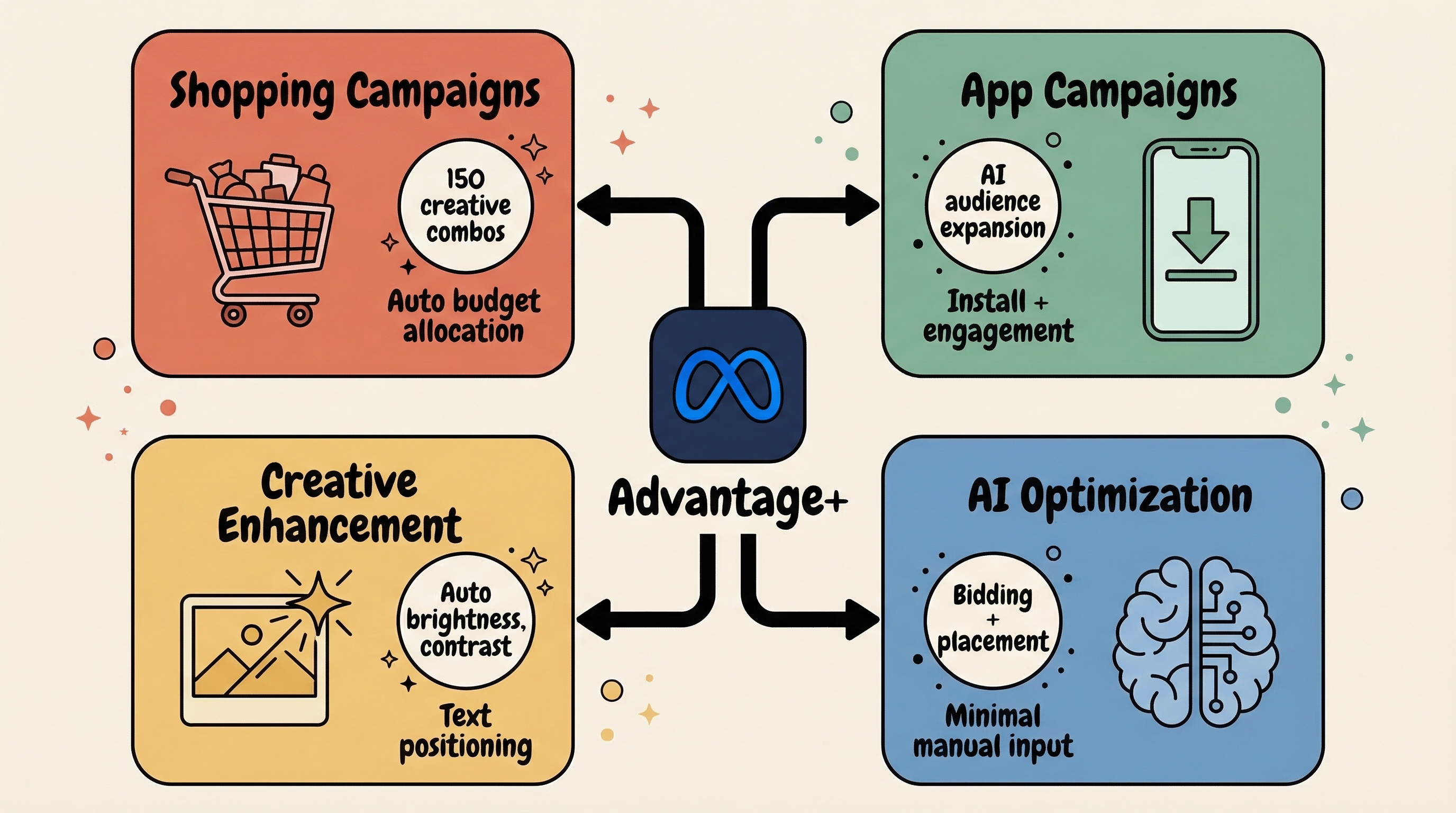
Any Meta ads course worth taking in 2026 should cover Advantage+ campaigns, Meta's AI-driven campaign type that has fundamentally changed how advertisers optimize ad delivery. Advantage+ uses machine learning to automate audience targeting, creative selection, and placement optimization -- reducing manual setup while often improving performance.
Key Advantage+ features your course should cover:
- Advantage+ Shopping Campaigns: Automated e-commerce campaigns that test up to 150 creative combinations and dynamically allocate budget to top performers
- Advantage+ App Campaigns: AI-optimized app install and engagement campaigns with automated audience expansion
- Advantage+ Creative: Automatic enhancements to ad creative including brightness, contrast, and text positioning adjustments
- AI-driven optimization: How Meta's algorithm handles bidding, placement, and audience selection with minimal manual input
Our free Meta Ads course covers Advantage+ in depth. If a course was last updated before 2025 and doesn't mention Advantage+ at all, it's likely outdated on a critical feature that now drives the majority of Meta's campaign performance improvements.
Top 11 Meta Ads Courses for 2026
Here are the best options available right now, organized by skill level and learning style.
1. Meta Blueprint Courses (Free)
Best for: Everyone - beginners to advanced marketers
Meta Blueprint remains the gold standard for learning Meta advertising. The platform offers over 100 mini-courses covering:
- Creating and managing ads across Facebook and Instagram
- Audience targeting strategies
- Reading campaign reports and analytics
- Meta advertising policies
- Advanced optimization techniques
Pros:
- Completely free
- Always current with platform updates
- Covers all skill levels
- Available in multiple languages
Cons:
- Self-directed (no instructor support)
- No formal certification without paying for exams
Time commitment: 20-40 hours depending on depth
2. Meta Certified Digital Marketing Associate ($99 USD)
Best for: Marketers wanting official Meta credentials
This isn't a course - it's Meta's official certification exam that validates your expertise. However, it pairs perfectly with the free Blueprint courses as your study material.
The certification covers:
- Campaign basics and objectives
- Basic audience targeting
- Analytics and reporting
- Platform policies and best practices
Why get certified? According to industry reports, certified professionals report 10-20% higher rates and improved client acquisition.
Cost: $99 USD. Validity: 12 months before renewal required
3. Udemy: 11 Ads Platforms in 1 Course 2026
Best for: Marketers wanting cross-platform skills
This comprehensive Udemy course by Tanmoy Das covers Meta Ads alongside Google Ads, Microsoft Ads, LinkedIn Ads, TikTok Ads, and more. With a 4.6 rating and over 35,000 learners, it's one of the most popular paid advertising courses on the platform.
What you'll learn:
- Complete Meta Ads Manager walkthrough
- Campaign creation for every objective
- Cross-platform advertising strategies
- Practical implementation videos
Pros:
- Comprehensive multi-platform coverage
- Lifetime access
- Regular updates
- Affordable (often $15-30 on sale)
Cons:
- Less depth on Meta specifically
- Auto-generated captions only
Time commitment: 40+ hours
For marketers considering multiple platforms, comparing Facebook ads vs Google ads helps clarify when to use each channel.
4. Meta Certified Media Buying Professional ($150 USD)
Best for: Campaign managers handling significant budgets
The Media Buying Professional certification is the intermediate credential for marketers managing significant monthly ad spend. It tests advanced tactical skills including:
- Advanced audience targeting
- Bidding strategy selection
- Budget allocation optimization
- Campaign troubleshooting
Pair this with Meta's free study materials for a structured learning path. If you're working with clients, understanding meta agency ad account structures becomes critical at this level.
Cost: $150 USD. Prerequisite: Real campaign management experience recommended
5. Launch Lab E-Commerce Facebook Ads Course 2026
Best for: E-commerce brand owners and marketers
This specialized course focuses specifically on Facebook and Instagram ads for online stores. Created by practitioners who've managed over $500,000 in ad spend, it covers:
- Catalog and dynamic ads setup
- ROAS optimization strategies
- Scaling profitable campaigns
- E-commerce-specific targeting
Pros:
- Laser-focused on e-commerce
- Real account examples
- Results guarantee
- One-time payment
Cons:
- Premium pricing
- Less relevant for service businesses
E-commerce advertisers should also explore proven ecommerce meta ads strategy frameworks to maximize course learnings.
6. Coursera: Meta Social Media Marketing Certificate
Best for: Career changers seeking recognized credentials
Part of Meta's collaboration with Coursera, this professional certificate program provides a comprehensive introduction to social media marketing with a focus on Meta platforms.
What you'll learn:
- Social media strategy fundamentals
- Content creation best practices
- Paid advertising basics
- Marketing analytics
Pros:
- University-backed credential
- Flexible schedule
- Financial aid available
- Portfolio projects included
Cons:
- Broader focus (not ads-specific)
- Subscription model
Time commitment: 7-month program at 6 hours/week
7. HubSpot Social Media Marketing Course (Free)
Best for: Marketers wanting broader marketing context
HubSpot Academy offers excellent free courses that complement Meta-specific training. While not focused exclusively on paid ads, their social media marketing course provides valuable strategic context.
Covers:
- Social media strategy development
- Content marketing fundamentals
- Marketing automation basics
- Inbound marketing principles
Pros:
- Completely free
- Well-structured curriculum
- Recognized certification
- Excellent production quality
Cons:
- Not Meta ads-specific
- General rather than tactical
8. Skills Development Academy: Facebook/Instagram Ad Campaigns
Best for: Singapore/Asia-based marketers seeking classroom training
SDA's 2.5-day course offers intensive, instructor-led training on Meta advertising. It's designed for professionals who prefer structured classroom learning over self-study.
Covers:
- Ads Manager account setup
- Campaign objective selection
- Performance metrics and ROI
- Step-by-step campaign creation
Pros:
- Hands-on, instructor-led
- Real practitioner instructors
- Networking opportunities
Cons:
- Location-dependent
- Higher cost than online options
Understanding how to run meta ads practically complements this classroom training experience.
9. Meta Certified Media Planning Professional ($150 USD)
Best for: Agency strategists and marketing leaders
The Media Planning certification targets senior marketers who develop campaign strategies rather than execute daily operations.
Covers:
- Cross-platform strategy development
- Audience research and segmentation
- Campaign forecasting
- Client strategy presentations
Cost: $150 USD. Best for: Strategists managing teams or enterprise clients
10. YouTube: Free Meta Ads Tutorials
Best for: Visual learners on a budget
Several YouTube creators offer excellent free Meta advertising education:
- Comprehensive crash courses for 2026
- Platform update breakdowns
- Real campaign walkthroughs
- Strategy discussions
Top channels to follow:
- Creators covering Andromeda algorithm updates
- E-commerce advertising specialists
- Agency owners sharing client strategies
Pros:
- Free and accessible
- Visual learning format
- Current strategies
Cons:
- Unstructured
- Variable quality
- Requires research to find good content
11. CXL: Advanced Meta Advertising Program ($999+)
Best for: Experienced marketers and agency professionals seeking practitioner-level depth
CXL (formerly ConversionXL) offers one of the most rigorous Meta advertising programs available. Unlike beginner-friendly platforms, CXL targets practitioners who already understand the basics and want to master advanced techniques used by top-performing agencies.
What you'll learn:
- Advanced campaign architecture and account structure
- Sophisticated A/B testing and creative testing frameworks
- Data-driven audience segmentation strategies
- Performance marketing measurement and attribution
- Landing page optimization for Meta ad traffic
Pros:
- Taught by recognized industry practitioners
- Depth unmatched by general platforms
- Includes assessments and skill verification
- Access to full CXL course library with subscription
Cons:
- Premium pricing ($999+ annually or per-course options)
- Not suitable for beginners
- Requires existing campaign management experience
Time commitment: 15-20 hours for the Meta-specific track
CXL is particularly valuable for marketers transitioning into senior campaign management roles or agency professionals who need to demonstrate advanced expertise to clients.
12. Stackmatix: Managed Meta Ads Services
Best for: Businesses that want expert-managed Meta ad campaigns without the steep learning curve.
- Done-for-you Meta advertising: campaign setup, creative strategy, and ongoing optimization
- Advantage+ campaign management with AI-driven audience targeting
- Transparent reporting and ROI-focused scaling
- Free consultation to audit your current Meta ads performance
Rather than spending weeks learning Meta ads yourself, Stackmatix manages your campaigns end-to-end — from pixel setup to scaling profitable ad sets. Get started with Stackmatix and let certified Meta advertising specialists grow your business.
Course Comparison: Quick Reference
Compare the top Meta ads courses side-by-side: cost, skill level, time commitment, and certification availability to find the right fit for your goals.
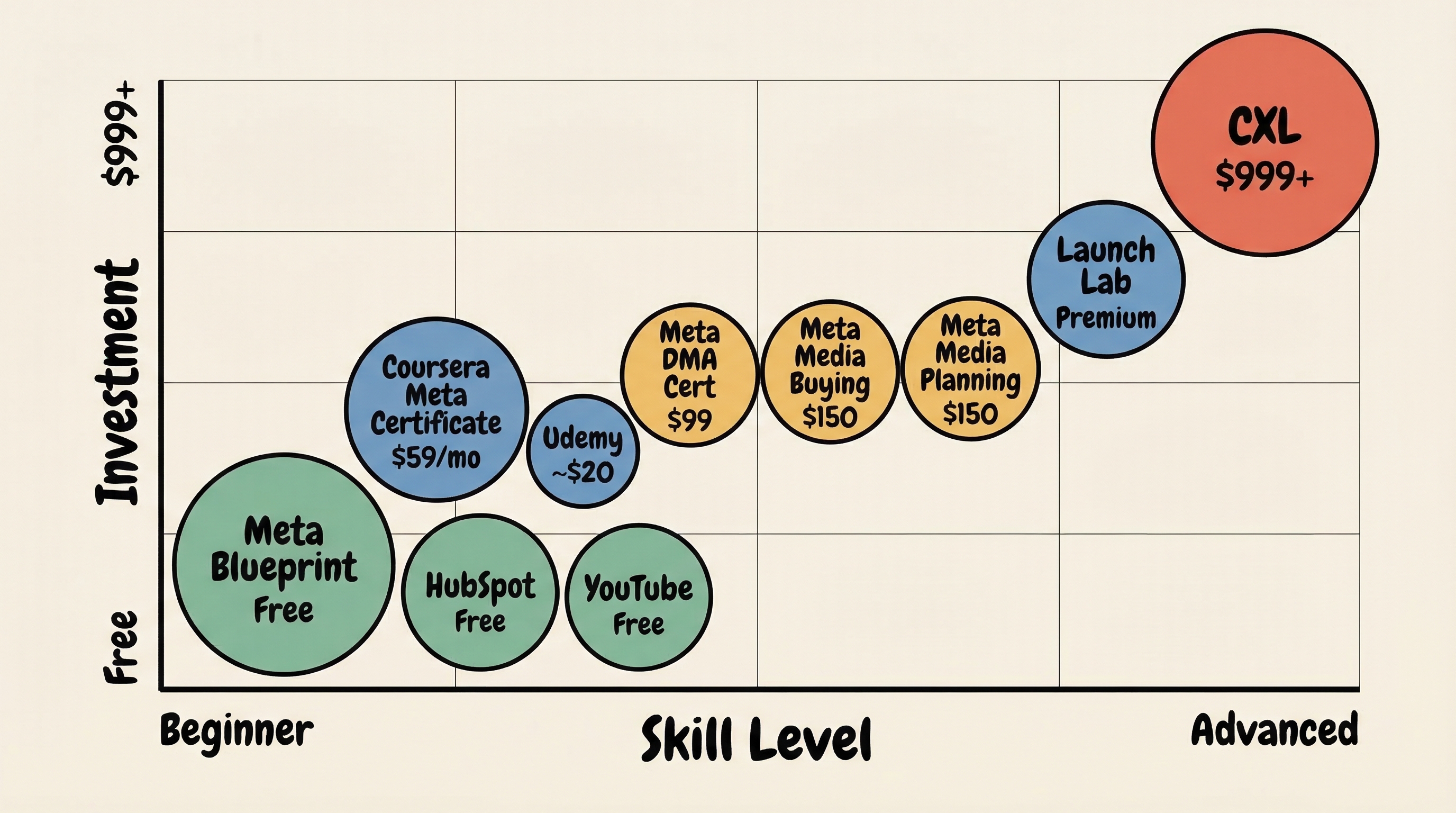
| Course | Cost | Level | Time | Certification |
|---|---|---|---|---|
| Meta Blueprint | Free | All levels | 20-40 hrs | No* |
| Meta Digital Marketing Associate | $99 | Beginner | Exam only | Yes |
| Udemy Multi-Platform Ads | ~$20 | Beginner-Intermediate | 40+ hrs | Yes |
| Meta Media Buying Pro | $150 | Intermediate | Exam only | Yes |
| Launch Lab E-commerce | Premium | Intermediate | 10-15 hrs | No |
| Coursera Meta Certificate | Subscription | Beginner | 7 months | Yes |
| HubSpot Social Media | Free | Beginner | 5-10 hrs | Yes |
| CXL Advanced Meta Ads | $999+ | Advanced | 15-20 hrs | Yes |
*Certification available separately through paid exams
Core Skills You'Ll Learn in a Meta Ads Course
Regardless of which course you choose, a comprehensive Meta advertising education should build proficiency across these core skill areas. Use this as a checklist when evaluating any course or certification program.
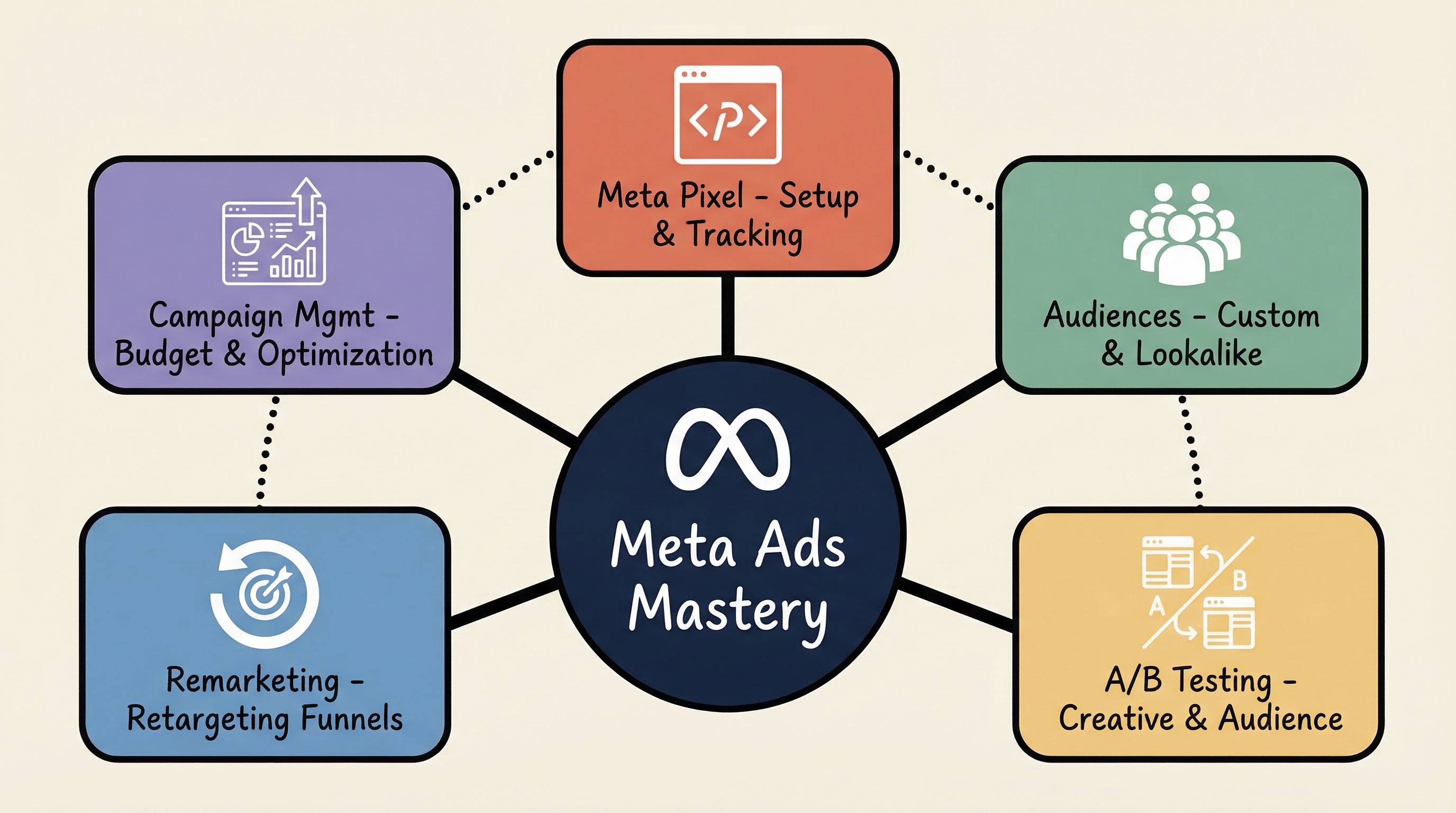
Meta Pixel Setup and Conversion Tracking
The Meta Pixel is the foundation of campaign measurement. Quality courses cover pixel installation, standard and custom events, Conversions API for server-side tracking, and troubleshooting pixel issues. Without proper conversion tracking, ad spend lacks direction.
Audience Building: Custom and Lookalike Audiences
Targeting is where Meta advertising excels. Look for courses covering custom audiences from website visitors and customer lists, plus lookalike audiences to reach new prospects. Advanced courses address exclusions, layering, and how Advantage+ expansion affects manual targeting.
A/B Testing and Creative Testing
Systematic testing separates profitable advertisers from wasteful ones. Your course should cover A/B tests for audiences, creatives, and placements — including statistical significance, test duration, and scaling winners. Creative testing frameworks are essential for sustained performance.
Remarketing and Retargeting Strategies
Retargeting campaigns typically deliver the highest ROAS in Meta advertising. Courses should cover building funnels from website behavior, video views, and lead interactions. Frequency caps and sequential messaging keep campaigns effective without ad fatigue.
Campaign Management and Budget Optimization
Day-to-day campaign management skills include monitoring key metrics, adjusting budgets based on performance, managing campaign budget optimization (CBO) vs. ad set budgets, and knowing when to kill underperforming ads. Courses that include real account walkthroughs or hands-on exercises build these skills faster than theory alone.
Meta Ads Placements and Delivery
Meta ads run across Facebook Feed, Instagram Feed, Stories, Reels, Messenger, and the Audience Network. Understanding placement performance and when to use automatic versus manual placement selection helps optimize costs and reach.
Bidding Strategies in Meta Ads
Meta offers Lowest Cost (automatic), Cost Cap, Bid Cap, and minimum ROAS bidding. Automatic bidding works best for most new campaigns; manual bidding suits advanced advertisers with clear cost-per-result targets and sufficient historical data.
Meta Ads Frequency and Ad Fatigue
Ad frequency measures how often the same user sees your ad. Frequency above 3-4 signals creative fatigue — refreshing your ad creative helps maintain performance. Most quality courses cover frequency monitoring as part of campaign management.
Understanding Meta Ads Attribution Windows
Attribution windows define how long after an ad impression or click a conversion is credited to your campaign. Meta supports 1-day and 7-day click windows, plus 1-day view windows — understanding these affects how you measure ROAS.
Dynamic Ads and Catalog Campaigns
Dynamic ads automatically show products from your catalog to users who have shown interest in them. Setting up a product catalog and dynamic retargeting campaigns is one of the highest-value skills for e-commerce advertisers on Meta's platform.
Meta Ads Campaign Objective Selection
Choosing the right campaign objective (Awareness, Traffic, Engagement, Leads, App Promotion, or Sales) determines how Meta optimizes delivery. Selecting the wrong objective is one of the most common beginner mistakes that wastes ad spend unnecessarily.
Creative Formats for Meta Advertising
Meta supports single image, carousel, video, collection, and Instant Experience ads. Video and Reels ads typically deliver lower CPMs; carousel ads work well for e-commerce product showcases. Understanding format strengths is taught in most structured courses.
Meta Pixel Events and Custom Conversions
Standard pixel events (ViewContent, AddToCart, Purchase) fire automatically with proper setup. Custom conversions let you define specific URL-based or event-based actions as conversion goals. Correct event tracking is essential for campaign optimization and audience building.
Split Testing in Meta Ads Manager
Meta's built-in split testing (A/B test) feature runs controlled experiments across audiences, creatives, placements, or optimization goals. Results show statistical significance so you can confidently scale winners and cut losers from your campaigns.
Using Meta Business Suite Effectively
Meta Business Suite consolidates Facebook and Instagram management. Ads Manager (within Business Suite) handles campaign creation and reporting. Understanding the difference between Ads Manager and the boosting interface is a fundamental skill covered in every structured course.
Account Structure Best Practices
A well-structured Meta ads account separates campaigns by objective, ad sets by audience, and ads by creative variation. Proper account hygiene — naming conventions, budget organization, and regular cleanup — makes optimization faster and reporting clearer.
Meta Ads Reporting and Key Metrics
Core reporting metrics include CPM, CPC, CTR, CPA, ROAS, and frequency. Ads Manager's customizable columns let you track what matters most for your campaigns. Quality courses teach you which metrics to prioritize for different objectives and audiences.
Conversion API and Server-Side Tracking
The Conversions API sends purchase and lead events directly from your server, bypassing browser-level tracking limitations. Strong courses cover CAPI setup alongside the pixel for improved signal quality and accurate attribution.
Lead Generation Ads and Instant Forms
Lead gen ads capture contact information without users leaving the app. The native Instant Form pre-fills data, reducing friction. Courses teach how to structure questions, integrate CRMs, and qualify leads efficiently.
Video Ads and Engagement Objectives
Video view campaigns build awareness and generate warm audiences for retargeting. Understanding video metrics—ThruPlay, 3-second views, cost-per-view—connects awareness spending to downstream conversions across the funnel.
Stories and Reels Ad Formats
Vertical video placements across Stories and Reels require different creative ratios and shorter hook windows than feed placements. Skilled advertisers design 9:16 assets natively and test them separately.
Catalog Sales and Shopping Campaigns
Dynamic product ads pull images, prices, and descriptions from a connected catalog and show relevant items to recent store visitors. Learning to upload, troubleshoot, and optimize a product feed is essential for e-commerce.
Brand Awareness and Reach Campaigns
Awareness objectives maximize unique reach and estimated ad recall lift rather than direct conversions. Knowing when to use reach campaigns—new market entry, product launches—is a key skill in media planning coursework.
Budget Pacing and Delivery Insights
Delivery Insights shows pacing, auction overlap, and first-time impression ratios to explain why performance shifts. Interpreting these signals helps you adjust bids, expand audiences, or refresh creatives before results deteriorate.
Cross-Campaign Attribution and Data Analysis
Comparing platform-reported conversions against analytics data reveals attribution discrepancies. Advanced measurement courses teach a blended view—not just last-click—to allocate budget across campaigns with greater confidence.
Advanced Techniques Covered in Top Courses
Leading programs go beyond beginner setup to cover campaign architecture, auction dynamics, and scaling frameworks. These advanced skills separate profitable advertisers from those who rely on guesswork to manage their accounts.
Understanding Auction Theory and Delivery
The ad auction evaluates bid, estimated action rate, and ad quality simultaneously. Understanding how these factors interact helps you prioritize creative quality and relevance over simply raising bids to win impressions.
ROAS Targets and Bid Cap Strategy
Minimum ROAS and bid cap settings constrain delivery to auctions where the platform predicts profitable outcomes. Advanced courses teach when these constraints help efficiency and when they limit scale unnecessarily.
Funnel Architecture Design
A three-stage funnel separates cold awareness, warm engagement, and hot retargeting audiences into distinct campaign sets. This structure prevents audience overlap, controls frequency at each stage, and clarifies budget allocation.
Excluding Audiences for Efficiency
Excluding purchasers from prospecting campaigns and cold audiences from retargeting reduces wasted spend. Proper exclusion lists are foundational to funnel hygiene and are covered in every intermediate course curriculum.
Scaling Winning Campaigns Safely
Scaling by more than 20% per day risks disrupting the learning phase and resetting delivery optimization. Courses teach gradual scaling techniques, duplicate-and-increase methods, and when to open new audience segments instead.
Creative Rotation and Fresh Ad Fatigue
Audience saturation drives up costs as users see identical ads repeatedly. Top courses teach rotation schedules, creative refresh cadences, and how to read frequency and relevance scores as early fatigue signals.
Troubleshooting Underperforming Campaigns
Diagnosing poor campaign performance requires isolating variables: audience, placement, creative, offer, and landing page. Structured courses provide frameworks for identifying root causes before making changes that could invalidate test data.
Seasonal Campaign Planning and Preparation
Q4 competition drives auction costs significantly higher, requiring larger creative libraries and earlier audience warm-up. Advanced training covers budget pacing, creative pre-approval timelines, and contingency structures for peak periods.
Competitor Targeting with Interest Stacks
Layering competitor brand interests with behavioral signals narrows delivery toward high-intent prospects already aware of alternatives. Courses teach how to construct and test these combinations without sacrificing audience size.
Naming Conventions and Campaign Organization
Consistent naming conventions enable fast filtering, reporting, and handoffs between team members. Formats encoding objective, audience, placement, and creative type are standard practice taught in agency and enterprise-focused course tracks.
Reading Breakdown Reports Effectively
Breakdown reports slice performance by age, gender, placement, and device, revealing hidden efficiency patterns. Learning to act on breakdown data—rather than optimizing at campaign level—is a core advanced skill.
Using Custom Audiences for Upsell Campaigns
Customer lists uploaded as custom audiences enable upsell and cross-sell campaigns targeting existing buyers. Combining purchase history segments with catalog data allows personalized offers matched to prior customer behavior.
Common Mistakes Courses Teach You to Avoid
Even experienced advertisers repeat costly errors that structured training helps eliminate. Knowing what to avoid before launching campaigns saves budget, protects account health, and shortens the learning curve significantly.
Launching Before the Pixel Is Fully Set Up
Running campaigns without verified conversion events wastes every dollar on traffic the algorithm cannot optimize toward. Courses emphasize event validation in Events Manager before any live spend begins.
Launching Too Many Ad Sets Simultaneously
Fragmenting budget across too many simultaneous ad sets slows each set from exiting the learning phase. Most training recommends consolidating to a small number of well-funded, broad audience sets first.
Changing Campaigns During the Learning Phase
Edits during learning reset optimization progress and extend the time before delivery stabilizes. Courses teach you to front-load decisions before launch and resist adjustments for at least seven days after going live.
Ignoring Mobile-First Creative Requirements
Most impressions are delivered on mobile, yet many advertisers repurpose desktop-designed graphics. Courses on creative strategy emphasize vertical formats, large text, and captions that work without audio for mobile viewers.
Over-Segmenting Audiences in Small Markets
Narrow audience segments in small geographic markets produce inconsistent delivery and inflated CPMs. Training recommends broader targeting and relying on algorithmic delivery to find your best customers within wider pools.
Relying on One Creative for Too Long
A single ad creative inevitably saturates its audience as frequency rises and relevance scores drop. Good courses build regular creative refresh schedules into your workflow before performance deteriorates noticeably.
Not Testing Offer Variations Against Each Other
Many advertisers test creative without ever testing the underlying offer. Courses on conversion optimization teach structured offer testing—free trial versus discount, demo versus guide—before investing in creative production.
Skipping Exclusions Between Funnel Stages
Without exclusion audiences, the same users appear across prospecting, retargeting, and upsell campaigns simultaneously. This inflates reported reach and leads to message confusion that courses and certifications consistently flag.
Measuring Success with Only Platform Data
Self-reported platform attribution overstates performance, particularly for view-through and click-assist conversions. Courses on measurement teach triangulating results against analytics tools, CRM data, and incrementality testing for a realistic picture.
Setting Unrealistic Optimization Timelines
Expecting profitable results within the first 48 hours leads to premature campaign shutdowns. Training programs explain the algorithm needs sufficient conversion data—typically 50 events per week per ad set—to optimize effectively.
Not Separating Prospecting from Retargeting
Mixing cold and warm audiences in the same campaign dilutes targeting signals and complicates budget allocation. Courses teach the importance of separate campaign structures for each funnel stage from day one.
Misaligning Ad Creative with Landing Page
Message discontinuity between the ad and the landing page creates cognitive friction that raises bounce rates. Quality training highlights the importance of matching visual style, headline, and offer from ad click to conversion.
Ignoring Post-Purchase Retention Campaigns
Acquisition-focused advertisers often overlook lifetime value by never retargeting past customers. Courses on full-funnel strategy include upsell, cross-sell, and loyalty campaigns as core budget allocations, not afterthoughts.
Copying Competitor Ads Without Testing Relevance
Replicating a competitor's creative without understanding their audience context frequently underperforms. Courses emphasize building your own creative hypothesis library through testing rather than imitating formats that work for different brand contexts.
Optimizing to the Wrong Conversion Event
Optimizing toward add-to-cart instead of purchase trains the algorithm on lower-intent signals, reducing conversion quality. Courses teach event selection based on sufficient volume—prioritizing the deepest funnel event with at least 50 weekly occurrences.
What to Look for in a Quality Course
Not every paid advertising course delivers equal value. Knowing which quality signals to evaluate before enrolling saves time and money while ensuring the curriculum matches your skill level and goals.
Updated Curriculum for Current Platform Features
Platform interfaces and campaign structures change frequently. A course last updated two or more years ago likely references outdated menus, deprecated objectives, and retired targeting options that no longer exist.
Hands-On Campaign Practice Opportunities
Reading about campaign structure is far less effective than building one yourself. Courses that include sandbox accounts, guided walkthroughs, or capstone project requirements build retention and practical confidence simultaneously.
Instructor Industry Experience and Credentials
The best instructors combine platform certifications with verified client experience across budgets and verticals. Look for instructors who publish case studies, manage active accounts, or consult for real businesses.
Community Access and Peer Learning
Access to a student community extends the value of the course beyond video modules. Active Slack groups, Discord servers, or live Q&A cohorts let you troubleshoot real campaign issues with other practitioners.
Support and Question-Answer Access
Async courses without instructor support leave questions unanswered for weeks. Premium courses offer direct instructor access through office hours, comment threads, or private coaching calls to unblock specific campaign problems.
Downloadable Resources and Templates
Swipe files, naming convention templates, audience research spreadsheets, and creative briefs accelerate implementation. Courses that bundle these resources reduce the time between completing training and launching your first optimized campaign.
Certificate Recognition by Employers
Not all certificates carry equal weight in hiring decisions. Meta Blueprint certifications are widely recognized, while lesser-known platform certificates may require supplemental portfolio proof to demonstrate real-world competency to employers.
Regular Content Updates and Patch Notes
The best course providers publish update logs when platform changes affect their curriculum. A transparent update history signals that the instructor actively monitors platform changes and maintains course relevance proactively.
Coverage of Analytics and Attribution Tools
Courses that ignore post-click analytics leave a critical gap in your measurement skills. Strong programs include at least one module on GA4, UTM parameters, and comparing platform data against external attribution sources.
Real Account Walkthroughs and Case Studies
Seeing inside a real account with real budgets grounds abstract concepts in operational reality. Case studies showing both successful and failed campaigns teach strategic thinking that curated success-only examples cannot provide.
Beginner-Friendly Onboarding Structure
Well-structured beginner modules define key terms, introduce the interface, and set campaign objectives before diving into optimization. Courses that skip foundational context often produce students who can follow steps but cannot adapt independently.
Advanced Modules for Experienced Advertisers
Top-tier programs include separate advanced tracks covering attribution modeling, creative testing frameworks, and multi-region campaign management. These sections keep experienced students engaged rather than recycling beginner content with minor additions.
Alumni Reviews and Verifiable Results
Third-party reviews on Trustpilot, Reddit, or verified LinkedIn testimonials offer unfiltered insight into course quality. Look for reviews that describe specific outcomes—cost-per-lead reductions, ROAS improvements—rather than generic praise.
ROI Benchmarks and Performance Expectations
Understanding typical performance benchmarks helps you set realistic goals and identify when campaigns need attention. Quality courses provide industry-specific data so you can contextualize your own results accurately.
Average CTR Benchmarks by Industry
Click-through rates typically range from 0.5% to 2% depending on industry, creative format, and audience temperature. Courses use benchmark data to show students when CTR indicates a creative problem versus an audience mismatch.
Expected CPC Ranges for Common Objectives
Traffic and conversion campaigns carry different cost-per-click norms across industries. Understanding expected ranges for your vertical prevents false conclusions when comparing costs across fundamentally different campaign objectives.
Cost per Lead Benchmarks for Lead Gen
Lead generation costs vary from under five dollars in competitive B2C niches to over one hundred in high-value B2B categories. Courses teach you to benchmark against your own industry cohort rather than global averages.
ROAS Expectations for E-Commerce Campaigns
Break-even ROAS depends entirely on product margins and fulfillment costs. Training programs teach ROAS calculation relative to your specific business model rather than promoting fixed targets that mislead advertisers with different cost structures.
CPM Trends and Auction Competitiveness
CPMs rise during Q4 holidays, election cycles, and major cultural events as more advertisers compete for the same impressions. Courses cover seasonal cost patterns so you can budget accurately and adjust expectations accordingly.
Conversion Rate Benchmarks by Vertical
Landing page conversion rates range from under 1% for complex B2B purchases to over 5% for impulse e-commerce products. Benchmarks taught in courses help you identify whether post-click performance or ad targeting is the primary bottleneck.
How Budget Size Affects Performance Metrics
Small budgets generate volatile performance data with wide statistical ranges. Courses explain the statistical significance required before drawing conclusions from campaign results, protecting advertisers from optimizing based on noise rather than trends.
Comparing Performance Across Placements
Feed placements, Stories, Reels, and Audience Network deliver different cost and quality profiles for the same audience. Advanced courses teach placement-level analysis to identify where your specific creative performs most efficiently.
Seasonal Fluctuations in Ad Costs
Advertising costs follow predictable seasonal patterns across most industries. Planning courses include annual cost calendars that help students allocate budgets strategically and avoid launching new campaigns during peak competitive periods.
Using Benchmarks to Set Client Expectations
Agencies and freelancers who present benchmark data during onboarding reduce scope disputes and misaligned expectations. Professional certification courses include client communication modules that teach benchmark-based goal setting and reporting practices.
When Your Metrics Beat or Trail Industry Averages
Outperforming benchmarks signals strong creative-audience alignment worth scaling. Underperforming benchmarks signals a specific variable needs attention—courses teach a structured diagnostic framework for isolating which factor to address first.
Career Paths and Outcomes After Training
Completing a structured meta ads course opens several career trajectories depending on your goals. Whether you want to freelance, join an agency, or manage your own brand's campaigns, training provides the credibility and skills to compete.
Freelance Media Buyer Career Path
Freelance media buyers manage paid campaigns for multiple clients simultaneously and typically charge monthly retainers based on ad spend under management. Most freelancers recommend completing at least one certification before approaching their first paying client.
In-House Social Advertising Specialist
In-house roles focus exclusively on one brand's campaigns, allowing deeper optimization and institutional knowledge over time. These positions often require platform certification as a baseline qualification alongside a portfolio of managed campaigns.
Agency Paid Social Manager Roles
Agency account managers handle multiple clients across different verticals and budgets simultaneously. Agencies value practitioners who understand both strategic planning and hands-on execution—skills that structured training programs develop.
E-Commerce Brand Owner Self-Managing Ads
Brand owners who manage their own campaigns save on agency fees while maintaining direct control over targeting, creative, and budget decisions. Structured training helps avoid costly beginner mistakes and interpret performance data confidently.
Performance Marketing Consultant
Consultants advise on strategy, audits, and campaign structure without day-to-day execution. This high-leverage role requires deep platform knowledge and communication skills—certifications and a documented portfolio are essential for building client trust.
Income Ranges for Certified Advertisers
Entry-level practitioners typically earn between forty and sixty thousand annually in salaried roles. Experienced freelancers managing over one hundred thousand in monthly ad spend often earn significantly more through performance-based compensation structures.
Portfolio Building After Training
Running campaigns on a small personal budget or managing a nonprofit's account provides real data to document in a portfolio. Two or three well-documented case studies showing measurable results outperform generic certification screenshots for client acquisition.
Getting Your First Client as a New Advertiser
Many practitioners secure their first client through referrals within existing personal or professional networks. Offering a lower introductory rate in exchange for a detailed case study is a proven strategy for building momentum early.
Continuing Education and Staying Current
Platform updates require practitioners to invest in learning continuously. Following official platform blogs, joining practitioner communities, and revisiting course materials quarterly keeps your skills current as new features replace old workflows.
Certification on Your Resume
Listing active certifications with their renewal dates signals to hiring managers that your platform knowledge is current. Including the specific certification name, credential ID, and expiration date adds verifiability that generic course completions lack.
Building a Track Record with Case Studies
Documenting campaigns from initial brief through optimization decisions to final results creates credible evidence of your methodology. Case studies that include before-and-after data tables are especially compelling for prospective clients.
Transitioning from Organic to Paid Social
Social media managers with organic experience often transition to paid advertising by applying their creative and audience knowledge to campaign structures. Structured courses bridge the gap between organic intuition and systematic paid campaign management.
Moving from Execution to Strategy Roles
Practitioners who master hands-on execution for three or more years naturally transition to channel strategy, media planning, and director-level roles. Advanced certifications and documented results across multiple verticals support this progression effectively.
How to Get the Most from Your Training
Passive watching rarely produces competent advertisers. Treating your meta ads course as a hands-on workshop—with real test campaigns, note-taking, and community discussion—dramatically accelerates skill development and retention.
Setting Up a Test Campaign Budget
Allocating a small dedicated budget—even twenty to fifty dollars per month—lets you apply each concept immediately after watching it. Hands-on testing converts theoretical understanding into procedural muscle memory faster than any passive review method.
Choosing a Practice Niche for Your Test Account
Selecting a familiar niche for practice campaigns reduces variables and makes performance interpretation easier. Practitioners who test in a domain they understand can distinguish audience issues from creative issues without industry-specific noise.
Building Daily Review Habits
Reviewing campaigns for fifteen minutes each morning builds pattern recognition over time. Consistent review develops intuition for when metrics are trending in the wrong direction before they become critical performance issues.
Joining Practitioner Communities Online
Active communities on Reddit, Facebook Groups, and Slack channels expose you to real campaign problems and solutions shared by experienced practitioners. Questions asked in these communities often produce faster answers than searching documentation alone.
Following Platform Release Notes
Platform product blogs publish changes to campaign structures, bidding options, and targeting capabilities several times per year. Practitioners who read release notes stay ahead of changes instead of discovering them after they break existing campaigns.
Documenting Each Optimization Decision
Writing down the hypothesis, change made, and expected result for every optimization creates a personal decision log. This log becomes a valuable reference when diagnosing performance patterns across campaigns managed over multiple months.
Analyzing Practice Campaign Results Weekly
Weekly analysis sessions teach you to distinguish weekly noise from emerging performance trends. Structured review sessions covered in advanced meta ads course content typically include breakdown analysis, audience overlap reports, and creative fatigue indicators.
Seeking Feedback from Experienced Practitioners
Sharing your campaign structure with a more experienced advertiser and asking for feedback accelerates growth beyond self-study. Many practitioners offer brief account reviews in exchange for thoughtful questions and genuine engagement with their feedback.
Preparing Questions Before Each Module
Reviewing the module title and objectives before watching primes your brain to actively seek specific answers. Pre-written questions transform passive video consumption into active learning that supports much stronger concept retention.
Applying Each Concept Before Moving Forward
Pausing after each lesson to implement what you just learned, rather than binge-watching modules, leads to faster skill development. Practitioners who apply concepts immediately require fewer reinforcement passes to achieve operational fluency.
Tracking Your Learning Progress
Maintaining a simple spreadsheet of completed modules, applied concepts, and outstanding questions gives you a clear progress map. Students who track their learning complete courses at higher rates and develop more structured professional habits over time.
Graduating from Courses to Live Client Work
The best meta ads course completion signals readiness—not mastery. Planning your transition from practice campaigns to your first real client engagement while your knowledge is fresh maximizes the return on your training investment.
Applying Course Knowledge by Business Type
The same meta ads course curriculum applies differently across business models. Understanding how e-commerce, service businesses, apps, and lead generation funnels each require distinct campaign structures is fundamental to professional practice.
E-Commerce and Direct-To-Consumer Campaigns
E-commerce campaigns prioritize purchase events, product catalog synchronization, and ROAS-based optimization. Effective course training for DTC brands covers dynamic product ads, cart abandonment retargeting, and post-purchase LTV campaigns as interconnected systems.
Service Business Lead Generation Structure
Service businesses optimize for appointments, form completions, or phone calls rather than purchases. Courses targeting service industry advertisers address longer consideration cycles, multi-touch attribution, and CRM integration for lead quality tracking.
App Install and in-App Event Campaigns
App campaigns connect to SKAdNetwork on iOS and SDK events on Android to optimize toward installs, registrations, or purchases. Training for mobile app advertisers covers event configuration, cost-per-install benchmarks, and lifetime value optimization strategies.
B2B Lead Generation with Paid Social
B2B campaigns typically target smaller, more expensive audiences with longer purchase cycles. Course modules on B2B strategy teach interest-based targeting for professional personas, lead scoring integration, and how to justify higher CPLs with downstream deal value.
Local Business and Brick-And-Mortar Campaigns
Local advertisers optimize for store traffic, phone calls, and local awareness rather than online conversions. Courses covering local advertising include store traffic objectives, radius targeting, and call tracking integrations for offline conversion attribution.
SaaS and Subscription Business Campaigns
SaaS campaigns often optimize toward free trials or demo requests with complex multi-session attribution. Training for subscription businesses covers trial-to-paid conversion funnels, churn retargeting, and calculating acceptable acquisition costs against LTV projections.
Nonprofit and Cause Marketing Applications
Nonprofits use paid social for donor acquisition, event promotion, and volunteer recruitment at reduced costs through special programs. Training programs sometimes include nonprofit-specific modules covering grant-eligible ad formats and community engagement objectives.
Content Creators and Personal Brand Campaigns
Content creators and personal brand advertisers focus on audience growth, product launches, and digital product sales. These campaigns prioritize engagement, video views, and list building rather than immediate purchase conversions common in traditional e-commerce.
Franchise and Multi-Location Campaign Structure
Franchise systems balance brand-level consistency with location-level customization across hundreds of simultaneous campaigns. Advanced course modules on multi-location advertising cover shared asset libraries, centralized reporting, and budget allocation frameworks for complex account hierarchies.
Agency Client Campaign Management
Agencies manage diverse clients across multiple verticals simultaneously, requiring adaptable frameworks rather than industry-specific templates. Course content targeting agency practitioners covers account organization, client reporting, and processes for onboarding new campaigns efficiently.
Direct Response vs Brand Awareness Campaigns
Direct response campaigns measure immediate conversions, while brand awareness campaigns build long-term audience familiarity. Understanding when to prioritize each objective—and how to allocate budget between them—is a strategic skill developed through structured advanced training.
Testing New Product Launches with Paid Social
Launch campaigns test audience receptiveness and messaging variants before committing significant production budgets. Training programs teach pre-launch research methods, soft launch testing protocols, and how to interpret early data to adjust messaging before scaling.
Integrating Paid Social with Your Marketing Stack
Standalone paid social campaigns rarely deliver maximum impact. A complete meta ads course should prepare you to connect advertising data with email, CRM, analytics, and other channels to create a unified, data-informed marketing operation.
Connecting Ads to Email Marketing Flows
Syncing platform audiences with email subscribers enables consistent messaging across channels. Advertisers who coordinate ad sequences with email nurture flows create reinforcing touchpoints that improve overall campaign conversion rates substantially.
CRM Integration for Lead Quality Tracking
Connecting ad platforms to your CRM closes the attribution loop between paid traffic and closed deals. This integration allows optimization toward lead quality signals—not just volume—producing higher-value customers over time.
UTM Parameters and Analytics Setup
Proper UTM tagging ensures that all paid traffic appears correctly in analytics platforms and attribution models. Courses on measurement teach parameter naming conventions, auto-tagging limitations, and how to reconcile data between ad platforms and analytics tools.
Retargeting Across Paid Social and Search
Users who engage with paid social often conduct branded searches before converting. Coordinating retargeting audiences across paid social and paid search prevents message gaps and captures intent signals from both platforms simultaneously.
Social Proof from Organic Content in Ads
High-performing organic posts can be boosted or used as ad creative, bringing accumulated engagement metrics into paid campaigns. Identifying which organic content to promote and how to structure paid amplification is covered in comprehensive social media marketing courses.
Coordinating with SEO and Content Strategy
Keyword research from SEO identifies high-intent topics that paid campaigns can target more immediately. Practitioners who understand both organic and paid channels allocate content investment toward topics with the highest combined organic and paid return.
Event-Driven Ad Triggers with Automation
Marketing automation platforms can trigger audience additions or exclusions based on CRM events, email opens, or purchase history. Advanced training covers how to connect these event streams to campaign targeting for timely, behavior-triggered ad delivery.
Cross-Channel Budget Allocation Decisions
Allocating marketing budget across paid social, search, email, and SEO requires understanding each channel's strengths and limitations. Senior practitioners trained in multi-channel attribution make these allocation decisions using incrementality data rather than last-click metrics.
Account Auditing and Troubleshooting Frameworks
A structured audit separates high-performing accounts from mediocre ones by identifying systematic issues. Quality meta ads course content dedicated to auditing teaches you to evaluate any account—client or your own—against a defined checklist of best practices.
Account Structure Audit Checklist
Auditing starts with campaign organization, naming conventions, and objective alignment. Courses teach a top-down review process that examines account settings, pixel configuration, and catalog health before diving into individual campaign performance metrics.
Identifying Budget Allocation Inefficiencies
Budget audit analysis compares spend distribution against conversion contribution across campaigns. Courses show how to identify campaigns that consume large budget percentages while generating disproportionately low conversion volume or revenue contribution.
Creative Performance Audit Methodology
Creative audits evaluate hook rates, thumbstop ratios, and click-through performance across all active ad sets. Systematic creative review frameworks taught in advanced courses reduce the guesswork in creative refresh decisions.
Audience Overlap and Saturation Diagnosis
The Audience Overlap tool reveals when multiple ad sets compete for the same users. Courses teach remediation strategies including audience consolidation, exclusion updates, and restructuring campaigns to eliminate internal competition.
Conversion Tracking Verification Process
Event duplication, misattributed conversions, and missing pixel events all distort performance data. Audit frameworks covered in training include a verification checklist for the Events Manager test events tool, deduplication settings, and Conversions API integration.
Landing Page and Funnel Audit
Ad performance cannot exceed the effectiveness of the landing page and checkout flow behind it. Training programs that include conversion rate optimization content teach you to audit post-click experiences as a standard component of account performance reviews.
Ad Policy Compliance Review
Policy violations can disable ad accounts without warning. Auditing for prohibited content, restricted categories, and landing page policy compliance reduces account risk. Certification programs cover ad policy categories that most commonly trigger restrictions.
Competitive Benchmarking in Account Audits
Comparing account metrics against industry benchmarks contextualizes performance and identifies categories needing attention. Audits that include competitive benchmarking produce more actionable insights than those evaluating performance in isolation.
Historical Performance Trend Analysis
Performance trends over 90 or 180 days reveal seasonal patterns, algorithmic shifts, and creative fatigue cycles. Training programs teach quarterly trend analysis as part of account health maintenance rather than treating it as a reactive diagnostic only.
Billing and Charge Reconciliation
Ad account billing discrepancies, failed charges, and unexpected account-level restrictions can halt all campaigns simultaneously. Courses covering account management include billing audit processes that prevent disruptions before they affect campaign delivery.
Third-Party Tool Integration Audit
CRM integrations, custom audiences, and API connections require periodic validation to confirm data is flowing correctly. Audits of third-party connections catch synchronization failures that silently degrade targeting quality over time.
Post-Audit Prioritization Framework
Audits typically produce dozens of findings that cannot all be addressed simultaneously. Advanced courses teach how to prioritize issues by estimated impact and implementation difficulty, creating a structured remediation roadmap from audit findings.
Advanced Creative Strategy for Paid Social
Creative is the primary differentiator in high-competition advertising markets. The best meta ads course content goes beyond technical campaign setup to develop systematic creative thinking, testing discipline, and production workflows.
Creative Brief Development for Ad Production
A creative brief defines the target audience, hook hypothesis, format requirements, and success metrics for each ad concept. Structured briefs—a skill developed in any serious meta ads course—eliminate revision cycles and align creative teams with campaign objectives.
Hook Rate Benchmarks and Improvement Tactics
Hook rate measures the percentage of viewers who watch past the first three seconds. Courses on video creative teach tactics for improving hook rate including open loops, bold visual statements, and direct-address techniques that stop mid-scroll behavior.
Ad Copy Frameworks for Different Funnel Stages
Cold audience copy introduces the problem, warm audience copy presents the solution, and retargeting copy handles objections. Courses on direct response copywriting teach these stage-specific frameworks alongside headline structures that complement each stage.
Creative Testing Velocity and Volume
High-performing advertising teams produce and test new creative concepts weekly rather than monthly. Courses on creative operations cover the minimum viable test framework, creative rotation schedules, and production workflows for maintaining testing velocity.
Format Selection for Different Objectives
Single images convert efficiently for simple offers while video builds consideration for complex products. Carousel ads communicate feature variety, and collection ads drive catalog browsing. Choosing the right format for each stage reduces wasted creative investment.
Working with Influencers and UGC Creators
Creator-generated content now outperforms traditional production in most direct response categories. Courses on creator partnerships teach brief development, licensing agreements, performance-based creator payment, and usage rights for paid amplification.
Motion Graphics and Animation for Ads
Simple animated text overlays and product demonstrations outperform static images in many feed and Stories placements. Courses covering motion creative teach low-cost animation techniques that non-designers can execute without video production skills.
Ad Creative Fatigue Monitoring System
Establishing a system for monitoring frequency, relevance, and engagement rate decline creates early warning signals for creative fatigue. Practitioners who automate these alerts refresh creative before performance deteriorates rather than after revenue impact occurs.
Testing Creative Hypothesis Libraries
Maintaining a documented library of creative hypotheses—tested and untested—prevents teams from repeating tests or losing institutional knowledge after personnel changes. Advanced courses teach hypothesis documentation as a standard creative operations practice.
Localizing Creative for Global Campaigns
International campaigns require culturally appropriate visuals, translated copy, and regionally relevant offers that go beyond literal translation. Courses on global advertising cover localization workflows, language-specific sizing, and how to adapt winning concepts for new markets.
Winning Ad Formula Reverse Engineering
Analyzing competitor ads through the Ad Library reveals patterns in successful creative—emotional triggers, offer structures, and visual styles that consistently generate engagement. Courses teach systematic analysis methods rather than superficial imitation of competitor formats.
Creative Performance Reporting for Stakeholders
Translating raw creative metrics into strategic insights for clients or executives requires a reporting framework that connects creative decisions to business outcomes. Advanced creative strategy courses include stakeholder communication modules alongside technical performance analysis.
Automation and AI-Powered Features
AI automation is reshaping how advertisers manage campaigns. A complete meta ads course should cover both when to embrace automated systems and when to apply manual constraints to protect campaign performance during learning and scaling.
Advantage+ Audience Targeting
Advantage+ Audience removes most targeting restrictions and allows the algorithm to find optimal audiences across the entire eligible user base. Courses explain the conditions where removing audience constraints improves results and when brand safety considerations warrant limitations.
Automated Creative Variations and Dynamic Formats
Dynamic formats automatically generate variations by swapping backgrounds, optimizing ad compositions, and personalizing content based on user signals. Training programs explain which creative elements to allow dynamic optimization versus which to lock for brand consistency.
Advantage+ Creative Optimization
Advantage+ creative features automatically enhance static images, add music to videos, and personalize call-to-action text. Courses teaching creative strategy explain which enhancements improve performance and which overrides are necessary for brand-controlled campaigns.
Automated Rules for Campaign Management
Automated rules pause underperforming ads, increase budgets on high performers, and send alerts when metrics fall outside acceptable ranges. Advanced courses cover rule construction, exception handling, and how to prevent rules from triggering during normal performance fluctuations.
AI-Generated Ad Copy and Image Testing
Platform-native AI tools now generate headline and copy variations for automated split testing. Courses on current platform capabilities teach how to evaluate AI-generated copy quality, when to accept automated suggestions, and when human creative judgment outperforms algorithmic generation.
Machine Learning Signal Quality Optimization
Algorithm performance depends on signal quality from conversion events, audience data, and engagement indicators. Courses on advanced campaign management teach practitioners to evaluate and improve signal quality rather than simply managing bid settings and budgets.
Future-Proofing Your Automation Strategy
Advertising automation will continue expanding as platforms reduce manual control options. Practitioners who understand the underlying automation logic adapt more quickly to platform changes than those who rely on memorizing specific interface settings or menu locations.
Balancing Automation with Strategic Control
Fully automated campaigns can optimize toward the wrong signals without strategic guardrails. Advanced meta ads course training teaches a layered automation approach—embracing algorithmic delivery while maintaining human control over offer strategy, creative direction, and audience exclusions.
E-Commerce Advertising Category Strategies
Different product categories require distinct ad approaches, audience targets, and creative strategies. Comprehensive advertising training covers category-specific tactics so practitioners can apply the right framework regardless of the products they are promoting.
Fashion and Apparel Advertising Approaches
Apparel campaigns rely on lifestyle imagery, seasonal relevance, and collection-based catalog ads that allow browsers to discover multiple products. Effective fashion advertising training emphasizes visual quality standards and the role of influencer content in driving discovery.
Beauty and Personal Care Product Campaigns
Beauty categories benefit from before-and-after creative, transformation testimonials, and tutorial-style video content. Courses covering beauty product advertising address ingredient claim restrictions, prohibited health language, and policy-compliant ways to communicate product benefits.
Home Goods and Furniture Advertising
High-consideration purchases like furniture require longer nurture sequences and lifestyle staging that helps customers visualize products in their own spaces. Catalog ads combined with room-scene imagery outperform product-only shots in most home goods categories.
Health and Wellness Product Advertising
Health and supplement advertising faces strict policy constraints around medical claims and before-and-after imagery. Training programs that cover regulated categories teach compliant claim language, landing page requirements, and how to position products without triggering policy violations.
Digital Products and SaaS Advertising
Software and digital product campaigns optimize for trial signups and demo requests rather than immediate purchases. Creative strategy for SaaS focuses on use-case demonstrations, integration benefits, and social proof from recognizable company logos or named customers.
Seasonal and Holiday Product Campaigns
Seasonal campaigns require earlier audience warm-up, larger creative libraries, and higher budgets to compete in elevated cost periods. Advanced training covers Q4 campaign calendars, pre-Black Friday audience building, and how to structure post-holiday retention campaigns.
Shopify Integration and Catalog Sync
Connecting a Shopify store to the platform's Commerce Manager enables automatic catalog updates, purchase event tracking, and catalog sales campaign creation. Courses covering e-commerce tech stack setup address catalog sync troubleshooting and product set configuration.
Cross-Sell and Bundle Offer Campaigns
Post-purchase campaigns targeting recent buyers with complementary product offers or bundles typically outperform cold prospecting on a cost-per-order basis. Training programs teach how to build purchase-based custom audiences and structure bundle offers for maximum average order value.
Subscription and Recurring Revenue Campaigns
Subscription campaigns balance acquisition cost against predicted lifetime value across multiple billing cycles. Courses on subscription advertising cover trial conversion optimization, churn audience suppression, and how to structure win-back campaigns for lapsed subscribers.
Limited Edition Drop and Launch Strategy
Product launches and limited drops benefit from teaser campaigns, waitlist building, and countdown sequences that create urgency before availability. Training programs cover launch campaign architectures that build anticipation while maximizing first-day conversion volume.
Product Review Integration in Ads
Incorporating verified review star ratings, review counts, and customer quotes into ad creative builds trust at the first touchpoint. Campaigns that feature real customer language in headlines and overlays outperform generic benefit claims in most product categories.
Gift Card and Gifting Campaign Strategy
Gift-focused campaigns targeting the giver rather than the recipient require different messaging, timing, and audience selection. Seasonal gifting campaigns that solve the problem of finding the right gift for specific recipient types consistently outperform generic discount promotions.
Data Analysis and Custom Reporting
Effective campaign management depends on extracting actionable insights from performance data. A thorough meta ads course teaches systematic reporting workflows that translate raw metrics into clear decisions about budget, creative, and audience adjustments.
Building Custom Dashboards in Ads Manager
Custom column sets in Ads Manager allow you to view the metrics most relevant to each campaign type simultaneously. Courses on campaign management teach how to configure saved views for prospecting, retargeting, and creative testing dashboards separately.
Scheduled Report Delivery and Automation
Automated scheduled reports delivered via email reduce manual reporting time for recurring client and internal reviews. Training programs cover report scheduling, date range automation, and how to format exports for presentation-ready stakeholder updates.
Attribution Window Comparison Analysis
Comparing 1-day click, 7-day click, and view-through attribution windows reveals how different audiences convert and at what time lag. Courses teach attribution window selection based on product consideration cycles rather than defaulting to platform settings.
Audience Overlap Report Interpretation
The Audience Overlap tool shows the percentage of users shared between any two audiences. High overlap between prospecting and retargeting sets signals a need for restructuring—a diagnostic skill taught in advanced account management curriculum.
Delivery Insights and Auction Overlap Data
Delivery Insights surfaces auction competition, audience saturation, and pacing data that explains delivery instability. Understanding these signals helps practitioners respond to performance shifts before they compound into significant budget waste.
Exporting Data for Third-Party Analysis
Platform data exports to CSV or API feeds enable deeper analysis in spreadsheet tools or BI platforms. Training programs that include data literacy teach practitioners to structure exports, clean raw data, and build comparison models across multiple campaigns.
Date Range Comparison and Trend Analysis
Period-over-period comparison mode identifies whether performance changes are meaningful trends or weekly noise. Courses teach statistical thresholds for declaring performance changes statistically significant before adjusting budgets or pausing campaigns.
Cross-Campaign Performance Comparison
Comparing performance metrics across campaigns with different objectives requires normalizing for impression volume, spend, and audience size. Advanced training covers the analytical frameworks that enable fair comparison between awareness, traffic, and conversion campaign types.
Meta Pixel Helper Validation Workflow
The Pixel Helper browser extension shows real-time event firing on any page, enabling rapid validation without accessing Events Manager. Courses on technical setup include a systematic pixel validation checklist that practitioners run before scaling any campaign.
Billing and Account Spending Reports
Monthly billing reconciliation confirms that platform-reported spend matches invoice amounts and credit card statements. Training programs covering agency account management include billing audit processes and how to investigate unexpected charges or billing discrepancies.
Creating Client-Facing Performance Summaries
Translating technical performance data into executive-level summaries requires a framework for connecting metrics to business outcomes. Courses on client communication teach report structures that prioritize business impact over platform-specific jargon that clients may not understand.
Using Breakdown Dimensions for Optimization
Breakdown dimensions—age, gender, placement, device type, and time of day—reveal performance disparities hidden at the campaign level. Systematic breakdown analysis is a core analytical skill taught in any comprehensive meta ads course at the intermediate and advanced level.
How the Algorithm Optimizes Ad Delivery
Understanding delivery mechanics turns campaign management from guesswork into engineering. Any effective meta ads course explains how the platform balances bid, predicted action rate, and creative quality to select which ads reach each user.
Bid, Action Rate, and Quality in Auctions
The auction system evaluates three inputs simultaneously for every ad impression: your bid, the estimated probability the viewer will take action, and your ad quality score. Higher quality can win auctions against higher bids, making creative excellence economically valuable.
How the Algorithm Builds a Delivery Profile
Early campaign delivery explores broadly while building a profile of users most likely to convert. Understanding this exploration phase helps practitioners avoid premature optimization decisions before the algorithm has gathered sufficient performance data.
Learning Phase Event Volume Requirements
The learning phase requires approximately 50 optimization events per ad set per week to exit and stabilize delivery. Campaigns that never accumulate sufficient events remain in perpetual learning, with erratic costs and unpredictable performance that resists optimization.
Why Consolidating Ad Sets Improves Performance
Splitting budget across many ad sets slows each from accumulating the event volume needed to exit learning. Consolidation into fewer, larger ad sets—a principle emphasized in every effective meta ads course—gives the algorithm more data and typically produces lower costs.
Creative Quality Impact on Auction Outcomes
High creative quality scores increase your ad's probability of winning impressions against competitors with higher bids. Practitioners who invest in creative testing ultimately pay less per conversion than those who attempt to buy their way to better delivery.
How Historical Performance Affects Delivery
Accounts with strong historical performance often receive favorable delivery at lower cost than new accounts optimizing toward the same goals. Understanding delivery advantages of established accounts helps practitioners set realistic performance expectations for new account launches.
Exploration vs Exploitation in Delivery
The algorithm balances exploring new potential audience segments against exploiting known high-converting audiences. Understanding this trade-off helps practitioners interpret delivery patterns and decide when to expand targeting versus when to constrain it for efficiency.
Why Broad Audiences Often Outperform Narrow Ones
Removing audience restrictions lets the algorithm access larger data pools, finding patterns that interest-based targeting cannot capture. This counterintuitive finding—documented across thousands of account tests—is now foundational content in advanced campaign management training.
Algorithm Response to Budget Increases
Rapid budget increases force the algorithm into re-exploration mode, temporarily destabilizing delivery and increasing costs. Courses teach gradual scaling thresholds and duplication strategies that grow spend while preserving the performance stability built during the learning phase.
Signal Loss and Algorithmic Accuracy
Privacy changes have reduced the volume and precision of conversion signals available to the algorithm. Courses covering modern tracking explain how to use CAPI, aggregated event measurement, and first-party data to restore signal quality in low-signal environments.
Why Editing Resets Learning Progress
Significant campaign edits trigger a learning reset, returning delivery to an exploration state and potentially increasing costs temporarily. Understanding which edits trigger resets—versus minor changes that do not—is essential knowledge for stable, predictable campaign management.
Multiple Ad Sets Targeting the Same Audience
When multiple ad sets compete for the same users, internal auction overlap wastes budget and distorts performance attribution. The Delivery Insights overlap report identifies this pattern, which advanced courses address through campaign consolidation and audience isolation strategies.
Preparing for Meta Blueprint Certification Exams
Meta Blueprint certifications validate platform knowledge through proctored exams. Following a structured meta ads course that aligns with the exam blueprint is the most efficient preparation strategy for candidates at any experience level.
Choosing the Right Certification Exam
Meta offers several certification tracks including Digital Marketing Associate, Media Buying Professional, and Media Planning Professional. Choosing the appropriate exam based on your current role and experience level prevents over-preparing for content irrelevant to your practice context.
Exam Format and Question Types
Blueprint exams typically consist of multiple-choice questions testing conceptual knowledge, scenario application, and best-practice identification. Familiarity with the question format and time constraints reduces exam anxiety and improves accuracy under timed testing conditions.
Official Study Resources and Learning Paths
The Meta Blueprint learning platform offers free courses organized by certification exam topic. Completing the official learning path before attempting any third-party meta ads course exam preparation ensures foundational coverage of all topics the official exam tests.
Creating a Structured Study Schedule
Distributing study sessions over several weeks produces stronger retention than last-minute cramming before the exam date. Study schedules that allocate time to practical application—not just video review—consistently produce better exam outcomes for working practitioners.
Practice Tests and Mock Exams
Third-party practice exams identify knowledge gaps before you invest in the official proctored exam fee. Multiple practice tests across different question banks provide broader topic coverage than relying on a single practice set for readiness assessment.
Most Frequently Tested Exam Topics
Campaign objectives, audience targeting options, ad format specifications, and performance measurement are consistently high-frequency exam topic areas. Reviewing the official exam guide topic weighting before studying helps prioritize preparation time toward the highest-yield knowledge areas.
Managing Exam Day Preparation
Prometric test center exams require a government-issued photo ID and adherence to strict personal item restrictions. Reviewing the exam check-in process, arrival timing recommendations, and permitted accommodation requests in advance prevents procedural issues on exam day.
Retake Policies and Score Review
Failed exams require a 30-day waiting period before retaking. Reviewing the score report's topic breakdown identifies specific knowledge areas to strengthen before the retake, making a targeted second attempt more efficient than broad re-review of all materials.
Maintaining Certification After Passing
Meta certifications expire after one year and require recertification to remain active. Setting a calendar reminder well before the expiration date ensures you can recertify before the credential lapses and disappears from your active certification profile.
Adding Credentials to Professional Profiles
Meta provides digital badges for passing candidates that can be displayed on LinkedIn and shared via email. Adding the credential with the verification link and expiration date to your profile immediately after passing maximizes its visibility to potential clients.
Which Certification to Pursue Next
The Digital Marketing Associate certification is typically the first credential for practitioners new to platform advertising. After achieving foundational certification, the Media Buying Professional track is the most relevant next step for hands-on campaign managers.
Exam Costs, Scheduling, and Testing Centers
Blueprint exams cost between and USD depending on certification level and testing modality. Scheduling is managed through the Prometric portal, and many candidates can find available appointments within two to three weeks of their intended exam date.
Agency Campaign Management Best Practices
Managing advertising campaigns for multiple clients requires systems, standardization, and communication frameworks. A specialized meta ads course for agency practitioners covers account organization, client management, and quality control processes that individual brand advertisers rarely encounter.
Setting Up Business Manager for Clients
Business Manager enables agencies to manage client ad accounts without sharing personal login credentials. Proper account structure—with clients owning their assets while granting agency access—protects both parties and ensures clean transitions if the relationship ends.
Managing Client Account Access and Permissions
Access roles including admin, advertiser, and analyst provide different capability levels within a shared account. Assigning the minimum necessary permissions to each team member or contractor reduces the risk of unauthorized changes in active client campaigns.
Agency Billing and Ad Spend Structures
Agencies typically charge management fees as a percentage of spend, flat monthly retainers, or performance-based compensation structures. Ensuring client ad spend invoices separately from agency management fees prevents billing confusion and simplifies client cost reconciliation.
Onboarding New Clients to the Platform
A structured onboarding process establishes baseline tracking setup, account architecture, and campaign objectives before any live spend begins. Standard onboarding checklists covered in agency-focused training prevent common setup errors that compound over time.
Standard Operating Procedures for Campaign Setup
Documented SOPs ensure consistent campaign builds regardless of which team member executes the setup. Agencies that invest in standardized procedures produce fewer errors, faster launch timelines, and more predictable performance outcomes across their client portfolio.
Quality Assurance Before Campaign Launch
Pre-launch QA checklists verify pixel firing, audience exclusions, budget allocation, and ad copy compliance before any spending begins. Catching errors during QA prevents wasted spend on misconfigured campaigns that could run undetected for days.
Managing Multiple Clients Across Verticals
Different industries carry different policy constraints, creative norms, and performance benchmarks. Agency advertisers who document client-specific guidelines maintain consistent performance standards even when switching context rapidly between unrelated accounts throughout the workday.
Client Communication Frequency and Cadences
Proactive weekly updates reduce inbound client questions and prevent the perception of neglect. Communication frameworks taught in professional training programs define update formats, escalation thresholds, and how to present performance data clearly to non-technical stakeholders.
Handling Conflicting Client Requests
Clients sometimes request tactics that contradict platform best practices or performance evidence. Professional training prepares practitioners to present data-backed alternatives, explain the likely consequences of the requested approach, and maintain professional rapport when disagreeing.
Setting Performance Expectations at Onboarding
Misaligned expectations are the primary source of client dissatisfaction in agency relationships. Establishing benchmark-based goals and realistic ramp-up timelines during onboarding prevents disputes and creates a shared framework for evaluating campaign success objectively.
Offboarding Clients and Transferring Accounts
A documented offboarding process transfers account ownership, removes agency access, and provides campaign documentation to departing clients. Professional offboarding protects agency reputation, preserves client data rights, and reduces the risk of platform policy violations during transitions.
Building Scalable Campaign Template Systems
Template-based campaign systems enable faster launches while maintaining structural consistency across clients. Agencies that invest in building reusable templates for common campaign types reduce per-client setup time and minimize the configuration errors that accompany manual builds.
Mobile-First Creative and Placement Strategy
Across all major social platforms, the overwhelming majority of impressions occur on mobile devices. A comprehensive meta ads course dedicates significant attention to mobile-native creative principles that differ substantially from desktop or television advertising conventions.
Designing for the Vertical 9:16 Format
Vertical video fills the entire screen in Stories and Reels placements, creating a more immersive experience than horizontal formats. Creative designed natively for 9:16 outperforms horizontally cropped video in vertical placements across all tested product categories.
Text Overlay Best Practices for Mobile
Mobile screens require larger text, higher contrast, and shorter copy blocks than desktop creative. Text-heavy designs lose legibility on small screens, particularly for viewers watching without glasses or in environments with ambient glare affecting display readability.
Safe Zones for Stories and Reels Placements
Platform interface elements—like username bars, action buttons, and caption areas—obscure content placed too close to screen edges. Following the 9:16 safe zone guidelines during production prevents critical visual elements from being hidden behind platform UI overlays.
Sound-Off Viewing and Caption Best Practices
The majority of mobile video viewers watch without audio, particularly in public settings. Auto-captions and supertitles that deliver the full message visually ensure videos communicate their value proposition to the large silent-viewing segment of your audience.
Thumb-Stopping First Frame Design
The first frame of any mobile video determines whether viewers stop scrolling or continue. Movement, unexpected visuals, and direct-address techniques that break habitual scroll patterns are the most consistently effective first-frame approaches tested across consumer categories.
Static vs Motion for Mobile Placements
Static images with strong compositional contrast can outperform video for simple conversion-focused messages. Testing both formats for each core offer determines which delivers the best cost-per-action for your specific audience and creative combination.
Native-Looking Content for Feed Placements
Ads that resemble organic content generate higher engagement and better comment sentiment than obviously produced branded material. Understanding the visual conventions of organic content in your target audience's feed helps you create ads that feel familiar rather than intrusive.
Testing Creative Across Mobile Placements
Different mobile placements—Feed, Stories, Reels, and Audience Network—render creative at different aspect ratios and interaction contexts. Testing dedicated creative for each primary placement identifies which formats justify the additional production investment through improved performance.
Mobile Landing Page Optimization
Even high-performing ads cannot compensate for slow-loading or poorly designed mobile landing pages. Core Web Vitals scores, page load time under 3 seconds, and thumb-friendly conversion forms are minimum requirements for competitive mobile advertising performance.
Click-To-Call and Click-To-Message Formats
Mobile-specific ad formats that trigger phone calls or Messenger conversations without a landing page remove friction from the conversion path. Local service businesses and high-consideration purchases particularly benefit from these direct-response mobile formats.
Mobile Checkout Optimization for E-Commerce
Shopping ad performance depends as much on mobile checkout completion rates as on ad creative quality. Reducing checkout steps, enabling accelerated payment options like Shop Pay, and testing form autofill improve conversion rates more reliably than further creative refinement.
How Screen Size Affects Creative Decisions
Creative elements that appear distinct on a desktop monitor often merge or become illegible on a 6-inch phone screen at arm's length. Reviewing all creative on actual mobile devices before launch catches legibility and spacing issues that desktop previews routinely miss.
Future Trends Covered in Advanced Courses
Forward-looking advertising training prepares you for what comes next, not just what works today. The best meta ads course programs regularly update their content to cover emerging platform capabilities, privacy developments, and evolving measurement technologies.
AI-Generated Creative and Automated Testing
Platform-native AI now generates image variations, rewrites ad copy, and produces video adaptations from existing creative assets. Understanding when AI-generated variations improve performance versus when human creative direction produces better outcomes is a growing advanced skill area.
Cookieless Tracking Solutions
Third-party cookies are being deprecated across major browsers, requiring advertisers to transition to first-party data collection, server-side tracking, and probabilistic modeling for attribution. Courses updated for this transition provide implementation frameworks for tracking in a post-cookie environment.
Privacy-Preserving Measurement Frameworks
Aggregated event measurement, differential privacy, and on-device learning produce campaign performance estimates without exposing individual user data. Advanced measurement curriculum explains how these frameworks affect campaign optimization and what metrics can still be trusted at scale.
Conversational Commerce and Messenger Integration
Click-to-Messenger and WhatsApp commerce ads enable purchases directly within conversation threads without redirecting to external websites. This frictionless conversion path is particularly effective in markets where WhatsApp dominates as a primary communication platform.
The Evolution of Social Commerce
In-platform shopping features continue expanding, enabling product discovery, cart addition, and purchase completion without leaving the social environment. Practitioners trained on social commerce architecture are positioned to capture early-mover advantage as these features mature in Western markets.
Augmented Reality Ad Formats
AR filters and try-on experiences allow users to preview products in their own environment before purchasing. Early meta ads course content covering immersive formats helps practitioners adopt these capabilities before they become standard across competitive product categories.
Predictive Audience Technology
AI-powered audience prediction identifies users most likely to purchase before they demonstrate explicit interest signals. Value-based lookalike audiences and predictive lifetime value targeting represent the current frontier of automated audience discovery in paid social advertising.
AI Copywriting and Human Creative Direction
AI writing tools accelerate copy production but require human editorial judgment to select effective variants and maintain brand voice consistency. Advanced courses on AI-assisted creative teach practitioners to use these tools efficiently without ceding creative strategy entirely to automation.
Platform Consolidation and Multi-Surface Campaigns
Campaign structures that deliver across multiple owned surfaces—Feed, Stories, Reels, Messenger, and Audience Network simultaneously—are becoming the default optimization target. Understanding how multi-surface delivery improves reach efficiency is increasingly covered in contemporary training programs.
How Regulation Shapes Targeting Capabilities
Data privacy regulations in the EU, UK, and increasingly in US states continue removing targeting options and requiring consent mechanisms. Practitioners who understand the regulatory landscape adapt campaign strategies proactively rather than reactively when new restrictions take effect.
Preparing Your Skills for the Next Five Years
The skills most durable over the next decade are creative thinking, measurement literacy, and data-driven decision-making. Practitioners who build these foundational capabilities through a quality meta ads course remain competitive regardless of how platform mechanics evolve.
Learning from New Platform Capability Launches
New platform capabilities consistently offer early-adopter performance advantages before competitive saturation equalizes costs. Practitioners with strong foundational training adapt to new features faster, extracting performance benefits during the windows when new capabilities reward early experimentation.
Competitive Intelligence for Paid Social
Understanding competitor advertising strategies sharpens your own creative and positioning decisions. A thorough meta ads course includes competitive research methods that are both systematic and legally compliant with platform terms of service.
Using the Ad Library for Competitor Research
The Ad Library provides free, public access to all active ads run by any page on the platform. Systematically reviewing competitor creative—filtering by date, format, and platform—reveals patterns in messaging that inform your own creative hypothesis development.
Analyzing Competitor Creative Patterns
Tracking which competitors consistently run the same ad format or message theme over months indicates it is likely performing well for them. Creative pattern analysis distinguishes between ads that are working and those being tested for the first time.
Identifying Competitor Targeting Approaches
Ad Library transparency data shows which platforms and demographic ranges competitors are targeting, though not specific audience configurations. Inferring targeting strategy from creative content, landing page messaging, and offer positioning reveals who competitors consider their primary buyers.
Benchmarking Direct vs Indirect Competitors
Direct competitors target the same buyer persona with the same solution, while indirect competitors address the same problem differently. Analyzing both types reveals market gaps, positioning opportunities, and creative territories your category has not yet occupied.
Reverse-Engineering Competitor Landing Pages
The Ad Library links to competitor destination URLs, allowing systematic review of post-click offers, design choices, and social proof elements. Understanding what happens after a competitor's click reveals the complete proposition their campaigns are testing.
Building a Competitor Creative Swipe File
A regularly updated swipe file of notable competitor ads provides inspiration and benchmarking context for creative briefing sessions. Documenting why each ad was saved—hook type, offer format, visual approach—transforms passive collection into a structured creative reference library.
Competitive Positioning in Ad Copy
Comparative claims, category-defining language, and explicit differentiator statements require careful legal review before deployment. Training programs covering competitive copy strategy address what claims require substantiation and which comparative formats carry elevated regulatory risk.
Tracking Industry Trends Through Social Listening
Monitoring branded hashtags, comment sections, and social conversations about your category reveals emerging audience concerns and language patterns. Incorporating authentic audience language into ad copy often outperforms marketing-generated messaging written without direct consumer research input.
Third-Party Tools for Competitive Analysis
Tools that aggregate advertising intelligence from multiple sources supplement the Ad Library's transparency data. Advanced practitioners use these tools to identify emerging competitive trends and benchmark creative performance against industry norms before they affect their own campaigns.
Turning Competitor Insights into Creative Briefs
Competitive research only creates value when translated into actionable creative decisions. Effective briefing processes connect specific competitor observations to distinct hypotheses about what your brand can test to differentiate or outperform identified competitive patterns.
When Competitor Research Misleads Strategy
Imitating competitors without understanding their audience context or offer structure frequently produces disappointing results. Any quality meta ads course training distinguishes between learning principles from competitors and inappropriately applying their tactics to different brand situations.
Monitoring Category Entrants and Disruption
New market entrants with differentiated positioning can rapidly change competitive dynamics in stable categories. Systematic monitoring of new advertisers entering your keyword and audience space provides early warning before competitive saturation affects your campaign costs significantly.
Legal and Ethical Boundaries in Competitive Research
Claiming competitor brand names in ad copy or targeting competitor customer lists without authorization creates legal and policy exposure. Professional training programs address the boundaries between legal competitive strategy and actions that constitute trademark infringement or platform policy violations.
Media Planning and Campaign Forecasting
Professional campaign management extends beyond execution to include advance planning and financial forecasting. A comprehensive meta ads course for senior practitioners covers planning frameworks that align advertising investment with business objectives and resource constraints.
Estimating Reach and Frequency Before Launch
Campaign reach estimators provide projected unique reach, frequency targets, and estimated daily results based on budget and audience size. Understanding the reliability and limitations of these estimates helps practitioners set appropriate internal expectations before campaigns go live.
Budget Forecasting Based on Historical Benchmarks
Forecast models based on historical CPM, CTR, and conversion rate data produce more accurate projections than platform estimators alone. Building category-specific forecast models over time improves planning accuracy and makes budget conversations with stakeholders more credible.
Allocating Budget Across Campaign Objectives
Allocating spending between awareness, consideration, and conversion objectives requires understanding how each stage contributes to full-funnel performance. Training programs teach portfolio-based budget allocation frameworks that balance short-term conversion needs against long-term audience development.
Planning Flight Dates Around Business Cycles
Campaign timing decisions account for seasonal demand peaks, competitive spend patterns, and business constraints like product availability and sales team capacity. Media plans synchronized with business cycles produce better results than campaigns planned purely around available budget.
Integrating Paid Social into Omnichannel Plans
Paid social achieves best results when sequenced with email campaigns, organic content, and other marketing touchpoints in a coordinated calendar. Practitioners trained in omnichannel planning manage message frequency and channel sequencing across the full customer communication experience.
Reach Curve Analysis and Diminishing Returns
Reach curves plot incremental unique reach against incremental budget, revealing the point where additional spend reaches smaller new audience segments. Understanding the saturation point in your target audience helps practitioners allocate marginal budget dollars more efficiently across channels.
Scenario Planning for Different Budget Levels
Preparing low, base, and high budget scenarios before presenting plans to stakeholders demonstrates analytical rigor and facilitates faster decisions. Scenario plans that show incremental returns at each spending level give decision-makers the information needed to make informed tradeoff choices.
KPI Setting and Success Metric Definition
Ambiguous success metrics create post-campaign disputes about whether objectives were achieved. Establishing primary KPIs, secondary indicators, and guardrail metrics before launch creates a shared measurement framework that reduces subjectivity in performance evaluation discussions.
Aligning Plans with Product Launch Calendars
Advertising campaigns timed to support product launches require coordination with product availability, PR schedules, and sales team readiness. Misalignment between campaign timing and product readiness is a common source of wasted spend that advance planning prevents.
Mid-Campaign Budget Reallocation Decisions
Mid-flight reallocation moves budget from underperforming campaigns to high-performers based on pacing and early performance indicators. Systematic reallocation frameworks taught in advanced training programs improve full-campaign efficiency beyond what set-and-forget budget configurations achieve.
Building Post-Campaign Review Processes
Post-campaign reviews extract learnings for future planning cycles by comparing planned versus delivered results. Any well-designed meta ads course includes post-campaign review as a core professional workflow, not just an optional reflection exercise.
Documenting Plan vs Actuals for Future Planning
Comparing forecast assumptions against actual performance data improves future forecast models and identifies systematic planning biases. Practitioners who maintain plan-vs-actuals documentation produce progressively more accurate forecasts and more credible stakeholder presentations over time.
Presenting Media Plans to Stakeholders
Effective media plan presentations translate technical performance projections into business impact language that non-advertising stakeholders can evaluate. Training on stakeholder communication teaches how to structure plan presentations around business goals rather than channel-specific metrics.
Testing Frameworks and Statistical Validity
Effective optimization requires tests that produce trustworthy conclusions. A rigorous meta ads course explains how to design valid experiments, interpret results confidently, and avoid the common analytical errors that lead to misleading performance conclusions.
What Makes a Valid a/B Test
A valid test changes only one variable between control and variant while holding all other factors constant. Practitioners who change multiple elements simultaneously cannot attribute performance differences to any specific change, making test results uninterpretable for future decisions.
Minimum Sample Sizes for Reliable Results
Conclusions drawn from insufficient data are often wrong and lead to decisions that eliminate high-performing options prematurely. Understanding statistical power requirements—typically 95% confidence with at least 100 conversions per variant—prevents the most common testing validity error.
Holdout Testing and Incrementality Measurement
Holdout tests measure the incremental lift that advertising generates by comparing a treated group against a randomly excluded control population. This methodology provides the most accurate measure of true advertising value, removing the attribution inflation present in all click-based models.
How to Test One Variable at a Time
Isolating variables enables confident conclusions but requires more test budget and longer test durations. Training programs help practitioners decide when single-variable discipline is worth the overhead and when exploratory multi-variable tests are acceptable given available resources.
Reading Confidence Intervals in Test Results
Confidence intervals express the range within which the true performance difference likely falls, not just the point estimate. Wide confidence intervals indicate uncertainty that should delay decisions, while narrow intervals provide grounds for confident action based on observed results.
When to Stop a Test Early vs Let It Run
Stopping tests early when one variant shows early advantage inflates false positive rates through a phenomenon called peeking bias. Advanced testing methodology training explains sequential testing approaches that allow earlier stopping without sacrificing statistical validity.
Multi-Cell Test Design for Complex Comparisons
Multi-cell tests compare three or more variants simultaneously against a shared control, reducing total sample requirements versus running sequential pairwise tests. Courses on experimental design teach when multi-cell approaches are appropriate and how to interpret multi-variant results.
Testing Offer Variables vs Creative Variables
Offer tests—free trial versus discount, delivery time versus price—typically produce larger performance differences than creative tests alone. Practitioners who test offer strategy before creative optimization identify the largest performance levers with fewer testing cycles overall.
Platform-Native vs Manual Testing Methods
Platform A/B test tools automate traffic splitting and statistical calculation, while manual methods offer more structural control. A thorough meta ads course covers both approaches so practitioners can choose based on the test question, available budget, and required confidence level.
Avoiding Common Testing Biases
Confirmation bias, survivorship bias, and novelty effects can all distort test conclusions without practitioners realizing it. Advanced experimental training teaches systematic bias mitigation techniques including pre-registration of hypotheses and blind data review practices.
Documenting Test Results Systematically
A standardized test documentation template recording hypothesis, methodology, results, and conclusions creates an institutional knowledge base. Teams that maintain organized test result archives make faster, better-informed decisions because they can reference previous findings rather than repeating tests.
Building a Cumulative Test Insights Library
A growing library of documented test insights compounds in value as patterns emerge across multiple tests. Organizations that maintain structured testing libraries develop proprietary performance advantages that competitors without systematic testing disciplines cannot replicate from external benchmarks alone.
Applying Test Insights to Creative Briefing
Test results inform creative briefs by identifying which elements—hooks, offers, visual formats—have demonstrated performance impact in your specific audience context. Closing the loop between test results and creative production cycles is a discipline that distinguishes sophisticated practitioners from casual optimizers.
Content Strategy for Facebook Advertisers
Effective paid advertising works best when it complements a coherent organic content strategy. Top meta ads course programs explain how to align paid creative with organic brand voice and audience expectations across the full marketing presence.
Mapping Content to Funnel Stages
Each stage of the buyer journey responds to different content formats and message types. Awareness content introduces the brand, consideration content builds trust, and conversion content resolves purchase barriers—a framework that should guide both organic and paid creative production.
Repurposing Organic Content for Paid Campaigns
High-performing organic posts reveal which content resonates before any paid spend. Repurposing proven organic content as ad creative reduces production costs while starting from a validated performance signal rather than an untested hypothesis.
Editorial Calendar Coordination for Paid and Organic
A unified editorial calendar prevents messaging conflicts and creates coordinated moments where paid amplification boosts organic reach. Brands that synchronize paid and organic content creation extract more value from each creative production investment.
Content Types for Different Advertising Objectives
Educational content builds authority for awareness campaigns, while social proof content converts warm retargeting audiences. Matching content type to campaign objective reduces the creative mismatch that commonly explains underperformance in otherwise well-configured campaigns.
Long-Form vs Short-Form Content in Ads
Long-form video builds deeper brand connection while short-form drives higher click-through rates in direct response contexts. The optimal format depends on product complexity, audience awareness level, and whether the primary goal is persuasion or conversion.
Thought Leadership Content for B2B Campaigns
B2B audiences respond to educational content that demonstrates expertise before making buying considerations. Courses on B2B advertising content strategy teach how to use downloadable guides, webinars, and case studies as lead generation offers in social campaigns.
User-Generated Content Collection Strategy
Proactively collecting reviews, testimonials, and customer photos creates a sustainable library of performance-ready UGC. Structured post-purchase UGC requests, branded hashtag campaigns, and influencer seeding programs produce higher-volume content pipelines than ad-hoc collection approaches.
Storytelling and Brand Narrative in Advertising
Brand stories that follow recognizable narrative arcs—challenge, journey, transformation—create emotional connections that outlast any single campaign. Courses on brand advertising teach how to build narrative consistency across paid campaigns without sacrificing direct response performance.
Seasonal Content Planning for Advertisers
Content planned around seasonal moments—holidays, back-to-school, new year—benefits from audience receptiveness and buying intent that random campaign timing cannot replicate. Seasonal planning cycles require beginning content production weeks before the target moment arrives.
Comment Management and Community Moderation
Ads with active comment sections benefit from consistent moderation that removes spam while preserving authentic engagement. Responding to genuine questions and negative feedback in comment threads demonstrates brand responsiveness that builds trust with prospective buyers watching the interaction.
Social Listening for Organic and Paid Content Ideas
Monitoring conversations where your target audience discusses problems related to your product category reveals content opportunities. Campaigns built around language and topics that audiences are actively discussing perform better than those built from internal marketing assumptions alone.
Testing Content Angles and Hooks Systematically
Systematically testing different content angles—problem-solution, aspirational, educational, entertainment—identifies which frames resonate most with specific audience segments. Building a documented testing library of content angles informs both paid creative and organic content strategy decisions.
Cross-Platform Content Adaptation Strategy
Content that performs on one platform requires adaptation for different audience expectations, format requirements, and interaction contexts on others. Practitioners trained in multi-platform content strategy resize, reframe, and rewrite content rather than publishing identical assets across different channels.
Audience Research and Customer Insights
Deep audience understanding is the foundation of effective targeting and creative decisions. Every strong meta ads course dedicates training to audience research methodologies that go beyond demographic assumptions to uncover real customer motivations.
Customer Avatar Development for Targeting
A detailed customer avatar synthesizes demographic data, psychographic profiles, and behavioral patterns into a representative persona. A solid meta ads course shows that avatars built from real customer interviews produce more effective targeting than demographic guesses alone.
Analyzing Existing Customer Data for Insights
Purchase history, email engagement data, and website behavior patterns reveal the characteristics of your best customers. Uploading high-value customer segments as custom audiences and building lookalike models from them consistently outperforms cold interest-based targeting.
Surveys and Interviews for Creative Intelligence
Direct customer interviews and post-purchase surveys surface the language, objections, and motivations that most strongly influence buying decisions. Copy written in customers' own words consistently outperforms marketing language developed without direct research input.
Behavioral vs Interest-Based Targeting Comparison
Behavioral targeting based on purchase intent signals typically outperforms static interest-based targeting because it captures users at moments of active decision-making. Advanced courses compare these targeting approaches and teach when each produces better results for different campaign types.
Audience Insights Tool and Platform Data
Platform audience intelligence tools reveal demographic and interest profiles of people who engage with your page or fall within targeting criteria. Practitioners who use audience data tools for pre-campaign research build better-informed targeting strategies than those who rely on assumptions alone.
Psychographic Targeting Approaches
Psychographic targeting connects advertising to values, lifestyle choices, and personal identity rather than only demographic characteristics. Courses on advanced audience strategy teach how to construct psychographic profiles from behavioral data and apply them to creative messaging strategy.
Life Event and Milestone Targeting
Targeting users experiencing life events—new homeowners, recent job changers, expecting parents—captures audiences at moments of high purchase intent for relevant product categories. Life event targeting is particularly powerful for products that directly address transitional needs.
Negative Audience Signals and Exclusions
Excluding users who have recently purchased, submitted a form, or engaged with certain content prevents wasted impressions and message repetition that damages brand perception. Building comprehensive exclusion audiences is as important as building targeting audiences for campaign efficiency.
Audience Temperature and Campaign Sequencing
Matching campaign creative and offer to audience temperature—cold, warm, hot—requires understanding each segment's prior exposure to your brand. Mismatching message intensity to audience temperature produces poor results that are often attributed incorrectly to creative or targeting failure.
Lookalike Audience Seed Selection Strategy
The quality of a lookalike audience depends entirely on the quality of the seed list used to create it. Uploading your highest-value customers—not just any customers—as the seed population produces lookalike audiences that more accurately represent your ideal buyer profile.
Audience Refresh and Update Cadences
Custom audiences based on website visits, video views, and engagement become less accurate as users' behaviors change over time. Establishing systematic audience refresh schedules ensures that retargeting campaigns consistently target users whose recent behavior signals active purchase intent.
International Audience Research Differences
Audience composition, platform behavior, and purchasing motivation vary significantly across countries and regions. International campaigns require country-specific audience research rather than applying domestic customer insights to fundamentally different market contexts.
Using Customer Feedback to Inform Ad Testing
Customer support tickets, sales objection logs, and review themes reveal the specific concerns that prevent conversion. Ad copy and creative that directly addresses documented objections often produces the highest return on testing investment across all creative variables.
Video Production for Social Advertising
Video is the dominant ad format in social environments, but quality matters differently here than in traditional broadcast. A practical meta ads course on video production focuses on mobile-native techniques that produce high-performing content without broadcast-level production budgets.
Production Quality Standards for Different Budgets
Ultra-high production quality can actually harm performance by making ads feel too polished and advertorial. A focused meta ads course clarifies which quality level—phone-shot UGC, mid-production, or full broadcast—performs best for each offer type, preventing costly over-investment in production.
Lighting Basics for Video Ad Production
Natural window light, a ring light, or a simple key-fill setup provides sufficient lighting for social video ads without professional equipment. A good meta ads course shows that lighting consistency is the single biggest quality improvement small-budget advertisers can make.
Scripting and Storyboarding for Ad Videos
Scripted video ads follow a problem-agitate-solve structure that keeps viewers engaged through a logical narrative arc. Storyboarding before production reduces shoot time, minimizes reshoots, and ensures every video shot serves a specific narrative purpose.
Voiceover and Sound Design Basics
Voiceover scripts written at a slightly slower pace than natural speech are easier to understand on mobile speakers. Sound design that emphasizes key moments—a button click, an applause, a transformation sound—increases viewer retention and emotional engagement in ad videos.
Editing Techniques for Social Video Ads
Fast cuts, pattern interrupts, and text overlays at key moments maintain viewer attention in the competitive feed environment. Social video editing differs from broadcast editing in its emphasis on retaining viewers through rapid pacing rather than building emotional depth through longer sequences.
Subtitles and Captions for Silent Viewing
Open captions burned directly into video ensure readability without relying on the platform's auto-caption system. Captions styled to match brand colors and positioned within the safe zone increase comprehension rates among the significant portion of viewers who watch without audio.
B-Roll and Product Demonstration Footage
B-roll footage showing product use, results, or context adds visual variety that sustains viewer attention beyond talking-head content alone. Product demonstration footage that addresses specific use-case scenarios performs particularly well in consideration and retargeting campaign placements.
Green Screen and Virtual Background Techniques
Green screen setups allow placement of branded backgrounds, product imagery, or lifestyle scenes behind presenters without expensive location shoots. Virtual background tools in video editing software provide adequate quality for social video ads when properly lit subjects mask the artificial separation.
Repurposing Long-Form Video for Short Ads
Webinar recordings, podcast video clips, and long tutorial content can be edited into multiple 15-30 second ad variations. Repurposing existing long-form video reduces per-ad production cost while ensuring that high-engagement content formats are fully exploited across all placement types.
Animated Explainer Video for Complex Products
Animation simplifies complex product demonstrations and abstract concepts that are difficult to convey through live-action footage. Simple screen-recorded software tutorials and basic motion graphics serve as cost-effective alternatives to expensive custom animation for most advertising applications.
Testimonial and Case Study Video Formats
Customer testimonial videos in an unscripted interview format create authentic proof that outperforms polished endorsements. Case study videos that show measurable before-and-after results are particularly effective for high-consideration B2B and professional service categories.
Platform-Specific Video Specifications
File format, resolution, aspect ratio, and length specifications vary across placements and campaign types. Producing video assets to exact platform specifications prevents automatic cropping, compression artifacts, and playback issues that degrade creative performance.
Measuring Video Performance Metrics
Hook rate, ThruPlay, video retention curves, and sound-on rate collectively diagnose which elements of a video retain or lose viewers. Courses on video analytics teach how to interpret these metrics as feedback signals for improving the next iteration of video creative.
Instagram-Specific Advertising Strategies
Instagram audiences engage differently than Facebook users, and this difference matters for ad creative and placement decisions. Comprehensive meta ads course instruction covers platform-specific nuances rather than treating all surfaces as interchangeable.
Instagram Feed vs Stories vs Reels Strategy
Feed placements reward polished imagery while Stories and Reels favor native-looking, fast-paced content. A comprehensive meta ads course teaches developing separate creative strategies for each placement, which improves performance across all three Instagram surfaces.
Instagram Shopping Tags and Product Placement
Shopping tags on Instagram posts and Reels allow users to purchase products directly from creative content without leaving the platform. A meta ads course covering Instagram commerce explains how maintaining a synchronized shopping catalog is essential for e-commerce brands.
Instagram Creator Partnerships for Paid Advertising
Instagram's partnership ad format allows brands to run creator content as ads under the creator's handle while retaining full campaign management control. Partnership ads combine the authenticity of influencer content with the targeting precision of direct brand advertising.
Instagram Story Interactive Elements in Ads
Story ads can incorporate swipe-up links, polls, countdown stickers, and question boxes that create interactive experiences. Interactive elements increase engagement rates and time spent with the ad, creating stronger brand impressions than passive viewing alone.
Instagram Profile Visit Objective Campaigns
Profile visit campaigns drive traffic to an Instagram business profile rather than an external website, building platform-native audiences and engagement. For brands focused on building Instagram presence, profile-first campaigns often produce lower cost-per-engagement than externally directed campaigns.
Instagram Collab Posts for Ad Creative
Collab posts appear on both the brand page and the collaborating creator's profile simultaneously, doubling organic reach before any paid amplification. Promoting collab posts as ads extends their reach further while the social proof from the creator's existing audience improves conversion rates.
Instagram Carousel and Swipe-Through Ads
Instagram carousels allow multiple images or videos in a single placement with individual captions and links for each frame. Swipe-through creative that tells a story across frames or reveals a product from different angles produces higher engagement than single-image formats in most tested categories.
Instagram Reel Ads Production Strategy
Reels ads perform best when they match the pacing, sound, and content style of organic Reels content on the platform. Ads that feel native to Reels—using trending audio where appropriate, fast editing, and direct-address delivery—consistently outperform those that import traditional ad formats.
Instagram Explore Placement Campaigns
The Explore tab reaches users actively seeking new content beyond their followed accounts, representing a high-discovery context. Creative designed for the Explore feed benefits from strong visual differentiation that stops users who are actively browsing rather than passively scrolling their home feed.
Instagram Link-In-Bio Optimization for Ad Traffic
Ad campaigns driving traffic to Instagram profiles require an optimized link-in-bio that connects visitors to the most relevant destination pages. Multi-link landing page tools allow advertisers to direct different traffic segments to appropriate URLs based on what drove their profile visit.
Hashtag Strategy for Instagram Ad Reach
While hashtags primarily affect organic content discovery, using relevant hashtags on boosted posts extends organic distribution alongside paid reach. Research-backed hashtag selection that balances volume with competition improves both organic discovery and the cost efficiency of paid amplification.
Instagram Live Promotion Campaigns
Instagram Live events benefit from pre-promotion ad campaigns that build anticipated viewership before the live session begins. Reminder campaigns targeting warmed audiences in the 24 and 4 hours before a live event consistently increase peak concurrent viewers and post-event content engagement.
Instagram Analytics for Content and Ad Optimization
Instagram Insights provides organic reach data that complements paid performance metrics from Ads Manager. Cross-referencing organic engagement data with paid performance data reveals which content resonates most broadly, informing both organic posting strategy and paid creative prioritization.
Marketplace and Commerce Manager Features
Commerce Manager is the central hub for e-commerce advertising on Meta platforms. Practitioners who complete a focused meta ads course on Commerce Manager can configure catalogs, manage shops, and create commerce-specific campaign types that general training programs may not cover.
Setting Up Commerce Manager for the First Time
Commerce Manager setup requires connecting a catalog, configuring checkout settings, and linking relevant ad accounts and business pages. A meta ads course focused on commerce covers the systematic setup process that prevents catalog sync failures and misattributed conversion events.
Product Catalog Setup and Management
Product catalogs require proper data feed formatting with required fields including ID, title, description, availability, condition, price, and image URL. Courses on catalog management teach feed generation, error resolution, and update scheduling that keeps catalog data accurate in real time.
Product Sets for Targeted Dynamic Ads
Product sets filter catalog items by category, price range, availability, or custom label to serve relevant items to specific audience segments. Creating strategic product sets improves dynamic ad relevance by ensuring audiences see items most likely to match their browsing and purchase history.
Meta Shops and in-App Checkout
Meta Shops enable complete in-app shopping experiences including product discovery, collection browsing, and checkout without leaving the platform. Brands that enable in-app checkout for eligible products reduce friction in the purchase path, particularly for impulse and low-consideration product categories.
Catalog Event Integration with Pixel
Connecting pixel events to catalog items enables dynamic product ads that show users items they viewed, added to cart, or would likely purchase based on their browsing history. Proper catalog-pixel integration is foundational infrastructure for all e-commerce retargeting campaign strategies.
Troubleshooting Catalog Sync Errors
Catalog sync errors prevent products from appearing in dynamic ads and commerce surfaces, directly impacting campaign delivery. Courses on catalog management teach systematic error diagnosis including feed format validation, image specification compliance, and prohibited content detection.
Collection Ads and Instant Experience
Collection ads open an Instant Experience—a full-screen mobile landing page—when tapped, featuring product grids, lookbooks, and brand storytelling content. Instant Experience formats are particularly effective for fashion, home goods, and lifestyle categories where product context and styling inspiration drive purchase intent.
Advantage+ Shopping Campaigns Setup and Management
Advantage+ Shopping Campaigns automate audience targeting, placement selection, and creative optimization across both prospecting and retargeting simultaneously. Setting spending boundaries between new and existing customers prevents Advantage+ from concentrating budget entirely on easily-converted warm audiences.
Marketplace Placement for Product Discovery
Facebook Marketplace placement delivers ads to users actively browsing product listings in the buy-and-sell environment. Marketplace placement performs particularly well for used goods, local business inventory, and products priced competitively within their category.
Product Tags in Instagram and Facebook Posts
Product tags on organic posts enable direct purchase paths from social content without requiring users to navigate to a separate website. Brands that consistently tag products in their organic posts create commerce discovery opportunities that complement paid catalog advertising.
Commerce Catalog for Travel, Real Estate, and Other Verticals
Hotel, flight, real estate, and vehicle catalogs follow specialized feed formats with vertical-specific required fields and ad template options. Courses covering specialized catalog types help practitioners in high-value verticals take advantage of format features designed for their specific product category requirements.
Measuring Commerce Campaign Attribution
Commerce campaigns generate both platform-reported and pixel-tracked conversion data that often differ from third-party analytics. Understanding how Commerce Manager reports differ from Analytics reports prevents double-counting and helps practitioners reconcile data across their attribution systems.
International Commerce Setup and Currency Management
Selling internationally through Meta Shops requires configuring shipping regions, supported currencies, and compliance with each market's consumer protection requirements. Advanced Commerce Manager training covers multi-market catalog management and the tax and regulatory considerations that affect international commerce enablement.
Accessibility and Inclusive Advertising Practices
Inclusive advertising reaches broader audiences and avoids the legal and reputational risks of exclusionary practices. A forward-looking meta ads course addresses accessibility as a performance consideration, not only an ethical one.
Alt Text and Image Accessibility in Ads
Adding descriptive alt text to ad images helps users with visual impairments understand visual content through screen readers. A thorough meta ads course covers alt text best practices that improve ad relevance signals and assist platform categorization algorithms.
Color Contrast and Visual Accessibility Standards
Insufficient color contrast between text and background makes ads unreadable for users with color vision deficiencies. Designing ad creative to meet WCAG 2.1 AA contrast standards increases readability for approximately one in twelve men and one in two hundred women with common forms of color blindness.
Inclusive Language Standards in Ad Copy
Ad copy that unintentionally excludes or alienates segments of your target audience reduces both performance and brand equity. Training programs on inclusive copywriting teach language auditing practices that identify exclusionary phrasing before campaigns go live.
Age and Disability Representation in Creative
Creative that features diverse ages, abilities, and body types reflects the actual composition of most consumer markets. Representation in creative contributes to ad relevance scores among underrepresented segments and builds positive brand associations that outlast individual campaign windows.
Cultural Sensitivity in International Campaigns
Colors, symbols, gestures, and phrases carry different meanings across cultures, and some widely-used elements are deeply offensive in specific markets. International creative review by native cultural consultants prevents costly policy violations and reputation damage in target markets.
Socioeconomic Targeting Ethics and Policy Compliance
Targeting exclusions based on race, religion, gender, or national origin are prohibited in housing, employment, and credit categories with specific policy enforcement. Understanding the Special Ad Categories requirements prevents campaigns from inadvertently running into legal and policy exposure.
Gender and Pronouns in Ad Messaging
Gender-inclusive language in ad copy avoids alienating non-binary audiences while typically not reducing conversion rates among audiences with traditional preferences. Updating pronoun-dependent copy to inclusive alternatives is a low-cost improvement that broadens effective audience reach.
Multilingual Ad Campaigns and Localization Quality
Machine translation produces output that native speakers often find unnatural or awkward. Investing in native language review for ad copy in international markets prevents the credibility damage that poorly localized advertising creates among audiences with high-quality language standards.
Accessible Landing Page Design for Ad Traffic
Landing pages that meet accessibility standards serve users with disabilities while typically improving overall usability for all visitors. Screen reader compatibility, keyboard navigation support, and sufficient text contrast are baseline accessibility requirements for any advertising destination page.
Feedback Mechanisms for Ad Quality Complaints
The platform provides users with feedback options to report ads as offensive, misleading, or irrelevant. High negative feedback rates trigger ad review processes that can restrict delivery. Proactive creative testing for potential offense before launch prevents the post-campaign remediation required after feedback accumulation.
Diversity in Creative Teams and Decision-Making
Creative teams with diverse lived experiences identify potential blind spots in campaign concepts before launch. Inclusive review processes—including perspectives from team members who represent key audience segments—reduce the risk of creative that inadvertently alienates portions of the target audience.
Measuring the Business Impact of Inclusive Advertising
Brands that track performance segmented by demographic attributes can identify segments where inclusive creative adjustments produce measurable lift. Connecting inclusive creative decisions to performance data builds the business case for sustained investment in diverse representation and accessible design standards.
Platform Policies on Discriminatory Advertising
Policies prohibiting discriminatory advertising are enforced through both automated review and human evaluation. Understanding which industries face heightened policy scrutiny—housing, employment, credit—and how to construct compliant campaigns in these categories is essential knowledge for professional advertisers.
Whatsapp and Messaging Campaign Strategies
Messaging-based advertising creates direct conversations with prospects at scale. Practitioners completing a current meta ads course can activate Click-to-WhatsApp and Click-to-Messenger campaign types that perform exceptionally well in markets where messaging apps serve as primary communication channels.
Click-To-Whatsapp Campaign Setup
Click-to-WhatsApp campaigns redirect users from feed or Stories ads into a WhatsApp conversation with the business. A current meta ads course covers setup requirements including a verified WhatsApp Business account, Business Manager connection, and an initial message template.
Whatsapp Business Profile Optimization
A complete WhatsApp Business profile—with verified name, description, catalog, and quick reply templates—provides context to new contacts before the conversation begins. Profile quality directly affects first-message response rates and overall conversion rates in WhatsApp-based advertising programs.
Automated Responses and Chatbot Integration
Automated greeting messages, away messages, and structured quick replies manage initial conversation volume without requiring immediate human agent availability. Integrating chatbot platforms for lead qualification ensures every inbound WhatsApp conversation is processed promptly regardless of business hours.
Click-To-Messenger Campaign Objectives
Messenger campaigns optimize for conversation starts and qualified lead development through automated screening sequences. Ad sequences that pre-qualify intent—asking the user to confirm their specific need before connecting with a human—produce higher-quality conversations and better conversion rates from messaging campaigns.
Whatsapp Broadcast Lists and Re-Engagement
Opt-in contacts added through WhatsApp ad conversions can be re-engaged through broadcast list messages about promotions, new products, or service updates. Maintaining compliant opt-in records and respecting messaging frequency preferences is essential for WhatsApp marketing program longevity.
Whatsapp Commerce and Catalog Integration
WhatsApp Business supports product catalog browsing directly within the conversation interface, enabling in-chat product discovery and order initiation. In markets where WhatsApp dominates daily communication, catalog-integrated WhatsApp commerce creates frictionless paths from advertisement to purchase inquiry.
Compliance and Privacy in Messaging Campaigns
WhatsApp and Messenger advertising requires adherence to platform messaging policies including opt-in requirements, message content restrictions, and spam prevention standards. Compliance violations can suspend WhatsApp Business accounts, making policy adherence essential for messaging program continuity.
Whatsapp in Emerging Market Advertising Strategies
In many markets across Latin America, Africa, India, and Southeast Asia, WhatsApp is the primary internet communication channel for consumers. Advertising strategies in these regions require WhatsApp-centric campaign architectures that Western-market training programs do not adequately address.
Measuring Messaging Campaign ROI
Messaging campaign ROI requires tracking conversations from initial ad click through to purchase or appointment, often across multiple touchpoints. CRM integration, conversation tagging systems, and outcome tracking within messaging platforms are necessary infrastructure for accurate messaging campaign attribution.
Message Template Creation and Approval
WhatsApp Business API message templates require pre-approval from Meta before use in outbound messaging campaigns. Template approval processes, content guidelines, and category distinctions between utility, marketing, and authentication templates are specialized knowledge covered in advanced messaging campaign curriculum.
Scaling Messaging Campaigns with API Access
WhatsApp Business API provides programmatic access to messaging at scale beyond what the standard business app supports. Integrating API-based messaging with marketing automation, CRM systems, and customer data platforms enables enterprise-level personalization and conversation management.
Cost-Per-Conversation Benchmarks by Market
Cost-per-conversation varies dramatically across markets, with emerging market rates significantly lower than in mature Western advertising markets. Understanding regional benchmarks helps practitioners set appropriate campaign budgets and performance expectations before launching messaging-focused campaigns in new geographies.
Whatsapp for Customer Service and Advertising Integration
Advertising campaigns that drive WhatsApp conversations create ongoing service relationships that extend beyond the initial sale. Brands that integrate advertising-initiated WhatsApp contacts into their customer service infrastructure extract long-term retention value from each acquired conversational relationship.
Budgeting and Financial Management for Advertisers
Professional campaign management includes budget stewardship that protects client or business investments. A practical meta ads course addresses the financial mechanics of campaign spending alongside the technical platform skills most practitioners prioritize.
Campaign Budget Optimization vs Ad Set Budget Allocation
Campaign Budget Optimization centralizes budget across ad sets, allowing the algorithm to reallocate spending toward the best-performing audiences in real time. Understanding when CBO outperforms manual ad set budgeting—and when budget minimums and maximums are necessary constraints—is a practical campaign management skill.
Lifetime Budgets vs Daily Budgets
Lifetime budgets enable automatic pacing adjustments for scheduled delivery windows and dayparting requirements, while daily budgets provide more predictable spend patterns. Choosing between these budget types based on campaign duration, timing requirements, and reporting cadences prevents unexpected over or underspending.
Bid Strategy and Cost Control Options
Lowest-cost bidding maximizes conversion volume while cost cap and bid cap strategies constrain spending to auctions meeting minimum efficiency thresholds. Advanced courses explain how each bid strategy affects delivery volume, learning phase requirements, and the appropriate context for deploying cost control constraints.
Tracking Budget Pacing Across Campaigns
Proactive pacing monitoring prevents both underspending in capped campaigns and overspending through delivery acceleration before month-end. Daily budget tracking dashboards and automated pacing alerts allow timely intervention before pacing deviations compound into meaningful end-of-period variances.
Reconciling Ad Spend with Financial Accounting
Reconciling platform-reported spend with credit card statements, invoice amounts, and accounting systems prevents financial discrepancies that complicate bookkeeping. Understanding how platform billing works—threshold billing, monthly billing cycles, and prepaid balance mechanics—reduces billing confusion in agency and brand settings.
Managing Multiple Payment Methods Across Accounts
Managing payment methods across multiple client ad accounts requires documented billing authorization procedures and clear lines of financial responsibility. Unauthorized charge disputes and payment method failures can suspend all campaigns simultaneously, making payment management a critical operational responsibility.
Tax Implications of Advertising Spend
Advertising spend qualifies as a deductible business expense in most jurisdictions, requiring appropriate documentation for tax purposes. In some countries, Meta charges VAT or digital service taxes on advertising purchases that affect campaign budget calculations and financial reporting requirements.
Budget Authorization Processes for Agencies
Agency budget authorization workflows define spending thresholds that require client approval before adjustment. Clear authorization policies prevent unauthorized budget changes while providing account managers with enough flexibility to optimize campaigns within agreed parameters.
Cost Forecasting and Budget Variance Analysis
Comparing projected costs against actual spend identifies systematic forecasting biases and helps improve future budget planning accuracy. Practitioners who document and review variance patterns develop more reliable cost models that reduce budget surprises and improve stakeholder financial planning.
Profitability Analysis per Campaign and Channel
Connecting ad spend data to revenue outcomes at the campaign level enables return on ad spend calculation that accounts for all costs. Campaigns that show positive platform ROAS can still be unprofitable when production costs, fulfillment costs, and agency fees are included in the full unit economics calculation.
Working Capital Requirements for Scaling Advertising
Scaling advertising spend ahead of revenue recognition creates temporary cash flow requirements that businesses must plan for. Practitioners who understand advertising cash flow dynamics can help clients structure payment terms and credit facilities that support growth without creating unsustainable working capital pressure.
Invoicing Clients for Managed Ad Spend
Agencies that bill ad spend through their own accounts must maintain clean financial separation between client funds and operating revenue. Documented billing workflows, client approval procedures, and transparent markup structures protect both parties from disputes about advertising expenditure and associated management fees.
ROI Reporting and Financial Justification for Ad Budgets
Decision-makers approve advertising budgets based on demonstrated return data that speaks the language of financial performance. ROI reports structured around contribution margin, customer acquisition cost, and lifetime value projections are more persuasive than click-based performance summaries for budget allocation decisions.
Meta Ads Certification Costs: Meta Blueprint Certification and Beyond in 2026
One of the most common questions aspiring Meta advertisers ask is how much they'll actually spend on training and certification. Here's a comprehensive breakdown of every cost you should plan for.
Meta Blueprint Certification Exam Costs
Meta offers three professional certifications, each requiring a separate paid exam:
| Certification | Exam Fee | Renewal Fee | Validity |
|---|---|---|---|
| Digital Marketing Associate | $99 | $99 | 12 months |
| Media Buying Professional | $150 | $150 | 12 months |
| Media Planning Professional | $150 | $150 | 12 months |
All Meta Blueprint study materials and e-learning courses remain free -- you only pay when you sit for the certification exam. If you fail, you must pay the full fee to retake the exam.
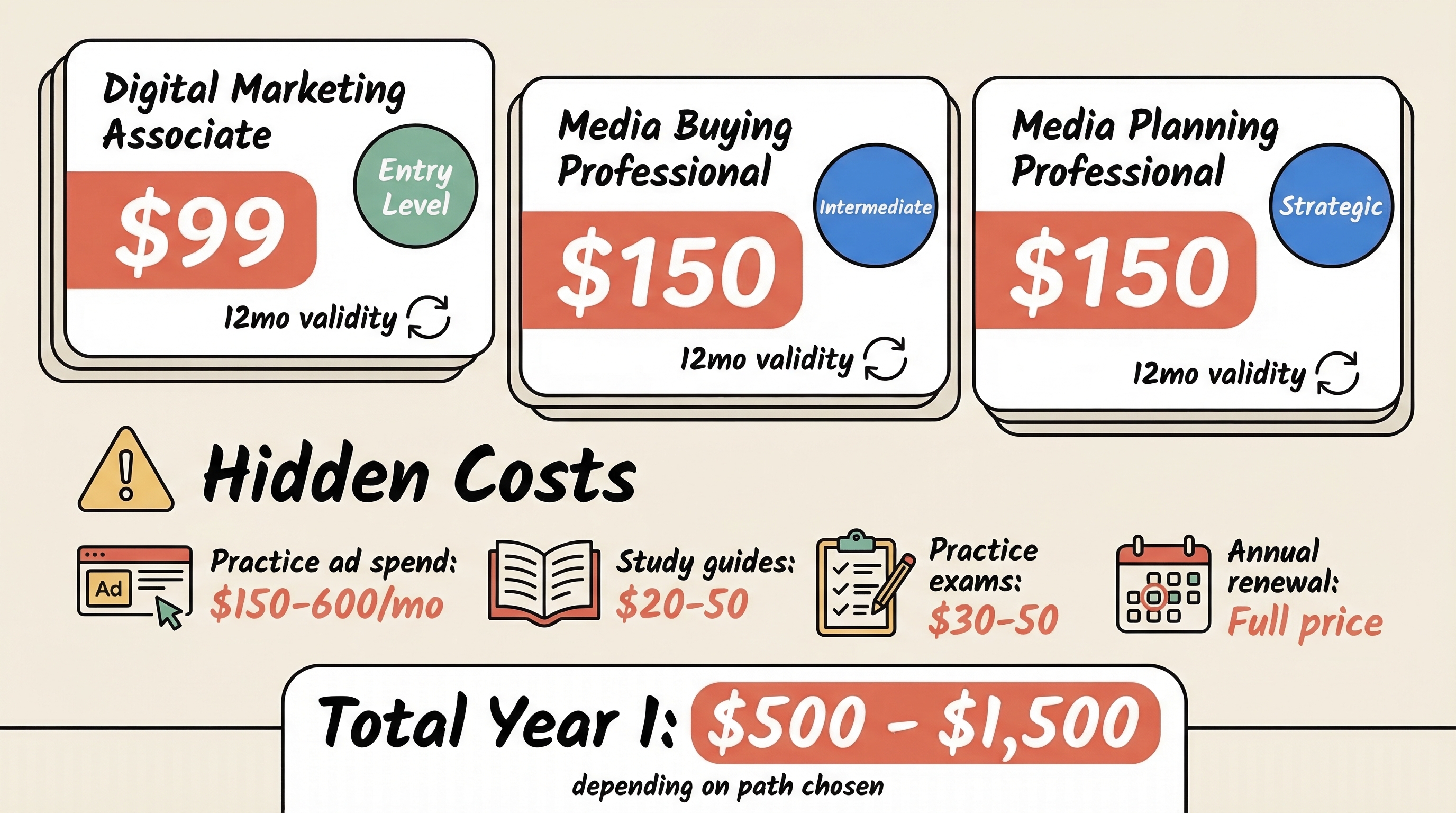
Coursera Meta Certificate Costs
The Meta Marketing Analytics Certificate on Coursera requires Coursera Plus at $59/month or $399/year. At 6 hours per week, the 7-month program costs roughly $413 monthly or $399 annually. Financial aid and free auditing are available.
CXL and Premium Course Costs
CXL's subscription starts at $999+ per year for full library access, or courses can be purchased separately. While expensive, CXL targets advanced practitioners — the ROI on deeper skills justifies the cost for agency professionals billing premium rates.
Hidden Costs to Plan For
Beyond course and exam fees, budget for these often-overlooked expenses:
- Practice ad spend: $5-20/day to run real campaigns while learning ($150-600/month)
- Third-party study guides: $20-50 for unofficial exam prep materials
- Practice exams: Some providers charge $30-50 for mock certification tests
- Annual renewal: Certifications expire after 12 months, requiring full-price re-examination
The total first-year investment for a fully certified Meta advertiser (one certification + practice spend + Coursera) ranges from $500-1,500 depending on which path you choose. For context on how ad budgets work in practice, see our guide on meta ads examples across different industries.
What to Expect After Completing a Meta Ads Course
After completing a Meta ads course, you should be able to set up campaigns, configure Meta Pixel, build custom audiences, and run A/B tests — with measurable improvements in ad performance within 30 days.
Your Learning Path: A Recommended Approach
Based on where you're starting, here's a suggested path:
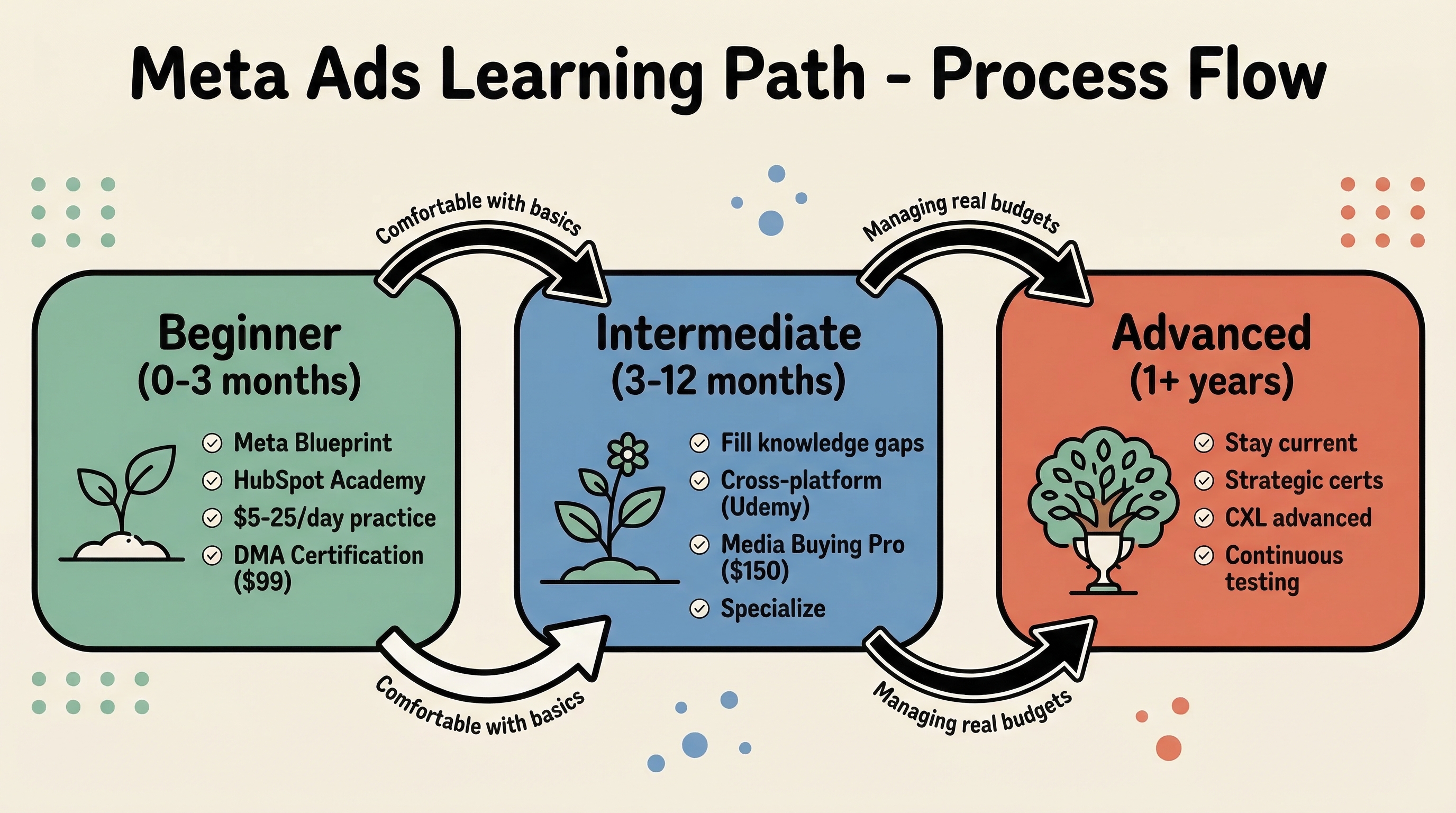
Complete Beginner (0-3 Months Experience)
The fastest way to get started is our free Meta Ads course, which covers everything from account setup to your first campaign.
- Start with Meta Blueprint - Complete the foundational courses
- Add HubSpot Academy - Build broader marketing context
- Practice with small budgets - Run campaigns with $5-25/day
- Consider certification - Take the Digital Marketing Associate exam once comfortable
Understanding Facebook ads objectives early helps you align course learning with campaign goals.
Intermediate (3-12 Months Experience)
- Fill knowledge gaps - Use Blueprint courses for specific topics
- Learn cross-platform - Udemy multi-platform courses add versatility
- Get certified - Media Buying Professional validates your skills
- Specialize - Consider e-commerce or creative strategy courses
At this stage, mastering meta ads scaling strategy becomes essential for advancing your campaigns.
Advanced (1+ Years Experience)
- Stay current - Follow platform updates and algorithm changes
- Strategic certifications - Media Planning or Marketing Science
- Deepen expertise - CXL or similar advanced programs for practitioner-level skills
- Continuous testing - Real campaigns teach more than courses
Advanced practitioners should monitor meta ads updates to stay ahead of platform changes. For applying advanced concepts in real campaigns, explore our breakdown of meta ads funnel strategy to connect course theory with practical execution.
For those pursuing performance marketing as a career path, Meta advertising skills form one pillar of a broader toolkit. Campaign management across paid social, combined with landing page optimization and analytics proficiency, creates a well-rounded skill set that employers and clients value highly. Many of the courses listed above -- particularly CXL and the Coursera certificate -- frame Meta ads within this broader performance marketing context.
Cross-Border and International Advertising Strategies
Running campaigns across multiple countries requires understanding platform delivery rules, currency settings, and regional audience behavior differences. A comprehensive meta ads course covers how international campaigns are structured, targeted, and optimized across different markets.
GEO-Targeting for International Campaigns
Country, region, and city targeting controls which audiences see specific ads, enabling localized offers and language-appropriate creative for different geographic segments.
Multi-Currency Campaign Budgeting
Campaigns running in multiple countries incur charges in the ad account currency, requiring advertisers to account for exchange rate fluctuations when setting budgets and evaluating performance.
Regional Audience Behavior Differences
Platform usage patterns, peak engagement hours, and content preferences vary significantly by region, requiring campaign schedules and creative to be adapted per market.
Language Targeting and Translated Creative
Targeting by language ensures ads reach users whose interface language matches the ad copy, improving relevance scores and engagement rates across multilingual markets.
Cross-Border Shipping and Compliance Messaging
International e-commerce campaigns require clear messaging about shipping times, customs duties, and return policies to maintain customer trust and reduce post-click friction.
International Pixel and Conversion Setup
Tracking international conversions accurately requires proper domain verification, event configuration, and potentially separate pixel setups for different regional properties.
GDPR and Regional Privacy Compliance
European campaigns must comply with GDPR requirements around consent and data processing, affecting how custom audiences, retargeting, and conversion tracking are configured.
Localized Pricing and Offer Strategies
Pricing presented in local currency with market-appropriate promotions consistently outperforms generic global offers that ignore regional purchasing power differences.
International Lookalike Audience Building
Building lookalike audiences from country-specific source audiences produces more relevant targeting than using global seed audiences for international expansion campaigns.
Time-Zone Management for Global Campaigns
Ad scheduling for global campaigns must account for time zone differences to ensure ads run during peak hours in each target country rather than the ad account's local time zone.
Cultural Sensitivity in Ad Creative
Images, colors, symbols, and messaging that resonate in one culture may be ineffective or offensive in another, requiring creative review by local market experts before launch.
International Landing Page Localization
Sending international traffic to localized landing pages with translated copy, local trust signals, and region-specific payment options significantly improves conversion rates.
Global Campaign Performance Benchmarks
CPMs, CPCs, and conversion rates vary widely by country, requiring market-specific performance benchmarks rather than applying a single global standard to all regions.
Nonprofit and Cause Marketing Campaigns
Charitable organizations and cause-driven brands use different campaign strategies than traditional commercial advertisers. A practical meta ads course addresses the unique objectives, messaging approaches, and ad policy requirements that apply to nonprofit advertising.
Nonprofit Ad Account Setup and Eligibility
Eligible nonprofits can apply for Meta's nonprofit discount program and access credits that reduce advertising costs for qualifying charitable campaigns.
Donation Campaign Objectives and Optimization
Campaigns optimized for donation conversions require proper Donations objective setup, Meta Pay integration, and post-conversion tracking to measure fundraising ROI accurately.
Cause Awareness and Reach Campaigns
Awareness-focused campaigns for nonprofits prioritize broad reach and message frequency over direct-response conversions, requiring different creative and bidding strategies.
Volunteer and Community Recruitment Ads
Lead generation campaigns for volunteer recruitment use interest-based targeting around civic engagement, community service, and cause-specific topics to reach motivated candidates.
Social Proof in Nonprofit Advertising
Testimonials from beneficiaries, volunteer stories, and impact statistics build credibility in nonprofit ads and motivate prospective donors and volunteers to take action.
Event Fundraising Campaign Strategies
Fundraising event campaigns combine awareness, RSVP, and ticket-purchase objectives in a sequenced campaign structure that moves prospects from discovery to attendance.
Peer-To-Peer Fundraising Amplification
Ads that promote peer-to-peer fundraising pages amplify organic sharing by reaching supporters who may not follow the organization directly but respond to personalized appeals.
Grant-Funded Advertising Compliance
Organizations using grant funds for advertising must track spend attribution carefully and follow any program-specific restrictions on ad content or targeting methods.
Political and Advocacy Advertising Requirements
Issue-based and advocacy campaigns may trigger Meta's political advertising requirements, including identity verification and disclaimer text that must be added to ad creative.
Impact Reporting for Nonprofit Campaigns
Nonprofit advertising performance reports typically include reach, donations generated, cost per donation, and narrative impact metrics that go beyond standard commercial KPIs.
Storytelling Creative for Cause Campaigns
Narrative-driven video ads that follow a single beneficiary's story typically outperform statistics-heavy creative for emotional engagement and donation conversion in cause marketing.
Annual Giving Season Campaign Planning
Nonprofit advertisers typically see peak performance during year-end giving season, requiring budget reserves and campaign preparation that begins 6-8 weeks before December campaigns launch.
Nonprofit Impact Metrics and Reporting in Ads
Donors respond to concrete impact metrics in nonprofit ad creative; a results-driven meta ads course teaches how to frame beneficiary outcomes, cost-per-impact statistics, and program efficiency data in compelling ad formats.
Real Estate Advertising and Lead Generation
Property advertising on Meta requires understanding housing advertising policies, lead capture strategies, and creative formats that perform in a competitive real estate market. A focused meta ads course for real estate covers compliant targeting, property showcase formats, and follow-up sequence design.
Housing Advertising Policy Compliance
Real estate ads are subject to Meta's Special Ad Category for housing, which restricts certain targeting options including age, gender, and location radius to ensure fair housing compliance.
Property Listing Carousel Creative
Carousel ads showcasing multiple property images with key details like price, bedrooms, and neighborhood generate higher engagement than single-image listing ads for real estate.
Real Estate Lead Generation Forms
Instant Forms for real estate pre-populate contact information and include custom questions about buyer timeline, financing status, and property preferences for lead qualification.
Video Walkthroughs and Virtual Tours
Property video walkthroughs and virtual tour links in ad creative significantly increase engagement time and lead quality compared to static photo galleries for residential listings.
GEO-Targeting for Real Estate Campaigns
Special Ad Category restrictions require a minimum 15-mile radius for location targeting, preventing hyper-local neighborhood exclusions that could constitute discriminatory ad delivery.
Real Estate Retargeting Sequences
Prospects who viewed listing pages but did not inquire receive retargeted ads featuring price reductions, new comparable listings, or open house invitations based on their browsing behavior.
New Development Pre-Launch Campaigns
Pre-launch awareness campaigns for new developments build interest lists of qualified buyers before construction completion, reducing time-to-sell once units become available.
Realtor Personal Brand Advertising
Individual agent campaigns focusing on local market expertise, transaction volume, and client testimonials build name recognition that complements property-specific listing campaigns.
Mortgage and Financing Companion Campaigns
Coordinated campaigns between real estate agents and lending partners provide a seamless buyer journey from property discovery through financing preapproval and closing.
Seasonal Real Estate Market Timing
Spring and fall market peaks justify increased advertising budgets, while winter campaigns for motivated sellers and year-end tax strategies maintain lead flow during slower periods.
Luxury Property Targeting Strategies
High-value property campaigns use income and behavior-based signals within Special Ad Category restrictions to reach qualified buyers without relying on prohibited demographic filters.
Property Management and Rental Advertising
Rental property campaigns differ from sales campaigns in objective selection, messaging urgency, and targeting, focusing on local renters in the right income range and life stage.
Financial Services Advertising Compliance
Banks, insurance providers, investment platforms, and fintech companies face strict advertising regulations that affect targeting options and required disclosures. A thorough meta ads course for financial services covers the Special Ad Category requirements, compliant messaging strategies, and performance optimization within regulatory constraints.
Financial Services Special Ad Category
Credit, insurance, and employment ads fall under Meta's Special Ad Category, restricting age, gender, and location targeting to comply with anti-discrimination laws across financial products.
Required Disclosures in Financial Ads
Financial services ads must include required regulatory disclosures about rates, terms, risks, and licensing that vary by product type, jurisdiction, and regulatory authority requirements.
Lead Generation for Financial Products
Financial product lead generation forms require custom qualification questions about income, credit range, or product interest to filter leads before passing them to sales teams.
Investment and Cryptocurrency Ad Policies
Investment products and cryptocurrency advertising require prior written authorization from Meta, with specific eligibility requirements that vary by product category and regional regulations.
Insurance Product Advertising Strategies
Insurance campaigns perform well with comparison messaging, life event targeting, and educational content that builds awareness before presenting product-specific offers.
Banking and Credit Product Campaigns
Credit card and banking product campaigns use life event triggers like moving, marriage, and graduation to reach prospects at the moment of highest product relevance.
Financial Advisor Personal Brand Campaigns
Independent financial advisors use thought leadership content, free consultation offers, and retirement planning calculators to generate qualified leads within regulatory guidelines.
Mortgage and Lending Campaign Optimization
Mortgage campaigns optimize for rate quote requests and prequalification applications, using interest rate benchmarks and competitor positioning within required disclosure frameworks.
Fintech App Install and Activation Campaigns
Mobile fintech campaigns focus on app install quality over volume, targeting users likely to complete onboarding and activate accounts rather than just download the application.
Wealth Management High-Net-Worth Targeting
Wealth management campaigns use behavioral and interest signals to reach high-net-worth prospects within the constraints of Special Ad Category targeting restrictions.
Regulatory Recordkeeping for Financial Ads
Financial services firms must maintain advertising records including creative, targeting parameters, and performance data to satisfy regulatory examination requirements in many jurisdictions.
Financial Education Content Marketing
Educational content about budgeting, investing, and financial planning builds brand authority and generates warm leads more cost-effectively than direct product promotion for many financial brands.
Healthcare and Wellness Advertising Guidelines
Medical practices, wellness brands, and health product companies navigate complex policy restrictions when advertising on Meta platforms. A current meta ads course addresses healthcare advertising policy requirements, compliant messaging strategies, and effective campaign structures for health and wellness brands.
Healthcare Advertising Policy Overview
Meta prohibits ads that imply knowledge of a user's health conditions, require advertisers to avoid health-condition-based targeting, and restrict before-and-after imagery for certain health products.
Pharmaceutical and Supplement Advertising Rules
Prescription drug ads require prior authorization, while supplement claims must comply with FTC guidelines about health benefit claims that are not permitted to make disease cure assertions.
Medical Practice Lead Generation
Healthcare provider campaigns generate appointment requests through lead forms and landing pages optimized for specific service lines like dental, vision, or elective procedures.
Wellness App Install and Subscription Campaigns
Fitness, meditation, and nutrition apps use benefit-focused messaging and free trial offers to drive app installs and convert trial users to paid subscriptions through retargeting sequences.
Telehealth and Virtual Care Advertising
Telehealth campaigns target convenience-oriented audiences with messaging about same-day appointments, no waiting rooms, and specialist access without requiring in-person visits.
Mental Health Service Advertising Sensitivities
Mental health campaigns require careful messaging that avoids stigmatizing language, uses empathetic framing, and complies with platform restrictions on crisis-related content.
Health Insurance Open Enrollment Campaigns
Open enrollment campaigns require precise timing aligned with enrollment windows, with Special Ad Category compliance for insurance products and required regulatory disclosures.
Fitness and Gym Membership Advertising
Gym and fitness campaigns leverage New Year resolution timing, weight loss interest audiences, and limited-time membership offers to drive sign-ups during peak motivation periods.
Corporate Wellness Program Advertising
B2B health and wellness campaigns target HR decision-makers with employee benefit program messaging, using LinkedIn-style professional targeting signals available through Meta's platforms.
Health Product E-Commerce Campaigns
Health supplement and wellness product e-commerce campaigns use educational content top-of-funnel followed by product-specific retargeting to build trust before purchase conversion.
Medical Device Advertising Requirements
Class I and II medical device advertising has specific claim restrictions, required clearance notifications, and appropriate-use limitations that must be reflected in ad copy and landing pages.
Patient Testimonial and Case Study Guidelines
Patient testimonials in healthcare ads must include typical results disclosures, avoid before-and-after imagery in restricted categories, and comply with HIPAA requirements for patient privacy.
Education and E-Learning Campaign Strategies
Schools, online course platforms, and professional certification providers use distinct campaign structures to reach students at different stages of the enrollment decision. Specialized meta ads course training for education marketers covers lead qualification, nurture sequences, and enrollment conversion optimization.
Higher Education Enrollment Campaigns
University and college enrollment campaigns target prospective students by age, interest, and life stage with program-specific value propositions and application deadline messaging.
Online Course Launch and Enrollment Strategies
Online course launches use webinar registration, free lesson previews, and limited enrollment windows to create urgency and demonstrate value before full course purchase.
Professional Certification Program Advertising
Certification program campaigns target professionals seeking career advancement with ROI-focused messaging about salary increases, promotion rates, and employer recognition of credentials.
Student Recruitment for Trade Schools
Vocational training campaigns emphasize job placement rates, starting salaries, and training duration to attract career-changers and recent graduates evaluating skilled trade pathways.
Lead Generation for Educational Institutions
Educational lead forms collect program interest, education level, and enrollment timeline to qualify prospects before routing them to admissions counselors for follow-up.
Education Retargeting and Nurture Campaigns
Prospective students who visited program pages but did not apply receive retargeted content including student testimonials, faculty profiles, and scholarship availability reminders.
K-12 School Choice and Private School Advertising
Private school campaigns target parents of school-age children with open house invitations, academic outcome data, and extracurricular program highlights during enrollment season.
Continuing Education and Adult Learner Campaigns
Adult learner campaigns address time constraints, employer tuition benefits, and career relevance to overcome the barriers that prevent working professionals from enrolling in continuing education.
Bootcamp and Accelerated Program Advertising
Coding bootcamp and accelerated learning programs use hiring partner testimonials, outcome statistics, and income share agreement messaging to justify premium pricing to prospective students.
Scholarship and Financial Aid Campaign Tactics
Scholarship deadline campaigns create genuine urgency that drives application volume, pairing financial award messaging with program outcome data to address both affordability and ROI concerns.
Alumni Network and Community Value Messaging
Highlighting alumni network size, industry connections, and career support services as program benefits addresses the long-term value proposition beyond immediate skill acquisition.
International Student Recruitment Campaigns
International student campaigns require language-appropriate creative, visa support messaging, and housing availability information that addresses the additional concerns of cross-border enrollment decisions.
SaaS and Software Product Advertising
Software-as-a-service companies face unique funnel challenges including longer sales cycles, technical buyer personas, and free trial conversion optimization. A technical meta ads course for SaaS marketers covers product-led growth advertising, trial-to-paid conversion campaigns, and enterprise demand generation strategies.
SaaS Free Trial Acquisition Campaigns
Free trial campaigns optimize for sign-up quality over volume by targeting audiences whose job titles, company sizes, and interests align with ideal customer profile characteristics.
Product Demo Lead Generation for SaaS
Demo request campaigns for enterprise software use technical benefit messaging and use-case specific creative to generate qualified sales pipeline from decision-maker audiences.
SaaS Trial-To-Paid Retargeting
Trial users who have not converted receive retargeted ads featuring advanced feature previews, integration highlights, and time-limited discount offers before their trial period expires.
B2B SaaS Audience Targeting Strategies
B2B software campaigns reach decision-makers using job title, seniority, company size, and industry targeting to ensure ad spend reaches people with budget authority for technology purchases.
SaaS Case Study and ROI Creative
Customer case studies showing specific ROI metrics, implementation timelines, and named company results outperform generic benefit claims for converting skeptical B2B software buyers.
Product Update and Feature Launch Campaigns
Feature launch campaigns targeting existing customers and warm prospects through custom audiences drive product adoption and reduce churn by communicating continuous value delivery.
SaaS Competitive Displacement Campaigns
Competitor displacement campaigns target users of competing software using interest-based signals and direct comparison messaging that highlights switching benefits and migration support.
Integration and Ecosystem Partner Advertising
Campaigns highlighting integration capabilities with popular business tools like Salesforce, HubSpot, and Slack expand the target audience to users of those platforms seeking enhanced functionality.
SaaS Onboarding and Activation Advertising
Post-sign-up campaigns promoting onboarding resources, setup tutorials, and customer success check-ins improve trial activation rates and accelerate time-to-value for new users.
Annual Contract and Expansion Campaigns
Upgrade and expansion campaigns targeting monthly subscribers with annual commitment discounts improve customer lifetime value and reduce churn risk across the customer base.
SaaS Event and Webinar Promotion
Webinar and virtual event campaigns generate qualified registrations from target personas, with post-event retargeting sequences converting attendees into trial users and demo requests.
Developer and Technical Audience Campaigns
Technical developer audiences respond to documentation previews, API capability highlights, and GitHub integration messaging rather than traditional benefit-focused advertising language.
SaaS Churn Signal Retargeting
A meta ads course covering SaaS retention advertising addresses how to identify login frequency drops, feature abandonment signals, and support ticket patterns that predict churn before subscription cancellation occurs.
Subscription Business Advertising Strategies
Subscription box companies, streaming services, and membership businesses optimize for acquisition cost relative to subscriber lifetime value rather than single-transaction ROAS. Understanding this distinction is central to any meta ads course designed for subscription business models.
Subscription LTV and CAC Optimization
Profitable subscription advertising requires understanding customer lifetime value by cohort and setting acquisition cost targets that reflect the expected revenue from subscription tenure rather than first-order value.
Free Trial and Introductory Offer Campaigns
Introductory offer campaigns lower the barrier to first subscription with discounted first months, free trial periods, or gift-with-subscription promotions that drive initial sign-up volume.
Subscription Box Unboxing Creative
Unboxing video ads showing the subscription product contents and customer reaction build curiosity and desire effectively for physical subscription box products across feed and Stories placements.
Churn Prevention Retargeting Campaigns
Retention campaigns targeting subscribers showing cancellation signals or reduced engagement deliver personalized reactivation offers or pause options before churn occurs.
Subscriber Winback Advertising
Winback campaigns targeting lapsed subscribers with special re-engagement offers typically generate higher conversion rates than new acquisition campaigns due to prior product familiarity.
Gifting and Seasonal Subscription Campaigns
Holiday gifting campaigns for subscription products require separate gift-purchase flows, recipient experience messaging, and redemption code delivery systems integrated with ad creative.
Subscription Upsell and Tier Upgrade Campaigns
Upsell campaigns targeting existing subscribers with premium tier features, family plan options, or add-on products improve average revenue per subscriber across the customer base.
Membership Community and Exclusivity Messaging
Exclusive member benefits, community access, and insider content previews provide compelling differentiation messaging for subscription products competing against free alternatives.
Pause vs Cancel and Retention Offer Advertising
Campaigns promoting pause options and retention offers to at-risk subscribers reduce hard cancellations and maintain subscriber counts during seasonal spending fluctuations.
Subscription Referral Program Amplification
Paid amplification of subscription referral programs reaches existing subscriber networks and their connections, generating lower-cost acquisitions through social proof and incentive messaging.
Annual Subscription Pre-Payment Campaigns
Annual prepayment campaigns offering significant discounts improve cash flow, reduce payment failure churn, and increase committed subscriber counts for subscription businesses.
Subscription Pause Period Reactivation
Reactivation campaigns targeting subscribers in pause status with personalized offers and product update highlights convert paused subscribers back to active status at higher rates than cold winbacks.
Local Business and Brick-And-Mortar Campaigns
Restaurants, retail shops, service businesses, and franchises use location-based advertising to drive foot traffic and local awareness. A practical meta ads course for local businesses covers store traffic objectives, local targeting strategies, and creative formats that work for neighborhood-level campaigns.
Store Traffic Campaign Objective Setup
The Store Traffic objective optimizes ad delivery to reach people near physical store locations who are most likely to visit, using location history and behavior signals for audience selection.
Local Awareness and Reach Campaigns
Reach campaigns targeting a defined radius around a business location build brand awareness among the local population that forms the core customer base for brick-and-mortar businesses.
Map Card and Directions Ad Formats
Map card attachments in local ads display business location, hours, and a directions link that reduces friction between ad exposure and physical store visit for nearby audiences.
Local Offer and Coupon Campaigns
Local discount and coupon campaigns drive immediate foot traffic with limited-time offers, happy hour promotions, and first-visit incentives targeted to people within driving distance.
Event and Grand Opening Promotion
Event awareness campaigns for grand openings, seasonal sales, and community events use date countdown messaging and local interest targeting to maximize attendance from the surrounding area.
Restaurant and Food Service Advertising
Restaurant campaigns combine food photography, reservation links, and delivery app partnerships with location-based targeting to drive both in-person dining and online order volume.
Franchise and Multi-Location Campaign Management
Franchise systems manage local advertising through collaborative ads or location-specific campaigns that allow individual location customization within brand-approved creative guidelines.
Local Service Provider Lead Generation
Home services, legal, and healthcare provider campaigns generate local leads through service-specific targeting, geographic radius settings, and call-optimized ad formats that connect prospects directly.
Seasonal Local Business Campaign Planning
Seasonal campaign calendars align advertising investment with peak business periods, holiday traffic surges, and weather-dependent demand patterns for local service and retail businesses.
Customer Review and Reputation Advertising
Review amplification campaigns that highlight positive customer testimonials build local social proof and improve new customer conversion rates for businesses dependent on local reputation.
Local Competitor Conquesting Strategies
Location-based conquesting campaigns reaching audiences near competitor locations use comparative messaging and incentive offers to capture customers considering alternative providers.
Foot Traffic Measurement and Offline Attribution
Store visit reporting in Ads Manager estimates how many ad viewers visited physical locations, providing offline attribution data to justify local advertising investment to business owners.
Event Marketing and Ticket Sales Campaigns
Conferences, concerts, festivals, and workshops use time-sensitive advertising strategies to fill seats and drive ticket sales before event dates. Event promotion is a specialized application covered in meta ads course curricula that addresses countdown urgency, interest-based targeting, and post-event retargeting.
Event Awareness and RSVP Campaigns
Early awareness campaigns build interest list size before ticket sales open, allowing event organizers to retarget a warm audience with purchase-focused messaging at launch.
Ticket Sales Conversion Optimization
Ticket purchase campaigns optimize for add-to-cart and checkout initiation events with product catalog integration that surfaces relevant ticket types based on audience interest signals.
Countdown Urgency and Limited Availability
Countdown messaging highlighting remaining tickets, early-bird deadline expiration, and sold-out tier notifications creates urgency that accelerates ticket purchase decisions among interested prospects.
Speaker and Performer Audience Targeting
Targeting fans of featured speakers, performers, or brands participating in an event creates a warm audience predisposed to interest in the event before general awareness campaigns run.
Virtual and Hybrid Event Advertising
Online event campaigns remove geographic targeting restrictions, enabling global audience reach with webinar registration, live stream access, and recording purchase objectives.
Post-Event Retargeting and Next Event Campaigns
Post-event campaigns targeting attendees with highlight reels, speaker content, and early access to future events convert satisfied attendees into repeat ticket purchasers for upcoming events.
Event Sponsorship and Partner Co-Marketing
Sponsor-amplified campaigns using partner audiences and co-branded creative extend event reach beyond the organizer's owned audience while providing additional exposure value to sponsors.
VIP and Premium Tier Ticket Upsell
Upsell campaigns targeting general admission ticket holders with VIP experience upgrades, backstage access, and exclusive networking tier offers improve revenue per attendee after initial purchase.
Recurring Event Series Audience Building
Annual conference and recurring event campaigns build year-round audiences through content marketing between events, reducing cold audience acquisition costs with each subsequent event edition.
Early Bird and Group Ticket Promotions
Early bird discount campaigns targeting past attendees and email list subscribers generate advance ticket revenue that funds event deposits and reduces organizer financial risk before general sale.
Event Venue and Location-Based Targeting
Location-based campaigns reaching audiences near the event venue or in the primary drive-market catchment area improve physical attendance rates compared to purely interest-based targeting.
Post-Purchase Attendee Engagement Campaigns
Pre-event engagement campaigns for confirmed attendees sharing agenda previews, networking tips, and preparation resources improve show rates and overall attendee satisfaction scores.
Event Registration Abandonment Retargeting
A focused meta ads course on event marketing covers registration abandonment retargeting that reaches users who started but did not complete ticket purchase with personalized reminder messages and simplified checkout flows.
Influencer and Creator Partnership Strategies
Collaborating with content creators and influencers to produce paid advertising provides authentic social proof that outperforms brand-produced content in many categories. Understanding creator partnership structures is increasingly important in any current meta ads course covering modern ad creative strategy.
Creator Partnership Ads and Branded Content
Branded content ads allow brands to amplify influencer posts as paid ads using creator handles, preserving the authentic feel of organic content while extending reach beyond the creator's follower base.
Influencer Content Performance Testing
Testing multiple creator interpretations of the same brief reveals which storytelling styles, product demonstrations, and audience relationships drive the highest conversion performance.
Micro-Influencer vs Macro-Influencer Advertising
Micro-influencer content often outperforms macro-influencer content on a cost-per-conversion basis due to higher audience trust, niche relevance, and stronger community engagement rates.
UGC Creator Sourcing and Brief Writing
User-generated content creators produce authentic-looking ad assets at scale, requiring clear creative briefs that specify hooks, product benefits to highlight, and call-to-action requirements.
Creator Content Licensing and Usage Rights
Usage rights agreements define how long and in which ad placements creator content can be used, with extended usage rights typically requiring additional compensation beyond the original fee.
Performance-Based Creator Compensation
Hybrid creator compensation models combining flat fees with performance bonuses align creator incentives with advertiser conversion goals and encourage creators to optimize their content approach.
Creator Audience Insights for Targeting
Creator audience demographic data from partnership analytics informs paid targeting strategy, helping advertisers identify audience segments that respond most to specific content styles.
Affiliate and Creator Code Tracking
Unique promo codes and UTM parameters assigned to each creator allow attribution of sales to specific partnerships, enabling data-driven creator investment decisions based on actual revenue contribution.
Creator Whitelisting Permissions Setup
Creator whitelisting grants brands permission to run ads from the creator's account, enabling audience expansion beyond follower retargeting while maintaining the creator's authentic identity in ad creative.
Long-Term Creator Partnership Programs
Ongoing creator ambassador programs produce higher-quality content, stronger audience trust signals, and more authentic brand integration than one-off sponsored post arrangements.
Creator Content Compliance and Disclosure
FTC disclosure requirements mandate clear paid partnership labeling in creator content used for advertising, and Meta's branded content tools automate the disclosure process for compliant partnership ads.
Niche Creator Identification and Outreach
Identifying creators with strong engagement rates in specific niches rather than follower-count alone produces better partnership ROI for brands with well-defined target customer profiles.
Brand Safety and Ad Quality Standards
Protecting brand reputation while maximizing ad delivery requires understanding Meta's quality ranking systems, policy enforcement mechanisms, and brand safety controls. A comprehensive meta ads course addresses how brand safety settings and quality scores affect campaign performance and account standing.
Ad Quality Ranking and Relevance Scores
Meta's ad quality ranking reflects feedback signals including engagement rate, hide rate, and reported rate relative to similar ads competing for the same audience attention.
Brand Safety Inventory Filter Settings
Inventory filter settings control ad placement proximity to sensitive content categories, with expanded, moderate, and limited inventory options that trade off reach against content adjacency risk.
Publisher and Placement Blocklists
Publisher block lists enable advertisers to prevent ad delivery on specific websites and apps within the Audience Network, protecting brand safety in sensitive or off-brand content environments.
Ad Creative Quality and Policy Compliance
Creative elements that generate high hide rates or policy violations reduce account quality scores and increase CPMs across all campaigns in the affected ad account over time.
Account Health and Policy Violation Management
Maintaining strong account health requires prompt response to policy violations, appeal submission for mistaken rejections, and proactive removal of ads approaching policy boundaries.
Comment Monitoring and Moderation Strategies
Active comment moderation on running ads prevents negative sentiment accumulation that harms quality scores and removes misleading responses or competitive interference from ad comment sections.
Ad Fatigue and Brand Reputation Management
Overexposing audiences to the same creative damages brand perception over time, requiring frequency caps and regular creative refreshes to maintain positive brand associations among target audiences.
Transparency Center and Ad Library Management
Meta's Ad Library makes all running ads publicly viewable, requiring brands to ensure their active ad creative reflects current brand standards and approved messaging at all times.
Sensitive Topic and Restricted Content Handling
Restricted content categories including alcohol, gambling, and adult content require opt-in acknowledgment during campaign setup and may limit available placements and targeting options.
Competitor Ad Monitoring Through Ad Library
The public Ad Library provides insights into competitor creative strategies, offer structures, and messaging positioning that inform competitive differentiation in brand advertising approaches.
Organic Content and Paid Brand Consistency
Maintaining visual and messaging consistency between organic social content and paid advertising creates a cohesive brand experience that reinforces trust and recognition across all platform touchpoints.
Crisis Management and Ad Pause Protocols
Pre-established protocols for pausing campaigns during brand crises, news events, or platform outages prevent inadvertent tone-deaf messaging during periods of elevated public sensitivity.
Seasonal Advertising Planning and Execution
Retail calendars, holiday shopping peaks, and cultural events create predictable demand cycles that reward advertisers who plan campaigns months in advance. A well-structured meta ads course covers seasonal budget planning, audience building, and the campaign sequencing that maximizes performance during competitive holiday periods.
Annual Advertising Calendar Development
A 12-month advertising calendar maps key promotional periods, audience building phases, and creative production timelines against budget allocation to enable proactive rather than reactive campaign management.
Q4 Holiday Season Campaign Preparation
Holiday campaign preparation begins in September with audience list building, creative production, and budget reservation that positions accounts for competitive performance during the October-December peak period.
Black Friday and Cyber Monday Strategy
BFCM campaigns require tiered offer reveal sequences, audience exclusion management, and post-purchase suppression that prevent wasted impressions on recently converted customers during peak traffic days.
Back-To-School Campaign Timing and Creative
Back-to-school campaigns targeting parents and students begin 6-8 weeks before school start dates in primary markets, with creative that emphasizes preparation, convenience, and value messaging.
Valentine'S and Gifting Season Campaigns
Gifting season campaigns require gender-split creative testing, last-minute shipping urgency messaging, and gift guide format ads that simplify purchase decisions for undecided buyers.
Summer and Travel Season Advertising
Summer campaigns for travel, outdoor, and recreational products launch in March and April to capture early planning behavior before summer inventory and pricing become constrained.
New Year and Resolution Period Advertising
January campaign strategy targets resolution-motivated audiences in fitness, education, finance, and wellness with messaging that acknowledges goal-setting psychology and provides credible achievement pathways.
Tax Season Campaign Opportunities
Tax refund season creates a predictable consumer spending increase in February through April that benefits retail, travel, electronics, and home improvement advertisers with well-timed campaigns.
Post-Holiday Clearance and New Year Sale Campaigns
Post-holiday clearance campaigns targeting recent buyers who did not convert on gift-focused offers capture extended holiday shopping behavior through early January with inventory clearance messaging.
Regional and Cultural Event Calendar Planning
Regional cultural holidays, sporting events, and local celebrations provide targeted campaign hooks for advertisers serving specific geographic markets or culturally aligned audience segments.
Always-On vs Seasonal Budget Allocation
Allocating a portion of annual budget to always-on campaigns maintains audience building and brand awareness between peaks, while seasonal budget reserves fund intensive promotional period campaigns.
Competitive CPM Management During Peak Periods
Holiday auction pressure increases CPMs significantly, requiring creative performance optimization, audience refinement, and bidding strategy adjustments to maintain profitability during expensive peak periods.
Seasonal Creative Production Timelines
Meta ads course best practices for seasonal campaigns recommend completing creative production 4-6 weeks before campaign launch to allow time for approval, testing, and audience building phases.
Multi-Language and Localized Campaign Management
Businesses serving multilingual markets or expanding internationally use language targeting and dynamic language optimization to deliver relevant ad experiences. A current meta ads course covers multi-language campaign architecture, translation workflows, and performance measurement across language segments.
Dynamic Language Optimization in Ads
Dynamic language optimization allows single campaigns to serve multiple language variations of ad copy to audiences based on their interface language without creating separate campaigns for each language.
Translation Quality and Cultural Adaptation
Professional translation combined with cultural adaptation of idioms, value propositions, and calls-to-action produces significantly better ad performance than direct literal translation alone.
Language Targeting vs Location Targeting
Language targeting reaches users who have set their platform language to the target language regardless of location, enabling service of diaspora communities and multilingual urban markets.
Bilingual Market Campaign Architecture
Markets with significant bilingual populations require separate ad sets for each language to enable language-specific optimization, creative testing, and performance reporting without cross-contamination.
Right-To-Left Language Creative Considerations
Arabic, Hebrew, and other RTL language ads require creative templates that reverse text layout direction, rethink visual flow, and account for different reading patterns in image and video design.
Localized Landing Page and Conversion Flow
Sending multilingual ad traffic to language-matched landing pages with localized trust signals, payment methods, and customer support options dramatically improves post-click conversion rates.
Multilingual Facebook Page Management
Facebook's multilingual Page feature enables businesses to create language-specific page content that surfaces to users based on their language settings, supporting organic and paid multilingual strategies.
Language Performance Reporting and Optimization
Separate reporting by language segment reveals significant performance differences that inform budget reallocation, creative iteration, and bidding strategy adjustments across multilingual campaigns.
Native Language Customer Support Alignment
Multilingual advertising campaigns require corresponding native-language customer support capability to prevent post-click service failures that damage conversion rates and brand reputation.
Market-Specific Compliance in Multilingual Campaigns
Different markets have varying advertising regulations, required disclosures, and restricted content categories that must be reflected in language-specific ad versions beyond simple translation.
Language Expansion Testing Methodology
Systematic language expansion testing starts with markets showing the highest organic traffic from target languages before committing to full multilingual campaign infrastructure investment.
Multilingual Audience Size and Targeting Viability
Validating sufficient audience size in each target language before building multilingual campaign infrastructure prevents overly fragmented targeting that raises CPMs and reduces algorithmic optimization data.
Multilingual Creative Testing Methodology
A structured meta ads course approach to multilingual creative testing rotates translated variants systematically across language segments to identify which messages resonate best in each target market.
Customer Lifetime Value Optimization Through Advertising
Maximizing the long-term revenue from each acquired customer through post-purchase advertising is increasingly critical as acquisition costs rise. Advanced meta ads course training covers LTV segmentation, loyalty advertising, and win-back campaign strategies that improve overall account profitability.
LTV-Segmented Custom Audience Creation
Segmenting customer audiences by lifetime value tier enables differentiated messaging, budget allocation, and offer structures tailored to high-value, mid-value, and at-risk customer segments.
Post-Purchase Upsell and Cross-Sell Campaigns
Post-purchase campaigns delivered within 24-48 hours of first purchase convert at significantly higher rates than cold acquisition campaigns by capitalizing on peak brand trust moments.
Loyalty Program Advertising and Activation
Loyalty program enrollment campaigns targeting recent purchasers who have not yet joined improve customer retention metrics and create first-party data assets for future campaign targeting.
VIP Customer Exclusive Offer Campaigns
Exclusive offer campaigns for top-tier customers reinforce their valued status, reduce churn risk, and generate incremental revenue from the highest-value segment with minimal acquisition cost.
Win-Back Campaign Sequencing for Lapsed Customers
Multi-step win-back sequences that progress from brand reminder to compelling offer to final urgency message convert lapsed customers at higher rates than single-exposure reactivation attempts.
Repeat Purchase Frequency Optimization
Replenishment reminder campaigns timed to average reorder intervals reduce customer acquisition costs by converting existing customers to repeat buyers before they consider alternatives.
Customer Anniversary and Milestone Campaigns
Anniversary campaigns celebrating the customer's first purchase or subscription date create personalized moments that strengthen brand-customer relationships and generate incremental purchase occasions.
High-LTV Lookalike Audience Creation
Building lookalike audiences from the top 10-20% of customers by lifetime value consistently produces better acquisition quality than lookalikes built from all customers or recent purchasers.
Subscription and Membership Retention Advertising
Pre-renewal reminder campaigns for subscription and membership products reduce involuntary churn by prompting payment method updates and reinforcing product value before renewal dates.
Product Review and Advocacy Activation Campaigns
Review request campaigns targeting satisfied customers at peak satisfaction moments generate authentic social proof that improves future campaign performance and organic conversion rates.
Dormant Customer Reactivation Strategies
Reactivation campaigns for customers who have not purchased in 180+ days use strong incentives, new product announcements, and personalized messages referencing past purchase behavior.
Referral Program Advertising for Existing Customers
Referral incentive campaigns targeting satisfied customers generate referred new customers who have higher lifetime values and lower churn rates than customers acquired through cold advertising channels.
App Advertising and Mobile Campaign Strategies
Mobile app campaigns use distinct objectives, tracking setups, and creative formats that differ fundamentally from web campaigns. A focused meta ads course for app marketers covers install optimization, in-app event tracking, and bidding strategies that reduce cost-per-install while improving user quality.
App Install Campaign Setup and Optimization
A meta ads course for app marketers explains how the App Installs objective uses the Meta SDK or server-to-server events to optimize delivery toward audiences most likely to complete installation.
App Event Optimization and in-App Tracking
Optimizing for post-install events like registration completion, first purchase, or subscription activation produces higher-quality users than optimizing for raw install volume alone.
Mobile Creative Formats and Specifications
Vertical 9:16 video, animated screenshots, and native-feeling creative formats consistently outperform repurposed horizontal video in mobile app install campaigns across iOS and Android devices.
iOS 14+ Skadnetwork and Attribution
Apple's ATT framework limits user-level tracking on iOS, requiring advertisers to implement SKAdNetwork attribution and aggregate event measurement for Apple device campaign optimization.
Android App Campaign Best Practices
Android campaigns face fewer attribution restrictions than iOS, enabling more granular user-level event tracking and optimization that supports lower-funnel event bidding strategies.
App Retargeting and Re-Engagement Campaigns
Re-engagement campaigns targeting lapsed app users with personalized content previews and return incentives reactivate dormant users at significantly lower cost than new user acquisition campaigns.
Deep Linking and Deferred Deep Linking
Deep links direct ad clicks to specific in-app screens rather than the app store, reducing friction between ad click and intended action for users who already have the app installed.
App Store Optimization and Paid Coordination
Coordinating app store page optimization with paid campaigns ensures users who click through from ads encounter compelling store listings that maximize install conversion rates.
Subscription App LTV and Trial Optimization
Subscription app campaigns optimize for trial start quality, with downstream LTV modeling adjusting bidding targets based on expected conversion-to-paid rates by audience segment.
Gaming App Advertising Strategies
Gaming app campaigns use playable ad formats, gameplay video creative, and player lookalike audiences built from high-engagement existing players to acquire users with strong retention profiles.
App Campaign Creative Iteration Velocity
High-performing app advertisers rotate new creative assets weekly to prevent ad fatigue in always-on install campaigns where audiences see ads at high frequency over extended periods.
Hybrid App and Web Campaign Coordination
Multi-surface campaigns coordinating web and app advertising create seamless user journeys that guide prospects from web discovery to app installation and first engagement actions.
App Rating and Review Impact on Performance
App store ratings directly affect install conversion rates from paid traffic, making in-app review request timing and response management critical components of paid app advertising strategy.
E-Commerce Catalog and Dynamic Product Ads
Dynamic ads automatically show relevant products to users based on browsing and purchase behavior, creating personalized ad experiences at scale. A comprehensive meta ads course for e-commerce covers catalog setup, dynamic creative, and retargeting strategies that drive product discovery and purchase completion.
Product Catalog Feed Setup and Management
A meta ads course covering dynamic ads explains how catalog feeds require properly formatted data with required fields including product ID, title, description, price, and image URL for accurate delivery.
Dynamic Retargeting for Product Browsers
Dynamic retargeting shows previously viewed products to users who visited product pages without purchasing, with pricing and availability overlays that create personalized purchase prompts.
Abandoned Cart Dynamic Ad Sequences
Cart abandonment sequences show the exact products left in cart with urgency messaging, discount offers, and product variant alternatives that address common purchase hesitation reasons.
Broad Audience Catalog Prospecting
Advantage+ catalog campaigns show relevant products to cold audiences based on behavioral signals, enabling personalized prospecting without manual product-level targeting configuration.
Collection Ads and Instant Experience Shopping
Collection ads combine a hero image with a product grid below, opening into an Instant Experience shopping environment that reduces friction between ad discovery and product purchase.
Catalog Product Set Segmentation Strategies
Segmenting product sets by category, price range, margin, or seasonal relevance enables targeted campaign structures that allocate budget efficiently across the product range.
Product Feed Enrichment and Optimization
Enriching catalog feeds with additional attributes like color, size, and material enables more granular audience segmentation and creative customization for product-specific campaigns.
Dynamic Creative Overlays and Templates
Creative overlays add pricing badges, discount percentages, free shipping indicators, and urgency callouts to catalog product images without requiring manual creative production for each item.
Cross-Sell and Upsell Dynamic Campaigns
Post-purchase dynamic campaigns showing complementary products or category upgrades to recent buyers generate incremental revenue from customers most receptive to brand recommendations.
Inventory-Aware Campaign Automation
Automated rules that pause campaigns for out-of-stock products and reactivate when inventory restores prevent poor customer experiences and wasted ad spend on unavailable products.
Shop Ads and Facebook Shops Integration
Facebook and Instagram Shops integration enables checkout-optimized ad experiences allowing users to complete purchases without leaving the platform, reducing cross-device attribution friction.
Catalog Performance Analysis and Optimization
Product-level performance analysis identifies high-ROAS catalog items, chronic underperformers, and seasonal products that warrant dedicated campaign structures rather than broad catalog inclusion.
E-Commerce Attribution and ROAS Optimization
Accurate revenue attribution across ad exposures requires proper pixel implementation, conversion window settings, and attribution model selection that reflects the actual customer purchase journey length.
Landing Page Optimization for Meta Ad Traffic
The post-click experience determines whether paid traffic converts, making landing page optimization inseparable from campaign performance. A complete meta ads course addresses landing page elements that most significantly impact conversion rates and Quality Score for Meta campaign traffic.
Message Match Between Ad and Landing Page
A foundational meta ads course concept is that visitors who click ads expecting specific offers and land on generic pages with mismatched messaging bounce immediately, wasting ad spend and damaging Quality Score.
Landing Page Load Speed and Core Web Vitals
Each second of landing page load delay reduces conversion rates by up to 20%, making technical performance optimization as important as copywriting and design for paid traffic profitability.
Above-The-Fold Conversion Element Placement
Primary headlines, value propositions, and call-to-action buttons visible without scrolling capture attention from mobile users who form rapid judgments within the first few seconds of landing.
Social Proof and Trust Signal Placement
Customer reviews, security badges, and testimonials placed strategically near call-to-action elements address purchase hesitation at the critical decision moment for conversion on paid traffic.
Mobile-Specific Landing Page Design
More than 70% of Meta ad clicks come from mobile devices, requiring landing pages designed specifically for thumb-navigation, small screen viewing, and mobile payment method accessibility.
Form Optimization and Friction Reduction
Reducing form field count, enabling autofill, implementing progress indicators, and offering social sign-in options significantly improves form completion rates for lead generation landing pages.
Video on Landing Pages for Paid Traffic
Explainer videos on landing pages increase time-on-page and conversion rates for complex offers by communicating product benefits more effectively than text and images alone.
Landing Page a/B Testing Methodology
Systematic A/B testing of headlines, hero images, CTA copy, and page structure identifies the highest-converting landing page variation through statistically valid split testing with adequate traffic.
Personalized Landing Pages for Different Audiences
Dynamic landing pages adapting headline and value proposition copy based on the ad clicked consistently outperform single generic landing pages across diverse traffic sources and audience segments.
Checkout Page Optimization for E-Commerce Traffic
Streamlined checkout flows with guest checkout options, multiple payment methods, and clear progress indicators reduce cart abandonment rates for campaigns driving direct product purchases.
Landing Page Heatmap and Session Recording Analysis
Heatmap and session recording tools reveal where paid traffic users click, scroll, and abandon pages, providing qualitative insights that complement conversion rate data for optimization.
Landing Page SEO and Paid Traffic Synergy
Landing pages optimized for both paid traffic conversion and organic search visibility extend content investment ROI beyond paid campaigns by capturing organic traffic to high-converting pages.
Conversion Rate Optimization Framework for Paid Traffic
A structured CRO process for paid traffic landing pages prioritizes high-impact tests using statistical significance requirements, preventing premature conclusions from insufficient sample sizes.
Copywriting Frameworks for Social Advertising
Social advertising copy must capture attention within milliseconds and motivate action amid competing organic content. A dedicated meta ads course on copywriting covers the frameworks, formulas, and testing approaches that produce high-performing ad copy across different objectives and audiences.
Hook-First Copywriting for Social Feeds
A meta ads course on copywriting shows that social feed copy must lead with the most compelling element in the first line, as most users never expand truncated ad text beyond visible preview characters.
AIDA Framework in Social Ad Copy
Attention, Interest, Desire, and Action structure remains effective for longer-form ad copy when each element is compressed into concise active-voice sentences appropriate for social platform reading.
Problem-Agitate-Solution Formula
PAS copy identifies the audience's specific pain point, amplifies the emotional stakes, and presents the product as the resolution, creating motivational momentum toward conversion actions.
Social Proof Integration in Ad Copy
Embedding specific customer numbers, named testimonials, and verifiable results statistics within ad copy increases credibility compared to general benefit claims for most product categories.
Urgency and Scarcity Copywriting Techniques
Genuine urgency through limited inventory, enrollment deadlines, and promotional expiration dates motivates faster decisions, while manufactured false scarcity risks policy violations and brand damage.
Call-To-Action Optimization and Testing
Specific CTA language like "Get Your Free Audit" consistently outperforms generic directives like "Click Here" by setting clear expectations about what happens immediately after clicking.
Emojis and Formatting in Ad Copy
Strategic emoji use draws visual attention to key benefits and CTAs in feed copy, while excessive use creates cluttered impressions that signal low-quality creative to platform algorithms.
Benefit vs Feature-Focused Copy Strategies
Benefit-focused copy addressing what the customer gains emotionally outperforms feature-list copy in most consumer categories, while B2B and technical audiences often prefer specification details.
Long-Form vs Short-Form Copy Testing
Copy length preference varies significantly by audience, offer complexity, and objective, requiring systematic testing of short, medium, and long versions for definitive performance conclusions.
Personalization Tokens and Dynamic Copy
Dynamic copy insertion using audience segment, location, or behavioral data creates personalized ad experiences that improve relevance scores and engagement rates across diverse audience compositions.
Competitive Copy Differentiation Strategies
Direct comparison copy highlighting specific advantages over competitors can be effective in mature categories where audiences actively evaluate alternatives, subject to Meta policy requirements.
Storytelling Narrative in Paid Social Copy
Mini-story narratives in ad copy that follow a protagonist through a relatable problem to resolution generate higher engagement than direct promotional language for many product categories.
Headline Testing Methodology for Social Ads
Systematic headline testing frameworks that isolate one variable per test produce more actionable learning than simultaneous multi-variable creative tests where winning elements cannot be cleanly attributed.
Video Script Writing for Paid Social
Paid social video scripts require a different structure than broadcast TV, optimized for silent autoplay, vertical orientation, and short attention windows. A practical meta ads course covers scripting frameworks, pacing guidelines, and hook structures that produce high-performing paid social video creative.
Three-Second Hook Script Structure
A meta ads course on video production confirms that scripts must open with a visual or audio hook establishing the core value proposition within the first three seconds before most users scroll.
Silent Viewing Optimization for Video Scripts
Since 85% of social video is watched without sound, scripts must convey the core message through on-screen text, captions, and visual storytelling that works without audio engagement.
UGC and Spokesperson Script Formats
User-generated content scripts use conversational, authentic language matching how real customers talk about products, distinct from polished brand voice that reads as overly promotional.
Testimonial Video Script Frameworks
Effective testimonial scripts follow a before-during-after structure that quantifies the transformation experienced, with specific metrics and named results that give the testimonial credibility.
Product Demonstration Script Structure
Demo video scripts lead with the problem being solved, demonstrate the solution in action, and close with social proof and a specific call-to-action timed to coincide with the visual showcase.
Educational Content Video Script Format
Tutorial video scripts commit to delivering genuine value in the hook, structure teaching in numbered steps, and position the brand as the enabler of the skill being demonstrated.
Short-Form 15-Second Script Optimization
Fifteen-second scripts require identifying the single most compelling message, eliminating all supporting context, and building every visual and word toward one clear conclusion and action.
Long-Form 2-Minute Video Script Strategy
Longer video scripts earn attention through continuous value delivery, using open loops and curiosity gaps that prevent drop-off while systematically building the case for conversion.
CTA Placement Within Video Scripts
Placing calls-to-action at multiple points including mid-video after value delivery and at the final frame captures both early decisive viewers and those who complete the full viewing.
Iterative Script Testing and Winner Scaling
Testing multiple script approaches for the same product with small budgets identifies the highest-converting narrative framework before committing production resources to full-scale creative execution.
Repurposing Long-Form Video into Short Clips
Long-form content can be cut into multiple short-form ads by identifying the highest-engagement segments, with each clip optimized as a standalone 15-30 second ad unit for paid placements.
Emotional Arc and Pacing in Video Scripts
Effective video scripts build emotional momentum through deliberate pacing that alternates between problem identification, aspiration, proof, and resolution to guide viewers toward purchase motivation.
Native Platform Video Scripting for Meta
Scripts written specifically for Meta placements account for feed context, mobile-first consumption, and platform-native behaviors that distinguish effective social scripts from repurposed broadcast content.
Customer Journey Mapping for Meta Campaigns
Aligning campaign objectives with stages of the customer decision process produces more efficient results than treating all traffic as equally ready to convert. A systematic meta ads course approach to journey mapping covers awareness through loyalty stages with appropriate tactics at each touchpoint.
Awareness Stage Campaign Objectives and Creative
Top-of-funnel awareness campaigns use Reach and Brand Awareness objectives with broad creative that introduces the brand to new audiences with no prior familiarity with the product.
Consideration Stage Engagement and Traffic Campaigns
Mid-funnel campaigns use Engagement, Traffic, and Video View objectives to deepen interest among prospects who have had initial brand exposure and are now actively evaluating options.
Conversion Stage Campaign Design
Bottom-of-funnel conversion campaigns target warm audiences with direct purchase or lead generation objectives and specific offer-focused creative that addresses remaining purchase barriers.
Full-Funnel Campaign Budget Allocation
Allocating budget proportionally across awareness, consideration, and conversion stages based on audience size and cycle length optimizes total funnel efficiency and sustainable acquisition cost.
Retargeting Window Configuration by Stage
Shorter retargeting windows of 7-14 days capture high-intent recent visitors, while longer 30-90 day windows maintain presence for higher-consideration purchases with extended decision timelines.
Audience Suppression and Exclusion Management
Excluding recent purchasers, current customers, and disengaged users from acquisition campaigns prevents budget waste and maintains positive brand experiences for audiences not ready to receive conversion messages.
Sequential Messaging Campaign Architecture
Sequential campaigns serve different creative messages to the same audience over multiple exposures, building narrative depth and addressing successive purchase objections across the decision journey.
Cross-Device Journey Tracking and Attribution
Customer journeys frequently span multiple devices between first ad exposure and final conversion, requiring cross-device attribution models that credit the full exposure sequence rather than last touch only.
Offline Touchpoint Integration in Journey Mapping
Customers who interact with both digital ads and offline touchpoints like store visits and phone calls require integrated attribution approaches that capture the complete influence model.
Journey Stage Content Mapping
Mapping specific content types to journey stages ensures prospects receive educational content at awareness, comparative content at consideration, and proof-based content at conversion decision points.
Post-Purchase Journey and Advocacy Stage
The post-purchase customer journey through onboarding, satisfaction, and advocacy represents the highest-ROI stage of journey management yet is often neglected in paid advertising planning.
Journey Analytics and Funnel Visualization
Funnel visualization tools that track audience movement from awareness through conversion reveal where prospects disengage and which journey stages require creative or targeting optimization.
Brand Lift and Journey Measurement Studies
Brand lift studies measure the incremental impact of awareness campaigns on consideration and purchase intent, providing upper-funnel attribution data that complements conversion-based measurement.
Audience Overlap and Fragmentation Management
Running multiple campaigns targeting similar audiences causes internal competition that raises CPMs and reduces efficiency. Managing audience overlap and fragmentation is a critical skill covered in any advanced meta ads course focused on account-level optimization and budget efficiency.
Audience Overlap Diagnostic Tools
Meta's Audience Overlap tool reveals the percentage of shared users between ad sets and campaigns, identifying internal competition that should be resolved through exclusion or consolidation.
Ad Set Consolidation for Budget Efficiency
Consolidating multiple similar ad sets into fewer larger ones provides the algorithm with more data per optimization unit, improving machine learning efficiency and reducing internal audience competition.
Campaign Budget Optimization and Overlap Prevention
CBO automatically manages budget distribution across ad sets, but audience overlap between campaigns requires manual exclusion management that automated budget optimization cannot resolve independently.
Exclusion Audience Architecture
Systematically excluding converted customers from acquisition campaigns, recent acquirers from retention campaigns, and high-funnel audiences from conversion campaigns prevents misaligned message delivery.
Lookalike Audience Sizing and Overlap
Multiple lookalike audiences at different percentage ranges often share significant user overlap, requiring either consolidation into a single broader lookalike or systematic exclusion between lookalike tiers.
Interest Audience Fragmentation Problems
Creating dozens of narrow interest-based ad sets fragments the optimization algorithm's learning data, typically producing worse results than fewer consolidated interest combinations with sufficient audience size.
Broad Targeting vs Defined Audience Efficiency
Meta's algorithm increasingly outperforms manual audience definitions when given broad targeting and sufficient conversion data, making detailed audience segmentation less critical for mature data-rich accounts.
Geographic Audience Segmentation Trade-Offs
Splitting campaigns by geography for creative localization creates budget fragmentation that may reduce algorithmic efficiency compared to consolidated national campaigns with dynamic location-based creative.
Audience Refresh and Saturation Management
Audience saturation occurs when frequency reaches the point of diminishing engagement returns, requiring fresh audience expansion, exclusion of overexposed users, or creative rotation to restore performance.
Custom Audience Overlap with Prospecting Campaigns
Custom audiences of website visitors and past customers should be excluded from cold prospecting campaigns to prevent brand-familiar audiences from receiving top-of-funnel awareness messaging.
Platform vs Manual Audience Control Balance
Balancing Meta's automated audience expansion features with manually defined exclusions requires ongoing testing to find the configuration that maximizes performance for specific account objectives.
Audience Testing and Winner-Scaling Protocol
Structured audience testing protocols identify the highest-performing targeting configurations before scaling budget, preventing premature investment in untested audience definitions based on assumptions.
Audience Insights and Planning Tools for Research
Meta's audience planning tools help estimate reachable audience sizes and identify demographic compositions before campaign launch, reducing wasted spend on impractical audience configurations.
Bidding Strategy Selection and Optimization
Choosing the right bidding strategy for each campaign objective significantly impacts cost efficiency and delivery consistency. A rigorous meta ads course treatment of bidding covers the algorithmic mechanics of each strategy and the conditions where each performs best for different business objectives.
Lowest Cost Bidding and When to Use It
Lowest cost bidding maximizes results within a defined budget without a cost target. A meta ads course explains it is ideal for campaigns in learning phase where establishing baseline cost data is the primary goal.
Cost per Result Goal and Bid Cap Differences
Cost Per Result Goal sets a target average cost while allowing flexibility to exceed it for better opportunities, while Bid Cap sets a strict per-auction maximum that may reduce delivery volume.
ROAS Target Bidding for E-Commerce
Minimum ROAS bidding maintains profitability thresholds by restricting delivery to auctions where expected revenue meets the defined return target, trading delivery volume for margin preservation.
Value-Based Bidding and Purchase Value Optimization
Value optimization prioritizes delivery to users predicted to generate higher purchase values rather than simply maximizing conversion volume, improving revenue quality from advertising budgets.
Learning Phase Management and Stabilization
Campaigns enter learning phase when optimization events are insufficient for algorithmic confidence, requiring reduced changes and adequate budget to accumulate the 50+ events needed for stable delivery.
Bid Strategy Transitions and Account Impact
Changing bid strategies mid-flight resets learning phase and temporarily destabilizes delivery, making bid strategy transitions most appropriate at campaign start or after deliberate performance review periods.
Dayparting and Budget Scheduling with Bid Strategies
Scheduling ads to run only during peak performance hours can improve cost efficiency but reduces algorithmic data accumulation speed in learning phase and may harm optimization for varied audiences.
Competitive Auction Dynamics and Bidding Responses
Understanding how competitor bidding affects auction clearing prices enables strategic bid adjustments during competitive periods like holiday season without simply raising bids reactively.
Minimum Cost-Volume Constraints and Bid Strategy
When campaigns cannot achieve both high volume and low cost simultaneously, bid strategy selection determines which constraint to prioritize based on current business objectives and budget availability.
Automated Rules and Bid Management
Automated rules that adjust budgets and bids based on performance thresholds provide systematic bid management that responds to fluctuations without requiring constant manual account monitoring.
Third-Party Bid Management Tool Integration
External bid management platforms provide additional optimization algorithms, cross-channel bid coordination, and portfolio optimization capabilities beyond what native Meta bid strategies offer.
Bid Strategy Performance Reporting and Analysis
Comparing bid strategy performance requires controlled testing with sufficient budget and duration to attribute performance differences to strategy choice rather than seasonal variation or audience differences.
Meta Advantage+ Bidding and Automation Features
Advantage+ bidding features use machine learning to automate adjustments across campaigns, requiring advertisers to understand which controls to retain manually and which to delegate to the platform algorithm.
Ad Account Structure Best Practices
Campaign, ad set, and ad organization within an account determines optimization efficiency, testing clarity, and reporting accuracy. A well-designed meta ads course dedicates significant coverage to account structure principles that balance algorithmic optimization with strategic control and measurement clarity.
Campaign Objective-Aligned Account Structure
Organizing campaigns by primary business objective rather than audience segment or creative type enables cleaner performance comparison and more accurate attribution of results to strategic priorities.
Ad Set Audience Isolation Principles
Each ad set should contain one clearly defined audience type to enable direct audience performance comparison and prevent optimization data from mixing between audience strategies within campaigns.
Creative Testing Account Structure
Dedicated creative testing campaigns with controlled audiences and budget allocations produce cleaner creative performance data than testing new assets within active production campaigns.
Naming Convention Standards and Enforcement
Consistent naming conventions for campaigns, ad sets, and ads that encode objective, audience, placement, and date enable efficient filtering, reporting, and historical performance analysis.
Account-Level Spend Limits and Controls
Account-level and campaign-level spend caps prevent runaway spending from algorithm decisions or user error, providing a safety layer that protects total budget allocation across active campaigns.
Campaign Limit and Ad Set Count Guidelines
Spreading budget across too many campaigns and ad sets fragments optimization data below the learning threshold, producing suboptimal algorithmic performance across all active campaigns simultaneously.
Active, Archive, and Deleted Campaign Management
Regular archiving of completed campaigns and ad sets reduces account clutter without losing performance history, maintaining clean account structure while preserving data for future reference.
Shared Library and Asset Organization
Organizing audiences, creative assets, and pixel events in Business Manager's shared library enables reuse across multiple campaigns and accounts while maintaining consistent audience definition standards.
Pixel Event Naming and Standard Event Implementation
Using Meta's standard events rather than custom events where possible ensures compatibility with optimization algorithms and Ads Manager reporting without requiring custom event definitions.
Multi-Account and Business Manager Organization
Agencies and multi-brand advertisers structure Business Manager to maintain clear client separation, asset ownership, and access permissions that protect account security and enable proper attribution.
Account Health Score Monitoring
Regular account health reviews that identify policy violations, quality score trends, and optimization issues prevent gradual performance degradation from accumulating problems that compound over time.
Testing vs Production Campaign Separation
Maintaining separate testing and production campaign structures prevents experimental changes from disrupting revenue-generating campaigns while still building performance data needed for strategic decisions.
Reporting and Custom Columns Setup
Customizing Ads Manager columns and saved reports for specific business metrics reduces reporting time and ensures consistent KPI tracking across team members reviewing account performance.
Scaling Successful Meta Campaigns
Growing ad spend profitably as campaigns prove their performance requires systematic approaches that preserve what works while testing market depth limits. A complete meta ads course covers vertical scaling through budget increases and horizontal scaling through new audiences and creative variations.
Vertical Budget Scaling and Learning Phase Risks
Increasing budgets by more than 20-30% within short periods typically triggers learning phase re-entry, temporarily destabilizing performance while the algorithm recalibrates to the new delivery volume.
Horizontal Audience Expansion Strategies
Horizontal scaling extends successful campaigns to new similar audiences through broader lookalikes, interest expansions, and geographic additions that increase total addressable market without reducing budget per audience.
Creative Volume Scaling for Sustained Performance
Scaling creative production to maintain a constant pipeline of fresh assets prevents ad fatigue from limiting campaign reach as budgets grow and impressions per user accumulate over time.
Campaign Duplication and Scaling Strategies
Duplicating winning campaigns with budget increases while keeping originals running at stable budgets allows scaling tests without risking the performance of proven revenue-generating campaign structures.
International Market Expansion for Scaling
Extending proven domestic campaigns to new international markets leverages existing creative and audience learnings while accessing additional market inventory that domestic campaigns cannot reach.
Offer and Product Line Scaling Strategies
Applying proven campaign structures from one product or offer to adjacent products in the same category accelerates new campaign performance by leveraging established algorithmic learnings.
Daypart and Placement Expansion for Scaling
Expanding delivery to additional placements, removing daypart restrictions, and broadening targeting within winning campaign structures extracts additional volume from existing audiences at acceptable costs.
Scaling Quality Control and CAC Monitoring
Monitoring customer acquisition cost trends during scaling identifies the point of diminishing returns where incremental budget generates progressively worse cost efficiency requiring strategic adjustments.
Scaling Creative Messaging to New Audiences
Creative that resonates with core audiences may require adaptation for broader audiences, as scaling often means reaching less qualified prospects who need more foundational brand education before converting.
Multi-Channel Scaling and Meta Budget Allocation
As Meta campaigns scale, marginal returns may decline before exhausting total market potential, making multi-channel investment in complementary platforms part of overall digital marketing scaling strategy.
Forecasting and Scaling Budget Modeling
Data-driven scaling models project campaign performance at higher budget levels based on historical response curves, enabling informed scaling decisions that account for expected efficiency curves.
Team and Process Scaling for Campaign Growth
Scaling ad spend requires proportional investment in team capacity, creative production workflows, and reporting infrastructure to maintain performance quality as campaign complexity and budget increase.
Scaling Measurement and Incrementality Testing
Incrementality tests during scaling phases measure the true lift from advertising versus organic growth, ensuring that budget increases are driving genuine incremental results rather than simply claiming credit for existing demand.
Cross-Platform Advertising Coordination
Meta campaigns rarely operate in isolation, requiring coordination with search, email, programmatic, and other paid channels. A comprehensive meta ads course addresses how Meta advertising integrates within a broader media mix and the measurement approaches that attribute results across multiple touchpoints.
Search and Social Campaign Coordination
Paid search and Meta advertising work synergistically when coordinated around shared keyword themes, audience signals, and sequential messaging strategies that guide prospects across channels.
Email and Paid Social Integration
Custom audiences built from email subscriber segments enable coordinated messaging between email campaigns and paid social ads, reinforcing key messages across multiple touchpoints with the same audience.
Programmatic Display and Meta Campaign Coordination
Frequency management across programmatic display and Meta placements prevents overexposure of the same messaging to audiences who encounter brand advertising across multiple ad networks.
Organic Social and Paid Amplification Strategy
Boosting high-performing organic content as paid ads amplifies proven messaging to broader audiences while reducing creative production costs associated with dedicated paid-only creative production.
Influencer and Paid Channel Coordination
Coordinating influencer campaign launches with paid amplification of influencer content maximizes the combined reach and social proof value of creator partnerships across Meta platforms.
Content Marketing and Paid Social Coordination
Promoting high-value content assets through paid social builds warm audiences of engaged readers who can be retargeted with product-specific messaging after demonstrating content consumption intent.
CRM and Paid Social Data Coordination
Syncing CRM lifecycle stage data with Meta custom audiences enables paid social messaging aligned with customer relationship status, preventing inappropriate acquisition offers to established customers.
TV and Meta Advertising Coordination
Brands running television advertising can capture second-screen behavior by running companion Meta campaigns during TV flight periods, reaching audiences who search social media while watching broadcast content.
Cross-Channel Attribution Modeling
Multi-touch attribution models that distribute credit across Meta, search, email, and display touchpoints provide more accurate campaign ROI assessments than last-click attribution methods.
Media Mix Modeling for Meta Budget Allocation
Statistical media mix models estimate the marginal contribution of Meta advertising to overall business outcomes, informing budget allocation decisions between Meta and competing media channels.
Unified Reporting Across Advertising Channels
Consolidated reporting dashboards that combine Meta, search, and other channel data into unified performance views enable cross-channel optimization decisions based on comparable metrics.
Brand Search Lift from Meta Advertising
Meta brand awareness campaigns generate measurable increases in branded search volume that benefit paid search campaigns, representing cross-channel value that single-channel attribution models miss.
Seasonal Cross-Channel Campaign Coordination
Coordinating Meta budget increases with search, email, and affiliate channel activity during peak seasons multiplies promotional impact through synchronized multi-channel message delivery to shared target audiences.
Agency-Client Reporting and Communication
Marketing agencies managing Meta campaigns on behalf of clients must translate technical performance data into strategic business insights that inform client decisions. A practical meta ads course for agency professionals covers reporting frameworks, client communication standards, and expectation management that builds long-term client relationships.
KPI Alignment and Reporting Setup
Establishing agreed KPIs, reporting cadence, and success metrics before campaign launch prevents misaligned expectations between agency performance assessment and client business outcome evaluation.
Executive Dashboard Design for Clients
Client-facing dashboards summarize performance in business terms like revenue, leads, and cost per acquisition rather than platform metrics like CPM and CTR that require additional translation.
Attribution Explanation for Non-Technical Clients
Explaining attribution methodology to clients who are unfamiliar with multi-touch models prevents misinterpretation of platform-reported results versus last-click results from other analytics sources.
Budget Recommendation Frameworks for Clients
Data-driven budget recommendations that reference historical performance curves, seasonal patterns, and competitive benchmarks provide clients with compelling rationale for investment level decisions.
Performance Narrative and Storytelling
Translating campaign data into a coherent performance narrative that explains why results occurred and what optimizations are planned helps non-technical stakeholders understand campaign management value.
Crisis Communication for Poor Performance Periods
Proactively communicating performance shortfalls with root cause analysis, corrective actions, and timeline expectations maintains client trust more effectively than waiting for clients to raise concerns.
Strategic Recommendations and Service Expansion
Proactive strategic recommendations for account improvements, new campaign types, and adjacent service opportunities demonstrate expertise and create organic service expansion conversations with existing clients.
Competitive Benchmarking in Client Reports
Including industry benchmark CPMs, CTRs, and conversion rates in client reports provides performance context that helps clients evaluate whether results represent strong or average outcomes.
Testing Roadmap Communication
Sharing a forward-looking testing roadmap with clients demonstrates proactive campaign management, aligns expectations about upcoming creative needs, and positions the agency as strategic partner.
Client Access and Permission Management
Properly configured Business Manager permissions give clients appropriate visibility into their accounts without enabling accidental changes to campaign settings or billing configurations.
White-Label Reporting Tools and Automation
Automated white-label reporting tools reduce manual report production time while enabling more frequent client communication and consistent data presentation across the agency's client portfolio.
Contract and Deliverable Alignment for Ad Services
Service agreements that clearly define scope, reporting deliverables, communication frequency, and performance review processes prevent scope creep and establish professional service boundaries.
Client Education and Knowledge Transfer
Educating clients about Meta advertising concepts, platform changes, and campaign strategy rationale builds informed client relationships that support better decision-making and longer agency partnerships.
Conversion Rate Optimization for Ad Traffic
Maximizing the percentage of paid traffic that converts requires systematic testing of every element between ad click and conversion completion. A thorough meta ads course addresses CRO principles specific to paid social traffic, including audience-message alignment, post-click experience optimization, and statistical testing frameworks.
CRO Hypothesis Development and Prioritization
Effective meta ads course CRO training prioritizes test hypotheses by potential impact and implementation ease, focusing optimization resources on changes most likely to produce meaningful conversion rate improvements.
Above-Fold vs Below-Fold Element Testing
Testing above-fold elements like headlines and hero images typically produces larger conversion rate impacts than below-fold changes, making them the highest-priority CRO starting points for paid traffic pages.
CTA Button Color, Copy, and Placement Testing
Call-to-action button optimization through systematic testing of color, copy, size, and placement can produce 10-40% conversion rate improvements without requiring complete page redesign.
Trust Signal Placement and Format Testing
A/B testing of trust signal types, positions, and formats reveals which social proof elements most effectively reduce purchase hesitation for specific product categories and audience demographics.
Form Length and Field Optimization
Reducing form length to the minimum required fields while maintaining lead quality significantly improves form submission rates for lead generation campaigns across most industry categories.
Page Speed Impact on Conversion Rate
Technical performance optimization that reduces page load time from 5 seconds to 2 seconds can improve conversion rates by 35-40%, representing one of the highest-ROI CRO investments available.
Mobile CRO Priorities for Paid Traffic
Mobile-specific CRO priorities include thumb-friendly button sizing, simplified navigation, streamlined checkout flows, and reduced form fields that address the specific friction points of mobile conversion journeys.
Exit Intent and Popups for Paid Traffic
Exit-intent overlays capturing email addresses or offering discounts to visitors about to leave without converting can recover 10-15% of otherwise lost paid traffic through secondary conversion capture.
Video Testimonial Impact on Conversion Rate
Video testimonials from real customers on landing pages typically outperform text testimonials by 2-4x for conversion rate improvement, particularly for higher-priced products requiring stronger social proof.
Personalization and Dynamic Content Testing
Dynamic content that adapts headlines, images, and offers based on ad source, audience segment, or geographic location consistently outperforms static pages across most paid traffic CRO scenarios.
Statistical Significance in CRO Testing
Running tests until 95% statistical significance is achieved prevents premature conclusions from test results that appear definitive but lack sufficient sample size for reliable performance predictions.
CRO Tool Selection and Implementation
Selecting appropriate CRO testing tools that integrate with the existing analytics stack and campaign tracking setup ensures clean test data and accurate attribution of conversion improvements.
Iterative CRO and Compounding Conversion Gains
Sequential CRO improvements compound over time, with each optimization building on prior gains to achieve significantly higher conversion rates than any single test could produce in isolation.
Meta Business Suite and Workflow Tools
Efficient campaign management requires mastery of the platform tools available for scheduling, collaboration, and workflow automation. A practical meta ads course covers Meta Business Suite features, third-party integrations, and workflow practices that improve team productivity and campaign execution quality.
Business Suite Overview and Navigation
Meta Business Suite consolidates Facebook and Instagram management into a single interface for content scheduling, inbox management, audience insights, and basic advertising campaign oversight.
Ads Manager Advanced Features and Shortcuts
Keyboard shortcuts, custom column sets, saved filters, and bulk editing tools in Ads Manager reduce time spent on routine campaign management tasks for advertisers managing multiple active campaigns.
Scheduled Posts and Content Planning
Scheduling organic content alongside paid campaigns in Business Suite enables coordination of paid amplification timing with organic publishing calendars for coherent audience communication.
Inbox and Comment Management Tools
Unified inbox tools in Business Suite enable efficient management of messages and comments across Facebook and Instagram, with automated response templates for common inquiries about advertised products.
Third-Party Management Platform Integration
Third-party advertising management platforms that integrate with Meta APIs provide additional workflow automation, cross-channel reporting, and team collaboration features beyond native Ads Manager capabilities.
Automated Rules for Campaign Management
Automated rules that pause underperforming ads, scale budgets on high-performing campaigns, and send performance alerts reduce the manual monitoring burden for advertisers managing large campaign portfolios.
Creative Hub and Mockup Tools
Meta's Creative Hub enables ad mockup creation, team creative review, and format testing before campaigns launch, reducing revision cycles and creative approval delays for advertising teams.
Audience Insights and Planning Tools
Audience planning tools reveal estimated reach, demographic breakdowns, and interest overlap data that inform targeting decisions before committing ad spend to untested audience configurations.
Business Manager Access and Permissions
Properly configured Business Manager access levels protect account security while enabling appropriate team member access to campaigns, audiences, payment methods, and performance data.
Pixel Event Manager and Testing Tools
The Events Manager pixel testing tool verifies that conversion events fire correctly before campaigns launch, preventing optimization failures from undetected pixel implementation errors.
Bulk Upload and Management Tools
Bulk upload templates enable efficient creation of large campaign volumes through spreadsheet-based campaign builds that bypass manual interface creation for high-volume campaign structures.
Partner Integrations and API Access
Meta Marketing API access enables custom reporting integrations, automated campaign management, and third-party tool connections that extend platform capabilities for sophisticated advertisers.
Workflow Documentation and SOP Development
Documented standard operating procedures for campaign setup, quality assurance, and optimization processes ensure consistent execution quality across team members and reduce training time for new staff.
Advantage+ Campaigns and Meta Automation
Meta's Advantage+ suite automates campaign elements traditionally managed manually, including audience selection, placements, creative combinations, and budget distribution. A current meta ads course covers how to configure Advantage+ campaigns to maximize algorithmic efficiency while maintaining appropriate advertiser control.
Advantage+ Shopping Campaigns Overview
A meta ads course covering Advantage+ Shopping Campaigns explains how these fully automated e-commerce campaigns use machine learning to find and convert high-value buyers across Meta's entire ad inventory automatically.
Advantage+ Audience Automation Features
Advantage+ Audience allows the algorithm to expand beyond defined audience parameters to find additional high-quality users, often outperforming manually constrained audience definitions in mature accounts.
Advantage+ Creative Automation and Variants
Advantage+ Creative automatically generates multiple creative variants from uploaded assets, testing combinations to identify which visual and copy pairings produce the best performance for each audience.
Advantage+ Placements for Maximum Reach
Advantage+ Placements distributes ads across all eligible Meta surfaces automatically, allowing the algorithm to allocate impressions where each specific ad performs best based on real-time auction signals.
Advantage+ Budget Optimization
Advantage+ Budget distributes spending across ad sets automatically based on performance signals, removing manual budget allocation decisions while the algorithm seeks the most efficient investment distribution.
Hybrid Manual and Automated Campaign Structure
Combining Advantage+ automated campaigns with manual campaigns for specific targeting needs creates a complementary structure that captures both algorithmic efficiency and strategic audience control.
Advantage+ Catalog Ads for E-Commerce
Advantage+ Catalog Ads automate product selection and audience matching for e-commerce advertisers, showing the most relevant catalog items to each user based on behavioral signals and product performance data.
Performance Reporting for Automated Campaigns
Automated campaign reporting requires different analysis frameworks than manual campaigns, focusing on business outcome metrics rather than granular audience or placement performance breakdowns.
Advantage+ Testing Against Manual Campaigns
A/B testing automated Advantage+ configurations against manual campaign structures identifies which approach produces better cost efficiency for specific account objectives and product categories.
Automation Control Settings and Guardrails
Configuring appropriate automation guardrails such as audience restrictions, placement exclusions, and brand safety filters maintains strategic control while benefiting from algorithmic optimization.
Advantage+ for Lead Generation Campaigns
Advantage+ lead generation campaigns combine automated audience finding with instant form integration to maximize lead volume from broad targeting while maintaining lead qualification through form questions.
Learning from Automated Campaign Insights
Automated campaign performance data reveals which audiences, placements, and creative combinations succeed without manual targeting, informing future manual campaign strategy with data-driven insights.
Scaling Advantage+ Campaigns Profitably
Scaling Advantage+ campaigns profitably requires monitoring cost efficiency as budgets increase, watching for the performance plateau where additional spend produces diminishing algorithmic optimization returns.
Privacy-First Advertising in a Cookieless World
Increasing privacy restrictions, browser cookie deprecation, and platform signal loss are transforming how Meta campaigns are targeted and measured. A forward-looking meta ads course addresses privacy-resilient targeting strategies, first-party data activation, and measurement methodologies that maintain performance as third-party data diminishes.
First-Party Data Collection Strategies
A meta ads course on privacy-first advertising teaches how first-party data assets collected through email capture, account creation, and purchase transactions form the foundation for privacy-resilient audience strategies.
Server-Side Tracking and Conversions API
The Meta Conversions API sends event data directly from brand servers to Meta without relying on browser-based pixel tracking, maintaining data quality as browser privacy restrictions increase.
iOS 14+ Impact and Mitigation Strategies
iOS 14.5's ATT framework reduced pixel event matching rates by 20-30%, requiring domain verification, aggregated event measurement, and modeled conversion data to maintain optimization performance.
Privacy Sandbox and Cookie Deprecation Readiness
Chrome's Privacy Sandbox initiative and third-party cookie deprecation require advertisers to transition retargeting strategies toward first-party data and contextual targeting approaches that do not rely on cross-site tracking.
Clean Room Technology for Privacy-Safe Matching
Data clean rooms enable privacy-safe matching between brand first-party data and Meta audience data without exposing individual user-level records, enabling large-scale audience building from proprietary data assets.
Consent Management and Ad Targeting Implications
GDPR, CCPA, and emerging privacy regulations require explicit consent for ad tracking that, when withheld, limits Meta's ability to track conversions and build custom audiences from website visitor behavior.
Modeled Conversions and Privacy Measurement
Meta uses statistical modeling to estimate conversions from iOS users who opt out of tracking, providing campaign optimization signals that compensate for reduced pixel event reporting.
Contextual Targeting and Interest-Based Signals
Interest and behavior-based targeting within Meta's platform uses owned data signals that do not rely on third-party cookies, providing a more privacy-resilient targeting foundation than pixel-based retargeting.
Customer Data Platform and Meta Integration
Customer data platforms that consolidate first-party data from multiple sources enable rich custom audience creation and enhanced measurement when integrated with Meta's advertising APIs.
Zero-Party Data Collection for Advertisers
Zero-party data collected directly from customers through quizzes, preference centers, and surveys provides voluntarily shared audience insights that complement inferred interest targeting with explicit customer preferences.
Privacy-Compliant Retargeting Approaches
First-party email-based retargeting through custom audiences provides a privacy-compliant alternative to pixel-based website visitor retargeting as cookie restrictions reduce behavioral tracking signal availability.
Future-Proofing Meta Advertising Strategy
Building advertising infrastructure around owned data, direct customer relationships, and platform-native targeting signals creates resilience against continued third-party tracking restrictions and platform policy changes.
User-Generated Content Strategy for Ads
Authentic customer-created content consistently outperforms polished brand-produced creative across most Meta advertising categories. A practical meta ads course on UGC covers sourcing strategies, content rights management, and performance optimization for user-generated advertising assets.
UGC Sourcing and Creator Identification
Discovering authentic content creators who genuinely use and discuss products requires monitoring branded hashtags, review platforms, and social mentions to identify existing brand advocates willing to participate in paid programs.
UGC Brief Writing for Paid Ads
A meta ads course on UGC explains how effective briefs provide specific hooks, required product mentions, and call-to-action guidance while leaving room for authentic creator expression that makes content credible.
UGC Content Rights and Licensing Agreements
Content usage agreements with UGC creators must specify usage rights, duration, placement types, and compensation to prevent disputes when repurposing organic content as paid advertising.
UGC Performance Testing and Iteration
Systematic A/B testing of UGC against brand-produced creative reveals performance differences by product category, audience type, and campaign objective that inform content strategy decisions.
UGC Moderation and Brand Safety
Brand safety review of UGC before paid promotion identifies content that could create legal, reputational, or policy issues when amplified to large audiences as paid advertising.
Review and Testimonial Amplification as Ads
Converting positive customer reviews and testimonials into ad creative through simple graphic treatments or compilation videos provides social proof assets with minimal production cost.
UGC Strategy for Different Product Categories
Beauty, fitness, food, and apparel categories see the strongest UGC performance lift, while technical B2B products may require professional creator production rather than pure consumer-created content.
UGC Hook Types and Performance Benchmarks
UGC hooks that perform consistently well include problem-first narratives, before-and-after reveals, tutorial demonstrations, and honest opinion reviews that mirror how consumers share products organically.
Paid UGC Creator Programs and Management
Structured paid UGC creator programs that maintain a rotating roster of content producers provide sustainable creative pipeline velocity for brands running continuous always-on advertising campaigns.
UGC and Influencer Marketing: Key Differences
UGC creators produce content for brand use without audience distribution commitments, unlike influencer partnerships that involve both content creation and organic posting to the creator's follower base.
AI-Assisted UGC Enhancement and Optimization
AI tools that add captions, enhance audio quality, and generate complementary text overlays improve UGC performance without undermining the authentic aesthetic that makes user-created content effective.
Seasonal UGC Production Planning
Planning UGC production 6-8 weeks ahead of seasonal campaigns ensures sufficient authentic content inventory for holiday periods when consumer purchase intent is highest and creative volume needs peak.
UGC Creative Brief Templates and Standardization
Standardized UGC brief templates that encode hook options, talking points, and visual requirements enable faster creator onboarding and more consistent content quality across large creator programs.
Ad Fatigue Detection and Prevention
Repeated ad exposure to the same audience reduces engagement and increases CPM over time. A systematic meta ads course approach to ad fatigue covers frequency monitoring, early warning signals, and proactive creative rotation strategies that maintain campaign performance before fatigue causes measurable decline.
Frequency and Fatigue Relationship
Ad fatigue begins at different frequency thresholds by audience type, creative format, and product category, requiring continuous monitoring rather than universal frequency rules applied across all campaigns.
Fatigue Early Warning Metrics
A meta ads course on ad fatigue covers early warning indicators including rising CPM trends, declining CTR over time, increasing negative feedback rates, and lower engagement rates among recently exposed audiences.
Creative Refresh Scheduling and Planning
Proactive creative refresh schedules that introduce new variations before fatigue metrics deteriorate prevent performance degradation and maintain campaign efficiency through continuous creative renewal.
Creative Variation Strategies for Fatigue Prevention
Creative variations that change visual format, hook type, spokesperson, or color scheme while maintaining core messaging extend the effective lifespan of proven campaign themes before requiring full creative overhaul.
Audience Rotation for Fatigue Management
Rotating target audiences by pausing overexposed segments and activating fresh audience pools maintains total campaign reach while giving fatigued audiences recovery time before re-exposure.
Dark Post and Organic Content Fatigue Differences
Organic content naturally reaches audiences less frequently than paid ads, making branded organic posts less susceptible to fatigue than dark post ads delivered at controlled commercial frequencies.
Frequency Cap Implementation and Configuration
Setting appropriate frequency caps by campaign objective and funnel stage limits the maximum number of times each user sees specific ads within defined time windows without restricting total campaign reach.
Seasonal Fatigue Acceleration During Peak Periods
Increased advertising competition during holiday and peak seasons accelerates audience fatigue as competing advertisers simultaneously increase frequency against the same target audiences.
A/B Testing to Identify Fatigue Thresholds
Testing different frequency caps against matched audiences establishes empirical fatigue thresholds for specific creative types and audience segments that inform long-term campaign management rules.
Incremental Creative Variations for Extended Lifespan
Making systematic incremental variations to a single winning creative—changing only one element at a time—extends effective ad lifespan while accumulating comparative performance data on each creative element.
Retargeting Frequency Management and Caps
Retargeting campaigns typically generate the fastest fatigue due to narrow audience sizes, requiring more aggressive frequency caps and creative rotation schedules than prospecting campaigns targeting broad audiences.
Fatigue Recovery and Re-Engagement Timing
Pausing campaigns to fatigued audiences for 7-14 days allows recovery before reintroducing ads, with fresh creative upon re-entry improving performance compared to resuming with the same previously fatigued assets.
Long-Term Brand Awareness Campaign Fatigue
Brand awareness campaigns run over extended periods require more varied creative libraries and conservative frequency pacing than direct-response campaigns to prevent long-term audience disengagement from brand messaging.
Campaign Analytics and Custom Reporting
Extracting actionable insights from Meta Ads Manager data requires custom reporting structures, dimension combinations, and segmentation approaches that standard dashboard views do not provide. A thorough meta ads course covers analytics frameworks, custom column configuration, and data analysis techniques for meaningful performance interpretation.
Custom Column Configuration in Ads Manager
A meta ads course analytics module covers how custom column sets in Ads Manager surface business-relevant KPIs like cost per lead, ROAS, and video completion rate alongside standard delivery metrics.
Breakdown Dimensions and Data Segmentation
Breakdown dimensions in Ads Manager segment performance by age, gender, placement, device, time, and region, revealing audience and context-specific performance patterns hidden in aggregated campaign data.
Attribution Window Comparison Reporting
Comparing performance across 1-day, 7-day, and 28-day click and view attribution windows reveals how attribution window selection affects reported conversion volume and calculated campaign ROAS values.
Funnel Analysis and Stage Performance Reporting
Multi-stage funnel reporting that tracks audience movement from ad impression through consideration engagement to final conversion identifies which funnel stages have the highest drop-off rates.
Cohort Analysis for Campaign Performance
Cohort analysis groups campaign audiences by acquisition date to compare lifetime performance of different audience batches, revealing whether campaign performance is improving or declining over acquisition cohorts.
Time-Series Analysis for Performance Trends
Graphing performance metrics over time reveals seasonal patterns, campaign lifecycle curves, and the impact of specific optimizations that point-in-time snapshots obscure from view.
Automated Reporting and Performance Alerts
Automated reporting schedules that deliver daily or weekly performance summaries with anomaly detection alerts reduce the manual monitoring burden while ensuring timely response to significant performance changes.
Cross-Objective Campaign Performance Comparison
Comparing campaign performance across different objectives requires normalizing metrics to common business outcomes rather than comparing platform metrics like CTR that measure fundamentally different actions.
Data Export and External Analysis Tools
Exporting Ads Manager data to spreadsheets or BI tools enables more sophisticated analysis, custom visualization, and integration with other data sources beyond what native Ads Manager reporting supports.
Statistical Significance in Performance Reporting
Reporting performance differences as significant findings without verifying statistical validity leads to false conclusions about optimization impact that guide future decisions based on random variation.
Reporting Frequency and Decision-Making Cadence
Matching reporting frequency to decision-making cadence prevents both under-optimization from insufficient performance reviews and over-optimization from reacting to short-term random performance fluctuations.
KPI Pyramid for Meta Advertising Performance
Organizing KPIs into a pyramid from business outcomes at the top through marketing metrics to platform metrics at the bottom creates a reporting framework that connects ad performance to business results.
Third-Party Analytics and Meta Data Reconciliation
Reconciling discrepancies between Meta Ads Manager data and third-party analytics platforms requires understanding attribution model differences, tracking methodology variations, and data processing delays.
Competitive Intelligence and Market Research
Understanding competitor advertising strategies, creative approaches, and audience tactics improves campaign positioning and creative differentiation. A practical meta ads course approach to competitive intelligence covers available research tools, systematic competitor monitoring, and insights application to campaign strategy.
Meta Ad Library Competitive Research
Systematic competitor research using Meta's public Ad Library reveals active ads, creative formats, messaging strategies, and promotional offers that inform differentiation opportunities in campaign planning.
Share of Voice Estimation Methods
A meta ads course on competitive intelligence covers how to estimate competitor share of voice through ad frequency observations, CPM trends, and impression share tools that reveal market advertising intensity.
Competitor Creative Analysis Framework
Documenting competitor creative formats, messaging themes, and promotional strategies in a structured analysis framework enables systematic differentiation rather than inadvertent creative similarity.
Competitor Landing Page Analysis
Analyzing competitor post-click experiences reveals conversion optimization patterns, offer structures, and trust element strategies that represent best-practice benchmarks for your own landing page testing.
Audience Overlap with Competitor Targeting
Estimating audience overlap between your target segments and competitor campaign targets reveals how much of your media investment competes directly against established competitors for the same user attention.
Market Research Integration with Paid Strategy
Primary market research data from surveys and customer interviews provides audience insight that informs ad messaging, targeting, and creative strategy with direct voice-of-customer intelligence.
Competitor Offer Benchmarking
Monitoring competitor promotional offers, pricing strategies, and value proposition claims enables competitive positioning decisions about whether to match, exceed, or differentiate from market standard offers.
Category Trend Analysis for Creative Strategy
Identifying creative trends gaining traction in your product category before they become oversaturated enables early adoption advantage and differentiation from laggard competitors still using previous creative formats.
Competitive Gap Analysis for Targeting
Identifying audience segments and interest categories with strong demand but low competitive advertising density reveals targeting opportunities with relatively favorable CPMs and conversion potential.
Brand Sentiment Monitoring for Ad Improvement
Monitoring social mentions, review trends, and community discussions about your brand and competitors reveals the emotional drivers and objections that most effectively inform ad messaging strategy.
New Entrant and Emerging Competitor Tracking
Systematic monitoring of new competitor entries into your product category enables early response through creative positioning, offer structure, and audience targeting strategy adjustments.
Competitive Share of Voice and Budget Planning
Maintaining adequate share of voice relative to category competitors requires budget planning that accounts for competitor spending growth, seasonal concentration, and new entrant activity in your category.
Competitive Benchmarking Integration in Reporting
Including competitive context in performance reporting demonstrates whether your metrics represent category leadership, competitive parity, or underperformance relative to the broader market environment.
Advanced Pixel and Tracking Implementation
Robust conversion tracking is the foundation of effective Meta advertising optimization. A technical meta ads course covers advanced pixel implementation techniques, server-side event tracking, and the testing methodologies that ensure data quality across diverse website platforms and technology stacks.
Standard Events vs Custom Events: When to Use Each
A meta ads course on tracking explains how standard events enable native algorithm optimization while custom events support business-specific tracking needs that standard event definitions cannot capture.
Pixel Helper and Debugging Tools
Meta Pixel Helper, Events Manager test events, and browser developer tools enable systematic pixel debugging that identifies duplicate events, misconfigured parameters, and missing event fires before campaigns launch.
Event Deduplication and Data Quality
Implementing event deduplication between browser-based pixel events and server-side Conversions API events prevents double-counting conversions that would inflate reported results and corrupt optimization algorithms.
Conversions API Gateway Setup and Configuration
Meta's Conversions API Gateway provides a no-code server-side implementation option that enables Conversions API benefits without requiring custom server-side development for standard e-commerce platforms.
Advanced Matching for Higher Event Match Rates
Advanced matching sends hashed customer data like email and phone number alongside pixel events, improving event match rates that determine how many reported conversions Meta can attribute to specific ad exposures.
Custom Audience Pixel Events Setup and Management
Creating effective custom audiences from pixel events requires properly structured audience rules, appropriate lookback windows, and event sequence logic that captures the right behavioral signals for each campaign type.
E-Commerce Platform Pixel Implementation
E-commerce platform integrations for Shopify, WooCommerce, and Magento provide automated pixel installation options with varying capabilities for advanced event customization and product data passing.
Single-Page Application and Javascript-Heavy Site Tracking
Single-page applications require custom pixel event implementations using router events, mutation observers, or framework-specific tracking hooks rather than standard page load event triggers.
Cross-Domain Tracking Configuration
Cross-domain tracking setup enables event attribution across multiple domains in a checkout flow, preventing attribution loss when users navigate from marketing sites to separate checkout or payment domains.
Offline Conversion Event Uploads
Uploading CRM conversion data through offline event uploads attributes in-store purchases, phone sales, and delayed offline conversions to the Meta ads that influenced them within the attribution window.
App Events and Mobile SDK Implementation
Mobile app tracking through the Meta SDK or server-to-server API requires proper event schema definition, user-level parameter passing, and ATT consent framework handling for iOS devices.
Tracking QA and Implementation Testing Processes
Systematic tracking quality assurance processes that test each conversion path before campaign launch prevent revenue losses from undetected tracking failures that cause optimization algorithm misdirection.
Tracking Audit and Ongoing Maintenance
Periodic tracking audits that verify event fires, parameter accuracy, and deduplication performance prevent gradual data quality degradation from website changes that break previously working tracking implementations.
Attribution Window Settings and Optimization
Attribution window selection determines which conversions are credited to Meta campaigns, significantly affecting reported ROAS and campaign investment decisions. A rigorous meta ads course covers attribution window mechanics, platform versus analytics discrepancies, and the window selection criteria that produce accurate performance assessment.
Click vs View Attribution Windows
A meta ads course on attribution covers how click-through attribution credits conversions to users who clicked ads, while view-through attribution credits conversions to users who saw but did not click ads within the window.
1-Day, 7-Day, and 28-Day Window Comparison
Shorter attribution windows attribute fewer but higher-intent conversions, while longer windows capture more conversions including those influenced by brand exposure across the full consideration period.
Attribution Model Selection Criteria
Attribution window selection should reflect the actual purchase consideration cycle length for each product category, with impulse products using shorter windows and considered purchases using longer windows.
View-Through Attribution Controversy and Risks
View-through attribution can overcount Meta's contribution by crediting conversions to users who would have converted without seeing the ad, inflating ROAS calculations beyond true incrementality measures.
Platform vs Analytics Attribution Reconciliation
Meta Ads Manager typically reports more conversions than Google Analytics due to different attribution models, data sampling approaches, and cookie-handling methods that create persistent data discrepancies.
Incrementality Testing for True Attribution
Holdout group experiments that compare conversion rates between ad-exposed and non-exposed audiences measure true advertising incrementality beyond what attribution models can determine from click and view data.
Data-Driven Attribution Model for Meta
Data-driven attribution distributes conversion credit across multiple ad touchpoints based on their statistical contribution to conversion, providing a more nuanced picture than single-touch attribution models.
Post-iOS 14 Attribution Changes and Adaptation
iOS 14+ restrictions reduced event reporting to a 7-day click window for iOS users, requiring advertisers to adapt campaign optimization strategies and performance expectations for Apple device audiences.
Offline Attribution and Customer Lifetime Value Modeling
Modeling the relationship between Meta ad exposure and offline conversion behavior using CRM data provides attribution credit for the full customer value generated from paid advertising investments.
Budget Allocation Based on Attribution Analysis
Attribution analysis results should inform budget allocation decisions by identifying which campaign types, audiences, and creative formats generate the most attributable conversions at the lowest cost.
Multi-Touch Attribution for Multi-Platform Advertisers
Brands advertising across multiple platforms require multi-touch attribution models that distribute credit between Meta touchpoints and other digital channels that jointly influence the customer conversion journey.
Reporting Attribution Changes to Stakeholders
Changing attribution window settings mid-campaign creates historical data discontinuities that require stakeholder communication to prevent misinterpretation of performance trend changes as campaign improvements or degradations.
Attribution Window Testing Methodology
Systematic testing of different attribution windows using controlled campaign structures identifies which window settings most accurately reflect actual customer behavior and campaign contribution for specific business models.
Retargeting Strategy and Sequence Design
Converting website visitors and engagement audiences into customers requires multi-touch retargeting sequences that address purchase barriers progressively. A complete meta ads course covers retargeting audience segmentation, message sequence design, and the timing strategies that maximize retargeting campaign ROI.
Retargeting Audience Segmentation Approaches
Segmenting retargeting audiences by page visited, time spent, engagement depth, and recency enables progressively relevant message delivery that matches ad content to demonstrated purchase intent signals.
Product Page Visitor Retargeting Sequences
A meta ads course on retargeting teaches how product page visitors receive sequenced ads that progress from brand credibility and social proof through urgency offers as time since visit increases.
Add-To-Cart Abandonment Sequences
Cart abandonment retargeting sequences deliver progressively stronger conversion incentives, from free shipping reminders to limited-time discounts, calibrated to conversion value and margin tolerance.
Category Browser Retargeting Strategies
Visitors who browse category pages without viewing specific products receive retargeted ads featuring editorial content, bestseller highlights, and curated product recommendations for their demonstrated interest area.
Engagement Audience Retargeting
Video viewers, page engagers, and lead form openers who did not convert represent warm audiences that can be retargeted with more conversion-focused creative than cold prospecting campaigns.
Cross-Sell Retargeting for Recent Purchasers
Post-purchase retargeting sequences showing complementary products within 7-14 days of initial purchase convert when purchase satisfaction is highest and receptivity to brand recommendations is elevated.
Lapsed Customer Retargeting Sequences
Lapsed customer sequences that begin with soft brand reminders and escalate to compelling winback offers over 30-90 days recover significant revenue from customers who have drifted to competitors.
Message Sequencing and Objection Handling
Retargeting message sequences that identify and address the most common purchase objections at appropriate timing intervals systematically reduce conversion barriers for prospects in extended consideration phases.
Retargeting Exclusion Management for Efficiency
Excluding converted customers, very recent purchasers, and actively churning customers from retargeting campaigns prevents wasted impressions and maintains the relevance of retargeting message content.
Dynamic vs Static Retargeting Creative Performance
Dynamic retargeting creative that shows previously viewed products typically outperforms static retargeting creative for e-commerce, while service businesses often benefit from static testimonial or offer-based retargeting approaches.
Retargeting Window Duration Optimization
Testing retargeting window durations from 3-day to 180-day ranges identifies the optimal audience age that balances intent recency with audience size for each specific product and purchase cycle combination.
Lookalike and Retargeting Campaign Coordination
Coordinating budget allocation between lookalike prospecting and retargeting campaigns ensures the funnel remains balanced between new audience entry and warm audience conversion at each business growth stage.
Retargeting Saturation and Creative Refresh Cycles
Narrow retargeting audiences reach saturation faster than prospecting audiences, requiring more aggressive creative rotation schedules to maintain engagement and prevent negative feedback accumulation.
Quality Score and Relevance Diagnostics
Meta's ad quality ranking system influences CPM costs and delivery priority based on estimated engagement and user experience. A thorough meta ads course covers quality ranking factors, diagnostic interpretation, and the creative and audience strategies that systematically improve ad quality metrics.
Quality Ranking System Explained
Meta's quality ranking compares each ad's predicted quality to other ads competing for the same audience, with higher quality rankings resulting in lower CPMs and priority access to in-demand ad placements.
Relevance Score and Three Component Metrics
A meta ads course on quality metrics covers how quality ranking, engagement rate ranking, and conversion rate ranking each measure different aspects of predicted ad performance relative to comparable ads.
Below-Average Quality Rank Diagnosis
Below-average quality rankings diagnose whether creative quality, audience relevance, or landing page experience is the primary driver of poor performance, guiding targeted optimization efforts.
Creative Quality Improvement Strategies
Improving creative quality rankings requires understanding which feedback signals are driving quality degradation and addressing the specific visual, copy, or experience elements generating negative audience reactions.
Audience Relevance and Quality Improvement
Narrowing audience targeting to more precisely relevant segments improves quality rankings by increasing the proportion of users genuinely interested in the advertised product or service.
Landing Page Quality and Policy Compliance
Landing page quality rankings reflect the post-click user experience, with slow load times, poor mobile experience, and misleading content negatively affecting quality scores across all associated ad campaigns.
Negative Feedback Reduction Strategies
High hide rates and ad report rates reduce quality rankings sharply, requiring immediate creative review and often audience targeting refinement to address the relevance mismatch generating negative reactions.
Engagement Rate Improvement Tactics
Improving engagement rate rankings requires creative that naturally generates likes, comments, shares, and saves from the target audience, not just clicks and conversions focused on advertising objectives.
Conversion Rate Ranking and Landing Page Optimization
Low conversion rate rankings indicate that despite adequate engagement, the post-click experience fails to convert interested visitors, pointing to landing page rather than creative as the primary optimization lever.
Policy Compliance and Quality Score Relationship
Policy violations that trigger ad rejection create quality score signals that can affect future ad delivery even after violations are corrected, making proactive policy compliance essential for quality maintenance.
Testing Strategies for Quality Score Improvement
A structured testing approach to quality improvement isolates creative elements, audience definitions, and landing page variables to identify the specific changes that most effectively raise quality rankings.
Quality Score Monitoring Cadence and Alerts
Regular quality score monitoring with automated alerts for significant ranking drops enables rapid response before quality degradation spreads to additional campaigns through account health signals.
Account Quality and Long-Term Performance
Account-level quality history affects the baseline CPMs and delivery priority available to new campaigns, making consistent quality maintenance a long-term competitive advantage over competitors with poor quality histories.
GEO-Expansion and Market Entry Campaigns
Entering new geographic markets requires distinct campaign strategies from sustaining campaigns in established markets. A practical meta ads course covers market entry research, launch campaign structure, and the performance benchmarking approaches that accelerate geographic expansion through paid advertising.
Market Opportunity Assessment for GEO-Expansion
Evaluating new geographic markets before investing in paid advertising involves analyzing search volume trends, competitive density, platform usage rates, and market size to prioritize expansion sequencing.
Geographic Market Entry Campaign Structure
Market entry campaigns typically run a full-funnel structure from initial awareness through conversion, investing more heavily in upper funnel stages than established market campaigns where brand familiarity already exists.
Localization vs Translation for Market Expansion
Successful market entry requires cultural localization of messaging, offers, and creative rather than simple translation, adapting value propositions to match local market preferences and competitive dynamics.
Market Entry Budgeting and Timeline Expectations
Geographic expansion campaigns require patience during the initial learning phase, with realistic timeline expectations that account for audience building, algorithm learning, and brand awareness establishment costs.
Competitor Landscape in New Markets
Researching the competitive advertising landscape in target expansion markets reveals the creative approaches, offer structures, and positioning strategies that incumbent advertisers are using to acquire customers.
Local Partnership and Co-Marketing for Market Expansion
Partnering with established local brands for co-marketed campaigns accelerates trust building in new markets by borrowing credibility from organizations with existing local audience relationships and brand familiarity.
Test Budget Allocation for New Market Evaluation
Allocating limited test budgets to multiple potential expansion markets enables data-driven prioritization decisions before committing substantial advertising investment to any single geographic market.
Performance Benchmarking for New Market Campaigns
New market campaign benchmarks should be calibrated against local industry standards rather than established market performance, as CPMs, CTRs, and conversion rates vary significantly by geography and market maturity.
Market Saturation and Expansion Timing
Identifying early signs of market saturation in existing geographic markets signals optimal timing for geographic expansion before growth constraints in established markets limit overall business revenue growth.
Regional Creative and Offer Testing
Testing region-specific creative concepts, value propositions, and promotional offers during market entry phases prevents applying a one-size-fits-all approach that underperforms against locally optimized alternatives.
Expansion Market Audience Building Strategy
Building retargeting and custom audiences in new markets from day one creates remarketing infrastructure that compounds in value as brand awareness campaigns expand the pool of engaged prospects.
Market Exit Criteria and Decision Framework
Establishing clear performance thresholds and evaluation timelines before market entry provides objective criteria for deciding whether to continue investing, optimize the approach, or exit underperforming geographic markets.
Multi-Market Campaign Management Efficiency
Managing advertising campaigns across multiple geographic markets simultaneously requires standardized campaign templates, localization workflows, and reporting structures that scale without proportional increases in management overhead.
Brand Awareness Measurement Methods
Quantifying the impact of upper-funnel brand advertising on awareness, perception, and purchase intent requires measurement methods beyond standard conversion metrics. A comprehensive meta ads course covers brand lift studies, awareness measurement tools, and the statistical frameworks that validate brand advertising investment returns.
Brand Lift Study Setup and Interpretation
Meta Brand Lift studies measure the incremental change in awareness, recall, and purchase intent between exposed and control groups, providing statistically valid attribution of brand metric improvements to advertising.
Awareness and Recall Metric Frameworks
A meta ads course on brand measurement covers aided awareness, unaided awareness, and ad recall metrics that capture different depths of brand memory formation resulting from advertising exposure.
Purchase Intent Lift Measurement
Purchase intent lift studies measure the incremental increase in expressed purchase likelihood among audiences exposed to brand advertising, connecting awareness campaign investment to downstream revenue potential.
Reach and Frequency Campaign Strategy for Awareness
Brand awareness campaigns optimize for reach among new audiences with appropriate frequency exposure rather than conversion rate, requiring different success metrics and optimization objectives than direct-response campaigns.
Brand Search Volume as Awareness Proxy
Monitoring branded search volume trends during and after awareness campaign periods provides a leading indicator of brand memory formation that correlates with Meta brand lift survey results.
Social Listening for Brand Awareness Measurement
Social listening tools that track branded mention volume, sentiment trends, and organic share of voice provide complementary awareness signals that go beyond paid survey measurement methodologies.
Awareness to Purchase Funnel Modeling
Modeling the relationship between awareness metrics and downstream conversion rates establishes the multiplier that justifies awareness campaign investment as a revenue driver despite lacking direct conversion attribution.
GEO-Based Awareness Measurement Studies
Geographic holdout studies that run awareness campaigns in some markets while withholding them from matched control markets provide causal evidence of brand advertising impact on market-level outcomes.
Competitor Awareness Benchmarking
Tracking brand awareness metrics relative to competitor awareness levels provides context for evaluating awareness campaign investment adequacy and identifying gaps in market mind share that represent growth opportunities.
Awareness to Consideration Pathway Analysis
Analyzing the time lag between awareness ad exposure and first consideration engagement action reveals the typical awareness incubation period that should inform attribution window settings for awareness campaigns.
Longitudinal Awareness Tracking Studies
Ongoing quarterly or annual brand awareness surveys that track unaided awareness, brand attributes, and competitive positioning provide longitudinal data that contextualizes short-term campaign lift measurements.
Brand Equity Contribution of Advertising
Connecting brand awareness and preference metrics to price sensitivity, purchase frequency, and customer lifetime value data demonstrates the business value of brand equity built through consistent awareness advertising.
Creative Impact on Brand Recall and Association
Testing creative variables in brand lift studies identifies which visual styles, messaging approaches, and brand elements most effectively drive the specific brand perception outcomes that the awareness campaign targets.
Emerging Ad Format Testing and Optimization
Meta regularly introduces new ad formats, placement types, and creative features that reward early adopters with lower CPMs and better engagement during novelty periods. A current meta ads course covers systematic emerging format evaluation, early adoption risk management, and the testing protocols that identify high-potential new formats efficiently.
Reels Ads Optimization Strategies
Reels ads require native-vertical content with strong first-second hooks, sound-on creative designs, and trending audio or visual styles that blend with the organic Reels content environment for maximum engagement.
Stories Ads Best Practices and Formats
A meta ads course covering Stories ads explains how full-screen vertical formats, swipe-up CTAs, and 15-second storytelling constraints require distinct creative approaches from feed-optimized ad content.
AR Filters and Interactive Ad Formats
Augmented reality filter ads that allow users to virtually try products or interact with branded experiences generate higher engagement and memory formation than passive viewing experiences.
In-Stream Video Placement Optimization
In-stream video ads appearing within creator content require different creative approaches than feed ads, with shorter durations, stronger immediate hooks, and non-skippable segments that respect viewer attention.
Messenger Ad Formats and Performance
Sponsored message campaigns targeting users who have previously messaged the brand achieve high open rates by delivering promotional content within an existing conversation context of customer familiarity.
Facebook Shop and Native Checkout Ad Formats
Native checkout ad formats that enable in-app purchase completion without platform switching reduce conversion friction for impulse-driven purchase categories with simple, low-consideration decision processes.
Collaborative Ads and Retail Media Integration
Collaborative ads between brands and retail partners like Amazon, Walmart, and Kroger enable joint advertising investments that combine brand creative with retailer product page conversion optimization.
Lead Gen Form Innovations and Higher Conversion Features
New lead form features including intent qualifications, appointment scheduling, and document upload capabilities expand lead form utility beyond simple contact collection for complex sales processes.
Short Video Best Practices for Emerging Format Success
Emerging short-form video formats reward content that adopts native platform conventions, trending audio, and community-familiar visual styles rather than repurposed static ad creative from other formats.
3D and Immersive Ad Experiences on Meta
Three-dimensional product visualization and immersive virtual environment experiences are emerging advertising formats that allow product exploration depth unavailable in traditional flat image or video formats.
Testing Framework for New Format Evaluation
Systematic new format testing with controlled budgets, matched audience comparisons, and defined success criteria enables objective evaluation of emerging formats without over-investing in unproven placements.
First-Mover Advantage in New Format Adoption
Early adoption of new Meta ad formats during introduction periods often yields lower CPMs and higher engagement due to reduced competitive density and platform-favored delivery during format promotion phases.
Format Retirement and Deprecation Monitoring
Monitoring platform announcements about format changes, deprecations, and new introductions enables proactive migration away from retiring formats before performance degradation creates campaign disruption.
Budget Pacing and Spend Optimization
Ensuring advertising budgets are spent efficiently across campaign flight periods requires understanding pacing algorithms, delivery mechanics, and the budget management strategies that maximize results from available investment. A practical meta ads course covers budget pacing theory, common underspend and overspend scenarios, and the optimization levers that improve spend efficiency.
Budget Pacing Algorithm Mechanics
Meta's pacing algorithm distributes budget spending across a day or campaign flight period to avoid depleting budget early and missing peak engagement windows later in the delivery cycle.
Daily vs Lifetime Budget Trade-Offs
A meta ads course covering budget management explains how daily budgets provide consistent spending control while lifetime budgets enable algorithmic pacing that concentrates spend during highest-performing delivery periods.
Underspend Diagnosis and Solutions
Campaign underspend diagnoses include overly restrictive audience sizes, tight bid caps, high CPM floors, and policy approval delays that prevent the algorithm from spending the allocated budget efficiently.
Overspend Prevention and Budget Controls
Account-level spending limits, campaign budget caps, and automated rules that pause campaigns at threshold amounts provide safety guardrails that prevent billing surprises from algorithm spend optimization decisions.
Budget Seasonality and CPM Fluctuation Management
CPM increases during competitive holiday periods require either increased budgets to maintain delivery volume or strategic pausing decisions that protect budgets for post-holiday periods with better cost efficiency.
Ad Scheduling and Budget Efficiency
Concentrating budget delivery during historically high-performing hours through ad scheduling improves cost efficiency, but risks learning phase disruption when scheduling restrictions reduce available optimization data.
Budget Allocation Modeling Across Campaigns
Systematic budget allocation modeling that assigns investment proportionally to the predicted marginal return of each campaign type prevents suboptimal concentration in low-ROI campaign categories.
Emergency Budget Pausing Protocols
Establishing clear decision frameworks for emergency campaign pausing during brand crises, product issues, or platform policy changes prevents accidental spend continuation during inappropriate advertising periods.
ROAS-Based Budget Reallocation Frameworks
Periodic budget reallocation from underperforming campaigns to high-ROAS campaigns based on rolling performance windows captures available efficiency gains without constant manual intervention.
Budget Testing and Scale Validation
Incrementally scaling test budgets before full commitment validates that performance at small scale translates to larger budgets, preventing expensive commitment to campaigns that only perform well at low investment levels.
Annual Budget Planning for Meta Advertising
Annual advertising budget planning that allocates investment across seasonal periods, campaign types, and audience stages creates a strategic spending calendar that aligns paid advertising with business growth priorities.
Budget Efficiency Metrics and Benchmarks
Tracking cost-per-acquisition trend lines, budget utilization rates, and impression-share data provides quantitative evidence for budget increase or decrease recommendations to business stakeholders and clients.
Multi-Product Budget Allocation Strategies
Businesses advertising multiple products or services require portfolio budget allocation frameworks that balance investment between core revenue generators and growth initiatives based on strategic business priorities.
Meta Advertising Career Development
Mastering Meta advertising opens career opportunities in agency roles, brand marketing teams, and independent consulting. A comprehensive meta ads course career component covers the skill development path, certification strategy, and portfolio-building approaches that accelerate career progression in digital advertising.
Career Paths in Meta Advertising
Meta advertising expertise supports career paths as paid social specialists, performance marketing managers, digital marketing directors, agency account leads, and independent consultants or freelancers.
Portfolio Building for Meta Advertisers
A meta ads course career module covers how to document campaign results, case studies, and performance improvements in portfolio formats that demonstrate competency to prospective employers and clients effectively.
Certification Strategy and Exam Preparation
Meta Blueprint certification demonstrates platform competency to employers and clients, requiring systematic study of official materials, practice with current interface features, and awareness of recent policy updates.
Freelance and Consulting Setup for Media Buyers
Independent Meta advertising consultants need proper business structure, client contract templates, retainer pricing models, and performance reporting systems that support profitable client management at scale.
Client Acquisition for Paid Social Specialists
Paid social specialists attract clients through case study content marketing, LinkedIn thought leadership, agency subcontracting, referral networks, and direct outreach to businesses with identifiable advertising needs.
Staying Current with Platform Changes
Meta's advertising platform changes frequently, requiring practitioners to maintain currency through official Meta Business News, industry publications, professional community membership, and platform beta program participation.
Developing Specialization in Meta Advertising
Developing expertise in specific verticals like e-commerce, lead generation, or app advertising—or technical specializations like Conversions API or catalog management—commands premium compensation and selective client access.
Team Building and Mentorship for Paid Social
Senior paid social practitioners develop team capability through structured onboarding, documented playbooks, campaign review processes, and progressive responsibility assignments that build junior team member expertise.
Client Retention in Paid Social Services
Client retention in paid social management depends on consistent performance delivery, proactive communication, strategic recommendation quality, and the perception that the agency relationship adds value beyond execution.
Negotiating Compensation for Media Buyers
Paid social compensation negotiation is strengthened by quantified portfolio results, platform certifications, vertical expertise documentation, and demonstrated understanding of client business outcomes beyond ad metrics.
Agency vs in-House Career Comparison
Agency careers provide broader industry exposure and faster skill development across account types, while in-house roles offer deeper product expertise, longer-term measurement visibility, and organizational influence.
Professional Networking in the Paid Social Community
Industry conferences, online communities, Meta's partner programs, and local digital marketing groups provide networking opportunities that accelerate career development through knowledge sharing and referral relationships.
Performance Benchmarking for Career Advancement
Documenting specific performance improvements, client growth metrics, and strategic contributions with quantified business outcomes creates compelling evidence for compensation increases and career advancement conversations.
Meta Advertising Compliance and Legal Considerations
Advertising compliance encompasses platform policies, industry regulations, and legal requirements that protect consumers and govern what can be advertised, how, and to whom. A thorough meta ads course addresses the compliance framework practitioners must navigate to advertise legally and sustainably within Meta's ecosystem.
Meta Advertising Policies Overview
Meta's advertising policies prohibit misleading claims, discriminatory targeting, illegal products, and content that violates community standards, with violations resulting in ad rejection, account suspension, or permanent bans.
FTC Guidelines for Digital Advertising
The FTC requires truthful claims, substantiation for benefit assertions, clear disclosures for endorsements, and transparent identification of paid advertising content that affects how social proof and testimonials can be presented.
GDPR and CCPA Advertising Compliance
European and California privacy regulations affect how advertising audiences can be built, what data can be processed for targeting, and what disclosures must appear in privacy policies and cookie consent mechanisms.
COPPA and Age-Targeted Advertising Restrictions
COPPA prohibits targeting advertising to children under 13 without parental consent, requiring advertisers to configure age restrictions in campaign targeting and avoid content that primarily appeals to minors.
Special Ad Categories Requirements
Housing, employment, credit, and social issue ads fall under Meta's Special Ad Categories, with restricted targeting options designed to prevent discriminatory ad delivery patterns in protected categories.
Misleading Advertising and Claim Substantiation
Advertising claims must be truthful and substantiated with reliable evidence, with superlatives, performance guarantees, and comparison claims requiring appropriate qualification and evidentiary support.
Intellectual Property Rights in Advertising Content
Using copyrighted music, images, logos, and trademarks in ad creative without proper licensing or permission creates legal liability that intellectual property rights holders actively enforce through Meta's reporting systems.
Influencer and Partnership Disclosure Requirements
FTC regulations require clear disclosure of paid partnerships in influencer content used as advertising, with Meta's branded content tools providing compliant disclosure mechanisms for creator partnership ads.
Ad Account Appeals and Reinstatement Processes
Understanding Meta's appeals process, account reinstatement procedures, and policy violation dispute resolution is essential knowledge for practitioners responsible for maintaining continuous advertising access for clients.
Regulated Industry Advertising Requirements
Financial services, healthcare, pharmaceutical, legal, and gambling advertisers face additional regulatory requirements beyond Meta's standard policies that require legal review before campaign deployment.
Privacy Policy and Data Use Disclosure Requirements
Meta requires advertisers using pixel tracking, lead generation, and app install campaigns to maintain current privacy policies that disclose how collected data is used for advertising and remarketing purposes.
Compliance Monitoring and Audit Processes
Regular compliance audits of active advertising campaigns, audience configurations, and data collection practices identify potential violations before regulatory enforcement actions or account suspensions occur.
Legal Review Processes for High-Risk Ad Content
Establishing legal review workflows for advertising content making specific claims, featuring testimonials, or targeting regulated audiences prevents costly enforcement actions and public relations issues from non-compliant advertising.
The Future of Meta Advertising Landscape
Meta's advertising platform evolves constantly with AI automation, augmented reality, and shifting privacy expectations shaping the next generation of paid social. A forward-looking meta ads course addresses emerging platform directions, regulatory developments, and practitioner skill investments that will remain valuable as the landscape evolves.
AI and Automation Transformation in Meta Advertising
Artificial intelligence is progressively automating audience selection, creative generation, bid optimization, and campaign structure decisions that previously required manual expertise from experienced media buyers.
Generative AI for Ad Creative Production
Meta's generative AI creative tools can produce ad image variations, background removals, and text overlay alternatives at scale, reducing production costs while expanding the volume of testable creative assets.
Metaverse and AR Advertising Opportunities
Augmented and virtual reality advertising formats within Meta's ecosystem offer immersive brand experience opportunities that traditional two-dimensional ad formats cannot replicate for appropriate product categories.
Privacy Regulation Trajectory and Advertising Impact
Continued expansion of privacy regulations globally will further restrict third-party data usage, accelerating the shift toward first-party data strategies and platform-native targeting that do not depend on cross-site tracking.
Social Commerce Evolution and Native Purchase Integration
Native social commerce capabilities that enable complete purchase journeys within Meta's platforms reduce friction between discovery and conversion, making ad-to-purchase attribution more accurate and conversion rates higher.
Creator Economy and Advertising Convergence
The growing creator economy is blurring the boundary between organic content and paid advertising, with brands increasingly activating creator networks as primary advertising channels rather than supplementary awareness vehicles.
Voice and Audio Advertising on Meta Platforms
Expanding audio content consumption through podcasts and live audio features is creating new advertising placements that reach audiences during passive consumption moments when visual content cannot capture attention.
Machine Learning Creative Optimization Trajectory
Machine learning systems that automatically optimize creative elements in real time based on individual user response signals will progressively reduce the value of manual creative testing in favor of algorithmic optimization.
Decentralized Social Media and Meta'S Strategic Response
Emerging decentralized social platforms and shifting audience demographics among younger users represent long-term platform usage risks that inform how heavily practitioners should invest in Meta advertising specialization.
Attention Economy and Declining Ad Effectiveness
Increasing competition for finite human attention is reducing average engagement rates across all digital advertising formats, requiring more relevant, creative, and valuable ad experiences to achieve historical engagement benchmarks.
Regulatory Landscape for Big Tech Advertising
Antitrust scrutiny, data protection enforcement, and digital market regulation are creating ongoing uncertainty about platform advertising capabilities that practitioners must monitor for strategic advertising infrastructure decisions.
Skills Future-Proofing for Meta Advertising Practitioners
Advertising practitioners who develop strong strategic, analytical, and creative strategy skills alongside platform execution expertise will remain valuable as automation handles increasing portions of the tactical execution work.
Staying Ahead in the Evolving Paid Social Landscape
Continuous learning through platform beta programs, industry research, testing new formats, and building a network of fellow practitioners creates the adaptive capacity needed to maintain competitive advantage in paid social advertising.
Meta Pixel and Conversions API Advanced Setup
Combining browser-based pixel tracking with server-side Conversions API creates redundant data signals that improve event match rates and resist browser privacy restrictions. A technical meta ads course covers the implementation patterns, deduplication logic, and data quality testing needed for robust hybrid tracking infrastructure.
Hybrid Pixel and CAPI Architecture Design
A meta ads course on tracking shows how parallel browser pixel and server Conversions API event sending, with deduplication via shared event IDs, maximizes event match rates while preventing double-counting conversions.
Event ID Deduplication Implementation
Implementing consistent event IDs across browser and server events enables Meta to deduplicate matching events, preventing inflated conversion counts while capturing the combined coverage benefits of both tracking methods.
Conversions API Data Quality Metrics
Event Match Quality scores in Events Manager indicate how effectively your CAPI implementation matches events to Meta users, with scores above 6.0 considered good for optimization algorithm performance.
Hashed Customer Data for Advanced Matching
Passing SHA-256 hashed email, phone, and address data alongside conversion events improves event match rates from 40-60% with pixel-only tracking to 80-95% with comprehensive advanced matching implementation.
CAPI Gateway vs Direct Integration Options
Meta's CAPI Gateway provides server-side event transmission without code development, while direct API integration enables custom event schemas and real-time event sending for high-volume transaction environments.
Shopify and E-Commerce Platform CAPI Integration
Native Shopify Meta integration, third-party CAPI apps, and custom webhook implementations each offer different trade-offs between setup simplicity, event coverage completeness, and customization flexibility for e-commerce advertisers.
Test Events and CAPI Implementation Verification
Events Manager's test event tool allows real-time verification of CAPI event fires, parameter passing accuracy, and deduplication behavior before campaigns launch on the fully integrated tracking setup.
CAPI for Offline and CRM Event Integration
Sending offline CRM conversion events through CAPI attributes in-store purchases, phone sales, and delayed conversions to the Meta ad exposures that influenced them within the configured attribution window.
Data Freshness and Event Timing Requirements
Meta recommends sending conversion events within one hour of occurrence for optimal algorithm optimization benefit, with events older than 7 days excluded from attribution and optimization signal use.
Custom Data Parameters for Enhanced CAPI Events
Custom parameters like order value, product category, and customer tier passed with CAPI events enable more granular optimization toward high-value customer segments beyond standard event type optimization.
CAPI Performance Monitoring and Maintenance
Regular monitoring of event match quality scores, received event volumes, and deduplication effectiveness identifies tracking degradation from server changes, code deployments, or API version deprecations requiring maintenance.
Privacy and Data Minimization in CAPI Implementation
Implementing CAPI with privacy-by-design principles ensures only necessary customer data is transmitted, hashed appropriately, and handled in accordance with applicable privacy regulations and Meta's data use policies.
Creative Strategy and Ideation Frameworks
Consistently producing high-performing ad creative requires systematic strategy frameworks, not random inspiration. A practical meta ads course covers creative ideation methods, concept testing approaches, and the strategic frameworks that produce winning creative hypotheses before production resources are committed.
Customer Insight-Led Creative Development
Creative strategies grounded in verbatim customer language from reviews, testimonials, and interviews produce more resonant messaging than internally generated creative concepts based on brand assumptions.
Jobs-To-Be-Done Creative Framework
A meta ads course on creative strategy uses the Jobs-to-Be-Done framework to identify the functional, emotional, and social goals customers hire products to fulfill, generating more compelling creative angles than feature-focused approaches.
Competitor Differentiation Creative Positioning
Systematic mapping of competitor creative positioning identifies unclaimed messaging territory where your brand can differentiate without competing directly for the same creative space as established market leaders.
Emotional vs Rational Creative Balance
Balancing emotional resonance with rational justification in ad creative depends on product category, audience sophistication, and funnel stage, with emotional approaches typically outperforming in awareness phases.
Hook Library Development and Cataloging
Maintaining a documented library of tested hook types, opening lines, and visual patterns with associated performance data accelerates creative production by providing validated starting points for new campaigns.
Creative Brief as Strategic Document
Well-structured creative briefs that include customer insights, competitive context, performance objectives, and success metrics align creative teams around strategic goals rather than execution preferences alone.
Concept Testing Before Full Production
Low-cost concept validation through rough animatics, static mockups, or first-draft scripts before full production investment reduces the risk of committing resources to creative directions with low market resonance.
Creative Learning Agenda Development
A structured creative learning agenda identifies the highest-value unanswered questions about audience preferences, message resonance, and creative formats that guide testing priorities and budget allocation.
Seasonal Creative Planning Calendar
Planning creative production timelines against promotional and seasonal campaigns ensures assets are available for testing and optimization before they are needed for active campaign deployment.
Creator Collaboration for Creative Ideation
Including content creators in creative ideation sessions produces more platform-native concepts than brand-only creative development, incorporating creator knowledge of current format trends and audience preferences.
Iteration and Improvement from Creative Performance Data
Systematic creative iteration that applies learnings from previous test results to each new creative generation produces compounding improvements that exceed what any single testing cycle could achieve independently.
Creative Strategy Documentation and Knowledge Transfer
Documenting creative strategy rationale, test hypotheses, and results in a searchable knowledge base prevents repeated testing of previously invalidated creative approaches and accelerates new team member development.
AI-Assisted Creative Ideation Tools
AI ideation tools that generate creative concept variations, headline alternatives, and visual direction suggestions supplement human creative strategy by rapidly expanding the option space before selective human evaluation.
Performance Marketing Measurement Frameworks
Measuring Meta advertising performance in a way that connects to business outcomes requires frameworks that go beyond platform-native metrics. A rigorous meta ads course covers performance measurement hierarchies, the metrics that matter by objective, and the analysis approaches that drive strategic advertising decisions.
North Star Metric Selection for Meta Campaigns
Selecting a single north star metric that aligns Meta campaign optimization with the most important business outcome prevents metric proliferation that obscures rather than guides strategic advertising decisions.
Metric Hierarchy and Diagnostic Framework
A meta ads course measurement module covers organizing metrics into a hierarchy from business outcomes at the top through marketing indicators to technical platform metrics that serve diagnostic rather than strategic functions.
ROAS Calculation and Its Limitations
Return on ad spend calculations must account for attribution model selection, return rates, cost of goods, and marketing overhead to convert platform-reported ROAS into meaningful business profitability assessments.
Customer Acquisition Cost and Payback Period Modeling
Modeling CAC alongside payback period and lifetime value provides the complete profitability picture needed to justify advertising investment levels that may appear unprofitable on single-transaction ROAS calculations.
Incrementality Measurement for Meta Advertising
Holdout experiments that compare business outcomes between ad-exposed and withheld audience groups measure the true incremental revenue contribution of Meta advertising beyond organic baseline performance.
Media Efficiency Ratios and Industry Benchmarks
Comparing advertising efficiency ratios like cost per mille, cost per engagement, and cost per acquisition against industry benchmarks contextualizes performance and guides investment level decisions.
Marketing Mix and Meta'S Contribution Assessment
Quantifying Meta advertising's contribution to overall marketing performance requires statistical attribution approaches that account for the synergistic effects of running Meta alongside other marketing channels.
Cohort-Level Performance Tracking
Tracking customer cohorts acquired through Meta advertising by acquisition month reveals the true lifetime performance of each acquisition cohort and whether recent cohorts are performing better or worse than historical ones.
Short-Term vs Long-Term Performance Balance
Optimizing exclusively for short-term conversion metrics can underinvest in brand-building activities that generate long-term revenue, requiring explicit allocation of resources to both immediate and future demand generation.
Performance Reporting Cadence and Decision-Making
Aligning reporting cadence with decision-making cycles prevents over-optimization from daily reporting or under-optimization from quarterly reviews that miss actionable performance changes within the cycle.
Statistical Process Control for Advertising Performance
Statistical process control techniques that distinguish normal performance variation from true signals of performance change reduce false optimization interventions that disrupt algorithmic learning without addressing real issues.
Forecast Modeling and Performance Projection
Building performance forecast models from historical campaign data enables forward-looking budget planning, capacity planning, and stakeholder expectation setting based on data-driven projections rather than intuitive estimates.
Measurement Framework Documentation and Governance
Documenting measurement frameworks, metric definitions, and reporting methodologies ensures consistent performance interpretation across team members and prevents methodology drift that makes historical performance comparison invalid.
Lead Generation Campaign Advanced Strategies
Generating high-quality leads that convert to customers requires optimization beyond minimizing cost per lead. A comprehensive meta ads course for lead generation marketers covers qualification-focused campaign design, lead quality scoring, and nurture sequence integration that connects Meta advertising to downstream revenue outcomes.
Lead Quality vs Quantity Optimization Trade-Offs
Optimizing for lead quality through qualification questions, intent signals, and downstream conversion tracking produces better sales outcomes than minimizing cost per lead without quality measurement.
Instant Form Design for Lead Qualification
A meta ads course on lead generation covers how instant form question design can pre-qualify leads by capturing budget, timeline, decision-maker status, and specific need information before lead submission.
Click-To-Website vs Native Form Testing
Testing native instant forms against click-to-website lead forms identifies which approach produces better lead quality for each specific offer type, audience segment, and business conversion process.
Lead Scoring Model Integration with Campaign Optimization
Feeding CRM lead quality scores back to Meta as offline conversion events enables campaign optimization toward audiences most likely to generate qualified leads rather than maximizing raw form submissions.
Lead Nurture Sequence Design Post-Meta Conversion
Designing email and retargeting nurture sequences aligned with the intent signals captured in lead form responses personalizes post-conversion communication and improves lead-to-opportunity conversion rates.
Speed-To-Lead and Meta Campaign Performance
Faster lead follow-up response times dramatically improve lead conversion rates, making CRM automation and sales team notification systems critical infrastructure investments that amplify Meta lead generation campaign ROI.
Lead Gen Campaign Creative for B2B Audiences
B2B lead generation creative typically performs best with specific ROI claims, named customer case studies, and free assessment offers that address business buyer risk aversion and measurable outcome requirements.
High-Ticket Lead Generation Strategies
High-ticket service and product lead generation requires extended nurture sequences, higher-value free offers, and longer conversion windows than commodity lead generation campaigns to build sufficient trust for large purchase decisions.
Lead Gen Form Conditional Logic and Branching
Conditional logic in Meta instant forms that routes respondents through different question paths based on earlier answers enables qualification branching that collects relevant information without presenting every question to all leads.
Retargeting Lead Form Abandoners
Lead form abandoners who open but do not submit are warm prospects who can be retargeted with simplified form offers, different creative approaches, or direct call booking options.
Lead Gen Landing Page vs Native Form Economics
While native forms typically generate lower CPLs, landing page leads often demonstrate higher intent and downstream conversion rates, making the economics decision dependent on sales team capacity and product margin.
Seasonal Lead Generation Campaign Planning
Lead generation demand varies seasonally for many categories, requiring budget concentration during peak intent periods and always-on nurture investment that converts leads generated during lower-demand periods.
Multi-Step Lead Gen Funnel Architecture
Multi-step lead generation funnels that use content engagement as a pre-qualification step before lead form presentation improve downstream lead quality by ensuring only genuinely interested prospects self-select into the final submission step.
Facebook and Instagram Organic-Paid Synergy
Organic social content and paid advertising work most effectively when coordinated as a unified strategy rather than managed as separate channels. A comprehensive meta ads course covers the amplification strategies, audience insights, and content performance signals that strengthen the relationship between organic presence and paid campaign performance.
Boosting Organic Content: Strategic Approach
Boosting organic content that has already demonstrated audience engagement amplifies proven messaging to larger audiences, reducing creative risk compared to dark posts with no prior performance validation.
Organic Insights for Paid Creative Development
Organic content performance data reveals which topics, formats, and messages generate authentic audience engagement that can be translated into paid creative hypotheses with evidence-based resonance expectations.
Page Health and Paid Advertising Performance
A meta ads course covering organic-paid integration explains how page quality, review ratings, and engagement history affect the Quality Score calculations that determine CPMs and delivery priority for associated paid campaigns.
Comment Engagement and Ad Performance Signals
Active comment engagement on running ads generates social proof that improves click-through rates, while negative comments or unmoderated spam reduce quality scores and increase advertising costs.
Stories and Reels Organic-To-Paid Amplification
High-performing organic Reels and Stories content can be directly amplified as paid content using the creator partnership tools that maintain the organic content's native appearance while extending reach.
Organic Audience Building for Paid Campaigns
Growing organic page followers and engagement audiences creates valuable retargeting pools that can be activated for paid campaigns at lower CPMs than cold audience campaigns targeting unfamiliar prospects.
Cross-Posting Organic Content to Multiple Pages
Cross-posting content across multiple Facebook pages or Instagram accounts simultaneously amplifies organic reach without incremental production cost, building page health metrics that support paid campaign performance.
Hashtag Strategy for Organic Discoverability
Strategic hashtag use on Instagram organic posts increases content discoverability that builds cold audience awareness, complementing paid campaigns by creating multiple entry points for potential customers.
Facebook Group Strategy for Brand Community Building
Active brand-managed Facebook Groups create owned community assets that generate organic content, brand advocacy, and retargeting audiences for paid campaigns independent of algorithm-controlled page feed distribution.
Live Video Strategy for Audience Engagement
Facebook and Instagram Live sessions generate high organic reach while building video view audiences that can be retargeted with paid campaigns, extending live event value beyond the real-time broadcast audience.
User Activity and Organic Algorithm Signals
Understanding how organic content distribution algorithms prioritize content helps advertisers create page activity patterns that increase organic reach, reducing the cost of broad awareness that paid campaigns must compensate for.
Content Calendar Organic-Paid Campaign Alignment
Aligning organic content publishing calendars with paid campaign messaging schedules creates reinforced messaging that audiences encounter through multiple channels at the same time for stronger brand impression formation.
Organic Brand Presence and Paid CPM Impact
Strong organic page presence with high engagement rates, active community, and positive reviews can reduce effective CPMs for paid campaigns by contributing to the ad quality signals Meta's auction system uses.
Facebook Ads for B2B Companies
Business-to-business advertisers face different targeting challenges and buyer journey dynamics than consumer brands when using Meta's primarily consumer-oriented platform. A specialized meta ads course for B2B marketers covers the targeting strategies, creative approaches, and measurement frameworks that work within Meta's consumer platform for business buyer acquisition.
B2B Audience Targeting on Facebook
B2B targeting on Meta uses job title, employer, industry, seniority, and education targeting in combination with interest audiences to approximate professional targeting without LinkedIn's direct business profile data.
B2B Creative Strategy Differences from B2C
A meta ads course on B2B advertising covers how business buyer creative emphasizes ROI evidence, risk reduction, peer validation, and organizational benefit rather than the individual emotional benefits that drive consumer purchase decisions.
Account-Based Marketing with Meta Ads
ABM strategies using custom audiences built from target account employee lists enable account-level advertising that reaches multiple decision-makers within specific high-value organizations simultaneously.
B2B Content Funnel for Meta Advertising
B2B Meta content funnels typically use research reports and educational content at awareness, webinars and case studies at consideration, and direct consultation offers and trials at conversion stages.
B2B Lead Generation Forms Optimization
B2B lead forms balance lead quantity and quality by including company size, role, and timeline qualification questions while keeping friction low enough to prevent high-intent prospects from abandoning the form.
B2B Retargeting for Long Sales Cycles
Extended 90-180 day retargeting windows are appropriate for B2B products with long consideration cycles, maintaining brand presence throughout the multi-month evaluation process typical of enterprise purchasing decisions.
LinkedIn and Facebook B2B Channel Comparison
While LinkedIn provides superior professional targeting precision, Facebook's lower CPMs and larger audience size make it an efficient complement for broad B2B awareness campaigns that LinkedIn budgets cannot afford at scale.
B2B Event and Webinar Promotion Through Meta
Professional event and webinar promotion through Meta reaches job-title-targeted audiences at lower cost than LinkedIn for initial awareness, with LinkedIn retargeting used for decision-maker follow-up conversion campaigns.
Thought Leadership Content for B2B Ads
Original research publications, industry analysis reports, and practitioner insight content generate higher-quality B2B leads who self-identify as buyers researching solutions, compared to generic promotional content.
B2B Campaign Attribution Challenges
Long B2B sales cycles with multiple stakeholders create attribution challenges where Meta's standard attribution windows miss the full influence period, requiring CRM integration for accurate campaign contribution measurement.
B2B Brand Awareness Value on Meta
Brand awareness investment on Meta reaches B2B decision-makers during personal browsing time when they are more receptive to new ideas, creating brand familiarity that accelerates consideration when formal purchase processes begin.
B2B Case Study and Social Proof Creative
Named customer case studies with specific ROI metrics, company logos, and quoted executives provide the high-credibility social proof that B2B buyers require before engaging with unfamiliar solution providers.
B2B Meta Ads ROI Demonstration Framework
Demonstrating Meta advertising ROI to B2B stakeholders skeptical of consumer social platforms requires connecting pipeline influence, lead quality, and revenue attribution data that justifies investment against LinkedIn and search alternatives.
Meta Advertising Team Structure and Roles
Building effective paid social advertising teams requires clear role definition, skill development pathways, and workflow processes that support quality execution at scale. A practical meta ads course for team leaders covers the organizational structures, hiring criteria, and management approaches that build high-performing Meta advertising capabilities.
Core Roles in Paid Social Advertising Teams
Core paid social team roles include media buyer specialists, creative strategists, data analysts, and campaign managers, with senior roles encompassing paid social directors and cross-channel performance marketing leads.
In-House vs Agency Hybrid Structure Considerations
A meta ads course for marketing leaders covers how hybrid structures that maintain in-house strategy and agency execution balance institutional knowledge development with flexible specialist resource access and geographic coverage.
Media Buyer Skill Assessment Criteria
Assessing media buyer competency requires evaluating campaign structure knowledge, data analysis skills, creative judgment, testing methodology rigor, and platform tool proficiency through work samples and structured interviews.
Creative Strategist Role Definition and Integration
Creative strategists who translate customer insights and performance data into creative briefs and hypotheses bridge the gap between data-driven optimization and creative production in high-performing paid social teams.
Campaign QA Processes for Teams
Pre-launch campaign quality assurance checklists that verify targeting, budgets, creative, pixel events, and naming conventions reduce costly launch errors and maintain consistent campaign quality standards across team members.
Team Training and Skill Development Programs
Structured skill development programs combining Meta Blueprint certification, platform training, internal knowledge sharing, and mentorship build team competency faster than unstructured on-the-job learning alone.
Performance Management for Media Buyers
Media buyer performance management requires establishing clear KPIs beyond campaign metrics, including testing velocity, creative iteration quality, and strategic contribution to account growth and client retention.
Cross-Functional Collaboration for Paid Social
Effective paid social teams collaborate cross-functionally with creative production, analytics, email marketing, and product teams to align advertising with broader marketing initiatives and customer data assets.
Freelancer and Contractor Management for Paid Social
Managing freelance media buyers and contractors requires clear scope definition, performance benchmarks, deliverable specifications, and access management protocols that maintain account security and campaign quality standards.
Knowledge Management and Documentation Systems
Centralizing campaign playbooks, creative libraries, audience definitions, and performance benchmarks in shared documentation systems prevents knowledge loss when team members transition and accelerates new hire onboarding.
Team Scaling and Account Growth Alignment
Scaling paid social team capacity in proportion to account growth prevents quality degradation from overextended media buyers managing too many campaigns to execute systematic optimization and testing effectively.
Incentive Structures for Paid Social Teams
Performance-based incentive structures that reward measurable business outcomes rather than platform metrics alone align team incentives with client or business success and encourage strategic thinking beyond metric optimization.
Remote and Distributed Team Management for Paid Social
Remote paid social team management requires structured communication protocols, shared performance dashboards, asynchronous collaboration tools, and regular video check-ins that maintain alignment and accountability across distributed team members.
Performance Reporting Cadence for Paid Social Teams
Establishing weekly and monthly reporting cadences for meta ads course students and professional teams ensures stakeholders receive timely performance insights without overwhelming media buyers with constant reporting requests during active campaign management.
Client Communication Frameworks for Media Buyers
Structured client communication frameworks define escalation paths, approval workflows, and update schedules that keep stakeholders informed about campaign performance while maintaining media buyer focus on optimization work.
Budget Authorization Workflows for Paid Social
Clear budget authorization workflows that specify spending thresholds, approval requirements, and emergency protocols prevent unauthorized spend while enabling media buyers to respond quickly to performance opportunities.
Competitive Benchmarking Practices for Teams
Systematically benchmarking team performance metrics against industry standards and competitor advertising helps identify relative strengths and weaknesses that inform strategic prioritization and skill development investments.
Quality Assurance Processes for Meta Ads Course Graduates
Implementing pre-launch QA checklists for meta ads course graduates and professional media buyers reduces costly errors in targeting configuration, creative specifications, and tracking implementation that undermine campaign performance from launch.
Meta Ads E-Commerce Strategy
Meta ads course e-commerce modules cover product catalog integration, dynamic product ads, and purchase funnel optimization techniques that connect online store inventory directly to qualified shoppers across Facebook and Instagram placements.
E-Commerce Catalog Structure for Meta Ads
Structuring product catalogs with complete attributes, accurate pricing, and high-quality images ensures dynamic product ads display relevant items to shoppers who have browsed similar products or shown purchase intent signals.
Dynamic Product Ads Setup and Configuration
Configuring dynamic product ads requires pixel event tracking for ViewContent, AddToCart, and Purchase events that enable catalog-based retargeting to reach shoppers with the exact products they previously viewed.
E-Commerce Audience Segmentation Strategies
Segmenting e-commerce audiences by purchase history, cart abandonment recency, and product category affinity enables personalized retargeting campaigns that match ad creative to each segment's position in the purchase funnel.
Shopping Campaign Optimization for ROAS
Optimizing shopping campaigns for return on ad spend requires bid adjustments based on product margin, inventory levels, and historical conversion rates that prioritize spend toward highest-value catalog items.
Cross-Sell and Upsell Campaign Architecture
Building cross-sell and upsell campaigns targets existing customers with complementary products based on purchase history, increasing average order value and customer lifetime value through personalized post-purchase advertising.
Seasonal E-Commerce Campaign Planning
Planning seasonal campaigns requires audience warm-up periods, creative stockpiling, and budget front-loading strategies that maximize performance during peak shopping windows like Black Friday and holiday seasons.
E-Commerce Creative Formats and Best Practices
Carousel ads, collection ads, and instant experience formats each serve distinct e-commerce objectives from product discovery to purchase conversion, requiring format-specific creative optimization and performance benchmarking.
Abandoned Cart Recovery Through Meta Ads
Recovering abandoned carts through Meta retargeting combines urgency messaging, social proof, and personalized product reminders with frequency-capped delivery to re-engage shoppers without creating ad fatigue.
E-Commerce Pixel Event Tracking Setup
Implementing comprehensive pixel event tracking for e-commerce captures the full purchase funnel from product views through checkout completion, enabling accurate attribution and audience building for all campaign types.
Post-Purchase Retention Advertising Strategy
Post-purchase retention campaigns targeting recent buyers with loyalty programs, subscription upgrades, and new arrivals convert one-time purchasers into repeat customers with higher lifetime value and lower acquisition costs.
Video Advertising Strategy on Meta Platforms
Mastering video advertising across Facebook and Instagram requires understanding format specifications, engagement benchmarks, and audience behavior patterns. The right meta ads course helps you build your marketing expertise across video and static ad formats simultaneously.
Video Format Specifications for Meta Ads
Optimizing video formats for each placement requires understanding aspect ratios, file size limits, caption requirements, and audio normalization standards that ensure proper rendering across feed, story, and reel placements.
Video Hook Strategies for First-Second Attention
Capturing viewer attention within the first three seconds requires visual hooks, pattern interrupts, and immediate value statements that prevent users from scrolling past video content in competitive feed environments.
Video Length Optimization by Campaign Objective
Matching video length to campaign objectives ranges from 6-15 second awareness videos to 60-90 second consideration content and longer conversion videos for high-ticket products requiring detailed explanation.
Reels Advertising Tactics and Best Practices
Advertising within Reels requires native-style content that blends with organic creator videos, using trending audio, vertical framing, and authentic presentation styles that resonate with the platform's entertainment-first audience.
Video Retargeting Sequence Architecture
Building video retargeting sequences serves progressively deeper content to viewers based on percentage of previous videos watched, moving engaged audiences through awareness, consideration, and conversion stages systematically.
Live Video Advertising Integration
Integrating paid promotion with live video broadcasts amplifies reach for product launches and events by targeting both engaged page followers and cold audiences with interest-based and lookalike targeting.
Video Creative Testing Methodologies
Testing video creative variables including hooks, music, pacing, and calls-to-action through structured A/B experiments identifies performance drivers that can be applied across creative iterations to improve campaign efficiency.
Video Completion Rate Optimization
Improving video completion rates through tighter editing, narrative structure, and value revelation pacing increases the depth of audience engagement signals available for building high-intent custom audiences.
UGC Video Production for Paid Advertising
Producing user-generated content style videos for paid advertising combines the authenticity of organic creator content with the targeting precision of paid campaigns to achieve superior engagement and conversion rates.
Animated vs Live-Action Video Performance Analysis
Comparing animated and live-action video performance across audiences and objectives helps identify format preferences within specific demographics and product categories that inform future creative production investments.
Instagram Advertising Mastery
Instagram advertising demands platform-specific creative strategies, placement optimization, and audience targeting approaches that leverage the visual nature and influencer culture defining Instagram's user behavior patterns.
Instagram Feed Ad Optimization Techniques
Optimizing Instagram feed ads requires high-quality visuals, minimal text overlays, and clear brand identity that stops scrolling users with compelling imagery before delivering the campaign message and call-to-action.
Instagram Stories Ad Creative Best Practices
Creating effective Stories ads uses full-screen vertical formats, fast-paced visual storytelling, interactive stickers, and swipe-up calls-to-action that leverage the ephemeral, immersive nature of the Stories placement.
Instagram Reels Ad Integration Strategy
Integrating ads within Reels requires entertainment-first content that delivers value before presenting the brand message, matching the energetic, trend-driven content style that Reels users expect from the placement.
Instagram Explore Tab Advertising
Advertising in the Explore tab reaches users actively discovering new content and accounts, targeting people in high discovery mindset with interests-based and behavioral targeting that aligns with their browsing intent.
Instagram Shopping Ad Integration
Integrating Instagram Shopping with paid advertising creates seamless product discovery-to-purchase experiences by combining organic product tags with paid promotion to reach new audiences directly within the shopping ecosystem.
Influencer Partnership Ad Amplification
Amplifying influencer partnership content through paid promotion extends the reach of branded creator posts beyond organic followers, targeting relevant audiences with authentic content that benefits from creator credibility.
Instagram Audience Research and Personas
Researching Instagram audiences through interest analysis, competitor audience insights, and platform analytics reveals behavioral patterns and content preferences that inform both creative development and targeting strategy.
Instagram-Specific Creative Testing Approaches
Testing creative variables specifically for Instagram audiences requires separate ad sets from Facebook placements to capture platform-specific preferences and avoid diluting Instagram performance data with cross-platform averaging.
Hashtag Strategy Integration with Paid Content
Integrating relevant hashtags in Instagram ad copy improves organic discoverability of ad content while providing additional interest signals that the platform can use to optimize ad delivery within targeted segments.
Instagram Analytics Dashboard Configuration
Configuring Instagram analytics dashboards to track reach, saves, profile visits, and website clicks alongside standard ad metrics provides a complete picture of how paid content influences organic growth and brand awareness.
Messenger and Click-To-Message Advertising
Click-to-message campaigns and Messenger advertising create direct communication channels between brands and prospects, enabling personalized qualification conversations that convert cold audience members into warm leads.
Click-To-Messenger Campaign Setup
Setting up click-to-Messenger campaigns requires compelling ad creative with clear value propositions, optimized conversation starter questions, and automated message sequences. Just as you select your audience, platforms and schedule in standard campaigns, Messenger campaigns require the same structured setup process.
Messenger Bot Integration for Lead Qualification
Integrating chatbots with Messenger advertising automates initial lead qualification through structured conversation flows that gather prospect information and segment leads by purchase readiness before routing to sales teams.
Whatsapp Business Campaign Strategy
WhatsApp Business campaigns leverage high open rates and direct messaging preferences in international markets to deliver personalized communications that drive consultation bookings, purchases, and customer service interactions.
DM Conversation Optimization for Conversion
Optimizing direct message conversations for conversion requires scripting qualification frameworks, objection handling responses, and closing sequences that guide prospects from initial inquiry through purchase decision.
Messenger Retargeting Audience Building
Building retargeting audiences from Messenger engagement captures users who initiated conversations but did not complete desired actions, enabling follow-up meta ads course campaigns with specific messaging addressing potential objections.
Message Automation Sequence Design
Designing message automation sequences balances immediate response delivery with natural conversation pacing, using conditional logic to branch conversations based on user responses and qualification criteria.
Messenger Ad Creative for Direct Response
Creating Messenger ad creative for direct response uses conversational copy, personal addressing, and question-based hooks that encourage users to initiate conversations rather than passive content consumption.
Click-To-Call Campaign Integration
Integrating click-to-call objectives with messaging campaigns provides multiple contact pathway options that accommodate different user communication preferences and urgency levels within the same campaign funnel.
Messenger Campaign Cost Optimization
Optimizing Messenger campaign costs requires monitoring cost per conversation initiated, conversation-to-lead conversion rates, and downstream purchase attribution to identify the most cost-efficient messaging formats.
Cross-Channel Message Attribution Modeling
Attributing conversions from messaging campaigns requires multi-touch attribution models that account for the conversational nature of Messenger interactions and the often-delayed purchase timeline following initial contact.
Automation Rules and Bid Strategy Mastery
Mastering Meta Ads automation rules and bidding strategies enables systematic campaign management at scale, removing manual monitoring burden while maintaining performance guardrails that protect budget efficiency.
Automated Rules Setup and Configuration
Configuring automated rules requires defining clear trigger conditions, action thresholds, and notification settings that automatically pause underperformers, scale winners, and adjust bids based on performance metrics.
Bid Cap Strategy Implementation
Implementing bid cap strategies gives advertisers control over maximum cost per result while allowing the algorithm flexibility to find conversions within budget constraints, balancing cost control with delivery volume.
Cost Cap Optimization for Stable ROAS
Optimizing cost cap campaigns requires testing initial cap levels, monitoring delivery pacing, and gradually adjusting caps based on observed cost per result trends during the learning phase and beyond.
Minimum ROAS Bidding Strategy
Minimum ROAS bidding instructs Meta's algorithm to only deliver ads when predicted return on ad spend meets or exceeds the specified threshold, protecting campaign profitability at the expense of delivery volume.
Advantage+ Campaign Automation Features
Advantage+ campaign automation removes manual targeting and creative decisions by allowing Meta's AI to test combinations across broad audiences, finding the optimal delivery mix for the specified conversion objective.
Budget Automation Rules for Scaling
Creating budget automation rules that increase spend when ROAS exceeds targets and decrease when costs rise enables systematic campaign scaling without requiring constant manual monitoring and adjustment.
Dayparting Automation and Scheduling
Automating dayparting schedules based on historical performance data allocates budget to peak-performance hours while reducing spend during low-conversion periods that drain budget without contributing to campaign goals.
Performance Alert Automation Setup
Setting performance alerts that notify when campaigns exceed cost thresholds or miss delivery targets enables rapid human intervention before small performance issues escalate into significant budget waste.
Frequency Cap Automation for Ad Fatigue
Automating frequency caps that pause or rotate creative when impressions-per-user exceed thresholds prevents ad fatigue from degrading performance, maintaining audience engagement quality throughout campaign flights.
Campaign Budget Optimization Automation
Campaign Budget Optimization automation allocates budget across ad sets based on real-time performance signals, typically improving overall campaign efficiency by concentrating spend on the highest-performing targeting segments.
Custom Audience Advanced Strategies
Advanced custom audience strategies leverage first-party data, behavioral signals, and platform engagement patterns to build high-intent targeting segments that outperform broad interest-based and demographic targeting approaches.
CRM Audience Upload and Matching Optimization
Optimizing CRM audience uploads requires clean data formatting, complete contact records, and regular refresh schedules that maintain match rates above 60% for effective email list-based targeting and exclusion campaigns.
Website Custom Audience Segmentation
Creating granular website custom audiences from pixel events enables targeting segments based on specific page visits, time spent, scroll depth, and custom event triggers that indicate varying levels of purchase intent.
Engagement Custom Audience Building
Building engagement custom audiences from video views, lead form interactions, Instagram profile visits, and event responses creates retargeting pools of users who have demonstrated awareness of the brand and interest in content.
Lookalike Audience Scaling Architecture
Scaling lookalike audiences requires testing 1%, 2%, and 3-5% lookalikes from different seed audiences to identify the optimal balance between similarity to source and total addressable audience size for each objective.
Value-Based Lookalike Audience Creation
Creating value-based lookalikes using customer lifetime value data from CRM uploads instructs Meta to find audiences resembling the highest-value customers, improving targeting efficiency for acquisition campaigns.
Audience Overlap Management and Exclusions
Managing audience overlap between ad sets prevents internal competition for the same users, requiring systematic exclusion rules that segment audiences into distinct, non-competing targeting groups across campaigns.
Retention-Based Audience Targeting
Building retention-based audiences from purchase recency, engagement frequency, and content consumption patterns identifies at-risk customers for re-engagement campaigns before they completely disengage from the brand.
Negative Audience List Management
Maintaining negative audience lists that exclude recent purchasers, active trial users, and unqualified prospects prevents wasted impressions on audiences unlikely to convert and improves overall campaign efficiency.
Audience Refresh Schedule Management
Scheduling regular audience refreshes updates custom audience composition as new users meet criteria and old users age out, maintaining audience relevance and preventing performance degradation from stale targeting data.
Sequential Audience Targeting Architecture
Sequential audience targeting exposes users to progressive campaign messages based on prior ad interactions, building brand familiarity through a structured narrative that moves audiences through awareness to purchase intent.
Facebook Pixel Advanced Implementation
Advanced Pixel implementation beyond basic page view tracking captures granular behavioral signals across the purchase funnel, enabling sophisticated audience building and conversion optimization for all campaign types.
Custom Event Tracking Setup
Setting up custom events captures user actions beyond standard Pixel events, tracking behaviors like tool usage, content downloads, and engagement milestones that indicate intent signals relevant to specific business models.
Pixel Implementation via Google Tag Manager
Implementing Pixel through Google Tag Manager centralizes tracking management, enables version control, and allows non-developers to create and modify event tracking without direct website code modifications.
Server-Side Pixel Event Implementation
Implementing server-side events through Conversions API supplements browser-based Pixel tracking by capturing conversions that ad blockers and browser privacy settings would otherwise prevent from reaching Meta.
Pixel and CAPI Event Deduplication
Deduplicating events between browser Pixel and server-side Conversions API requires consistent event naming, matching eventID parameters, and proper deduplication window configuration to prevent double-counting conversions.
Pixel Testing and Validation Methods
Validating Pixel implementation using Events Manager testing tools, browser developer console, and Meta Pixel Helper extension ensures all events fire correctly before campaign launch and optimization begins.
Cross-Device Tracking Configuration
Configuring cross-device tracking requires Pixel implementation across all customer touchpoints and proper user identification mechanisms that connect the same person's sessions across mobile, tablet, and desktop devices.
Pixel Privacy Compliance Configuration
Configuring Pixel for privacy compliance requires implementing cookie consent management, respecting user opt-out preferences, and ensuring data collection practices align with GDPR, CCPA, and other applicable regulations.
Offline Conversion Tracking Setup
Setting up offline conversion tracking connects in-store purchases, phone orders, and other offline transactions to Meta ad exposure by uploading transaction data matched against platform identifiers.
Conversions API Troubleshooting Guide
Troubleshooting Conversions API issues requires checking event match quality scores, reviewing server-side code for errors, validating authentication tokens, and ensuring event parameters meet Meta's data requirements.
Pixel Data Quality Monitoring Practices
Monitoring Pixel data quality through regular Events Manager reviews identifies signal degradation from website changes, cookie blocking, or implementation errors before they significantly impact campaign optimization.
Meta Ads for Lead Generation Optimization
Optimizing Meta ads specifically for lead generation requires testing native lead forms against landing page funnels, qualification question sequences, and follow-up automation that maximizes lead quality while managing cost per lead.
Lead Form Optimization for Quality and Volume
Optimizing lead forms balances field quantity with completion rate, using pre-filled contact fields for lower friction while adding qualifying questions that filter for the most relevant prospects before submission.
Lead Magnet Strategy for Meta Advertising
Creating compelling lead magnets specific to target audience pain points increases lead form conversion rates by offering immediate value that justifies sharing contact information with an unfamiliar brand.
Lead Scoring Integration with Meta Campaigns
Integrating lead scoring systems with Meta campaigns enables feedback loops that optimize toward high-quality leads by uploading scored leads as custom audiences and using CRM conversion data to inform campaign optimization.
Lead Nurture Automation After Meta Forms
Automating lead nurture sequences triggered by Meta lead form completions delivers immediate follow-up content and qualification steps while the prospect's interest is highest following their initial inquiry.
B2B Lead Generation on Meta Platforms
Generating B2B leads on Meta requires job title and employer targeting through partner data segments, content that addresses professional pain points, and multi-touch nurture sequences appropriate for longer B2B sales cycles.
Cost per Lead Optimization Strategies
Optimizing cost per lead requires identifying the highest-intent audience segments, testing creative formats, and continuously refining targeting parameters that deliver qualified prospects within acceptable acquisition cost limits.
Lead Quality Measurement and Attribution
Measuring lead quality requires tracking downstream metrics from Meta-sourced leads including qualification rates, sales pipeline value, and closed-won revenue that justify higher cost per lead for better-quality prospects.
Competitive Lead Generation Intelligence
Analyzing competitor lead generation approaches through Ad Library research reveals messaging strategies, offer structures, and funnel architectures that inform differentiated positioning and creative development.
Webinar and Event Registration Campaign Strategy
Running webinar and event registration campaigns combines urgency-driven deadlines, social proof from confirmed attendees, and topic-specific targeting to fill virtual and in-person events with qualified participants.
Lead Generation for Service-Based Businesses
Lead generation campaigns for service-based businesses require building trust through testimonials, credentials, and case studies before presenting consultation offers to prospects unfamiliar with the service provider.
Meta Ads Analytics Deep Dive
Deep analytics proficiency separates advanced Meta advertisers from intermediate practitioners, enabling data-driven decisions that continuously improve campaign efficiency through rigorous performance analysis frameworks.
Attribution Model Comparison and Selection
Comparing last-click, first-click, linear, and data-driven attribution models reveals how each assigns conversion credit differently, informing which model best aligns with business objectives and sales cycle characteristics.
Custom Reporting Column Configuration
Configuring custom reporting columns with calculated metrics like blended ROAS, revenue per click, and profit contribution creates performance dashboards aligned with business financial metrics rather than platform vanity metrics.
Cohort Analysis for Meta Campaign Performance
Performing cohort analysis groups users by acquisition date or campaign exposure to compare retention, purchase frequency, and lifetime value across different audience segments and campaign periods.
Incrementality Testing Methodology
Incrementality testing through holdout groups and conversion lift studies measures the true causal impact of Meta advertising by comparing conversion rates between exposed and unexposed audience segments.
Cross-Channel Analytics Integration
Integrating Meta campaign data with Google Analytics, CRM systems, and data warehouses creates unified analytics views that support cross-channel attribution and true understanding of Meta's role in the conversion path.
Statistical Significance in Campaign Testing
Applying statistical significance testing to campaign results prevents premature optimization decisions based on random performance fluctuations, ensuring sufficient data collection before declaring test winners or losers.
Performance Benchmarking Against Industry Standards
Benchmarking campaign performance against industry-specific metrics from third-party research and competitive intelligence tools contextualizes absolute performance numbers and identifies gaps versus category leaders.
Predictive Analytics for Campaign Forecasting
Applying predictive analytics to historical Meta campaign data enables budget forecasting, performance projection modeling, and proactive strategy adjustments based on anticipated seasonal and competitive changes.
Data Visualization Dashboard Development
Developing performance visualization dashboards in tools like Looker Studio or Tableau transforms raw Meta campaign data into actionable insights that stakeholders can interpret without technical advertising expertise.
Anomaly Detection Systems for Campaign Monitoring
Building anomaly detection systems that flag unusual performance deviations enables rapid response to algorithm changes, competitor activity shifts, and technical tracking issues before they compound into significant problems.
Meta Ads Content Strategy Integration
Integrating paid advertising with broader content strategy creates compounding competitive advantages where organic content informs paid creative development and advertising data improves organic content prioritization.
Content Calendar Alignment with Ad Strategy
Aligning content calendars with paid advertising campaigns ensures creative assets, landing pages, and promotional materials are ready for launch dates while maintaining messaging consistency across organic and paid channels.
Blog Content to Ad Creative Repurposing
Repurposing high-performing blog content into ad creative leverages proven messaging frameworks and audience insights from organic content analytics to accelerate paid creative development with validated concepts.
Social Proof Integration in Ad Creative
Integrating customer reviews, case study statistics, and user-generated testimonials into ad creative reduces perceived purchase risk and increases conversion rates by providing third-party validation of brand claims.
Thought Leadership Campaign Architecture
Building thought leadership campaigns that promote educational content creates brand awareness and audience trust that supports downstream conversion campaigns by positioning the brand as an authoritative industry resource.
Content Testing via Paid Amplification
Using paid advertising to rapidly test content resonance with target audiences provides faster feedback than organic distribution, identifying high-performing messaging and topics for broader content investment.
Seasonal Content Campaign Coordination
Coordinating seasonal content campaigns requires advance planning, creative asset development, and audience warm-up strategies that position campaigns for peak performance during high-competition seasonal windows.
Evergreen vs Topical Content Campaign Balance
Balancing evergreen content campaigns that run continuously with topical campaigns tied to news and trends creates a content advertising mix that builds long-term brand equity while capturing short-term attention opportunities.
Content Distribution Strategy Across Meta Placements
Distributing content strategically across Meta placements matches content format and depth to placement context, from brief awareness content in Stories to detailed educational articles promoted in feed placements.
Editorial Calendar Management for Meta Advertisers
Managing editorial calendars for Meta advertising integrates campaign launch dates, creative production timelines, and content publication schedules into unified planning systems that prevent launch delays and resource conflicts.
Podcast and Long-Form Video Content Promotion
Promoting podcast episodes and long-form video content through Meta ads requires teaser creative that communicates episode value, guest credentials, and key insights that motivate target audiences to invest listening time.
International Meta Advertising Strategy
Expanding Meta advertising internationally requires localization beyond translation. A meta ads course with international modules covers targeting strategies, creative approaches, and bidding methodologies tailored to each target market.
Market Localization Strategy for Meta Ads
Localizing Meta ads beyond language translation requires adapting cultural references, visual styles, value propositions, and call-to-action language to resonate with target market sensibilities and purchasing behavior norms.
Multi-Currency Campaign Management
Managing campaigns across multiple currencies requires separate accounts or careful budget allocation to avoid currency conversion costs and ensure accurate ROAS calculations that account for exchange rate fluctuations.
GDPR and International Privacy Compliance
Advertising to European audiences requires GDPR-compliant data collection practices, consent management platforms, and restricted data processing configurations that limit personalization in privacy-sensitive markets.
International Audience Research Methods
Researching international audiences requires studying local competitor advertising in Ad Library, analyzing platform usage patterns, and understanding cultural purchase drivers that differ from domestic market assumptions.
Language Targeting Best Practices
Targeting by language ensures ad creative reaches users in their preferred language, improving comprehension and emotional resonance while allowing geographic targeting to remain broad across language-diverse regions.
Local Influencer Partnership Integration
Partnering with local influencers in target markets provides cultural credibility and audience access that accelerates brand awareness in regions where international brands face initial skepticism and discovery challenges.
International Payment Method Considerations
Adapting advertising creative and landing pages to highlight locally preferred payment methods reduces conversion friction in international markets where credit card penetration or payment infrastructure differs from primary markets.
Timezone Management for Global Campaigns
Managing campaign scheduling across multiple timezones requires dayparting configurations, budget pacing strategies, and team communication protocols that maintain optimization oversight across all active market hours.
Cross-Border Creative Testing Methodology
Testing creative performance across international markets identifies whether messaging transfers effectively or requires local adaptation, preventing assumption-based creative decisions that underperform in culturally distinct markets.
International Market Bid Adjustment Strategies
Adjusting bids by market based on local competition levels, average order values, and customer lifetime value differences ensures appropriate spend allocation across international campaigns relative to each market's revenue potential.
Conversion Rate Optimization for Meta Ads
Meta ads course conversion optimization modules teach landing page alignment, offer-message match, and post-click experience improvements that maximize the value of every dollar spent driving traffic from Meta platforms.
Landing Page Alignment with Ad Creative
Ensuring landing pages mirror the specific offer, creative style, and messaging from ad creative maintains conversion momentum by delivering exactly what prospects expect after clicking through from the ad.
Headline Testing for Conversion Improvement
Systematically testing landing page headlines against ad creative messaging identifies continuity gaps that cause prospect confusion and abandonment before they can engage with the offer on the page.
Call-To-Action Optimization on Landing Pages
Optimizing calls-to-action through button copy, placement, color, and surrounding text experiments incrementally improves conversion rates for landing pages receiving substantial traffic from paid campaigns.
Form Abandonment Reduction Strategies
Reducing form abandonment requires minimizing required fields, adding progress indicators on multi-step forms, and testing inline validation that prevents errors without disrupting the completion momentum.
Page Load Speed Impact on Conversion Rates
Measuring and improving page load speed for mobile visitors from Meta ads directly impacts conversion rates, as each additional second of load time can reduce conversions by measurable percentages.
Trust Signal Integration on Landing Pages
Placing security badges, customer logos, review ratings, and privacy policy links near conversion elements reduces perceived risk and increases conversion rates for unfamiliar brands asking for personal information.
Above-The-Fold Content Optimization
Optimizing above-the-fold content ensures the primary value proposition, supporting visual, and call-to-action are visible without scrolling, accommodating the attention patterns of visitors arriving from mobile Meta ads.
Mobile Conversion Rate Optimization
Optimizing for mobile conversions requires large tap targets, thumb-friendly navigation, minimal text input requirements, and fast-loading lightweight pages that serve the majority of Meta ad traffic.
Split Testing Landing Page Variations
Running split tests between landing page variants requires adequate traffic volume for statistical significance, isolated variable testing, and documented hypotheses that build conversion optimization knowledge over time.
Heatmap Analysis for Conversion Optimization
Analyzing heatmaps, scroll maps, and session recordings from landing page visitors reveals user behavior patterns that identify friction points and optimization opportunities not visible in quantitative analytics data.
Retargeting Funnel Architecture
Building systematic retargeting funnels requires sequencing ad messages based on user engagement depth, creating progressive touchpoints that move prospects from initial awareness through purchase decision across multiple sessions.
Top-Of-Funnel Retargeting Strategy
Retargeting top-of-funnel visitors who viewed content or engaged with social posts uses educational and storytelling ads that build brand familiarity before presenting purchase-focused messages to partially engaged audiences.
Mid-Funnel Retargeting Sequence Design
Mid-funnel retargeting sequences target prospects who have visited key pages or initiated lead forms with more specific offers, testimonials, and urgency elements that address identified purchase barriers.
Bottom-Funnel Retargeting for Purchase Conversion
Bottom-funnel retargeting converts cart abandoners and checkout starters with direct response messaging, limited-time offers, and friction-reducing guarantees that overcome remaining purchase hesitations.
Post-Purchase Retargeting Campaign Architecture
Post-purchase retargeting campaigns serve recent buyers with complementary product recommendations, subscription upgrades, and referral incentives during the period of highest brand sentiment following successful purchases.
Exclusion Strategy in Retargeting Funnels
Building exclusion rules that prevent serving conversion-stage ads to top-funnel audiences maintains message relevance across funnel stages while controlling cost by avoiding premature offers to unready prospects.
Frequency Management in Retargeting Campaigns
Managing ad frequency in retargeting campaigns requires impression caps that maintain presence without creating negative brand associations from over-saturation among audiences repeatedly exposed to the same creative.
Dynamic Content in Retargeting Sequences
Serving dynamic content in retargeting sequences that adapts messaging based on specific user behaviors, product views, or form responses creates personalized experiences that address individual prospect needs.
Cross-Channel Retargeting Coordination
Coordinating retargeting across Meta, Google, and email channels creates consistent brand presence across multiple touchpoints while preventing audience fatigue from any single channel's over-saturation.
Retargeting Window Testing and Optimization
Testing different retargeting windows from 1-day to 180-day audiences identifies the optimal recency range for each stage of the funnel, balancing audience size with relevance of previous engagement signals.
Lookalike Expansion from Retargeting Audiences
Creating lookalike audiences from high-intent retargeting segments like cart abandoners or high-engagement visitors expands prospecting campaigns with audiences that share behavioral characteristics with near-converters.
Meta Ads Creative Production Workflow
Establishing efficient creative production workflows for meta ads course applications reduces time-to-launch for new campaigns, maintains creative freshness, and scales content output to support ongoing testing requirements.
Creative Brief Development Process
Developing comprehensive creative briefs for meta ads course campaigns documents campaign objectives, target audience insights, key messages, and design specifications that align creative teams with performance requirements before production begins.
Creative Asset Organization and Management
Organizing creative assets in structured digital asset management systems enables efficient creative reuse, version control, and rapid retrieval when building new campaigns or adapting existing creative for different placements.
Ad Copy Writing Frameworks for Meta
Applying proven copywriting frameworks like problem-agitate-solution, before-after-bridge, and features-advantages-benefits to Meta ad copy creates structured persuasive messages that consistently outperform unstructured creative attempts.
Creative Iteration and Optimization Process
Establishing systematic creative iteration processes that analyze performance data, identify improvement hypotheses, and produce variants for testing creates continuous improvement cycles that compound creative performance gains over time.
Design System Development for Ad Creative
Developing brand design systems with standardized color palettes, typography, logo usage, and layout templates accelerates creative production while maintaining visual consistency across campaigns and platforms.
Creative Localization Production Workflow
Streamlining creative localization workflows with translation management systems, local review processes, and adaptation guidelines enables efficient market-specific creative production at scale.
Video Production Pipeline for Ad Creative
Building efficient video production pipelines with standardized scripts, filming protocols, and post-production templates reduces per-video production costs while maintaining quality standards for paid video advertising.
Creator and UGC Production Workflow
Managing creator partnerships for UGC production requires clear briefs, usage rights agreements, revision processes, and delivery standards that ensure brand-appropriate content arrives on schedule for campaign launches.
Creative Approval Process Optimization
Streamlining creative approval processes with clear stakeholder roles, feedback timeframes, and revision limits prevents production delays while maintaining brand and compliance standards across ad creative.
Seasonal Creative Production Pipeline
Planning seasonal creative production pipelines 6-8 weeks in advance ensures assets are ready for peak campaign periods without the quality compromises that result from rushed last-minute creative production.
Meta Ads Account Structure Optimization
Optimizing Meta ads account structure improves campaign management efficiency, learning signal quality, and algorithm performance. When you create your ads and evaluate your campaign results systematically, structured account organization makes the optimization process significantly more efficient.
Campaign Objective Selection Framework
Selecting appropriate campaign objectives in meta ads course training aligns Meta's optimization algorithm with the actual business outcome desired, preventing misaligned optimization when incorrect objectives generate vanity metrics instead of business results.
Ad Set Structure Best Practices
Structuring ad sets in meta ads course campaigns with sufficient budget for algorithmic learning, appropriate audience sizes for delivery, and logical targeting logic prevents the over-segmentation that fragments learning signals and degrades performance.
Campaign Naming Convention Systems
Implementing systematic naming conventions across campaigns, ad sets, and ads enables efficient filtering, reporting, and bulk editing operations that become critical as account complexity scales with advertising investment.
Campaign Consolidation Strategy
Consolidating fragmented campaign structures reduces algorithm learning inefficiencies by concentrating budget signals within fewer, better-funded campaigns that reach learning phase thresholds more quickly.
Testing vs Production Campaign Separation
Separating testing campaigns from production campaigns prevents experimental variables from contaminating proven campaign performance while maintaining clean data for both optimization and learning purposes.
CBO vs ABO Strategy Selection
Choosing between Campaign Budget Optimization and Ad Set Budget Optimization depends on confidence in audience segment performance variance and whether centralized or manual budget control better serves campaign objectives.
Ad Set Audience Sizing Guidelines
Sizing ad set audiences between 500,000 and 5,000,000 users for most objectives provides the algorithm sufficient scale to optimize delivery while maintaining targeting relevance that broad audiences can undermine.
Creative Rotation Settings and Frequency
Configuring creative rotation settings between sequential, weighted, and optimized delivery modes affects how quickly new creative receives meaningful test traffic and how aggressively the algorithm exploits top performers.
Account Health Monitoring and Maintenance
Maintaining account health through regular quality checks on pixel status, payment method validity, policy compliance, and ad delivery confirms technical foundations support campaign performance goals continuously.
Pause vs Delete Campaign Strategy
Understanding when to pause versus delete campaigns and ad sets preserves historical data and audience learning while preventing resource waste from campaigns that no longer serve active business objectives.
Meta Ads Competitor Research Methods
Systematic competitor research through Ad Library analysis and third-party tools reveals competitive advertising strategies that inform defensive positioning, creative differentiation, and opportunity identification for improved campaign performance.
Ad Library Research Techniques
Researching competitors in Meta Ad Library reveals active creative, messaging frameworks, landing page approaches, and campaign longevity that indicate which messages resonate with shared target audiences.
Competitor Creative Analysis Framework
Analyzing competitor creative through systematic documentation of formats, headlines, offers, and visual approaches identifies patterns that define category advertising conventions and opportunities for differentiation.
Offer and Positioning Comparison Research
Comparing competitor offers, pricing structures, guarantees, and positioning statements reveals market perception gaps that can be exploited through differentiated messaging that addresses unmet audience expectations.
Competitive Audience Overlap Assessment
Assessing audience overlap with competitors through Meta Audience Insights and third-party analytics tools identifies shared audience segments where competitive positioning directly impacts conversion rates and cost per acquisition.
Competitive Spend Estimation Methods
Estimating competitor advertising spend through impression share data, Ad Library activity levels, and industry benchmarking tools helps calibrate competitive budget requirements and identify spending imbalances to exploit.
Competitor Landing Page Analysis
Analyzing competitor landing pages for conversion elements, proof structures, and funnel architecture reveals optimization opportunities and identifies best practices that have been validated by sustained competitive investment.
Whitespace Opportunity Identification
A meta ads course competitor research module helps identify gaps in advertising coverage, revealing audience segments, dayparts, or placement types underserved by category advertising that can be exploited for lower-cost traffic before competitive awareness increases.
Competitive Intelligence Tool Stack
Building a competitive intelligence tool stack combining AdSpy, SimilarWeb, SEMrush, and native platform tools creates comprehensive visibility into competitor advertising activity across channels and platforms.
Competitive Response Strategy Development
Developing competitive response strategies for scenarios including new entrant disruption, aggressive bidding, and creative saturation ensures prepared tactical responses rather than reactive decisions under competitive pressure.
Ongoing Competitive Monitoring Systems
Establishing ongoing competitive monitoring systems with regular Ad Library checks, alert configurations, and reporting cadences maintains awareness of competitive advertising changes that require strategic response.
Meta Ads for SaaS and Subscription Businesses
Advertising SaaS and subscription products on Meta requires funnel strategies adapted to longer evaluation cycles, free trial conversion flows, and lifetime value optimization that differs from transactional e-commerce advertising.
Free Trial Acquisition Campaign Strategy
Acquiring free trial users through Meta advertising requires low-friction offers, clear value demonstration, and educational content that communicates software benefits to prospects unfamiliar with the product category.
Trial-To-Paid Conversion Campaign Architecture
Building trial-to-paid conversion campaigns retargets active trial users with feature highlights, success stories, and upgrade incentives during peak engagement periods when conversion intent is highest.
SaaS Customer Lookalike Audience Building
Creating lookalike audiences from paying SaaS customers with high retention and expansion revenue finds prospects most likely to become valuable long-term subscribers rather than short-term trial users who churn quickly.
Subscription Retention Advertising Strategy
Advertising to at-risk subscription customers identified through usage data and churn signals can prevent cancellation through timely re-engagement campaigns highlighting unused features and available support resources.
Product-Led Growth Advertising Integration
Integrating Meta advertising with product-led growth strategies amplifies viral acquisition loops by promoting shareable features, referral programs, and community touchpoints that multiply the reach of paid advertising investment.
SaaS Demo Request Campaign Optimization
Optimizing demo request campaigns requires targeted messaging by role and company size, specific outcome promises relevant to different buyer personas, and qualification questions that connect prospects with appropriate sales resources.
Annual vs Monthly Plan Promotion Strategy
Promoting annual subscription plans through Meta advertising requires communicating per-month cost savings and commitment benefits that overcome the psychological resistance to larger upfront payments compared to monthly billing.
SaaS Persona-Based Targeting Strategies
Targeting distinct SaaS buyer personas including end users, managers, and executives requires separate campaign messaging that addresses the different evaluation criteria and concerns relevant to each decision-making role.
Freemium to Premium Upgrade Campaigns
Running freemium upgrade campaigns targets free tier users approaching usage limits or showing engagement patterns that predict premium feature need, timing upgrade offers at peak conversion likelihood moments.
Churn Prevention Through Targeted Advertising
Targeting subscription cancellation-risk segments identified through product analytics with retention offers, success story reinforcement, and support resources demonstrates ongoing product value before churn decisions are finalized.
Meta Ads for Local Business Growth
Local business advertising on Meta combines geographic targeting precision, local awareness objectives, and community-focused creative strategies that drive foot traffic, local service inquiries, and regional brand recognition effectively.
Local Awareness Campaign Architecture
Building meta ads course local awareness campaigns around physical locations uses radius targeting, local imagery, and community-relevant messaging that resonates with nearby audiences more personally than generic national advertising creative.
Store Traffic Objective Optimization
Optimizing store traffic objective campaigns requires accurate business location data, realistic radius settings, and creative messaging that communicates clear reasons to visit during specific hours or promotional periods.
Local Event Promotion Strategy
Promoting local events through Meta advertising combines event-specific targeting, urgency-driven deadlines, and local social proof that motivates nearby audience members to attend or share event information with their networks.
Location Ad Integration with Business Listings
Integrating Meta location ads with Google Business Profile and Apple Maps listings creates consistent local presence that captures high-intent local searches while Meta advertising builds broader community awareness.
Hyperlocal Targeting Strategies
Hyperlocal targeting using neighborhood-level geographic precision, combined with competitor location targeting and recently-in-area audiences, captures nearby prospects at moments of maximum geographic relevance.
Local Offer and Discount Campaign Optimization
Local offer campaigns driving immediate foot traffic require time-limited promotions, map-integrated ad formats, and clear redemption instructions that overcome the inertia preventing nearby prospects from visiting.
Community Building Through Local Advertising
Building local community presence through event promotion, local news sharing, and neighborhood-specific content creates organic engagement that amplifies paid campaign reach through word-of-mouth within tight geographic areas.
Franchise Advertising Management Strategies
Managing franchise advertising across multiple locations requires centralized brand standards, location-specific creative customization, and co-op advertising structures that balance brand consistency with local market relevance.
Seasonal Local Campaign Planning
Planning seasonal local campaigns around regional events, weather patterns, and community calendars captures demand increases specific to local markets that national advertising strategies miss entirely.
Local Reputation Advertising Strategy
Advertising local business reviews, community involvement, and neighborhood credentials builds reputation-based competitive advantages that overcome the discoverability challenges facing small businesses competing against established regional brands.
Meta Ads Budget Planning and Allocation
Strategic budget planning for Meta advertising balances prospecting and retargeting investment, seasonal adjustments, and testing allocation in ways that maximize total return while maintaining continuous campaign learning momentum.
Annual Budget Planning Framework
Developing annual Meta advertising budgets requires analyzing historical performance seasonality, competitive calendar awareness, and planned product launches to allocate monthly budgets that capture peak opportunity periods.
Prospecting vs Retargeting Budget Ratio
Determining optimal prospecting-to-retargeting budget ratios depends on retargeting audience size, current brand awareness levels, and funnel conversion rates that indicate where marginal budget investment generates highest returns.
Testing Budget Allocation Strategy
Allocating 10-20% of total Meta advertising budget to creative and audience testing experiments maintains continuous performance improvement without disrupting proven campaigns that generate reliable business results.
Is $1000 Enough for Facebook Ads?
A $1000 monthly budget is enough for Facebook ads to generate results for many small businesses, though optimal spend depends on industry competition and audience size. Meta ads course budget planning modules teach efficient allocation at every spend level.
Incremental Budget Scaling Methodology
Scaling campaign budgets incrementally in 20-30% increases every 3-7 days prevents algorithm disruption while allowing performance validation at each new spend level before committing to higher investment.
Budget Pacing Strategies for Monthly Management
Managing budget pacing across monthly cycles requires monitoring daily spend rates, adjusting for weekend performance patterns, and implementing automation rules that prevent month-end underspend or budget exhaustion.
ROAS-Based Budget Allocation Models
Allocating meta ads course campaign budgets based on ROAS targets rather than fixed amounts enables dynamic investment scaling that increases spend during high-performing periods and reduces investment when returns fall below profitability thresholds.
Emergency Budget Protocols for Performance Drops
Establishing emergency budget protocols for sudden performance declines defines automated pause thresholds, escalation paths, and investigation procedures that prevent sustained budget waste during algorithm or technical issues.
Agency-Client Budget Management Best Practices
Managing client budgets as an agency requires transparent reporting, pre-approved scaling criteria, and documented approval workflows that maintain client trust while enabling responsive optimization decisions.
Cross-Platform Budget Allocation Decisions
Allocating budget across Meta, Google, LinkedIn, and other platforms requires performance comparison methodologies that account for different attribution windows and measurement standards across advertising ecosystems.
Budget Forecasting Models for Meta Advertising
Building budget forecasting models using historical CPA trends, seasonal indices, and competitive pressure indicators creates data-driven projections that inform budget requests and set realistic performance expectations.
Meta Ads Troubleshooting Common Issues
Systematic troubleshooting frameworks help meta ads course practitioners diagnose performance declines, delivery issues, and technical problems through structured diagnostic processes rather than reactive trial-and-error optimization attempts.
Ad Delivery Problem Diagnosis Process
Diagnosing ad delivery problems requires checking account status, payment methods, ad approval status, audience size, bid competitiveness, and budget adequacy through a systematic checklist that isolates root causes efficiently.
Cost per Acquisition Increase Troubleshooting
Troubleshooting CPA increases requires isolating whether cost rises stem from audience saturation, creative fatigue, increased competition, landing page issues, or attribution changes before implementing targeted solutions.
Low Click-Through Rate Diagnosis
Diagnosing low click-through rates requires analyzing creative relevance, audience alignment, placement performance, and competitive benchmarks to identify whether the problem lies in targeting, messaging, or visual engagement.
High Frequency Management Solutions
Managing high ad frequency requires expanding audience definitions, refreshing creative assets, broadening targeting parameters, or rotating campaigns to new segments that have not experienced saturation with current messaging.
Pixel Tracking Issue Resolution
Resolving Pixel tracking issues requires systematic testing from browser-side firing through data receipt in Events Manager, isolating whether problems occur in event triggering, data transmission, or platform processing stages.
Low Quality Lead Resolution Strategy
Resolving low quality lead problems requires auditing targeting parameters, reviewing form questions for qualification rigor, analyzing traffic sources by placement, and implementing CRM feedback loops that identify lead quality drivers.
Account Restriction Recovery Process
Recovering from Meta account restrictions requires reviewing policy violation notices, appealing legitimate restrictions with documentation, identifying policy-violating content for removal, and implementing review processes to prevent recurrence.
Algorithm Learning Phase Issue Resolution
Resolving learning phase difficulties requires evaluating whether budget levels support sufficient conversion volume, whether optimization events are appropriate for available data, and whether audience sizes allow algorithmic exploration.
Creative Rejection Prevention and Resolution
Preventing creative rejections requires understanding Meta's advertising policies for prohibited content, restricted categories, and misleading claims before creative production, reducing wasted production investment on non-compliant creative.
Billing Issue Resolution for Meta Ads
Resolving billing issues in meta ads course accounts requires verifying payment method validity, checking spending limits, reviewing invoice discrepancies, and maintaining updated billing contacts that receive account notifications about payment processing issues.
Meta Ads Audience Psychology Principles
Understanding the psychological principles behind effective audience targeting in any meta ads course enables more persuasive creative development and strategic messaging that aligns with how target audiences process advertising information and make decisions.
Cognitive Bias Application in Ad Creative
Applying cognitive biases like social proof, scarcity, authority, and reciprocity in ad creative creates psychological persuasion triggers that make advertising messages more compelling and action-oriented to target audiences.
Emotional vs Rational Appeal Strategy
Balancing emotional and rational appeals based on product category, audience stage, and purchase motivation creates ad messaging that resonates with both immediate emotional responses and deliberate analytical evaluation processes.
Loss Aversion Messaging Techniques
Framing offers around what prospects stand to lose rather than gain can increase conversion rates for appropriate products, as loss aversion creates stronger motivation to act than equivalent gain-framed messaging.
Price Anchoring in Ad Creative
Using price anchoring techniques in ad creative establishes value reference points before presenting the actual offer price, making the purchase price appear more favorable through deliberate comparison framing.
Social Proof Types and Implementation
Implementing diverse social proof types including customer counts, expert endorsements, peer reviews, and case study metrics provides multiple credibility signals for different audience segments with varying trust drivers.
Urgency and Scarcity Tactic Implementation
Implementing urgency and scarcity tactics through limited-time offers, inventory countdowns, and exclusive access messaging creates motivation to act immediately rather than defer purchase decisions indefinitely.
Reciprocity Principle in Lead Generation
Applying reciprocity through valuable free offers before requesting contact information creates psychological obligation that increases lead form completion rates by establishing value exchange before asking for commitment.
Authority Positioning in Ad Messaging
Positioning brands as authoritative through credentials, certifications, media features, and expert associations creates trust signals that reduce purchase hesitation for audiences unfamiliar with the brand.
Dopamine-Driven Creative Development
Designing ad creative that triggers dopamine responses through novelty, pattern interrupts, and reward anticipation captures attention and creates positive brand associations that improve brand recall and consideration.
Decision Fatigue Reduction in Ad Funnels
Reducing decision complexity in ad funnels by limiting choices, providing clear recommendations, and structuring offers with obvious next steps prevents decision fatigue that causes abandonment at conversion moments.
Meta Ads for Health and Wellness Brands
Advertising health and wellness products on Meta requires navigating policy restrictions while building trust through educational content, scientific credibility, and community-based social proof that converts skeptical health consumers.
Health Advertising Policy Compliance
Navigating Meta health advertising policies requires understanding prohibited health claims, restricted categories, and compliant messaging frameworks that communicate product benefits without violating platform guidelines.
Wellness Community Building Through Ads
Building wellness communities through Facebook Groups combined with paid advertising creates ongoing engagement ecosystems that support product advocacy, retention, and referral generation beyond individual campaign metrics.
Before-After Creative for Wellness Products
Creating before-after content for wellness products requires careful compliance review while maximizing visual impact through transformation stories that resonate emotionally without making prohibited health outcome claims.
Health Influencer Campaign Integration
Integrating health influencer partnerships with paid promotion amplifies authentic testimonials through branded content ads that combine creator credibility with the targeting precision of paid advertising tools.
Subscription Wellness Product Campaign Strategy
Advertising subscription wellness products requires highlighting convenience, customization, and ongoing value delivery that justifies recurring investment compared to one-time purchase alternatives from competitors.
Health Education Content Campaign Architecture
Building health education content campaigns establishes brand authority by providing genuine value to audience health journeys, creating trust that supports downstream product consideration and purchase campaigns.
Wellness Product Retargeting Sequence Design
Designing wellness retargeting sequences respects the longer consideration cycles typical of health purchases by nurturing prospects through educational content before presenting purchase-focused conversion messaging.
Clinical Proof Integration in Wellness Ads
Incorporating clinical studies, nutritional information, and scientific backing into wellness ad creative provides intellectual credibility for analytically-oriented audience segments who require evidence before purchase consideration.
Health Audience Targeting Strategies
Targeting health audiences through behavioral interest signals, health app engagement data, and supplement interest categories reaches people actively seeking wellness solutions without relying on prohibited health condition targeting.
Wellness Challenge Campaign Architecture
Running wellness challenge campaigns that invite participation in structured programs creates community engagement, generates UGC content, and builds habit formation that increases product retention rates.
Meta Ads Data Privacy Strategy
Adapting meta ads course data strategy to post-iOS14 privacy changes requires building first-party data assets, implementing Conversions API, and developing measurement frameworks that maintain optimization capability despite signal loss.
First-Party Data Collection Strategy
Building first-party data collection strategies through email capture, loyalty programs, and direct customer relationships creates proprietary audience assets less vulnerable to third-party cookie deprecation and platform policy changes.
Ios14 Campaign Performance Adaptation
Adapting meta ads course campaigns to iOS14 signal loss requires prioritizing purchase events in the Meta pixel hierarchy, accepting longer learning phases, and developing alternative measurement approaches that account for modeled conversions.
Aggregated Event Measurement Configuration
Configuring Aggregated Event Measurement domain verification and event priority settings ensures campaigns can optimize toward the most important conversion events within the 8-event limit imposed by privacy changes.
Consent Mode Implementation for Meta Tracking
Implementing consent mode that passes behavioral consent signals to Meta through tag management systems maintains measurement capabilities for opted-in users while respecting the privacy preferences of opted-out visitors.
Cookieless Measurement Transition Planning
Planning transitions to cookieless measurement environments requires evaluating clean room technologies, privacy-preserving attribution models, and first-party measurement alternatives that maintain performance visibility.
Data Clean Room Integration for Meta Campaigns
Integrating data clean rooms enables privacy-safe audience activation and measurement by allowing audience overlap analysis between advertiser first-party data and Meta platform data without exposing individual user records.
Privacy-First Creative Strategy
Developing privacy-first creative strategies that perform well with less personalization data requires broader creative concepts that resonate across larger audience segments rather than hyper-personalized individual targeting.
Signal Loss Modeling and Compensation
Developing signal loss compensation models using historical conversion patterns, Modeled Conversions data, and incrementality testing maintains optimization confidence despite incomplete attribution from privacy-driven measurement gaps.
Zero-Party Data Collection Through Advertising
Collecting zero-party data through interactive ad formats, preference surveys, and quiz campaigns creates declared intent signals that complement inferred behavioral targeting with explicit audience self-identification data.
Privacy-Compliant Personalization Techniques
Developing personalization techniques that operate within privacy constraints uses contextual signals, declared preferences, and cohort-based targeting to deliver relevance without requiring individual-level behavioral tracking.
Meta Ads Creative Refresh Strategies
Systematic meta ads course creative refresh strategies prevent performance decline from ad fatigue by maintaining consistent creative testing pipelines that introduce new variations before frequency-driven engagement decay affects campaign efficiency.
Creative Fatigue Signal Detection
Detecting creative fatigue early through frequency-per-user monitoring, CTR decline trends, and negative feedback rates enables proactive creative refresh before performance drops force reactive responses.
Evergreen Creative Development Strategy
Developing evergreen creative concepts with broad appeal and long creative lifecycles reduces refresh frequency requirements while maintaining performance, balancing creative investment with operational management demands.
Modular Creative System Development
Building modular creative systems with interchangeable headlines, visuals, and calls-to-action enables rapid variation production that refreshes creative without requiring full creative redesign for each new version.
Seasonal Creative Rotation Planning
Planning seasonal creative rotations with themed variants maintains audience relevance throughout the year while providing performance comparison data that identifies seasonally optimal creative approaches.
Dark Post Strategy for Creative Testing
Using dark posts for creative testing runs experiments without publishing to organic pages, enabling confidential competitive creative development and audience segment testing without public brand communication consequences.
Competitor Creative Differentiation Strategy
Differentiating creative from competitor advertising identified through Ad Library research prevents category visual homogeneity that reduces brand recognition and increases audience confusion between similar advertisers.
Creative Performance Forecasting Models
Building creative performance forecasting models using historical creative metrics predicts expected performance ranges for new creative based on format, message type, and audience alignment with past top performers.
Micro-Content Strategy for Ad Placements
Developing micro-content strategies with short-form video, static images, and carousel formats optimized for specific placement types ensures creative assets match the consumption context and attention spans of each placement.
Creative Longevity Optimization Techniques
Extending creative longevity through audience exclusion rotations, geographic cycling, and demographic segment targeting prevents any single audience group from reaching fatigue thresholds while maintaining total campaign reach.
Creative Testing Velocity Management
Managing creative testing velocity ensures sufficient budget allocation for each test to reach statistical significance without spreading resources so thin that individual tests lack the data needed for confident conclusions.
Meta Ads Reporting Frameworks for Agencies
Developing standardized reporting frameworks for meta ads course agency operations creates consistent performance communication that builds client trust, enables cross-account benchmarking, and demonstrates advertising value effectively. Meta ads course reporting mastery separates strategic agencies from tactical execution partners.
Client Report Structure and Design
Structuring client reports with executive summary insights, performance trend analysis, and forward-looking recommendations communicates strategic understanding beyond data presentation that distinguishes sophisticated agency reporting.
KPI Selection for Client Reporting
Selecting KPIs for client reporting requires aligning metrics with stated business objectives, avoiding vanity metrics, and maintaining consistent measurement frameworks that enable meaningful performance comparison across time periods.
Data Visualization Best Practices for Reports
Applying data visualization best practices through clear chart selection, consistent color coding, and hierarchical information presentation transforms complex campaign data into accessible insights for non-technical client stakeholders.
Benchmark Comparison in Agency Reports
Including industry benchmark comparisons in agency reports contextualizes client performance against category standards, demonstrating relative performance strength that pure number reporting cannot convey alone.
Attribution Reporting Clarity for Clients
Explaining attribution model choices, limitations, and implications in client reports builds understanding of measurement complexity that prevents misinterpretation of reported results and unrealistic performance expectations.
Automated Reporting System Development
Building automated reporting systems using Google Looker Studio, Supermetrics, or custom data pipelines reduces manual reporting time while improving consistency and enabling real-time performance visibility between scheduled reports.
Performance Narrative Development Skills
Developing performance narrative skills that contextualize data within competitive, seasonal, and strategic frameworks demonstrates analytical sophistication that justifies agency fees through insight delivery beyond data aggregation.
Multi-Account Reporting Consolidation
Consolidating multi-account reporting for agency portfolio clients requires standardized metric definitions, consistent tagging conventions, and aggregation methodologies that enable meaningful cross-account performance comparison.
ROI Calculation Frameworks for Meta Advertising
Developing ROI calculation frameworks that account for attribution windows, blended conversion rates, and total marketing contribution creates defensible performance narratives that justify ongoing advertising investment.
Executive Summary Writing for Ad Reports
Writing executive summaries for meta ads course agency reports distills complex performance data into strategic insights and clear recommendations that executives can act upon without reviewing detailed campaign data.
Advanced Meta Ads Optimization Techniques
Advanced meta ads course optimization techniques beyond basic campaign management separate top-performing media buyers from intermediate practitioners through systematic testing discipline, analytical rigor, and strategic platform expertise.
Micro-Testing Methodology for Rapid Learning
Implementing micro-testing methodologies with small budget experiments accelerates learning cycles, enabling more hypothesis testing per budget dollar compared to traditional large-scale A/B tests requiring substantial commitment.
Audience Signal Layering Techniques
Layering multiple audience signals including interest, behavioral, and demographic qualifiers creates more precisely defined target audiences, though excessive layering can restrict delivery below minimum sizes for algorithmic optimization.
Bid Strategy Testing Framework
Testing bid strategies through controlled experiments with isolated ad sets evaluates performance differences between lowest cost, bid cap, cost cap, and minimum ROAS approaches under identical audience and creative conditions.
Placement Performance Optimization Strategy
Analyzing placement-level performance to identify top and bottom performers enables asset customization and budget concentration decisions that maximize efficiency beyond default automatic placement delivery settings.
Campaign Architecture Testing Approaches
Testing different campaign architecture approaches including consolidated versus segmented structures, single versus multiple ad sets, and varying budget levels identifies optimal organization for specific business contexts.
Seasonality Adjustment and Planning
Planning seasonality adjustments using historical performance data, competitive calendar analysis, and consumer behavior research enables proactive bid, budget, and creative modifications that maximize performance during seasonal fluctuations.
Advanced Daypart Optimization Analysis
Advanced daypart optimization analyzes hourly performance patterns across campaign types, audience segments, and creative formats to identify time-based performance variations that inform scheduling and bid adjustment strategies.
Device Performance Analysis and Optimization
Analyzing performance differences between mobile, desktop, and tablet devices reveals optimization opportunities through device-specific creative, landing pages, and bid adjustments that improve overall campaign efficiency.
Geographic Performance Analysis Methods
Analyzing geographic performance variations across regions, states, and metropolitan areas identifies over and under-performing locations that warrant bid adjustments, exclusions, or separate campaigns with localized creative.
Demographic Performance Segmentation Analysis
Segmenting performance reporting by age range and gender reveals demographic variations in cost efficiency, conversion rates, and creative preferences that enable targeted optimization without requiring separate campaign structures.
Meta Ads Agency Client Acquisition
Growing an agency's client base using meta ads expertise requires demonstrating ROI track record, building specialized positioning, and developing service offerings that solve specific pain points for ideal client profiles.
Agency Positioning Strategy Development
Developing a clear agency positioning strategy around industry vertical, company stage, or advertising objective specialization attracts better-fit clients and enables premium pricing compared to generalist agency positioning.
Client Case Study Development Process
Developing compelling client case studies with specific metrics, before-after comparisons, and client testimonials creates credible social proof that accelerates prospective client evaluation and reduces sales cycle length.
Agency Pricing Structure Development
Developing transparent agency pricing structures with clearly defined service tiers, performance incentives, and scope boundaries builds trust with prospective clients and reduces scope creep disputes during engagement delivery.
Client Onboarding Process Optimization
Optimizing client onboarding processes with structured discovery frameworks, account audit methodologies, and 90-day roadmap development accelerates time-to-results and establishes performance expectations that support retention.
Referral Program Development for Agencies
Developing structured referral programs with clear incentives, tracking systems, and partner recognition creates consistent new client pipelines from existing relationships without requiring significant new business development investment.
Thought Leadership for Agency Growth
Building thought leadership through content marketing, conference speaking, and industry publication contributions attracts inbound client inquiries from organizations seeking advertising expertise demonstrated through public knowledge sharing.
Retainer vs Project-Based Pricing Strategy
Evaluating retainer versus project-based pricing models based on client commitment preferences, agency capacity planning, and revenue predictability needs identifies the optimal billing structure for different service offerings.
Service Level Agreement Development
Developing clear service level agreements that specify deliverable timelines, communication protocols, and performance review schedules sets professional expectations that protect both agency and client interests throughout engagements.
Client Retention Strategy Development
Building proactive client retention strategies with regular performance reviews, strategic roadmap updates, and proactive problem escalation prevents churn by demonstrating ongoing value creation beyond campaign execution tasks.
Agency Team Training on Meta Ads Best Practices
Training agency teams on meta ads course best practices creates consistent service delivery standards, enables junior team member development, and builds institutional knowledge that reduces dependency on individual expertise.
Facebook Groups Integration with Paid Strategy
Integrating Facebook Groups with paid advertising creates community-driven acquisition funnels where group engagement provides qualified audience signals, authentic social proof, and remarketing pools for conversion campaigns.
Facebook Group Building for Advertising Strategy
Building engaged Facebook Groups around brand communities creates owned audience assets that provide organic reach, product feedback, user-generated content, and custom audiences for retargeting campaigns.
Group Content Amplification Through Paid Ads
Amplifying high-performing group content through paid promotion extends reach beyond current group members, attracting new community members while demonstrating authentic community engagement to prospective customers.
Group Engagement Custom Audience Building
Building custom audiences from group member engagement signals creates retargeting segments of highly interested prospects who have demonstrated sustained engagement with brand content and community discussions.
Community-Driven Product Launch Strategy
Launching products within established brand communities creates peer-to-peer advocacy dynamics where community members amplify announcements organically, multiplying paid advertising reach through authentic word-of-mouth distribution.
Group Moderation Standards for Advertised Communities
Establishing clear group moderation standards maintains community quality that supports advertising objectives by preventing spam, off-topic content, and negative experiences that would undermine brand perception goals.
Live Events and Group Integration Strategy
Integrating live events within Facebook Groups creates appointment-driven engagement that increases group activity metrics, provides paid promotion opportunities, and generates event-based remarketing audiences for conversion campaigns.
Group Insights for Campaign Intelligence
Mining Group Insights for audience language patterns, frequently asked questions, and content engagement signals provides campaign intelligence for creative development and messaging validation without requiring primary research.
Challenge Group Campaign Architecture
Creating challenge-based group campaigns combines structured participation frameworks with paid promotion to drive group membership growth, generate success story content, and build product integration habits among participants.
Paid Community Membership Advertising Strategy
Advertising paid community memberships through Meta requires clearly communicating exclusive access value, member success outcomes, and ongoing content delivery that justifies subscription investment beyond free community alternatives.
Cross-Promotion Between Groups and Paid Campaigns
Coordinating cross-promotion between organic group activities and paid advertising campaigns creates reinforcing touchpoints that expose target audiences to consistent brand messaging through both community and direct advertising channels.
Meta Ads for Real Estate Marketing
Real estate advertising on Meta requires meta ads course knowledge of lead generation funnels, geographic targeting precision, and listing showcase formats that connect property buyers and sellers with relevant opportunities in their target markets.
Real Estate Lead Form Optimization
Optimizing real estate lead forms captures buyer qualification data including budget range, timeline, and property preferences that enable lead routing to the appropriate agents and listing recommendations.
Property Listing Showcase Ad Formats
Showcase listing ads using carousel formats with high-quality property photography, virtual tour integration, and key specification highlights create immersive property discovery experiences within the Meta feed placement.
Real Estate Geographic Targeting Strategy
Targeting real estate audiences by precise geographic areas, commute zones, and neighborhood boundaries reaches buyers researching specific locations without wasting impressions on geographically irrelevant prospects.
Mortgage and Finance Integration in Real Estate Ads
Integrating mortgage pre-qualification offers with property advertising creates comprehensive buyer journey touchpoints that capture leads at multiple stages from early research through active purchase consideration.
Real Estate Agent Personal Brand Advertising
Building personal brand advertising for real estate agents establishes local market expertise, transaction volume credibility, and community presence that differentiates individual agents from competing practitioners.
Virtual Tour Promotion Through Meta Ads
Promoting virtual property tours through Meta advertising reaches remote buyers and busy local prospects who prefer digital exploration before committing to in-person viewings, expanding qualified prospect pools.
Open House Event Campaign Strategy
Creating open house event campaigns with Facebook Events integration, geographic targeting, and reminder sequence automation drives attendance from qualified local buyers actively searching in the property's target market.
Home Seller Lead Generation Campaigns
Generating home seller leads through Meta advertising targets homeowners with equity-based messaging, market appreciation highlights, and valuation offer incentives that convert ownership interest into listing consultations.
Real Estate Retargeting Sequence Architecture
Building real estate retargeting sequences nurtures property researchers through extended consideration cycles with new listing alerts, market update content, and agent introduction messaging that builds relationship before consultation requests.
New Development Launch Campaign Strategy
Launching new residential developments through Meta advertising requires awareness-building phases, early access incentives, and VIP list collection that create purchase urgency before public sales opening.
Meta Ads for Education and Online Learning
Advertising educational products and online courses requires meta ads course positioning expertise that demonstrates learning outcomes, career advancement, and skill development value propositions to aspiring students and professionals. This meta ads course approach to educational advertising creates compelling enrollment journeys.
Course Outcome Messaging Strategy
Messaging educational course outcomes through career advancement statistics, student testimonials, and employer recognition builds confidence in learning investment value that overcomes purchase hesitation for high-ticket programs.
Free Content to Course Conversion Funnel
Building free content to paid course conversion funnels uses webinars, sample lessons, and downloadable resources to demonstrate educational quality before presenting enrollment offers to engaged prospects.
Student Success Story Campaign Architecture
Showcasing student success stories through video testimonials, before-after career comparisons, and income outcome data creates aspirational social proof that motivates prospect enrollment decisions in online learning programs.
Enrollment Deadline Urgency Campaign Strategy
Creating enrollment deadline urgency through cohort start dates, early bird pricing, and limited seat availability campaigns drives faster purchase decisions from prospects in extended consideration periods.
Educational Content Marketing Integration
Integrating educational content marketing through free tutorials, methodology previews, and instructor credibility content builds audience trust before presenting paid program enrollment offers to warmed prospects.
Professional Certification Campaign Strategy
Advertising professional certification programs requires emphasizing employer recognition, industry standards alignment, and career differentiation benefits that justify continuing education investment for working professionals.
Corporate Training Program Advertising
Advertising corporate training programs requires targeting by job title and company size with ROI-focused messaging that appeals to procurement and HR decision-makers evaluating training vendor options.
International Student Acquisition Strategy
Acquiring international students through Meta advertising requires localization, cultural adaptation, and country-specific compliance with educational advertising regulations that vary significantly across target enrollment markets.
Alumni Referral Program Campaign Integration
Integrating alumni referral programs with Meta advertising activates graduate networks as credential validators and course recommenders, combining paid reach with authentic peer endorsements from credible program completers.
Scholarship and Financial Aid Campaign Strategy
Promoting scholarship and financial aid programs through Meta advertising reduces cost barriers for qualified prospects by communicating funding accessibility that makes program enrollment financially realistic.
Meta Ads for Financial Services
Financial services advertising on Meta requires navigating strict policy compliance while building trust through educational content, regulatory credential display, and conservative messaging that maintains compliance standards.
Financial Services Policy Compliance Framework
Meta ads course modules on financial advertising cover the policies requiring understanding restricted financial categories, prohibited claims, required disclaimers, and country-specific regulatory requirements that vary across target markets.
Trust Building in Financial Services Advertising
Building trust in financial services advertising requires regulatory credential display, transparent fee disclosure, client success documentation, and corporate background information that reduces perceived risk for new prospects.
Investment Service Campaign Strategy
Advertising investment services requires educational content approaches that provide genuine financial education before presenting service offers, building competence demonstration that supports investment management trust.
Insurance Lead Generation Campaign Architecture
Generating insurance leads through Meta advertising requires life event targeting, risk awareness messaging, and instant quote offer incentives that capture prospects at peak insurance consideration moments.
Banking Product Acquisition Campaigns
Advertising banking products including checking accounts, credit cards, and mortgage products requires competitive benefit comparison, sign-up bonus incentives, and trust signal integration that overcomes banking inertia.
Fintech App Acquisition Campaign Strategy
Acquiring fintech app users requires demonstrating feature superiority over traditional banking alternatives, app store rating social proof, and security credential display that addresses financial data trust concerns.
Retirement Planning Service Campaign Architecture
Advertising retirement planning services requires age-appropriate targeting, compound growth visualization, and urgency messaging that motivates earlier retirement planning action without creating inappropriate financial anxiety.
Credit Improvement Service Campaign Strategy
Advertising credit improvement services requires clear outcome communication, regulatory compliance with credit repair advertising rules, and testimonials from verified customers who achieved meaningful score improvements.
Debt Consolidation Campaign Messaging Strategy
Creating debt consolidation campaign messaging requires empathetic tone, monthly payment reduction quantification, and application simplicity emphasis that addresses the emotional weight of financial stress situations.
Wealth Management Prospecting Campaign Architecture
Prospecting for wealth management clients requires high-net-worth audience identification through behavioral signals, exclusive event invitations, and consultative positioning that attracts qualified high-value client relationships.
Advanced Split Testing Methodologies
Advanced split testing methodologies for meta ads course practitioners establish rigorous experimental frameworks that isolate variables, ensure statistical validity, and generate actionable insights that compound campaign performance improvements.
Hypothesis-Driven Testing Framework
Building hypothesis-driven meta ads course testing frameworks requires documenting specific performance predictions, identifying success metrics, and planning measurement approaches before launching experiments that produce conclusive actionable insights.
Multivariate Testing Methodology
Conducting multivariate tests that simultaneously evaluate multiple creative variables requires careful experimental design with sufficient statistical power that prevents inconclusive results from under-sampled test conditions.
Sequential Testing Strategy for Continuous Improvement
Building sequential testing strategies that use winning variants as new baselines creates compounding improvement trajectories where each test iteration builds upon validated performance gains from previous experiments.
Audience-Creative Interaction Testing
Testing creative performance across different audience segments identifies interaction effects where specific creative approaches resonate dramatically differently with particular demographic or behavioral audience groups.
Holdout Group Testing Methodology
Implementing holdout group testing in meta ads course advanced analytics maintains unexposed control audiences that measure true incremental impact of advertising, isolating campaign contribution from organic conversion activity.
Test Documentation and Knowledge Management
Documenting test hypotheses, methodologies, and results in shared knowledge systems prevents repeated testing of already-validated concepts while building institutional campaign optimization knowledge across team members.
Sample Size Calculation for Ad Tests
Calculating required sample sizes before launching tests ensures experiments collect sufficient data for statistical significance at specified confidence levels before making optimization decisions based on test outcomes.
Test Budget Optimization Allocation
Allocating test budgets based on expected variance, required confidence levels, and potential performance upside creates rational prioritization of testing investment across the available experimental opportunities in active campaigns.
Creative Testing to Production Scaling Process
Establishing clear processes for scaling test winners to production campaigns with appropriate budget increases, audience expansions, and monitoring protocols ensures validated performance lifts transfer to production scale.
Negative Result Value in Testing Programs
Extracting value from negative test results through hypothesis refinement, insight documentation, and elimination of unproductive testing directions builds testing program efficiency by progressively focusing on highest-potential experiments.
Meta Ads for Nonprofit and Cause Marketing
Nonprofit advertising on Meta combines cause-driven emotional messaging with budget efficiency discipline, using reduced platform costs from nonprofit grants to maximize awareness and donation campaign impact per dollar spent.
Meta Nonprofit Ad Grant Program Utilization
Maximizing Meta nonprofit grant programs requires understanding eligibility requirements, application processes, and spending restrictions that enable cause organizations to access subsidized advertising credits for impact campaigns.
Donation Campaign Optimization for Nonprofits
Optimizing nonprofit donation campaigns requires testing donation amount anchoring, impact quantification, and urgency framing that motivates immediate giving while building long-term donor relationship foundations.
Cause Awareness Campaign Architecture
Building cause awareness campaigns combines emotional storytelling, impact visualization, and community building that creates sustainable movements around nonprofit missions beyond transactional donation relationships.
Volunteer Recruitment Campaign Strategy
Recruiting volunteers through Meta advertising requires community connection messaging, specific time commitment clarity, and local relevance that attracts participants who can realistically contribute to organizational mission delivery.
Fundraising Event Promotion Campaign Strategy
Promoting fundraising events through Meta advertising combines local awareness targeting, peer fundraising amplification, and registration conversion optimization that maximizes both attendance and fundraising totals.
Major Donor Prospecting Through Meta Ads
Prospecting for major donors through Meta advertising requires high-net-worth audience targeting, institutional credibility messaging, and relationship-building content that introduces the organization before direct solicitation approaches.
Grant-Funded Campaign Reporting Requirements
Reporting on grant-funded Meta advertising campaigns requires documenting reach, engagement, and conversion metrics that demonstrate program impact to funders evaluating advertising grant effectiveness and renewal decisions.
Cause-Related Brand Partnership Campaign Integration
Integrating cause-related brand partnerships with Meta advertising combines nonprofit mission authenticity with corporate brand awareness goals, creating mutually beneficial campaigns that amplify both organizations' reach.
Recurring Giving Campaign Architecture
Building recurring giving campaigns focuses on monthly donation conversion with impact communication, donor recognition, and automatic payment convenience messaging that increases donor lifetime value for sustainable funding.
Social Proof Integration in Nonprofit Advertising
Integrating beneficiary testimonials, donor impact stories, and program statistics in nonprofit advertising provides compelling social proof that demonstrates organizational effectiveness and encourages additional giving participation.
Meta Ads Industry Performance Benchmarks
Understanding meta ads course industry benchmarks provides performance context that separates genuinely strong results from misleading vanity metrics, enabling realistic goal-setting and honest client communication about campaign performance expectations.
CTR Benchmarks by Industry Vertical
Analyzing click-through rate benchmarks across industries like e-commerce, B2B, finance, and healthcare contextualizes campaign CTR performance and identifies targets for creative testing focused on improving engagement rates.
CPA Benchmarks for Campaign Planning
Using industry CPA benchmarks for initial campaign budget planning and KPI setting prevents unrealistic performance expectations while identifying when achieved CPAs represent true competitive advantage versus category averages.
ROAS Benchmarks by Business Model
Understanding ROAS benchmarks by business model accounts for different margin structures, customer lifetime values, and purchase frequencies that make identical ROAS metrics represent vastly different business profitability levels.
Frequency Benchmarks for Campaign Health
Monitoring ad frequency against industry benchmarks identifies when campaigns are reaching saturation thresholds where additional impressions create diminishing returns or negative brand perception rather than conversion improvement.
CPM Benchmark Analysis for Budget Forecasting
Analyzing CPM benchmarks by placement, audience type, and campaign objective improves budget forecasting accuracy and helps identify periods of competitive pricing pressure that require bid strategy adjustments.
Conversion Rate Benchmarks for Funnel Analysis
Comparing landing page conversion rates against industry benchmarks identifies conversion optimization opportunities while setting realistic performance expectations for new campaign launches in competitive categories.
Engagement Rate Benchmarks for Creative Quality
Using engagement rate benchmarks to evaluate creative quality across different formats and industries provides objective creative performance standards beyond subjective assessment of individual campaign results.
Benchmark Data Sources and Reliability Assessment
Evaluating benchmark data sources for sample size, methodology transparency, and publication recency ensures performance comparisons reflect current market conditions rather than outdated historical averages from different advertising environments.
Creating Internal Performance Benchmarks
Building internal performance benchmarks from historical campaign data creates account-specific standards that account for unique audience, creative, and competitive factors more relevant than generic industry averages.
Communicating Benchmarks to Clients Effectively
Communicating benchmark context to clients in plain language that explains performance relative to industry standards demonstrates sophisticated market knowledge and builds credibility for performance evaluation discussions.
Meta Ads Creative Psychology and Persuasion
Deep creative psychology knowledge enables meta ads course practitioners to develop more persuasive advertising that creates genuine emotional resonance with target audiences rather than merely informative content delivery.
Color Psychology in Ad Creative Design
Applying color psychology principles to ad creative ensures brand color choices and accent colors support the emotional messaging context, creating visual reinforcement of the psychological response the campaign intends to evoke.
Typography Choices and Persuasive Impact
Selecting typography that aligns with brand personality and message tone creates subliminal credibility signals, with serif fonts conveying authority and sans-serif fonts communicating modernity and accessibility to different audience contexts.
Visual Hierarchy in Ad Design
Designing clear visual hierarchy in ad creative guides viewer attention through the intended message sequence, from attention-capturing primary visual through value proposition to call-to-action in logical reading order.
Facial Recognition and Human Connection in Ads
Incorporating human faces in ad creative triggers natural social attention responses that increase visual engagement time, with gaze direction strategically guiding viewer attention toward key message or call-to-action elements.
Storytelling Arc Implementation in Ad Creative
Implementing classic storytelling arcs in ad creative creates narrative tension and resolution that maintains viewer attention through the complete message, increasing engagement depth and emotional message retention.
Pattern Interrupt Techniques for Scroll Stopping
Using pattern interrupts through unexpected visuals, contrasting colors, and unconventional compositions captures user attention in competitive feed environments where habituated scrolling behavior filters out predictable content.
Specificity and Credibility in Ad Copy
Using specific numbers, dates, and statistics rather than vague claims in ad copy increases credibility perception, as precise details signal genuine results documentation rather than marketing exaggeration.
Emotional Trigger Identification and Application
Identifying primary emotional drivers for target audiences through research and testing enables creative development that activates specific emotional states aligned with the purchase motivation driving conversion decisions.
Repetition and Brand Recall in Advertising
Understanding repetition effects on brand recall informs frequency strategy decisions, balancing sufficient exposure for memory encoding with frequency cap implementation that prevents irritation from over-saturation.
Contrast and Comparison in Persuasive Messaging
Using contrast and comparison in ad messaging makes value propositions more tangible by comparing offer benefits against familiar reference points that help prospects calibrate the relative value of the opportunity presented.
Meta Ads Measurement Maturity Framework
Developing measurement maturity across meta ads course applications requires progressing from basic platform attribution through multi-touch modeling to statistical incrementality testing that accurately quantifies advertising business contribution.
Measurement Maturity Level Assessment
Assessing current measurement maturity across tracking implementation, attribution modeling, and analytical capability identifies improvement priorities that increase measurement accuracy and advertising investment confidence.
Last-Click Attribution Limitations Analysis
Understanding last-click attribution limitations prevents misallocation of advertising investment by recognizing which campaign types are systematically undervalued by attribution models that ignore the full customer journey.
Data-Driven Attribution Model Implementation
Implementing data-driven attribution models that use machine learning to assign conversion credit based on actual path contribution provides more accurate campaign performance measurement than rule-based attribution alternatives.
Marketing Mix Modeling for Meta Advertising
Applying marketing mix modeling to Meta advertising investment in meta ads course measurement frameworks measures channel contribution while accounting for external factors like seasonality and competitive activity that influence conversion rates.
Conversion Lift Study Implementation
Running Meta conversion lift studies measures true advertising incrementality by comparing conversion rates between randomly selected exposed and holdout groups, providing causal evidence of advertising campaign contribution.
Brand Lift Measurement for Awareness Campaigns
Measuring brand lift through Meta's brand survey tools quantifies awareness, recall, and consideration changes attributable to advertising exposure among surveyed audience samples across awareness and consideration campaign objectives.
Unified Measurement Framework Development
Building unified measurement frameworks that combine platform analytics, web analytics, CRM data, and econometric modeling creates comprehensive performance visibility that supports confident advertising investment decisions.
Measurement Cadence and Review Planning
Establishing regular measurement review cadences with defined analytical questions, data source integration, and insight documentation creates systematic performance improvement rhythms beyond reactive campaign management.
Executive-Level Measurement Reporting
Translating technical measurement findings into executive-level business impact narratives demonstrates advertising value in revenue, profit contribution, and strategic objective advancement terms that matter to senior decision-makers.
Measurement Tool Stack Optimization
Optimizing measurement tool stacks by evaluating attribution platform capabilities, data integration requirements, and analytical output quality prevents measurement complexity from exceeding the team's capacity to act on insights generated.
Meta Ads for Travel and Hospitality
Travel and hospitality advertising on Meta requires dynamic inventory integration, destination inspiration content, and booking conversion optimization that captures travel intent at different stages of trip planning journeys.
Destination Inspiration Campaign Architecture
Building destination inspiration campaigns in meta ads course travel modules uses aspirational photography, traveler lifestyle content, and experience storytelling to plant travel consideration seeds with audiences in pre-planning research stages.
Travel Intent Audience Targeting Strategies
Targeting travel intent audiences through behavioral signals including recent travel searches, airline website visits, and travel publication engagement captures prospects actively planning trips who show high booking readiness.
Hotel Booking Campaign Optimization
Optimizing hotel booking campaigns requires competitive rate positioning, amenity differentiation, location proximity messaging, and review aggregation that converts destination consideration into specific property selection.
Travel Retargeting Sequence Design
Designing travel retargeting sequences follows extended consideration cycles typical of high-value travel purchases with price monitoring, package deal alerts, and booking urgency messaging delivered over weeks of engagement.
Dynamic Travel Ads Configuration
Configuring dynamic travel ads with hotel and flight inventory integration automatically shows relevant property and route options to users based on their searched destinations, travel dates, and pricing preferences.
Seasonal Travel Campaign Planning
Planning seasonal travel campaigns requires advance booking window awareness, competitor promotion calendar analysis, and inventory-based bid adjustments that maximize revenue during peak travel demand periods.
Group Travel and Events Campaign Strategy
Advertising group travel packages and destination events requires audience targeting by group size, event interest, and activity preferences that identify participants for reunion trips, corporate retreats, and destination celebrations.
Travel Experience Upsell Campaign Architecture
Building travel experience upsell campaigns targets confirmed bookers with activity packages, room upgrades, and dining reservations that increase total trip revenue while enhancing the customer travel experience.
Travel Loyalty Program Advertising Strategy
Advertising travel loyalty programs through Meta advertising highlights point accumulation benefits, elite status perks, and redemption opportunities that motivate frequent travelers to consolidate bookings with loyalty-rewarding partners.
Travel Influencer Campaign Integration
Integrating travel influencer partnerships with paid promotion creates destination authenticity through creator-documented experiences that provide aspirational social proof and destination familiarity for prospect audiences.
Meta Ads for Automotive Industry
Automotive advertising on Meta combines vehicle showcase formats, dealer inventory integration, and purchase-intent targeting that connects car shoppers with relevant vehicle options across the extended automotive consideration journey.
Vehicle Catalog Ad Configuration
Configuring vehicle catalog ads in a meta ads course advanced module teaches you how make, model, year, price, and availability data creates dynamic inventory-based advertising that shows relevant vehicle options to users based on their automotive research behavior.
Test Drive Lead Generation Campaign Strategy
Generating test drive appointments through Meta advertising requires compelling offer presentation, scheduling convenience emphasis, and no-pressure messaging that reduces the commitment barrier associated with dealership visits.
Automotive Audience Targeting Methods
Targeting automotive audiences through in-market signals, vehicle ownership data, and model comparison research behavior captures car shoppers at peak purchase consideration moments with relevant inventory messaging.
Dealership Branding Campaign Architecture
Building dealership brand campaigns beyond vehicle promotion creates trust, reputation, and community presence that differentiates dealers from competitors when prospects enter active vehicle purchase consideration phases.
Electric Vehicle Advertising Strategy
Advertising electric vehicles requires addressing range anxiety, charging infrastructure, total cost comparisons, and environmental benefit messaging that educates and converts prospects approaching EV consideration for the first time.
Trade-In Value Campaign Strategy
Running trade-in value campaigns targets existing vehicle owners approaching trade-in timing windows with equity valuation offers, upgrade incentives, and appointment scheduling that captures leads before competitors.
Service Department Advertising Campaign Architecture
Advertising dealership service departments through Meta combines maintenance reminder timing, competitive pricing messaging, and convenience differentiation that retains service customers against independent shop competition.
Auto Finance Campaign Integration
Integrating auto finance messaging with vehicle advertising provides monthly payment context that makes vehicle purchases accessible to payment-sensitive buyers who evaluate affordability before evaluating specific models.
Fleet Sales Campaign Strategy
Advertising fleet vehicle programs to business buyers requires professional fleet management positioning, volume discount messaging, and fleet manager targeting that reaches commercial purchase decision-makers effectively.
Advanced Automotive Remarketing Architecture
Building advanced automotive remarketing sequences sequences vehicle-specific retargeting with competitive conquest, trade-in offers, and dealership event invitations that recover prospects from extended purchase deliberation periods.
Advanced Meta Pixel and Event Strategies
Advanced pixel event strategies beyond standard e-commerce tracking enable meta ads course practitioners to capture granular behavioral signals that improve audience quality, attribution accuracy, and campaign optimization effectiveness.
Micro-Conversion Tracking Implementation
Implementing micro-conversion tracking for intermediate engagement actions like quiz completions, calculator uses, and content downloads provides optimization signals for campaigns targeting audiences not yet ready for primary conversion events.
Custom Conversion Setup and Optimization
Setting up custom conversions from pixel events that match specific business outcomes enables optimization toward actions directly tied to revenue generation beyond the standard purchase and lead events in the pixel taxonomy.
Event Parameter Optimization for Match Quality
Passing rich event parameters including email, phone, and customer ID with pixel events improves Meta's identity matching capabilities, increasing the percentage of conversions successfully attributed to advertising exposure.
Product Catalog Pixel Integration
Integrating product catalog data with pixel events enables dynamic retargeting that shows viewers the exact products they previously browsed, connecting behavioral signals with inventory data for personalized product recommendations.
Pixel-Based Audience Building Strategies
Building pixel-based audiences from granular behavioral events creates highly specific targeting segments that separate users by engagement depth, funnel stage, and product interest more precisely than demographic targeting alone.
Cross-Domain Pixel Tracking Setup
Configuring cross-domain pixel tracking maintains conversion attribution across multiple domains in complex customer journeys involving third-party checkout systems, subdomain transitions, and partner landing pages.
Pixel Data Governance and Retention
Establishing pixel data governance policies that define retention periods, access controls, and usage restrictions ensures compliance with privacy regulations while maintaining the audience and optimization capabilities advertisers require.
Real-Time Event Validation Systems
Building real-time event validation monitoring that alerts on pixel firing failures, parameter formatting errors, and duplicate event detection enables rapid issue resolution before campaign optimization degrades from tracking problems.
Test and Learn Pixel Event Architecture
Designing pixel event architectures that support test and learn programs requires consistent event naming, parameter standardization, and documentation that enables confident audience building and attribution analysis across campaign experiments.
Pixel Migration Planning and Execution
Planning pixel migrations during website platform changes or domain transitions requires parallel tracking validation, audience continuity strategies, and custom audience rebuilding protocols that minimize advertising performance disruption.
Meta Ads for Food and Beverage Brands
Food and beverage advertising on Meta uses sensory-driven creative strategies, occasion-based targeting, and meta ads course e-commerce integration to connect consumers with products that satisfy specific taste preferences and dining occasions.
Food Photography Best Practices for Meta Ads
Optimizing food photography for Meta advertising requires styling techniques, lighting approaches, and composition choices that make product imagery compelling enough to interrupt passive scrolling behavior.
Recipe Content Campaign Integration
Integrating recipe content with product advertising creates utility-first campaigns that provide genuine cooking value while positioning branded ingredients as essential components of desirable meal experiences.
Occasion-Based Food Targeting Strategy
Targeting food audiences by dining occasion including meal prep, entertaining, and special events reaches consumers when purchase intent is highest for specific product categories aligned with those consumption moments.
Dietary Preference Audience Targeting
Targeting dietary preference audiences including keto, vegan, and gluten-free segments enables product-specific messaging that immediately communicates product compatibility with the dietary choices of each audience segment.
Grocery Digital Coupon Campaign Strategy
Running digital coupon campaigns for grocery products drives purchase consideration through promotional offer incentives that reduce trial barriers for shoppers comparing multiple brand options within the same category.
Restaurant and Food Service Advertising Strategy
Advertising restaurants and food service businesses requires location-based targeting, menu item showcase creative, and promotional offer distribution that drives foot traffic and delivery order placement.
Food Subscription Box Campaign Architecture
Advertising food subscription boxes requires variety demonstration, convenience positioning, and first-box discount offers that reduce initial commitment barriers for prospects considering recurring food delivery services.
Seasonal Food Campaign Planning
Planning seasonal food campaigns around holidays, grilling seasons, and harvest periods captures elevated consumer interest in category-relevant products during peak consumption windows with themed creative.
Food Influencer Campaign Integration
Integrating food creator partnerships with paid promotion amplifies authentic recipe development and product endorsement content through paid distribution that reaches new audiences beyond the influencer's organic followers.
Beverage Brand Campaign Architecture
Advertising beverage brands requires consumption occasion association, lifestyle alignment, and sampling offer incentives that connect brand identity with the specific moments and emotional states where beverages are enjoyed.
Meta Ads for Fashion and Beauty Brands
Fashion and beauty advertising on Meta leverages visual storytelling, trend alignment, and meta ads course catalog integration to drive purchase consideration through aspirational content that connects personal style with brand products.
Fashion Catalog Ad Optimization
Optimizing fashion catalog ads requires high-quality product photography, lifestyle imagery alternatives, and seasonal collection organization that presents clothing and accessories in contexts that inspire purchase consideration.
Beauty Tutorial Campaign Integration
Integrating beauty tutorial content with product advertising demonstrates application techniques, achievable results, and product versatility that builds consumer confidence in purchase decisions for makeup and skincare products.
Beauty Influencer Content Amplification
Amplifying beauty influencer tutorial and review content through paid promotion distributes authentic product endorsements to new audiences beyond organic influencer reach with demographic-specific targeting precision.
Seasonal Fashion Campaign Planning
Planning seasonal fashion campaigns around new collection launches, style season transitions, and major shopping events requires advance creative development and audience warm-up strategies that maximize launch-period performance.
Beauty Subscription Service Advertising
Advertising beauty subscription boxes and membership services requires product variety demonstration, personalization capability messaging, and trial offer incentives that reduce commitment anxiety for prospective subscribers.
Sustainable Fashion Brand Messaging Strategy
Communicating sustainable fashion brand values through Meta advertising attracts eco-conscious consumers with supply chain transparency, material certification, and environmental impact quantification that builds brand differentiation.
Size-Inclusive Fashion Campaign Strategy
Building size-inclusive fashion campaigns with diverse model representation and size-specific messaging creates authentic brand connection with underserved customer segments that reward inclusive representation with brand loyalty.
Skin Type Targeting for Beauty Products
Targeting beauty campaigns by skin type and concern through interest and behavioral signals enables product-specific messaging that immediately communicates relevance for consumers with specific skincare needs and concerns.
Lookbook-Style Ad Creative Development
Developing lookbook-style ad creative that showcases complete outfit combinations or beauty looks creates higher-value purchase consideration by showing individual products within aspirational style contexts.
Beauty Product Repurchase Campaign Strategy
Running repurchase campaigns targeting buyers approaching product depletion timelines with automatic reorder reminders and bundle upgrade offers increases customer lifetime value through systematic repeat purchase capture.
Meta Ads for Software and App Marketing
Software and app advertising on Meta requires meta ads course app campaign configuration knowledge, install optimization strategies, and in-app event measurement that drives qualified user acquisition at sustainable cost per install benchmarks.
App Install Campaign Setup and Optimization
Setting up app install campaigns requires SDK integration for install attribution, creative format optimization for app store clicks, and audience targeting that reaches users most likely to install and engage with the application.
In-App Event Optimization Configuration
Configuring in-app event optimization beyond install clicks drives higher-quality user acquisition by optimizing toward users who complete tutorial completions, first purchases, or subscription activations that indicate valuable engagement.
App Retargeting Campaign Architecture
Building app retargeting campaigns that re-engage inactive users with feature announcements, personalized content recommendations, and re-engagement incentives recovers churned users at lower cost than new acquisition campaigns.
SaaS Free Trial App Campaign Strategy
Advertising SaaS free trial apps requires low-friction download messaging, feature preview creative, and post-install nurture sequences that guide trial users toward activation milestones indicating likely paid conversion.
Gaming App Campaign Optimization
Optimizing gaming app campaigns requires creative that demonstrates gameplay excitement, reward system appeal, and social competition elements that motivate installation from target audience segments with gaming behavior signals.
Mobile-First Creative for App Campaigns
Creating mobile-first creative for app campaigns uses device mockups, screen recording demonstrations, and in-app environment simulation that helps prospects visualize the user experience before installation commitment.
App Store Optimization Integration with Paid
Integrating App Store Optimization improvements with paid acquisition campaigns increases conversion rates from ad click to install by improving app store page quality that paid traffic encounters after clicking through.
Subscription App Monetization Campaign Strategy
Advertising subscription app monetization requires premium feature education, free tier limitation communication, and annual plan pricing that converts free users to paying subscribers at each product touchpoint.
B2B Software Platform Advertising Strategy
Advertising B2B software platforms requires decision-maker targeting, ROI quantification messaging, and enterprise feature demonstration that addresses the complex evaluation criteria of organizational software procurement processes.
App Launch Campaign Architecture
Building app launch campaigns requires pre-launch waitlist campaigns, launch day paid amplification, and post-launch review acquisition strategies that maximize early install velocity and app store ranking momentum.
Meta Ads and Programmatic Integration
Integrating Meta advertising with programmatic media buying creates cross-platform audience activation strategies that coordinate messaging consistency and attribution methodologies across the digital advertising ecosystem.
Cross-Platform Audience Sharing Strategies
Sharing audience data between Meta and programmatic platforms through clean room partnerships enables coordinated targeting that reaches the same users across multiple inventory sources with consistent brand messaging.
Programmatic vs Meta Performance Comparison
Comparing programmatic and Meta advertising performance requires standardized attribution methodologies, consistent creative quality, and time-aligned testing periods that isolate platform performance differences from external variables.
Omnichannel Frequency Management
Managing total advertising frequency across Meta and programmatic channels prevents over-saturation of target audiences who receive impressions from multiple platforms, requiring coordinated frequency management across buying systems.
Meta and Google Display Network Integration
Coordinating Meta and Google Display Network campaigns creates comprehensive digital touchpoint coverage that reaches target audiences across social, search, and content environments throughout the customer journey.
Connected TV and Meta Campaign Synchronization
Synchronizing Connected TV advertising with Meta campaigns creates reinforced multi-screen exposure that improves brand recall and conversion rates compared to single-channel advertising investment of equivalent budget.
Programmatic Retargeting Coordination with Meta
Coordinating programmatic retargeting with Meta retargeting campaigns requires audience deduplication, sequential messaging design, and attribution modeling that accounts for multi-platform touchpoints in the conversion path.
Data Management Platform Integration with Meta
Integrating DMP audience segments with Meta campaigns activates third-party data that complements Meta's first-party platform data, enabling more sophisticated audience targeting than either system provides independently.
Header Bidding Considerations for Meta Advertisers
Understanding header bidding dynamics helps Meta advertisers contextualize their auction participation within the broader programmatic ecosystem, informing budget allocation decisions across direct and programmatic inventory sources.
Media Mix Modeling Across Meta and Programmatic
Building media mix models that include both Meta and programmatic advertising channels provides holistic attribution across the digital advertising investment portfolio for more accurate ROI optimization decisions.
Viewability Standards and Meta Ad Quality
Understanding viewability measurement differences between Meta native placements and programmatic inventory helps advertisers make accurate cross-platform cost efficiency comparisons for reach and engagement campaign objectives.
Meta Ads for B2B SaaS Lead Generation
B2B SaaS advertising on Meta requires meta ads course enterprise targeting knowledge, longer consideration cycle strategies, and multi-stakeholder messaging that supports complex organizational buying processes effectively.
B2B Job Title and Function Targeting
Targeting B2B audiences by job title, department function, and seniority level through Meta partner data reaches decision-makers and influencers within target organizations at appropriate funnel stages.
Account-Based Advertising on Meta
Building account-based advertising campaigns on Meta requires uploading target company employee lists, creating company-specific messaging, and coordinating with sales teams on timing and outreach integration.
B2B Content Marketing Promotion on Meta
Promoting thought leadership content, whitepapers, and webinars through Meta advertising to B2B audiences builds consideration by delivering genuine value before presenting solution-oriented sales messaging.
Enterprise Software Campaign Strategy
Advertising enterprise software requires security compliance credential display, IT decision-maker targeting, and integration capability messaging that addresses the technical and organizational concerns of enterprise procurement.
B2B Lead Qualification Through Meta Forms
Qualifying B2B leads through Meta lead forms with company size, industry, and current solution questions improves lead quality by filtering for prospects who match ideal customer profiles before routing to sales.
Demo Request Optimization for B2B SaaS
Optimizing B2B SaaS demo request campaigns requires outcome-specific messaging by role, calendar booking integration, and pre-demo qualification that maximizes conversion rate from click to qualified sales conversation.
B2B Retargeting Sequence Architecture
Building B2B retargeting sequences accounts for multi-week consideration cycles with content-nurture approaches that provide progressively deeper product education before presenting direct purchase or demo request offers.
B2B Customer Churn Prevention Advertising
Preventing B2B customer churn through Meta advertising targets at-risk accounts identified through usage analytics with feature education, success story inspiration, and support resource awareness that demonstrates ongoing product value.
B2B Expansion Revenue Campaign Strategy
Driving expansion revenue through Meta advertising targets existing B2B customers with upsell messaging for additional seats, premium features, and complementary modules that increase average contract value.
Partner Channel Advertising Integration
Coordinating partner channel advertising programs enables reseller and system integrator partners to run co-branded Meta campaigns with brand-approved creative and compliant messaging that maintains brand standards.
Meta Ads Creative Iteration Framework
Systematic creative iteration frameworks for meta ads course practitioners establish structured processes that continuously improve campaign performance through disciplined testing, analysis, and optimization cycles.
Creative Brief Template Standardization
Standardizing creative brief templates with performance hypothesis sections, audience insight documentation, and success metric specification creates consistent brief quality that improves creative development outcomes.
Winning Creative Analysis Framework
Analyzing winning creative by identifying common structural elements, emotional triggers, and format characteristics builds pattern libraries that inform future creative development with validated performance signals.
Creative Fatigue Monitoring Dashboard
Building creative fatigue monitoring dashboards that track frequency per user, CTR trends, and negative feedback rates enables proactive creative refresh scheduling before performance degradation impacts campaign efficiency.
Creative Portfolio Management Strategy
Managing creative portfolios with staggered launch schedules, format diversity, and lifecycle tracking ensures active campaigns always have fresh creative alternatives ready to replace fatigued variants.
User Feedback Integration in Creative Development
Integrating user feedback from comments, messages, and focus groups into creative development creates audience-validated concepts that reduce reliance on internal assumptions about what target audiences find compelling.
Creative Performance Scoring System
Developing creative performance scoring systems that weight metrics by campaign objective enables objective comparison between creative formats and concepts to prioritize future production investment rationally.
Creative Batch Production Efficiency
Producing creative in coordinated batches that share visual assets, photography sessions, and production resources reduces per-creative cost while maintaining the variety needed for continuous split testing.
AI Creative Tool Integration for Meta Ads
Integrating AI creative tools for image generation, copy variation, and video editing accelerates creative production velocity, enabling faster testing cycles with reduced production costs per creative variant.
Creative Review Process and Quality Standards
Establishing creative review processes with clear quality standards, brand compliance checklists, and platform policy verification reduces approval cycle length while maintaining creative quality and compliance standards.
Post-Campaign Creative Audit Process
Conducting post-campaign creative audits that document performance outcomes against hypotheses builds institutional knowledge that improves future campaign planning through accumulated creative intelligence.
Meta Ads for Professional Services
Professional services advertising on Meta requires credibility-first messaging, consultation conversion funnels, and meta ads course trust-building strategies that overcome the skepticism facing service providers competing for high-value client relationships.
Professional Credentialing in Ad Creative
Displaying professional credentials, certifications, and industry recognition in ad creative builds immediate trust with prospects evaluating service provider qualifications before committing to initial consultations.
Consultation Conversion Funnel Architecture
Building consultation conversion funnels for professional services combines educational lead magnets, qualification sequences, and scheduling integration that moves prospects from initial interest to booked appointments efficiently.
Case Study Social Proof in Service Advertising
Incorporating anonymized or consented client case studies with specific outcome metrics provides compelling social proof that demonstrates service value for professional services where results vary significantly by client context.
Legal Services Advertising Best Practices
Advertising legal services requires jurisdictional compliance with attorney advertising rules, outcome representation restrictions, and disclaimer requirements that vary significantly across practice areas and geographic markets.
Medical Practice Patient Acquisition Strategy
Advertising medical practices and healthcare services requires HIPAA compliance awareness, appropriate health claim limitations, and patient testimonial handling that respects privacy regulations and professional standards.
Accounting and Financial Service Advertising
Advertising accounting and financial advisory services requires expertise demonstration through educational content, tax deadline urgency messaging, and fee transparency that builds prospect confidence before initial consultations.
Consulting Firm Lead Generation Strategy
Generating consulting firm leads through Meta requires thought leadership content promotion, ROI quantification in messaging, and executive decision-maker targeting that reaches buyers authorized to engage consulting services.
Business Coaching Service Campaign Architecture
Advertising business coaching services requires outcome-focused messaging, transformation story testimonials, and program structure transparency that differentiates legitimate coaching programs from low-quality alternatives in the category.
PR Agency Service Advertising Strategy
Advertising PR agency services to marketing and communications decision-makers requires media placement credibility, client roster demonstrations, and measurable outcome communication that justifies PR investment to business-focused buyers.
IT Services and Managed Services Advertising
Advertising IT and managed services requires downtime cost quantification, security threat education, and response time differentiation messaging that connects technology investment to business continuity value propositions.
Meta Ads for Entertainment and Media
Entertainment and media advertising on Meta requires trailer-style creative strategies, audience anticipation building, and meta ads course event-driven campaign architecture that drives ticket sales and streaming subscriptions effectively.
Movie and Show Premiere Campaign Strategy
Building movie premiere campaigns requires teaser creative sequences, talent feature integration, and pre-release audience warm-up that builds anticipation and drives opening-weekend ticket purchase commitments.
Streaming Service Subscription Campaign Architecture
Advertising streaming service subscriptions requires content library variety demonstration, exclusive content preview emphasis, and free trial offer conversion optimization that reduces initial commitment barriers for prospective subscribers.
Live Event Ticket Sales Campaign Strategy
Driving live event ticket sales through Meta advertising combines venue showcase creative, performer highlight content, and purchase urgency messaging that converts consideration interest into advance ticket purchases.
Podcast Audience Growth Through Meta Ads
Growing podcast audiences through Meta advertising requires episode preview content, guest highlight features, and topic-specific targeting that reaches potential listeners with demonstrated interest in the content subject matter.
Music Release Campaign Architecture
Building music release campaigns combines listening platform integration, music video creative, and concert tour announcement sequencing that maximizes release momentum across streaming platforms and live performance revenue.
Video Game Launch Campaign Strategy
Advertising video game launches requires gameplay footage creative, review score integration, and pre-order incentive offers that convert gaming audience consideration into advance purchase commitments before release.
Sports Team and League Advertising Strategy
Advertising sports teams and leagues requires season ticket conversion, single game attendance drives, and merchandise sales campaigns that engage fan bases with locally relevant content and community connection messaging.
Event Sponsorship Activation Through Meta Ads
Activating event sponsorships through Meta advertising amplifies physical sponsorship presence with digital audience reach that extends brand association beyond event attendees to broader target market segments.
Entertainment Content Marketing Integration
Integrating entertainment content marketing with paid promotion amplifies behind-the-scenes content, creator profiles, and brand narrative content that builds cultural relevance beyond promotional campaign objectives.
Fan Community Building Through Meta Advertising
Building fan communities through Facebook Group promotion and community event advertising creates sustained audience engagement ecosystems that support ongoing entertainment content discovery and recommendation sharing.
Meta Ads Scaling Strategy Frameworks
Systematic scaling frameworks for meta ads course practitioners enable campaign investment growth without proportional performance degradation through controlled expansion methodology and algorithmic learning preservation.
Horizontal Scaling Strategy Implementation
Horizontal scaling through audience expansion, new creative introduction, and additional placement coverage grows reach without relying solely on budget increases that can disrupt algorithmic learning in active campaigns.
Vertical Budget Scaling Methodology
Vertical budget scaling requires incremental increases within algorithmic tolerance, typically 15-25% per 3-7 day period, that allow the algorithm time to maintain optimization quality at each new spend level.
New Market Expansion Scaling Strategy
Expanding into new geographic markets requires separate campaign structures, localized creative development, and market-specific performance benchmarks that account for varying competitive dynamics and consumer behavior patterns.
Product Line Expansion Campaign Architecture
Scaling campaigns across product line expansions requires new creative development, audience refinement for product-specific segments, and performance isolation that prevents successful product campaigns from subsidizing weaker launches.
Seasonal Scaling Preparation Strategy
Preparing for seasonal campaign scaling requires audience building in advance of peak periods, creative pre-loading in account, and budget authorization processes that enable rapid spend increases when demand signals emerge.
Creative Scaling Systematic Process
Scaling creative systematically from test-validated concepts to production volumes requires production partner relationships, quality control processes, and variant management systems that maintain performance standards at scale.
Team Scaling for Campaign Growth Management
Scaling teams alongside campaign investment growth requires role definition, knowledge transfer processes, and quality oversight systems that maintain management quality as account complexity increases with advertising investment.
Technology Stack Scaling for Campaign Management
Scaling advertising technology stacks with campaign investment ensures management tools, reporting systems, and automation capabilities grow with operational needs without creating technology limitations on campaign performance.
Financial Modeling for Advertising Scaling Decisions
Building financial models that project profitability at different advertising spend levels enables informed scaling decisions that balance growth ambition with margin preservation across customer acquisition investment scenarios.
Risk Management in Advertising Scale-Up Programs
Managing risks in advertising scale-up programs requires performance monitoring intensification, budget circuit breakers, and rollback protocols that protect business profitability if scaling triggers unexpected performance deterioration.
Meta Ads Certification and Career Development
Meta advertising certifications and meta ads course professional development pathways provide structured knowledge validation. Understanding why people choose Coursera for their career advancement or Meta Blueprint for professional development helps learners select the right certification path.
Meta Advertising Certification Overview
Meta's official advertising certification programs validate campaign management knowledge through standardized assessments. Participants earn a career certificate demonstrating platform expertise to employers. There are 5 modules in this course format progressing from foundational basics through advanced topics.
Certification Study Strategy and Resources
Developing effective certification study strategies requires combining official Meta Blueprint courses, hands-on account practice, and third-party study resources that reinforce theoretical knowledge with practical application experience.
Media Buying Career Path Development
Developing media buying career paths requires building both technical platform skills and strategic business acumen, with progression from campaign execution through strategy development to client leadership roles over time.
Freelance Media Buyer Business Development
Building a freelance media buying business requires portfolio development, rate card creation, client acquisition systems, and service delivery frameworks that enable sustainable independent practice without agency support structures.
Agency vs in-House Career Path Comparison
Comparing agency and in-house media buying career paths requires evaluating breadth versus depth of experience, compensation structures, advancement opportunities, and skill development priorities relevant to different career objectives.
Continuing Education for Meta Advertising Professionals
Maintaining current Meta advertising expertise requires following platform update communications, industry publication subscriptions, and community participation that keeps practitioners current with evolving algorithm and feature changes.
Mentorship Programs in Digital Advertising
Participating in mentorship programs accelerates meta ads course skill development through experienced practitioner guidance that provides practical context for theoretical knowledge and career navigation advice.
Industry Community Participation Benefits
Participating in digital advertising communities through forums, social groups, and local meetups creates peer learning opportunities, referral networks, and knowledge-sharing relationships that accelerate professional development.
Portfolio Building for Advertising Careers
Building advertising portfolios that demonstrate campaign architecture, analytical capability, and performance improvement requires documenting specific campaigns with anonymized performance data and strategic decision rationale.
Thought Leader Development in Meta Advertising
Developing thought leadership in Meta advertising through content creation, speaking engagements, and industry contribution builds professional reputation that attracts career opportunities and client relationships aligned with expertise areas.
Customer Journey Mapping for Meta Ads Strategy
Mapping customer journeys for meta ads course campaign planning creates audience-stage alignment that delivers relevant messages at each touchpoint from first awareness through post-purchase advocacy and retention engagement.
Awareness Stage Campaign Architecture
Building awareness stage campaigns requires broad audience targeting, educational content formats, and reach-focused objectives that introduce brand to prospects who have no prior familiarity with the company.
Consideration Stage Campaign Strategy
Designing consideration stage campaigns delivers product education, comparison content, and social proof to audiences who demonstrated initial interest through awareness campaign engagement or organic brand discovery.
Decision Stage Conversion Campaign Design
Creating decision stage campaigns uses direct response creative, specific offer presentation, and urgency mechanics that convert evaluation-mode prospects into active purchasers through compelling action triggers.
Post-Purchase Journey Campaign Architecture
Building post-purchase journey campaigns serves onboarding guidance, upsell opportunities, and referral incentives to new customers during the critical first 30-90 days when satisfaction and retention patterns are established.
Customer Journey Mapping Tools for Meta Strategy
Using customer journey mapping tools to document touchpoint sequences, decision triggers, and emotional states at each stage creates strategic foundations for campaign architecture decisions aligned with actual purchase behavior.
Micro-Moments Targeting Strategy
Targeting micro-moments when purchase intent peaks requires understanding which platform behaviors, search patterns, and life events signal readiness for different product categories at specific journey stages.
Journey Touchpoint Attribution Analysis
Analyzing touchpoint contribution across the customer journey reveals which campaign types play essential awareness or consideration roles that last-click attribution models systematically undervalue and underfund.
Cross-Channel Journey Optimization
Optimizing customer journeys across Meta and other digital channels requires coordinated messaging, consistent visual identity, and complementary objectives that create cohesive brand experiences across touchpoints.
Journey Persona Development for Campaign Planning
Developing customer journey personas that document motivations, barriers, and information needs at each stage creates empathetic campaign briefs that address actual customer psychology rather than assumed decision processes.
Customer Journey Testing Framework
Testing customer journey assumptions through controlled experiments that vary message sequences, timing intervals, and content formats builds evidence-based journey optimization beyond theoretical frameworks.
Meta Advertising Policy Deep Dive
Deep meta ads course policy knowledge prevents costly account restrictions, creative rejections, and business disruption by enabling proactive compliance management across all advertising categories and placements.
Prohibited Content Category Overview
Understanding Meta's prohibited advertising content categories including illegal products, discriminatory targeting, and deceptive practices prevents account-level violations that can result in permanent advertising privileges suspension.
Restricted Content Navigation Strategy
Navigating restricted advertising categories including financial services, healthcare, and political content requires pre-submission review processes, authorization applications, and compliant creative frameworks for each restricted category.
Personal Attribute Targeting Policy Compliance
Complying with personal attribute targeting restrictions requires avoiding audience creation or creative messaging that implies knowledge of users' health conditions, financial status, or other sensitive personal characteristics.
Housing, Employment, and Credit Advertising Compliance
Advertising housing, employment, and credit opportunities requires special ad category configuration that limits targeting options to prevent discriminatory advertising practices governed by fair housing and lending regulations.
Political and Issue Advertising Authorization
Running political and issue advertising requires Meta's authorization process completion, disclaimers identifying ad payers, and ongoing compliance with campaign finance disclosure requirements applicable to electoral advertising.
Cryptocurrency and Financial Product Policy
Advertising cryptocurrency and financial investment products requires Meta's written permission for restricted financial products, prohibition on misleading investment promises, and jurisdiction-specific regulatory compliance management.
Counterfeit and Intellectual Property Policy
Preventing intellectual property violations in advertising requires trademark and copyright compliance review, licensed content verification, and brand representation accuracy that protects both advertiser accounts and rights holders.
Health and Wellness Advertising Policy Compliance
Advertising health and wellness products requires avoiding prohibited medical claims, following supplement advertising guidelines, and maintaining before-after imagery compliance with Meta's policies for health-related content.
Adult Content Policy Navigation
Understanding Meta's adult content policies for appropriate versus prohibited sexual content ensures creative development and targeting decisions remain compliant while effectively reaching adult audiences for appropriate product categories.
Policy Violation Appeal Process and Strategy
Managing policy violation appeals requires thorough violation documentation, clear compliance argument development, and professional communication with Meta's review teams that maximizes successful appeal outcomes for legitimate businesses.
Meta'S Machine Learning and Ad Delivery
Understanding Meta's machine learning systems for ad delivery optimization enables meta ads course practitioners to structure campaigns that work with algorithmic optimization rather than against it for maximum performance efficiency.
Ad Auction Dynamics Explained
Meta's ad auction combines advertiser bid, estimated action rate, and ad quality score to determine delivery priority, meaning bid increases alone cannot improve performance without accompanying improvements in creative relevance.
Learning Phase Management Strategy
Managing the learning phase requires providing sufficient budget for 50 optimization events per week, avoiding audience or creative changes that reset learning, and setting realistic performance expectations during algorithm calibration.
Audience Network Algorithm Optimization
Understanding Audience Network delivery characteristics enables informed inclusion and exclusion decisions that maintain campaign performance quality when reaching audiences beyond Facebook and Instagram primary placements.
Broad Targeting and Algorithm Exploration
Allowing broad audience targeting with minimal demographic restrictions enables Meta's algorithm to discover high-performing audience segments through exploration that manually-constrained campaigns cannot access.
Signal Quality Impact on Algorithmic Performance
Improving conversion signal quality through Conversions API implementation, event parameter enrichment, and match rate optimization directly improves algorithmic targeting accuracy by providing clearer optimization targets.
Campaign Budget Algorithm Behavior Understanding
Understanding how Campaign Budget Optimization algorithms allocate budgets across ad sets helps predict performance behavior and informs decisions about when to override algorithmic allocation with manual budget controls.
Creative Relevance Score Impact on Delivery
Monitoring creative relevance diagnostic scores for quality ranking, engagement ranking, and conversion ranking provides actionable feedback on how Meta's algorithm evaluates creative performance relative to competitive advertisements.
Value Optimization Algorithm Configuration
Configuring value optimization instructs Meta's algorithm to find users most likely to generate high purchase values rather than maximum conversion volume, improving ROAS at the cost of reduced total conversion numbers.
Algorithm Update Adaptation Strategy
Adapting to Meta algorithm updates requires monitoring performance changes post-update, testing new features released alongside updates, and adjusting optimization strategies that may have been invalidated by algorithmic improvements.
Predictive Audience Building Through Algorithm
Leveraging Meta's predictive audience capabilities allows the algorithm to expand targeting beyond explicitly defined audiences to users the system predicts would respond positively based on behavioral similarity signals.
Meta Ads Economic Framework for Businesses
Understanding the economic framework governing Meta advertising profitability enables meta ads course business owners to make investment decisions grounded in unit economics rather than platform metrics that obscure true financial performance.
Unit Economics Calculation for Meta Campaigns
Calculating unit economics requires determining customer acquisition cost, customer lifetime value, payback period, and contribution margin that together determine whether Meta advertising investment creates positive business economics.
Blended Customer Acquisition Cost Analysis
Analyzing blended CAC across all channels prevents Meta attribution inflation that can occur when organic conversions are credited to paid campaigns sharing the same attribution window as organic acquisition touchpoints.
LTV:CAC Ratio Optimization Framework
Optimizing LTV:CAC ratios for Meta advertising requires simultaneously improving customer lifetime value through retention and upsell programs while reducing acquisition costs through targeting and creative optimization.
Payback Period Analysis for Campaign Planning
Analyzing advertising payback periods determines how long until customer acquisition investment is recovered through revenue contribution, informing sustainable budget limits for early-stage and capital-constrained businesses.
Marginal Cost Analysis for Scaling Decisions
Calculating marginal customer acquisition costs at different budget levels reveals whether scaling Meta advertising produces increasing or decreasing returns that should inform investment level decisions.
Contribution Margin Analysis by Campaign
Analyzing contribution margin generated by each campaign rather than revenue alone ensures campaign performance evaluation accounts for product costs, fulfillment expenses, and advertising investment net of all variable costs.
Breakeven Analysis for Meta Ad Campaigns
Calculating campaign breakeven points determines the minimum conversion rate, average order value, or customer lifetime value required to justify current advertising investment levels across different business models.
Customer Lifetime Value Modeling for Meta
Building customer lifetime value models that incorporate purchase frequency, retention rates, and expansion revenue creates more accurate economic foundations for meta advertising investment and CAC target setting.
Advertising ROI Calculation Methodologies
Calculating advertising ROI requires defining the revenue attribution methodology, cost allocation approach, and time horizon that together produce meaningful financial performance measures for advertising investment evaluation.
Financial Forecasting for Advertising Programs
Building financial forecasts for Meta advertising programs requires historical performance baselines, market sizing assumptions, and scenario modeling that produce credible projections for business planning and budget approval.
Meta Ads Data Integration Strategy
Integrating meta ads course advertising data with business intelligence systems provides comprehensive performance visibility that connects advertising investment to business outcomes through unified data architectures and reporting frameworks.
CRM Data Integration with Meta Campaigns
Integrating CRM data with Meta campaigns enables closed-loop attribution that connects advertising exposure to CRM pipeline development, closed revenue, and customer lifetime value across the full sales cycle.
Data Warehouse Integration for Meta Analytics
Integrating Meta campaign data into centralized data warehouses enables cross-platform analysis, custom attribution modeling, and business intelligence reporting that transcends platform-native analytics limitations.
Meta API Data Extraction Best Practices
Extracting Meta advertising data through the Marketing API requires understanding rate limits, data freshness delays, and metric calculation methodologies that affect data accuracy in integrated reporting systems.
Real-Time Data Pipeline Development for Meta
Building real-time data pipelines for Meta advertising data enables live performance monitoring dashboards that support rapid optimization decisions without waiting for standard platform reporting refresh cycles.
Data Normalization Across Advertising Platforms
Normalizing data definitions across Meta and other advertising platforms requires standardizing metric names, attribution window alignment, and currency conversion that enable meaningful cross-platform performance comparison.
Predictive Modeling Using Meta Campaign Data
Building predictive models using Meta campaign historical data enables performance forecasting, audience propensity scoring, and budget allocation optimization that goes beyond reactive reporting to proactive investment management.
ETL Process Development for Advertising Data
Developing ETL processes for advertising data extraction, transformation, and loading requires scheduling, error handling, and data validation procedures that maintain reporting reliability as data volumes scale.
Data Governance for Advertising Analytics
Establishing data governance frameworks for advertising analytics defines metric definitions, calculation methodologies, and access controls that ensure reporting consistency across teams and time periods.
Business Intelligence Integration for Meta Advertising
Integrating Meta advertising data into business intelligence platforms like Tableau or Power BI creates executive dashboards that connect advertising performance to business KPIs through visual analytics interfaces.
Anomaly Detection in Advertising Data Pipelines
Building anomaly detection systems for advertising data pipelines identifies data quality issues, tracking failures, and performance outliers that require investigation before influencing optimization decisions.
Meta Ads for Subscription Box Businesses
Subscription box advertising on Meta requires meta ads course retention economics knowledge, unboxing experience marketing, and curation value communication that converts single-purchase shoppers into recurring subscribers.
Unboxing Experience Creative Strategy
Creating unboxing experience content that captures subscriber surprise reactions, product variety reveals, and curation quality demonstrations builds aspirational purchase motivation for prospective subscribers considering their first box.
Subscription Value vs Individual Purchase Messaging
Communicating subscription value relative to individual product purchases requires per-item value calculations, discovery benefit emphasis, and convenience positioning that justifies recurring commitment over ad-hoc purchasing.
Subscriber Retention Campaign Architecture
Building subscriber retention campaigns that combat cancellation intent requires personalization demonstration, member community benefits, and skip-box option promotion that reduces cancellations compared to no-engagement alternatives.
Gift Subscription Campaign Strategy
Advertising gift subscriptions requires occasion-specific targeting around holidays and celebrations, recipient persona messaging, and gifting convenience emphasis that captures subscription gifting revenue beyond self-purchase audiences.
Referral Program Growth Through Meta Advertising
Amplifying subscription box referral programs through Meta advertising activates subscriber word-of-mouth at scale, combining organic advocacy with paid distribution to maximize referral program participation and new subscriber acquisition.
Seasonal Box Promotion Campaign Architecture
Creating seasonal limited-edition box promotions drives impulse subscription upgrades and first-time conversions through exclusive product inclusions and themed curation that creates FOMO unavailable through standard subscription offerings.
Box Personalization Advertising Strategy
Advertising subscription box personalization capabilities addresses the curation quality concern that prevents trial by demonstrating how personalization quizzes and preference data create individually relevant product selections.
Subscription Win-Back Campaign Strategy
Building subscription win-back campaigns targeting lapsed subscribers with new product highlights, reactivation offers, and improved service communications recovers churned revenue at lower cost than acquiring entirely new subscribers.
Multi-Tier Subscription Level Advertising
Advertising multiple subscription tier options enables self-selection among value-focused and premium audiences while communicating tier differentiation through product quantity, exclusivity, and customization benefit comparisons.
Subscriber Community Advertising Integration
Integrating subscriber community access as an advertising benefit positions subscription membership beyond product delivery to include social connection, shared interest communities, and brand engagement that increases retention motivation.
Meta Ads Competitive Conquest Strategies
Competitive conquest advertising using meta ads course targeting captures prospects actively evaluating alternatives to competitors through targeted messaging, comparison positioning, and switching incentives that convert competitor consideration into brand selection.
Competitor Interest-Based Audience Building
Building competitor interest audiences from brand page fans, competitive product interest signals, and industry category behaviors creates targeting pools of prospects currently engaged with competitive alternatives.
Comparison Creative Strategy for Conquest
Developing comparison creative that highlights specific competitive advantages requires factual accuracy, legal compliance with comparative advertising regulations, and messaging that resonates with prospect switching motivations.
Conquest Offer Design for Switching Incentives
Designing conquest offers that reduce switching barriers through migration support, onboarding assistance, and first-period pricing incentives addresses the practical friction that prevents consideration-stage prospects from making switching decisions.
Competitive Differentiation Messaging Framework
Building competitive differentiation messaging frameworks identifies the specific product, service, and value attributes where meaningful competitive advantages exist that are relevant to target audience switching motivations.
Conquest Audience Qualification Methods
Qualifying conquest audiences through behavioral signals, content engagement patterns, and platform data reduces conquest campaign waste by concentrating investment on prospects demonstrating highest competitor switching probability.
Timing Conquest Campaigns Strategically
Timing competitive conquest campaigns around competitor renewal periods, contract expiration signals, and competitive pricing changes captures prospects at peak switching consideration when competitive displeasure is highest.
Retention Advertising Against Competitive Conquest
Defending against competitor conquest campaigns requires proactive customer retention advertising that reinforces product value and relationship strength before prospects enter competitive evaluation triggered by competitor outreach.
Conquest Campaign Budget Allocation Strategy
Allocating conquest campaign budgets requires evaluating competitor customer base size, switching probability estimates, and customer lifetime value projections that together determine appropriate conquest investment levels.
Conquest Campaign Measurement Framework
Measuring conquest campaign effectiveness requires tracking competitive win rates in CRM, survey-based competitive displacement data, and customer acquisition source attribution that identifies whether conquest targeting drives incremental competitive gains.
Category-Level Conquest Strategy
Building category-level conquest campaigns targets users of entire competitive categories rather than specific competitors, capturing switching intent from multiple alternatives simultaneously through category pain point messaging.
Meta Ads for Social Impact and CSR Campaigns
Social impact and CSR advertising through meta ads course strategies builds brand authenticity and purpose-driven connection with cause-motivated consumers through mission communication, impact transparency, and community engagement programs.
CSR Campaign Messaging Strategy
Developing CSR campaign messaging requires authentic cause alignment, impact quantification, and stakeholder credibility that prevents greenwashing perception while communicating genuine social and environmental commitment.
Cause-Consumer Connection Building
Building cause-consumer connections through Meta advertising creates emotional brand relationships that transcend transactional purchase relationships, developing loyalty based on shared values and mission alignment.
Impact Reporting Campaign Architecture
Creating impact reporting campaigns that document program outcomes, beneficiary stories, and progress toward social goals demonstrates CSR program authenticity and builds stakeholder trust in corporate commitment.
Employee Advocacy for Social Impact Campaigns
Activating employee advocacy in social impact advertising campaigns amplifies authentic internal commitment by featuring staff volunteers, program participants, and purpose-driven employees as credible mission ambassadors.
Social Enterprise Business Model Advertising
Advertising social enterprise business models requires communicating mission integration into commercial activity, impact per purchase metrics, and cause partnership credibility that distinguishes authentic social enterprises.
Environmental Campaign Strategy for Brands
Building environmental advertising campaigns requires specific emission reduction data, certification display, and measurable environmental commitment communication that withstands scrutiny from environmentally-informed audiences.
Diversity and Inclusion Campaign Architecture
Creating diversity and inclusion advertising campaigns requires authentic representation research, community partnership development, and sustained commitment demonstration beyond performative single-campaign execution.
Community Investment Advertising Strategy
Advertising community investment programs through Meta builds local brand affinity by documenting program contributions, community partnerships, and neighborhood impact that creates genuine local market connection.
Social Impact Measurement for Advertising Programs
Measuring social impact of cause advertising requires tracking both commercial performance metrics and mission-specific outcomes that together demonstrate alignment between purpose-driven marketing and business performance goals.
Cause Partnership Campaign Integration Strategy
Integrating nonprofit cause partnerships with brand advertising creates credibility-transfer opportunities where partner organization legitimacy reinforces brand social commitment claims to skeptical consumer audiences.
Meta Ads Annual Strategic Planning Process
Annual strategic planning for meta ads course program management integrates historical performance analysis, competitive landscape assessment, and business objective alignment into campaign roadmaps that guide investment decisions throughout the year.
Annual Campaign Audit Process
Conducting annual meta ads course campaign audits reviews account structure efficiency, audience freshness, creative performance decay, and strategic alignment to identify optimization priorities for the coming planning period.
Annual Competitive Landscape Analysis
Performing annual competitive landscape analysis through Ad Library research, spend estimation tools, and competitive positioning review identifies strategic advertising opportunities and threats for the upcoming planning period.
Audience Strategy Annual Planning
Planning annual audience strategies requires projecting first-party data growth, anticipating platform targeting changes, and developing audience diversification plans that reduce dependency on any single targeting approach.
Creative Strategy Annual Planning Process
Planning annual creative strategies integrates past performance analysis, upcoming product launches, and cultural calendar awareness into production roadmaps that ensure creative assets are ready when campaigns need them.
Annual Budget Request Preparation
Preparing annual advertising budget requests requires performance ROI documentation, growth projection modeling, and competitive investment benchmarking that together justify advertising investment to financial decision-makers.
Advertising Technology Roadmap Planning
Planning annual advertising technology roadmaps evaluates measurement platform upgrades, automation tool investments, and integration development priorities that improve campaign management efficiency and performance visibility.
Annual Channel Mix Strategy Review
Reviewing annual channel mix strategies evaluates Meta's role relative to other digital channels based on performance data, audience reach data, and business objective fit that may warrant investment rebalancing.
Annual Team Development Planning for Meta Ads
Planning annual team development investments in certification programs, conference attendance, and training resources maintains competitive Meta advertising expertise as platform capabilities and best practices evolve.
Annual Vendor and Partner Review Process
Conducting annual reviews of advertising technology vendors, agency partners, and creative production relationships ensures strategic partnerships continue delivering value aligned with current program needs.
Annual Goal Setting Framework for Meta Advertising
Setting annual Meta advertising goals requires aligning campaign KPIs with business objectives, establishing measurement methodologies, and creating accountability frameworks that track progress throughout the year.
Meta Ads for Pet Industry Brands
Pet industry advertising on Meta leverages emotional owner-pet relationships, health benefit messaging, and meta ads course audience targeting to reach pet owners with product relevance based on pet type and ownership behavior signals.
Pet Owner Audience Targeting Strategy
Targeting pet owner audiences through Meta's interest categories, page engagement signals, and behavioral data reaches pet owners actively engaged with pet content, products, and communities relevant to their specific pet types.
Pet Health Product Campaign Strategy
Advertising pet health products requires veterinarian credibility signals, ingredient quality communication, and pet health outcome messaging that addresses owner concerns about product efficacy and pet safety.
Pet Food Brand Campaign Architecture
Building pet food campaigns combines ingredient quality storytelling, palatability demonstration through pet reaction content, and nutritional benefit communication that differentiates premium products from commodity alternatives.
Pet Subscription Box Advertising Strategy
Advertising pet subscription boxes requires species and breed-specific product curation demonstrations, first-box value communication, and pet reaction content that makes unboxing experiences relatable for prospective subscribers.
Pet Insurance Campaign Architecture
Advertising pet insurance requires emotional pet-owner bond imagery, veterinary cost education, and coverage comparison messaging that converts owner anxiety about unexpected pet health expenses into insurance enrollment decisions.
Pet Care Service Local Advertising Strategy
Advertising pet care services including grooming, boarding, and training requires local awareness targeting, trust signal integration, and pet safety credential communication that addresses owner concerns about service quality.
Pet Technology Product Campaign Strategy
Advertising pet technology products including GPS trackers, automated feeders, and health monitors requires demonstration of practical benefits, connectivity features, and peace of mind value that justifies technology investment.
Seasonal Pet Campaign Planning
Planning seasonal pet advertising campaigns around pet adoption seasons, holiday gift-giving, and summer travel periods captures elevated purchase intent windows for different pet product and service categories.
Pet Influencer Campaign Integration
Integrating pet social media influencer content with paid advertising combines authentic owner endorsements with targeted distribution that reaches pet owner audiences through credible community-recognized sources.
Multi-Pet Household Targeting Strategy
Targeting multi-pet household audiences enables higher-value customer acquisition for brands with multi-species product lines, reaching households where purchase frequency and basket sizes are elevated by multiple pet ownership.
Meta Ads for Home Improvement and Renovation
Home improvement advertising on Meta connects homeowners with products and services during active project planning phases through meta ads course visual showcase strategies and contractor service lead generation campaigns.
Home Project Intent Audience Targeting
Targeting home project intent audiences in meta ads course campaigns through life event signals, home improvement content engagement, and recently moved behavioral data reaches homeowners during active renovation planning and purchase decision windows.
DIY Content Campaign Integration
Integrating DIY tutorial content with product advertising demonstrates application quality, ease of use, and final result achievability that reduces purchase hesitation for home improvement products requiring installation skill.
Contractor Lead Generation Campaign Architecture
Building contractor lead generation campaigns requires local targeting precision, license and insurance credential display, and portfolio work demonstration that builds trust with homeowners evaluating service providers.
Home Renovation Showcase Creative Strategy
Creating before-after renovation showcase content demonstrates product transformation potential through completed project photography that makes product benefits tangible and aspirational for homeowners planning similar improvements.
Seasonal Home Improvement Campaign Planning
Planning seasonal home improvement campaigns around spring renovation seasons, fall weatherization projects, and holiday home preparation captures homeowner purchase intent aligned with project timing patterns.
Home Product Catalog Ad Optimization
Optimizing home product catalogs with room setting photography, dimension specifications, and style compatibility information enables dynamic catalog ads that show relevant products to homeowners with matching design aesthetic signals.
Trade Professional Audience Targeting
Targeting trade professionals including contractors, designers, and architects for trade program advertising requires job-specific messaging, professional credential recognition, and wholesale pricing communication.
Home Financing Integration with Product Advertising
Integrating financing offer messaging with high-ticket home improvement products reduces purchase barrier anxiety by communicating monthly payment accessibility for home improvement investments that stretch immediate budgets.
New Home Buyer Targeting Strategy
Targeting new home buyer audiences through recent purchase behavioral signals and new mover demographic data reaches homeowners during high-purchase-velocity windows when furnishing and improvement needs peak.
Smart Home Technology Campaign Architecture
Advertising smart home technology requires ecosystem compatibility messaging, installation simplicity emphasis, and energy savings quantification that justifies smart device investment through practical home efficiency benefits.
Meta Ads for Fitness and Sports Brands
Fitness and sports advertising on Meta leverages transformation motivation, community belonging, and meta ads course performance messaging to connect active audiences with products and services supporting their athletic goals.
Fitness Transformation Campaign Strategy
Creating fitness transformation campaigns requires authentic progress documentation, realistic timeline communication, and community support messaging that motivates action without creating unrealistic expectation frameworks.
Gym Membership Acquisition Campaign Architecture
Building gym membership acquisition campaigns requires local awareness targeting, facility showcase creative, and new year resolution timing that captures peak fitness motivation windows with compelling trial offers.
Sports Equipment Campaign Optimization
Advertising sports equipment requires performance feature demonstration, athlete endorsement integration, and sport-specific audience targeting that communicates product benefits to participants at appropriate skill and commitment levels.
Fitness App User Acquisition Strategy
Acquiring fitness app users through Meta advertising requires workout feature previews, progress tracking demonstrations, and community engagement benefits that differentiate the app experience from competing fitness applications.
Sports Nutrition Product Campaign Architecture
Advertising sports nutrition products requires performance benefit specificity, ingredient quality communication, and athletic achievement social proof that builds product confidence among serious athletes evaluating supplementation options.
Fitness Challenge Campaign Architecture
Creating fitness challenge campaigns builds community participation through shared goal frameworks, progress tracking mechanics, and social accountability features that increase product engagement and retention during challenge periods.
Athletic Apparel Campaign Creative Strategy
Advertising athletic apparel requires performance feature demonstration, style versatility showcase, and athlete aspiration imagery that connects product functionality with the athletic identity consumers want to project.
Recovery and Wellness Product Campaign Strategy
Advertising recovery and wellness products to active audiences requires performance optimization framing, science-backed benefit communication, and professional athlete endorsement that positions recovery as essential training investment.
Youth Sports Program and Camp Advertising
Advertising youth sports programs requires parent-focused messaging about child development benefits, safety credential display, and coach qualification communication that addresses parental evaluation criteria for youth activity enrollment.
Outdoor and Adventure Brand Campaign Architecture
Building outdoor adventure brand campaigns requires environmental authenticity, activity participation community, and gear performance in actual field conditions creative that resonates with outdoor enthusiasts evaluating equipment investments.
Meta Ads for Family and Childcare Services
Family and childcare advertising on Meta requires safety-first messaging, parent trust building, and meta ads course community-focused strategies that connect families with services addressing the high-stakes needs of child development and care.
Childcare Center Advertising Strategy
Advertising childcare centers requires safety credential display, staff qualification documentation, and facility showcase photography that builds parental confidence in the care environment and staff competency.
Parent Audience Targeting Strategies
Targeting parent audiences through Meta's life stage data, child age behavioral signals, and parenting content engagement reaches families at specific child development stages when relevant service and product needs are highest.
Educational Toy and Learning Product Campaigns
Advertising educational toys requires development benefit communication, age-appropriate feature demonstration, and play-based learning value that addresses parent concerns about screen time while justifying premium product pricing.
Family Subscription Service Advertising Strategy
Advertising family subscription services including meal kits, activity boxes, and streaming platforms requires household value communication, family time benefit emphasis, and per-family-member cost framing that justifies subscription investment.
Pediatric Healthcare Service Advertising
Advertising pediatric healthcare services requires parent reassurance messaging, doctor credential display, and appointment convenience emphasis that reduces anxiety around child healthcare decisions and provider selection.
Family Travel Campaign Architecture
Building family travel campaigns requires child-friendly experience emphasis, safety and supervision communication, and value-per-family pricing that addresses the specific considerations shaping family vacation destination decisions.
After-School Program Campaign Strategy
Advertising after-school programs requires activity variety demonstration, convenience for working parents, and child development outcome communication that positions programs as enrichment investments beyond basic supervision.
Back-To-School Campaign Planning and Execution
Planning back-to-school campaigns requires advance creative development, supply list product integration, and school-start timing that captures the concentrated parent purchasing activity concentrated in late summer months.
Family Wellness Product and Service Advertising
Advertising family wellness products requires whole-family benefit communication, ingredient safety emphasis, and family health outcome messaging that addresses parent responsibility for family health optimization.
Parenting Community Building Through Meta Ads
Building parenting community advertising programs creates brand affinity through parent peer connection, expert resource access, and shared parenting journey validation that extends brand relationship beyond individual product transactions.
Meta Ads for Early Education Programs
Advertising early childhood education programs through meta ads course local targeting strategies connects parents with developmental learning opportunities that combine academic preparation with age-appropriate play-based engagement.
Preschool and Kindergarten Readiness Campaigns
Building preschool readiness campaigns targets parents of 2-4 year olds with school readiness benefit messaging, curriculum preview content, and enrollment deadline urgency that motivates early educational investment.
Learning Center and Tutoring Service Advertising
Advertising tutoring centers requires grade-level outcome messaging, subject-specific expertise demonstration, and academic improvement timeline communication that addresses parent academic concern with achievable progress benchmarks.
Summer Educational Program Campaign Architecture
Creating summer program campaigns captures parent interest during school-year planning phases with activity variety demonstration, learning loss prevention messaging, and day camp convenience benefits for working families.
STEM Program and Coding Camp Advertising
Advertising STEM education programs requires career readiness framing, hands-on project demonstration, and future technology relevance messaging that positions STEM skill development as essential preparation for evolving job markets.
Children'S Language Learning Campaign Strategy
Advertising children's language learning programs requires immersion methodology explanation, age-appropriate learning demonstration, and bilingual advantage communication that motivates parents to invest in early language acquisition.
Arts Education Program Advertising Architecture
Building arts education program campaigns demonstrates creative expression development, performance opportunity showcasing, and multi-disciplinary benefit communication that positions arts training as comprehensive child development investment.
Montessori and Alternative Education Advertising
Advertising Montessori and alternative education programs requires methodology explanation, self-directed learning benefit demonstration, and individualized progress communication that differentiates from traditional educational approaches.
Homeschool Resource and Curriculum Advertising
Advertising homeschool curriculum and resource products targets homeschooling families with subject-specific program depth, flexibility benefit messaging, and learning outcome validation that supports homeschool parent confidence.
College Prep Program Campaign Strategy
Advertising college preparation programs to high school families requires test score improvement quantification, college admission outcome statistics, and program differentiation that justifies investment in competitive admissions contexts.
Special Needs Educational Service Advertising
Advertising special needs educational services requires empathetic messaging, credential display for therapeutic staff, and individualized approach communication that builds parent trust for services supporting diverse learning needs.
Meta Ads for Home Services Businesses
Home services advertising on Meta leverages meta ads course local targeting precision to connect homeowners with plumbing, HVAC, cleaning, and maintenance providers during high-urgency need moments and planned service windows.
Emergency Home Service Campaign Architecture
Creating emergency home service campaigns uses urgency messaging, 24/7 availability communication, and local response time guarantees that capture homeowners facing immediate plumbing, electrical, or HVAC service needs.
Seasonal HVAC Service Campaign Planning
Planning seasonal HVAC campaigns around spring cooling preparation and fall heating readiness captures homeowners before system failures occur through maintenance offer timing that generates preventive service appointments.
Home Cleaning Service Acquisition Campaigns
Advertising home cleaning services requires trust signal integration through background check verification, cleaning staff credentials, and satisfaction guarantee messaging that overcomes security concerns about home access.
Landscaping and Lawn Care Campaign Strategy
Building landscaping campaigns requires before-after project portfolio content, seasonal service timing, and neighborhood reference integration that establishes local reputation and captures homeowner curb appeal motivation.
Pest Control Service Campaign Architecture
Advertising pest control services requires problem identification education, treatment safety communication, and prevention program messaging that converts reactive treatment needs into recurring prevention service relationships.
Pool Service and Maintenance Campaign Strategy
Advertising pool service businesses requires chemical expertise demonstration, water quality safety messaging, and seasonal opening/closing package offers that position professional pool management over DIY maintenance alternatives.
Home Security System Campaign Architecture
Advertising home security systems requires local crime statistic context, monitoring response time demonstration, and smart home integration benefits that convert security awareness into system purchase commitment.
Moving Service Campaign Timing Strategy
Timing moving service campaigns around peak relocation periods including spring through summer, school year transitions, and military move seasons captures high-intent leads during concentrated moving demand windows.
Painting Contractor Lead Generation Campaigns
Generating painting contractor leads requires portfolio quality demonstration, color consultation service promotion, and seasonal exterior painting timing that captures homeowner project planning before competitive season congestion.
Home Organization Service Advertising Strategy
Advertising professional home organization services requires transformation showcase photography, decluttering outcome communication, and seasonal spring cleaning motivation that converts chronic organization frustration into service bookings.
Meta Ads Advanced Measurement Frameworks
Advanced measurement frameworks for meta ads course practitioners integrate statistical methodology, econometric modeling, and business intelligence to quantify advertising contribution with accuracy beyond platform-reported metrics.
Bayesian Testing Methods for Ad Campaigns
Applying Bayesian statistical methods to ad campaign testing enables probability-based decision-making that accounts for prior performance beliefs and updates with new evidence, supporting better optimization decisions with less data.
Causal Inference Methods in Advertising Analytics
Applying causal inference methodologies including difference-in-differences analysis and instrumental variable approaches provides rigorous measurement of advertising incrementality beyond correlation-based performance reporting.
Geographic Experiment Design for Meta Ads
Designing geographic experiments that test advertising effects in treatment versus control regions provides causal evidence of advertising impact that holdout testing cannot achieve for campaigns targeting nationally.
Time Series Analysis for Advertising Performance
Applying time series analysis to advertising performance data identifies seasonal patterns, trend components, and cyclical variations that improve forecast accuracy and optimization decision context.
Regression Analysis for Meta Campaign Optimization
Using regression analysis to identify performance drivers across campaign variables including creative type, audience segment, and placement enables data-driven optimization prioritization beyond single-variable testing approaches.
Customer Segmentation Analysis for Campaign Design
Applying customer segmentation analysis to advertising data identifies distinct audience clusters with different response patterns, informing creative personalization and budget allocation decisions across heterogeneous target markets.
Media Efficiency Frontier Analysis
Calculating media efficiency frontiers that plot reach versus cost at different budget levels identifies diminishing returns thresholds that optimize total advertising investment allocation across channels and campaigns.
Attribution Model Calibration Methodology
Calibrating attribution models against holdout test results and marketing mix model findings validates attribution accuracy, enabling confidence in budget allocation decisions based on attributed performance data.
Survival Analysis for Customer Retention Modeling
Applying survival analysis to Meta-acquired customer cohorts models retention probability curves that inform lifetime value calculations and campaign optimization toward audiences with higher predicted retention rates.
Multi-Armed Bandit Testing for Creative Optimization
Implementing multi-armed bandit algorithms for creative testing allocates traffic dynamically toward better-performing variants in real-time, balancing exploration of new creative against exploitation of proven performers.
Meta Ads for Legal Services Advertising
Legal services advertising on Meta requires meta ads course compliance expertise with attorney advertising ethics rules while building trust through credential display, case outcome communication, and consultation offer conversion funnels.
Personal Injury Law Firm Campaign Architecture
Building personal injury campaign architecture requires compassionate messaging, case evaluation offer presentation, and no-win-no-fee transparency that reduces financial barrier perception for potential clients evaluating legal representation.
Family Law Practice Campaign Strategy
Advertising family law practices requires sensitive tone management, practitioner empathy demonstration, and consultation privacy assurance that creates safety and trust for potential clients facing emotionally challenging legal situations.
Estate Planning Service Campaign Architecture
Creating estate planning campaigns requires life event targeting precision around marriage, parenthood, and business formation, combined with mortality awareness messaging that overcomes procrastination around estate planning decisions.
Business and Corporate Law Advertising Strategy
Advertising business law services requires industry-specific expertise communication, business formation offer promotion, and contract review service positioning that attracts small business owners seeking ongoing legal support relationships.
Immigration Law Campaign Architecture
Building immigration law campaigns requires language-appropriate targeting, jurisdiction-specific service communication, and case type expertise demonstration that connects immigrants with attorneys specialized in their specific legal situation.
Criminal Defense Advertising Ethical Framework
Advertising criminal defense services requires strict compliance with attorney advertising rules, confidentiality assurance messaging, and immediate availability communication that captures time-sensitive legal need moments.
Real Estate Law Practice Advertising Strategy
Advertising real estate law practices requires transaction timing targeting around property purchase and sale activity, title service partnership integration, and closing cost transparency that attracts clients during peak transaction periods.
Class Action Lawsuit Participant Recruitment
Recruiting class action lawsuit participants through Meta advertising requires product or service exposure-based audience targeting, clear eligibility criteria communication, and compensation claim education that drives participant registration.
Legal Consultation Conversion Optimization
Optimizing legal consultation conversion requires free consultation offer presentation, intake form simplification, and callback scheduling integration that reduces barriers between ad click and initial attorney contact.
Law Firm Reputation Management Through Advertising
Managing law firm reputation through Meta advertising requires consistent review promotion, case outcome highlighting, and community involvement demonstration that builds trusted brand presence in competitive local legal markets.
Staying Current with Meta Advertising Platform Updates
Maintaining current meta ads course knowledge requires systematic monitoring of platform changes, feature releases, and algorithm updates that continuously alter best practices and campaign management requirements.
Platform Update Monitoring Strategy
Monitoring Meta platform updates requires following official Meta Business News, Business Help Center notifications, and community forums that provide advance notice of changes affecting campaign management and optimization approaches.
Beta Feature Access and Testing Strategy
Accessing Meta advertising beta features through representative account relationships and advertiser programs provides competitive advantages from early adoption of features that will eventually become standard best practices.
Meta Marketing API Version Management
Managing Meta Marketing API version upgrades requires monitoring deprecation timelines, testing new version compatibility, and planning integration updates that maintain reporting and automation functionality through API transitions.
Policy Update Compliance Monitoring
Monitoring Meta advertising policy updates requires systematic policy change tracking, creative audit processes, and campaign review procedures that prevent existing campaigns from becoming non-compliant after policy revisions.
New Creative Format Adoption Strategy
Adopting new creative formats as Meta introduces them provides first-mover advantages in lower-competition inventory before advertiser adoption increases format costs through competitive bidding pressure.
Targeting Capability Change Adaptation
Adapting to targeting capability changes requires proactive audience strategy diversification that reduces dependency on targeting approaches vulnerable to platform policy restrictions or technical limitations.
Measurement Capability Update Adaptation
Adapting measurement strategies to Meta platform updates requires understanding attribution model changes, new signal collection capabilities, and reporting methodology updates that affect performance data interpretation.
Competitive Feature Adoption Timing Strategy
Timing adoption of new Meta advertising features requires evaluating maturity, testing requirements, and competitive landscape to balance early adoption advantages against risks from incomplete feature functionality.
Team Training for Platform Update Integration
Training teams on Meta platform updates requires systematic change communication, practice account testing opportunities, and performance impact assessment that builds team confidence before applying changes to production campaigns.
Meta Advertising Changelog Management Process
Managing Meta advertising changelogs through documented update logs, impact assessments, and campaign modification histories creates institutional memory that supports troubleshooting when performance changes coincide with platform updates.
Advanced Meta Ads Automation Systems
Advanced automation systems for meta ads course operations reduce manual management burden while improving campaign consistency through rules-based and AI-driven decision systems that scale campaign optimization beyond human bandwidth.
Rules Engine Development for Campaign Automation
Building rules engines for campaign automation requires mapping decision logic, defining action triggers, and testing rule interactions that prevent conflicting automation actions from degrading campaign performance.
Script-Based Campaign Automation Development
Developing script-based automation for Meta campaigns through the Marketing API enables custom logic that surpasses built-in rule capabilities, supporting complex optimization workflows across large account structures.
Bulk Editing Automation for Campaign Management
Automating bulk editing operations for campaign naming, budget adjustments, and audience updates enables operational efficiency in large accounts where manual updates would create unacceptable management time requirements.
Third-Party Automation Tool Evaluation
Evaluating third-party Meta advertising automation tools requires assessing API integration stability, rule customization capability, reporting integration, and total cost relative to manual management efficiency gains.
Creative Rotation Automation System Development
Building creative rotation automation systems that manage creative lifecycle from launch through fatigue detection to replacement ensures continuous creative freshness without requiring constant manual monitoring and intervention.
Bid Automation System Architecture
Architecting bid automation systems requires defining target efficiency metrics, acceptable performance variance bounds, and escalation paths for scenarios where automation cannot find acceptable solutions within defined parameters.
Reporting Automation System Development
Developing reporting automation systems that schedule data extraction, calculate derived metrics, and distribute formatted reports eliminates manual reporting work while improving data delivery consistency and frequency.
Audience Refresh Automation Implementation
Automating audience refresh cycles ensures custom audiences maintain current membership without manual export-upload processes, reducing audience management overhead as first-party data volumes scale.
Anomaly Response Automation Framework
Building anomaly response automation that triggers investigation alerts, implements protective pause rules, and escalates to human review creates responsive campaign protection that operates continuously without manual monitoring.
Cross-Platform Automation Coordination
Coordinating automation across Meta and other advertising platforms requires standardized rule frameworks, shared data pipelines, and integrated reporting systems that provide unified campaign management visibility.
Meta Ads Competitive Intelligence Systems
Building comprehensive competitive intelligence systems for meta ads course practitioners enables systematic monitoring of competitor advertising activity that informs strategic positioning and creative differentiation decisions.
Systematic Competitor Ad Tracking Process
Building systematic competitor ad tracking processes requires defining monitored competitor lists, establishing Ad Library review schedules, and creating documentation frameworks that capture competitive creative changes over time.
Competitive Creative Intelligence Database Development
Developing competitive creative intelligence databases that catalog competitor messaging, visual approaches, and offer structures creates searchable repositories that inform creative briefing and differentiation strategy development.
Share of Voice Analysis Methodology
Analyzing share of voice in advertising requires estimating competitive impression volumes, brand awareness survey data, and platform visibility metrics that together indicate relative brand presence in target audience environments.
Competitive Messaging Evolution Analysis
Tracking competitive messaging evolution over time reveals strategic repositioning signals, new value proposition development, and emerging differentiator emphasis that indicates competitive strategic direction changes.
Creative Pattern Recognition in Competitor Ads
Recognizing creative patterns in competitor advertising identifies successful industry conventions that have been validated through sustained competitive investment, informing whether to adopt conventions or differentiate against them.
Competitor Offer and Promotion Intelligence
Tracking competitor promotional offers, discount depths, and incentive structures through regular Ad Library monitoring reveals pricing strategy patterns that inform competitive offer positioning decisions.
Competitor Landing Page Intelligence System
Building systematic competitor landing page monitoring captures funnel architecture changes, conversion optimization tests, and offer presentation evolution that reveals competitive conversion optimization priorities.
Competitive Response Playbook Development
Developing competitive response playbooks for common competitive scenarios prepares teams to react quickly to competitive advertising changes without requiring extensive deliberation under time-sensitive competitive pressure.
Industry Advertising Trend Intelligence
Monitoring industry-level advertising trends through trade publications, creative award programs, and platform trend reports provides broader strategic context beyond direct competitor tracking for creative direction decisions.
Competitive Intelligence Sharing Processes
Establishing competitive intelligence sharing processes that distribute relevant competitive findings to creative, strategy, and sales teams ensures competitive insights drive action rather than sitting unused in analyst reports.
Meta Ads Influencer Marketing Integration
Integrating influencer marketing with meta ads course paid advertising creates amplification strategies that combine authentic creator reach with paid targeting precision to maximize content performance and audience quality.
Influencer Selection Criteria for Paid Amplification
Selecting influencers for paid advertising amplification requires evaluating audience demographics alignment, engagement authenticity, content quality consistency, and past brand partnership performance rather than follower count alone.
Branded Content Ad Setup and Requirements
Setting up branded content ads requires influencer partnership tool access, creator disclosure compliance, and business manager integration that enables running paid promotions from creator accounts with brand targeting capabilities.
UGC Rights Management for Paid Advertising
Managing usage rights for user-generated content in paid advertising requires clear licensing agreements, usage term definitions, and rights documentation that protect brand legal interests when amplifying creator content.
Influencer Creative Brief Development
Developing influencer creative briefs that balance brand direction requirements with creator authentic voice requirements creates compliant content that maintains the organic quality differentiating creator content from traditional advertising.
Nano and Micro-Influencer Campaign Strategy
Building nano and micro-influencer programs at scale creates authentic local and niche audience reach through many smaller partnerships that aggregate to significant audience coverage at cost-per-reach rates competitive with macro-influencers.
Influencer Performance Measurement Framework
Measuring influencer campaign performance requires tracking both organic reach metrics and paid amplification efficiency across content quality, audience engagement, and downstream conversion contribution to brand objectives.
Affiliate Influencer Program Architecture
Combining affiliate commission structures with influencer partnerships creates performance-based compensation models that align influencer incentives with actual business outcomes rather than impression or engagement delivery.
Influencer Audience Insight Utilization
Utilizing influencer audience insights for advertising targeting enables leveraging creator audience data to refine prospecting campaign parameters based on the demographic and behavioral characteristics of engaged creator followers.
Creator Content Repurposing Strategy
Repurposing high-performing creator content across multiple Meta placements and advertising objectives maximizes content investment value by extending successful organic content into structured paid advertising campaigns.
Long-Term Creator Partnership Development
Developing long-term creator partnerships beyond single-campaign activations builds genuine brand advocate relationships that produce more authentic content and improve campaign performance through deepened brand familiarity.
Advanced Meta Ads Practitioner Mindset
Developing an advanced meta ads course practitioner mindset requires cultivating data-driven curiosity, systematic experimentation discipline, and strategic patience that distinguishes elite advertisers from reactive campaign managers.
Testing Culture Development in Advertising Teams
Building testing cultures in advertising teams requires leadership modeling of experimental thinking, celebrating learnings from failed tests, and establishing processes that make continuous testing the default operating mode.
Client Education in Digital Advertising
Educating clients about Meta advertising complexity, learning phases, and performance variability builds realistic expectation frameworks that support optimization-focused decision-making rather than reactive campaign disruptions.
Performance Psychology for Meta Advertisers
Developing performance psychology skills that maintain analytical objectivity during performance volatility prevents emotionally-driven optimization decisions that interrupt algorithmic learning and compound performance problems.
Strategic Patience in Meta Advertising Optimization
Cultivating strategic patience resists premature optimization that interrupts campaign learning before sufficient data accumulates, balancing urgency for results with the algorithmic time requirements for genuine performance improvement.
Long-Term Client Relationship Development
Building long-term advertising client relationships requires demonstrating expanding strategic value, proactive performance optimization, and business growth contribution that creates partnership dependency transcending vendor relationships.
Innovation Mindset in Meta Advertising
Cultivating innovation mindsets in advertising teams requires creating psychological safety for creative experimentation, allocating dedicated innovation budgets, and celebrating unconventional approaches that produce breakthrough performance results.
Advertising Ecosystem Understanding for Practitioners
Developing comprehensive advertising ecosystem understanding positions Meta specialists to make cross-channel budget allocation recommendations and competitive landscape assessments that demonstrate strategic business value.
Continuous Learning Commitment for Meta Advertisers
Committing to continuous learning in Meta advertising requires structured study habits, community engagement, and applied experimentation that maintains competitive expertise as platform capabilities evolve rapidly.
Expertise Demonstration in the Advertising Market
Demonstrating meta ads course expertise in the advertising marketplace through published insights, conference presentations, and community teaching creates professional reputation that attracts client relationships aligned with demonstrated specialization.
Ethical Advertising Practices and Standards
Maintaining ethical advertising practices through transparent reporting, honest performance communication, and responsible targeting decisions builds sustainable professional relationships that withstand performance volatility and competitive pressure.
Future of Digital Advertising Landscape
Understanding the future digital advertising landscape including AI-driven creative, privacy-first measurement, and immersive format evolution enables forward-looking strategy development that positions campaigns for emerging opportunity capture.
AI Integration in Meta Advertising Future
Preparing for AI-integrated advertising futures requires understanding how generative AI, automated optimization, and predictive modeling will change campaign management responsibilities and skill requirements for meta ads course practitioners.
Privacy-Driven Advertising Evolution
Navigating privacy-driven advertising evolution requires first-party data infrastructure investment, privacy-preserving measurement methodology adoption, and targeting diversification that maintains advertising effectiveness as tracking capabilities diminish.
Web3 and Immersive Advertising Preparation
Preparing for Web3 and immersive advertising environments requires monitoring metaverse advertising developments, NFT marketing experiments, and decentralized platform emergence that may create new audience engagement channels.
Augmented Reality Advertising Future Preparation
Preparing for augmented reality advertising expansion requires understanding AR creative production requirements, user interaction design principles, and measurement methodology development for immersive ad format performance evaluation.
Voice Search Integration with Meta Advertising
Integrating voice search behavior insights with Meta advertising strategy informs conversational ad copy development and audience intent modeling as voice-first interaction patterns influence broader digital behavior signals.
First-Party Data Strategy for Advertising Future
Building first-party data strategies for advertising futures requires CRM expansion, preference center development, and data activation capabilities that create sustainable targeting alternatives to deprecated third-party data sources.
Creator Economy Integration with Advertising
Integrating creator economy dynamics with Meta advertising strategies requires understanding creator monetization incentives, audience trust mechanisms, and content commerce evolution that transforms how brands reach consumers.
Sustainable Advertising Practices Development
Developing sustainable advertising practices that minimize carbon footprint, support diverse creator communities, and contribute positively to platform ecosystems builds long-term business value beyond short-term campaign performance metrics.
Advertising Community Contribution and Leadership
Contributing to the meta ads course advertising community through knowledge sharing, mentorship, and collaborative research creates professional networks and industry reputation that sustain long-term career development and business growth.
Meta Ads Mastery Learning Journey
The meta ads course mastery journey requires consistent practice, systematic learning, and community engagement that compounds advertising expertise over time into genuine competitive advantage in the digital advertising marketplace.
Practitioner Network Building for Ongoing Learning
Building practitioner networks through advertising communities, mastermind groups, and peer learning partnerships creates ongoing knowledge exchange relationships that accelerate skill development beyond individual study and practice.
Personal Brand Development for Advertising Careers
Developing personal brands around Meta advertising expertise through content creation and community engagement creates inbound career opportunities and client relationships that replace outbound business development with attraction-based growth.
Teaching as Learning Reinforcement in Advertising
Teaching Meta advertising concepts to others reinforces practitioner knowledge by requiring articulation of implicit expertise, identification of knowledge gaps, and development of explanation frameworks that deepen personal mastery.
Compounding Expertise Model for Advertisers
Understanding the compounding expertise model for Meta advertising helps practitioners prioritize foundational skill investments that create multiplicative performance advantages rather than surface-level tactical improvements.
Reflection Practices for Continuous Improvement
Establishing regular reflection practices that review campaign decisions, performance outcomes, and learning hypotheses creates systematic self-improvement cycles that accelerate practitioner development beyond experience accumulation alone.
Goal Tracking for Advertising Career Development
Tracking advertising career development goals through milestone measurement, skill assessment frameworks, and achievement documentation creates accountability structures that accelerate professional progression toward mastery.
Conference and Community Networking Strategy
Building conference and community networking strategies for Meta advertising practitioners requires identifying relevant events, preparing value exchange approaches, and following up relationships that convert conference contacts to professional partnerships.
Mentoring Junior Meta Advertisers
Mentoring junior Meta advertising practitioners creates positive industry contribution, reinforces mentor expertise through teaching, and builds professional network relationships that support long-term career development for both parties.
Building Legacy Through Advertising Excellence
Building professional legacy through advertising excellence requires documenting innovations, sharing discoveries openly, and contributing frameworks that help the broader meta ads course advertising community achieve better business outcomes for clients and brands.
Meta Ads Workflow Automation Systems
Systematic meta ads course workflow automation reduces operational overhead while maintaining optimization quality through standardized processes, template libraries, and documented procedures that scale advertising management capacity.
Campaign Launch Template Library
Building campaign launch template libraries standardizes setup quality across campaigns and team members, reducing setup errors and launch time while ensuring consistent structure for performance comparison.
Standard Operating Procedure Development
Developing standard operating procedures for routine campaign tasks creates institutional knowledge documentation that enables consistent execution regardless of which team member manages individual campaign responsibilities.
Checklist Automation for Campaign Quality
Automating pre-launch checklists through workflow tools ensures every campaign receives quality verification for pixel status, audience exclusions, budget caps, and creative specifications before ad delivery begins.
Account Audit Automation Tools
Automating regular account audits through scheduled scripts and rule-based checks identifies structural inefficiencies, policy compliance issues, and optimization opportunities without requiring manual account reviews.
Campaign Archiving Workflow Development
Developing systematic campaign archiving workflows preserves historical performance data in organized structures that enable efficient retrieval for benchmarking, reporting, and strategy development purposes.
Creative Template System Architecture
Building creative template systems with approved visual assets, copy frameworks, and format specifications enables rapid creative production that maintains brand consistency while accelerating campaign launch timelines.
Workflow Documentation Best Practices
Documenting advertising workflows with process maps, decision trees, and tool guides creates self-service resources that reduce team training time and ensure consistent execution across all campaign management activities.
Workflow Integration Tool Evaluation
Evaluating workflow integration tools for connecting Meta Ads Manager with project management, CRM, and reporting systems identifies automation opportunities that reduce manual data transfer and communication overhead.
Sprint-Based Campaign Planning Process
Applying agile sprint planning methodologies to advertising campaign development creates structured production cycles with clear deliverables, review checkpoints, and retrospective improvement processes.
Continuous Improvement Workflow Implementation
Implementing continuous improvement workflows that systematically identify, prioritize, and address process inefficiencies creates compounding operational efficiency gains that scale advertising program capacity.
Meta Ads Agency Growth and Operations
Growing a Meta advertising agency requires meta ads course service delivery excellence, systematic client acquisition, and operational infrastructure that supports quality maintenance as team size and client portfolio scale.
Agency Service Tier Architecture
Designing service tiers with clearly differentiated deliverables, management levels, and pricing enables self-selection among different client segments while protecting margin across variable-complexity engagements.
Client Success Framework Development
Building client success frameworks with defined milestone timelines, health score metrics, and escalation protocols enables proactive retention management that prevents churn before dissatisfaction becomes cancellation intent.
Advertising Talent Acquisition Strategy
Acquiring advertising talent with Meta platform expertise requires sourcing from certification databases, industry communities, and training program graduates while competing against in-house team recruitment from target clients.
Agency Profit Margin Management
Managing agency profit margins requires balancing media spend percentages, retainer structures, and time-based billing models while accounting for platform management overhead that varies by account complexity.
White-Label Service Development for Agencies
Developing white-label Meta advertising services for reseller partners creates passive revenue streams that leverage existing campaign management capabilities without proportional increases in direct client management overhead.
Agency Technology Stack Optimization
Optimizing agency technology stacks for Meta advertising management requires evaluating reporting platforms, project management tools, and creative production systems that improve team efficiency and client transparency.
New Business Presentation Framework
Building new business presentation frameworks that demonstrate strategic thinking, relevant case studies, and clear methodology differentiates agency capabilities beyond platform expertise that all competitors claim equally.
Employee Training Program Development
Developing structured employee training programs that progress from Meta platform fundamentals through account strategy creates consistent skill development pathways for advertising practitioners at all experience levels.
Agency Culture and Performance Standards
Building agency cultures that prioritize performance accountability, continuous learning, and client success creates retention-supporting work environments that reduce the recruitment burden of growing advertising teams.
Strategic Partnership Development for Agencies
Developing strategic partnerships with creative studios, data analytics firms, and complementary marketing agencies creates service ecosystem expansion that addresses client needs beyond core Meta advertising execution.
Meta Ads for Marketplace Sellers
Marketplace seller advertising on Meta through meta ads course external traffic strategies drives qualified buyers directly to product listings, building brand equity beyond algorithm-dependent marketplace discovery mechanisms.
Amazon Listing Traffic from Meta Ads
Driving external traffic to Amazon listings through Meta advertising requires pixel workarounds, conversion tracking alternatives, and ROI measurement frameworks that account for Amazon attribution limitations.
Etsy Seller Meta Advertising Strategy
Advertising Etsy shops through Meta requires product showcase creative emphasizing handmade quality, creator story content, and gift occasion targeting that differentiates artisan products from mass-produced alternatives.
Shopify Meta Channel Integration
Integrating Shopify with Meta advertising through native channel connection enables product catalog synchronization, conversion tracking, and audience building that simplifies campaign management for direct-to-consumer sellers.
Marketplace Brand Building Through Meta Ads
Building brand recognition beyond marketplace platforms through Meta advertising creates customer relationships that reduce dependency on platform algorithm changes affecting organic product discovery and ranking.
Product Review Acquisition Campaign Strategy
Driving post-purchase review acquisition through Meta advertising targets recent customers with review request messaging that improves marketplace listing quality and conversion rates for all organic traffic.
Direct-To-Consumer Migration Campaign Architecture
Running direct-to-consumer migration campaigns shifts customer relationships from marketplace accounts to owned channels, reducing platform fee dependency and improving customer lifetime value through direct relationship ownership.
Seasonal Marketplace Advertising Planning
Planning seasonal marketplace advertising around peak shopping windows requires advance inventory coordination, promotional offer development, and pre-season audience building that maximizes marketplace sales velocity.
Multi-Marketplace Advertising Coordination
Coordinating advertising across multiple marketplace platforms requires consistent product messaging, inventory-based ad pausing, and performance comparison methodologies that optimize cross-platform advertising investment allocation.
Marketplace Customer Data Utilization
Utilizing marketplace customer purchase data for Meta advertising through email list uploads and purchase signal customization enables targeted reactivation and cross-sell campaigns to established buyer relationships.
Private Label Brand Advertising Strategy
Advertising private label brands through Meta requires brand identity establishment, review social proof accumulation, and differentiation messaging that overcomes consumer unfamiliarity with unrecognized brand names.
Meta Ads Customer Retention Programs
Customer retention advertising through Meta enables systematic re-engagement of existing customers using first-party data segments that maintain brand relationships and increase purchase frequency without acquisition cost.
Loyalty Program Advertising Integration
Integrating loyalty program messaging with Meta advertising rewards active members with exclusive offers while recruiting new program participants through benefit demonstration that motivates enrollment commitment.
Win-Back Campaign Architecture for Lapsed Customers
Building win-back campaigns for lapsed customers uses purchase recency segmentation, product update messaging, and reactivation incentives timed to peak repurchase probability windows for different customer categories.
VIP Customer Advertising Strategy
Advertising to VIP customer segments with exclusive early access, premium service offers, and appreciation recognition creates reciprocity-driven retention that converts transactional relationships into brand advocacy partnerships.
Subscription Renewal Campaign Architecture
Running subscription renewal campaigns targeting members approaching renewal dates with benefit reminders, annual upgrade incentives, and loyalty appreciation messaging prevents passive churn from inattentive subscription management.
Reorder Reminder Campaign Strategy
Automating reorder reminder campaigns based on average repurchase intervals targets customers approaching typical reorder windows with convenience-focused messaging that prevents competitive switching during replenishment decisions.
Cross-Sell Campaign Architecture for Existing Customers
Building cross-sell campaigns targets purchase history cohorts with complementary product recommendations that match demonstrated preferences, increasing basket size and product adoption within existing customer relationships.
Product Update Campaign Strategy
Communicating product updates and improvements through Meta advertising targets past purchasers with enhanced version messaging that creates upgrade opportunities and demonstrates continued brand investment in product quality.
Birthday and Anniversary Campaign Automation
Automating birthday and purchase anniversary campaigns through CRM integration delivers personalized recognition messaging that strengthens emotional customer connections and creates natural conversion opportunities.
Referral Program Customer Campaign Architecture
Building referral program campaigns targets satisfied customers during peak satisfaction periods with advocate recruitment messaging that converts positive product experiences into active word-of-mouth amplification programs.
Churn Prediction Advertising Integration
Integrating churn prediction models with Meta advertising targets at-risk customers with retention intervention messaging before cancellation decisions are made, reducing churn rates through timely proactive engagement.
Advanced Creative Psychology for Meta Ads
Advanced meta ads course creative psychology knowledge enables development of advertising that operates below conscious awareness through priming, framing, and emotional anchoring that increases persuasive effectiveness.
Priming Effects in Advertising Creative
Understanding priming effects enables strategic creative sequencing that prepares audience mindsets for subsequent messages, creating receptivity to offers that follow aligned content in retargeting sequences.
Framing Theory Application in Ad Messages
Applying framing theory to ad messaging uses reference point selection, context setting, and comparison structuring that makes identical offers appear more or less valuable depending on how information is presented.
Mere Exposure Effect in Advertising Strategy
Leveraging the mere exposure effect through consistent brand visual presentation across multiple low-frequency touchpoints builds familiarity-based preference that improves conversion rates when purchase consideration eventually emerges.
Narrative Transportation in Ad Storytelling
Creating narrative transportation through immersive story advertising reduces cognitive resistance to persuasive messages by engaging viewers in story worlds that decrease analytical evaluation of brand claims.
Peak-End Rule Application in Creative Design
Applying the peak-end rule to ad creative design ensures the emotional peaks and final moments of video ads create the strongest memory traces, optimizing remembered experience rather than average moment-by-moment engagement.
Embodied Cognition in Visual Advertising
Incorporating embodied cognition principles uses physical sensation references, texture imagery, and movement cues that activate sensory memory systems creating stronger product associations than purely visual or informational content.
Endowment Effect Techniques in Ad Creative
Activating the endowment effect through ownership visualization, personalization, and try-before-you-buy offers creates psychological ownership that increases willingness to pay and purchase commitment for considered purchases.
Future Self Visualization in Advertising
Connecting advertising messages to future self-identity goals activates aspirational motivation that makes purchase decisions feel like investments in desired self-concepts rather than expenses on current wants.
Variable Reward Mechanisms in Ad Creative
Incorporating variable reward principles through mystery offers, surprise bonuses, and discovery-based creative creates dopamine-driven engagement patterns that increase click-through rates and repeat brand interaction frequency.
Social Comparison Theory in Ad Creative
Using social comparison principles through peer benchmarking, social status signals, and community belonging messaging activates comparison motivations that create purchase urgency based on social positioning rather than pure need.
Data-Driven Creative Development for Meta Ads
Data-driven creative development for meta ads course programs uses performance analytics, audience intelligence, and competitive research to build evidence-based creative briefs that improve campaign effectiveness from initial launch.
Audience Language Mining for Creative Development
Mining audience language from review platforms, social conversations, and customer support interactions captures authentic vocabulary and emotional drivers that create more resonant ad copy than internally-generated messaging.
Search Query Data for Creative Intelligence
Analyzing search query data from Google Search Console and paid search campaigns reveals the exact language prospects use when expressing product need, providing keyword-native creative language that improves relevance scores.
Winning Ad Pattern Database Development
Building winning ad pattern databases that catalog successful creative structures, emotional hooks, and offer frameworks creates institutional knowledge that accelerates new creative development with validated performance starting points.
Customer Interview Insights for Creative Development
Conducting customer interviews specifically for creative insight extraction uncovers the exact words customers use to describe product benefits, objections overcome, and emotional outcomes that authentic testimonial-style messaging can leverage.
Heatmap Data for Creative Visual Optimization
Using landing page heatmap data to identify high-attention visual zones informs ad creative design by revealing which elements capture the most processing attention that can be replicated in advertising visual layouts.
Competitor Creative Swipe File Management
Managing competitor creative swipe files with tagged categorization of messaging themes, visual approaches, and offer structures creates searchable inspiration libraries for creative briefs and differentiation strategy development.
Customer Journey Data for Creative Targeting
Analyzing customer journey data to identify where emotional states change and decisions are made informs creative message timing and content that meets prospects with the right emotional state alignment.
Predictive Creative Scoring Models
Building predictive creative scoring models that estimate performance potential before campaign launch reduces production waste on creative concepts unlikely to perform based on historical pattern matching.
Data Integration in Creative Brief Development
Integrating audience data, search intelligence, and competitive analysis directly into creative brief development creates evidence-based foundations that reduce creative subjectivity and align production investment with performance probability.
Post-Campaign Creative Performance Debrief
Conducting post-campaign creative performance debriefs that analyze what worked, what failed, and why builds creative intelligence that continuously improves future brief quality and creative direction hypothesis accuracy.
Meta Ads Media Planning Framework
Comprehensive media planning for meta ads course campaigns integrates reach and frequency objectives, audience segment sequencing, and cross-channel coordination into systematic plans that achieve communication goals efficiently.
Reach and Frequency Campaign Planning
Planning reach and frequency campaigns sets specific audience exposure targets that ensure brand message penetration among defined audience segments with predictable cost models for awareness objective campaigns.
Advertising Media Calendar Development
Developing advertising media calendars coordinates campaign launches, creative rotations, and promotional alignments into unified planning documents that prevent resource conflicts and ensure strategic message sequencing.
Audience Sequencing Media Plan Architecture
Architecting audience sequencing media plans maps message progressions across multiple touchpoints that move defined audience segments through awareness, consideration, and conversion stages in planned communication journeys.
Flight Scheduling Optimization for Media Efficiency
Optimizing campaign flight scheduling uses historical performance data, competitive calendar awareness, and consumer behavior patterns to identify optimal campaign periods that maximize reach efficiency and conversion probability.
Media Mix Optimization Within Meta Placements
Optimizing media mix across Meta's placement inventory requires understanding performance characteristics of each environment and matching campaign objectives to the consumption context where target audiences engage most actively.
Impression Share Strategy for Brand Campaigns
Building impression share strategies for brand awareness campaigns establishes target audience reach penetration goals that ensure sufficient brand exposure frequency for memory formation and consideration development.
CPX Optimization Planning Framework
Planning CPX optimization frameworks that define acceptable cost thresholds for reach, click, and conversion objectives creates budget allocation guardrails that prevent inefficient spending during algorithmic optimization periods.
Campaign Pacing Management Systems
Building campaign pacing management systems that monitor daily delivery rates against planned schedules enables proactive budget adjustments that prevent underpacing or overpacing that wastes impression opportunities.
Competitive Reach Planning Strategy
Planning competitive reach strategies that maintain brand presence in front of competitive audiences ensures share-of-mind defense against competitors actively prospecting for the same customer segments.
Upfront Measurement Planning for Media Campaigns
Planning measurement methodologies before campaign launch ensures data collection infrastructure, KPI definitions, and analysis frameworks are ready to evaluate performance against communication objectives immediately.
Meta Ads Performance Culture Development
Building high-performance cultures around meta ads course execution requires leadership modeling, accountability systems, and recognition programs that align team behavior with campaign performance goals systematically.
Performance Accountability System Design
Designing performance accountability systems with clear ownership assignments, measurement cadences, and consequence frameworks creates environments where advertising performance is treated as individual professional responsibility.
OKR Framework for Advertising Teams
Implementing Objectives and Key Results frameworks for advertising teams connects individual campaign activities to business-level objectives, creating strategic alignment between daily optimization work and company growth goals.
Peer Review Processes for Campaign Quality
Establishing peer review processes where campaign strategies receive colleague feedback before launch creates collaborative quality assurance that prevents individual blind spots from degrading campaign performance.
Learning from Campaign Failure Culture
Creating cultures that systematically learn from campaign failures through structured postmortem processes extracts strategic insights from poor performance that prevent similar failures while building team analytical capability.
Celebrating Performance Wins in Advertising Teams
Celebrating advertising performance wins through team recognition, case study documentation, and knowledge sharing creates positive reinforcement for effective practices that encourages strategic risk-taking and innovation.
Coaching Conversations for Performance Development
Conducting regular coaching conversations that review campaign decisions, question analytical reasoning, and provide strategic guidance develops practitioner judgment more effectively than feedback limited to final results.
Competitive Performance Benchmarking Culture
Building competitive performance benchmarking cultures that regularly compare results against industry peers and historical bests creates healthy performance tension that motivates continuous improvement beyond baseline expectations.
Innovation Budget Programs for Advertising Teams
Establishing dedicated innovation budgets for experimental campaign approaches enables teams to test novel strategies without risking core campaign performance, creating safe environments for breakthrough discovery.
Transparency in Performance Reporting Culture
Building cultures of transparent performance reporting that honestly communicate both successes and failures creates stakeholder trust that supports long-term investment in advertising programs through inevitable performance volatility.
Stretch Goal Culture in Advertising Teams
Setting stretch performance goals that require innovative approaches rather than incremental optimization creates conditions for breakthrough campaign performance that transforms business results beyond steady improvement trajectories.
Meta Ads Seasonal Strategy Framework
Systematic seasonal strategy frameworks for meta ads course campaigns capture elevated consumer intent during peak periods while maintaining efficient baseline performance during lower-demand seasons through proactive planning cycles.
Q4 Holiday Season Campaign Planning
Planning Q4 holiday campaigns requires audience building from September, creative production completion by October, and budget authorization processes that enable aggressive scaling during November and December peak periods.
Back-To-School Campaign Strategy Framework
Building back-to-school campaign strategies requires parent and student audience warm-up from July, product category alignment with school preparation needs, and competitive spend planning for the high-intensity August launch period.
Spring Sales Season Campaign Architecture
Developing spring sales campaign strategies targets post-winter consumer spending increases with renovation, fitness, and travel category alignment that captures seasonal motivation through well-timed promotional offer presentations.
New Year Resolution Campaign Architecture
Building New Year resolution campaigns in fitness, finance, and personal development categories requires December warm-up audiences, January 1st campaign launches, and resolution support content that maintains engagement through February.
Mother'S and Father'S Day Campaign Planning
Planning Mother's and Father's Day campaigns requires gift guide creative development, shopping deadline urgency scheduling, and gift recipient targeting that identifies givers based on family relationship behavioral signals.
Summer Campaign Strategy Development
Developing summer campaign strategies accounts for reduced business decision-making activity in B2B categories, increased consumer leisure spending, and outdoor activity product demand that peaks during warm weather months.
Tax Season Advertising Campaign Strategy
Planning tax season advertising for financial services, software, and professional categories captures the annual demand spike that creates concentrated audience intent during January through April filing preparation windows.
Major Sports Event Campaign Integration
Integrating major sports events like Super Bowl and World Cup into advertising strategies requires sponsorship alignment, fan audience targeting, and content relevance that connects brand messaging to high-engagement viewing moments.
Shopping Event Campaign Architecture
Building shopping event campaign strategies for Black Friday, Cyber Monday, and Prime Day requires competitor price monitoring, promotional offer development, and bid strategy adjustments for heightened auction competition.
Post-Season Campaign Wrap-Up and Analysis
Conducting thorough post-season campaign wrap-up analyses documents performance outcomes, creative learnings, and strategic improvements that inform next year's planning with evidence-based insight rather than recency bias.
Advanced Targeting Strategies for Meta Ads
Advanced targeting strategies beyond basic interest and demographic selection use behavioral data layers, intent signals, and audience modeling that improve targeting precision in ways meta ads course practitioners leverage for competitive advantage.
Advanced Life Event Targeting Applications
Targeting life events including new parenthood, home purchase, and job changes connects advertising messages to moments of maximum relevance when category consideration is elevated and purchase probability is highest.
Purchase Behavior Targeting Strategies
Targeting purchase behavior data segments connects advertising to consumers with demonstrated spending patterns in relevant categories, improving targeting efficiency versus interest-based proxies for actual purchase behavior.
Device Usage and Technology Targeting
Targeting by device type, operating system, and technology adoption behavior reaches audiences with specific technological contexts that affect ad experience, conversion flow, and product relevance for technology-sensitive categories.
Travel Behavior Audience Targeting
Targeting audiences based on frequent travel behavior, international travel patterns, and destination research connects travel-related products and services with audiences who demonstrate consistent travel intent signals.
Financial Behavior Targeting Strategies
Targeting financial behavior segments including investment activity, credit score ranges, and homeownership status enables more precise audience qualification for financial product advertising than demographic targeting alone.
Health and Fitness Behavior Targeting
Targeting health and fitness behavior segments based on gym membership signals, health app usage, and supplement purchase patterns reaches active wellness audiences with product-category behavioral alignment.
Parenting Stage Behavioral Targeting
Targeting parenting stages from new parenthood through child developmental milestones enables age-appropriate product and service advertising that matches family lifecycle stages with maximum category relevance.
Business Owner and Entrepreneur Targeting
Targeting small business owners, entrepreneurs, and self-employed individuals through behavioral signals and platform usage patterns reaches the decision-makers responsible for business purchasing and service selection.
Political and Charitable Interest Targeting
Targeting audiences based on political and charitable interest signals enables value-aligned advertising for mission-driven brands that seek audience affinity beyond demographic and behavioral targeting approaches.
Gaming and Entertainment Behavior Targeting
Targeting gaming and entertainment behavior audiences through platform usage, content engagement, and digital entertainment purchase patterns reaches audiences with relevant behavioral profiles for gaming, streaming, and entertainment products.
Conversion Rate Optimization for Meta Ads
Improving conversion rates requires systematic testing of landing pages, ad creative, and audience targeting in the meta ads course framework.
Landing Page Alignment
Match ad creative messaging to landing page headlines for higher Quality Scores and reduced CPCs in meta ads course campaigns.
CTA Testing Strategies
Test button text, placement, and color systematically across all meta ads course traffic to identify highest-converting combinations.
Form Optimization for Ad Traffic
Reduce form fields to the minimum required information to maximize completion rates from meta ads course-driven visitors.
Page Speed Impact on Ad Performance
Pages loading under 3 seconds see significantly higher conversion rates from meta ads course paid traffic across all device types.
Mobile CRO Tactics
Optimize for thumb-friendly navigation, large tap targets, and minimal scrolling to convert mobile meta ads course visitors effectively.
Social Proof on Landing Pages
Customer testimonials, review counts, and trust badges increase conversion rates for meta ads course landing pages by building credibility.
Video Landing Pages
Explainer videos under 90 seconds on landing pages improve time-on-page and conversion rates for meta ads course audience segments.
Checkout Optimization for Ad Traffic
Streamline purchase flows with progress indicators and guest checkout options to reduce abandonment from meta ads course shoppers.
Personalization in CRO
Dynamic content personalized to audience segments from meta ads course data increases relevance and conversion probability significantly.
Heatmap Analysis for Ad Pages
Heatmap tools reveal where meta ads course visitors focus attention, enabling data-driven optimization of page layout and content placement.
Exit Intent Strategies
Exit-intent popups offering discounts or lead magnets capture meta ads course visitors who might otherwise leave without converting.
Urgency and Scarcity Tactics
Limited-time offers and countdown timers create urgency that motivates action among meta ads course traffic segments showing purchase intent.
Multivariate Testing for CRO
Simultaneously test headline, image, and CTA combinations to identify the most effective page variant for meta ads course audiences.
Micro-Conversion Tracking
Track scroll depth, video views, and button clicks as micro-conversions to build complete meta ads course attribution models.
Post-Click Experience Optimization
Align post-click experiences with ad promises to reduce bounce rates and improve overall meta ads course campaign performance metrics.
Meta Ads for E-Commerce Businesses
E-commerce advertisers leverage meta ads course strategies to drive product discovery, cart additions, and repeat purchases at scale.
Dynamic Product Ads
Automatically show relevant products from your catalog to users who viewed them or similar items using meta ads course retargeting logic.
Product Catalog Setup
Connect your product feed to Meta Commerce Manager following meta ads course best practices for accurate pricing and availability data.
Collection Ads for Product Discovery
Collection ads combine video or image cover creative with product grid to drive immersive shopping experiences for meta ads course audiences.
Shopping Campaign Structure
Organize campaigns by product category, price tier, or margin level to optimize bidding strategies within your meta ads course framework.
Cart Abandonment Recovery
Target visitors who added to cart but did not purchase with urgency-driven creative following meta ads course retargeting best practices.
Post-Purchase Upsell Campaigns
Target recent buyers with complementary product recommendations using customer lists built from meta ads course conversion data.
Seasonal E-Commerce Strategy
Plan budget increases and creative refreshes for peak shopping periods based on historical meta ads course performance benchmarks.
Product Launch Ad Campaigns
Build awareness before launch with teaser content, then drive conversions with direct response ads following meta ads course launch playbooks.
LTV Optimization for E-Commerce
Maximize customer lifetime value by segmenting buyers by purchase frequency and targeting high-LTV lookalikes in meta ads course campaigns.
Price Testing Through Ads
Use split testing in meta ads course campaigns to assess price sensitivity across different audience segments and product categories.
Influencer Content in E-Commerce Ads
Repurpose influencer-generated content as paid ads for authentic creative that resonates with meta ads course discovery audiences.
Review and UGC in Ad Creative
Incorporate product reviews and user-generated content into ad creative to build social proof for meta ads course e-commerce campaigns.
Cross-Sell Campaign Automation
Automate cross-sell sequences based on purchase history using meta ads course custom audience rules and product catalog connections.
Subscription Box Advertising
Highlight curation value and first-box discounts in meta ads course creative to acquire subscription customers at target acquisition costs.
Sizing and Inventory Management in Ads
Suppress ads for out-of-stock products automatically using meta ads course catalog rules to prevent wasted spend and poor user experiences.
Meta Ads for SaaS and Software Companies
SaaS companies use meta ads course strategies to generate qualified free trial signups and drive product-led growth at efficient CAC.
Free Trial Ad Strategy
Lead with free trial offers using meta ads course frameworks to reduce friction and acquire high-intent software prospects efficiently.
Demo Request Campaigns
Target mid-funnel prospects with personalized demo offers using meta ads course audience segmentation based on job title and company size.
SaaS Retargeting Sequences
Guide trial users through activation milestones with timed retargeting ads built following meta ads course nurture campaign playbooks.
Feature Announcement Ads
Re-engage churned users and inactive trial participants with new feature announcements using meta ads course re-engagement strategies.
Competitive Displacement Campaigns
Target competitor audiences with comparison-focused creative highlighting key advantages using meta ads course competitive targeting methods.
Annual Plan Promotion Campaigns
Convert monthly subscribers to annual plans with targeted upgrade offers using meta ads course lookalike and customer list strategies.
Onboarding Support Ads
Deliver onboarding tips and feature education to new users through meta ads course retargeting to improve activation and retention rates.
Case Study and Social Proof Ads
Showcase customer success stories and ROI metrics in meta ads course content to build credibility with evaluation-stage prospects.
Integration and Partner Ads
Highlight key integrations with popular tools in meta ads course creative to appeal to prospects already using complementary software.
Freemium to Paid Upgrade Campaigns
Target freemium users who hit usage limits with upgrade offers using meta ads course custom audience segments based on product behavior.
Enterprise SaaS Ad Campaigns
Deploy account-based advertising strategies targeting enterprise decision-makers using meta ads course B2B audience targeting capabilities.
Security and Compliance Positioning
Highlight SOC 2, GDPR, and enterprise security features in meta ads course creative when targeting security-conscious buyer personas.
ROI Calculator Lead Magnets
Offer interactive ROI calculators as lead magnets in meta ads course campaigns to attract high-intent prospects evaluating software investments.
Webinar and Event Promotion for SaaS
Drive registrations for product webinars and virtual events using meta ads course event promotion strategies targeting ideal customer profiles.
Churn Prevention Retargeting
Identify at-risk customers through product usage signals and deliver retention-focused ads using meta ads course custom audience methods.
Meta Ads for Service-Based Businesses
Service businesses apply meta ads course frameworks to generate qualified leads, consultations, and long-term client relationships.
Lead Form Campaigns for Services
Capture qualified leads directly on Facebook using native lead forms optimized with meta ads course best practices for service inquiries.
Consultation Booking Ads
Drive discovery call bookings using friction-reducing creative and targeted offers developed through meta ads course conversion optimization.
Portfolio and Results Showcase
Display before-and-after results and client outcomes in meta ads course creative to demonstrate service value to prospective customers.
Retainer Client Acquisition
Target high-value prospects for long-term retainer relationships using value-demonstration creative from meta ads course campaign frameworks.
Local Service Provider Advertising
Combine geographic targeting with service-specific creative using meta ads course local optimization for brick-and-mortar service businesses.
Referral Program Promotion
Amplify referral programs by targeting existing customers with refer-a-friend offers using meta ads course customer list targeting.
Testimonial Video Ad Campaigns
Client testimonial videos convert service prospects by building trust and credibility through authentic reviews in meta ads course campaigns.
Pricing Transparency in Service Ads
Displaying pricing ranges in meta ads course creative pre-qualifies prospects and improves lead quality by setting accurate expectations.
Urgency-Driven Service Promotions
Limited availability and seasonal promotions drive immediate inquiries when communicated through targeted meta ads course campaigns.
Authority Positioning for Service Providers
Showcase industry expertise through educational content ads that build awareness before conversion-focused meta ads course remarketing campaigns.
Service Package Upsell Campaigns
Promote premium packages to existing clients using meta ads course custom audiences built from CRM data and service history.
Seasonal Demand Campaigns
Align ad spend with seasonal service demand peaks using meta ads course budget planning tools and historical performance data.
Industry-Specific Audience Targeting
Refine service ad targeting to specific industries and job functions using meta ads course detailed targeting for B2B service providers.
Discovery and Awareness Campaigns
Build brand awareness among in-market service buyers using reach and frequency objectives within meta ads course campaign architecture.
Client Nurture Retargeting
Stay visible with warm prospects through nurture sequences using meta ads course video view and engagement retargeting audiences.
Meta Ads for Local Businesses
Local businesses use meta ads course geographic and demographic targeting to drive foot traffic, calls, and local brand awareness.
Radius and Proximity Targeting
Target users within specific distances from your location using meta ads course geo-targeting to maximize local ad relevance and efficiency.
Local Awareness Campaign Type
The local awareness objective in meta ads course campaigns helps businesses reach people near their location with store visit optimization.
Call Now Ad Creative
Include click-to-call CTAs in meta ads course local campaigns for service businesses where phone inquiries drive the highest conversion value.
Directions and Store Visit Campaigns
Optimize for store visits using meta ads course conversion objectives and in-store visit measurement for physical retail locations.
Neighborhood-Level Targeting
Use custom radius or zip code targeting in meta ads course campaigns to concentrate spend in the highest-value local market areas.
Local Event Promotion
Drive attendance to in-store events and local promotions using meta ads course event response and local awareness campaign objectives.
Competitor Proximity Targeting
Target users near competitor locations with differentiation-focused creative using meta ads course geographic targeting capabilities.
Community Building for Local Brands
Build loyal local communities through consistent engagement ads that reinforce brand identity using meta ads course awareness strategies.
Weather-Responsive Ad Campaigns
Trigger seasonal and weather-based promotions automatically using meta ads course scheduling and automated rules for local businesses.
Franchise and Multi-Location Advertising
Coordinate national brand messaging with local customization using meta ads course collaborative ads for franchise network advertisers.
Holiday and Local Calendar Campaigns
Plan campaign calendars around local holidays and community events using meta ads course scheduling for timely and relevant messaging.
Cross-Platform Review Integration
Encourage reviews on Google and Yelp by retargeting recent visitors with review request ads using meta ads course local strategies.
Coupon and Discount Offer Ads
Distribute digital coupons and limited-time offers to local audiences using meta ads course offer ad format for measurable in-store redemptions.
Loyalty Program Ads
Drive loyalty program sign-ups among local customers using meta ads course lead generation campaigns with instant form integrations.
Back-To-School and Seasonal Local Campaigns
Align ad creative and targeting with local school calendars and community events using meta ads course seasonal campaign playbooks.
Meta Ads for B2B Companies
B2B marketers adapt meta ads course strategies for longer sales cycles, account-based targeting, and professional audience segments.
LinkedIn vs Meta for B2B Advertising
Meta offers lower CPCs than LinkedIn for B2B campaigns when using meta ads course interest and behavioral targeting for professional audiences.
Job Title and Seniority Targeting
Target decision-makers by job title, seniority level, and industry using meta ads course detailed targeting for B2B campaigns.
Company Size Targeting
Reach employees at target company sizes using meta ads course employer targeting to focus B2B ads on ideal account profiles.
Content Marketing Amplification
Amplify whitepapers, case studies, and research reports to B2B audiences using meta ads course content promotion strategies.
B2B Webinar and Event Promotion
Drive qualified registrations for B2B webinars using meta ads course event promotion targeting professional and interest-based audiences.
E-Book and Gated Content Lead Generation
Generate qualified B2B leads by offering valuable gated content through meta ads course lead form campaigns with pre-populated fields.
Account-Based Advertising on Meta
Upload target account lists to Meta as custom audiences for account-based marketing campaigns using meta ads course matching capabilities.
B2B Retargeting Sequences
Build multi-touch retargeting sequences for long B2B sales cycles using meta ads course sequential messaging across decision stages.
Thought Leadership Ad Campaigns
Position executives as industry authorities through promoted content using meta ads course awareness campaigns for B2B brands.
CRM-Integrated B2B Campaigns
Sync CRM contact lists with Meta for precise account targeting and pipeline-stage personalization using meta ads course integration methods.
Trade Show and Conference Promotion
Drive meeting bookings and booth visits at industry events using meta ads course geo-targeting around conference venues.
Partnership and Co-Marketing Ads
Collaborate with complementary B2B brands on co-branded meta ads course campaigns to expand reach among shared target audiences.
Industry Association Audience Targeting
Reach members of professional associations and industry groups using meta ads course interest targeting for niche B2B audiences.
B2B Video Ad Strategies
Use explainer videos and customer testimonials in meta ads course video campaigns to educate B2B decision-makers throughout the funnel.
ROI-Focused B2B Ad Messaging
Lead with quantified business outcomes and ROI statistics in meta ads course creative to resonate with ROI-driven B2B buyers.
Meta Ads Analytics and Reporting
Robust analytics and reporting practices ensure meta ads course investments are measured accurately and optimized systematically.
Ads Manager Reporting Setup
Customize column sets in Ads Manager to surface the metrics most relevant to your meta ads course campaign objectives and KPIs.
Custom Reporting Views
Save custom reporting views in meta ads course Ads Manager to quickly access key metrics across campaigns, ad sets, and individual ads.
Attribution Comparison Reporting
Compare different attribution windows side-by-side using meta ads course attribution comparison tools to understand true campaign impact.
Cross-Channel Analytics Integration
Connect meta ads course data with Google Analytics, Amplitude, or Mixpanel for unified cross-channel performance measurement.
Weekly Reporting Cadence
Establish consistent weekly reporting rhythms to identify meta ads course performance trends before they compound into significant issues.
Cohort Analysis for Ad Performance
Analyze customer cohorts acquired through meta ads course campaigns to measure LTV, retention, and downstream revenue contribution.
Incrementality Test Reporting
Report lift study results alongside direct response metrics to demonstrate true meta ads course campaign incremental value to stakeholders.
Executive-Level Reporting Frameworks
Present meta ads course results to leadership using business outcome metrics like revenue, ROAS, and new customer acquisition rates.
Automated Reporting Tools
Automate meta ads course performance reports using tools like Supermetrics, Looker Studio, or custom API integrations for efficiency.
Campaign Health Scoring
Develop campaign health scores combining delivery, efficiency, and effectiveness metrics from meta ads course campaigns for quick triage.
Competitive Benchmarking Reports
Compare meta ads course performance against industry benchmarks using Facebook's business benchmarking data and third-party reports.
Anomaly Detection in Reporting
Set up automated alerts for significant deviations in meta ads course key metrics to enable rapid response to performance changes.
Data Visualization for Ads Data
Create clear visual dashboards for meta ads course performance data to communicate results effectively to diverse stakeholder audiences.
Qualitative Insights in Reporting
Supplement quantitative meta ads course metrics with creative performance insights, audience feedback, and competitive observation.
Performance Forecasting
Build predictive models based on historical meta ads course data to forecast future performance and set realistic campaign expectations.
Meta Ads Policy Compliance and Best Practices
Understanding Meta's advertising policies ensures meta ads course campaigns remain active and avoid costly account-level restrictions.
Prohibited Content Categories
Meta prohibits ads for certain product categories including tobacco, weapons, and surveillance software as outlined in meta ads course policy guides.
Restricted Advertising Categories
Financial services, healthcare, and political advertising require special permissions and compliance with meta ads course category-specific policies.
Text in Image Policy
Meta limits text overlay in ad images to avoid delivery restrictions; meta ads course guidelines recommend under 20% text coverage for full reach.
Anti-Clickbait and Sensationalism Rules
Avoid exaggerated claims, shock tactics, and misleading headlines to maintain ad approval and account trust in meta ads course campaigns.
Landing Page Policy Requirements
Destination URLs must be functional, relevant to the ad, and comply with data collection requirements outlined in meta ads course guidelines.
Non-Discrimination Requirements
Housing, employment, and credit advertisers must use special ad categories in meta ads course and comply with fair advertising requirements.
Data Use and Privacy Policy
Advertisers must comply with Meta's data use policy when collecting, sharing, and processing user data through meta ads course campaigns.
Account Quality Management
Monitor account quality score in Business Manager to prevent meta ads course ad delivery restrictions from policy violations accumulating.
Ad Rejection Appeal Process
Submit policy appeals through Ads Manager providing additional context when legitimate meta ads course ads are incorrectly rejected.
Third-Party Verification Requirements
Some ad categories require pre-approval or third-party verification before running within meta ads course campaign management systems.
Terms of Service Compliance
Regularly review Meta's terms of service updates to keep meta ads course account management practices aligned with current requirements.
Proactive Compliance Audits
Conduct quarterly compliance audits reviewing all active meta ads course creative and targeting against current platform policies.
Transparency in Advertising
Authentic representation of products, services, and claims builds long-term meta ads course account health and sustainable performance.
GDPR and CCPA Compliance for Ads
Ensure data collection and retargeting practices comply with applicable privacy regulations when running meta ads course campaigns in regulated markets.
Ad Archive and Transparency Tools
Use Meta's Ad Library to review competitor compliance and ensure your meta ads course campaigns meet transparency requirements.
Advanced Creative Production for Meta Ads
High-quality creative production elevates meta ads course performance by capturing attention and communicating value within the first three seconds.
Hook Rate Optimization
Optimize the first 3 seconds of video ads to maximize hook rate and reduce wasted impressions in meta ads course video campaigns.
Motion Graphics and Animation
Motion graphics and kinetic text animations drive higher video completion rates than static images in meta ads course campaigns.
Voiceover and Audio Strategy
Clear, benefit-focused voiceovers combined with captions improve comprehension and conversion in meta ads course video ad production.
Storyboard Development for Ads
Develop clear storyboards before production to ensure meta ads course video ads communicate key messages efficiently and on-brand.
Brand Consistency in Creative
Consistent use of brand colors, fonts, and tone across all meta ads course creative builds recognition and trust over time.
Creative Brief Development Process
Detailed creative briefs ensure production teams understand meta ads course messaging priorities, audience insights, and performance objectives.
Iterative Creative Development
Develop multiple creative variations in each batch to enable systematic testing in meta ads course campaigns with statistical rigor.
UGC Production Guidelines
Provide creators with clear guidelines on messaging, disclosure requirements, and brand standards for meta ads course UGC production.
Product Demo Ad Production
Screen recordings and product demonstrations with clear UI highlighting convert product-aware audiences in meta ads course campaigns.
Customer Testimonial Production
Record authentic customer interviews with specific outcome metrics for high-converting social proof in meta ads course campaigns.
Creative Fatigue Monitoring
Track frequency and engagement rate trends to identify creative fatigue in meta ads course campaigns before performance degradation occurs.
Seasonal Creative Calendar
Plan creative production timelines around seasonal peaks to ensure fresh meta ads course creative is ready before demand increases.
Creative Performance Scoring
Score and rank all meta ads course ad creative by composite performance metrics to guide production investment decisions.
AR Filter and Interactive Creative
Augmented reality filters and interactive ad experiences drive engagement and sharing among younger meta ads course audience demographics.
Creative Research and Inspiration Process
Systematically analyze competitor ads in the Meta Ad Library as part of your meta ads course creative research and competitive intelligence process.
Mobile Optimization for Meta Ads
With over 98% of Facebook users accessing via mobile, meta ads course mobile optimization is essential for campaign success.
Vertical Video Format Optimization
9:16 vertical video fills the screen on mobile devices and outperforms horizontal formats in meta ads course mobile placement delivery.
Thumb-Stopping Mobile Creative
Bold visuals, high contrast, and movement in the first frame stop scrolling and drive engagement in meta ads course mobile placements.
Mobile-First Copywriting
Lead with the most compelling value proposition in the first line since mobile users rarely expand meta ads course truncated ad text.
App Install Campaign Optimization
Optimize app install campaigns using meta ads course SKAdNetwork measurement and creative strategies tailored to mobile app audiences.
Stories Ad Format Optimization
Design Stories ads with action in the first second and clear CTAs, following meta ads course creative guidelines for ephemeral placements.
Reels Placement Strategy
Reels placements require native-style vertical video that blends with organic content using meta ads course entertainment-first principles.
Mobile Page Load Speed Optimization
Slow mobile experiences destroy meta ads course conversion rates; target sub-2-second load times for all landing pages receiving paid traffic.
Instant Experience Ad Format
Instant Experience ads load instantly on mobile without leaving Facebook, providing immersive brand experiences in meta ads course campaigns.
Tap-To-Expand Creative Concepts
Design multi-frame experiences that reward engagement from meta ads course audiences curious to explore products or services in depth.
Swipe-Up Equivalent Ctas
Use clear directional CTAs in Stories and Reels meta ads course placements to guide users toward intended conversion actions.
Mobile-Specific Retargeting
Build device-specific retargeting audiences to deliver mobile-optimized messaging to meta ads course users who engaged on smartphones.
Cross-Device Attribution
Track users across mobile and desktop touchpoints using meta ads course people-based measurement to understand true multi-device journeys.
Mobile Payment Integration
Enable Facebook Pay integration for meta ads course campaigns to reduce friction in mobile purchase flows for e-commerce advertisers.
Augmented Reality Mobile Ads
AR try-on and filter experiences drive product engagement among mobile meta ads course audiences in beauty, fashion, and home categories.
Mobile-Specific a/B Testing
Test mobile-specific variables including vertical vs. square format, sound-on vs. off, and CTA placement in meta ads course mobile splits.
Video Ad Strategy for Meta Platforms
Video content dominates Meta platforms and forms the cornerstone of high-performing meta ads course creative strategies.
Video Length Optimization
Match video length to campaign objective — 6-15 seconds for awareness, 30-60 seconds for consideration in meta ads course frameworks.
Silent Viewing and Caption Optimization
85% of Facebook videos are watched without sound; meta ads course best practices mandate captions for all video ad content.
Video Completion Rate Improvement
Hook viewers immediately and maintain narrative momentum throughout to maximize completion rates in meta ads course video campaigns.
In-Stream Video Ad Format
In-stream ads appear within Facebook video content and require 5-15 second versions optimized for meta ads course mid-roll placement.
Video Thumbnail Optimization
Custom thumbnails showing the most compelling video frame improve click-through rates for meta ads course video content distribution.
Product Demonstration Videos
Short product demonstration videos showing key features in action convert consideration-stage audiences in meta ads course campaigns.
Educational Video Ad Content
How-to and tutorial videos establish expertise and build trust with meta ads course target audiences before conversion-focused remarketing.
Live Video Advertising Opportunities
Boost live video content with paid promotion to amplify reach and engagement using meta ads course live video distribution strategies.
User-Generated Video Content
Authentic UGC video testimonials and reviews outperform polished brand videos in meta ads course trust-building and conversion campaigns.
Video View Retargeting Audiences
Build custom audiences of users who watched 25%, 50%, 75%, or 95% of meta ads course video content for progressive nurture sequences.
Animation and Explainer Video Ads
Animated explainer videos simplify complex offerings and improve comprehension among new meta ads course audiences in discovery phases.
Documentary-Style Brand Videos
Long-form documentary content builds deep brand affinity when boosted to warm audiences as part of meta ads course brand storytelling.
Customer Testimonial Video Strategy
Film structured testimonials addressing specific objections and outcomes for use in meta ads course consideration and decision-stage campaigns.
Video Series Advertising
Sequential video series build narrative arcs that engage meta ads course audiences across multiple touchpoints in brand storytelling campaigns.
Video Performance Metrics
Track 3-second video plays, ThruPlays, and video completion rates as primary success metrics for meta ads course video campaigns.
Audience Research and Insights for Meta Ads
Deep audience research underpins effective meta ads course targeting, creative development, and campaign optimization strategies.
Meta Audience Insights Tool
Use Audience Insights to research demographics, interests, and behaviors of target customers before building meta ads course targeting strategies.
Psychographic Audience Research
Understanding audience values, motivations, and pain points enables more compelling meta ads course creative that resonates emotionally.
Customer Survey Research for Ads
Conduct customer surveys to uncover language, motivations, and objections that inform meta ads course ad copy and creative development.
Social Listening for Audience Research
Monitor social conversations to identify emerging audience interests and pain points for meta ads course targeting and creative strategy.
Competitor Audience Analysis
Research competitor audiences using available tools to identify overlap and differentiation opportunities in meta ads course targeting strategy.
Ad Persona Development
Create detailed buyer personas based on data to guide meta ads course targeting, messaging, and creative decisions across campaigns.
Behavioral Data Analysis
Analyze purchase behaviors, device usage, and content engagement patterns to refine meta ads course audience targeting parameters.
Interest Category Research
Explore Meta's interest taxonomy systematically to identify relevant targeting categories for meta ads course audience building strategies.
Negative Audience and Exclusion Research
Identify audiences to exclude from meta ads course campaigns — existing customers, competitors, and unqualified segments — to improve efficiency.
Audience Overlap Analysis
Use the audience overlap tool to prevent cannibalization between ad sets in meta ads course campaigns targeting related audiences.
Seasonal Audience Behavior Research
Research how audience behaviors and preferences shift seasonally to inform meta ads course campaign timing and messaging adjustments.
Geographic Audience Insights
Analyze performance data by geography to identify highest-value regions for meta ads course budget concentration and localization strategies.
Income and Affinity Audience Research
Study affinity scores and income-level data available in Meta's platform to refine meta ads course premium product targeting strategies.
Life Events Targeting Research
Research life event audiences (new homeowners, new parents, recent graduates) for meta ads course campaigns with timing-dependent offers.
First-Party Data Audience Analysis
Analyze CRM and pixel data to understand existing customer characteristics before building meta ads course lookalike and expansion audiences.
Budget Planning and Financial Management for Meta Ads
Strategic budget planning ensures meta ads course investment delivers maximum business impact within defined financial parameters.
Annual Ad Budget Planning
Develop annual meta ads course budgets based on revenue targets, historical ROAS, and planned business initiatives for the year ahead.
Budget Allocation by Campaign Objective
Distribute meta ads course budgets across awareness, consideration, and conversion objectives based on funnel stage volume requirements.
Incremental Budget Testing
Increase budgets incrementally by 15-20% to minimize learning phase disruption in meta ads course campaigns with established performance.
Budget vs. Bid Strategy Trade-Offs
Understand the interplay between budget size and bid strategy in determining meta ads course ad delivery volume and auction competitiveness.
Dayparting and Time-Based Budget Allocation
Analyze hourly performance data to optimize meta ads course budget scheduling around peak conversion windows throughout the day.
Campaign vs. Ad Set Budget Allocation
Choose between CBO and ABO strategies in meta ads course campaigns based on audience size, creative variety, and optimization objectives.
Contingency Budget Planning
Reserve 10-15% of meta ads course budget for opportunistic testing, competitive response, and unexpected performance optimization needs.
Performance-Based Budget Reallocation
Implement weekly budget reallocation processes shifting meta ads course spend toward highest-ROAS campaigns and audience segments.
Cost Efficiency Target Setting
Set realistic CPA and ROAS targets for meta ads course campaigns based on unit economics, competitive landscape, and growth objectives.
Break-Even ROAS Calculation
Calculate minimum ROAS required for profitable meta ads course campaigns based on product margins and operational cost structures.
Budget Forecast Models
Build scenario-based forecast models to project meta ads course revenue outcomes under different budget and performance assumptions.
Agency and Management Fee Structures
Structure meta ads course management fees as percentage of spend or performance-based models aligned with client growth objectives.
Media Mix Budget Allocation
Determine optimal allocation between Meta and other paid channels using media mix modeling and incrementality data from meta ads course campaigns.
ROI Calculation for Meta Ads
Calculate true meta ads course ROI incorporating all costs, attribution adjustments, and LTV multipliers for accurate profitability assessment.
Budget Pause and Suspension Criteria
Define clear performance thresholds that trigger meta ads course campaign pauses to prevent runaway spend on underperforming campaigns.
Scaling Meta Ads Campaigns Successfully
Sustainable scaling requires systematic approaches to growing meta ads course campaigns without sacrificing efficiency or triggering instability.
Vertical Budget Scaling
Scale budgets vertically by 15-20% increments with 48-hour stabilization periods between increases in meta ads course campaigns.
Horizontal Campaign Scaling
Duplicate winning ad sets with new audiences, placements, or geographic targets to scale reach in meta ads course campaigns.
Lookalike Audience Scaling
Expand from 1% to 2-3% lookalike audiences after initial success to scale meta ads course campaigns while maintaining acceptable CPA.
Creative Scaling Strategy
Maintain scaling momentum by continuously developing new meta ads course creative to replace fatigued ads in high-spend campaigns.
New Geographic Market Scaling
Systematically test new geographic markets with proven creative from existing meta ads course campaigns to expand addressable audience size.
Product Line Scaling
Extend successful meta ads course campaign frameworks to new products and categories using proven targeting and creative formulas.
Seasonal Scaling Preparation
Pre-build creative assets and audience segments before peak seasons to enable rapid meta ads course budget scaling when demand increases.
Managing Learning Phase During Scaling
Minimize learning phase disruptions when scaling by making gradual changes and avoiding simultaneous edits in meta ads course campaigns.
Automation Tools for Scaling
Leverage Meta's automated rules and Advantage+ features to manage scaling meta ads course campaigns efficiently at high spending levels.
Team and Process Scaling
Scale team capabilities and processes alongside meta ads course budget growth to maintain quality and strategic oversight at larger spend levels.
Performance Benchmark Maintenance
Track performance benchmarks during scaling to identify efficiency degradation before it significantly impacts meta ads course campaign profitability.
Bid Strategy Adjustment for Scaling
Adjust bid strategies from lowest cost to cost cap or bid cap as meta ads course campaigns scale to maintain target cost efficiency.
Audience Refresh During Scaling
Regularly refresh custom and lookalike audiences during scaling to maintain quality as meta ads course campaigns grow to larger budgets.
Cross-Channel Scaling Coordination
Coordinate meta ads course scaling with other channels to prevent audience cannibalization and maintain cohesive customer messaging.
Scaling Exit Criteria
Define performance thresholds that indicate maximum efficient scale for meta ads course campaigns to prevent over-spending beyond profit-maximizing points.
Meta Ads for Nonprofits and Cause Marketing
Nonprofits apply meta ads course strategies to donor acquisition, volunteer recruitment, and mission-driven awareness campaigns.
Meta Nonprofit Ad Credits Program
Eligible nonprofits can access Meta's nonprofit ad credit program to extend meta ads course campaign reach with subsidized advertising.
Donation Campaign Setup
Facebook's native donation feature enables frictionless giving directly through meta ads course social cause campaigns and fundraising posts.
Volunteer Recruitment Campaigns
Target community-minded audiences with volunteer opportunity ads using meta ads course local and interest-based targeting strategies.
Cause Awareness Campaign Strategies
Build public awareness for social causes using reach and frequency objectives in meta ads course campaigns with compelling storytelling.
Impact Storytelling for Nonprofits
Beneficiary stories with specific outcomes and emotional resonance drive higher donor engagement in meta ads course nonprofit campaigns.
Peer-To-Peer Fundraising Promotion
Amplify peer fundraising campaigns by targeting fundraisers' social networks using meta ads course look-alike and engagement audiences.
Fundraising Event Promotion
Drive event registrations and ticket sales for nonprofit galas and fundraisers using meta ads course event promotion strategies.
Matching Gift Campaign Optimization
Urgency created by donation matching periods significantly improves giving rates in meta ads course fundraising campaign messaging.
Major Donor Prospecting
Identify high-net-worth prospects using income and wealth affinity signals available in meta ads course detailed targeting for major gift campaigns.
Recurring Donor Acquisition
Convert one-time donors to monthly giving through targeted follow-up campaigns using meta ads course custom audience segmentation.
Advocacy and Petition Campaigns
Drive petition signatures and advocacy actions using urgency-focused meta ads course campaign creative around legislative and policy moments.
Grant Reporting and Impact Communications
Share measurable impact stories with donor audiences using meta ads course retargeting to maintain engagement and inspire continued giving.
Board Member and Ambassador Activation
Equip board members and brand ambassadors with shareable content amplified by meta ads course to extend organic and paid reach.
Corporate Partnership Promotion
Highlight corporate partnerships and matching programs in meta ads course campaigns to increase donor confidence and campaign reach.
Year-End Giving Season Campaigns
Maximize Giving Tuesday and year-end giving with intensive meta ads course campaign schedules timed around peak charitable giving periods.
Meta Ads for Educational Institutions and Online Learning
Educational marketers use meta ads course strategies to attract students, promote programs, and drive enrollment at target acquisition costs.
Program Awareness Campaigns
Build awareness of degree programs, courses, and certifications among prospective students using meta ads course interest targeting.
Enrollment Funnel Campaign Structure
Map meta ads course campaigns to enrollment funnel stages from awareness through application submission and deposit conversion.
Virtual Tour and Campus Experience Ads
Promote virtual campus tours through meta ads course video campaigns to convert prospective students unable to visit in person.
Information Session and Webinar Ads
Drive information session attendance using meta ads course event promotion targeting students researching educational opportunities.
Scholarship and Financial Aid Promotion
Highlight scholarship opportunities and financial aid availability in meta ads course campaigns to reduce enrollment cost barriers.
Alumni Engagement Campaigns
Re-engage alumni for giving, events, and referral programs using meta ads course custom audience targeting from alumni databases.
Online Course Promotion
Drive course enrollments for online and hybrid programs using meta ads course conversion campaigns with strong outcome-focused messaging.
Career Outcome Messaging
Highlight employment rates, salary outcomes, and career support services in meta ads course creative to attract outcome-focused students.
Continuing Education and Professional Development
Target working professionals for continuing education programs using meta ads course job title and employer targeting capabilities.
Application Deadline Campaign
Create urgency around application deadlines using countdown and reminder-focused meta ads course creative in the pre-deadline period.
Parent Targeting for Education Ads
Reach parents of college-aged students using parenting behavior and demographic targeting in meta ads course education campaigns.
International Student Recruitment
Target prospective international students using country-specific meta ads course campaigns with localized messaging and currency.
Graduate Program Recruitment
Target working professionals for MBA and graduate programs using meta ads course career-stage and educational attainment targeting.
Bootcamp and Intensive Program Ads
Promote bootcamp and accelerated learning programs with outcomes-first creative following meta ads course direct response frameworks.
Lifelong Learning Audience Targeting
Reach continuous learners and self-improvement audiences using meta ads course interest targeting for professional development programs.
Meta Ads for Healthcare and Wellness Businesses
Healthcare marketers navigate special ad categories while leveraging meta ads course strategies for patient acquisition and wellness promotion.
Healthcare Ad Policy Compliance
Healthcare advertisers must navigate special category requirements and avoid prohibited health claims to maintain compliant campaigns on Meta platforms.
Telehealth Patient Acquisition
Telehealth platforms use lead generation strategies to acquire new patients efficiently while remaining within regulatory and platform policy constraints.
Wellness Product Advertising
Supplement and wellness brands leverage creative testing to identify highest-converting claims within permissible advertising guidelines on Meta.
Mental Health Service Promotion
Mental health providers use empathetic creative to reach people seeking support services while avoiding stigmatizing language in their ads.
Fitness and Gym Membership Campaigns
Gyms and fitness studios use social proof and trial offers in local campaigns to drive membership sign-ups at target acquisition costs.
Dental and Medical Practice Ads
Medical and dental practices drive appointment bookings using local targeting with service-specific creative for their geographic catchment areas.
Health Insurance Open Enrollment Campaigns
Insurance marketers intensify advertising activity during open enrollment windows with eligibility and benefits-focused creative targeting uninsured audiences.
Health Content Marketing Amplification
Educational health content builds authority before conversion in meta ads course awareness campaigns for medical service providers and clinics.
Weight Loss and Body Image Policy
Before-and-after imagery and weight loss claims require careful compliance review to meet platform policies on health transformation content.
Hospital and Health System Advertising
Large health systems build patient preference and loyalty through brand awareness and service line promotion campaigns on social platforms.
Health Screening Event Promotion
Community health screenings and wellness events drive registrations through targeted local awareness campaigns reaching nearby residents.
Senior Care and Assisted Living Ads
Senior care facilities target adult children and primary decision-makers using demographic and life-stage targeting approaches available in paid social.
Nutrition and Supplement Advertising
Nutrition brands navigate health claim restrictions while building compelling ad creative that communicates product benefits within approved guidelines.
Healthcare Remarketing Strategies
Retarget website visitors showing health service interest with educational content in nurture sequences that respect user privacy requirements.
Healthcare Video Ad Production
Patient story videos and clinical explainers in meta ads course healthcare campaigns build trust and educate prospective patients effectively.
Meta Ads for Real Estate Professionals
Real estate professionals use meta ads course special category strategies to generate buyer and seller leads within fair housing compliance requirements.
Special Ad Category: Housing
Real estate ads must use Meta's Special Ad Category for Housing which restricts certain targeting options to ensure fair housing compliance.
Homebuyer Lead Generation
Target prospective homebuyers in life transition moments with property showcase creative and compelling financing messaging in lead generation campaigns.
Home Seller Lead Campaigns
Generate seller leads by targeting homeowners with equity appeal and market timing messages in direct response social advertising campaigns.
Property Listing Promotion
Promote individual listings with compelling photography and video tours using dynamic and carousel ad formats to maximize property exposure.
Virtual Tour Advertising
Drive virtual property tour registrations with 3D home walkthrough previews in video and link click campaigns targeting active property searchers.
Luxury Real Estate Advertising
Target affluent buyers with lifestyle-focused creative and neighborhood prestige messaging using high-value audience targeting on social platforms.
First-Time Homebuyer Campaigns
Educate and qualify first-time buyers with informational content before consultation offers in meta ads course nurture sequences for real estate.
Investment Property Advertising
Target real estate investors with yield, cap rate, and appreciation-focused messaging using financial interest targeting parameters in paid social.
Rental Property and Property Management Ads
Property managers drive tenant inquiries using neighborhood highlight videos and amenity-focused creative across social media ad placements.
Open House Event Promotion
Drive open house attendance using time-sensitive event ads targeting local homebuyers through local awareness campaign objectives on Meta.
Neighborhood and Community Feature Ads
Showcase neighborhood amenities, schools, and community features in content to attract buyers researching specific geographic target areas.
Real Estate Agent Personal Brand Ads
Real estate professionals build local brand authority using consistent awareness campaigns showcasing their expertise, listings, and transaction results.
Mortgage Partner Cross-Promotion
Partner with mortgage lenders for co-branded meta ads course campaigns combining property and financing into comprehensive buyer value offerings.
Referral Network Cultivation Ads
Build professional referral relationships by targeting relocation professionals and HR departments with B2B social advertising campaigns.
New Development Pre-Sale Campaigns
Generate pre-sale interest and reservation deposits for new developments using waitlist and VIP access campaign strategies on Meta.
Meta Ads for Hospitality and Travel
Hospitality brands apply meta ads course dynamic catalog and retargeting strategies to drive bookings and maximize revenue per guest.
Hotel Direct Booking Campaigns
Drive direct bookings by retargeting OTA visitors with better rates and exclusive offers to capture demand with improved margins.
Travel Dynamic Ads
Automatically show relevant destinations and travel packages to users based on browsing behavior using travel catalog advertising on Meta.
Destination Marketing Campaigns
Build destination awareness among travel interest audiences using aspirational imagery and video in upper-funnel brand campaigns on Meta.
Vacation Package Promotion
Bundle flights, hotels, and experiences into compelling vacation packages marketed through carousel and collection ad formats on Meta.
Seasonal Travel Campaign Planning
Align campaign budgets and creative with seasonal travel demand curves including summer peaks, holiday periods, and spring break windows.
Last-Minute Travel Deal Campaigns
Target spontaneous travelers with urgent last-minute deals using automated scheduling and availability-based creative in meta ads course hospitality campaigns.
Travel Loyalty Program Campaigns
Drive loyalty program enrollment and tier upgrades using targeted campaigns to frequent traveler audiences across Meta platforms.
Wedding and Event Venue Advertising
Target engaged couples and event planners with venue showcase creative using life event and interest targeting strategies available in Meta.
Group and Corporate Travel Promotion
Reach corporate travel buyers and group event planners using B2B targeting methods for conference and incentive travel programs.
Experience-Based Travel Advertising
Adventure, cultural, and wellness experiences appeal to experience-seeking audiences targeted through lifestyle interests on social platforms.
Restaurant and Bar Advertising
Drive reservations and foot traffic for dining establishments using geo-targeted local campaigns with high-quality food photography creative.
Spa and Wellness Resort Campaigns
Promote spa and wellness offerings to self-care and luxury travel audiences using aspirational video and image campaigns on Meta.
Retargeting Travel Intent Audiences
Retarget users who searched specific destinations or dates with personalized offers through travel intent retargeting in meta ads course strategies.
In-Stay Upsell Campaigns
Target guests during their stay with upgrade and experience upsell offers using geo-fenced local awareness campaigns near your property.
Post-Stay Review Generation Campaigns
Prompt recent guests to leave reviews through targeted follow-up campaigns linked to Google, TripAdvisor, and other review platforms.
Meta Ads for Financial Services
Financial services advertisers navigate special category requirements while leveraging meta ads course strategies for efficient customer acquisition.
Special Ad Category: Credit
Credit, lending, and financial product ads require Meta's Special Ad Category which modifies targeting parameters for regulatory compliance.
Fintech App User Acquisition
Fintech companies drive app downloads and account openings using mobile app install and lead generation campaigns on Meta platforms.
Investment Platform Advertising
Investment platforms balance regulatory compliance with compelling ad creative that educates and converts prospective investors on Meta.
Insurance Lead Generation Campaigns
Insurance companies generate qualified comparison leads using lead form campaigns with pre-qualification questions integrated into Meta placements.
Mortgage and Refinance Campaigns
Mortgage lenders target homeowners with refinance opportunities using rate-focused creative and home equity messaging in paid social campaigns.
Personal Loan Campaign Strategies
Consumer lending companies drive loan applications using pre-approval offers and rate comparison messaging within meta ads course financial frameworks.
Credit Card Acquisition Campaigns
Card issuers highlight rewards, cashback, and travel benefits in direct response campaigns for new cardholder acquisition on Meta platforms.
Wealth Management and Advisory Ads
Wealth management firms target high-net-worth prospects with relationship-focused creative in long sales cycle nurture campaigns on Meta.
Financial Education Content Campaigns
Educational content about budgeting, investing, and financial planning builds trust with audiences before product conversion on social platforms.
Tax Preparation Service Campaigns
Tax services intensify campaigns in Q1 tax season with urgency messaging around filing deadlines and maximum refund messaging.
Payroll and HR Technology Advertising
HR and payroll software companies target small business owners using meta ads course B2B targeting for employee management technology solutions.
Personal Finance App Advertising
Budgeting and personal finance apps drive installations through campaigns targeting financially-conscious consumer segments on Meta platforms.
Retirement Planning Campaign Strategies
Retirement and pension products target age-specific audiences with long-term wealth security messaging in paid social advertising campaigns.
Financial Wellness Program Advertising
Employer benefit programs and financial wellness platforms target HR decision-makers with B2B campaign strategies available in meta ads course tools.
Fintech Trust and Security Messaging
Highlight security certifications, encryption standards, and regulatory compliance in creative to build trust with cautious financial service audiences.
Meta Ads for Fashion and Beauty Brands
Fashion and beauty brands leverage meta ads course visual-first creative strategies to drive discovery, desire, and purchase intent at scale.
Product Discovery Campaign Strategies
Fashion brands prioritize visual discovery using collection ads and dynamic catalog creative to showcase product assortment to new audiences.
Seasonal Fashion Campaign Planning
Fashion advertisers plan campaigns around seasonal transitions, fashion weeks, and major shopping events for maximum cultural relevance.
Influencer Partnership Advertising
Fashion and beauty brands convert influencer content to paid ads using branded content tools for authentic, high-performing reach on Meta.
AR Beauty Try-On Experiences
Augmented reality lipstick, eyeshadow, and foundation try-on filters reduce purchase hesitation and increase conversion rates for beauty brands.
Lookbook and Style Guide Carousel Ads
Showcase outfit combinations and styling inspiration through multi-card carousel creative in meta ads course fashion awareness campaigns.
Limited Edition Drop Campaigns
Build hype and drive purchase urgency for limited drops using countdown creative and waitlist campaigns for exclusive product launches.
Size-Inclusive and Diverse Representation
Diverse model representation in ad creative improves brand perception and broadens audience resonance across all demographic segments on Meta.
Sustainable Fashion Messaging
Eco-conscious consumers respond to sustainability-focused creative highlighting materials sourcing and environmental commitments in fashion advertising.
Subscription Beauty Box Advertising
Subscription beauty brands showcase curation value and first-box discounts in meta ads course acquisition campaigns for recurring revenue models.
Beauty Tutorial Video Advertising
How-to beauty tutorials demonstrating product application outperform static creative in video engagement campaigns across Meta platforms.
Luxury Fashion Brand Advertising
Luxury brands maintain exclusivity while driving aspirational desire through carefully crafted awareness campaigns on Meta and Instagram.
Gift Guide and Gifting Season Campaigns
Fashion and beauty brands capture gifting occasions with curated gift guide creative in seasonal campaigns during holiday shopping periods.
Virtual Fashion Show and Event Promotion
Drive virtual fashion event viewership using event promotion targeting fashion-forward audiences and brand enthusiasts across Meta platforms.
Loyalty Program and Rewards Advertising
Fashion loyalty programs drive repeat purchases when promoted through meta ads course campaigns targeting existing customer purchase segments.
Resale and Secondhand Fashion Advertising
Peer-to-peer resale platforms use environmental and value messaging to attract both sellers and buyers in sustainable fashion campaigns.
Meta Ads for Food and Beverage Brands
Food and beverage brands leverage meta ads course appetite-appeal creative and occasion-based targeting to drive purchase and trial.
Food Photography in Ad Creative
High-quality food photography that evokes appetite appeal is the foundation of effective visual creative for food brands on Meta.
Recipe and How-To Content Ads
Recipe videos and cooking tutorials featuring products drive engagement and consideration for food brands advertising on Meta platforms.
CPG Retail and Distribution Campaigns
Consumer packaged goods brands use meta ads course campaigns to drive retail awareness and encourage in-store trial at partner retailers.
Beverage Sampling and Trial Campaigns
Free sample offers and money-back guarantees reduce trial barriers for new beverage products advertised on Meta platforms.
Restaurant Chain Campaign Strategies
Multi-location restaurant chains combine national brand messaging with local offers using collaborative ads in meta ads course local strategies.
Meal Kit Subscription Advertising
Meal kit brands highlight convenience, variety, and value in creative targeting busy households through paid social advertising on Meta.
Health Food and Wellness Nutrition Ads
Functional and health-positioned food brands target wellness-conscious audiences using interest and behavior targeting on Meta platforms.
Alcohol Advertising Policy Compliance
Alcohol brands must implement age-gating targeting and comply with regional advertising regulations in their Meta campaigns.
Food Delivery App Advertising
Delivery platforms drive app downloads and order frequency using meta ads course local geo-targeting and hunger-moment contextual strategies.
Seasonal Food and Occasion Campaigns
Barbecue season, holiday baking, and game day occasions drive purchase intent for food brands with timely Meta advertising campaigns.
Premium and Artisan Food Branding
Craft and artisan food brands differentiate through origin story, craftsmanship, and ingredient quality messaging in Meta brand campaigns.
Grocery and Grocery Delivery Advertising
Grocery retailers drive basket-building and store visits using product offer creative and geo-targeted campaigns on Meta platforms.
Snack and Impulse Purchase Campaigns
Snack brands use appetite-trigger creative with strong CTAs in meta ads course campaigns targeting snacking behavior and occasion audiences.
Food Influencer and Creator Partnerships
Food creators and recipe bloggers provide authentic creative for boosted content campaigns reaching engaged culinary audiences on Meta.
Beverage and Lifestyle Brand Advertising
Lifestyle-positioned beverage brands associate products with aspirational activities and social occasions in awareness campaigns on Meta.
Meta Ads for Consumer Technology Products
Consumer tech brands apply meta ads course product demonstration and feature-highlight creative to drive awareness and purchase intent.
Technology Product Launch Campaigns
Build pre-launch awareness through teaser creative and waitlist sign-up campaigns before transitioning to direct conversion on Meta.
Product Feature Highlight Videos
Demonstrate key product differentiators through short feature highlight videos in meta ads course consideration campaigns for consumer tech.
Competitive Comparison Advertising
Side-by-side product comparisons highlighting key advantages perform well in consideration-stage campaigns targeting actively evaluating consumers.
Unboxing and First Impression Creative
Unboxing videos trigger excitement and purchase desire in meta ads course awareness campaigns for new consumer technology products.
Accessory and Ecosystem Upsell Campaigns
Target recent technology purchases with complementary accessory offers in post-purchase retargeting campaigns on Meta platforms.
Gaming Hardware and Software Advertising
Reach gaming audiences through gaming interest targeting and gaming behavior signals available in Meta's detailed audience system.
Smart Home and Iot Product Advertising
Demonstrate smart home integration and convenience benefits in meta ads course video campaigns for connected device products.
Wearable Technology Campaign Strategies
Fitness trackers and smartwatches appeal to health and activity audiences identified through Meta's detailed targeting capabilities.
Certified Refurbished Product Advertising
Certified pre-owned and refurbished technology campaigns target value-conscious buyers seeking quality products at reduced prices.
Consumer-Business Crossover Technology Ads
Dual-use technology products targeting both consumer and business audiences require segmented creative strategies in meta ads course campaigns.
Technology Review and Rating Social Proof
Incorporate expert review scores and verified purchase ratings into ad creative to build confidence among tech-evaluating consumers.
Technology Bundle and Package Offers
Hardware and software bundles increase average order value when promoted through carousel and collection ads on Meta platforms.
Extended Warranty and Service Plan Ads
Post-purchase warranty and service plan offers targeted to recent tech buyers generate high-margin ancillary revenue through Meta retargeting.
Holiday Technology Gifting Campaigns
Consumer electronics see major gifting demand in Q4; meta ads course seasonal strategies maximize share of holiday technology purchases.
Content Creator and Productivity Tech Ads
Creative professionals and content creators represent high-value audiences for productivity technology campaigns on Meta platforms.
Meta Ads for Automotive Industry
Automotive advertisers use meta ads course strategies to drive dealership traffic, model consideration, and vehicle purchase inquiries.
Automotive Inventory Dynamic Ads
Dynamic automotive ads automatically show relevant in-stock vehicles to users based on browsing behavior using Meta's automotive catalog format.
Test Drive Lead Generation
Drive qualified test drive bookings using lead form campaigns with appointment scheduling in meta ads course automotive strategies.
Vehicle Model Awareness Campaigns
Build model awareness among in-market auto shoppers using video and image campaigns targeting automotive interest audiences on Meta.
Electric Vehicle Advertising Strategies
EV brands educate range-anxious consumers with charging infrastructure and total cost of ownership content in meta ads course consideration campaigns.
Lease vs. Buy Campaign Messaging
Present both lease and purchase options in automotive ads to appeal to different buyer preferences in meta ads course dealership campaigns.
Trade-In Value Campaign Strategies
Drive dealership traffic by promoting trade-in appraisals and instant value estimates through targeted social advertising campaigns.
Automotive Financing Promotion
Low APR and promotional financing offers drive consideration among payment-sensitive auto shoppers in targeted Meta campaigns.
Certified Pre-Owned Vehicle Campaigns
Certified pre-owned programs appeal to quality-seeking buyers with budget constraints through value-focused creative on Meta platforms.
Manufacturer Brand Awareness Campaigns
Auto manufacturers build brand equity and model consideration through large-scale awareness campaigns utilizing Meta reach objectives.
Parts and Accessories Advertising
Aftermarket parts and accessories retailers use meta ads course vehicle ownership targeting to reach enthusiasts and maintenance-minded drivers.
Fleet and Commercial Vehicle Advertising
Commercial vehicle brands target business owners and fleet managers using B2B targeting methods in automotive Meta campaigns.
Luxury Automotive Advertising
Luxury auto brands target affluent audiences with lifestyle-focused creative emphasizing craftsmanship and driving experience on Meta.
Auto Service and Maintenance Ads
Dealership service departments drive repeat service appointments using past purchaser retargeting and mileage-milestone targeting strategies.
Seasonal Automotive Campaign Planning
End-of-model-year clearances and seasonal buying events drive dealership traffic when promoted through timely meta ads course campaigns.
Auto Insurance Cross-Sell Opportunities
Insurance providers partner with dealerships for cross-sell opportunities targeting recent vehicle purchasers through Meta retargeting campaigns.
Sports, Fitness, and Active Lifestyle Meta Ads
Sports and fitness brands apply meta ads course strategies to drive product discovery and community engagement among active audiences.
Sporting Goods Retail Advertising
Sporting goods retailers drive online and in-store purchases using product catalog ads targeting sports interest audiences on social platforms.
Home Gym Equipment Campaigns
Home fitness equipment brands leverage transformation creative and product demonstration videos to convert health-conscious buyer audiences.
Running and Cycling Product Campaigns
Performance-focused creative highlighting speed, endurance, and technical specifications appeals to serious athletes evaluating running and cycling gear.
Team Sports Equipment Advertising
Team sports brands target youth sports parents and school administrators with bulk purchase offers and team sponsorship creative.
Outdoor Adventure and Recreation Ads
Outdoor brands use aspirational landscape and adventure imagery to inspire purchase consideration among nature and outdoor activity enthusiasts.
Yoga and Mind-Body Fitness Advertising
Yoga and pilates brands target wellness-oriented audiences with practice-focused creative and studio membership offers on Meta platforms.
Sports Nutrition and Supplement Advertising
Protein, creatine, and performance supplement brands target gym-going audiences with results-focused and ingredient-transparency messaging.
Athletic Apparel and Footwear Campaigns
Athletic wear brands combine performance claims with lifestyle imagery to appeal to both serious athletes and fashion-conscious consumers.
Sports Event and Sponsorship Campaigns
Brands activate sports sponsorships through Meta campaigns targeting fans and event attendees around sponsored athletic competitions.
Esports and Gaming Community Advertising
Esports brands reach competitive gaming audiences through gaming interest targeting and tournament sponsorship activation on Meta platforms.
Martial Arts and Combat Sports Advertising
Martial arts studios and combat sports brands drive class trials and equipment purchases using local and interest-based targeting approaches.
Swimming and Water Sports Advertising
Water sports brands use seasonal targeting to maximize campaign relevance during warm weather months when purchase intent peaks.
Sports Betting and Fantasy Sports Policy
Gambling and sports betting operators require pre-approval and must comply with geographic restrictions in their social advertising campaigns.
Youth Sports and Kids Activity Advertising
Brands targeting youth sports audiences reach parents through parenting interest and life stage targeting on Meta advertising platforms.
Sports Coaching and Training Program Ads
Athletic coaching programs drive enrollment using meta ads course testimonial creative showcasing athlete improvement and competitive results.
Meta Ads for Pet Care and Animal Products
Pet care brands leverage meta ads course pet owner targeting to drive food, accessory, and veterinary service purchases.
Premium Pet Food Advertising
Premium pet food brands use ingredient quality and pet health outcome messaging to justify price premiums among health-conscious pet owners.
Veterinary Practice Advertising
Veterinary practices drive new patient appointments and wellness visits using local geo-targeting and pet health awareness creative.
Pet Insurance Campaign Strategies
Pet insurance providers target new pet owners immediately after acquisition events when insurance consideration is highest for their animals.
Pet Subscription Box Advertising
Monthly pet product subscription brands highlight discovery value and curation in acquisition campaigns targeting engaged pet owner audiences.
Dog Training and Behavior Service Ads
Dog trainers and obedience programs drive consultations using behavior-challenge creative that resonates with frustrated pet owners.
Pet Grooming Service Advertising
Mobile and in-salon grooming services drive bookings through before-and-after creative and convenience-focused messaging in local campaigns.
Pet Technology and Gadget Advertising
GPS collars, smart feeders, and pet cameras target tech-savvy pet owners through innovation-focused creative on social platforms.
Cat Owner Audience Targeting
Cat product brands identify cat-owner audiences through pet behavior targeting and Facebook interest categories for feline product campaigns.
Animal Shelter and Adoption Campaigns
Rescue organizations and shelters drive adoptions using individual animal stories and urgency-focused creative in community awareness campaigns.
Exotic Pet and Specialty Animal Advertising
Specialty pet products target niche communities of reptile, bird, and small animal owners through interest-based targeting on Meta.
Pet Boarding and Daycare Advertising
Pet boarding and daycare facilities drive bookings around travel seasons using geo-targeted campaigns reaching local pet owner audiences.
Pet Health and Pharmaceutical Advertising
Prescription and over-the-counter pet health products navigate advertising restrictions while communicating health benefits to pet owners.
Pet Owner Community Building
Pet brands build engaged communities through organic and paid social content fostering connection among pet enthusiasts on Meta platforms.
Wildlife Conservation and Animal Welfare Ads
Conservation organizations reach animal welfare supporters using cause-driven creative and petition-building campaigns on social platforms.
Pet E-Commerce and Marketplace Advertising
Online pet retailers use meta ads course conversion campaigns to drive direct-to-consumer sales competing with marketplace channels.
Meta Ads for Home, Garden, and Improvement
Home improvement and garden brands use meta ads course visual creative strategies to drive project inspiration and purchase conversion.
Home Decor and Furnishings Advertising
Interior decor brands showcase room vignettes and styled environments to inspire home improvement decisions in discovery campaigns on Meta.
Home Renovation Service Lead Generation
Contractors and renovation services drive qualified consultation requests using before-and-after project showcase creative in targeted campaigns.
Smart Home Improvement Products
Smart lighting, security, and climate control brands demonstrate energy savings and convenience benefits in product education campaigns on Meta.
Outdoor Living and Landscaping Ads
Patio furniture and landscaping brands target homeowners with outdoor project inspiration and summer living content during warm seasons.
DIY and Power Tools Advertising
Tool brands target DIY enthusiasts and tradespeople with project-based creative demonstrating capability and professional-grade performance.
Cleaning Products and Home Care Ads
Cleaning product brands use demonstration videos and efficacy proof-points to drive household product consideration and purchase on Meta.
Kitchen Appliance Campaign Strategies
Kitchen appliance brands convert recipe-viewer audiences into buyers using cooking demonstration videos and meal inspiration creative.
Mattress and Bedding Advertising
Sleep wellness brands combine trial offers with educational sleep health content to convert mattress shoppers through extended nurture sequences.
Storage and Organization Product Advertising
Organization product brands ride life transition moments like moving and spring cleaning through timely and relevant Meta campaigns.
Home Security System Advertising
Security system brands use neighborhood crime awareness and family protection messaging to drive consultation requests and installations.
Pool and Spa Product Advertising
Pool and hot tub brands intensify campaigns during spring consideration periods when purchase decisions for warm-weather installations peak.
Moving and Relocation Service Advertising
Moving companies target life transition audiences experiencing job changes, new home purchases, and family growth events on Meta.
Flooring and Carpet Advertising
Flooring brands showcase room transformation through visual before-and-after creative and material quality comparison content on Meta.
Paint and Wallpaper Campaign Strategies
Decorative paint brands use room visualization tools and color inspiration content to drive purchase decisions and professional consultation requests.
Window, Door, and Siding Advertising
Home exterior renovation contractors generate leads through energy savings ROI messaging and curb appeal transformation creative on Meta.
Meta Ads for Kids, Family, and Parenting Products
Family and parenting brands use meta ads course life-stage targeting to reach parents with relevant products during child development milestones.
Baby Product and Nursery Advertising
Baby gear brands target expectant parents and new parents using life event and parenting behavior targeting on Meta platforms.
Children'S Clothing and Apparel Ads
Kids apparel brands appeal to parent purchasing decisions with durability, value, and season-appropriate styling creative on social platforms.
Educational Toy and Learning Product Ads
Educational toy brands highlight developmental benefits and age-appropriate learning outcomes to convert investment-minded parent audiences.
Children'S Entertainment and Media Advertising
Kids entertainment platforms target parents with safety, educational value, and screen time management messaging in family-focused campaigns.
Childcare and Daycare Service Advertising
Childcare providers drive enrollment inquiries using safety, curriculum, and care quality messaging in locally targeted parenting campaigns.
Tutoring and Academic Support Advertising
Tutoring services target parents of school-age children using academic performance anxiety and college preparation messaging in paid social campaigns.
Summer Camp and Activity Program Ads
Summer programs drive enrollment during winter and spring planning seasons when parents are researching summer activity options for children.
Birthday Party and Event Service Advertising
Party entertainment and venue brands target parents with children's approaching birthdays through life event and demographic targeting on Meta.
Teenager and Young Adult Marketing
Brands targeting teens balance parent influence and teen autonomy in meta ads course dual-audience campaign strategies on social platforms.
Parenting Content and Community Advertising
Parenting publications and communities drive subscription and membership growth through shared experience and peer connection messaging.
Family Travel and Vacation Advertising
Family vacation destinations and child-friendly resorts target parents during school calendar planning periods with family memory messaging.
Baby Safety and Monitoring Product Ads
Baby safety product brands target first-time parents with peace-of-mind messaging and safety certification claims in new parent campaigns.
Fertility and Pregnancy Product Advertising
Fertility and prenatal brands navigate sensitive audience segments with empathetic, clinically-credible creative in targeted parenting campaigns.
Family Financial Planning Advertising
Education savings, life insurance, and family financial products target parents with future security and planning-horizon messaging.
Homeschool Curriculum and Resource Advertising
Homeschool curriculum providers target homeschooling parent communities through interest and community affiliation targeting on Meta platforms.
Meta Ads for Arts, Crafts, and Creative Products
Creative product brands leverage meta ads course visual inspiration strategies to reach passionate craft enthusiast communities on Meta.
Art Supply and Fine Arts Advertising
Art supply brands target fine arts audiences with medium-specific creative demonstrating product quality and technique inspiration on Meta.
Craft Supply and DIY Creative Advertising
Craft supply retailers drive project inspiration and supply purchases using tutorial content and project gallery creative on social platforms.
Handmade and Artisan Marketplace Advertising
Etsy sellers and artisan marketplaces drive product discovery using visually distinctive handcrafted product creative in Meta campaigns.
Photography Equipment and Course Advertising
Camera brands and photography educators reach aspiring and professional photographers through equipment and skill development campaigns on Meta.
Music Instrument and Education Advertising
Musical instrument brands and music lesson services target parents and adult learners with beginner-friendly messaging on social platforms.
Sewing, Knitting, and Textile Craft Ads
Fabric and textile craft brands reach the passionate sewist and knitting communities through hobby interest targeting on Meta platforms.
3D Printing and Maker Community Advertising
3D printing brand and maker community products target technology enthusiast and engineering hobbyist audiences on Meta platforms.
Scrapbooking and Paper Craft Advertising
Paper craft brands reach memory-preservation and creative project audiences through passion interest targeting in Meta campaigns.
Pottery and Ceramics Studio Advertising
Pottery studios drive class enrollment and pottery supply purchases using hands-on creative demonstrating the tactile joy of working with clay.
Candle Making and Soap Craft Advertising
Home craft and small batch manufacturing brands target makers and gift-givers through creative and artisan lifestyle content on Meta.
Digital Art and Design Tool Advertising
Digital creative tools target illustrators, graphic designers, and hobbyist creators with capability demonstration videos on Meta platforms.
Writing and Authorship Program Advertising
Creative writing courses and self-publishing platforms target aspiring authors through storytelling interest and book lover audience targeting.
Art Gallery and Auction Advertising
Fine art galleries and auction platforms target collector audiences through art interest targeting and luxury affinity segments on Meta.
Children'S Art Program Advertising
Youth art programs drive enrollment among parents seeking creative development and self-expression opportunities for their children.
Interior Design and Decorative Art Advertising
Decorative art and interior design services target homeowners undertaking renovation projects through home improvement interest and event targeting.
Meta Ads for Gaming and Entertainment
Gaming and entertainment brands apply meta ads course strategies to drive installs, subscriptions, and engaged player acquisition at scale.
Mobile Game Install Campaigns
Mobile game publishers optimize install campaigns using creative that demonstrates gameplay mechanics and social competition features.
In-App Purchase and Monetization Ads
Gaming brands drive in-app purchase conversion through targeted campaigns reaching players who have demonstrated spending propensity.
Console Game Launch Advertising
Console game publishers build pre-launch hype and drive day-one purchases through awareness and consideration campaigns on Meta.
Video Streaming Platform Advertising
Streaming platforms drive subscription sign-ups using content preview creative and free trial offers targeted to entertainment interest audiences.
Music Streaming Service Advertising
Music streaming platforms drive premium subscription conversion through artist-specific creative and playlist discovery campaigns on Meta.
Podcast and Audio Platform Advertising
Podcast networks and audio platforms target content consumption audiences with episode preview and host personality creative on Meta.
Live Event Streaming and Ticketing Ads
Event ticketing platforms drive live stream purchases and in-person attendance through urgency-focused creative for upcoming entertainment events.
OTT and Connected TV Advertising
Connected TV advertisers use Meta's video formats to complement television campaigns and reach cord-cutting audiences on mobile devices.
Interactive Entertainment Platform Ads
Interactive experience platforms differentiate from passive entertainment by demonstrating user agency and community elements in creative.
Board Game and Tabletop Gaming Ads
Board game brands target family game night and tabletop enthusiast audiences with play demonstration and social bonding creative.
VR and AR Gaming Advertising
Virtual and augmented reality gaming brands demonstrate immersive experiences through Meta's own AR capabilities in interactive ad formats.
Gaming Peripheral and Hardware Advertising
Gaming accessory brands target competitive and enthusiast gamers with performance specification and professional player endorsement creative.
Esports Tournament and Event Promotion
Esports organizations drive viewership and live attendance for gaming tournaments through competitive gaming interest audience targeting.
Gaming Community Platform Advertising
Discord, streaming communities, and gaming platforms drive user acquisition through social proof and community belonging messaging on Meta.
Retro and Nostalgic Gaming Advertising
Retro gaming brands and re-releases target older gaming audiences through nostalgia-driven creative in meta ads course awareness campaigns.
Meta Ads for Professional Services Firms
Professional services firms leverage meta ads course thought leadership and credibility strategies to generate qualified client inquiries.
Law Firm and Legal Service Advertising
Law firms generate qualified consultation requests using practice area-specific creative targeting audiences facing relevant legal situations.
Accounting and Tax Advisory Advertising
Accounting firms drive client acquisition during tax season and financial year-end periods with service value and expertise messaging.
Management Consulting Advertising
Consulting firms target C-suite and decision-maker audiences with thought leadership content and specific business challenge messaging on Meta.
HR and Recruiting Firm Advertising
Executive search and recruiting firms target hiring managers and HR leaders with candidate quality and time-to-fill outcome messaging.
IT and Managed Service Provider Advertising
MSPs target small and medium business owners with security risk and technology productivity messaging in meta ads course B2B campaigns.
Architecture and Design Firm Advertising
Architecture and interior design firms showcase portfolio work through high-production visual content in project discovery campaigns on Meta.
PR and Marketing Agency Advertising
Marketing agencies demonstrate expertise through result metrics and client success case studies in business owner-targeted campaigns on Meta.
Business Coaching and Advisory Advertising
Business coaches generate discovery call bookings through authority-establishing content and outcome promise messaging in paid social campaigns.
Event Planning and Production Advertising
Event planning agencies drive corporate booking inquiries using event showcase reels and social proof messaging on Meta platforms.
Market Research and Analytics Advertising
Research firms target CMOs and strategy leaders with data-driven decision-making value propositions in B2B paid social campaigns.
Translation and Localization Service Ads
Language service providers target globally expanding businesses with time-to-market and cultural accuracy messaging in B2B campaigns.
Commercial Printing and Production Advertising
Printing and production firms target business buyers with turnaround time, quality, and volume pricing messaging in B2B social campaigns.
Cybersecurity and Risk Consulting Ads
Cybersecurity firms target technology and operations leaders with threat awareness and compliance requirement messaging in B2B campaigns.
Sustainability and ESG Consulting Ads
ESG advisory firms target corporate responsibility leaders with regulatory compliance and stakeholder reporting value proposition messaging.
Professional Association Membership Ads
Industry associations drive membership growth through career development, networking, and certification benefit messaging in targeted campaigns.
Meta Ads for Government and Public Sector
Government and public sector organizations leverage meta ads course strategies for citizen communication and public awareness campaigns.
Public Health Awareness Campaigns
Government health agencies use Meta platforms for vaccination campaigns, disease prevention messaging, and public health awareness programs.
Government Service Awareness Advertising
Public service campaigns inform citizens about benefits programs, enrollment deadlines, and government service access through Meta advertising.
Political Advertising Policy Requirements
Political and election advertising requires identity verification, disclaimers, and compliance with Meta's political advertising policies and regulations.
Military Recruitment Advertising
Armed forces recruitment campaigns target age-appropriate audiences with service values, career development, and benefit messaging on Meta.
Public Safety and Emergency Awareness
Emergency management agencies use Meta for disaster preparedness messaging, evacuation alerts, and community safety awareness campaigns.
Tourism and Destination Marketing Organizations
DMOs promote regional destinations and tourism experiences to travel-intent audiences using visual content campaigns on Meta platforms.
Economic Development and Business Attraction
Regional development organizations promote business location advantages to corporate decision-makers through targeted B2B awareness campaigns.
Utility and Conservation Campaign Advertising
Utility companies promote energy conservation programs and rebate offers through behavioral targeting in regional awareness campaigns on Meta.
Public Transit and Transportation Advertising
Transit authorities drive ridership through route awareness, fare promotion, and service improvement announcement campaigns on social platforms.
Library and Cultural Institution Advertising
Libraries and cultural institutions drive program attendance and membership engagement through community interest targeting on Meta platforms.
Census and Survey Participation Campaigns
Participation campaigns for government surveys and census initiatives use targeted messaging to reach underrepresented demographic communities.
Veterans Services and Benefits Advertising
Veterans service organizations target military veteran audiences with benefits access, healthcare, and transition support messaging on Meta.
Arts Council and Cultural Funding Advertising
Arts funding organizations promote grant opportunities and cultural events to artist and creative professional audiences on Meta platforms.
Environmental Agency Awareness Campaigns
Environmental protection agencies promote conservation programs and regulatory compliance awareness through targeted public education campaigns.
Civic Participation and Voter Education
Nonpartisan civic organizations encourage voter registration and civic participation through community-targeted awareness campaigns on Meta.
Advanced Measurement and Attribution in Meta Ads
Sophisticated measurement frameworks ensure meta ads course investments are attributed accurately across touchpoints and channels.
Multi-Touch Attribution Models
Compare first-click, last-click, linear, and time-decay attribution models to understand the full customer journey through paid social campaigns.
View-Through Attribution Windows
Configure view-through attribution windows carefully to avoid over-crediting impression-based conversions in social advertising performance reports.
Data-Driven Attribution
Meta's data-driven attribution model assigns fractional credit based on actual conversion path data from your advertising account history.
Offline Conversion Tracking Setup
Upload offline sales and CRM data to Meta to attribute in-store and phone conversions back to the paid social ads that influenced them.
Conversions API Integration
Server-side event tracking through Conversions API improves measurement accuracy by capturing conversions that browser-side pixel may miss.
Conversion Lift Study Design
Design well-controlled lift studies with adequate sample sizes and holdout periods for statistically valid measurement of advertising incrementality.
Brand Lift Measurement
Brand lift studies measure advertising impact on awareness, recall, and purchase intent among exposed versus unexposed audience groups.
Attribution Window Comparison
Compare 1-day, 7-day, and 28-day attribution windows to understand how time affects reported performance metrics in social advertising campaigns.
Unified Measurement Frameworks
Build cross-channel measurement frameworks that integrate social, search, email, and organic attribution for complete marketing performance visibility.
Pixel Event Configuration Best Practices
Configure standard and custom events with accurate parameters for precise optimization signal quality in meta ads course conversion campaigns.
Third-Party Measurement Integration
Partner with Nielsen, Kantar, or IRI for third-party validated advertising effectiveness measurement beyond platform-reported metrics.
Customer Journey Mapping for Ads
Map typical multi-touchpoint paths to conversion to inform budget allocation and creative strategy across the full funnel in paid social.
SaaS Revenue Attribution Models
Attribute subscription revenue to acquisition campaigns using cohort analysis and contract value weighting for accurate B2B measurement.
Measurement Review Cadence
Establish weekly, monthly, and quarterly measurement review processes to ensure meta ads course campaigns are evaluated at appropriate time horizons.
Probabilistic Matching and Privacy
Understand how Meta uses probabilistic matching to attribute conversions in a privacy-preserving manner across connected users and devices.
AI and Automation in Meta Ads Management
Meta's AI-powered tools transform meta ads course campaign management through automated bidding, creative, and audience optimization.
Advantage+ Campaign Automation
Advantage+ campaigns automate audience selection, creative combinations, and placement optimization using Meta's machine learning systems.
Automated Bidding Strategy Selection
Choose between lowest cost, cost cap, minimum ROAS, and bid cap strategies based on campaign objectives and budget stability requirements.
Dynamic Creative Optimization
DCO automatically combines headlines, images, and descriptions to serve personalized ad versions to different audience segments.
Predictive Audience Targeting
Meta's predictive audience modeling identifies users likely to convert based on behavioral signals and similarity to existing converters.
Automated Rules and Campaign Management
Set automated rules that adjust budgets, bids, and campaign status based on performance thresholds without manual intervention.
AI-Assisted Creative Generation
Meta's AI creative tools generate background variations, text suggestions, and image crops to expand creative testing at scale.
Campaign Budget Optimization Automation
CBO automatically redistributes budget between ad sets based on real-time performance signals to maximize campaign-level ROAS.
Advantage+ Shopping Campaigns
Advantage+ Shopping combines catalog, creative, and audience automation for e-commerce brands to maximize conversion value efficiently.
Automated Placement Optimization
Advantage+ Placements automatically allocates impressions across Facebook, Instagram, Audience Network, and Messenger for lowest cost delivery.
AI-Powered Audience Expansion
Meta's audience expansion tools automatically broaden targeting when initial audiences are exhausted to maintain delivery and scale.
AI Creative Performance Prediction
Pre-launch creative quality scores predict expected performance ranges based on historical data from similar ad formats and audiences.
AI-Powered Anomaly Detection
Automated performance monitoring systems alert advertisers to significant metric changes before they compound into larger campaign issues.
API-Based Campaign Automation
The Marketing API enables programmatic campaign creation, management, and reporting for advertisers requiring custom automation workflows.
Machine Learning Signal Optimization
Provide high-quality conversion signals through proper pixel and Conversions API setup to improve Meta's machine learning optimization.
Future of AI in Meta Ads Management
Increasing automation through meta ads course AI tools shifts advertiser focus from manual optimization toward strategy, creative, and measurement.
Instagram-Specific Ad Strategies
Instagram's visual-first environment requires adapted meta ads course creative approaches distinct from Facebook feed placements.
Instagram Feed Ad Best Practices
Instagram feed ads require high aesthetic quality that fits naturally within the visual discovery scroll experience of the platform.
Instagram Stories Ad Strategy
Stories ads with 9:16 vertical format, quick hooks, and clear CTAs drive efficient performance in Instagram placement campaigns.
Instagram Reels Advertising
Reels ads mimicking native entertainment content drive higher engagement when they lead with entertainment value before promotional messaging.
Instagram Explore Placement Ads
Explore placements reach users actively discovering new content and accounts, providing high-intent audience exposure in meta ads course campaigns.
Instagram Shopping Ad Integration
Instagram Shopping enables seamless product discovery and purchase through in-app checkout for eligible e-commerce advertisers on Meta.
Instagram Brand Aesthetic Consistency
Maintaining cohesive visual identity across Instagram ads and organic profile builds brand recognition among recurring audience touchpoints.
Instagram Creator Whitelisting
Whitelist creator accounts to run ads from their handles, accessing their audience trust and organic content distribution on Instagram.
User-Generated Content on Instagram
Reposting and boosting authentic customer content from Instagram users builds social proof and community validation for brands.
Hashtag Strategy for Instagram Ads
Relevant hashtags in Instagram organic content support discoverability even when the same content is amplified with paid promotion.
Instagram Carousel Storytelling
Multi-image carousels on Instagram enable sequential storytelling and product showcase formats that reward swipe engagement.
Instagram Video Length Optimization
Feed video under 15 seconds, Reels under 60 seconds, and Stories under 15 seconds optimize for completion rates across Instagram placements.
Instagram Call-To-Action Best Practices
Instagram CTAs must overcome the closed-ecosystem preference by offering compelling destination reasons that justify leaving the platform.
Instagram B2B Advertising Opportunities
B2B brands use Instagram for employer brand, thought leadership, and event promotion targeting professional audiences in meta ads course campaigns.
Instagram Ad Kpis and Performance Metrics
Engagement rate, save rate, and profile visits augment conversion metrics for upper-funnel Instagram placement performance evaluation.
Instagram Collaboration and Co-Creation Ads
Collaborative Instagram posts between brands and creators or partner brands receive combined audiences and dual engagement attribution.
Facebook-Specific Ad Format Strategies
Facebook's diverse placement inventory requires meta ads course format-specific creative adaptation for optimal performance across surfaces.
Facebook News Feed Optimization
News Feed ads compete with personal content and must offer genuine value to earn attention among users scrolling through social updates.
Facebook Marketplace Advertising
Marketplace placements reach active product searchers with high commercial intent in a transactional environment on Facebook.
Facebook Groups Advertising Strategy
Group feed placement ads reach engaged niche communities, providing contextually relevant exposure among interest-aligned audiences.
Facebook Messenger Ad Campaigns
Messenger destination ads open conversations with prospects directly, enabling personalized engagement and lead qualification through chat.
Facebook Watch and Video Advertising
In-stream video ads within Facebook Watch reach engaged video viewers consuming longer-form content on the platform.
Facebook Events Advertising
Event response campaigns drive RSVPs and attendance by promoting Facebook Events to relevant audience segments through paid promotion.
Facebook Page Like Campaigns
Page like campaigns build organic reach foundation for future content distribution to engaged audiences interested in brand topics.
Facebook Lead Ad Format Optimization
Lead ads with pre-populated form fields and clear value exchange offers deliver lower cost per lead than external landing page campaigns.
Facebook Offer Ad Format
Offer ads distribute digital coupons and promotional codes directly within Facebook for measurable in-store and online redemption tracking.
Facebook Branded Content Ads
Branded content partnerships allow publishers and creators to promote sponsored content using meta ads course paid amplification tools.
Facebook Desktop Placement Optimization
Right-column and desktop news feed placements reach professionals browsing Facebook during work hours for B2B campaign strategies.
Audience Network Placement Strategy
Facebook Audience Network extends reach to third-party apps and websites with variable quality requiring careful placement filtering.
Facebook Live Promotion and Advertising
Boost live streaming events with paid promotion to expand viewership beyond organic reach using meta ads course live video distribution.
Facebook Stories Format Specifics
Facebook Stories ads reach an older demographic than Instagram Stories while maintaining the vertical format requirements across both platforms.
Facebook Reels Advertising Strategy
Facebook Reels offers entertainment-format video exposure in meta ads course campaigns reaching users consuming short-form content on Facebook.
Systematic Creative Testing Frameworks
Structured creative testing enables meta ads course advertisers to continuously identify and scale winning ad elements.
Creative Testing Velocity
Maintain consistent creative testing velocity by shipping minimum 3-5 new creative concepts weekly to sustain performance improvements.
A/B Test Design Principles
Isolate single variables per A/B test to generate clear causal conclusions about which creative elements drive performance differences.
Creative Hypothesis Development
Formulate specific hypotheses before testing — articulating why you expect a creative change to impact performance metrics.
Winner-Loser-Test Framework
Classify all creative assets as winner (scale), loser (retire), or test (continue observing) based on statistical performance thresholds.
Creative Iteration Principles
Iterate on winning creative elements rather than replacing wholesale — small improvements compound into significant performance gains over time.
Concept vs. Copy vs. Creative Variables
Test at the concept level before optimizing copy and visual elements to identify the highest-leverage creative strategy first.
Control Creative Management
Always maintain a proven control creative in active rotation to benchmark new variants and prevent catastrophic performance drops.
Brief-To-Test Creative Development Pipeline
Establish efficient production pipelines that translate creative insights into testable assets within defined turnaround time standards.
Ad Account Creative Data Analysis
Mine historical account data for creative performance patterns that inform future hypothesis development and concept prioritization.
Emotional vs. Rational Appeal Testing
Test emotional storytelling against rational benefit-focused messaging to identify which appeal style resonates with target audiences.
Format vs. Message Variable Testing
Separate format testing (video vs. image vs. carousel) from message testing to understand which dimension drives the largest impact.
Social Proof Element Testing
Test different social proof formats — review counts, specific testimonials, celebrity endorsements, and statistical credibility claims in ads.
Creative Scoring System Development
Develop composite creative scoring systems that weight multiple performance metrics to make objective keep-kill-iterate decisions.
Creative Brief and Feedback Loops
Close feedback loops between performance data and creative teams to ensure learnings directly inform future production in meta ads course campaigns.
Creative Asset Library Management
Maintain organized creative libraries with performance tags enabling efficient asset retrieval and cross-campaign creative reuse.
Annual Seasonal Planning for Meta Ads
Proactive seasonal planning ensures meta ads course campaigns capitalize on demand peaks with appropriate budgets and fresh creative.
Q1 New Year and Resolution Campaigns
January campaigns target goal-oriented consumers making resolutions around health, finance, education, and self-improvement in the new year.
Valentine'S Day Advertising Strategy
Valentine's Day campaigns drive gift purchase consideration in the 2-3 weeks preceding February 14 across relevant product categories.
Spring Season Campaign Planning
Spring campaigns across home, garden, fashion, and outdoor categories align with seasonal behavioral shifts and increased consumer spending.
Summer Peak Season Advertising
Summer campaigns capitalize on travel, outdoor, and leisure spending peaks with aspirational creative and seasonal product promotions.
Back-To-School Campaign Execution
Back-to-school campaigns drive purchases of electronics, clothing, supplies, and services among parent and student audiences in late summer.
Fall and Harvest Season Campaigns
Fall campaigns align product messaging with seasonal themes including Halloween, fall home decor, and autumn lifestyle content on Meta.
Black Friday Advertising Strategy
Black Friday campaigns require pre-build awareness, email capture, and early access offers weeks before the main promotional period begins.
Cyber Monday Digital Campaign Execution
Cyber Monday campaigns focus on digital products, software, and online services with urgency-driven creative and flash sale offers.
Holiday Gift Season Campaign Planning
Q4 gift season campaigns require the most intensive planning and budget with creative spanning discovery, consideration, and purchase phases.
Christmas and Holiday Campaign Creative
Holiday campaigns blend emotional family and tradition themes with product messaging to connect purchases to meaningful gifting experiences.
New Year'S Eve and Year-End Campaigns
Year-end campaigns capitalize on reflection, goal-setting, and celebration themes to drive purchases in final campaign weeks of the year.
Cultural and Diversity Calendar Planning
Plan inclusive campaigns around diverse cultural observances and community celebrations to demonstrate brand values and reach broad audiences.
Industry Event-Driven Campaign Timing
Time campaigns around major industry events and trade shows when target audience attention and buying intent peak in professional categories.
Evergreen vs. Seasonal Campaign Balance
Maintain evergreen conversion campaigns alongside seasonal awareness campaigns to ensure consistent business results throughout the year.
Post-Season Retargeting Strategies
Capture post-season purchasers with cross-sell and loyalty programs in the weeks following major seasonal peaks and promotional periods.
Crisis Management and Brand Safety in Meta Ads
Proactive brand safety and crisis response protocols protect meta ads course campaign performance during unexpected business challenges.
Brand Safety Placement Controls
Block specific content categories, publisher lists, and placement types to protect brand reputation from unsafe contextual adjacency on Meta.
Crisis Communication Pause Protocol
Establish clear criteria and authority for pausing advertising campaigns when brand crisis events make promotional messaging inappropriate.
Negative Comment and Response Management
Monitor ad comment sections and establish escalation protocols for handling negative feedback and crisis amplification in paid social campaigns.
Account Suspension Recovery Process
Understand the appeal process and preventive account hygiene practices that protect against campaign delivery disruptions on Meta platforms.
Competitive Attack Response Strategy
Develop response plans for competitive conquesting campaigns targeting your customers with aggressive comparison and discount messaging.
PR Crisis and Ad Campaign Coordination
Coordinate advertising pause decisions with PR teams during brand crisis events to ensure messaging consistency across all channels.
Ad Fatigue Prevention and Recovery
Monitor frequency and engagement metrics to identify and recover from ad fatigue before it creates negative brand associations at scale.
Algorithm Change Response Plans
Maintain awareness of Meta platform updates and develop rapid response protocols for adapting campaigns to algorithm changes.
Data Incident and Privacy Response
Coordinate advertising communication adjustments following data incidents to maintain trust and regulatory compliance in campaign messaging.
Mis-Targeting Discovery and Correction
Investigate audience composition discrepancies when campaign performance deviates unexpectedly from expected demographic targeting parameters.
Reputational Content Blocking
Use inventory filters and publisher block lists to prevent association with controversial content categories in Meta Audience Network placements.
Emergency Budget Reallocation Procedures
Define procedures for rapid budget reallocation when primary campaign objectives become temporarily inappropriate due to external events.
Stakeholder Communication During Crisis
Prepare stakeholder communication templates for advertising pause decisions that explain rationale and expected timeline for campaign resumption.
Post-Crisis Campaign Relaunch Strategy
Develop sensitive relaunch approaches that acknowledge context while rebuilding campaign momentum after pauses for brand crisis events.
Brand Monitoring and Alert Integration
Integrate social listening tools with campaign management systems to enable rapid response to brand safety threats in paid social campaigns.
Global Expansion with Meta Ads
International advertisers apply meta ads course geo-targeting capabilities to efficiently expand into new markets with localized strategies.
International Geographic Targeting
Expand campaigns into new international markets by targeting country, region, or city levels with localized creative and messaging.
Language and Localization Strategy
Serve ads in users' preferred languages using Meta's automatic language matching and manual language-specific campaign structures.
Currency and Pricing Adaptation
Display local currency pricing and region-specific offers to remove purchase friction for international audiences in global campaigns.
Cultural Adaptation for International Campaigns
Adapt creative concepts, imagery, and messaging to respect local cultural norms and preferences in each target international market.
GDPR and International Privacy Compliance
Ensure data collection, pixel implementation, and retargeting comply with GDPR, CCPA, and local privacy regulations in each market.
Emerging Market Advertising Opportunities
Southeast Asia, Latin America, and Africa represent high-growth opportunities for mobile-first advertising in meta ads course global expansion.
International Payment Method Optimization
Enable local payment methods and digital wallets to maximize conversion rates from international traffic in global e-commerce campaigns.
Time Zone Scheduling for Global Campaigns
Configure ad scheduling to match peak audience activity windows across multiple time zones in international multi-market campaigns.
Multilingual Customer Service Integration
Ensure customer support infrastructure can handle inquiries generated from international advertising campaigns in each target language.
International Logistics and Shipping Messaging
Communicate shipping costs, delivery times, and customs information clearly in international ad creative to reduce post-purchase friction.
International Tax and Duty Compliance Communication
Inform international buyers about applicable duties and taxes in ad creative to set accurate expectations and prevent order abandonment.
Global Brand Consistency with Local Relevance
Balance global brand identity consistency with local market relevance through structured campaign templates with localization parameters.
International Competitive Landscape Analysis
Research local competitors and market dynamics in target countries before launching international expansion campaigns on Meta platforms.
Sequenced Market Entry Strategy
Prioritize international market entry sequence based on TAM, competitive intensity, and platform penetration data from Meta analytics.
Global Campaign Reporting Framework
Consolidate international campaign performance into unified reporting frameworks that compare markets on normalized performance metrics.
Customer Loyalty and Retention Through Meta Ads
Meta advertising plays a key role in meta ads course customer retention strategies that maximize lifetime value of existing customers.
Existing Customer Campaign Targeting
Upload customer lists to target existing buyers with loyalty rewards, exclusive offers, and re-engagement campaigns on Meta platforms.
Customer Churn Prevention Campaigns
Identify at-risk customers through behavioral signals and deliver win-back messaging before subscription cancellation or purchase lapse.
Loyalty Program Tier Progression Ads
Promote tier upgrade opportunities to loyalty members approaching qualification thresholds using personalized progress-based messaging.
Customer Anniversary Retention Campaigns
Celebrate customer anniversaries and milestones with personalized offers that reinforce relationship value and reduce churn probability.
Subscription Renewal Campaign Strategy
Target subscription customers approaching renewal dates with value reinforcement and renewal incentive messaging through paid social.
Lapsed Customer Win-Back Campaigns
Segment churned customers by recency and category for progressive win-back offer sequences using Meta custom audience targeting.
Referral Program Activation Campaigns
Prompt satisfied customers to refer friends and family through targeted referral program awareness and incentive campaigns on Meta.
VIP Customer Experience Campaigns
Deliver premium-feel exclusive content and early access offers to high-LTV customer segments through custom audience campaigns on Meta.
Seasonal Reactivation Campaigns
Re-engage dormant customers during seasonal moments when category purchase intent naturally peaks for formerly active buyer segments.
NPS Promoter Amplification Campaigns
Target high-NPS promoters with referral and review request campaigns to amplify organic advocacy through paid social support.
Post-Purchase Engagement Sequence
Deliver product education, tips, and complementary purchase recommendations in post-purchase sequences through Meta retargeting campaigns.
Bundle and Upgrade Offer Campaigns
Present product bundles and service upgrades to existing customers based on purchase history and engagement data through Meta targeting.
Community Membership and Loyalty Ads
Drive loyalty program enrollment through community value propositions — exclusive content, events, and member benefits — in targeted campaigns.
LTV Segmentation for Retention Campaigns
Segment customers by lifetime value quintile to allocate retention advertising budgets proportionally to economic value at risk.
Personalized Product Recommendation Ads
Deliver algorithmically personalized product recommendations to existing customers using purchase history and browse data through Meta.
Whatsapp and Meta Messaging Advertising
WhatsApp click-to-chat ads enable meta ads course conversational conversion paths with direct messaging for high-intent prospects.
Click-To-Whatsapp Campaign Setup
Drive WhatsApp conversation initiations using click-to-message ads that open pre-populated conversations with your business account.
Whatsapp Business API Integration
Enterprise advertisers use WhatsApp Business API to automate responses, manage volumes, and integrate with CRM systems at scale.
Whatsapp Product Catalog Sharing
Share product catalogs directly within WhatsApp conversations to enable discovery and purchase consideration in messaging environments.
Whatsapp Broadcast Advertising Campaigns
Reach opted-in WhatsApp contacts with broadcast promotional messages for time-sensitive offers and new product launches in messaging.
Messenger Destination Campaign Optimization
Optimize Messenger destination campaigns for conversation starts and qualified lead collection through automated message workflows.
Chatbot Lead Qualification Workflows
Deploy automated qualification bots in Messenger and WhatsApp to prequalify leads from paid social advertising campaigns efficiently.
Conversational Commerce Opportunities
Enable product discovery and purchase directly within messaging threads to reduce friction in mobile conversion paths for shoppers.
Whatsapp Customer Service Integration
Position WhatsApp as a customer service channel in ad creative to build conversation engagement with prospects and existing customers.
Messaging Engagement Retargeting
Retarget users who initiated but did not complete messaging conversations with re-engagement creative and renewed offer incentives.
Whatsapp Community and Group Advertising
Build and promote WhatsApp community groups to create direct communication channels with engaged brand audiences and prospects.
Privacy-First Messaging Advertising
Meta's messaging platforms offer privacy-respecting advertising formats that work within end-to-end encryption and data minimization principles.
Omnichannel Messaging Campaign Strategy
Coordinate messaging across WhatsApp, Messenger, Instagram DMs, and SMS for consistent customer experience in conversational marketing.
Whatsapp Payments and Commerce Integration
In select markets, WhatsApp native payment integration enables complete purchase journeys within the messaging environment without leaving the app.
Rich Media Messaging Ad Formats
Utilize images, video, document sharing, and interactive buttons in messaging ad flows to enhance prospect engagement and conversion.
First Response Time Optimization
Fast response times to messaging-initiated conversations significantly improve lead conversion rates from click-to-message campaign investments.
Privacy-First Advertising Strategies
As cookie deprecation and privacy regulation reshape digital advertising, meta ads course privacy-first strategies ensure sustainable performance.
First-Party Data Strategy Development
Build robust first-party data assets through email capture, loyalty programs, and purchase data to reduce dependence on third-party cookies.
Consent Management Platform Integration
Implement CMPs to manage user consent for data collection and ensure Meta pixel fires only for users who have provided consent.
Contextual Targeting Without Third-Party Data
Contextual and interest-based targeting on Meta relies on platform data rather than third-party cookies, maintaining performance in privacy landscape.
Cookieless Measurement Solutions
Prepare for cookieless measurement through modeled conversions, Conversions API implementation, and probabilistic attribution approaches.
Privacy Sandbox Impact on Meta Advertising
Understand how browser privacy initiatives affect Meta advertising through reduced pixel match rates and measurement attribution changes.
Data Minimization Best Practices
Collect only essential user data for advertising purposes and implement data retention limits aligned with privacy regulation requirements.
Privacy-Enhancing Technology Adoption
Adopt privacy-enhancing technologies like clean rooms and aggregated measurement APIs to maintain insights without compromising user privacy.
Zero-Party Data Collection Strategies
Collect preferences, interests, and purchase intent through quizzes, surveys, and preference centers to build consented audience data assets.
Email-Based Audience Building
Build hashed email customer match audiences from CRM data as a durable first-party targeting solution resilient to cookie deprecation.
Aggregate Event Measurement for iOS
Configure Meta's Aggregate Event Measurement to maintain campaign optimization capabilities within Apple's App Tracking Transparency framework.
Transparent Data Use Communication
Build audience trust by communicating clearly how you collect and use data in advertising through privacy policy and preference center messaging.
Privacy Regulation Monitoring
Monitor evolving privacy regulations across markets to proactively adapt data collection and advertising practices before regulatory deadlines.
Attribution Modeling in Privacy-Limited Environment
Transition from deterministic to modeled attribution approaches that estimate conversion credit within privacy-preserving data constraints.
Conversions API Gateway Implementation
Implement server-side Conversions API Gateway to send first-party signals that improve measurement accuracy independent of browser tracking.
Privacy-First Creative Strategy
Develop creative strategies that rely less on behavioral retargeting and more on contextual relevance and compelling product storytelling.
Industry Benchmarks and Performance Standards
Meta ads course performance benchmarks help advertisers evaluate results against industry standards and set realistic expectations.
Click-Through Rate Industry Benchmarks
Facebook average CTR across industries ranges from 0.5% to 1.5%, with strong creative and targeting achieving 2%+ in optimized campaigns.
Cost per Click Industry Benchmarks
Average Facebook CPC ranges from /bin/zsh.50 to .50 across industries, with B2B and financial services commanding premium costs per click.
CPM Benchmarks Across Industries
Facebook average CPM ranges from to with holiday Q4 periods driving premiums up to 3x baseline costs per thousand impressions.
E-Commerce ROAS Benchmarks
E-commerce campaigns typically target 3-5x ROAS as a minimum threshold, with optimized accounts achieving 6-10x on conversion-optimized campaigns.
Cost per Acquisition Industry Standards
CPA benchmarks vary significantly by industry and product value — software leads average -100, e-commerce purchases -35 depending on AOV.
Landing Page Conversion Rate Benchmarks
Average landing page conversion rates from social traffic range from 2-5%, with optimized destinations for high-intent audiences achieving 10%+.
Video Completion Rate Benchmarks
Facebook video completion rates average 15-25% for full video views, with 15-second formats achieving 30-50% completion in well-optimized campaigns.
Engagement Rate Benchmarks
Organic Facebook post engagement averages under 1%, while paid ads targeting relevant audiences achieve 1-3% engagement rates with compelling creative.
Lead Quality and Conversion Benchmarks
Facebook lead form submissions convert to qualified leads at 20-40%, depending on form length, pre-qualification questions, and offer relevance.
Optimal Frequency Benchmarks
Optimal ad frequency ranges from 1.5-3x per week for awareness campaigns and 3-7x total for conversion campaigns before creative fatigue impacts performance.
Mobile App Install Benchmarks
Facebook app install CPI varies from -5 for gaming apps to -20 for utility and business apps depending on audience and offer.
B2B Lead Generation Cost Benchmarks
B2B lead generation on Facebook typically costs -200 per lead, significantly lower than LinkedIn's -400 average for similar audience segments.
Account Performance Health Scoring
Compare account metrics against industry benchmarks quarterly to identify performance gaps and opportunities for improvement across campaigns.
Industry Benchmark Data Sources
Reference WordStream, Databox, and Meta's own business benchmark reports for current industry performance standards across campaign objectives.
Above-Benchmark Performance Indicators
Consistently outperforming industry benchmarks indicates strong creative-audience alignment and effective campaign optimization discipline.
Building a Freelance Meta Ads Career
Skilled meta ads course practitioners can build profitable freelance consulting businesses serving clients across industries and company sizes.
Portfolio Building for Meta Ads Freelancers
Build a compelling case study portfolio documenting client results with specific metrics before launching your freelance advertising practice.
Freelance Client Acquisition Strategies
Attract initial clients through LinkedIn outreach, referral networks, content marketing, and freelance platform profiles showcasing your expertise.
Freelance Pricing and Rate Setting
Structure freelance fees as percentage of ad spend, project-based, or retainer models aligned with client company size and budget levels.
Freelance Client Onboarding Process
Develop standardized onboarding processes covering access setup, goal alignment, baseline audits, and campaign strategy documentation.
Client Reporting and Communication Templates
Create professional reporting templates that communicate campaign results clearly to non-technical clients focused on business outcomes.
Scope Management and Contract Structure
Define clear service scopes, revision limits, and change order processes to prevent scope creep in freelance advertising engagements.
Specialization and Niche Selection
Develop deep expertise in one or two industry verticals to command premium rates and win clients seeking specialized Meta advertising knowledge.
Freelance Tools and Technology Stack
Invest in project management, reporting automation, and creative tools to deliver professional-grade service delivery as a solo practitioner.
Scaling Freelance to Agency
Transition from solo freelancing to agency by systematizing delivery, building contractor networks, and creating scalable service packages.
Certifications and Credibility Building
Meta Blueprint certifications, case study publications, and speaking engagements build credibility that commands premium freelance rates.
Long-Term Client Retention Strategies
Proactively communicate strategy, results, and recommendations to build trusted advisor relationships that reduce client churn in freelance work.
Performance Guarantees and Risk Sharing
Performance-based compensation models can differentiate freelance offerings while aligning incentives with client growth objectives.
Continuous Education for Practitioners
Dedicate time to meta ads course continuing education to stay current with platform changes and maintain competitive expertise advantage.
Advertising Community and Networking
Participate in advertising communities, forums, and events to build referral networks and stay current with practitioner best practices.
Passive Income from Advertising Expertise
Monetize expertise through digital courses, templates, and coaching programs that leverage deep knowledge beyond active client work.
Meta Ads Account Audit Framework
Systematic account audits identify meta ads course optimization opportunities and structural inefficiencies that limit campaign performance.
Campaign Structure Audit
Evaluate campaign and ad set organization for proper objective alignment, budget hierarchy, and audience segmentation across all active campaigns.
Pixel and Event Tracking Audit
Verify pixel installation, event firing accuracy, and conversion window configuration to ensure campaign optimization receives quality signals.
Audience Quality and Size Audit
Review custom audience sizes, lookalike seed quality, and interest targeting relevance scores to identify targeting improvement opportunities.
Creative Performance Audit
Analyze creative fatigue indicators, variation depth, and creative velocity to ensure consistent fresh content in active campaigns.
Bidding and Budget Allocation Audit
Review bid strategy appropriateness, CBO versus ABO allocation, and budget distribution across campaign objectives for optimal efficiency.
Placement Performance Audit
Analyze placement-level performance data to identify over-performing and under-performing inventory for targeted optimization actions.
Ad Account Health Score Review
Check account quality score, payment history, policy compliance status, and any active restrictions that may limit campaign delivery.
Marketing Funnel Gap Analysis
Identify stages in the customer journey where campaign coverage is insufficient, creating drop-off that limits overall conversion rates.
Audience Overlap and Cannibalization Audit
Use overlap analysis tools to identify competing ad sets targeting the same users, causing internal bid competition and inflated CPMs.
Attribution Settings Review
Verify attribution window settings match business cycle length and compare reported performance across different attribution model options.
Conversion Funnel Efficiency Audit
Trace click-to-conversion paths to identify landing page drop-off points that undermine the downstream impact of paid social campaigns.
Competitive Activity Audit
Review competitor ad activity in Meta Ad Library to understand competitive creative approaches and identify differentiation opportunities.
Historical Performance Trend Analysis
Review multi-month performance trends to distinguish seasonal patterns from structural performance changes requiring strategic response.
Third-Party Tool Integration Audit
Verify CRM, analytics, and reporting tool integrations are functioning correctly and providing accurate synchronized data for decision making.
Audit Finding Prioritization Matrix
Prioritize audit findings by implementation complexity and expected impact to create an efficient optimization roadmap from audit results.
Competitive Intelligence for Meta Advertisers
Systematic competitive monitoring improves meta ads course positioning and informs creative strategy through competitor insight.
Meta Ad Library Research Methodology
Search competitor brand names and keywords in Meta's Ad Library to analyze active creative, messaging angles, and offer strategies.
Competitor Creative Analysis Framework
Categorize competitor ads by format, message type, CTA, and offer structure to identify patterns and gaps in competitive advertising approaches.
Competitor Messaging and Positioning Analysis
Document competitor value propositions, brand positioning, and key messaging themes to inform differentiated creative strategy development.
Competitive Offer and Pricing Analysis
Track competitor promotional offers, discount depths, and limited-time campaigns to assess pricing strategy and promotional response options.
Competitor Audience Overlap Assessment
Identify shared audience segments targeted by competitors to understand competitive intensity and develop conquest targeting approaches.
Competitor Landing Page Analysis
Evaluate competitor destination experiences to identify best practices and gaps that represent conversion optimization opportunities for your campaigns.
Share of Voice Monitoring
Estimate competitive share of voice using impression share data and ad library activity to understand relative market presence.
Competitor Marketing Funnel Mapping
Reverse-engineer competitor customer journeys by tracking ad exposure sequences, landing page flows, and email follow-up strategies.
New Market Entrant Monitoring
Monitor Meta Ad Library for new competitors entering your category to enable rapid response to emerging competitive threats.
Competitor Spend Estimation Methods
Estimate relative competitor ad spend through ad volume in library, creative refresh rate, and third-party competitive intelligence tools.
Differentiation Opportunity Identification
Identify unaddressed audience needs and messaging gaps in competitor strategies to develop differentiated positioning in campaign creative.
Conquest Campaign Development
Design campaigns specifically targeting competitor audiences with differentiated value propositions and compelling competitive switch offers.
Competitive Response Playbooks
Develop pre-built response scenarios for common competitive actions — price cuts, product launches, and aggressive conquest campaigns.
Win-Loss Analysis Integration
Connect sales win-loss data with campaign attribution to understand which advertising approaches successfully counter competitive challenges.
Industry Trend and Innovation Monitoring
Track creative innovation and format experimentation across industry competitors to identify emerging best practices worth testing in your campaigns.
Meta Ads Data Analysis and Business Intelligence
Advanced data analysis transforms meta ads course campaign data into actionable business intelligence supporting strategic decision making.
SQL Queries for Ads Data Analysis
Build SQL queries against exported campaign data or connected data warehouses for custom analysis beyond the Ads Manager reporting interface.
Python-Based Campaign Data Analysis
Use Python pandas and visualization libraries to conduct sophisticated statistical analysis of advertising performance data at scale.
Looker Studio Dashboard Development
Build connected Looker Studio dashboards combining Meta Ads data with CRM, analytics, and business data for unified performance views.
Data Warehouse Integration for Ads
Connect Meta Ads API data to BigQuery, Snowflake, or Redshift for scalable analysis and cross-channel reporting capabilities.
Statistical Analysis for Campaign Evaluation
Apply t-tests, confidence intervals, and regression analysis to distinguish statistically significant campaign improvements from random variation.
Customer Cohort Analysis
Analyze cohorts of customers acquired through different campaigns to measure LTV, retention, and revenue contribution over time.
Predictive Performance Modeling
Build predictive models using historical campaign data to forecast future performance under different budget and strategy scenarios.
Media Mix Modeling Implementation
Implement marketing mix models that estimate channel contribution to business outcomes independent of platform-reported attribution.
Customer Segmentation Analytics
Use clustering and segmentation techniques to identify distinct customer groups with different response rates to paid social advertising.
Real-Time Performance Dashboard Architecture
Build real-time monitoring dashboards that pull live data from Meta Ads API to enable immediate response to performance anomalies.
Attribution Path Analysis
Analyze multi-touch conversion paths to understand how Meta advertising interacts with other channels in driving customer conversions.
Customer Lifetime Value Prediction Models
Develop LTV prediction models that enable optimization toward customers with highest predicted long-term value in Meta campaigns.
A/B Testing Statistical Framework
Implement rigorous experimentation frameworks with proper sample sizing, power calculations, and significance testing for campaign tests.
Anomaly Detection and Alerting Systems
Build automated systems that detect unusual performance patterns and trigger alerts when metrics deviate significantly from forecasts.
Executive Insights and Business Case Development
Translate campaign data analysis into business case language connecting advertising investment to revenue, customer acquisition, and growth metrics.
Agency Operations for Meta Ads Management
Advertising agencies scale meta ads course delivery through structured processes, team development, and technology investments.
Agency Campaign Structure Standards
Establish naming conventions, campaign architecture templates, and structural standards that enable consistent delivery across client accounts.
Client Brief and Strategy Process
Develop standardized brief processes that capture business objectives, audience insights, and success metrics before campaign strategy development.
Agency Team Training and Development
Build structured training programs covering platform fundamentals, strategy, and creative competencies for advertising team development.
Campaign Quality Assurance Processes
Implement pre-launch QA checklists and peer review processes to catch errors before campaigns go live and spend client budgets.
Client Account Onboarding and Handoff
Document account history, strategy rationale, and institutional knowledge during client onboarding and account transitions.
Client Reporting Cadence and Format
Establish consistent reporting schedules with standardized formats that communicate performance relative to objectives efficiently.
Campaign Launch Checklist Process
Use comprehensive launch checklists covering pixel verification, audience configuration, creative approval, and budget settings before activation.
Client Account Retention Strategies
Proactively communicate value, results, and strategic recommendations to build long-term client relationships and reduce account churn.
Agency Technology Stack Selection
Invest in project management, reporting automation, creative collaboration, and analytics tools that improve agency delivery efficiency.
White-Label Advertising Service Delivery
Structure white-label service agreements that enable scaling delivery volume while maintaining quality standards for agency partners.
Agency Profit Margin Management
Optimize service delivery efficiency and scope management to maintain healthy profit margins as account complexity and team costs grow.
New Business Development for Ad Agencies
Build predictable new business pipelines through referral programs, case study marketing, and targeted prospecting for ideal client profiles.
Strategic Account Growth Planning
Develop proactive account growth plans that identify service expansion opportunities aligned with client business evolution and objectives.
Agency Specialization and Positioning
Differentiate agency positioning through vertical industry specialization, proprietary methodology, or technology platform partnerships.
Performance-Based Agency Compensation Models
Structure performance incentive compensation that aligns agency financial outcomes with client business results and advertising effectiveness.
Technical Setup and Configuration for Meta Ads
Proper technical configuration forms the foundation of reliable meta ads course campaign delivery and measurement accuracy.
Business Manager Account Configuration
Configure Business Manager with appropriate user roles, asset permissions, and ad account structure for efficient account governance.
Meta Pixel Installation and Configuration
Install the Meta pixel correctly on all relevant pages and configure standard events for proper campaign optimization signal delivery.
Product Catalog Feed Setup
Configure product feeds with accurate pricing, inventory status, and required fields for dynamic product ads and catalog campaigns.
Custom Conversion Event Configuration
Define custom conversion events that match specific business actions beyond standard pixel events for precise optimization targeting.
Domain Verification and Ownership
Verify domain ownership in Business Manager to enable conversion event configuration and Aggregate Event Measurement setup for iOS.
Payment Method and Billing Configuration
Configure reliable payment methods, billing thresholds, and account spending limits to prevent unexpected campaign delivery interruptions.
Ad Account Permission Management
Grant appropriate access levels to team members, partners, and agencies using Meta's asset-based permission system in Business Manager.
Agency and Partner Access Configuration
Set up agency partner access through Business Manager to enable transparent collaboration while maintaining advertiser account ownership.
Marketing API Access and Token Management
Configure Marketing API access tokens and system user permissions for automated campaign management and custom integration development.
Offline Conversion Upload Configuration
Set up offline event data upload processes through Business Manager to attribute offline sales and phone orders to digital campaigns.
CRM Integration Technical Setup
Connect CRM platforms to Meta through direct integrations or data connectors for automated audience syncing and lead management.
Catalog Update Scheduling Configuration
Configure automated catalog feed updates to maintain accurate inventory and pricing data in dynamic product advertising campaigns.
Event Testing Tool Verification
Use Meta's Event Testing tool to verify pixel events fire correctly and contain required parameters before launching conversion campaigns.
Aggregated Event Measurement Configuration
Configure Aggregated Event Measurement with prioritized conversion events for iOS 14+ attribution in order of business importance.
UTM Parameter Framework
Implement consistent UTM tagging conventions across all Meta ads to enable accurate attribution in web analytics and reporting tools.
Meta Ads Strategies for Startups and Early-Stage Companies
Startups adapt meta ads course principles to achieve product-market fit validation and efficient customer acquisition on limited budgets.
Product-Market Fit Testing Through Ads
Use paid social campaigns with small budgets to rapidly test product positioning and audience hypotheses before committing larger investments.
MVP Launch Advertising Strategy
Drive early user acquisition for minimum viable products using targeted lead generation and app install campaigns on Meta platforms.
Lean Creative Testing for Startups
Create diverse creative variations using low-cost production methods to test messaging before investing in professional ad production.
Founder-Led Advertising Content
Founder and team member video ads build authentic trust and brand personality that resonates with early adopter audiences in startup campaigns.
Early Adopter Audience Targeting
Target early technology adopters and innovation enthusiasts using interest and behavioral signals that indicate openness to new products.
Pre-Launch Waitlist Acquisition Campaigns
Build pre-launch email lists using lead generation campaigns that create demand before product availability through waitlist exclusivity messaging.
Customer Acquisition Cost Optimization for Startups
Obsessively track CAC relative to LTV estimates from early cohort data to ensure paid social acquisition economics are viable at scale.
Investor Credibility Building Through Ads
Consistent brand advertising builds category presence and awareness that supports startup fundraising narratives and investor perception.
Referral Loop Acceleration
Amplify organic referral loops with paid campaigns that reach referred prospects with social proof and urgency-driven conversion messaging.
Community Building for Startups
Build engaged early communities through content campaigns before conversion focus — communities provide advocacy, feedback, and organic growth.
Content-Driven Market Validation
Publish and promote educational content to validate market interest and build SEO presence alongside direct response startup campaigns.
Bootstrap Budget Advertising Strategies
Maximize impact on minimal budgets through hyper-focused niche targeting, high creative diversity, and continuous performance optimization.
Early Cohort Tracking and Analysis
Track first customer cohorts meticulously to understand retention, LTV, and payback periods that determine sustainable advertising budgets.
Growth Hacking with Paid Social
Combine viral mechanics, referral incentives, and paid amplification to create growth loops that extend startup advertising budget impact.
Advertising Impact on Startup Valuation
Documented customer acquisition efficiency and paid channel scalability contributes to startup valuation arguments in funding conversations.
Influencer Marketing Integration with Meta Ads
Combining influencer partnerships with meta ads course paid amplification creates authentic, high-performing content that scales efficiently.
Influencer Selection and Vetting Criteria
Evaluate influencer audience authenticity, engagement rates, and content alignment before committing partnership budgets for Meta campaigns.
Micro-Influencer Campaign Strategy
Micro-influencers with 10,000-100,000 followers often deliver superior engagement rates and conversion efficiency compared to celebrity partnerships.
Influencer Creative Brief Development
Provide detailed briefs covering brand messaging, product features, disclosure requirements, and content formats for consistent influencer output.
Creator Whitelisting for Paid Amplification
Whitelist creator content to run paid ads from their accounts, accessing audience trust and authentic performance at paid media scale.
UGC Licensing and Usage Rights
Secure comprehensive content licensing agreements that cover paid advertising usage across Meta platforms and specified time periods.
Influencer Payment and Compensation Models
Structure influencer compensation as fixed fee, commission, gifting, or hybrid models aligned with campaign objectives and creator tier.
Influencer Campaign Performance Tracking
Attribute performance of influencer-created content in paid campaigns through unique UTMs, tracking pixels, and promo code attribution methods.
Long-Form Influencer Content Repurposing
Extract short-form clips and still images from longer influencer content for efficient creative repurposing across Meta ad formats.
Always-On Influencer Content Programs
Build always-on ambassador programs that deliver consistent fresh influencer content for ongoing paid amplification throughout the year.
Niche Expert and Thought Leader Partnerships
Partner with industry experts and thought leaders for credibility-lending content in consideration-stage campaigns for high-consideration purchases.
Influencer Exclusivity and Competitor Restrictions
Include competitor exclusivity clauses in influencer agreements to prevent simultaneous partnerships that dilute campaign impact.
Creator Economy Trends and Opportunities
Emerging creator economy platforms and direct creator monetization present new partnership models for paid social advertising programs.
Celebrity Endorsement Campaign Strategy
Celebrity partnerships provide mass awareness and credibility transfer at premium costs requiring careful ROI analysis before investment.
Long-Term Brand Ambassador Programs
Multi-year ambassador relationships build deeper brand association and enable more authentic content evolution than one-off campaign partnerships.
Influencer Fraud Detection and Vetting
Audit influencer audience quality for fake followers, suspicious engagement patterns, and purchased metrics before partnership investment.
Multi-Channel and Omnichannel Advertising Integration
Integrating meta ads course with other paid channels creates cohesive customer journeys and maximizes overall marketing efficiency.
Search and Social Campaign Integration
Coordinate keyword targeting in Google Ads with Meta audience targeting to provide consistent messaging across search and social channels.
Email Marketing and Paid Social Integration
Use email engagement signals to build custom audiences and sync email journey stages with complementary paid social messaging sequences.
Organic and Paid Social Content Synergy
Promote top-performing organic content with paid amplification to extend reach while maintaining the authentic engagement signal of organic posts.
Programmatic Display and Meta Integration
Coordinate programmatic display retargeting with Meta campaigns to maintain consistent messaging across multiple digital touchpoints.
TV, CTV, and Meta Cross-Channel Strategy
Use Meta campaigns to reinforce television advertising messages among the same target audiences through multi-screen marketing coordination.
Affiliate and Partner Channel Coordination
Align affiliate promotion windows with paid social campaigns to avoid audience fatigue from simultaneous offers across multiple channels.
Direct Mail and Meta Digital Integration
Coordinate direct mail campaigns with Meta retargeting to create multi-channel surround-sound experiences for high-value prospect segments.
Event Marketing and Meta Campaign Integration
Build pre-event awareness, event-day engagement, and post-event follow-up sequences that bridge physical events and paid social campaigns.
Loyalty Program and CRM Integration
Sync loyalty program data with Meta custom audiences for personalized campaigns that respect purchase history and engagement preferences.
Content Marketing and Meta Paid Amplification
Drive content discovery through paid social amplification while using content engagement data to build high-intent remarketing audiences.
Marketplace and Meta Channel Coordination
Coordinate Meta campaigns with Amazon, Etsy, and other marketplace presence to build brand recognition that improves organic marketplace performance.
Partnership and Co-Op Advertising Programs
Leverage co-op advertising funds from brand partners and manufacturers to subsidize Meta advertising investment for retail and dealer networks.
Customer Journey Orchestration
Map and orchestrate customer touchpoints across paid social and other channels to deliver coherent messaging at each journey stage.
Multi-Channel Attribution Modeling
Implement cross-channel attribution models that appropriately credit Meta's role in customer journeys spanning multiple marketing touchpoints.
Cross-Channel Budget Optimization
Allocate budgets across channels based on marginal return analysis and incrementality data rather than platform-reported last-touch metrics.
Video Production Workflows for Meta Ads
Efficient video production workflows enable meta ads course advertisers to maintain creative freshness without unsustainable production costs.
Video Production Planning and Storyboarding
Develop storyboards and shot lists that maximize production efficiency by capturing all needed content variations in a single shoot.
Batch Video Production Strategy
Produce multiple video concepts simultaneously in single production days to build large creative libraries efficiently and cost-effectively.
DIY and in-House Video Production
Modern smartphones and affordable lighting equipment enable high-quality in-house video production for authentic creative without agency budgets.
Video Editing Workflow Optimization
Establish efficient editing workflows with templates and presets that enable rapid production of multiple variations from source footage.
Aspect Ratio Variation Production
Shoot and edit content in multiple aspect ratios — 9:16, 1:1, and 16:9 — simultaneously to maximize placement eligibility from single productions.
Motion Graphics and Animation Production
After Effects and Canva enable in-house production of motion graphics creative that performs competitively against live-action video content.
Screen Recording and Product Demo Production
High-quality screen recordings with clear UI highlights and voiceover narration demonstrate software products effectively in consideration campaigns.
Customer Testimonial Video Production
Structure testimonial interviews with specific outcome questions to capture compelling, quotable content for conversion-focused ad creative.
B-Roll Library Development
Build comprehensive b-roll libraries of products, teams, and processes that can be repurposed across multiple video productions efficiently.
Audio and Music Selection for Video Ads
Select licensed music and record professional voiceovers that enhance creative impact within Meta's audio content guidelines and rights requirements.
Text Overlay and Caption Production
Add captions and text overlays optimized for silent viewing using clear fonts, high contrast, and key message emphasis in production.
Remote Video Production Coordination
Coordinate remote video productions with content creators and customers using briefing documents and real-time review processes.
Video Quality Standards and Guidelines
Define minimum quality standards for resolution, lighting, audio clarity, and brand consistency in creative production guidelines.
Creative Variation Matrix Development
Plan variation matrices that systematically combine hooks, offers, and formats to maximize creative diversity from each production investment.
Video Production Brief Templates
Develop production brief templates that standardize information capture for external producers and internal team video productions.
Meta Ads for Small Business Success
Small businesses leverage meta ads course strategies on modest budgets to compete effectively against larger advertisers in local markets.
Starting Budget Recommendations for Small Business
Begin with -500 monthly Meta advertising budgets to generate sufficient data for optimization before scaling successful campaigns.
Local Service Area Advertising
Small service businesses focus geo-targeting on realistic service radius areas to avoid wasting budgets on unreachable potential customers.
DIY Creative Production for Small Business
Canva, smartphone cameras, and free stock photography enable small businesses to produce competitive ad creative without professional budgets.
Small Business Audience Targeting Strategy
Start with interest targeting and small custom audiences from existing customer emails before testing lookalike audience expansion approaches.
Marketing Automation for Small Business
Simple automated rules and scheduled campaigns reduce daily management burden for small business owners managing advertising independently.
Small Business Competitive Advantages in Ads
Small businesses leverage authenticity, local community connection, and personal story to differentiate from larger competitor advertising.
Seasonal Campaign Planning for Small Business
Plan seasonal advertising calendars 4-6 weeks in advance to ensure creative readiness before peak demand periods arrive each year.
Customer Review and Testimonial Creative
Authentic customer reviews and testimonials carry particular persuasive weight for small businesses competing against established brand names.
Lead Generation for Service-Based Small Business
Facebook lead forms with simple 3-4 field designs generate cost-effective consultation and service inquiry leads for small service businesses.
Owner and Team Member in Ad Creative
Featuring the business owner's face builds personal trust and brand connection that large businesses cannot replicate in their advertising.
Holiday Promotion Campaign Planning
Small retail and service businesses plan holiday promotion campaigns 6-8 weeks ahead to capitalize on seasonal consumer spending intent.
Local Event and Sale Promotion
Drive event attendance and sale participation among local audiences using boosted posts and targeted local awareness campaign objectives.
Small Business Competitive Positioning Ads
Highlight specific advantages over larger competitors — personalization, quality, local ownership — in ad messaging to justify customer preference.
Essential Metrics for Small Business Advertisers
Focus on cost per lead, cost per sale, and new customer acquisition rate as primary small business advertising performance indicators.
Small Business Scaling Path
Scale from basic awareness campaigns to full-funnel advertising as business revenue and budget grow following documented meta ads course progression.
Emerging Trends Shaping Meta Advertising
Forward-thinking advertisers prepare meta ads course strategies for emerging trends that will reshape social advertising in the near term.
AI-Generated Creative Trends
Generative AI tools are transforming creative production timelines, enabling rapid concept iteration and personalization at unprecedented scale.
Social Commerce Growth and Opportunities
Native shopping experiences within Meta platforms continue evolving, shortening the path from discovery to purchase for social shoppers.
Metaverse and Immersive Advertising
Meta's investment in virtual and augmented reality creates emerging advertising surfaces that will require new creative competencies.
Creator Economy Evolution and Impact
Growing creator monetization tools are reshaping the influencer landscape and creating new partnership models for paid social advertisers.
First-Party Data as Strategic Asset
Accelerating privacy regulation and cookie deprecation make first-party data collection a critical competitive advantage for advertisers.
AI-Driven Media Buying Automation
Increasing automation through AI is shifting human advertiser roles from tactical execution toward strategy, creative, and measurement oversight.
Short-Form Video Format Dominance
Reels and Stories format consumption continues growing, making vertical video fluency an essential capability for effective Meta advertising.
Conversational AI in Advertising
AI-powered chatbot and messaging integrations will enable increasingly personalized conversation-based conversion paths in social advertising.
Sustainability-Conscious Consumer Targeting
Growing consumer environmental consciousness creates opportunities for brands with authentic sustainability commitments in creative messaging.
Gen Z and Emerging Generation Advertising
Gen Z's preference for authenticity, creator content, and social commerce requires fundamental creative approach shifts for advertisers.
Privacy as Competitive Advantage
Brands that champion user privacy in advertising practices will build trust advantages as consumers grow more aware of data use practices.
Retail Media Network Integration
Meta's evolving retail partnerships create new audience data integration opportunities that enhance targeting precision for commerce brands.
Voice and Audio Search Impact on Advertising
Growing voice interface adoption will influence discovery patterns and require adaptation of paid social strategies for audio-first contexts.
Predictive Analytics and Intent Modeling
Advanced predictive modeling will enable increasingly precise identification of high-purchase-intent audiences before traditional signals emerge.
Future of Advertising Measurement
Measurement innovation continues through privacy-preserving computation, synthetic data, and AI-enhanced attribution as tracking deprecates.
Customer Acquisition Cost Frameworks for Meta Ads
Rigorous CAC frameworks ensure meta ads course investments drive profitable customer acquisition aligned with business unit economics.
CAC Payback Period Analysis
Calculate months required to recover customer acquisition costs from gross margin to determine financially sustainable advertising growth rates.
CAC by Customer Segment Analysis
Segment acquisition cost analysis by product, channel source, and customer characteristics to identify highest-efficiency acquisition strategies.
LTV:CAC Ratio Framework
Target LTV:CAC ratios above 3:1 for sustainable growth, with higher ratios in early stage allowing investment in audience learning phases.
CAC Benchmarking by Industry
Compare acquisition costs against industry benchmarks quarterly to assess relative efficiency and identify improvement opportunities in paid social.
Marginal CAC at Scale
Monitor marginal CAC as spending increases to identify diminishing returns thresholds and inform maximum efficient budget levels per channel.
Lead Quality Scoring for CAC
Incorporate downstream conversion rates into CPL analysis to calculate true CAC rather than relying on platform-reported conversion metrics.
CAC Reduction Optimization Tactics
Reduce acquisition costs through creative testing, audience refinement, and landing page optimization rather than solely reducing bids.
Cohort-Based CAC Tracking
Track acquisition costs by monthly or quarterly cohorts to understand trends and the impact of strategic changes on acquisition efficiency.
Blended vs. Paid CAC Calculation
Distinguish blended total acquisition costs from paid social-specific CAC to accurately measure channel contribution and efficiency.
CAC Prediction Modeling
Build forecasting models that predict expected acquisition costs under different budget, targeting, and creative strategy scenarios.
Seasonal CAC Variation Analysis
Document seasonal CAC patterns to anticipate cost fluctuations and adjust budget forecasts for peak competition periods throughout the year.
New vs. Returning Customer Acquisition Analysis
Separate acquisition costs for new customer acquisition from returning customer reactivation to understand true new customer economics.
Geographic CAC Variation Analysis
Compare acquisition costs across geographic markets to prioritize budget allocation toward regions with most favorable acquisition economics.
CAC Reporting and Communication Framework
Present acquisition cost trends to leadership with context about volume, quality, and LTV projections for complete investment performance picture.
CAC Improvement Roadmap Development
Build quarterly roadmaps targeting specific CAC reduction opportunities through structured testing and optimization initiatives in paid social.
Content Strategy for Sustainable Meta Advertising
A robust content strategy ensures meta ads course campaigns maintain fresh, relevant creative that resonates across customer journey stages.
Content Calendar Development for Ads
Build rolling 90-day content calendars that align paid social creative with business campaigns, seasonal moments, and product launches.
Content Pillar Strategy for Paid Social
Define core content pillars — educational, inspirational, promotional, social proof — and maintain balanced creative mix across ad campaigns.
Educational Content Marketing Strategy
Educational content builds audience trust and establishes expertise that makes conversion-focused remarketing campaigns significantly more effective.
Brand Storytelling Content Strategy
Develop narrative arcs across content series that deepen brand affinity and create emotional investment in customer relationship building.
Product Feature Content Strategy
Create systematic product benefit content that covers top features, use cases, and objections through a structured content production approach.
Social Proof Content Production Strategy
Build systematic social proof content pipelines collecting testimonials, case studies, and review screenshots from satisfied customers regularly.
Seasonal Content Production Planning
Plan seasonal content production 8-12 weeks ahead to ensure creative readiness before high-demand campaign periods begin.
Content Repurposing for Ad Efficiency
Systematically repurpose blog posts, webinars, and organic social content into paid ad formats to maximize content investment returns.
Content Gap Analysis for Campaign Coverage
Map content inventory against customer journey stages and audience segments to identify production priorities for campaign coverage.
Competitor Content Gap Analysis
Identify topics and formats competitors are not addressing effectively to develop differentiated content advantage in paid social campaigns.
Content Performance Taxonomy
Tag content by format, message, audience, and objective to analyze performance patterns that inform future content production decisions.
UGC Collection and Curation Strategy
Develop systematic UGC collection programs through review requests, hashtag campaigns, and creator partnerships for ongoing creative supply.
Content Localization and Adaptation Strategy
Build localization workflows that adapt content for different markets while maintaining brand consistency and cultural relevance.
Live Content Integration with Paid Strategy
Amplify live video events through paid promotion during broadcasts and repurpose highlights as ad creative across subsequent campaign windows.
Content ROI Measurement Framework
Measure content investment returns through engagement, audience building, and downstream conversion attribution across paid social campaigns.
Meta Ads for Subscription Economy Businesses
Subscription businesses apply meta ads course frameworks to optimize trial conversion, activation, and long-term subscriber retention.
Trial to Paid Conversion Campaigns
Target free trial users with upgrade offers and value reinforcement messaging timed to trial expiration periods for maximum conversion impact.
Subscriber Onboarding Campaign Sequences
Guide new subscribers through activation milestones with educational retargeting sequences that increase feature adoption and retention.
Subscription Winback Campaign Strategy
Segment churned subscribers by recency and cancellation reason for progressively improving offers in structured winback campaign sequences.
Annual vs. Monthly Plan Promotion
Target monthly subscribers with annual plan conversion offers timed to key engagement moments and invoice cycles in the subscription relationship.
Subscription Pause and Cancellation Prevention
Identify churn-risk signals through product usage data and trigger retention-focused campaigns before subscribers initiate cancellation flows.
Subscription Tier Upsell Campaigns
Drive tier upgrades by communicating feature limitations and premium benefits to subscribers approaching plan capacity constraints.
Family and Team Plan Promotion
Convert individual subscribers to family or team plans through campaigns highlighting shared value and per-seat cost advantages.
Referral Program Subscriber Acquisition
Drive new subscriber acquisition through existing subscriber referral programs amplified by paid campaigns targeting lookalike audiences.
Content Release Promotion for Subscribers
Promote new content releases and feature launches to subscriber audiences to reinforce subscription value and reduce passive churn.
Engagement-Based Retention Campaigns
Retarget low-engagement subscribers with feature education and use case inspiration to prevent passive churn from underutilization.
Payment Failure Recovery Campaigns
Reach subscribers with failed payments through Meta retargeting to prompt payment method updates before subscription lapses occur.
Subscription Gifting Campaign Strategy
Target gift-givers with subscription gift offer campaigns during holiday periods to acquire subscribers with strong long-term retention potential.
Subscriber Community Building Campaigns
Build subscriber communities that increase switching costs through social connection and exclusive community access reinforcement in retention campaigns.
Subscription Loyalty Milestone Campaigns
Celebrate subscriber anniversary milestones with exclusive offers and appreciation content that reinforces relationship value and loyalty.
Subscription Economics and Advertising ROI
Calculate subscription advertising ROI using 12-24 month LTV projections rather than first-month revenue to justify acquisition investments.
Direct-To-Consumer Brand Building with Meta Ads
DTC brands leverage meta ads course strategies to build direct customer relationships that create competitive advantages over traditional retail channels.
DTC Brand Story Campaign Strategy
Build compelling brand origin narratives that connect mission-driven consumers to DTC brand values and differentiated product positioning.
First Purchase Acquisition Optimization
Optimize first purchase campaigns with strong introductory offers that attract high-LTV customers likely to become repeat buyers.
Owned Channel Building Through Paid Social
Use paid social to drive email list, SMS subscriber, and loyalty program enrollment that builds owned channel communication assets.
DTC Product Storytelling and Origin Stories
Authentic product origin and founder stories resonate particularly well with DTC audiences seeking meaningful brand connections.
DTC Customer Retention Program Advertising
Invest proportionally more in DTC customer retention advertising versus acquisition when cohort LTV data supports the economics.
DTC Community Development Campaigns
Build brand communities that increase customer connection, advocacy, and retention through consistent community-focused content and events.
Unboxing Experience Advertising
DTC brands use unboxing content to differentiate premium packaging and customer experience in upper-funnel awareness campaigns.
DTC Subscription and Bundle Strategy
Convert one-time buyers to subscription relationships using meta ads course post-purchase targeting with subscription convenience messaging.
DTC Brand Ambassador Programs
Develop customer ambassador programs that convert highest-LTV customers into content creators for authentic paid social advertising supply.
DTC Product Line Expansion Advertising
Launch new products to existing DTC customers using custom audience targeting before expanding to new customer acquisition campaigns.
DTC vs. Retail Channel Advertising Coordination
Coordinate DTC and retail channel advertising to minimize channel conflict while maximizing total brand reach and availability.
DTC Personalization and Recommendation Ads
Deliver personalized product recommendations to DTC customers based on purchase history and browsing behavior through Meta retargeting.
DTC Cause Marketing Campaign Strategy
Align DTC brand advertising with social and environmental causes that resonate authentically with target consumer value systems.
Supply Chain Transparency in DTC Advertising
Showcase ethical sourcing and transparent manufacturing in DTC campaign creative to attract values-aligned consumer segments.
DTC First-Party Data Competitive Advantage
Direct customer relationships generate first-party data assets that create sustainable targeting advantages as third-party data diminishes.
Advanced Copywriting for Meta Ads
Compelling copy transforms meta ads course creative performance by communicating value, overcoming objections, and motivating action.
Hook Copywriting Techniques
Open ads with pattern interrupts, provocative questions, or bold claims that stop the scroll and earn first-line readership.
Benefit-Led vs. Feature-Led Copy
Lead with customer outcomes and life improvements rather than product specifications to connect with emotionally motivated purchasing decisions.
Pain Point and Problem-Aware Copy
Agitate audience pain points before presenting the solution to create emotional resonance and urgency in conversion-focused ad copy.
Social Proof Integration in Copy
Weave customer statistics, review excerpts, and credibility signals naturally into ad copy to build trust and reduce purchase friction.
Urgency and Scarcity Copywriting
Create genuine urgency through limited time offers and inventory scarcity without resorting to false scarcity that damages brand trust.
CTA Copywriting Optimization
Test specific action-oriented CTAs against generic options — replacing Shop Now with Get 20% Off Today typically improves conversion rates.
Long vs. Short Copy Decision Framework
Match copy length to audience temperature — longer copy works for cold audiences needing education, shorter copy for warm retargeting audiences.
Conversational Copy Style
Write in first and second person using natural conversational language that feels personal and direct rather than formal advertising voice.
Objection Handling in Ad Copy
Identify top purchase objections and address them directly within ad copy to remove barriers before prospects reach the landing page.
Story-Based Copy Frameworks
Structure ad copy as mini-stories with problem, journey, and transformation arcs that engage readers emotionally before the conversion pitch.
Question-Based Copy Techniques
Open with qualifying questions that help audiences self-select relevance and increase engagement among high-intent prospect segments.
Numerical Specificity in Copy
Specific numbers in copy — 847 customers, 43% reduction, savings — outperform vague claims by creating concreteness and credibility.
Negative and Contrarian Copy Angles
Counter-intuitive and contrarian angles create pattern interrupts that earn attention when positive benefit-led messaging becomes oversaturated.
Copy Testing Methodology
Test copy systematically by isolating variables — headline, primary text opening, CTA — to build a proprietary copy performance playbook.
Copy Localization Beyond Translation
Effective international copy localization requires cultural context, idiom replacement, and market-specific benefit emphasis beyond word-for-word translation.
Product Launch Advertising with Meta Ads
Successful product launches use meta ads course strategies across awareness, waitlist, and conversion phases for maximum launch day impact.
Pre-Launch Awareness Phase
Build anticipation through teaser content and mystery reveals 4-6 weeks before launch to generate organic interest and waitlist demand.
Waitlist and Early Access Campaigns
Capture early adopter emails through waitlist lead generation campaigns that create exclusivity and launch day conversion intent.
Countdown Timer Launch Campaigns
Implement countdown timer creative in the 48-72 hours before launch to create urgency and trigger procrastinating audiences to act.
Influencer Seeding for Product Launch
Send products to creators 2-3 weeks before launch for organic review content that can be whitelisted for paid amplification.
Launch Day Budget Surge Strategy
Concentrate significant budget on launch day conversion campaigns targeting pre-built waitlist and engagement audiences from pre-launch phase.
Post-Launch Momentum Maintenance
Sustain launch momentum with social proof creative highlighting early customer reviews and real-world usage in weeks following launch.
Product Positioning Campaign Development
Test multiple positioning angles pre-launch to identify the most compelling product narrative before committing to launch campaign creative.
Competitive Response to Product Launch
Prepare for competitor responses to your launch with retention campaigns for at-risk customers and differentiation messaging pre-built.
A/B Testing During Product Launch
Run creative and audience split tests from launch day one to rapidly identify highest-performing combinations for budget concentration.
Product Launch Metrics Tracking
Track launch-specific KPIs including waitlist conversion rate, day-one revenue, and customer acquisition cost benchmarks versus projections.
Iterative Campaign Optimization Post-Launch
Optimize based on early performance data weekly in the first month, compounding improvements into sustained launch campaign performance.
PR and Paid Launch Coordination
Coordinate paid social campaigns with PR placements and media coverage to amplify earned media reach through paid distribution.
Soft Launch Testing Strategy
Test campaigns in smaller geographic or demographic segments before full launch to optimize performance with lower-stakes early data.
Launch Retargeting Sequence
Build systematic retargeting sequences for visitors who engaged with launch content but did not purchase in the initial launch window.
Product Launch Post-Mortem Analysis
Conduct structured launch post-mortems documenting what worked and what would be improved for future product launch campaign planning.
Lead Nurturing Through Meta Ads
Meta ads course lead nurturing strategies maintain brand presence and build purchase intent throughout extended consideration journeys.
Lead Status Segmentation for Nurture
Segment leads by funnel stage, engagement recency, and qualification status to deliver appropriately targeted nurture messages on Meta.
Video View Retargeting Nurture Sequence
Build progressive video sequences retargeting high-percentage viewers with deeper product education and conversion-closer creative messages.
Multi-Touch Nurture Campaign Architecture
Design 5-7 touch nurture sequences that progressively move prospects through awareness, consideration, and decision stages toward conversion.
Objection-Based Nurture Campaigns
Address specific purchase objections — price, trust, timing, complexity — in targeted nurture campaigns for segments showing resistance signals.
Case Study and Proof Point Nurture
Serve relevant case studies and customer success content to prospects matching the profile of existing successful customers during nurture.
Educational Blog and Content Nurture
Promote educational content addressing top prospect questions to build expertise credibility during extended consideration periods.
Comparison Guide and Buyer Education Nurture
Provide buyer education content helping prospects evaluate alternatives fairly, positioning your brand favorably through helpful transparency.
Time-Based Nurture Trigger Sequences
Trigger additional nurture content based on days elapsed since initial engagement to prevent lead cooling during extended sales cycles.
Lead Re-Engagement Campaigns
Reactivate cold leads with fresh value offers and updated social proof after 30-60 day engagement gaps signal decreased purchase intent.
Sales and Advertising Nurture Alignment
Coordinate paid social nurture sequences with sales follow-up timing to create consistent multi-channel engagement without audience confusion.
Personalization in Nurture Advertising
Leverage CRM data and website behavior to personalize nurture content based on stated interests, browsing patterns, and engagement history.
Frequency Management in Nurture
Monitor frequency caps carefully in nurture campaigns to maintain brand favorability without creating fatigue among engaged prospect audiences.
Nurture to Conversion Transition Strategy
Recognize buying signal behaviors and shift nurture audiences to conversion-focused campaigns when purchase intent indicators peak.
Nurture Sequence Drop-Off Analysis
Analyze where prospects disengage from nurture sequences to identify messaging gaps and sequence optimization opportunities.
Post-Demo and Post-Trial Nurture Campaigns
Maintain deal momentum after product demonstrations and trials with evidence-based nurture addressing objections revealed during evaluation.
Consumer Psychology Principles for Meta Advertising
Applying behavioral economics and consumer psychology improves meta ads course creative performance by leveraging how decisions are made.
Social Proof and Conformity Psychology
Humans seek social validation for decisions — leveraging review counts, customer testimonials, and popularity signals increases ad conversion rates.
Loss Aversion in Ad Messaging
Framing offers as avoiding losses rather than achieving gains can improve response rates based on loss aversion behavioral economics principles.
Price Anchoring and Reference Points
Show original prices, competitor prices, or premium alternatives before your offer to frame value favorably through anchoring effects.
Reciprocity Principle in Lead Generation
Provide genuine value through free resources, tools, and education to create reciprocal obligation that increases conversion from subsequent asks.
Scarcity and Availability Psychology
Genuine scarcity signals — limited inventory, enrollment caps, expiring offers — create urgency without the credibility damage of false scarcity.
Authority and Expert Credibility Signals
Expert endorsements, professional certifications, media mentions, and industry awards build authority that improves conversion rates in ads.
Commitment and Consistency Techniques
Small initial commitments — email signup, quiz completion, video view — increase probability of larger subsequent conversion actions.
Cognitive Ease and Simplicity Principles
Simpler ad messages and friction-reduced conversion paths improve performance by reducing cognitive load and decision-making effort.
Emotional Decision-Making in Purchasing
Purchasing decisions are primarily emotional and rationally justified afterward — emotional resonance in creative drives conversion more than rational arguments.
Peak-End Rule in Customer Experience
Memorable peaks and endings in brand experiences create stronger memories than the average experience, informing post-purchase creative strategy.
Framing Effects in Ad Copy
Presenting identical information in different frames — 95% fat-free vs. 5% fat — produces significantly different audience perceptions and responses.
Status and Identity Signaling in Advertising
Products that signal status or group membership leverage identity-based purchasing motivations particularly effective among aspirational audiences.
Choice Architecture and Decision Design
Structure offer presentations with optimal defaults and limited options to guide audience decision-making toward intended outcomes.
Color Psychology in Ad Creative
Color choices in ad creative influence emotional response and brand associations — blue builds trust, red creates urgency, green signals growth.
Narrative Transportation and Storytelling
Compelling stories that transport readers into narratives create stronger persuasion effects than direct product claims through engagement and empathy.
Landing Page Optimization for Meta Ad Traffic
Optimized landing pages maximize the value of meta ads course traffic investment by converting more visitors into qualified leads and buyers.
Message Match and Ad-To-Page Consistency
Match landing page headline and imagery to ad creative for seamless transitions that reduce bounce rates from paid social traffic.
Page Speed Optimization for Paid Traffic
Prioritize page load speed under 2 seconds for mobile landing pages — each second delay reduces conversions by an estimated 7%.
Mobile-First Landing Page Design
Design landing pages mobile-first with thumb-friendly CTAs, minimal scroll, and fast-loading media for the majority of paid social visitors.
Hero Section Optimization
Optimize the above-the-fold hero section with clear headline, supporting subtext, social proof, and CTA visible without scrolling.
Social Proof Implementation on Landing Pages
Integrate star ratings, customer counts, review excerpts, and trust logos prominently to overcome conversion resistance from paid traffic.
CTA Button and Form Optimization
Test CTA copy, button color, placement, and form field count systematically to identify highest-converting combinations for paid traffic.
Video Integration on Landing Pages
Above-the-fold autoplay video demonstrating products or showcasing customers increases engagement and conversion rates from paid social traffic.
Objection Handling Sections
Address top purchase objections with FAQ sections, guarantee messaging, and risk-reduction elements below the primary conversion area.
Landing Page Personalization
Dynamically personalize landing page content based on audience segment, ad creative, and traffic source for improved relevance and conversion.
Landing Page Split Testing Process
Run continuous split tests on landing pages using adequate sample sizes and testing frameworks to generate statistically valid optimization insights.
Checkout Flow Optimization
Streamline checkout flows with minimal required fields, multiple payment options, and progress indicators to reduce cart abandonment rates.
Trust Signal Placement and Selection
Position security badges, guarantees, and certifications near conversion elements to reduce anxiety at the moment of commitment.
Post-Conversion Experience Optimization
Optimize confirmation pages and post-purchase experiences for upsell, referral, and review generation from newly converted customers.
Landing Page Analytics and Heatmap Analysis
Use heatmap, scroll map, and session recording tools to understand visitor behavior and identify specific drop-off points on landing pages.
Ad-Specific Landing Page Variants
Create dedicated landing page variants for different ad campaigns to enable both message matching and targeted optimization for each audience.
Building a Career in Meta Ads and Digital Marketing
Expertise in meta ads course campaigns creates valuable career opportunities in agency, in-house, and independent consulting roles.
Career Entry Paths for Digital Advertisers
Entry paths include digital marketing coordinator, paid social specialist, and agency media buyer roles requiring foundational platform knowledge.
In-House vs. Agency Career Trade-Offs
Agency careers offer diverse client exposure and faster learning while in-house roles provide deeper product expertise and business context.
Salary Progression for Paid Social Specialists
Paid social specialists progress from ,000 entry-level to ,000+ mid-level with demonstrated performance and platform certification credentials.
Portfolio Development for Ad Professionals
Document campaign results with anonymized metrics and case study presentations that demonstrate measurable performance improvement capabilities.
Certification Value and ROI for Practitioners
Meta Blueprint and Google Ads certifications provide credibility signals that improve hiring outcomes and justify rate increases for practitioners.
Career Specialization Strategy
Develop T-shaped expertise with deep paid social specialization and broad digital marketing knowledge for maximum career optionality.
Industry Networking and Community Participation
Active participation in advertising communities, conferences, and online forums builds professional networks that drive referrals and career opportunities.
Thought Leadership and Content Creation
Publishing insights, case studies, and educational content establishes professional authority that attracts inbound career and client opportunities.
Continuous Learning Investment Strategy
Allocate 5-10% of professional time to structured learning — courses, certifications, experiments — to maintain competitive expertise advantage.
Management and Leadership Track in Advertising
Senior practitioners transition to management through team leadership, client relationship ownership, and strategic campaign planning responsibilities.
Remote Work Opportunities in Digital Advertising
Paid social expertise translates well to remote work arrangements with global agencies, distributed teams, and international clients.
Transition to Independent Consulting
Agency and in-house experience builds the client management and performance delivery skills needed for successful independent consulting.
AI and Automation Impact on Ad Careers
Increasing automation shifts value from tactical execution toward strategy, creative thinking, and measurement interpretation for practitioners.
Interview Preparation for Advertising Roles
Prepare for case studies, campaign audits, and platform knowledge assessments commonly used in paid social specialist hiring processes.
Performance Review and Compensation Negotiation
Document campaign performance improvements quantitatively to support compensation increase requests and career advancement conversations.
Geographic Market Expansion Through Meta Ads
Systematic geographic expansion uses meta ads course targeting to test and scale into new markets with validated creative frameworks.
Market Size Assessment for Ad Expansion
Estimate addressable audience size and competitive intensity in target geographic markets before committing expansion advertising budgets.
Test Market Selection Criteria
Select geographic test markets that are representative of target expansion regions while limiting risk of broader campaign investment.
Geographic Split Testing Methodology
Design controlled geographic tests that isolate market-specific performance factors from broader seasonal and competitive influences.
Local Market Research for Campaign Adaptation
Research local purchasing preferences, cultural norms, and competitive dynamics before adapting national campaign frameworks for new markets.
Franchise Expansion Support Advertising
Build coordinated geo-expansion advertising programs for franchise development using lead generation campaigns targeting investor audiences.
Rural vs. Urban Audience Targeting Strategies
Adapt messaging and channel strategies for rural audiences whose media consumption and purchasing behaviors differ from urban markets.
Suburban Market Targeting Opportunities
Suburban audiences represent significant e-commerce and service purchasing power with distinct demographic and behavioral targeting characteristics.
Metropolitan Area Expansion Campaigns
Expand into adjacent metropolitan areas using geographic targeting with radius overlap analysis to prevent cannibalizing existing campaigns.
Weather-Triggered Geographic Campaigns
Deploy weather-responsive targeting rules that activate location-specific campaigns based on real-time weather conditions in target markets.
Time Zone Optimization for Geographic Targeting
Schedule campaigns to align with local peak engagement windows across multiple time zones when managing multi-market advertising programs.
Regional Offer and Price Differentiation
Customize offers and pricing for regional market dynamics while maintaining brand consistency across geographic advertising campaigns.
Local Partnership and Co-Marketing Geographic Campaigns
Collaborate with local businesses and community organizations for co-branded campaigns that accelerate brand trust in new geographic markets.
Geographic Market Withdrawal Criteria
Define performance thresholds that trigger market withdrawal decisions to avoid prolonged investment in uneconomical geographic expansions.
Geographic Rollout Sequencing
Plan market entry sequences based on proximity to existing markets, market attractiveness scores, and operational readiness to support growth.
Geographic Performance Comparison Framework
Build geographic performance comparison dashboards that normalize metrics for market size and competitive intensity for fair assessment.
Organic Social and Paid Integration Strategy
Aligning organic and paid social strategies multiplies impact of meta ads course campaigns through coordinated audience engagement.
Top Organic Post Identification and Amplification
Boost organic posts demonstrating strong engagement signals to amplify proven content with minimal additional creative production cost.
Social Listening as Paid Targeting Insight
Monitor organic social conversations for audience language, interests, and pain points that inform targeting and copywriting in paid campaigns.
Organic Audience Building for Paid Efficiency
Strong organic followings reduce paid audience building costs by providing warm engagement audiences for retargeting and lookalike seed lists.
Community Management and Paid Campaign Alignment
Align community management response strategies with paid campaign messaging for consistent brand voice across organic and paid touchpoints.
Employee Advocacy and Organic Amplification
Mobilize employee networks as organic amplifiers that extend paid campaign reach through authentic personal network sharing.
Page Health Impact on Paid Campaign Performance
Strong organic page engagement and follower growth improves paid campaign quality scores and delivery efficiency in Meta's algorithm.
UGC as Organic-To-Paid Content Bridge
Organic user-generated content provides authentic paid ad material that performs credibly because it originated from real customer experience.
Hashtag Strategy for Organic-Paid Synergy
Consistent hashtag use across organic content and ad creative builds searchable campaign identities that extend discoverability.
Cross-Platform Organic and Paid Coordination
Coordinate organic posting schedules with paid amplification windows to maximize total reach from combined organic and paid distribution.
Creator Partnership Organic-To-Paid Pipeline
Build creator partnership pipelines that generate both organic community content and paid ad assets from the same content creation investments.
Social Proof Accumulation from Organic for Paid
Organic engagement and positive comments on boosted posts accumulate social proof that improves conversion rates for ongoing paid campaigns.
Organic Analytics Informing Paid Targeting
Analyze organic content performance by demographic and interest segment to identify highest-engagement audiences for paid targeting priorities.
Paid-To-Organic Attribution Analysis
Measure paid campaign impact on organic follower growth and engagement to quantify the compounding value of paid social investment.
Brand Voice Consistency Across Paid and Organic
Maintain consistent brand voice, visual identity, and messaging tone across all organic and paid social content for cohesive brand presence.
Organic Testing as Paid Creative Validation
Test creative concepts organically before committing paid budget to validate audience resonance with minimal financial risk.
Building an Advertising Testing Culture
Organizations with strong testing cultures outperform competitors through systematic learning that compounds into sustainable performance advantages.
Growth Mindset and Testing Culture
Frame all campaign changes as experiments with hypotheses to build organizational cultures that value learning over protecting assumptions.
Experimentation Program Infrastructure
Invest in testing infrastructure including experiment tracking tools, statistical analysis capabilities, and clear decision-making processes.
Test Prioritization and Backlog Management
Maintain organized test backlogs prioritized by expected impact and implementation complexity to maximize learning program efficiency.
Test Documentation and Learning Repository
Document all experiment results — wins and losses — in searchable repositories that prevent organizational forgetting and duplicate testing.
Cross-Team Learning Sharing
Share testing insights across product, creative, and growth teams to enable cross-functional application of paid social performance learnings.
Statistical Literacy for Advertising Teams
Invest in team statistical literacy to prevent premature test conclusions from underpowered experiments or misinterpreted variance.
Failure Tolerance and Learning from Losses
Celebrate failed experiments that generate learning as much as winning tests — 80% of tests should fail in a well-designed program.
Testing Velocity vs. Quality Trade-Offs
Balance testing velocity goals with statistical rigor requirements to ensure conclusion reliability without sacrificing learning speed.
Holdout Group and Control Group Management
Maintain dedicated holdout audiences for long-term incrementality measurement independent of specific campaign test cycles.
Quarterly Testing Roadmap Planning
Plan quarterly testing roadmaps that systematically address strategic questions about audiences, creative, bidding, and landing pages.
Test Results Communication to Stakeholders
Communicate experiment results in business language with confidence intervals and practical significance alongside statistical metrics.
External vs. Internal Validity in Advertising Tests
Understand limits of advertising tests — results may not generalize across seasons, audiences, and budget levels without re-validation.
Compounding Benefits of Sustained Testing Programs
Organizations running consistent testing programs build knowledge assets that compound into increasing performance advantages over time.
Advertising Testing Tools Comparison
Evaluate Meta's native split test tool against third-party experimentation platforms based on control requirements and integration needs.
Organizational Culture Change for Testing
Drive cultural adoption of testing through executive sponsorship, success stories, and removing incentives that discourage experimentation.
Optimal Account Structure for Meta Ads Management
Well-designed account structures improve meta ads course campaign performance through clear objectives, efficient learning, and organized optimization.
Campaign Objective Alignment Strategy
Match campaign objectives to actual business goals — awareness, traffic, leads, or conversions — for proper algorithm optimization targeting.
Naming Convention Strategy
Implement systematic naming conventions that encode campaign objective, audience, creative type, and date for efficient account navigation.
Ad Set Segmentation Approach
Segment ad sets by audience type, placement group, or creative theme based on budget scale and optimization data availability requirements.
CBO vs. ABO Account Strategy
Apply CBO for campaigns with 3+ comparable ad sets and ABO when controlling delivery to specific audiences is strategically important.
Creative Testing Account Structure
Maintain dedicated creative testing campaigns separate from scaled performance campaigns to preserve learning phase stability in winners.
Remarketing Campaign Architecture
Organize remarketing campaigns by audience recency, engagement type, and funnel stage for targeted messaging and bid management.
Always-On vs. Burst Campaign Architecture
Combine always-on lower-funnel campaigns with burst awareness campaigns during launches and promotions for balanced account performance.
Budget Hierarchy and Allocation Framework
Establish clear budget hierarchy from annual planning to monthly allocation to weekly optimization for disciplined budget management.
Ad Library and Asset Organization
Organize creative assets in Meta's ad library with consistent naming and tagging for efficient asset discovery and reuse across campaigns.
Pixel Event Prioritization and Account Structure
Configure and prioritize conversion events across account structure to ensure campaigns optimize toward correct business outcomes.
Audience Organization and Management
Maintain organized custom audience libraries with consistent naming, recency refresh schedules, and archive processes for deprecated audiences.
Billing and Payment Account Organization
Structure ad accounts, payment methods, and billing thresholds to maintain delivery continuity and financial control across campaigns.
Access and Permission Account Structure
Grant appropriate access levels to team members, agencies, and partners while maintaining account security and governance requirements.
Account Health Monitoring Systems
Implement regular account health reviews covering policy compliance, pixel performance, audience freshness, and campaign delivery quality.
Account Restructuring and Migration Process
Plan account restructuring carefully to minimize learning phase disruption while implementing structural improvements for long-term performance.
Growth Hacking with Meta Ads and Paid Social
Growth-focused practitioners combine meta ads course paid strategies with product, analytics, and experimentation for outsized results.
Viral Loop Acceleration Through Paid
Identify natural viral mechanics in your product and amplify them with paid campaigns targeting audiences most likely to spread adoption.
Referral Program Paid Amplification
Use paid social to amplify referral programs by targeting satisfied customers with referral incentive messaging at the right engagement moments.
Growth Experiment Velocity
Run high-velocity growth experiments with small budgets to identify breakthrough tactics before scaling winners through larger paid campaigns.
Product-Market Fit Validation Through Paid
Use paid social signals — CTR, conversion rate, and post-purchase behavior — to validate product-market fit hypotheses efficiently.
Aha Moment Advertising Strategy
Identify user activation moments and build campaigns that help prospects experience or anticipate the product value that drives retention.
Reverse Trial and Freemium Advertising
Start users on premium plans with graceful downgrade to freemium, and use paid campaigns to drive premium plan reactivation.
Network Effect Amplification Campaigns
Accelerate network effect flywheel in marketplaces and communities through targeted campaigns that add the most valuable network participants first.
Community-Led Growth Advertising
Build brand communities through paid acquisition of high-engagement members who attract additional organic community participants.
Content-Led Growth and SEO Amplification
Distribute high-value educational content through paid social to drive SEO, backlinks, and organic audience growth from paid social investment.
Partnership and Ecosystem Growth Advertising
Launch co-marketing partnerships amplified by paid campaigns targeting combined audiences for accelerated mutual growth outcomes.
Acquisition vs. Retention Budget Balance
Optimize acquisition and retention advertising budget split based on cohort LTV data and growth stage business economics.
Growth Loop Design and Paid Optimization
Design self-reinforcing growth loops that use paid social to seed organic loops that amplify initial paid investment returns.
User Journey Optimization for Growth
Map and optimize every step of the user journey from first ad exposure through long-term retention for compounding growth improvements.
Data-Driven Growth Advertising
Build data infrastructure that tracks full customer journeys from first ad exposure to long-term value generation for informed growth decisions.
Growth Team Structure and Advertising Integration
Integrate paid social advertising expertise into cross-functional growth teams combining product, data, and marketing capabilities.
Advanced Brand Safety and Ad Quality
Sophisticated brand safety programs protect meta ads course campaign reputation through proactive monitoring and quality control systems.
Inventory Filter Configuration
Configure inventory filters to exclude specific content categories while balancing brand protection against delivery volume requirements.
Publisher Block List Management
Maintain and regularly update publisher block lists in Audience Network placement to prevent brand association with inappropriate content.
Ad Placement Suitability Assessment
Regularly review placement performance reports to identify content environments that underperform or create brand suitability concerns.
Third-Party Brand Safety Tool Integration
Integrate Integral Ad Science, DoubleVerify, or similar tools for independent brand safety monitoring across Meta placements and Audience Network.
Brand Safety Incident Response Protocol
Establish rapid response protocols for brand safety incidents including pause authorities, monitoring escalation, and stakeholder communication plans.
Audience Network Quality Controls
Review Audience Network publisher performance regularly and implement restrictions for placements delivering poor quality or brand-unsafe context.
Comment Moderation for Brand Safety
Monitor and moderate ad comment sections to prevent negative brand associations from accumulating user-generated problematic content.
Competitive Brand Safety Monitoring
Monitor competitor brand safety incidents and implement preventive measures before similar threats materialize in your advertising programs.
Brand Safety and SEO Reputation Alignment
Align paid social brand safety standards with broader SEO and online reputation management for consistent brand protection strategy.
Employee Content and Brand Safety
Educate employees on brand safety standards for social sharing that could reflect on brand reputation across organic and paid contexts.
Seasonal Brand Safety Considerations
Heighten brand safety monitoring during sensitive cultural periods, crisis events, and elections when brand adjacency risks increase significantly.
Brand Safety ROI and Business Justification
Quantify brand safety program value through research on consumer perception impact of brand unsafe adjacency to justify program investment.
Inclusive Advertising Standards Development
Develop internal inclusive advertising standards covering representation, language, and imagery that exceed platform minimum requirements.
Authenticity and Transparency Standards
Establish advertising authenticity standards requiring honest claims, appropriate disclosures, and transparent sponsored content identification.
Brand Safety Audit Schedule and Process
Schedule regular brand safety audits reviewing placements, creative content, targeting parameters, and policy compliance status across all campaigns.
ROI Calculation and Profitability Analysis
Rigorous ROI frameworks ensure meta ads course investments are evaluated against true business economics rather than platform-reported metrics.
Gross Margin Adjusted ROAS
Calculate ROAS using gross margin contribution rather than revenue to determine true advertising profitability across product categories.
Fully-Loaded CAC Calculation
Include all agency fees, technology costs, and internal team time in CAC calculations for accurate total cost of customer acquisition.
Payback Period ROI Analysis
Calculate advertising investment payback periods using cohort revenue data to make accurate budget allocation decisions across channels.
Customer Cohort ROI Tracking
Track monthly cohorts of acquired customers to measure actual LTV realization versus projected LTV used in acquisition investment decisions.
Contribution Margin and ROI Framework
Build contribution margin models that account for variable product costs, fulfillment, and returns in advertising investment ROI calculations.
Attribution-Adjusted ROI Measurement
Adjust platform-reported ROI downward based on incrementality lift study data to calculate true incremental advertising investment returns.
Brand Building ROI Measurement
Measure brand advertising investment ROI through brand lift studies, search volume trends, and organic traffic correlation analysis.
Opportunity Cost in ROI Analysis
Include opportunity cost of alternative budget deployments in ROI comparisons to ensure optimal cross-channel budget allocation decisions.
Long-Term vs. Short-Term ROI Frameworks
Balance short-term conversion ROI metrics with long-term brand and customer relationship value creation in advertising performance evaluation.
ROI Analysis by Campaign Type
Compare ROI across awareness, consideration, and conversion campaigns recognizing different time horizons and measurement approaches are required.
Incremental Revenue ROI Calculation
Use holdout group data to calculate incremental revenue attributed to advertising investment versus baseline organic conversion rates.
ROI Forecasting and Scenario Modeling
Build scenario models projecting ROI under different performance assumptions to inform budget planning and stakeholder expectation setting.
ROI Communication to Business Stakeholders
Translate advertising ROI into business language connecting ad performance to revenue, customer growth, and market share outcomes.
ROI Improvement Roadmap Development
Identify specific initiatives — creative testing, audience refinement, landing page optimization — with expected ROI improvement projections.
Cross-Channel ROI Comparison Framework
Compare advertising ROI across Meta, search, email, and other channels using consistent methodology for defensible budget allocation decisions.
Programmatic Advertising and Meta Integration
Meta advertising integrates with programmatic ecosystems through API connections that enable sophisticated audience management strategies.
DSP and Meta Platform Comparison
Compare demand-side platform capabilities against Meta's native advertising for targeting precision, inventory quality, and measurement options.
Data Clean Room Integration
Use data clean rooms to combine first-party data with Meta platform data for privacy-preserving audience analysis and targeting enhancement.
Third-Party DMP Audience Integration
Integrate data management platform segments with Meta advertising through API connections for enhanced audience targeting capabilities.
CDP and Meta Platform Integration
Connect customer data platforms to Meta for real-time audience syncing that enables dynamic targeting based on current customer behavioral states.
Automated Audience Syncing via API
Implement automated audience syncing through Meta Marketing API to maintain fresh custom audiences without manual CSV upload processes.
Programmatic Direct and Meta Coordination
Coordinate programmatic direct buys with Meta campaigns to deliver sequential messaging across premium and social inventory types.
Cross-Channel Frequency Management
Manage total audience exposure frequency across Meta, programmatic, and other digital channels to optimize advertising experience quality.
Meta Audience Extension Capabilities
Extend Meta audience segments to third-party inventory through Facebook's publisher network for expanded reach beyond owned Meta placements.
Retargeting Coordination Across Platforms
Coordinate retargeting audience definitions across Meta and programmatic platforms to prevent audience cannibalization and messaging inconsistency.
Lookalike Model Extension to Programmatic
Apply learnings from Meta lookalike audience performance to inform prospecting strategy and modeling in programmatic advertising channels.
Cross-Platform Creative Management
Maintain creative consistency across Meta and programmatic placements through centralized creative management and delivery systems.
Unified Attribution Across Meta and Programmatic
Implement consistent attribution models across Meta and programmatic to prevent double-counting and enable valid cross-channel budget decisions.
Header Bidding Dynamics and Meta Comparison
Understand how Meta's auction mechanics compare to open programmatic RTB to make informed decisions about budget allocation strategies.
Viewability Standards Across Channels
Apply consistent viewability measurement standards across Meta and programmatic to enable fair cross-channel performance comparison.
Programmatic vs. Meta Budget Allocation
Allocate budgets between Meta and programmatic channels based on audience overlap analysis, CAC comparison, and incremental reach value.
Retention Marketing with Meta Ads
Retention-focused meta ads course campaigns extend customer relationships and increase lifetime value through targeted re-engagement strategies.
RFM Segmentation for Retention Targeting
Segment customers by recency, frequency, and monetary value to deliver appropriately personalized retention advertising to each cohort.
Loyalty Program Integration for Retention
Sync loyalty program data with Meta to target members approaching tier thresholds or at risk of lapsing with personalized retention offers.
Personalized Reorder Reminder Campaigns
Target customers with replenishment reminders timed to estimated product exhaustion dates using purchase history and product consumption patterns.
Cross-Sell Retention Campaign Strategy
Expand customer relationships into adjacent product categories using purchase history-informed cross-sell recommendations in Meta campaigns.
New Feature and Product Announcement Campaigns
Re-engage existing customers with new capability announcements that demonstrate ongoing product investment and subscription value delivery.
Customer Satisfaction Check-In Campaigns
Proactively engage customers at key relationship milestones with satisfaction surveys that signal care and prevent passive churn accumulation.
Exclusive Customer Content Campaigns
Deliver premium content and insider access exclusively to existing customers to reinforce the privilege of being a current customer.
Onboarding Completion Campaign Sequences
Target new customers who have not completed key onboarding steps with guided completion campaigns that improve product adoption rates.
Surprise and Delight Retention Campaigns
Deliver unexpected appreciation through anniversary gifts and surprise discounts to create memorable positive moments that reduce churn probability.
Community Event and Webinar Retention Campaigns
Drive community participation among existing customers through event promotion campaigns that deepen relationships and increase switching costs.
Purchase Anniversary Campaigns
Recognize product purchase anniversaries with personalized milestone messages and loyalty rewards that celebrate long customer relationships.
Usage Milestone Celebration Campaigns
Celebrate significant product usage milestones through targeted campaigns that reinforce the positive impact of customer platform engagement.
Graduated Win-Back Campaign Sequences
Deploy progressively stronger offers over time for churned customers — starting with value reminders and escalating to significant discount incentives.
Feedback Collection Campaign Integration
Collect customer feedback through targeted survey campaigns that demonstrate product investment commitment and generate improvement insights.
Retention Cohort Analysis and Campaign Optimization
Analyze retention rates by acquisition cohort to identify which campaign sources acquire customers with the strongest long-term retention.
Staying Current with Meta Ads Platform Updates
Meta frequently updates its advertising platform requiring practitioners to maintain current meta ads course knowledge through multiple channels.
Meta Blueprint Continuing Education Resources
Meta Blueprint provides free and paid courses covering platform updates, new features, and best practice evolution for advertising practitioners.
Platform Changelog and Update Monitoring
Monitor Meta's official developer changelog, business blog, and ad manager release notes for early awareness of platform changes.
Beta Program Participation Strategy
Apply for Meta advertising beta programs to gain early access to new features and build competitive advantage before general availability.
Community Forums and Practitioner Networks
Participate in Facebook advertising communities on Reddit, Slack, and LinkedIn for real-time practitioner insights on platform changes.
Meta Business Partner Program Benefits
Meta Marketing Partners and Business Partner badging provide early access, dedicated support, and platform relationship benefits for qualifying agencies.
Conference and Industry Event Updates
Attend Cannes Lions, Advertising Week, and Meta's own events for major platform announcements and strategic direction insights.
Industry Podcasts and Newsletter Following
Subscribe to specialized paid social newsletters and podcasts for curated platform update intelligence from experienced practitioners.
Meta Developer Documentation Monitoring
Follow Meta's developer documentation for technical API changes that may affect campaign management workflows and measurement integrations.
Proactive New Feature Testing
Systematically test new platform features with small budgets upon release to build early expertise before competitors adopt them.
Quarterly Account and Strategy Review
Conduct quarterly comprehensive reviews incorporating recent platform changes into updated campaign strategies and optimization approaches.
Platform Update Impact Assessment
Assess the impact of significant platform changes on existing campaign performance before making reactive structural modifications.
Team Training for Platform Updates
Schedule regular team training sessions on significant platform updates to ensure all practitioners have current operational knowledge.
Client Communication on Platform Changes
Proactively communicate significant platform updates to clients with explanations of potential performance impact and adaptation strategies.
Algorithm Change Monitoring and Response
Track performance anomalies that may indicate algorithm changes and investigate systematically before making reactive campaign adjustments.
Competitive Platform Monitoring
Monitor developments on TikTok, LinkedIn, and emerging platforms to maintain informed perspective on Meta's competitive positioning.
Advanced Bidding Strategy Mastery
Mastering meta ads course bidding strategies enables precise cost control and efficient budget deployment across diverse campaign objectives.
Cost Cap Bidding Strategy
Cost cap bidding sets maximum desired cost per result, allowing Meta's algorithm to bid below this threshold while maximizing delivery volume.
Bid Cap Strategy and Application
Bid cap sets maximum bid in each individual auction, providing tighter control than cost cap at the expense of potential delivery limitations.
Minimum ROAS Bidding Strategy
Minimum ROAS bidding ensures campaigns only deliver when purchase return meets defined thresholds, optimizing profitability over volume.
Understanding Legacy Bidding Strategy Changes
Meta periodically updates available bidding strategies — staying current with platform changes ensures optimal strategy selection for campaign objectives.
Bidding Strategy Comparison Testing
Test bidding strategy variants in controlled experiments to identify which approach delivers optimal cost efficiency for your specific objectives.
Auction Dynamics and Learning Phase
Understand Meta's auction learning phase requirements — approximately 50 optimization events per week — for stable automated bid optimization.
Manual Bidding Advanced Techniques
Advanced manual bidding allows precise dayparting and placement-level bid control at the cost of reduced machine learning optimization benefits.
Bid Multiplier and Adjustment Strategy
Apply bid adjustments by placement, device, and audience to fine-tune automated bidding algorithms toward desired delivery distribution.
Auction Competition Analysis for Bidding
Analyze auction competition metrics including CPM trends and impression share to inform bidding adjustments during competitive periods.
Budget and Bid Strategy Interaction
Understand how budget size interacts with bid strategy — insufficient budget limits algorithm learning and delivery regardless of bid levels.
Bidding Performance Review Process
Review bidding effectiveness metrics including auction win rate, CPM benchmarks, and delivery efficiency on a regular optimization schedule.
Bid Strategy Selection by Campaign Objective
Match bid strategies to campaign objectives — lowest cost for awareness, cost cap for conversion, minimum ROAS for e-commerce profitability goals.
Budget Pacing and Delivery Optimization
Configure budget pacing settings for standard or accelerated delivery based on whether even spend distribution or maximum delivery rate is prioritized.
Bidding in Highly Competitive Markets
Navigate CPM inflation in competitive markets through creative differentiation, audience refinement, and bid strategy adjustments to maintain efficiency.
Bid Strategy Adaptation During Scaling
Transition between bid strategies as campaigns scale — lowest cost works early while cost cap provides stability at higher spending levels.
Product Catalog Management for Dynamic Ads
Well-maintained product catalogs are the foundation of effective meta ads course dynamic product advertising for e-commerce brands.
Product Catalog Feed Requirements
Meta product catalogs require specific fields including id, title, description, availability, condition, price, link, and image_link at minimum.
Catalog Data Quality Optimization
Optimize product titles, descriptions, and imagery within catalog feeds to improve dynamic ad relevance and creative presentation quality.
Automated Feed Update Configuration
Configure automated hourly or daily catalog feed updates to maintain accurate pricing, inventory, and product information in dynamic ads.
Product Catalog Segmentation Strategy
Segment catalogs into product sets by category, price tier, and margin level to enable targeted dynamic ad campaign optimization.
Catalog Ad Format and Creative Optimization
Test catalog ad creative settings including product image cropping, overlay text, and background removal for optimal visual performance.
Inventory Management Integration
Integrate inventory management systems with product catalogs to automatically pause ads for out-of-stock products and resume upon restocking.
Catalog Pricing Accuracy and Updates
Maintain real-time pricing accuracy in product catalogs to prevent policy violations from price discrepancies between ads and landing pages.
Custom Label Strategy for Catalog Segmentation
Use custom label fields in product catalogs to create performance-based segments — best sellers, margin tiers, seasonal relevance — for targeting.
Multi-Currency Catalog Localization
Configure multi-currency product catalogs for international advertising campaigns to display local pricing and availability information accurately.
Product Variant Management in Catalogs
Manage product variants — sizes, colors, configurations — in catalog feeds to ensure dynamic ads show the most relevant product options.
Catalog Diagnostic and Error Resolution
Regularly run catalog diagnostic tools to identify and resolve feed errors that reduce product eligibility for dynamic advertising campaigns.
Supplemental Feed Strategy
Use supplemental product feeds to override specific catalog fields with custom titles, descriptions, and imagery for advertising purposes.
B2B Catalog Adaptation for Dynamic Ads
Adapt product catalog strategies for B2B dynamic advertising by creating service and solution catalogs with appropriate B2B-focused field values.
Catalog Performance Reporting
Analyze catalog-level performance reporting to identify top and bottom performing products for bid optimization and inventory investment decisions.
Cross-Sell and Complementary Product Catalog Strategy
Configure product set relationships to enable cross-sell dynamic ads showing complementary items alongside viewed or purchased products.
Team Workflows and Collaboration for Meta Ads
Efficient team workflows ensure meta ads course campaigns are executed with quality, speed, and consistent brand alignment across stakeholders.
Creative Briefing and Approval Workflow
Establish streamlined creative briefing processes that capture campaign objectives, audience insights, and brand guidelines for production teams.
Campaign Launch Workflow and Checklist
Use standardized pre-launch checklists covering pixel verification, creative approval, budget confirmation, and audience setup before activation.
Weekly Performance Review Workflow
Establish consistent weekly review processes covering performance metrics, optimization actions, and campaign adjustment implementation.
Stakeholder Approval and Sign-Off Process
Define clear approval workflows for campaign launches, creative assets, and budget changes to prevent bottlenecks in campaign execution.
Agency-Client Collaboration Workflow
Structure agency-client relationships with clear communication protocols, review schedules, and responsibility boundaries for each campaign phase.
Cross-Functional Team Alignment Process
Align paid social campaigns with product, sales, and customer success teams through regular briefing sessions and shared campaign calendars.
Remote Team Collaboration Tools and Process
Invest in project management, creative collaboration, and communication tools that enable effective remote paid social team operations.
Team Knowledge Management and Documentation
Maintain living documentation of account strategies, campaign learnings, and best practices to preserve institutional knowledge across team changes.
New Team Member Onboarding Process
Design structured onboarding programs covering account history, strategic context, and platform competency for new advertising team members.
Team Performance Review and Development
Establish clear performance metrics for advertising team members aligned with campaign KPIs and professional development objectives.
Creative Feedback and Iteration Workflow
Implement structured creative review processes that provide actionable, performance-informed feedback to creative teams for efficient iteration.
Budget Change Approval Workflow
Define authority levels for budget changes of different magnitudes to enable rapid response while maintaining appropriate financial controls.
Performance Incident Escalation Workflow
Define clear escalation paths for significant performance incidents so the right people are informed and empowered to respond quickly.
Vendor and Tool Management Workflow
Maintain organized vendor relationships and tool access management to prevent security risks and ensure continuity across team changes.
Quarterly Campaign Planning Workflow
Run structured quarterly planning processes that align advertising strategy with business objectives and allocate budgets across campaign types.
Conversion Rate Optimization for Meta Traffic
Systematic conversion optimization multiplies the value of meta ads course traffic investment by increasing the percentage that converts.
CRO Audit Methodology for Paid Traffic
Conduct structured CRO audits examining friction points, drop-off rates, and user behavior patterns from paid social advertising traffic.
Heatmap and Session Recording Analysis
Analyze visitor interaction patterns from paid traffic using heatmaps and session recordings to identify specific conversion barriers on landing pages.
Lead Form and Checkout Optimization
Reduce form complexity, implement inline validation, and test field ordering to maximize completion rates from paid social advertising traffic.
Value Proposition Clarity Testing
Test headline and subheadline variations to identify which value proposition articulation best converts paid social advertising visitors.
Social Proof Placement and Format Testing
Test review star ratings, customer count displays, and specific testimonials near conversion elements to identify highest-converting proof formats.
Price Display and Pricing Presentation
Test price anchoring, payment plan displays, and value framing to identify pricing presentations that maximize conversion from paid social traffic.
CTA Button Design and Placement Testing
Test button color, size, copy, and page placement systematically to optimize CTA performance for paid social landing page visitors.
Urgency and Scarcity Implementation Testing
Test countdown timers, stock alerts, and promotional deadline messaging placement and intensity to maximize urgency-driven conversion rates.
Personalized Landing Page Experience Testing
Test dynamic personalization of headlines and offers based on ad source, audience segment, and visitor characteristics for improved relevance.
Exit Intent Implementation and Testing
Test exit intent triggers, offer types, and capture mechanisms to recover conversion intent from paid traffic about to abandon the page.
Page Layout and Information Architecture Testing
Test single-column vs. multi-column layouts, section ordering, and content hierarchy to optimize information flow for paid social visitors.
Security Badge and Trust Indicator Testing
Test security seal placement, types, and visual design to identify trust indicators most effective at reducing conversion anxiety from paid traffic.
Testimonial Format and Placement Testing
Compare video, photo, and text testimonial formats in different page positions to identify highest-converting social proof configurations.
Pop-Up and Modal Implementation Testing
Test pop-up timing, trigger conditions, and offer types to identify implementations that capture leads without degrading conversion experience.
Mobile Checkout Optimization Testing
Optimize mobile checkout flows through payment method selection, address autofill, and step simplification for highest mobile conversion rates.
Strategic Planning for Meta Advertising Programs
Annual strategic planning ensures meta ads course investments are purposefully allocated to achieve specific business growth objectives.
Annual Advertising Strategy Development
Develop annual advertising strategies linking paid social investment to revenue goals, market share targets, and customer acquisition objectives.
Competitive Strategy in Paid Social
Assess competitive advertising intensity and develop strategies for sustainable competitive positioning in Meta's paid social auction ecosystem.
Market Opportunity Assessment for Advertising
Quantify addressable market opportunity and audience size before setting advertising budgets and performance targets for the year ahead.
Channel Mix Strategy and Meta'S Role
Define Meta's strategic role within the broader marketing mix — awareness, conversion, or retention — to align investment and measurement approach.
Audience Development Roadmap
Plan 12-month audience development initiatives building custom audiences, lookalikes, and data assets needed for future campaign sophistication.
Creative Investment and Production Strategy
Plan annual creative production investments aligned with testing velocity goals, seasonal needs, and campaign sophistication requirements.
Technology Investment Strategy for Advertising
Evaluate and plan investments in advertising technology — CDPs, measurement tools, creative platforms — that will improve campaign performance.
Talent and Capability Development Strategy
Identify capability gaps in paid social expertise and plan hiring, training, and agency partnership strategies to fill critical skill needs.
Risk Management in Advertising Strategy
Identify strategic risks — platform policy changes, competitive dynamics, cookie deprecation — and develop contingency plans for each scenario.
Growth Stage-Appropriate Advertising Strategy
Adapt advertising strategy to business growth stage — early-stage validation, growth-stage scaling, or maturity-stage efficiency optimization.
Advertising Strategy and Investor Narrative
Align advertising strategy with investor growth narratives by demonstrating efficient customer acquisition economics and scalable paid channels.
Brand vs. Performance Advertising Balance
Determine optimal brand-to-performance advertising budget split based on awareness levels, competitive intensity, and business growth objectives.
Measurement Strategy Planning
Plan measurement infrastructure investments needed to accurately assess advertising impact in an increasingly privacy-constrained environment.
Scenario Planning for Advertising Strategy
Develop advertising response plans for key business scenarios — rapid growth, economic downturn, competitive attack — to enable decisive action.
Strategic Review and Adaptation Process
Establish quarterly strategic reviews that assess progress against annual goals and enable informed strategy adaptation based on market learnings.
Key Takeaways
- Free options work for beginners: Meta Blueprint and HubSpot Academy provide solid foundational training at no cost.
- Certifications add credibility: Meta Blueprint certifications signal verified skills to clients and employers.
- Advanced learners need premium courses: CXL and Stackmatix offer practitioner-level Meta ads training and managed services.
- Apply while learning: Running live campaigns during training accelerates skill development significantly.
- ROI justifies paid courses: Certified Meta advertisers report 20-30% higher rates; courses paying for themselves quickly.
Related: our guide to Super Bowl ads: cost, strategy, and marketing lessons looks at the highest-cost end of paid media.
Frequently Asked Questions
Common questions about Meta ads courses, certifications, costs, and learning paths for 2026.
What Is the Best Free Meta Ads Course?
Meta Blueprint is the best free Meta ads course. It offers over 100 self-paced modules covering campaign setup to advanced optimization. HubSpot Academy and YouTube channels supplement it with real-world examples — together rivaling many paid options.
Is Meta Blueprint Certification Worth It in 2026?
Yes, Meta Blueprint certification is worth it in 2026. The Digital Marketing Associate exam ($99) provides an official credential that boosts earnings — freelancers report 20-30% higher rates. Budget $99-$150 annually for renewal.
Certified Meta advertisers command 20-30% higher freelance rates — making Meta Blueprint one of the highest-ROI investments in digital marketing education.
What Are Advantage+ Campaigns in Meta Ads?
Advantage+ campaigns are Meta's AI-powered campaign type that automates audience targeting, creative optimization, and placement selection. Launched in 2022 and expanded through 2026, they test up to 150 creative combinations while dynamically allocating budget to top performers — essential knowledge for modern Meta advertisers.
Can I Learn Meta Ads for Free?
Yes. Meta Blueprint offers over 90 free courses. Combined with HubSpot Academy and YouTube, you can build strong Meta advertising skills at no cost. The free path requires self-discipline but is completely viable — even running free Facebook ads is possible.
How Long Does It Take to Learn Facebook Advertising?
Expect 3-6 months to become competent and 12+ months to become proficient. The learning curve includes:
- Month 1-2: Platform basics and first campaigns
- Month 3-4: Audience targeting and optimization
- Month 5-6: Advanced strategies and scaling
- Year 1+: Mastery through continuous practice
Understanding metrics like Facebook ads cost per click and Facebook ads cost per impression helps track your progress.
Which Certification Should I Get First?
Start with Meta Certified Digital Marketing Associate. It's the foundational certification that validates core competencies. After earning it, wait 3-6 months of additional practice before pursuing advanced certifications like Media Buying Professional. Most marketers only need the associate level plus one professional certification.
How Much Does Meta Blueprint Certification Cost in 2026?
Meta Blueprint exams cost $99 (Digital Marketing Associate) or $150 (Media Buying/Planning Professional). Study materials are free — you only pay for the exam. Certifications last 12 months; budget $99-$300 annually for renewal depending on which levels you maintain.
Are Free Facebook Ads Courses Worth It Compared to Paid Ones?
Free courses like Meta Blueprint and HubSpot Academy cover 80-90% of what paid courses offer. Paid options add structured curricula, certifications, and instructor support. For most beginners, free resources are sufficient — invest in paid courses only when you need credentials or specialized e-commerce knowledge.
How Often Should I Update My Meta Ads Skills?
Meta advertising evolves rapidly — Advantage+ updates, new ad formats, and algorithm changes mean you should refresh your skills every 6-12 months with platform-specific content or recertification.
What Budget Do I Need to Practice Meta Ads?
You can start practicing Meta ads with as little as $5-10 per day. Most courses recommend a $100-300 practice budget to test campaigns and see meaningful data from your learning.
Can I Get Certified in Meta Ads for Free?
Meta Blueprint e-learning courses are free, but certification exams cost $99 (Digital Marketing Associate) or $150 (Media Buying Professional). Study free, then pay for the exam when ready.
Which Meta Ads Course Is Best for E-Commerce?
For e-commerce, Launch Lab's Facebook Ads course and Meta Blueprint's Shopping campaign modules are best. They cover Dynamic Product Ads, Advantage+ Shopping, and catalog-based retargeting strategies essential for online retailers.
Do Meta Ads Courses Cover Instagram Advertising?
Yes. Since Meta manages both platforms through Ads Manager, Meta ads courses cover Instagram placements, Stories ads, Reels ads, and cross-platform campaign management within the same curriculum.
Is There a Difference Between Facebook Ads and Meta Ads Courses?
Not functionally. "Facebook Ads" and "Meta Ads" courses teach the same platform (Ads Manager). Older courses use "Facebook" terminology; newer ones use "Meta" — the underlying skills and tools are identical.
How Do I Know If a Meta Ads Course Is Outdated?
Check if the course covers Advantage+ campaigns (2022+), AI-driven optimization, and Reels ads. If it only discusses the old "campaign structure" without mentioning Meta AI or Advantage+ features, it likely needs updating.
What Is the Fastest Way to Learn Meta Advertising?
The fastest path combines Meta Blueprint free courses (2-3 weeks) with hands-on practice using a small live budget ($100-200). Running real campaigns while studying accelerates learning more than theory alone.
Should I Learn Google Ads Before Meta Ads?
Not necessarily. Meta and Google Ads use different models — Meta focuses on audience-based targeting while Google is intent-based. Both can be learned independently, though marketing fundamentals apply across both platforms.
What Makes a Good Meta Ads Creative?
Effective Meta ads creative stops the scroll within 2-3 seconds, uses motion (video/GIF) when possible, shows a clear value proposition, and includes a direct call-to-action. Hook, value, and CTA are the essential three elements.
How Does Meta Pixel Knowledge Help Your Campaigns?
Understanding Meta Pixel allows you to track conversions accurately, build custom audiences from website visitors, and optimize campaigns for specific actions — making it one of the highest-ROI skills covered in any Meta ads course.
What Is Retargeting in Meta Ads?
Retargeting in Meta ads serves ads to people who previously visited your website, engaged with your content, or interacted with your business. It typically delivers 3x-5x higher ROAS compared to cold audience campaigns.
What Are Lookalike Audiences in Meta Ads?
Lookalike audiences in Meta ads are groups of users who share characteristics with your existing customers. Meta's AI analyzes your source audience and finds similar users — typically delivering better CPAs than broad targeting for new customer acquisition.
How Does Learning Meta Ads Improve Campaign ROI?
Proper training in audience targeting, creative testing, and bid strategies typically reduces wasted ad spend by 15-30%. Students in a structured meta ads course see measurable campaign improvements within 30 days of applying new skills.
What Is the Difference Between Meta Ads and Google Ads?
Meta ads target users based on demographics and interests, while Google Ads target users based on search intent. Both platforms are valuable, but Meta excels at brand awareness and retargeting while Google Ads captures high-intent purchase traffic.
How Does Creative Testing Work in Meta Advertising?
Creative testing in Meta advertising involves running multiple ad variations simultaneously to identify which images, videos, headlines, and copy drive the best results. Test one element at a time to isolate what's actually driving performance differences.
What Is a Good ROAS for Meta Ads?
A good ROAS for Meta ads is typically 3:1 to 5:1, meaning $3-5 revenue per $1 spent. E-commerce campaigns often target 4:1+ while lead generation focuses on cost per qualified lead rather than direct revenue ROAS.
How Do Conversion Tracking and Meta Pixel Work Together?
The Meta Pixel fires tracking events when users take specific actions on your website. These events feed into Ads Manager for optimization, audience creation, and attribution — making pixel setup essential knowledge for any serious advertiser.
Meta Blueprint courses are free and should be every marketer's starting point. Official certifications ($99-$150) provide credibility and often pay for themselves quickly through higher rates or better job opportunities.
Paid courses make sense when you need structure, support, or specialized knowledge beyond what free resources provide. Combining multiple resources creates the most comprehensive education - no single course covers everything.
Ready to start learning? Enroll in our free Meta Ads course and begin building your campaign management skills today.
Practice matters more than courses. Apply what you learn with real campaigns, even small budgets. Testing meta ads creative strategy and calculating how to calculate ROI Facebook ads builds practical skills faster than theory alone.