
Scaling Meta ads is where most advertisers struggle. You find a winning campaign, increase the budget, and watch performance tank. Sound familiar? The key to scaling Facebook ads profitably isn't just spending more - it's understanding when to scale, how to scale, and how to maintain performance as budgets grow.
This guide covers the fundamentals of Meta ads scaling: knowing when you're ready, choosing between horizontal and vertical scaling, budget management techniques, and avoiding the common performance drops that kill profitable campaigns.
When to Scale
Before increasing spend, verify your campaigns are actually ready to scale. Scaling a weak campaign will only waste money.
Readiness Checklist
Your campaigns should meet these criteria before scaling:
Performance Requirements:
- ROAS consistently at 2x-3x or higher for at least 7-14 days
- CPA at or below your profitable threshold
- Conversion volume sufficient for algorithm learning (50+ per week per ad set)
- Stable day-over-day performance (not wildly fluctuating)
Technical Requirements:
- Meta Pixel or Conversions API properly configured and firing
- Attribution settings appropriate for your sales cycle
- All key conversion events tracking correctly
Creative Requirements:
- Multiple winning ad creatives (not just one)
- Fresh creative pipeline ready for testing
- Variety of formats (static, video, carousel)
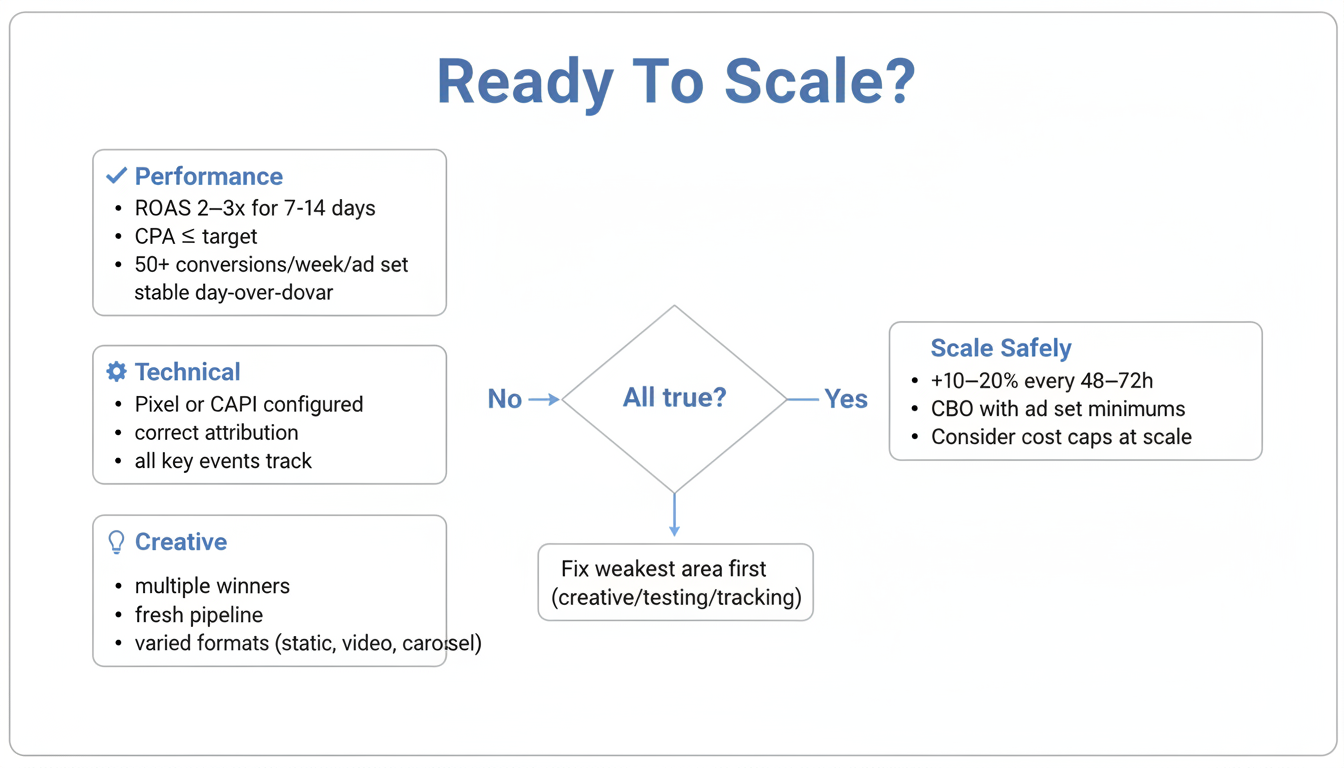
If you're seeing profitable results but only have one winning ad creative, prioritize creative testing before aggressive budget scaling. Single-creative scaling leads to rapid fatigue and performance collapse.
Horizontal vs Vertical Scaling
There are two fundamental approaches to scaling Meta ads, and the most successful advertisers use both.
Vertical Scaling
What it is: Increasing budget on campaigns and ad sets that are already performing well.
How to do it:
- Increase budgets by 10-20% every 48-72 hours
- Monitor performance after each increase
- Pause increases if ROAS drops below breakeven
- Never make budget changes more frequently than every 2-3 days
Pros:
- Simple to implement
- Low risk if done gradually
- Maintains existing audience and creative performance
Cons:
- Limited ceiling (audiences saturate)
- Same people see your ad 5, 6, 7 times
- Eventually hits diminishing returns
Horizontal Scaling
What it is: Expanding reach by testing new audiences, creatives, and campaign structures alongside existing winners.
How to do it:
- Duplicate winning ad sets into new campaigns
- Test lookalike audiences at different percentages (1%, 2%, 3%)
- Launch new creative angles and formats
- Expand geographic targeting
- Test new messaging angles to increase creative diversity
Pros:
- Higher scaling ceiling
- Diversified risk across multiple ad sets
- Combats creative fatigue
- Finds new profitable audiences
Cons:
- More complex to manage
- Requires ongoing creative production
- New ad sets don't guarantee same performance
The Optimal Approach
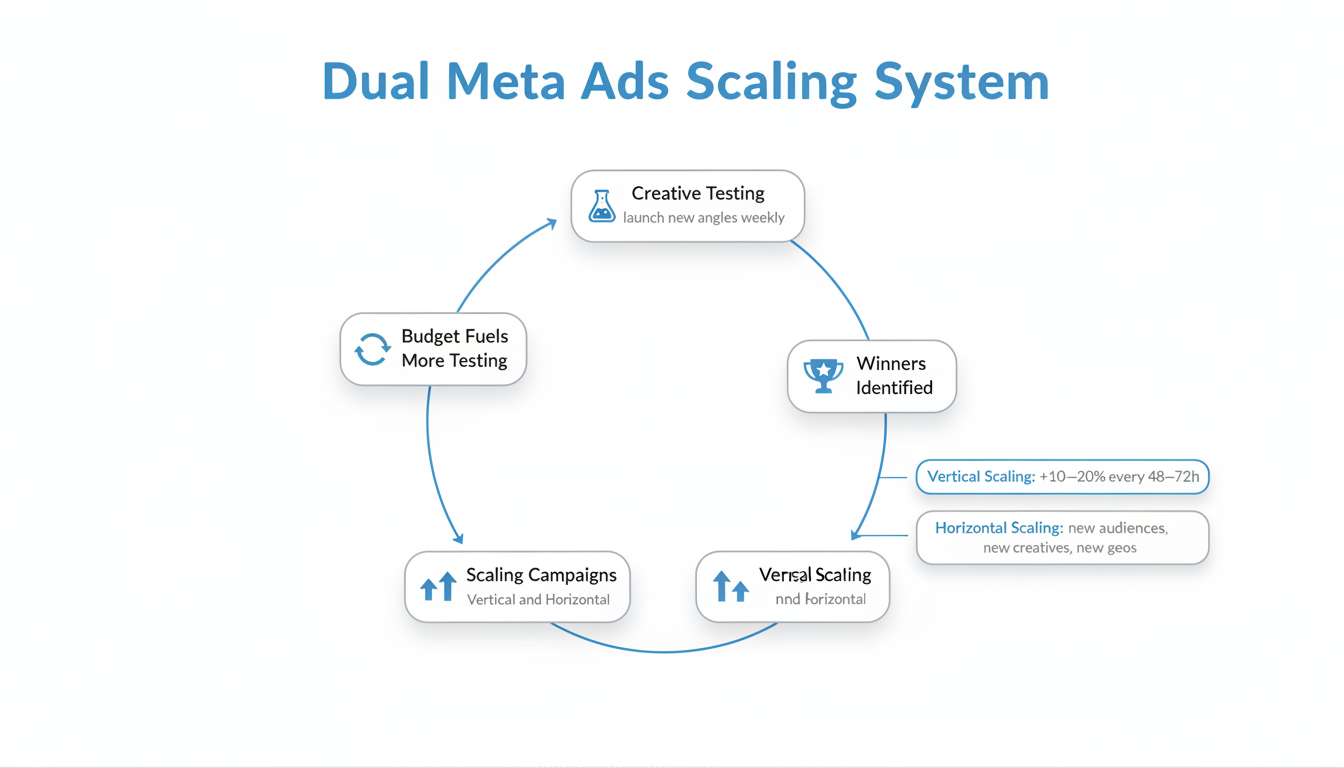
The best-performing accounts combine both strategies:
- Vertically scale proven winners with gradual budget increases
- Horizontally scale by launching new creative and audiences weekly
- Graduate winners from testing campaigns into scaling campaigns
- Kill underperformers quickly to reallocate budget
This dual approach builds a self-sustaining system: testing finds new winners, winners graduate to scaling, and scaling funds more testing.
Budget Scaling Best Practices
How you increase budgets matters as much as how much you increase.
The 10-20% Rule
Increase budgets by 10-20% maximum per adjustment. Larger increases reset the learning phase and destabilize performance.
Example scaling path:
Day | Daily Budget | Change |
1 | $100 | Starting point |
3 | $115 | +15% |
6 | $130 | +13% |
9 | $150 | +15% |
12 | $175 | +17% |
Wait 48-72 Hours Between Changes
Meta's delivery system needs time to stabilize after budget modifications. Adjusting more frequently forces ad sets back into learning phase, increasing CPA and reducing consistency.
Use CBO with Ad Set Minimums
Campaign Budget Optimization (CBO) lets Meta allocate budget across ad sets automatically. However, new ad sets often get starved while one dominant ad set absorbs all spend.
Set ad set spending minimums equal to your target CPA. This guarantees each ad set gets sufficient budget to test while still allowing Meta to favor top performers. Understanding how to run effective Facebook ads is crucial for maximizing your CBO strategy.
Consider Cost Caps for Advanced Scaling
At scale ($30K+/month), cost caps become essential. They tell Meta your maximum acceptable CPA:
- Without cost cap: Meta spends your full budget, even at unprofitable CPAs
- With cost cap: Meta only spends when it can acquire customers at or below your target
Start cost caps at 1.2x your target CPA, then gradually lower once the algorithm stabilizes.
Avoiding Performance Drops
Scaling failures usually stem from predictable mistakes. Here's how to avoid them.
Creative Fatigue
The problem: Increasing budget means the same people see your ad repeatedly. Frequency rises, CTR drops, CPA increases.
The solution:
- Monitor frequency (pause ads above 3-4 for cold audiences)
- Refresh creative every 2-4 weeks
- Maintain creative diversity (different formats, angles, lengths)
- Launch 5-7 new creative concepts weekly during scaling
Looking at successful meta ads examples can provide inspiration for your creative refreshes.
Audience Saturation
The problem: Your target audience gets exhausted. You've reached everyone who's likely to convert.
The solution:
- Expand lookalike percentages (1% -> 2% -> 3%)
- Add new geographic markets
- Test interest expansion or go fully broad
- Ensure prospecting spend stays high relative to retargeting
Algorithm Instability
The problem: Rapid budget changes trigger constant learning phases, preventing optimization.
The solution:
- Limit changes to every 48-72 hours
- Keep budget increases under 20%
- Don't make creative and budget changes simultaneously
- Turn off ads that are 20-30% worse than target CPA
Spend Distribution Issues
The problem: Too much budget goes to existing customers instead of new customer acquisition.
The solution:
- Monitor audience segment spend distribution (new vs. engaged vs. existing)
- Ensure 60-70%+ of spend targets new customers
- Set up proper exclusion audiences for retargeting campaigns
- Use separate campaigns for prospecting vs. retargeting
Frequently Asked Questions
How Fast Can I Scale Facebook Ads?
Safe scaling means 10-20% budget increases every 2-3 days. More aggressive scaling risks performance drops. If you're at $100/day and want to reach $1,000/day, expect 6-8 weeks of gradual increases while maintaining profitability. Learning how to increase roi facebook ads will help you maintain profitability throughout your scaling journey.
Why Did My Ads Stop Working After Scaling?
Common causes include creative fatigue (frequency too high), audience saturation (reached most of your potential customers), or algorithmic disruption from too-rapid budget changes. Check frequency, expand audiences, refresh creative, and ensure you're making gradual adjustments.
Should I Use Advantage+ for Scaling?
Advantage+ Shopping campaigns can work well for scaling ecommerce accounts with sufficient conversion data. They require less management and let Meta's algorithm optimize fully. However, they offer less control - test them alongside your proven manual campaigns rather than replacing everything. For specialized needs, consider working with a facebook ads marketing agency to optimize your Advantage+ strategy.
Structuring Your Account for Sustainable Scaling
Budget tactics fail when the underlying account structure cannot support them. Before you push spend, make sure the structure lets Meta learn and lets you diagnose problems quickly.
Separate prospecting from retargeting. Keep cold audiences in their own campaigns and warm or existing customers in others. Mixing them in one campaign hides whether your growth is new-customer acquisition or just repeat purchases, and it lets retargeting soak budget that should find new buyers. Aim for 60-70% of spend on prospecting.
Use a testing-to-scaling ladder. Run a low-budget testing campaign where you launch many creatives and audiences. Graduate only the winners into the scaling campaign with the 10-20% budget rule. This keeps weak experiments from eating scaling budget and keeps your best performers in stable ad sets.
Protect creative volume. Scaling is a creative problem disguised as a budget problem. At $30K/month you need 5-7 new creative concepts weekly just to hold frequency down. Build a production system - a brief, a source of raw assets, and a review loop - so refreshes ship on schedule instead of when performance has already collapsed.
Name everything for diagnosis. A campaign named "ASC_TEST_0926_A" tells you more in a crisis than "Campaign 14". When spend is moving fast, legible naming is the difference between a five-minute fix and a lost afternoon.